Tag: Mountain Men

  • A Tale: A Fur Trader Travels to Geyserland — Ferris, 1834

    Only a few of the rugged mountain men who penetrated the area that became Yellowstone National Park could read and write. One who could was Warren Angus Ferris,  a clerk for the American Fur Company. Ferris kept a journal that was published in serialized form in 1843-44 in the Western Literary Messenger and later as a book entitled Life in the Rocky Mountains. In these writings he offered one of the earliest written descriptions of the grand geysers in the Upper Geyser Basin.

    ∞§∞
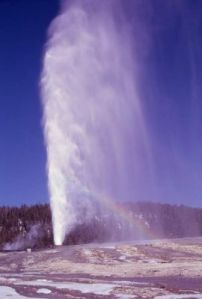
    Beehive Geyser

    I had heard in the summer of 1833, while at rendezvous, that remarkable boiling springs had been discovered, on the sources of the Madison, by a party of trappers in their spring hunt; of which the accounts they gave, were so very astonishing, that I determined to examine them myself, before recording their descriptions, though I had the united testimony of more than twenty men on the subject, who all declared they saw them, and that they really were, as extensive and remarkable as they had been described.

    Having now an opportunity of paying them a visit, and as another or a better might not soon occur, I parted with the company after supper, and, taking with me two Pen-d’orielles, set out at a round pace, the night being clear and comfortable. We proceeded over the plain about twenty miles, and halted until daylight on a fine spring, flowing into Cammas Creek.

    Refreshed by a few hours sleep, we started again after a hasty breakfast, and entered a very extensive forest called the Piny Woods, which we passed through, and reached the vicinity of the springs about dark, having seen several small lakes or ponds, on the sources of the Madison; and rode about forty miles; which was a hard day’s ride, taking into consideration the rough irregularity of the country through which we had travelled.

    We regaled ourselves with a cup of coffee, and immediately after supper lay down to rest, sleepy, and much fatigued. The continual roaring of the springs, however, for some time prevented my going to sleep, and excited an impatient curiosity to examine them; which I was obliged to defer the gratification of, until morning; and filled my slumbers with visions of water spouts, cataracts, fountains, jets d’eau of immense dimensions, etc. etc.

    When I arose in the morning, clouds of vapor seemed like a dense fog to overhang the springs, from which frequent reports or explosions of different loudness, constantly assailed our ears. I immediately proceeded to inspect them, and might have exclaimed with the Queen of Sheba, when their full reality of dimensions and novelty burst upon my view, “The half was not told me.”

    From the surface of a rocky plain or table, burst forth columns of water, of various dimensions, projected high in the air, accompanied by loud explosions, and sulphurous vapors, which were highly disagreeable to the smell. The rock from which these springs burst forth, was calcareous, and probably extends some distance from them, beneath the soil. The largest of these wonderful fountains, projects a column of boiling water several feet in diameter, to the height of more than one hundred and fifty feet—in my opinion; but the party of Alvarez, who discovered it, persist in declaring that it could not be less than four times that distance in height accompanied with a tremendous noise.

    These explosions and discharges occur at intervals of about two hours. After having witnessed three of them, I ventured near enough to put my hand into the water of its basin, but withdrew it instantly, for the heat of the water in this immense cauldron, was altogether too great for comfort, and the agitation of the water, the disagreeable effluvium continually exuding, and the hollow unearthly rumbling under the rock on which I stood, so ill accorded with my notions of personal safety, that I reheated back precipitately to a respectful distance.

    The Indians who were with me, were quite appalled, and could not by any means be induced to approach them. They seemed astonished at my presumption in advancing up to the large one, and when I safely returned, congratulated me on my “narrow escape.”  They believed them to be supernatural, and supposed them to be the production of the Evil Spirit. One of them remarked that hell, of which he had heard from the whites, must be in that vicinity.

    The diameter of the basin into which the water of the largest jet principally falls, and from the centre of which, through a hole in the rock of about nine or ten feet in diameter, the water spouts up as above related, may be about thirty feet. There are many other smaller fountains, that did not throw their waters up so high, but occurred at shorter intervals. In some instances, the volumes were projected obliquely upwards, and fell into the neighboring fountains or on the rock or prairie. But their ascent was generally perpendicular, falling in and about their own basins or apertures.

    These wonderful productions of nature, are situated near the centre of a small valley, surrounded by pine covered hills, through which a small fork of the Madison flows. Highly gratified with my visit to these formidable and magnificent fountains, jets, or springs, whichever the reader may please to call them, I set out after dinner to rejoin my companions.

    ∞§∞

    — From Warren Angus Ferris, A Diary of Wanderings on the sources of the Rivers Missouri, Columbia, and Colorado from February, 1830, to November, 1835.

    — Image from the Coppermine Photo Gallery.

    — You might also enjoy these early descriptions of geysers:

  • A Tale: Teaching Greenhorns About Snipe Driving — Langford, 1872

    When I was a little boy my father told me the way to catch a bird was to put salt on its tail. If you do that, he assured me, you can reach right out and pick it up. I looked to my mother for confirmation, and she said something like, “I suppose that’s true.”

    They armed me with a salt shaker and I spent the afternoon trying to get close enough to a bird to salt its tail. Not until my brothers came home from school and started laughing at me did I get the joke.

    The tradition of playing tricks on the naive runs deep in the history of the northern Rockies. The famous Yellowstone explorer, N.P. Langford, told this story in his account of  traveling with the second Hayden Expedition to Yellowstone Park in 1872.

    ∞§∞

    Among our own hunters was a trapper named Shep Medary—a lively, roystering mountaineer, who liked nothing better than to get a joke upon any unfortunate “pilgrim” or ” tender foot ” who was verdant enough to confide in his stories of mountain life.

    “What a night!” said Shep, as the moon rose broad and clear—”what a glorious night for drivin’ snipe!”

    Here was something new. Two of our young men were eager to learn all about the mystery.

    “Driving snipe! what’s that, Shep? Tell us about it.”

    “Did ye never hear?” replied Shep, with a face expressive of wonder at their ignorance. “Why, it’s as old as the mountains, I guess; we always choose such weather as this for drivin’ snipe. The snipe are fat now, and they drive better, and they’re better eatin’ too. I tell you, a breakfast of snipe, broiled on the buffalo chips, is not bad to take, is it, Dick?”

    Beaver Dick, who had just arrived in camp, thus appealed to, growled an assent to the proposition contained in Shep’s question; and the boys, more anxious than ever, pressed Shep for an explanation.

    “Maybe,” said one of them, “maybe we can drive the snipe tonight and get a mess for breakfast: what have we got to do, Shep?”

    “Oh well,” responded Shep, “if you’re so plaguey ignorant, I’m afeard you won’t do. Howsomever, you can try. You boys get a couple of them gunny-sacks and candles, and we’ll go out and start ’em up.”

    Elated with the idea of having a mess of snipe for breakfast, the two young men, under Shep’s direction, each equipped with a gunnysack and candle, followed him out upon the plain, half a mile from camp, accompanied by some half-dozen members of our party. The spot was chosen because of its proximity to a marsh which was supposed to be filled with snipe. In reality it was the swarming place for mosquitoes.

    “Now,” said Shep, stationing the boys about ten feet apart, “open your sacks, be sure and keep the mouths of ’em wide open, and after we leave you, light your candles and hold ’em well into the sack, so that the snipe can see, and the rest of us will drive ’em up. It may take a little spell to get ’em started, but if you wait patiently they’ll come.”

    With this assurance the snipe-drivers left them and returned immediately to camp.

    “I’ve got a couple of green ‘uns out there,” said Shep with a sly wink. “They’ll wait some time for the snipe to come up, I reckon.”

    The boys followed directions—the sacks were held wide open, the candles kept in place. There they stood, the easy prey of the remorseless mosquitoes. An hour passed away, and yet from the ridge above the camp the light of the candles could be seen across the plain. Shep now stole quietly out of camp, and, making a long circuit, came up behind the victims and, raising a war-whoop, fired his pistol in the air.

    The boys dropped their sacks and started on a two-forty pace for camp, coming in amid the laughter and shouts of their companions.

    ∞§∞

    — Excerpt from N. P. Langford, “The Ascent of Mount Hayden,” Scribner’s Monthly (June 1873) 6(3)129-157.

    — Illustration from the article.

    — You can read a condensed version of Langford’s The Discovery of Yellowstone Park in my book, Adventures in Yellowstone.

    — To see more stories by this author, click on “Langford” under the “Categories” button to the left.

  • A Tale: Dunraven Says Mountain Men Led a “Delicious Life” — 1874

    Beginning in 1807 when John Colter first passed through the area that became Yellowstone National Park through the 1830s, Mountain Men flourished in the Rocky Mountain West. Then a combination of over trapping and a shift in men’s fashions to silk hats ended the lucrative beaver trade. The last big Mountain Man rendezvous occurred  in 1840.

    Although a trapper couldn’t earn a fortune after that, a few hardy souls remained in the area making a subsistence living. Yellowstone tourists encountered such men until the 1880s. Here’s a description of  an encounter with two Mountain Men and their entourage written by the Earl of Dunraven, a wealthy Irish nobleman who visited the Park in the 1874.

    ∞§∞

    In the afternoon we passed quite a patriarchal camp, composed of two men with their Indian wives and several children; half a dozen powerful savage-looking dogs and about fifty horses completed the party.

    They had been grazing their stock, hunting and trapping—leading a nomad, vagabond, and delicious life—a sort of mixed existence, half hunter, half herdsman, and had collected a great pile of deer-hides and beaver-skins. They were then on their way to settlements to dispose of their peltry, and to get stores and provisions; for they were proceeding to look for comfortable winter quarters, down the river or up the canyon.

    We soon discovered that the strangers were white, and, moreover, that there were only two men in camp; and without more ado we rode in and made friends. What a lot of mutually interesting information was given and received! We were outward bound and had the news, and the latitude and the longitude. They were homeward bound, had been wandering for months, cut off from all means of communication with the outside world, and had but the vaguest notion of their position on the globe.

    But, though ignorant of external matters and what was going on in settlements, they had not lost all desire for information. An American, although he lives with an Indian woman in the forests or on the plains, never quite loses his interest in politics and parties; and these two squaw-men were very anxious to hear all about electioneering matters

    These men looked very happy and comfortable. Unquestionably the proper way for a man to travel with ease and luxury in these deserts is for him to take unto himself a helpmate chosen from the native population. With an Indian wife to look after his bodily comforts, a man may devote himself to hunting, fishing, or trapping without a thought or care. He may make his mind quite easy about all household matters. His camp will be well arranged, the tent pegs driven securely home, the stock watered, picketed, and properly cared for, a good supper cooked, his bed spread out, and everything made comfortable; his clothes and hunting-gear looked after, the buttons sewn on his shirt (if he has got any shirt—or any buttons) and all the little trivial incidents of life, which, if neglected, wear out one’s existence, he will find carefully attended to by a willing and affectionate slave.

    They had a lot to tell us also about their travels and adventures, about the wood and water supply, and the abundance or deficiency of game. So we sat down on bales of beaver-skins and retailed all the civilized intelligence we could think of. The women came and brought us embers for our pipes, and spread out robes for us and made us at home. And the little, fat, chubby children, wild and shy as young wolves, peered at us from behind the tent out of their round, black, beady eyes.

    ∞§∞

    — Text from The Great Divide by the Earl of Dunraven, 1875.

    — You might also enjoy:

    — To see more stories by this author, click on “Dunraven” under the “Categories” button to the left.