Tag: N.P. Langford

  • A Tale: Gathering a Specimen From a Boiling Spring— N.P. Langford, 1870

    When the famous Washburn Expedition of 1870 explored the area that later became Yellowstone National Park, they wanted to bring back specimens to prove that the geological wonders they reported weren’t just tall tales. Locating remarkable features like geysers, hot springs and paint pots wasn’t hard, but collecting tangible evidence could be dangerous.  Here’s Nathaniel P. Langford’s description of gathering a specimen.

    ∞§∞

    gathering a specimen

    Entering the basin cautiously, we found the entire surface of the earth covered with the incrusted sinter thrown from the springs. Jets of hot vapor were expelled through a hundred natural orifices with which it was pierced, and through every fracture made by passing over it. The springs themselves were as diabolical in appearance as the witches’ caldron in Macbeth, and needed but the presence of Hecate and her weird band to realize that horrible creation of poetic fancy.

    They were all in a state of violent ebullition, throwing their liquid contents to the height of three or four feet. The largest had a basin twenty by forty feet in diameter. Its greenish-yellow water was covered with bubbles, which were constantly rising, bursting, and emitting sulphurous gas from various parts of its surface. The central spring seethed and bubbled like a boiling caldron. Fearful volumes of vapor were constantly escaping it.

    Near it was another, not so large, but more infernal in appearance. Its contents, of the consistency of paint, were in constant, noisy ebullition. A stick thrust into it, on being withdrawn, was coated with lead-colored slime a quarter of an inch in thickness. Nothing flows from this spring. Seemingly, it is boiling down.

    A fourth spring, which exhibited the same physical features, was partly covered by an overhanging ledge of rock. We tried to fathom it, but the bottom was beyond the reach of the longest pole we could find. Rocks cast into it increased the agitation of its waters. There were several other springs in the group, smaller in size, but presenting the same characteristics.

    The approach to them was unsafe, the incrustation surrounding them bending in many places beneath our weight—and from the fractures thus created would ooze a sulphury slime of the consistency of mucilage.

    It was with great difficulty that we obtained specimens from the natural apertures with which the crust is filled—a feat which was accomplished by one only of our party, who extended himself at full length upon that portion of the incrustation which yielded the least, but which was not sufficiently strong to bear his weight while in an upright position, and at imminent risk of sinking into the infernal mixture, rolled over and over to the edge of the opening, and with the crust slowly bending and sinking beneath him, hurriedly secured the coveted prize.

    ∞§∞

    — Excerpt and illustration from Nathaniel P. Langford, “The Wonders of the Yellowstone,” Scribner’s Monthly 2(1):1-27 (May 1871).

    — To see other stories by this author, click “Langford” under the Categories button.

    — An abridged version of Langford’s 1905 book, The Discovery of Yellowstone Park—Diary of the Washburn Expedition to the Yellowstone and Firehole Rivers in the Year 1870, is available in my book, Adventures in Yellowstone.

  • Moran’s Legacy: Tower Fall — Text by N.P. Langford

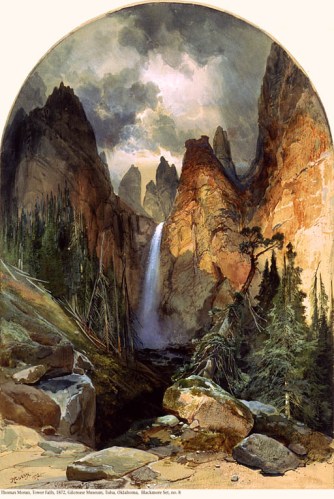
    Tower Falls, Thomas Moran, 1875

    Thomas Moran began conjuring images of the upper Yellowstone before he even saw the place. Moran was an illustrator for Scribner’s Monthly and provided drawings for N.P. Langford’s article about the famous Washburn expedition of 1870.

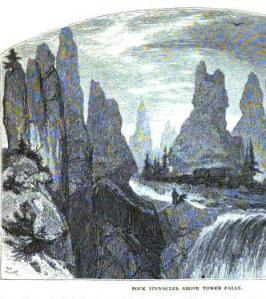
    While learning to paint, Moran sought inspiration from literary works such as Longfellow’s “Hiawatha,” so it wasn’t hard for him to base his illustrations entirely on Langford’s words. The results were interesting (if sometimes inaccurate). Below is what Langford said about Tower Fall and how Moran pictured it.

    ∞§∞

    Tower Falls Illustration from Scribner’s

    Tower Creek is a mountain torrent flowing through a gorge about forty yards wide. Just below our camp, it falls perpendicularly over an even ledge 112 feet, forming one of the most beautiful cataracts in the world. For some distance above the fall, the stream is broken into a great number of channels each of which has worked a torturous course through a compact body of shale to the verge of the precipice where they re-united and form the fall.

    The countless shapes into which the shale has been wrought by the action of the angry waters, add a feature of great interest to the scene. Spires of solid shale, capped with slate, beautifully rounded and polished, faultless in symmetry, raise their tapering forms to the height of from 80 to 150 feet, all over the plateau above the cataract. Some resemble towers, others spires of churches, and others still shoot up as lithe and slender as the minarets of a mosque.

    Some of the loftiest of these formations, standing like sentinels upon the very brink of the fall, are accessible to an expert and adventurous climber. The position attain on one of their narrow summits, amid the uproar at a height of 250 feet above the boiling chasm, as the writer can affirm, requires a steady hand and strong nerves; yet the view which rewards the temerity of the exploit is full of compensations.

    Below the fall the stream descends in numerous rapids, with frightful velocity, through a gloomy gorge, to its unions with the Yellowstone. Its bed is filled with enormous boulders, against which the rushing waters break with great fury. Many of the capricious formations wrought from the shale excite merriment as well as wonder. Of this kind especially was a huge mass sixty feet in height, which, from its supposed resemblance to the proverbial foot of his Satanic Majesty, we called the ‘Devil’s Hoof.’

    The scenery of mountain, rock, and forest surrounding the falls is very beautiful. Here too, the hunter and fisherman can indulge their tastes with the certainty of ample reward. As a halfway resort to the greater wonders still farther up the marvelous river, the visitor of future years will find no more delightful resting place. No account of this beautiful fall has ever been given by any of the former visitors to this region. The name of “Tower Falls,” which we  gave it, was suggested by some of the most conspicuous features of the scenery.”

    ∞§∞

    Moran’s 1871 field sketch of Tower Falls.

    Moran actually got to see Tower Fall in 1871 when he accompanied the government explorer, F.V. Hayden there. During the two days Moran spent at Tower Fall, he must have worked diligently making sketches from various vantage points in ink and watercolor. He used these en plain air studies later to produce several paintings in his studio.

    Tower Fall, Thomas Moran, 1872.

    A year after the Washburn Expedition, Moran produced the full color rendition seen below. This piece reflects the Romantic Hudson River School that dominated American art at the time. It is characterized by aerial perspective, concealed brushstrokes and luminist techniques that made the landscapes seem to glow.

    In 1875, Moran offered the version of Tower Fall shown at the top of this post that is more impressionistic in that it juxtaposes elements in ways that can’t be seen from any actual viewpoint. Moran, who famously said, “I place no value upon literal transcripts from Nature,” was a Romantic who sought to reproduce the emotional rapture that some landscapes evoke.

    ∞§∞

    — The magazine illustration and N. P. Langford’s description are from his article “The Wonders of the Yellowstone.” Scribner’s Monthly, 2(1) 1-16 (May, 1871)

    — Other images are from the Coppermine Gallery.

    — For more on Moran’s Legacy, click on “Thamas Moran” under the Categories button to the left.

    — You might also enjoy N.P. Langford’s humorous tale about the naming of Tower Fall.

  • A Tale: Teaching Greenhorns About Snipe Driving — Langford, 1872

    When I was a little boy my father told me the way to catch a bird was to put salt on its tail. If you do that, he assured me, you can reach right out and pick it up. I looked to my mother for confirmation, and she said something like, “I suppose that’s true.”

    They armed me with a salt shaker and I spent the afternoon trying to get close enough to a bird to salt its tail. Not until my brothers came home from school and started laughing at me did I get the joke.

    The tradition of playing tricks on the naive runs deep in the history of the northern Rockies. The famous Yellowstone explorer, N.P. Langford, told this story in his account of  traveling with the second Hayden Expedition to Yellowstone Park in 1872.

    ∞§∞

    Among our own hunters was a trapper named Shep Medary—a lively, roystering mountaineer, who liked nothing better than to get a joke upon any unfortunate “pilgrim” or ” tender foot ” who was verdant enough to confide in his stories of mountain life.

    “What a night!” said Shep, as the moon rose broad and clear—”what a glorious night for drivin’ snipe!”

    Here was something new. Two of our young men were eager to learn all about the mystery.

    “Driving snipe! what’s that, Shep? Tell us about it.”

    “Did ye never hear?” replied Shep, with a face expressive of wonder at their ignorance. “Why, it’s as old as the mountains, I guess; we always choose such weather as this for drivin’ snipe. The snipe are fat now, and they drive better, and they’re better eatin’ too. I tell you, a breakfast of snipe, broiled on the buffalo chips, is not bad to take, is it, Dick?”

    Beaver Dick, who had just arrived in camp, thus appealed to, growled an assent to the proposition contained in Shep’s question; and the boys, more anxious than ever, pressed Shep for an explanation.

    “Maybe,” said one of them, “maybe we can drive the snipe tonight and get a mess for breakfast: what have we got to do, Shep?”

    “Oh well,” responded Shep, “if you’re so plaguey ignorant, I’m afeard you won’t do. Howsomever, you can try. You boys get a couple of them gunny-sacks and candles, and we’ll go out and start ’em up.”

    Elated with the idea of having a mess of snipe for breakfast, the two young men, under Shep’s direction, each equipped with a gunnysack and candle, followed him out upon the plain, half a mile from camp, accompanied by some half-dozen members of our party. The spot was chosen because of its proximity to a marsh which was supposed to be filled with snipe. In reality it was the swarming place for mosquitoes.

    “Now,” said Shep, stationing the boys about ten feet apart, “open your sacks, be sure and keep the mouths of ’em wide open, and after we leave you, light your candles and hold ’em well into the sack, so that the snipe can see, and the rest of us will drive ’em up. It may take a little spell to get ’em started, but if you wait patiently they’ll come.”

    With this assurance the snipe-drivers left them and returned immediately to camp.

    “I’ve got a couple of green ‘uns out there,” said Shep with a sly wink. “They’ll wait some time for the snipe to come up, I reckon.”

    The boys followed directions—the sacks were held wide open, the candles kept in place. There they stood, the easy prey of the remorseless mosquitoes. An hour passed away, and yet from the ridge above the camp the light of the candles could be seen across the plain. Shep now stole quietly out of camp, and, making a long circuit, came up behind the victims and, raising a war-whoop, fired his pistol in the air.

    The boys dropped their sacks and started on a two-forty pace for camp, coming in amid the laughter and shouts of their companions.

    ∞§∞

    — Excerpt from N. P. Langford, “The Ascent of Mount Hayden,” Scribner’s Monthly (June 1873) 6(3)129-157.

    — Illustration from the article.

    — You can read a condensed version of Langford’s The Discovery of Yellowstone Park in my book, Adventures in Yellowstone.

    — To see more stories by this author, click on “Langford” under the “Categories” button to the left.