Tag: Rossiter Raymond

  • A Tale: Guarding the Horses — Rossiter Raymond, 1871


    Early travelers to Yellowstone Park often woke up in the morning to discover that their horses and wandered away in the night. That’s because the tourists faced a dilemma. Their horses needed to graze to keep up their strength, so the travelers had to give them some freedom. But with too much freedom, the animals would wander away leaving the travelers afoot in the remote wilderness.

     Rossiter Raymond, who led the first group of tourists to visit Yellowstone Park in 1871, solved the problem by picketing his men’s horses and posting a guard to keep their roped untangled. His Raymond’s description of what it was like to be on guard duty.

    ∞§∞

    grazing horsesOur practice, at night was to pour water on the fire after supper, and picket the animals close around us where we lay on the ground. After reaching the Upper Madison we took turns in standing guard, to watch again possible stealing or stampeding of the stock and also, from time to time, to see to it that the picket-ropes were clear.

    When you want to pasture one horse for one night on an ample lawn, the business is easy enough. You drive your picket pin deep enough to hold, and leave enough of it above ground to permit the firm fastening of the rope, but not to permit the winding up of the rope oil the pin by possible circular promenades on the horse’s part; after which, you bid the horse, and all care on his behalf, goodnight.

    Unless he is a very raw recruit at picket-duty, he will move about with perfect freedom over the whole circle of which the rope is the radius; and you will hear him nibble and crunch the squeaking grass at all hours of the night. But, when you apprehend Indians you can’t afford to hunt up a smooth lawn for each horse. As the higher mountains are entered, the grass grows scanty, and it is necessary to make the best of such patches as occur.

    So the animals get picketed where bushes interfere with the free circulation of the ropes, or so near together that they can (and accordingly do) get up mutual entanglements. Every such performance shortens the radius, and the realm of food. An experienced picketer generally makes one or two attempts to disentangle himself, by traveling around in the direction that first occurs to him. If this happens to be the right one, he may work out again to the, full arc of his destined supper: otherwise he winds himself up, and then (unlike a clock) stops going.

    It is the duty of the guard to go out, unwind him, and start him again, lest, standing in patient disgust all night, he be found in the morning empty of grass and of spirit for the day’s work. It is solemnly amusing to march in a moony midnight hither and thither, followed by a silent steed, through all the intricacies of the knot he has tied, with the aid of stumps, bushes, his own legs, and his neighbor’s rope. Fancy yourself unraveling a bad case of shoestring, and obliged to pull a horse through every loop at the end of the string. The Lancers ” is nothing to it. For a real mazy dance, to puzzle the floor-committee, give me the nine-horse pick picket cotillion.

    At daylight the animals are let loose, and stray about, trailing their long ropes, in search of untrampled grass for breakfast. It is easy to catch them by means of the ropes, though now and then an experienced old fellow has learned the exact length of his lariat, and will not let you get near enough to clutch the end of it.

    This keeping guard at night without the companionship of the campfire is a chilly and dispiriting affair. The first watch is not very lonely. There is generally some wakeful comrade who sits up in his bed to talk; or perhaps the whole party linger around the flameless embers, exchanging stories of adventure. But he who “goes on” from midnight till dawn, surrounded only by mummies rolled in blankets on the ground, is thrown upon his thoughts for company.

    The night-noises are mysterious and amazingly various, particularly if the camp is surrounded by woods. There are deer and elk going down to the water to drink; there are unnatural birds that whistle and answer, for the world, like ambuscading savages; there are crackling twigs; the picket-ropes crawl through the grass with a dreadful sound; the grass itself squeaks in an unearthly way when it is pulled by the horses’ mouths.

    The steady crunching of their grinders is a re-assuring, because familiar sound; but ever and anon it stops suddenly, all the horses seeming to stand motionless, and to listen. Their ears are quicker than yours: they hear something moving in the forest, -doubtless the wily Sioux. You glide from tree to tree, revolver in hand, until you get near enough to see that they are all asleep. Old Bony is dreaming unpleasantly besides: it is an uncanny thing—a horse with the nightmare. You make the rounds. They all wake and go to eating again: so you know they were not scared except the blooded bay, who mistakes you for an Indian, and snorts and cavorts furiously.

    I remember well such a night, near the banks of the Yellowstone Lake, when we were doubly suspicious, because we had heard a rifle-shot close by our camp, not fired by any member of our party. I was on guard at about 1 a.m., and keenly alive to all the blood-curdling sensations I have mentioned, when suddenly the trees above and the ground beneath were shaken by a brief but unmistakable earthquake. The shock was in the nature of a horizontal vibration; and the emotion produced by the experience at such an hour, in the solemn woods, was a unique combination of awe and nausea. I was not sorry that one or two of the party were waked by it: under the circumstances, I was grateful for a little conversation.

    ∞§∞

     — Pages 173-176 in  Rossiter W. Raymond, Camp and Cabin. New York: Ford Howard and Hulbert, 1880.

    — B.H. Alexander Postcard, Pioneer Museum of Bozeman.

    — You might also enjoy these tales about Raymond’s expedition.

  • A Tale: Early Travelers Confuse Geyser Basins — Rossiter Raymond, 1871

    In the summer of 1871, U.S. Commissioner of Mines Rossiter Raymond was in Virginia City, Montana, when he decided to organize a group to tour the area that would become Yellowstone National Park the next year. Of course, nobody had published any guidebooks by then, so Raymond and his companions decided to take copies of N.P. Langford’s descriptions of wonderland that Scribner’s Monthly published in its May and June 1871 issues.

    1116-7
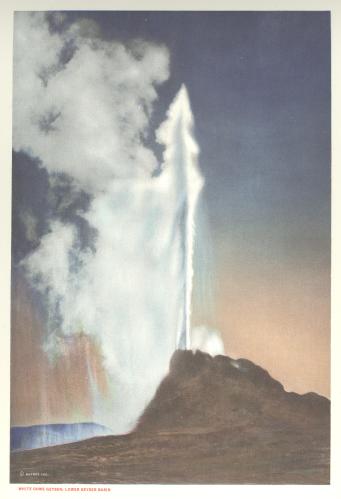
    White Dome Geyser, Lower Geyser Basin

    There were no signs in the roadless Yellowstone wilderness, so it was easy for travelers to become confused about the things they were seeing. When Augustus F. Thrasher, a photographer on the expedition, compared the Lower Geyser Basin to Langford’s descriptions of the Upper Basin, he became convinced that Langford’s description of geysers were exaggerations and decided to use his camera to prove it. 

    Raymond said, “Thrasher invests the profession of photography with all the romance and adventure . . ..  No perilous precipice daunts him, if it’s just the place for his camera.”  Given Thrasher’s passion, he must have taken some marvelous photographs, but, unfortunately, none of them are known to have survived.

     Here’s Raymond’s description of his expedition’s confusion over geysers.

    ∞§∞

    We approached the geyser basin with our expectation at the boiling-point, and ready to discharge; for we had among the baggage two copies of Scribner’s, containing Mr. Langford’s account of the wonders of the region, as seen by the Washburn exploring party. His article occupied two numbers, and we had two copies of each: so four persons could be accommodated with intellectual sustenance at one time. For the other two, it was, as one of them mournfully observed, “Testaments, or nothin’.”

    Mr. Langford’s articles were vivid and fascinating; and we found them, in the end, highly accurate. At the outset, however, we were inclined to believe them somewhat exaggerated; and Thrasher was divided between his desire to catch an instantaneous view of a spouting column two hundred and fifty-six feet high, and his ambition to prove, by the relentless demonstration of photography, that these vents of steam and hot water were not half as big as they had been cracked up to be.”

    We were not at first aware that there are two geyser basins on the Fire-Hole River; the upper one, ten miles above the other being the smaller, but containing the largest geysers. It was this one, which Washburn’s party, coming from Yellowstone Lake, first stumbled upon, and, after viewing its splendid display, naturally passed by the inferior basin with little notice. But we, emerging from the forest, and finding ourselves on the border of a great gray plain, with huge mounds in the distance, from which arose perpetually clouds of steam, supposed we had reached the great sensation, and prepared to be enthusiastic or cynical as circumstances might dictate.

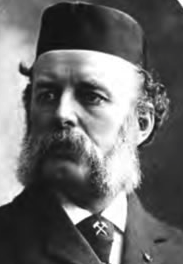
    Rositer Raymond Wikipedia
    Rossister Raymond

    We rode for a mile across the barren plain picking our way to avoid the soft places. This is quite necessary in the neighborhood of the hot springs. Where they have deposited a white, hard crust, it is generally strong enough to bear horse and man; but, over large areas, the ground is like what we call, in the East, “spring-holes;” and the treacherous surface permits uncomfortable slumping through, haply into scalding water. It is not very deep; but a small depth under such circumstances is enough to make a fellow “suffer some,” like the lobster in the lobster pot. ”

    The plain contains a few scattered springs; and along the river, its western border, there are many in active ebullition. The principal group of geysers is at the upper or southern end extending for some distance up the valley of a small tributary from the east. With cautious daring, we rode up the side of the great white mound, winding among the numerous fissures, craters, and reservoirs that on every side of us hissed, gurgled, or quietly vapored, with now and then a slight explosion, and a spurt to the height of a dozen feet or more. Sawtell’s dog nosed suspiciously around several of the basins, until, finding that seemed not too hot for a bath, be plunged in, and emerged in a great hurry, with a yelp of disprobation.

    A couple of dead pines stood, lonesome enough, in the side of the hill, “whence all the rest had fled.” They had died at their posts, and to the said posts we made fast our horses, and ascended a few rods farther, until we stood by the borders of the summit springs. There were two or three large vents at the bottom of deep reservoirs or intricate caverns. It gives one an unpleasant thrill, at first, to bear the tumult of the imprisoned forces, and to feel their throes and struggles shaking the ground beneath one’s feet; but this soon passes away, and the philosopher is enabled to stand with equanimity on the rim of the boiling flood, or even to poke his inquisitive nose into some dark fissure, out of which, perhaps in a few moments more a mass of uproarious liquid and vapor will burst forth.

    We lingered much longer in this basin than my brief notice of it indicates; for, you see, we thought we had found the geysers; and oh the hours that we spent “identifying” the individual springs that Langford had described! Since, the largest eruptions we observed did not exceed forty-five feet in height, we set down his account as hugely overdrawn, and were deeply disgusted at the depravity of travelers. But Sawtell remarked, in his quiet way, that, “if it were not for that there article in that there magazine, these yer springs would be considered a big thing, after all, and perhaps it was just as well to let the magazine go to thunder, and enjoy the scenery.”

    This sensible advice we followed with much profit and pleasure; and we are all now ready to admit that our happening upon the wrong lot of geysers first was a most fortunate occurrence, since we should otherwise have been tempted to pass them by as insignificant. The truth is that in some of the elements of beauty and interest the lower basin is superior to its more thrilling rival. It is broader, and more easily surveyed as a whole; and its springs are more numerous though not so powerful. Nothing can be lovelier than the sight at sunrise, of the white steam-columns tinged with rosy morning ascending against the background of the dark pinewoods and the clear sky above. The variety in form and character of these springs is quite remarkable.

    ∞§∞

    — Excerpt from Rossiter Raymond, “Wonders of the Yellowstone.” Pages 153-207 in Camp and Cabin, New York: Fords, Hubbard & Howard, 1880.

    — Geyser postcard, Pioneer Museum of Bozeman; Raymond photo, Wikipedia Commons.

    — You might also enjoy Calvin Clawson’s tale about “First Blood” on the Raymond Expedition.

    — Find out more about Yellowstone’s first tourist guide, Gilman Sawtell.

    — For tales by N.P. Langford, click “Langford” under the Categories button above.

  • Views: Yellowstone Park Belongs in Montana

    After I urged my FaceBook Friends last week to buy my book as a Christmas gift, sales surged. In fact, Amazon.com ranked Adventures in Yellowstone Number One among books on Wyoming history for a while.

    Of course, I’m grateful for book buyers, and it’s always fun to be on top, but I think Wyoming history is the wrong category. Although most of Yellowstone Park’s land mass lies in Wyoming, most of its early history is in Montana. In fact, the Montana territorial legislature asked the U.S. Congress to attach the park to Montana twice, in 1872 and 1874. The territorial legislators offered two interrelated reasons for their request: the wonders of the Yellowstone Plateau were accessible only from Montana, and, Montana residents had explored the area and begun to develop it.

    As the accompanying relief map shows, extremely rugged mountains surround the Yellowstone Plateau. As the “Memorial” the territorial legislature drafted in 1872 put it:

    . . . this portion of Wyoming is only accessible from the side of Montana, contains the heads of streams whose courses lie wholly in Montana, while, through the enterprise of citizens of Montana, it has been thoroughly explored, and its innumerable and magnificent array of wonder in geysers, boiling springs, mud volcanoes, burning mountains, lakes, and waterfalls brought to the attention of the world. Your memorialists would, therefore, urge upon your honorable bodies that the said portion of Wyoming Territory be ceded to Montana . . . .

    The legislators had a point. While the trappers of the Mountain Man Era sometimes entered what is now Yellowstone Park over the rugged mountains to the east and south, by the time the Montana and Wyoming Territories were established in the 1860s, most explorers came from north and west. In 1863, Walter DeLacy led a group of prospectors from Bannack, Montana, up the Snake River into what is now Yellowstone Park. In 1869, David Folsom and his friends, Charles Cook and William Peterson, left Diamond City, Montana, and went up the Yellowstone River to the Yellowstone Plateau.

    A year later, an expedition led by General Henry Washburn, with an Army escort under Lt. Gustavus Doane, followed the same route as the Folsom-Cook-Peterson party. In 1871, U.S. Commissioner of Mines Rossiter Raymond led a party of men up the Madison River to see Yellowstone’s wonders.

    Also, in 1871, Montana entrepreneurs were racing to capture the tourist trade. Bozeman businessmen were building a road up the Yellowstone River through the canyon that would come to be named after toll taker, “Yankee Jim” George. At the same time, Virginia City businessmen were extending the road from Henry’s Lake to the Lower Geyser Basin. And, other adventurous Montana businessmen were building a hotel and bathhouses at Mammoth Hot Springs.

    And, what were Wyoming residents doing then to develop Yellowstone Park? Nothing!

    In 1874, the Montana territorial legislature renewed its request to the U.S. Congress that the part of Yellowstone Park that “now lies within the Territory of Wyoming be detached therefrom and attached to the territory of Montana.” Obviously, the Congress demurred. Even today, after more than a century of road building, nearly twice as many visitors enter Yellowstone Park from Montana entrances than from Wyoming entrances.

    I think Montana pioneers made a good case for making all of Yellowstone Park a part of Montana. And, it would make more sense for Amazon.com to categorize Adventures in Yellowstone with Montana books instead of Wyoming books. But I understand that geography trumps history.

    I’m just glad when my book sells—no matter what category it’s in. And remember, Adventures in Yellowstone makes a great gift for Valentines Day.

    ∞§∞

    — Relief map from the Yellowstone Digital Slide File.

    — Related Stories you might enjoy: