Tag: stagecoach robbery

  • A Tale: Lone Outlaw Holds Up Seventeen Stagecoaches — 1908

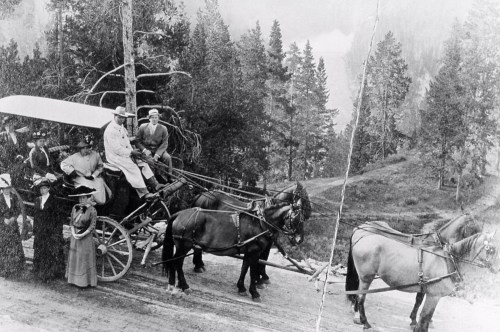
    A Wylie Way Coach, 1908.

    What was probably the greatest stagecoach robbery of the Twentieth Century in terms of people (174)  and coaches (17) occurred in Yellowstone Park on August 24, 1908, but the bandit grossed only about $2,000 in cash and jewelry.  The holdup man was never caught. A similar robbery of 14 coaches occurred on July 29, 1914, but the holdup man was caught.  Here’s how the park superintendent described the events of 1908.

    ∞§∞

    The unfortunate event, the hold-up of seventeen coaches, surreys, and spring wagons on August 24, and the robbery by one man or many of the passengers therein at a point on the main road between Old Faithful Inn and the Thumb of Lake Yellowstone, and about 4 1/4 miles distant from the former, took place about 9 a. m. on August 24.

    In accordance with the established time schedule, the first coach of Yellowstone Park Transportation Company loads at Old Faithful Inn at 7.30 o’clock in the morning; after all coaches of that company have been loaded, the Monida and Yellowstone Company coaches are loaded at same point and follow after. These are followed in turn by the coaches of the Wylie Permanent Camping Company—all on the road eastward toward the Thumb.

    This was the order of travel on morning of August 24. As a precaution against dust and against accident on grades, drivers are instructed to maintain a distance of approximately 100 yards between coaches. On the morning in question eight vehicles were not molested by the robber. It appears that the trooper on patrol passed the point where the robbery took place ahead of the first coaches. The interval between the eighth and ninth coaches in order of travel was rather extended, with an angle of the road intervening in a narrow defile, thickly wooded on either side. The ninth vehicle was stopped by the robber with repeating rifle at a ” ready; ” and in vulgar, blasphemous language he ordered a young man down from the box seat and made him carry a sack alongside the coach—into which passengers were commanded to deposit their money and jewelry. This was repeated with each of the sixteen vehicles following. No one received physical injury excepting one passenger, whose actions did not suit the robber and who was disciplined by a stroke on the head with the gun, which was discharged at the same time. The injury was not reported serious. Four of the looted coaches belonged to the Yellowstone Park Transportation Company, five to the Monida and Yellowstone Stage Company, and eight to the Wylie Permanent Camping Company. As near as can be learned by the separate memoranda handed in by the passengers the losses sustained by them in the robbery aggregated $1,363.95 cash and $730.25 in watches and jewelry. Upon being liberated the first coach of those robbed drove rapidly to the camp of the road sprinkling crew, located about 2 miles east of the hold-up point, where notice was given and a messenger dispatched to Old Faithful Inn—distant 6 miles—with news of the robbery.

    The agent of the Yellowstone Park Transportation Company at the inn telegraphed the news to all stations in the park and notified the detail of soldiers stationed at Upper Geyser Basin, within a few hundred yards of the inn. He also states that he notified the officer in command of a troop of cavalry camped in the Lower Basin, about 9 miles distant by the old road. Telegraphic notice was received at Mammoth Hot Springs Hotel and immediately transmitted to my office by telephone. The message was repeated to Major Allen, who was up in the park, and he was requested to give the matter his personal attention. All guard stations were warned and instructed and two scouts present at Mammoth were dispatched to the scene. They made the ride (49 miles) in four hours. Major Allen, who was in the park with General Edgerly, came into Mammoth the same evening, and on the following morning reported that he had given the necessary orders to his troops by telephone and telegraph from Norris. The robber was on foot, and disposed of a few pocketbooks and purses near the scene of the robbery, where they were found in a clump of bushes. One of these contained valuable papers and all were returned to their respective owners.

    The trail could only be followed a short distance. The robber had apparently taken off his shoes and passed into a densely wooded region. All United States marshals, sheriffs, and peace officers in surrounding States, counties, and towns were duly notified and given description of the robber, as nearly as could be ascertained from tourists and drivers in the hold-up.

    All passengers in their excitement blamed the soldiers. The character of the country is such that the entire Army of the United States could not prevent an evil-disposed man from entering the park with a gun.

    On the date of the hold-up one troop was on practice march in the park and was camped within 10 or 12 miles from Old Faithful Inn. One troop has been camped in Lower Geyser Basin all the season and one troop has been camped on Yellowstone River within a mile of Lake Hotel all the season.

    So far it has been impossible to locate an escaped criminal who was convicted of poaching in the park and escaped from confinement in the military prison at Fort Yellowstone in October last. There seems to be a well-grounded suspicion that he is the perpetrator of this daring highway robbery. It is a slow and difficult task to conduct a systematic search for this criminal, without funds for expenses, by correspondence alone. The detectives in adjacent States, with whom I have corresponded since the robbery, work for a per diem and expenses and not for rewards offered, and although they have been informed that this office has no money for that purpose, they have never hesitated to give any information in their possession in regard to this particular matter.

    ∞§∞

    — Report of the Superintendent of Yellowstone National Park. Department of Interior, Yellowstone Park, Wyoming, October 15, 1908.

    — Photo, Yellowstone Digital Slide File.

    — You might also enjoy.

  • A Tale: The Facts Are Tangled, But The Stagecoach Robbery Stories Are Fun

    When I got to the Pioneer Museum on Friday for my afternoon of volunteer work, Associate Director Ann Butterfield told me, “I found something that might interest you.” After a few minutes of her muttering “now where did I see that thing,” she pulled out a file folder entitled “QK Club.” QK stands for “quest for knowledge.” The club began in Bozeman in the 1920s and still meets monthly.

    At its meetings, members present learned papers and other members offer critiques on topics ranging from the death of Montana pioneer John Bozeman to the future of nuclear power. The paper Ann handed me contained a marvelous descriptions of stagecoach robberies in Yellowstone National Park.

    It was written by Jefferson Jones, long time publisher of The Bozeman Daily Chronicle, who was critiquing a paper entitled “Road Agents of Early Yellowstone National Park” by the famous Yellowstone photographer, Jack E. Haynes. In it, Jones quoted an interview with Lester Piersdorff, a Bozeman pioneer who claimed to be a witness to “the holdup of the park stages on October 14, 1897.” Piersdorff, who was in his 80s at the time of the interview, also said he knew about a stagecoach robbery in the 1880s, a that Haynes apparently hadn’t heard of.

    The first thing I did was dig through the collection of QK Club papers held at the Pioneer Museum to look for the Haynes paper. Supposedly, it was presented on October 21, 1952, and the Museum’s collection begins with 1956, so I decided to look for it later in the more extensive collection at Montana State University.

    The Museum has an index of QK Club papers that runs back to 1923, so I decided to look there. Not only did the index fail to list a paper by Jack E. Haynes, it didn’t even show a meeting on October 21, 1952.

    Next, I decided to check the Museum’s vertical files to see if there was a folder on Piersdorff, who sounded like a very colorful character. I went through the file drawers asking myself “was that ‘I’ before ‘E’ or ‘E’ before ‘I.’”I checked both spellings and was getting ready to give up when I saw a file labeled “Pierstorff,” with a “T.”  I pulled it out and there was a photo of “Lester Pierstorf” peering out from under a hat with a pipe protruding from his walrus mustache. It was a great picture, so I checked the Museum’s photo archive for it—no luck!

    Another clipping in the folder had a headline “Masked Bandits Loot 19 Stages; Lester Piersdorff Driver of One.” This time the spelling went back to “Piersdorff” with a “d,” but said he was a driver in robberies in 1897, but didn’t mention the robbery in the 1880s that he described to  Jones. Also, the clipping (from an unnamed source) had a different date for the robbery. Jones said it happened on August 14, but the clipping said August 7.

    Tired of the contradictory evidence, I decided to look up stagecoach robberies in Aubrey Haines definitive history of Yellowstone Park, The Yellowstone Story. (That’s Haines, the historian, not to be confused with Haynes, the photographer.) Sure enough, historian Haines reports the story that Jones attributes to Piersdorff, but he introduces it this way, “The holdup incident spawned a legend. Jefferson Jones told it this way.” Then Haines offers the story in the identical words that Jones attributed to Piersdorff.

    After repeating the story, Haines says: “It is a beautiful little story, but there is no truth in it.” In a footnote he says, “Told to J.E. Haynes during a discussion of his article “Yellowstone’s Stage Holdups,” [probably by Jones].

    So for what it’s worth, here’s Piersdorff’s account of stagecoach holdup in the 1880s.

    ∞§∞

    The circumstances of the holdup, as I recall them, were somewhat as follows:

    Major McDougle, paymaster of the army in the park, traveling in an ambulance with a bodyguard of six soldiers rounded a turn in the road at Eagles Nest on the Gardner River to find himself confronted by nine mounted road agents, dressed in military uniform, carrying army carbines and their horses bore regulation army saddles and saddle bags.

    Until the command “Hands Up” was issued, Major McDougle though he was looking at a cavalry patrol out on a morning maneuver. With the McDougle party covered by rifles, one road agent dismounted and searched the group for rifles and revolvers, which he took from the men and heaved into the nearby Gardner River.

    He then went to work breaking open the army chest containing $40,000 in gold, all sacked. As the road agent lifted out a sack, he would place it in the saddlebag of one of his confederates. When the robbery was completed, the men saluted the Major and rode down the road toward Gardiner.

    The robbery created much talk at the time, but the men were never apprehended nor the money recovered.

    [Piersdorff then continue with corrections to things Jack Haynes had reported about the 1897 robberies.]

    Jack is in error in stating that only six stagecoaches of the Yellowstone Park Transportation Company were involved in the August 14, 1897, holdup. There were 15 stages in all. [Various accounts put the number of coaches robbed at 6, 15 and 19.] Jack mentions loot taken in that robbery was $400. Not counting the jewelry taken there was approximately $8,000 cash split by the two road agents from that holdup, as I shall tell you about.

    Passengers in the last stagecoach were never robbed and only half of the passengers in Steele’s stage were robbed because at that moment the two road agents spied a Corporal and soldier riding on the old freight road near Spring Creek not far distant and the road agents evidently decided to pull out.

    As Jack states in his paper, I happened to eat opposite Gus Smitzer and George Heeb at the employees’ mess at Canyon the night before the holdup. It was then that I first noted Heeb had a bad scar on his right hand between the thumb and first finger. I little realized at the time how important that scar was to loom in just 14 hours.

    When the following morning the holdup occurred on the Canyon-Norris road, I turned to my passenger in my stage and said: “There’s a holdup going on here and if you have any valuables you better pass them to me.” Purses, billfolds, watches and the like, were all handed to me and I shoved them under the driver’s seat in a water bucket.

    Shortly afterwards when a road agent, who proved to be Heeb, stood opposite us on a bank and shouted, “This is a holdup. Give me your valuables,” only some $15 in loose cash from the pockets of my passengers was handed down. The valuables in the water bucket were never touched.

    The bandit, who had sewed together flour sacks over his head, that extended down to his waist, though which his arms protruded and which had holes for the eyes, pointed his revolver at me with his announcement, “This is a holdup.”

    Being in a higher position on the driver’s seat of the stage than he was, I looked down at the gun. As Jack in his account states, the men had covered their hands with charcoal. I noticed that the right hand of the road agent, which held the revolver, had a scar between the thumb and first finger to which the charcoal had not adhered. I noticed, too, as the road agent held his gun up toward me that the trigger guard had a peculiar “S” mark inscribed on it. When Heeb was captured later, he was carrying a gun with an “S” on the trigger guard. Testimony regarding the scar on Heeb’s right hand and his revolver with the “S” marking I gave in court at the Cheyenne trial was part of the evidence that convicted him.

    ∞§∞

    — Story from the Pioneer Museum of Bozeman.

    — Image, Coppermine Photo Gallery.

    — You might also enjoy