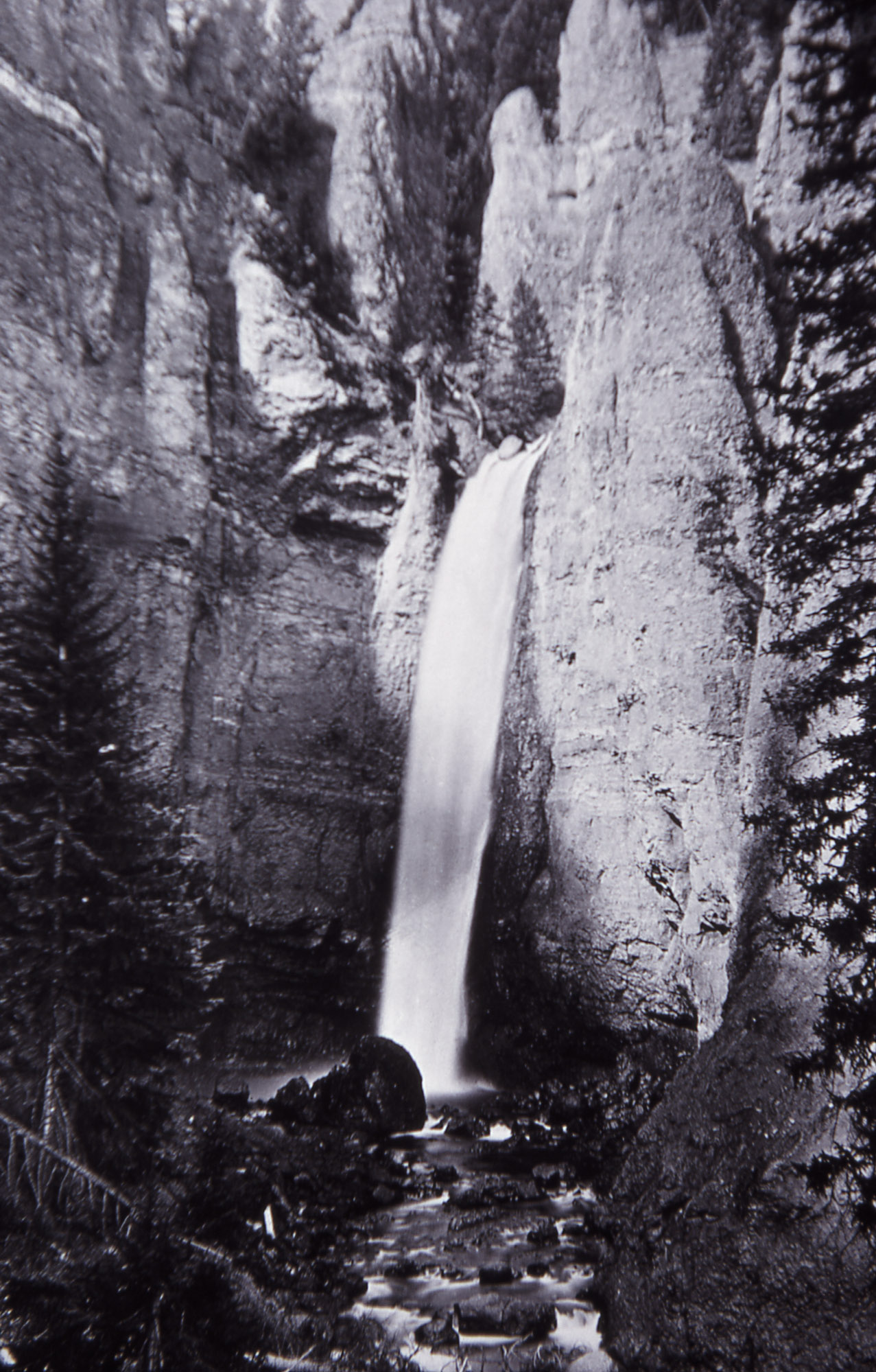
Tag: Tower Fall

  • Moran’s Legacy: Tower Fall — Text by N.P. Langford

    Tower Falls, Thomas Moran, 1875

    Thomas Moran began conjuring images of the upper Yellowstone before he even saw the place. Moran was an illustrator for Scribner’s Monthly and provided drawings for N.P. Langford’s article about the famous Washburn expedition of 1870.

    While learning to paint, Moran sought inspiration from literary works such as Longfellow’s “Hiawatha,” so it wasn’t hard for him to base his illustrations entirely on Langford’s words. The results were interesting (if sometimes inaccurate). Below is what Langford said about Tower Fall and how Moran pictured it.

    ∞§∞
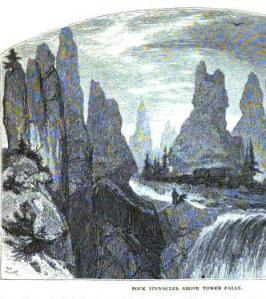
    Tower Falls Illustration from Scribner’s

    Tower Creek is a mountain torrent flowing through a gorge about forty yards wide. Just below our camp, it falls perpendicularly over an even ledge 112 feet, forming one of the most beautiful cataracts in the world. For some distance above the fall, the stream is broken into a great number of channels each of which has worked a torturous course through a compact body of shale to the verge of the precipice where they re-united and form the fall.

    The countless shapes into which the shale has been wrought by the action of the angry waters, add a feature of great interest to the scene. Spires of solid shale, capped with slate, beautifully rounded and polished, faultless in symmetry, raise their tapering forms to the height of from 80 to 150 feet, all over the plateau above the cataract. Some resemble towers, others spires of churches, and others still shoot up as lithe and slender as the minarets of a mosque.

    Some of the loftiest of these formations, standing like sentinels upon the very brink of the fall, are accessible to an expert and adventurous climber. The position attain on one of their narrow summits, amid the uproar at a height of 250 feet above the boiling chasm, as the writer can affirm, requires a steady hand and strong nerves; yet the view which rewards the temerity of the exploit is full of compensations.

    Below the fall the stream descends in numerous rapids, with frightful velocity, through a gloomy gorge, to its unions with the Yellowstone. Its bed is filled with enormous boulders, against which the rushing waters break with great fury. Many of the capricious formations wrought from the shale excite merriment as well as wonder. Of this kind especially was a huge mass sixty feet in height, which, from its supposed resemblance to the proverbial foot of his Satanic Majesty, we called the ‘Devil’s Hoof.’

    The scenery of mountain, rock, and forest surrounding the falls is very beautiful. Here too, the hunter and fisherman can indulge their tastes with the certainty of ample reward. As a halfway resort to the greater wonders still farther up the marvelous river, the visitor of future years will find no more delightful resting place. No account of this beautiful fall has ever been given by any of the former visitors to this region. The name of “Tower Falls,” which we  gave it, was suggested by some of the most conspicuous features of the scenery.”

    ∞§∞

    Moran’s 1871 field sketch of Tower Falls.

    Moran actually got to see Tower Fall in 1871 when he accompanied the government explorer, F.V. Hayden there. During the two days Moran spent at Tower Fall, he must have worked diligently making sketches from various vantage points in ink and watercolor. He used these en plain air studies later to produce several paintings in his studio.
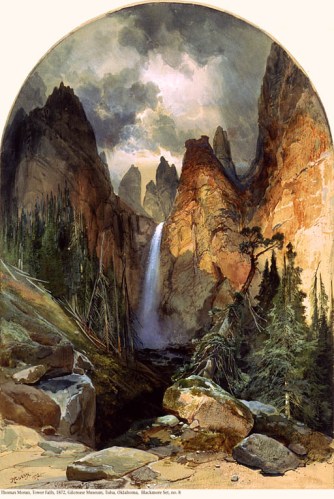
    Tower Fall, Thomas Moran, 1872.

    A year after the Washburn Expedition, Moran produced the full color rendition seen below. This piece reflects the Romantic Hudson River School that dominated American art at the time. It is characterized by aerial perspective, concealed brushstrokes and luminist techniques that made the landscapes seem to glow.

    In 1875, Moran offered the version of Tower Fall shown at the top of this post that is more impressionistic in that it juxtaposes elements in ways that can’t be seen from any actual viewpoint. Moran, who famously said, “I place no value upon literal transcripts from Nature,” was a Romantic who sought to reproduce the emotional rapture that some landscapes evoke.

    ∞§∞

    — The magazine illustration and N. P. Langford’s description are from his article “The Wonders of the Yellowstone.” Scribner’s Monthly, 2(1) 1-16 (May, 1871)

    — Other images are from the Coppermine Gallery.

    — For more on Moran’s Legacy, click on “Thamas Moran” under the Categories button to the left.

    — You might also enjoy N.P. Langford’s humorous tale about the naming of Tower Fall.

  • A Tale: Part 5: A Lady’s Visit To The Geysers Of The Yellowstone Park — HWS 1880

    Tower Creek, Thomas Moran, 1871

    HWS abandons her wagon and mounts “a sober old creature named Foxey” to cross the roadless wilderness to the Grand Canyon of the Yellowstone.

    Begin with Part 1

    ∞§∞

     The day we left the Mammoth Hot Springs, we had an accumulation of all the miseries of camping-out life. Fierce heat succeeded by torrents of wind and rain, and, to add to everything else, perfect swarms of mosquitoes. But we were repaid by the sight of Tower Creek, which rises in the high divide between the valleys of the Missouri and Yellowstone, and flows for ten miles through a cavern so deep and gloomy that it is called the Devil’s Gorge.

    About two hundred yards before entering the Yellowstone River, it dashes over an abrupt descent of 156 feet, forming a very beautiful waterfall. All around are columns of volcanic breccia, some resembling towers, some the spires of churches, and some are almost as slender and graceful as the minarets of a mosque. But, alas, one sad fatality spoiled the scene for me.

    It was impossible to take the wagon any further, and there was no alternative but to mount one of those wild beasts named by Adam a horse. The guides picked me out a sober old creature named Foxey, used to carry a pack, and likely therefore to be equal to my weight, and unlikely to be frisky or foolish. On the morning of the 9th of August, we started a long train of twenty-six horses, two dogs, and three colts, for the Yellowstone Falls and Canyon.

    As I was quite determined never to go out of a walk, on account of the tendency to slip off, I took the tail end of the pack train, and plodded on very contentedly for a while. But, alas, my comfort was of short duration, for, when we stopped to lunch, Foxey lost sight of the pack, to which he felt he rightfully belonged, and getting either bewildered or angry, he began to behave in the most unaccountable manner. He backed and forwarded and sidled and turned round and round and neighed, and completely mastered me, till our of the guides came up and fastened a rope to his bridle and led him the rest of the way.

    It is beyond my power to depict the grandeur and beauty of the mystic river, and its falls and canyon. There are two falls, half a mile apart; the upper is 140 feet high, and the lower 397. The water is compressed into a mass about 100 feet wide, and from four to six feet deep, and falls over the precipices in one apparently solid mass of glorious emerald, into its marvelous canyon below. This canyon is one of the Park’s greatest wonders.

    It is a stupendous chasm about twenty-five miles long and from 1,000 to 3,000 feet high. It can only be seen from the top, as its sides are inaccessible except in one place six miles below the falls. The river has cut its way through a material largely composed of soft clays, sand, tufa, volcanic ash and breccia, with occasional layers of basalt, and has wrought out for itself a wonderful channel.

    Towers and turrets and dykes and castle walls of all shapes and sizes are crowded together throughout its whole length in wild confusion. Here and there a single tower stands out in solitary grandeur, isolated from all its fellows, with perhaps a lonely fish hawk’s nest on its top, and little birds stretching out their open mouths towards the mother, who was circling in the grand and awful chasm over the river. But wonderful as these walls are for their height, and the grotesque and beautiful forms into which they are eroded, they are vastly more so for their color.

    From their lofty tops to the very edge of the water, they are dyed with an endless variety of the most vivid and delicate coloring. They are a mass of yellows and red and coal black and snow-white and cream and buff and brown and gray and olive, mingled together in richest confusion, while at the bottom runs the river, a glorious roaring torrent of purest emerald green, embroidered with silvery foam, between slopes decorated with velvet grass. The effect is indescribable.

    ∞§∞

    — From H. W. S., “A Lady’s Visit To The Geysers Of The Yellowstone Park.” Friends Intelligencer May 19, 1883. Pages 218-221, and May 27, Pages 234-237.

    — Coppermine Gallery Image.

  • A Tale: Naming Tower Fall— Langford, 1870

    In 1870 the famous Washburn Expedition explored the remote area that became Yellowstone National Park. While the explorers always had be be alert for the dangers of Indians, wild animals, and strange geothermal features, they also found ways to have fun. Here’s Nathaniel P. Langford’s description of  one of the pranks they played on each other.

    ∞§∞

    At the outset of our journey we had agreed that we would not give to any object of interest that we might discover the name of any of our party nor of our friends. This rule was to be religiously observed.

    While in camp on Sunday, August 28th, on the bank of this creek, it was suggested that we select a name for the creek and fail. Walter Trumbull suggested “Minaret Creek” and “Minaret Fall.” Mr. Hauser suggested “Tower Creek” and “Tower Fall.” After some discussion a vote was taken, and by a small majority, the name “Minaret” was decided upon.

    During the following evening Mr. Hauser stated with great seriousness that we had violated the agreement made relative to naming objects for our friends. He said that the well known Southern family—the Rhetts—lived in St. Louis, and that they had a most charming and accomplished daughter named “Minnie.” He said that this daughter was a sweetheart of Trumbull, who had proposed the name her name, “Minnie Rhett” — and that we had unwittingly given to the fall and creek the name of this sweetheart of Mr. Trumbull.

    Mr. Trumbull indignantly denied the truth of Hauser’s statement, and Hauser as determinedly insisted that it was the truth. The vote was therefore reconsidered, and by a substantial majority it was decided to substitute the name “Tower” for “Minaret.” Later, and when it was too late to recall or reverse the action of our party, it was surmised that Hauser himself had a sweetheart in St. Louis — a Miss Tower.

    ∞§∞

    —Excerpt from N. P. Langford, The Discovery of Yellowstone Park.

    —William Henry Jackson Photo, Yellowstone Digital Archive.

    — You can read a condensed version of Langford’s The Discovery of Yellowstone Park in my book, Adventures in Yellowstone.

    — To see more stories by this author, click on “Langford” under the “Categories” button to the left.

    — For more stories about the Washburn Expedition, click on “Washburn” under the “Categories” button to the left.