Tag: W. W.Wylie

  • News: Giantess Geyser Erupts for the First Time in Years

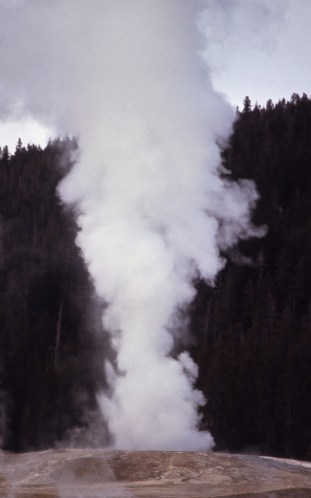
    Live Science reported yesterday that Yellowstone’s Giantess Geyser was erupting for the first time in two and a half years. When I heard the news, I immediately searched my files to see if I had a first-hand account by an early tourist who actually watched the geyser play. No luck.

    Lots of people mention the Giantess in their description of the Upper Geyser Basin, but it seems they are usually borrowing from guidebook descriptions. Here’s an example from W. W. Wylie’s 1882 Yellowstone guidebook. It would be interesting to know if this year’s eruption follows the pattern Wylie described.

    ∞§∞
    GiantessGeyserYDSF
    Giantess Geyser

    The Giantess is upon the summit of the formation, about 100 yards to the northeast of the Bee-hive. It is a large oval aperture, with scalloped edges, the diameters of which are twenty-five and eighteen feet. This Geyser is very irregular, acting once in about fourteen days. The crater is usually full and boiling gently; gives no warning of an approaching eruption. The beautiful walls may be seen to a great depth through the wonderfully transparent water.

    When this Geyser does act, the eruption at intervals of about forty minutes lasts for twelve to sixteen hours; so that, although it may begin in the night, it may be seen in daylight. When it begins an eruption, for some minutes it throws 250 feet high, but after this not eighty feet high. Its action is very much like that of the Splendid, in viewing which one finds a very good substitutejbr the Giantess.

    ∞§∞

    — Page 36 in The Yellowstone National Park or the Great American Wonderland by William Wallace Wylie,Ramsey, Kansas City, MO.:Millett and Hudson, 1882.

    — Photo from the Yellowstone Digital Slide File.
  • First Women: Mary Wylie Crosses Yellowstone Park in a Covered Wagon — 1880

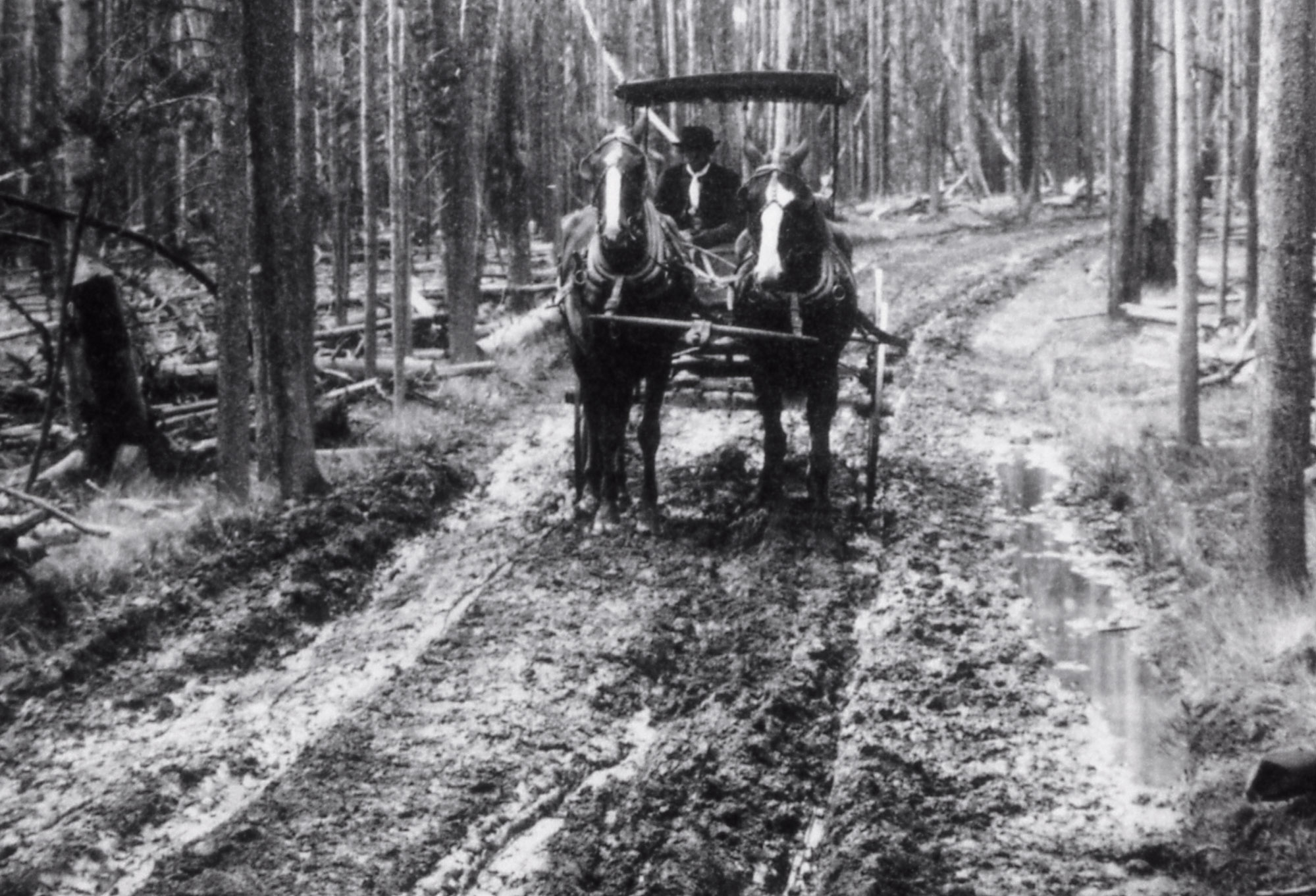
    In 1880, Mary Wylie crossed Yellowstone Park as a member of the first tourist party to use a wheeled conveyance for this trip. She went from Mammoth Hot Springs to the Lower Geyser Basin in a covered wagon.

    Mary came to Montana from Iowa in 1879 with her children. Her husband, William Wallace Wylie, had arrived in Montana the year before to become Bozeman’s first school superintendent.

    Mr. Wylie came west in 1878 on the Union Pacific transcontinental railroad to Corinne, Utah, and then took a stagecoach 400 miles north. When Mary and the children took the same trip a year later, they came north on the Utah and Northern Railroad to the Montana border and traveled about 200 miles by stage from there to Bozeman.

    Mr. Wylie left his mark on Yellowstone Park history as a lecturer, interpreter, and inventor of “permanent camps.” After he did a lecture tour across the nation, school teachers began asking him to guide them into the park. He said this “accidentally” launched him into the tourist business.

    In 1893, he founded the Wylie Permanent Camping Company, which specialized in tours of the park where guests stayed in tents left up for a full season. His moderately priced tours provided competition to the more expensive hotel tours and opened the park to middle class tourists.

    Wylie first visited the park in the spring of 1880. When he learned that Park Superintendent P. W. Norris was building the first road across the park and was going to have it finished by August, Wylie resolved to show his wife the wonders of Yellowstone Park.

    He returned to Bozeman, bought a lumber wagon and rigged it with an emigrant cover. He then assembled a nine-person party that included Mary and two of their children, a woman friend of Mary’s, and three men.

    The party met a couple with a spring wagon at Mammoth who went with them on their tour. This proved to be a good arrangement because the travelers often had to hitch both of their teams to a single wagon to get up steep hills and through rough country.

    Superintendent Norris’s new road was extremely rough. Sometimes tree stumps were too tall to let the wagons pass. When the wagons got stuck, the party had to hitch a team to the back of the wagon and pull it back so they could cut the stump lower. This made travel extremely slow. It took more than a week to travel from Mammoth to the Lower Geyser Basin.

    It was the first time tourists made the trip in wheeled conveyances. Wylie said this fact helped him get licenses to set up his tourists business in the park.

    A few weeks after Mary Wylie crossed the park beginning at Mammoth Hot Springs, Carrie Strahorn and her husband traversed Norris’s new road starting at the other end.  But after starting from the Lower Geyser Basin in a wagon, the Strahorns decided the road was too rough, and continued on horseback.

    Mary’s trip by covered wagon must have been quite an adventure. It’s too bad she didn’t leave a written account of it.

    ∞§∞

    — Photo from Yellowstone Digital Slide File.

    You also might enjoy Carrie Strahorn’s story about traveling Norris’s new road in 1880 and encountering a winter storm.

    — For related stories, look at “First Women in Yellowstone” under the Categories button to the upper left of this page.