
Today it’s easy to hire a boat with a guide to run the rapids through Yankee Jim Canyon north of Yellowstone Park. But that wasn’t always the case, as Lewis Ransome Freeman discovered more than a hundred years ago.
After graduating from Stanford University in 1898, Freeman decided to become an adventurer and traveled America, Asia, Africa and the Pacific Islands. About 1902, after snowshoeing through Yellowstone Park, he decided to float to the Gulf of Mexico down the Yellowstone, Missouri, and Mississippi Rivers. His first obstacle was to get through Yankee Jim Canyon, a rugged streatch of the Yellowstone River just north of the Park.
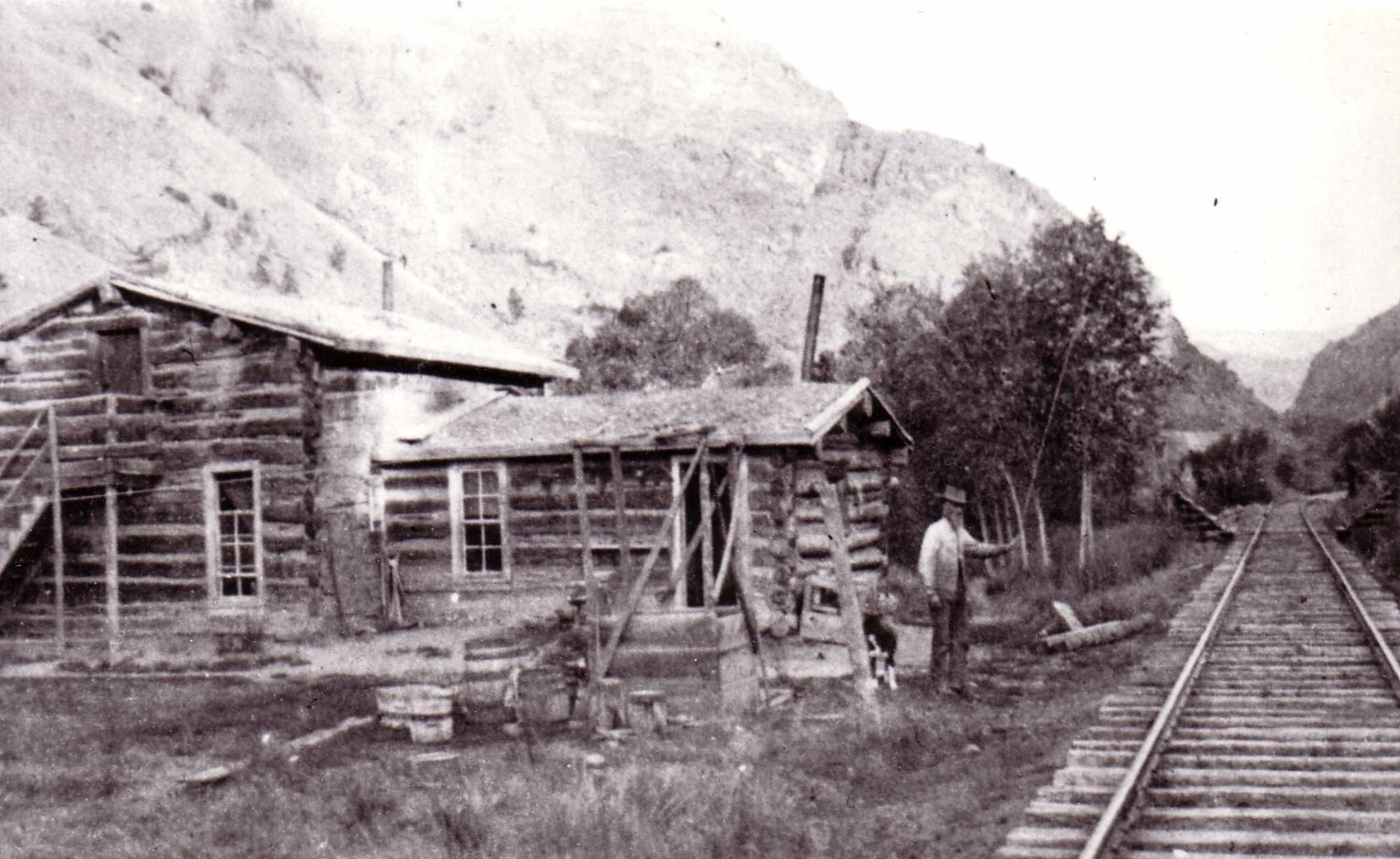
Freeman solicited help from Yankee Jim George, a colorful character who had lived for 30 years in the canyon that bears his name. The government had taken over Jim’s toll road by then, but he still provided accommodations in his rustic cabin. And, he knew where Freeman could get a boat.
Freeman covered the Russo-Japanese War beginning in 1905 and continued to work as a war correspondent through World War I. It wasn’t until 1922 that he published this description of running the rapids of Yankee Jim Canyon.
∞§∞
The boat I secured about ten miles down river from the Park boundary. The famous “Yankee Jim” gave it to me. This may sound generous on Jim’s part, but seeing the boat didn’t belong to him it wasn’t especially so. Nor was the craft really a boat.
We found the craft where it had been abandoned at the edge of an eddy. It was high and dry on the rocks. Plain as it was that neither boat-builder nor even carpenter had had a hand in its construction, there was still no possible doubt of its tremendous strength arid capacity to withstand punishment.
Jim said that a homesick miner had built this fearful and wonderful craft with the idea of using it to return to his family in Hickman, Kentucky. He had bade defiance to the rapids of the Yellowstone with the slogan “HICKMAN OR BUST.” Kentucky Mule he had called it.
Our plan of operation was something like this: Bill and Herb, the neighboring ranchers, were to go up and help me push off, while Jim went down to the first fall at the head of the Canyon to be on hand to pilot me through. If I made the first riffle all right, I was to try to hold up the boat in an eddy until Jim could amble down to the second fall and stand-by to signal me my course into that one in turn. And so on down through.
I was to take nothing with me save my camera. My bags were to remain in Jim’s cabin until he had seen me pass from sight below the Canyon. Then he was to send the stuff on to me at Livingston
As I swung round the bend above the head of the Canyon, I espied old Jim awaiting my coming on a rocky vantage above the fall. A girl in a gingham gown had dismounted from a calico pony and was climbing up to join us. With fore-blown hair and skirt, she cut an entrancing silhouette against the sun-shot morning sky.
I think the presence of that girl had a deal to do with the impending disaster, for I would never have thought of showing off if none but Jim had been there. But something told me that the exquisite creature could not but admire the sang froid of a youth who would let his boat drift while he stood up and took a picture of the thundering cataract over which it was about to plunge.
And so I did it—just that. Then, waving my camera above my head to attract Jim’s attention to the act, I tossed it ashore. That was about the only sensible thing I did in my run through the Canyon.
As I resumed my steering oar, I saw that Jim was gesticulating wildly in an apparent endeavor to attract my attention to a comparatively rock-free chute down the left bank. Possibly if I had not wasted valuable time displaying my sang froid I might have worried the Mule over in that direction, and headed right for a clean run through.
As it was, the contrary brute simply took the bit in her teeth and went waltzing straight for the reef of barely submerged rock at the head of the steeply cascading pitch of white water. Broadside on she sunk into the hollow of a refluent wave, struck crashingly fore and aft, and hung trembling while the full force of the current of the Yellowstone surged against her up-stream gunwale.
Looking back up-stream as the reeling Mule swung in the current, I saw Jim, with the Gingham Girl in his wake, ambling down the bank at a broken-kneed trot in an apparent endeavor to head me to the next fall as per schedule.
Poor old chap! He was never a hundred-to-one shot in that race now that the Mule had regained her head and was running away down mid-channel regardless of obstacles. He stumbled and went down even as I watched him with the tail of my eye. The Gingham Girl pulled him to his feet and he seemed to be leaning heavily against her fine shoulder as the Mule whisked me out of sight around the next bend.
With the steering oar permanently unshipped there was more difficulty than ever in exercising any control over the balkiness of the stubborn Mule. After a few ineffectual attempts, I gave up trying to do anything with the oar and confined my navigation to fending off with a cottonwood pike-pole.
This really helped no more than the oar, so it was rather by good luck than anything else that the Mule hit the next pitch head on and galloped down it with considerable smartness. When she reeled through another rapid beam-on without shipping more than a bucket or two of green water I concluded she was quite able to take care of herself, and so sat down to enjoy the scenery.
I was still lounging at ease when we came to a sharp right-angling notch of a bend where the full force of the current was exerted to push a sheer wall of red-brown cliff out of the way. Not unnaturally, the Mule tried to do the same thing. That was where I discovered I had over-rated her strength of construction.
I have said that she impressed me at first sight as being quite capable of nosing the Rock of Gibraltar out of her way. This optimistic estimate was not borne out. That little patch of cliff was not high enough to make a respectable footstool for the guardian of the Mediterranean, but it must have been quite as firmly socketed in the earth. So far as I could see it budged never the breadth of a hair when the Mule, driving at all of fifteen miles an hour, crashed into it with the shattering force of a battering ram. Indeed, everything considered, it speaks a lot for her construction that she simply telescoped instead of resolving into cosmic stardust. Even the telescoping was not quite complete.
The Mule had ceased to be a boat and become a raft, but not a raft constructed on scientific principles. The one most desirable characteristic of a properly built raft of logs is its stability. It is almost impossible to upset. The remains of the Mule had about as much stability as a toe dancer, and all of the capriciousness.
She kept more or less right side up on to the head of the next riffle and then laid down and negotiated the undulating waves by rolling. I myself, after she had spilled me out at the head of the riffle, rode through on one of her planks, but it was a railroad tie, with a big spike in it, that rasped me over the ear in the whirlpool at the foot.
And so I went on through to the foot of “Yankee Jim’s Canyon.” In the smoother water, I clung to a tie, plank or the thinning remnants of the Mule herself. At the riffles, to avoid another clout on the head from the spike-fanged flotsam, I found it best to swim ahead and flounder through on my own. I was not in serious trouble at any time, for much the worst of the rapids had been those at the head of the Canyon. Had I been really hard put for it, there were a dozen places at which I could have crawled out. As that would have made overtaking the Mule again somewhat problematical, I was reluctant to do it. Also, no doubt, I was influenced by the fear that Jim and the Gingham Girl might call me a quitter.
Beaching what I must still call the Mule on a bar where the river fanned out in the open valley at the foot of the Canyon, I dragged her around into an eddy and finally moored her mangled remains to a friendly cottonwood on the left bank. Taking stock of damages, I found that my own scratches and bruises, like Beauty, were hardly more than skin deep. As the day was bright and warm and the water not especially cold, I decided to make way while the sun shone—to push on toward Livingston.
The rest of that day’s run was more a matter of chills than thrills, especially after the evening shadows began to lengthen and the northerly wind to strengthen. The Mule repeated her roll-and-reduce tactics every time she came to a stretch of white water.
There were only three planks left when I abandoned her at dusk, something over twenty miles from the foot of the Canyon, and each of these was sprinkled as thickly with spike-points as a Hindu fakir’s bed of nails. One plank, by a curious coincidence, was the strake that had originally borne the defiant slogan, “HICKMAN OR BUST.” Prying it loose from its cumbering mates, I shoved it gently out into the current.
Spending the night with a hospitable rancher, I walked into Livingston in the morning. There I found my bags and camera, which good old “Yankee Jim” had punctually forwarded by the train .
∞§∞
— Condensed from Down the Yellowstone, Lewis Ransom Freeman, 1902.
— National Park Service Photo.
— You might also enjoy “Rudyard Kipling Goes Fishing with Yankee Jim.”

 M. Mark Miller, Author