Tag: Yellowstone Park HIstory

  • A Tale: In a Country Swarming With Grizzly Bears — 1874

    Dr. George Henry Kingsley

    While doing research for my next book, Encounters in Yellowstone , I’ve kept a list of  everbody who was in the park when the Nez Perce passed through there in 1877. I’ve discovered some interesting people who skedaddled before the Indians arrived.

    Among them was an intrepid trio that was reprising a trip they had made to Yellowstone Park in 1874.  They were “Texas Jack” Omohundro, a frontiersman and sometimes partner of Buffalo Bill Cody and his Wild West Show; The Earl of Dunraven, whose book The Great Divide popularized Yellowstone Park in England, and George Henry Kingsley, an English physician and adventurer.

    After Dr. Kingsley’s death, his daughter, Mary Henrietta Kingsley, compiled his papers into a book entitled Notes on Sport and Travel.  Here’s Dr. Kingley’s account of hunting grizzlies in Yellowstone Park in 1874 from that book.

    ∞§∞

    We have had very poor sport, for though we have been in a country swarming with grizzly bears we have only killed one. I was mousing around by myself the other day with the little Ballard—(a little, single-barreled rifle)—and hearing something smashing about in the willow beds, and thinking that it might be a deer, I proceeded quietly to investigate, when out there lounged the great-grandfather of all the grizzlies.

    He looked at me for a moment, and then turned and trotted off, and I trotted after him, when he, being suddenly struck with the idea that valor was the better part of discretion, faced round and walked straight at me, stopping about thirty yards off.

    As I only had the Ballard, and was quite out in the open, away from any decently sized trees, I hardly knew what to do. We stood facing each other thus for a few moments, and I could plainly see his pink tongue licking his lips, and his bright little eyes twinkling with rage.

    I put up the rifle, but could not cover any part of him where a ball would have been mortal, and if I had only wounded him, he would have been at me in a brace of shakes. After interviewing one another thus, he said “hough” and decided to advance, and I decided to retreat, which I did with considerable decision up the thickest sapling in the neighborhood, hoping, however, that he would follow me at least to the foot of it.

    I was in no small state of exultation at the prospect of killing my bear single-handed, but before I was settled, he swerved and went crashing away through the willows, and I saw him no more. He looked as big as an ox.

    Texas Jack quizzed me tremendously about this on my return, but the very next day he came back to camp with a far-away look in his eye and requested whisky. He too had come across a grizzly. He found him in a patch of trees, covering up the carcass of an elk—they are wonderfully cunning, these bears, and will plaster mud and moss over carcasses they don’t want at once, will even plaster over their wounds when they have been shot.

    Jack fired. Hit him. The bear gave one tremendous yell—looked round a moment—then tore up the ground like mad and flew at the trees, sending the bark flying in all directions. Jack lay as flat as a flounder behind a tree, and when, at length, the bear made off, came home a wiser man.

    After hearing his account I was rather glad, on the whole, that my friend had not followed to the foot of my sapling, for had I not killed him first shot, he would certainly have made it a very shaky perch to reload on.

    ∞§∞

    — Frmm Notes on Sport and Travel by George Henry Kingsley, 1900.

    — Illustration from Notes on Sport and Travel.

    — For more stories about The Earl of Dunraven, click on “Dunraven” under the “Categories” button to the right.
  • News: Climate Change—Not Just Wolves—May Cause Fewer Yellowstone Elk

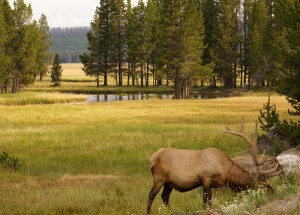
    Hunters have been blaming the introduction of Wolves for the recent decline in the number of elk in Yellowstone National Park, but new research indicates that climate change may be to blame. New West has provided a nice summary of the evidence.

    The news reminded me that several of the accounts of early travel to Yellowstone Park talk about summer snow storms bigger than anything we see now. Of course, the storytellers may have been exaggerating, but perhaps I should see if travel accounts provide evidence of climate change.

    Also, early travelers who went to the Park in August (apparently to avoid bad weather) often couldn’t find game. Before the Army outlawed hunting in 1886, many groups counted on living off the land, so when game was scarce they went hungry. Several stories tell about the great joy of returning to the ranches near the park and getting “civilized grub.”

    The Earl of Dunraven, who visited the Park in 1874, commented explicitly about how weather affects the migration of elk and other game.

    ∞§∞

    The herds of game move according to the seasons. In Estes Park, for instance, near Denver, you might go out in winter or in early spring, when the snow is deep upon the ranges and shoot blacktail deer till you were sick of slaughter. I daresay you might—if you knew where to go—sit down, and, without moving, get ten, fifteen, or even as many as twenty shots in the day.

    At other seasons you might walk the flesh off your bones without seeing a beast of any kind. Yet the deer are somewhere all the time; and, if you can only find out to what deep recesses of the forest, or to what high mountain pastures they have betaken themselves in their search for cool shelter, or in their retreat from mosquitoes and other insect pests, you would be amply rewarded for your trouble.

    It is the same with wapiti. Sometimes the park will be full of them; you may find herds feeding right down on the plains among the cattle; and in a fortnight there will be none left. All will have disappeared; in what is more, it is almost impossible to follow them up and find them, for they are much shyer than the deer.

    Where do they go? Not across the snowy range, certainly. Where then? Up to the bare fells, just under the perpetual snow, where they crop the short sweet grass that springs amid the debris fallen from the highest peaks; to the deep black recesses of primeval forest; to the valleys, basins, little parks and plains, hidden among the folds of the mountains, where even the wandering miner has never disturbed the solitude.

    ∞§∞

    — Excerpt from The Great Divide by the Earl of Dunraven.

    — New West Photo.

    — You can read a condensed version of the Earl’s 1874 trip to Yellowstone Park in my book, Adventures in Yellowstone.

  • A Tale: Dunraven Says Mountain Men Led a “Delicious Life” — 1874

    Beginning in 1807 when John Colter first passed through the area that became Yellowstone National Park through the 1830s, Mountain Men flourished in the Rocky Mountain West. Then a combination of over trapping and a shift in men’s fashions to silk hats ended the lucrative beaver trade. The last big Mountain Man rendezvous occurred  in 1840.

    Although a trapper couldn’t earn a fortune after that, a few hardy souls remained in the area making a subsistence living. Yellowstone tourists encountered such men until the 1880s. Here’s a description of  an encounter with two Mountain Men and their entourage written by the Earl of Dunraven, a wealthy Irish nobleman who visited the Park in the 1874.

    ∞§∞

    In the afternoon we passed quite a patriarchal camp, composed of two men with their Indian wives and several children; half a dozen powerful savage-looking dogs and about fifty horses completed the party.

    They had been grazing their stock, hunting and trapping—leading a nomad, vagabond, and delicious life—a sort of mixed existence, half hunter, half herdsman, and had collected a great pile of deer-hides and beaver-skins. They were then on their way to settlements to dispose of their peltry, and to get stores and provisions; for they were proceeding to look for comfortable winter quarters, down the river or up the canyon.

    We soon discovered that the strangers were white, and, moreover, that there were only two men in camp; and without more ado we rode in and made friends. What a lot of mutually interesting information was given and received! We were outward bound and had the news, and the latitude and the longitude. They were homeward bound, had been wandering for months, cut off from all means of communication with the outside world, and had but the vaguest notion of their position on the globe.

    But, though ignorant of external matters and what was going on in settlements, they had not lost all desire for information. An American, although he lives with an Indian woman in the forests or on the plains, never quite loses his interest in politics and parties; and these two squaw-men were very anxious to hear all about electioneering matters

    These men looked very happy and comfortable. Unquestionably the proper way for a man to travel with ease and luxury in these deserts is for him to take unto himself a helpmate chosen from the native population. With an Indian wife to look after his bodily comforts, a man may devote himself to hunting, fishing, or trapping without a thought or care. He may make his mind quite easy about all household matters. His camp will be well arranged, the tent pegs driven securely home, the stock watered, picketed, and properly cared for, a good supper cooked, his bed spread out, and everything made comfortable; his clothes and hunting-gear looked after, the buttons sewn on his shirt (if he has got any shirt—or any buttons) and all the little trivial incidents of life, which, if neglected, wear out one’s existence, he will find carefully attended to by a willing and affectionate slave.

    They had a lot to tell us also about their travels and adventures, about the wood and water supply, and the abundance or deficiency of game. So we sat down on bales of beaver-skins and retailed all the civilized intelligence we could think of. The women came and brought us embers for our pipes, and spread out robes for us and made us at home. And the little, fat, chubby children, wild and shy as young wolves, peered at us from behind the tent out of their round, black, beady eyes.

    ∞§∞

    — Text from The Great Divide by the Earl of Dunraven, 1875.

    — You might also enjoy:

    — To see more stories by this author, click on “Dunraven” under the “Categories” button to the left.

  • A Tale: Lord Blackmore Riles His Guide by Catching 254 Fish in One Day — 1872

    In the 1870s a curious conflict developed  over who got to kill wildlife in Yellowstone Park. After decimating the bison herds on the great plains, hide hunters converged on the park and  slaughtering elk by the thousand leaving their carcasses to rot.

    Sport hunters condemned commercial hunting, but reserved their own right to blast away at anything that moved. On the other hand, hide hunters said they were just trying to make a living and condemned killing “just for fun.”

    The differing attitudes are illustrated  in the story below. It comes from the reminiscence of Jack Bean, an Indian fighter and commercial hunter who hired on as a guide to the Hayden Expedition of 1872.

    Lord William Blackmore, a wealthy Englishman who had helped fund the expedition, was Hayden’s guest and an avid fisherman. Here’s what Bean says happened when he went fishing with Lord Blackmore.

    ∞§∞

    While the doctor was geologizing the country there, I went fishing with Sir William Blackmore in Lake Abundance.

    You could see plenty of trout close to shore in the lake, but when he got to catching them he thought it would be wonderful if he caught one for each year he was old—fifty four. He soon caught the fifty four and tried for a hundred, and was not long catching this and made a try for fifty-four more and kept fishing for another hundred, and another fifty-four.

    As we had gotten two thirds of the way around the lake by this time, I told him that I would quit as I had all the fish I could drag along on the grass, being two hundred and fifty-four. I dragged them into camp which was close along the lake and wanted to make a little show of these fish.

    Sir Blackmore, whenever he would see any bones would always ask, “How come those bones there?” I would tell him they were left by skin hunters in the winter.  He thought that all skin hunters should be put in jail for such vandalism and I told him he would do the same if he were in this country for the winter.

    So when I had shook all these fish off from the strings they made such a sight that I called Dr. Hayden’s attention to what Sir Blackmore would do if he had a chance. He colored up considerable and excused himself by saying, “The fish were so plenty it was Godsend to catch some of them out.”

    ∞§∞

    In 1886 the U.S. Army took over administration of the Park and ended the holocaust by forbidding hunting for any purpose and regulating fishing.

    — For more stories about fishing in Yellowstone Park, click on “fishing” under the “Categories” button on the right.

    — Excerpt from Jack Bean’s Reminiscence, Pioneer Museum of Bozeman.

    — NPS llustration, Yellowstone Digital Slide.

    — You might enjoy Jack Bean’s sarcastic description of guiding a greenhorn in Colonel Pickett Gets His Bear.  It fun to compare Bean’s story with Colonel Pickett’s version.

    — You can read more of Bean’s delightful reminiscence in my book, Adventures in Yellowstone.

  • A Tale: Hour Spring, A Geyser by Another Name — c. 1834

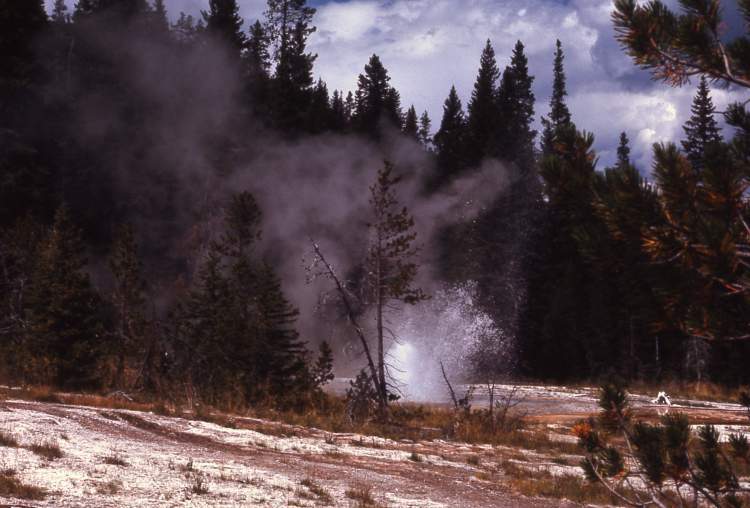
    Rustic Geyser, Heart Lake Geyser Basin

    In the decade between 1834 and 1843, a trapper named Osborne Russell kept a journal describing his adventures in the frontier northwest. Russell’s journal provides one of the earliest written accounts of travel to the upper Yellowstone. Here’s his description of hot springs and geysers in a now extinct geothermal area.

    ∞§∞

    The next day we traveled along the border of the lake till we came to the northwest extremity, where we found about 50 springs of boiling hot water. We stopped here some hours as one of my comrades had visited this spot the year previous he wished to show us some curiosities.

    The first spring we visited was about ten feet in diameter, which threw up mud with a noise similar to boiling soap. Close about this were numerous similar to it throwing up the hot mud and water five or six feet high. About thirty or forty paces from these along the side of a small ridge the hot steam rushed forth from holes in the ground with a hissing noise which could be heard a mile distant.

    On a near approach we could hear the water bubbling under ground some distance from the surface. The sound of our footsteps over this place was like thumping over a hollow vessel of immense size. In many places were peaks from two to six feet high formed of limestone, deposited by the boiling water, which appeared of snowy whiteness. The water when cold is perfectly sweet except having a fresh limestone taste.

    After surveying these natural wonders for sometime, my comrade conducted me to what he called the “Hour Spring.” At this spring the first thing that attracts the attention is a hole about 15 inches in diameter in which the water is boiling slowly about 4 inches below the surface. At length it begins to boil and bubble violently and the water commences raising and shooting upwards until the column arises to the height of sixty feet. It falls to the ground in drops on a circle of about 30 feet in diameter being perfectly cold when it strikes the ground.

    It continues shooting up in this manner five or six minutes and then sinks back to its former state of slowly boiling for an hour — and then shoots forth as before. My comrade said he had watched the motions of this spring for one whole day and part of the night the year previous and found no irregularity whatever in its movements.

    ∞§∞

    — Photo, Coppermine Photo Galley

    — From Osborn Russell, Journal of a Trapper, Syms-York Company, Boise, Idaho, 1921. Pages 99-100.

    — You might also enjoy:

  • A Tale: “Into the Scalding Morass,” Langford — 1870

    After the 1862 gold strike in Bannack, Montana, prospectors scoured every canyon and gully looking for pay dirt. That included the region that would become Yellowstone National Park.

    These men told about the wonders they had seen—mountains of glass, towering waterfalls, and fountains of boiling water, but, at first, people dismissed their reports as tall tales. Soon it became clear that there really were marvelous things in the area, so a group of government officials and businessmen decided to mount an expedition to document them. The result was the famous Washburn Expedition of 1870.

    Of course, documenting the wonders included gathering specimens—task that could be downright dangerous. Here’s a description of just how dangerous it could be, written by one of the expedition’s principle chroniclers, Nathaniel P. Langford.

    ∞§∞

    Washburn and I passed over a low divide, which, I think, must be the main range of the Rocky Mountains. Just beyond is another brimstone basin containing forty or fifty boiling sulphur and mud springs. A small creek runs through the basin—and the slopes of the mountains on either side showed unmistakable signs of volcanic action beneath the crust.

    A considerable portion of the slope of the mountain was covered with a hollow incrustation of sulphur, lime, or silica, from which issued in many places hot steam. We found many small craters from six to twelve inches in diameter —  from which issued the sound of the boiling sulphur or mud. In many instances we could see the mud or sulphur water.

    The water was too hot for us to bear the hand more than two or three seconds.  It had overflowed the green spaces between the incrustations, completely saturating the ground. In many places the grass had grown—forming a turf compact and solid enough to bear the weight of a man ordinarily. But when it gave way the underlying deposit was so thin that it afforded no support.

    While crossing one of these green places, my horse broke through—and sank to his body as if in a bed of quicksand.  I was off his back in an instant and succeeded in extricating the struggling animal.  The fore legs of my horse, however, had gone through the turf into the hot, thin mud beneath.

    General Washburn was a few yards behind me on an incrusted mound of lime and sulphur, which bore us in all cases. He had just before called to me to keep off the grassy place.  Now he inquired of me if the deposit beneath the turf was hot. Without making examination I answered that I thought it might be warm.

    Shortly afterwards the turf again gave way—and my horse plunged more violently than before, throwing me over his head. As I fell, my right arm was thrust violently through the treacherous surface into the scalding morass. It was with difficulty that I rescued my poor horse—and I found it necessary to instantly remove my glove to avoid blistering my hand.

    The frenzied floundering of my horse had in the first instance suggested to General Washburn the idea that the under stratum was hot enough to scald him. General Washburn was right in his conjecture. It is a fortunate circumstance that I today rode my light-weight pack horse. If I had ridden my heavy saddle horse, I think that the additional weight of his body would have broken the turf—and that he would have disappeared in the hot boiling mud—taking me with him.

    ∞§∞

    — Text and ilustration from Langford’s book, The Discovery of Yellowstone Park, 1870.

    — You can read a condensed version of Langford’s The Discovery of Yellowstone Park in my book, Adventures in Yellowstone.

    — To see more stories by this author, click on “Langford” under the “Categories” button to the left.

    — For more stories about the Washburn Expedition, click on “Washburn” under the “Categories” button to the left.

  • First Women: Mary Wylie Crosses Yellowstone Park in a Covered Wagon — 1880

    In 1880, Mary Wylie crossed Yellowstone Park as a member of the first tourist party to use a wheeled conveyance for this trip. She went from Mammoth Hot Springs to the Lower Geyser Basin in a covered wagon.

    Mary came to Montana from Iowa in 1879 with her children. Her husband, William Wallace Wylie, had arrived in Montana the year before to become Bozeman’s first school superintendent.

    Mr. Wylie came west in 1878 on the Union Pacific transcontinental railroad to Corinne, Utah, and then took a stagecoach 400 miles north. When Mary and the children took the same trip a year later, they came north on the Utah and Northern Railroad to the Montana border and traveled about 200 miles by stage from there to Bozeman.

    Mr. Wylie left his mark on Yellowstone Park history as a lecturer, interpreter, and inventor of “permanent camps.” After he did a lecture tour across the nation, school teachers began asking him to guide them into the park. He said this “accidentally” launched him into the tourist business.

    In 1893, he founded the Wylie Permanent Camping Company, which specialized in tours of the park where guests stayed in tents left up for a full season. His moderately priced tours provided competition to the more expensive hotel tours and opened the park to middle class tourists.

    Wylie first visited the park in the spring of 1880. When he learned that Park Superintendent P. W. Norris was building the first road across the park and was going to have it finished by August, Wylie resolved to show his wife the wonders of Yellowstone Park.

    He returned to Bozeman, bought a lumber wagon and rigged it with an emigrant cover. He then assembled a nine-person party that included Mary and two of their children, a woman friend of Mary’s, and three men.

    The party met a couple with a spring wagon at Mammoth who went with them on their tour. This proved to be a good arrangement because the travelers often had to hitch both of their teams to a single wagon to get up steep hills and through rough country.

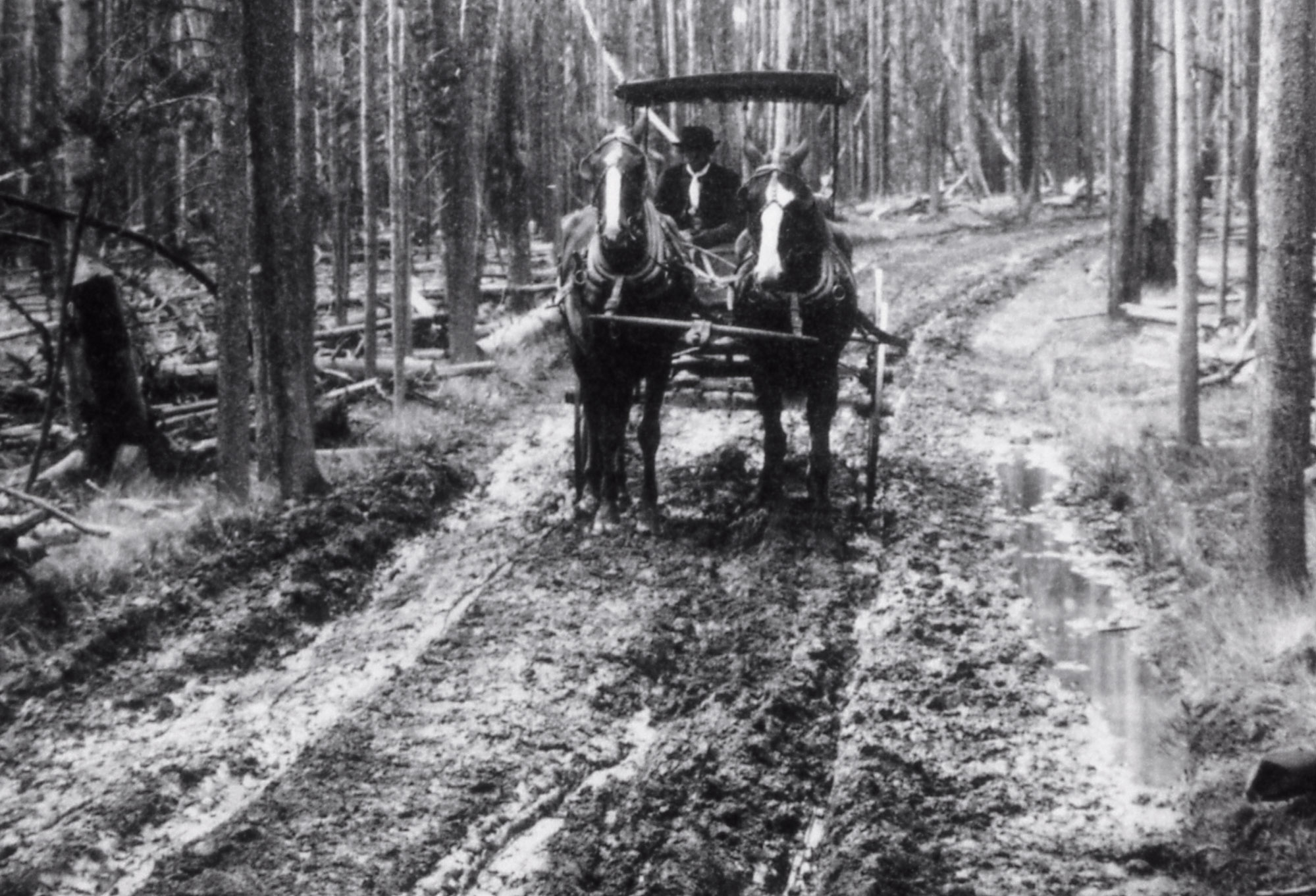
    Superintendent Norris’s new road was extremely rough. Sometimes tree stumps were too tall to let the wagons pass. When the wagons got stuck, the party had to hitch a team to the back of the wagon and pull it back so they could cut the stump lower. This made travel extremely slow. It took more than a week to travel from Mammoth to the Lower Geyser Basin.

    It was the first time tourists made the trip in wheeled conveyances. Wylie said this fact helped him get licenses to set up his tourists business in the park.

    A few weeks after Mary Wylie crossed the park beginning at Mammoth Hot Springs, Carrie Strahorn and her husband traversed Norris’s new road starting at the other end.  But after starting from the Lower Geyser Basin in a wagon, the Strahorns decided the road was too rough, and continued on horseback.

    Mary’s trip by covered wagon must have been quite an adventure. It’s too bad she didn’t leave a written account of it.

    ∞§∞

    — Photo from Yellowstone Digital Slide File.

    You also might enjoy Carrie Strahorn’s story about traveling Norris’s new road in 1880 and encountering a winter storm.

    — For related stories, look at “First Women in Yellowstone” under the Categories button to the upper left of this page.

  • News and Views: Presenting to “Smart Women” Was Great Fun

    The Library at Aspen Pointe

    There I was in the beautiful lobby of Aspen Pointe, an independent living facility run by Deaconess Hospital in Bozeman.  I looked out over a sea of women’s faces — and they were all looking back at me.  I thought I had died and gone to heaven.

    Indeed, the audience was filled with “Smart Women.”  They cringed when I told them about Emma Cowan’s chilling account of watching an Indian hold a pistol to her husband’s head and pull the trigger. And they laughed when I read Eleanor Corthell’s hilarious story about her husband getting arrested for letting their horse graze too close to Old Faithful and sweet talking his way into a $2 fine.

    I knew that Eleanor’s granddaughter, Phoebe Montagne, lives at Aspen Pointe, and I hoped she would be in the audience, but I wasn’t that lucky.  After signing copies of my book, I asked to be shown to Phoebe’s room.

    After my escort introduced us, I gave Phoebe a copy of my book and showed her the chapter containing Eleanor Corthell’s account of  her trip to Yellowstone Park in 1903.  While Eleanor’s husband stayed home in Laramie, she took their seven children clear across Wyoming in a horse-drawn wagon to see the wonders of the park.  Eleanor told wonderful stories about fording a flooded river, chasing a bear out of camp, and counting heads at a geyser basin to make sure none of her children had fallen in.

    When I asked Phoebe what she remembered about her grandmother, her eye twinkled and a smile slid across her face.

    “I remember Grandmother surrounded by us grandchildren sitting on the floor,” she said.  “She would read us books like David Copperfield.”

    I’m sure a smile slid across my face too while I listened to Phoebe reminisce.  As much as I enjoyed talking with 75 smart women, that was the highlight of the day.

    ∞§∞

    — You can read Eleanor Corthell’s story of her trip to Yellowstone Park in my book, Adventures in Yellowstone.

  • A Tale: Doughnuts in Bear Grease, Sarah Tracy — 1873

    Doing Laundry in a Hot Spring

    Indians stole a band of horses the day before Sarah Tracy left Bozeman for Yellowstone Park in June of 1873. But Mrs. Tracy was used to Indians. When she arrived in Bozeman in 1869 with her new husband, Bozeman Pioneer W.H. Tracy, Indians were encamped on the south side of town. She said, “They would peer in the windows if the doors were locked, or come flocking around the door begging for biscuits, soap, clothes, everything.”

    Such encounters left Mrs. Tracy with little fear of Indians, but the commander at Fort Ellis still didn’t want to let her party go to Yellowstone in the midst of “Indian troubles.” Finally, after some haggling, he agreed to provide an armed escort.

    “We were soon on our way with twelve mounted soldiers following us,” Mrs. Tracy said in a reminiscence she wrote about the trip. “With their guns and knapsacks on their shoulders, and their belts filled with cartridges, they looked very war like.” The soldiers escorted the stage across Trail Creek Pass to the Yellowstone River and then turned back after seeing no signs of Indians. The party then headed south to the Bottler brothers’ ranch. Diaries of early trips to Yellowstone often mention a stop at Bottlers.

    In 1868 Frederick and Phillip Bottler started the first permanent ranch in the Paradise Valley. The Bottlers’ ranch was a one-day ride from Bozeman and located halfway to Mammoth Hot Springs. That made it an ideal stopping point for travelers heading for the park. The Bottlers always made visitors welcome and eventually started a guesthouse.

    After a night at Bottlers, the stage headed to Mammoth Hot Springs over a new road through Yankee Jim Canyon. This road was so bad Mrs. Tracy said that it “fairly made one shudder to ride over it in a four-wheeled stage coach.” As the coach approached Mammoth passengers got a marvelous view from the top of a hill, but the descent down the mountain required chaining the stage’s rear wheels. This “rough locking” slowed the stage by making it skid and keeping it from crowding the horses.

    “We drove up to the hotel with a grand flourish of the four-horse whip, bringing the landlord and the guests to the door to meet us.” This description conjures pictures of an elegant building, but the “hotel” at Mammoth then was just an 25-by-35 foot log cabin with a sod roof. Crude as it was, the hotel had hot and cold running water; a stream of 40 degrees ran on one side and of 150 degrees on the other.

    Mrs. Tracy and her companion, Sarah Graham, waited for their husbands to join them for two days. They enjoyed fishing, climbing the terraces, two baths a day and three hearty meals. When the men arrived they all started on horseback for a tour of the Park.

    “We rode side saddles,” Mrs. Tracy said, “and it was quite difficult for an amateur rider to keep seated.” Their train of a saddle horse for each traveler and eight packhorses made an impressive appearance strung out on the trail.  Their route frequently crossed the rushing, boulder-strewn Gardiner River, and Sarah said,

    I was in great fear of crossing, but as there was no alternative, I had to hold on as best I could. At first, I dismounted to walk over the bad places, but they were so frequent, I concluded to remain in my saddle. One old mountaineer remarked, “Wait until the mountains are so steep you must hold onto the horse’s ears going up, and tail going down.” And we certainly found some mountains where the saddle would slip over the back going up, and nearly over the head coming down. We made only one ride each day, as it was too much work to repack the horses.

    At Yellowstone Lake they found the man who had guided Emma Stone’s party, E.S. Topping, and his partner, Frank Williams. The men had recently built a sailboat. They said they would let the first woman to visit name the boat.  Since Mrs. Tracy and Mrs. Graham were both named Sarah, they decided to christen the boat “The Sallie.” Mrs. Tracy said after the name was painted on the boat, “We had a fine sail across the lake and our pictures taken on board,”

    At their camp, Topping and Williams rewarded the women by letting them make doughnuts fried in bear grease. In her reminiscence, Mrs. Tracy said of her twelve-day trip:

    “The balmy breezes and mountain sunshine had done our complexions to a turn. While our clothing was little worse for wear, yet we had seen the Yellowstone National Park in its primitive beauty. And bear’s grease doughnuts had certainly agreed with us.”

    ∞§∞

    — Sarah Tracy’s reminiscence is at the Museum of the Rockies in Bozeman.

    — You also might enjoy reading about Emma Stone, the first woman to make a complete tour of Yellowstone Park.

    — Photo, Yellowstone Digital Slide File

  • A Tale: Emma Cowan Visits Mammoth — 1873

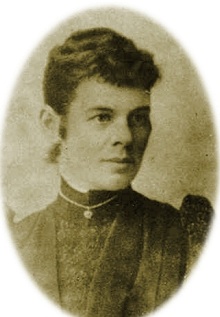
    Emma Cowan

    Most of the women who visited Yellowstone Park in the 1870s were Montana Pioneers. For them, camping out in the wilderness was no big deal. After all, they had already crossed the plains in a covered wagon, or come up the Missouri River on a crowded steamboat.

    Emma Cowan was such a pioneer. She was 10 years old when came to Montana in a covered wagon with her parents during the gold rush of 1864. Shortly after she arrived in Virginia City, Emma began hearing about the wonders of the upper Yellowstone. One day her father brought home a man who told marvelous stories.

    Emma said of the stories, “My fairy books could not equal such wonderful tales. Fountains of boiling water, crystal clear, thrown hundreds of feet into the air, only to fall back into pools of their own forming; pools of water in whose limpid depths tints of various rainbows were reflected; mounds and terraces of gaily colored sand.”

    Emma and her family thought the stories were just fantasies, but she said, “As I grew older and found truth in the statements, the desire to some day visit this land was ever present.”

    Emma’s first trip to Yellowstone Park was a visit to Mammoth Hot Springs in 1873 with her parents. She didn’t say a lot about it, but the normal starting point for such a trip would have been Bozeman, a thriving trade center and agriculture town about 75 miles from the park.

    After they left Bozeman, travelers usually would spend their first night at the Bottler brothers’ ranch—a one-day ride from Bozeman. Bottlers’ ranch was located halfway to Mammoth Hot Springs, which made it an ideal stopping point for early travelers heading to the park.

    After a night at Bottlers, Emma’s family would have gone to Mammoth Hot Springs over a new road through Yankee Jim Canyon. Emma said this road was scarcely more than a trail, but “by careful driving, unhitching the horses, and drawing the wagon by hand over the most dangerous places, we made it safely.”

    The road was so bad, Emma said, that just a few weeks before a man, who was taking his crippled wife to Mammoth to soak in mineral waters that he hoped would cure her, didn’t even try to travel by wagon. Instead, he carried her on an Indian-style travois.

    Although the park was only a year old in 1873 when Emma and her family visited there, Mammoth Hot Springs had already become a tourist destination. When her family arrived, Emma said, “We found an acquaintance or two, a number of strangers, a small hotel and a bath house.”

    At Mammoth, tourists could hire guides to take them into the roadless wilderness to see the Grand Canyon of the Yellowstone, the Falls, and, most important, the Grand Geysers. Here they could also buy supplies that included such luxuries as canned fruit, baked bread, fresh milk, and butter.

    Visitors could either camp nearby, or pay $20 a week to the hotel for room and board. In addition, they could pay five dollars for twice-daily baths in tin tubs that had been coated with a porcelain like finish by the mineral waters. Visitors often made their own souvenirs by leaving items in pools where mineral waters encrusted them.

    Emma and her family stayed at Mammoth for two weeks seeing nearby sights, soaking in hot baths, and making souvenirs. But they decided not to visit the geysers. That would have required an arduous seventy-five mile trip on horseback because there were no roads across the park.

    Several parties returned from the geysers during Emma’s stay, and their accounts intrigued her. People often told her that words couldn’t convey the wonders they had seen. “You must see them for yourself,” they told her.

    Emma’s interest was piqued. When she got home she learned everything she could about the geysers from magazines, newspapers, and friends’ accounts.

    In 1877 Emma’s wish to see the geysers came true. But the adventure was even more that she expected when Indians shot her husband and took her captive.

    Coming Soon: “Doughnuts Fried in Bear Grease, Sarah Tracy — 1874”

    — Related stories you might enjoy: