Tag: Yellowstone Park

  • A Tale: In a Country Swarming With Grizzly Bears — 1874

    Dr. George Henry Kingsley

    While doing research for my next book, Encounters in Yellowstone , I’ve kept a list of  everbody who was in the park when the Nez Perce passed through there in 1877. I’ve discovered some interesting people who skedaddled before the Indians arrived.

    Among them was an intrepid trio that was reprising a trip they had made to Yellowstone Park in 1874.  They were “Texas Jack” Omohundro, a frontiersman and sometimes partner of Buffalo Bill Cody and his Wild West Show; The Earl of Dunraven, whose book The Great Divide popularized Yellowstone Park in England, and George Henry Kingsley, an English physician and adventurer.

    After Dr. Kingsley’s death, his daughter, Mary Henrietta Kingsley, compiled his papers into a book entitled Notes on Sport and Travel.  Here’s Dr. Kingley’s account of hunting grizzlies in Yellowstone Park in 1874 from that book.

    ∞§∞

    We have had very poor sport, for though we have been in a country swarming with grizzly bears we have only killed one. I was mousing around by myself the other day with the little Ballard—(a little, single-barreled rifle)—and hearing something smashing about in the willow beds, and thinking that it might be a deer, I proceeded quietly to investigate, when out there lounged the great-grandfather of all the grizzlies.

    He looked at me for a moment, and then turned and trotted off, and I trotted after him, when he, being suddenly struck with the idea that valor was the better part of discretion, faced round and walked straight at me, stopping about thirty yards off.

    As I only had the Ballard, and was quite out in the open, away from any decently sized trees, I hardly knew what to do. We stood facing each other thus for a few moments, and I could plainly see his pink tongue licking his lips, and his bright little eyes twinkling with rage.

    I put up the rifle, but could not cover any part of him where a ball would have been mortal, and if I had only wounded him, he would have been at me in a brace of shakes. After interviewing one another thus, he said “hough” and decided to advance, and I decided to retreat, which I did with considerable decision up the thickest sapling in the neighborhood, hoping, however, that he would follow me at least to the foot of it.

    I was in no small state of exultation at the prospect of killing my bear single-handed, but before I was settled, he swerved and went crashing away through the willows, and I saw him no more. He looked as big as an ox.

    Texas Jack quizzed me tremendously about this on my return, but the very next day he came back to camp with a far-away look in his eye and requested whisky. He too had come across a grizzly. He found him in a patch of trees, covering up the carcass of an elk—they are wonderfully cunning, these bears, and will plaster mud and moss over carcasses they don’t want at once, will even plaster over their wounds when they have been shot.

    Jack fired. Hit him. The bear gave one tremendous yell—looked round a moment—then tore up the ground like mad and flew at the trees, sending the bark flying in all directions. Jack lay as flat as a flounder behind a tree, and when, at length, the bear made off, came home a wiser man.

    After hearing his account I was rather glad, on the whole, that my friend had not followed to the foot of my sapling, for had I not killed him first shot, he would certainly have made it a very shaky perch to reload on.

    ∞§∞

    — Frmm Notes on Sport and Travel by George Henry Kingsley, 1900.

    — Illustration from Notes on Sport and Travel.

    — For more stories about The Earl of Dunraven, click on “Dunraven” under the “Categories” button to the right.
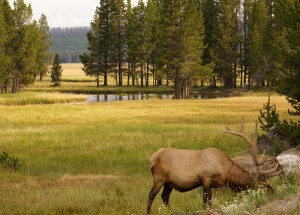
  • News: Climate Change—Not Just Wolves—May Cause Fewer Yellowstone Elk

    Hunters have been blaming the introduction of Wolves for the recent decline in the number of elk in Yellowstone National Park, but new research indicates that climate change may be to blame. New West has provided a nice summary of the evidence.

    The news reminded me that several of the accounts of early travel to Yellowstone Park talk about summer snow storms bigger than anything we see now. Of course, the storytellers may have been exaggerating, but perhaps I should see if travel accounts provide evidence of climate change.

    Also, early travelers who went to the Park in August (apparently to avoid bad weather) often couldn’t find game. Before the Army outlawed hunting in 1886, many groups counted on living off the land, so when game was scarce they went hungry. Several stories tell about the great joy of returning to the ranches near the park and getting “civilized grub.”

    The Earl of Dunraven, who visited the Park in 1874, commented explicitly about how weather affects the migration of elk and other game.

    ∞§∞

    The herds of game move according to the seasons. In Estes Park, for instance, near Denver, you might go out in winter or in early spring, when the snow is deep upon the ranges and shoot blacktail deer till you were sick of slaughter. I daresay you might—if you knew where to go—sit down, and, without moving, get ten, fifteen, or even as many as twenty shots in the day.

    At other seasons you might walk the flesh off your bones without seeing a beast of any kind. Yet the deer are somewhere all the time; and, if you can only find out to what deep recesses of the forest, or to what high mountain pastures they have betaken themselves in their search for cool shelter, or in their retreat from mosquitoes and other insect pests, you would be amply rewarded for your trouble.

    It is the same with wapiti. Sometimes the park will be full of them; you may find herds feeding right down on the plains among the cattle; and in a fortnight there will be none left. All will have disappeared; in what is more, it is almost impossible to follow them up and find them, for they are much shyer than the deer.

    Where do they go? Not across the snowy range, certainly. Where then? Up to the bare fells, just under the perpetual snow, where they crop the short sweet grass that springs amid the debris fallen from the highest peaks; to the deep black recesses of primeval forest; to the valleys, basins, little parks and plains, hidden among the folds of the mountains, where even the wandering miner has never disturbed the solitude.

    ∞§∞

    — Excerpt from The Great Divide by the Earl of Dunraven.

    — New West Photo.

    — You can read a condensed version of the Earl’s 1874 trip to Yellowstone Park in my book, Adventures in Yellowstone.

  • A Tale: “The Rod Bent Nearly Double,” General W. E. Strong — 1875

    One of the most luxurious early trips to Yellowstone Park was led by President U.S. Grant’s Secretary of War, General William Belknap. In 1875, Belknap was joined by four other Generals including W.E. Strong, who provide an account of the trip.

    The Generals crossed the country in a plush Pullman car smoking cigars, drinking whisky, and telling stories, on the new transcontinental railroad. Then they rode in a special stagecoach that traveled at breakneck speed from Utah to Montana.

    Along the way they were feted with banquets, parties and parades. In Bozeman a Silver Coronet Band greeted them at the edge of town and escorted them through the city to Fort Ellis.

    At Fort Ellis they were provided with an escort of active duty soldiers led by Gustavus Doane, who had commanded the escort of the Washburn Expedition in 1870.

    Each General was assigned an orderly to take care of his every whim: packing his personal belongings, putting up his tent, rolling out his bed roll, digging his latrine, and cleaning any fish he caught. All at army expense, of course. A year later the U.S. Senate impeached General Belknap for taking bribes.

    General Strong eloquently describes the wonders of Yellowstone—falls, hot springs and geysers, and describes the people he met—mountain men, stagecoach drivers, and towns people. Most of all, he revels in telling exciting tales of hunting elk, stampeding buffalo, and catching fish. Here’s his description of fishing.

    ∞§∞

    Again I threw my hook in the swift water, and down the stream it went like lightning, tossing about like a feather in the rapid. My reel whirled and spun like a buzz saw, the line went out so fast.

    I never touched the reel to check the running line till seventy-five feet, at least, was in the water. Then I pressed my thumb firmly upon it and drew gently back the rod. At the same instant something struck my hook that nearly carried me off my feet. I had to let go the reel to save the rod.

    I had him securely hooked, but could I land him? That was the question. I gave him twenty-five or thirty feet more line—then checked again and tried to hold him—but it was no use, the rod bent nearly double, and I had to let him run.

    My line was one hundred and fifty feet in length, and I knew when it was all out, if the fish kept in the rapids, I should lose him. No tackle like mine could stand for a moment against the strength of such a fish as I had struck in such swift water.

    I therefore continued to give him the line—but no faster than I was forced to.   No more than twelve or fifteen feet remained on the reel. Fortunately for me, he turned to the left and was carried into an eddy which swept him into more quiet water near the shore.

    Twice in his straight run down the rapid current of the stream he leaped clear from the water. I saw he was immense—something double or triple the size of any trout I had ever caught. The excitement to me was greater than anything I had ever experienced.

    No one but a trout fisherman can understand or appreciate the intense pleasure of a single run. I was crazy to kill and land him, and yet I knew the chances were against it. Again and Again I reeled him within twenty-five or thirty feet of the rock. But he was game to the last, and would dart off with the same strength as when he first struck. I had to let him go.

    Finally, he showed signs of exhaustion. I managed to get him to top the water, and then worked him in close to the sore. Flynn was waiting to take the line and throw him out, as I had no landing net. Flynn did it very well. When the trout was very near the bank and quiet, he lifted him out.

    He was a fine specimen, and would weigh four pounds if he weighed an ounce.   This trout was three times the size I had ever caught. At 4:30 o’clock I stopped fishing having landed thirty-five trout which would have run from two and a half to four pounds in weight—none less than two and one half pounds.

    ∞§∞

    See Paul Schulery’s comments on General Strong’s fishing tackle.

    — For more stories about fishing in Yellowstone Park, click on “fishing” under the “Categories” button on the right.

    — From W.E. Strong, A Trip to the Yellowstone National Park in July, August, and September, 1875.

    — Photo from Paul Schullery, Yellowstone Digital Slide File.

  • A Tale: “Into the Scalding Morass,” Langford — 1870

    After the 1862 gold strike in Bannack, Montana, prospectors scoured every canyon and gully looking for pay dirt. That included the region that would become Yellowstone National Park.

    These men told about the wonders they had seen—mountains of glass, towering waterfalls, and fountains of boiling water, but, at first, people dismissed their reports as tall tales. Soon it became clear that there really were marvelous things in the area, so a group of government officials and businessmen decided to mount an expedition to document them. The result was the famous Washburn Expedition of 1870.

    Of course, documenting the wonders included gathering specimens—task that could be downright dangerous. Here’s a description of just how dangerous it could be, written by one of the expedition’s principle chroniclers, Nathaniel P. Langford.

    ∞§∞

    Washburn and I passed over a low divide, which, I think, must be the main range of the Rocky Mountains. Just beyond is another brimstone basin containing forty or fifty boiling sulphur and mud springs. A small creek runs through the basin—and the slopes of the mountains on either side showed unmistakable signs of volcanic action beneath the crust.

    A considerable portion of the slope of the mountain was covered with a hollow incrustation of sulphur, lime, or silica, from which issued in many places hot steam. We found many small craters from six to twelve inches in diameter —  from which issued the sound of the boiling sulphur or mud. In many instances we could see the mud or sulphur water.

    The water was too hot for us to bear the hand more than two or three seconds.  It had overflowed the green spaces between the incrustations, completely saturating the ground. In many places the grass had grown—forming a turf compact and solid enough to bear the weight of a man ordinarily. But when it gave way the underlying deposit was so thin that it afforded no support.

    While crossing one of these green places, my horse broke through—and sank to his body as if in a bed of quicksand.  I was off his back in an instant and succeeded in extricating the struggling animal.  The fore legs of my horse, however, had gone through the turf into the hot, thin mud beneath.

    General Washburn was a few yards behind me on an incrusted mound of lime and sulphur, which bore us in all cases. He had just before called to me to keep off the grassy place.  Now he inquired of me if the deposit beneath the turf was hot. Without making examination I answered that I thought it might be warm.

    Shortly afterwards the turf again gave way—and my horse plunged more violently than before, throwing me over his head. As I fell, my right arm was thrust violently through the treacherous surface into the scalding morass. It was with difficulty that I rescued my poor horse—and I found it necessary to instantly remove my glove to avoid blistering my hand.

    The frenzied floundering of my horse had in the first instance suggested to General Washburn the idea that the under stratum was hot enough to scald him. General Washburn was right in his conjecture. It is a fortunate circumstance that I today rode my light-weight pack horse. If I had ridden my heavy saddle horse, I think that the additional weight of his body would have broken the turf—and that he would have disappeared in the hot boiling mud—taking me with him.

    ∞§∞

    — Text and ilustration from Langford’s book, The Discovery of Yellowstone Park, 1870.

    — You can read a condensed version of Langford’s The Discovery of Yellowstone Park in my book, Adventures in Yellowstone.

    — To see more stories by this author, click on “Langford” under the “Categories” button to the left.

    — For more stories about the Washburn Expedition, click on “Washburn” under the “Categories” button to the left.

  • First Women: Mary Wylie Crosses Yellowstone Park in a Covered Wagon — 1880

    In 1880, Mary Wylie crossed Yellowstone Park as a member of the first tourist party to use a wheeled conveyance for this trip. She went from Mammoth Hot Springs to the Lower Geyser Basin in a covered wagon.

    Mary came to Montana from Iowa in 1879 with her children. Her husband, William Wallace Wylie, had arrived in Montana the year before to become Bozeman’s first school superintendent.

    Mr. Wylie came west in 1878 on the Union Pacific transcontinental railroad to Corinne, Utah, and then took a stagecoach 400 miles north. When Mary and the children took the same trip a year later, they came north on the Utah and Northern Railroad to the Montana border and traveled about 200 miles by stage from there to Bozeman.

    Mr. Wylie left his mark on Yellowstone Park history as a lecturer, interpreter, and inventor of “permanent camps.” After he did a lecture tour across the nation, school teachers began asking him to guide them into the park. He said this “accidentally” launched him into the tourist business.

    In 1893, he founded the Wylie Permanent Camping Company, which specialized in tours of the park where guests stayed in tents left up for a full season. His moderately priced tours provided competition to the more expensive hotel tours and opened the park to middle class tourists.

    Wylie first visited the park in the spring of 1880. When he learned that Park Superintendent P. W. Norris was building the first road across the park and was going to have it finished by August, Wylie resolved to show his wife the wonders of Yellowstone Park.

    He returned to Bozeman, bought a lumber wagon and rigged it with an emigrant cover. He then assembled a nine-person party that included Mary and two of their children, a woman friend of Mary’s, and three men.

    The party met a couple with a spring wagon at Mammoth who went with them on their tour. This proved to be a good arrangement because the travelers often had to hitch both of their teams to a single wagon to get up steep hills and through rough country.

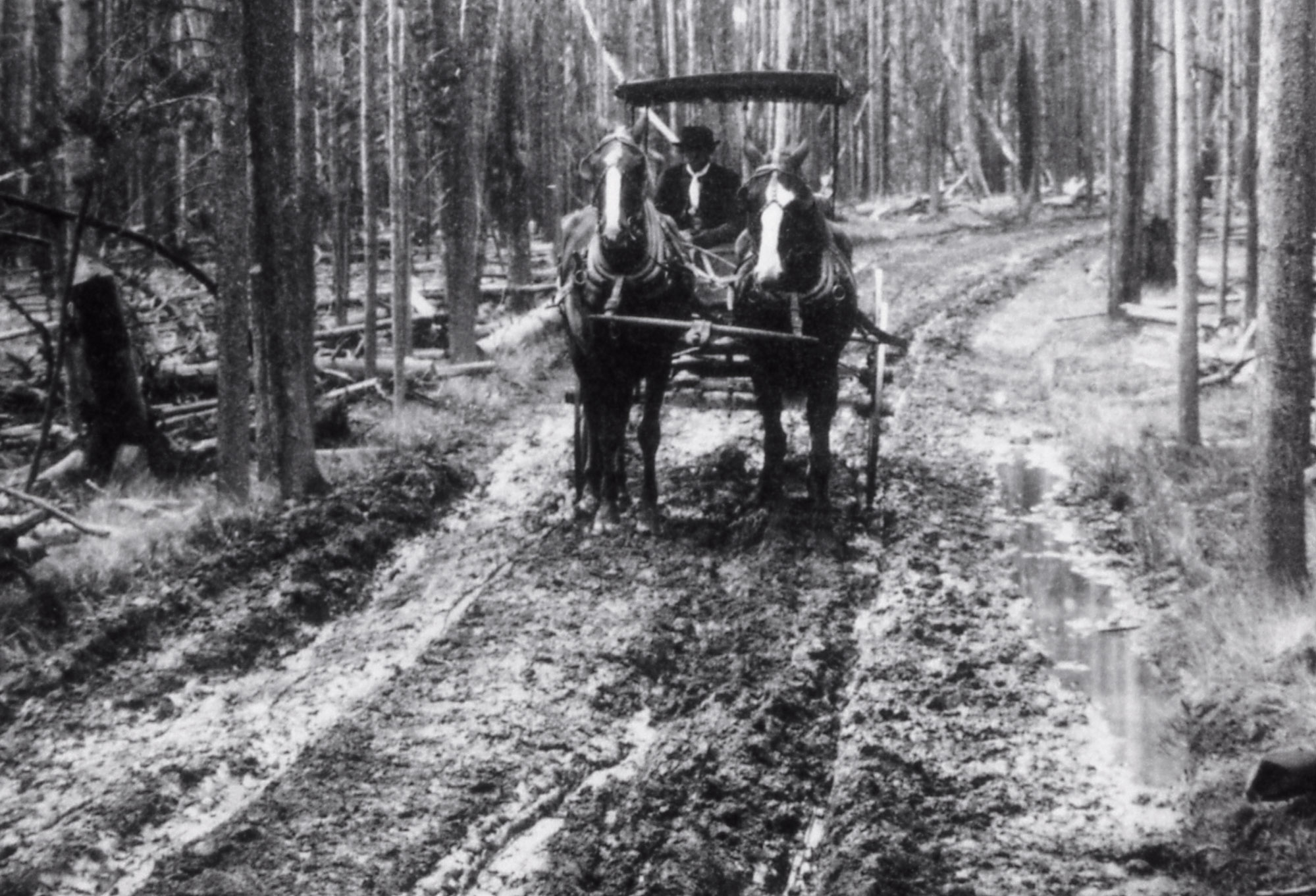
    Superintendent Norris’s new road was extremely rough. Sometimes tree stumps were too tall to let the wagons pass. When the wagons got stuck, the party had to hitch a team to the back of the wagon and pull it back so they could cut the stump lower. This made travel extremely slow. It took more than a week to travel from Mammoth to the Lower Geyser Basin.

    It was the first time tourists made the trip in wheeled conveyances. Wylie said this fact helped him get licenses to set up his tourists business in the park.

    A few weeks after Mary Wylie crossed the park beginning at Mammoth Hot Springs, Carrie Strahorn and her husband traversed Norris’s new road starting at the other end.  But after starting from the Lower Geyser Basin in a wagon, the Strahorns decided the road was too rough, and continued on horseback.

    Mary’s trip by covered wagon must have been quite an adventure. It’s too bad she didn’t leave a written account of it.

    ∞§∞

    — Photo from Yellowstone Digital Slide File.

    You also might enjoy Carrie Strahorn’s story about traveling Norris’s new road in 1880 and encountering a winter storm.

    — For related stories, look at “First Women in Yellowstone” under the Categories button to the upper left of this page.

  • A Tale: Mabel Cross Osmond: Dolly Saved My Life — 1874

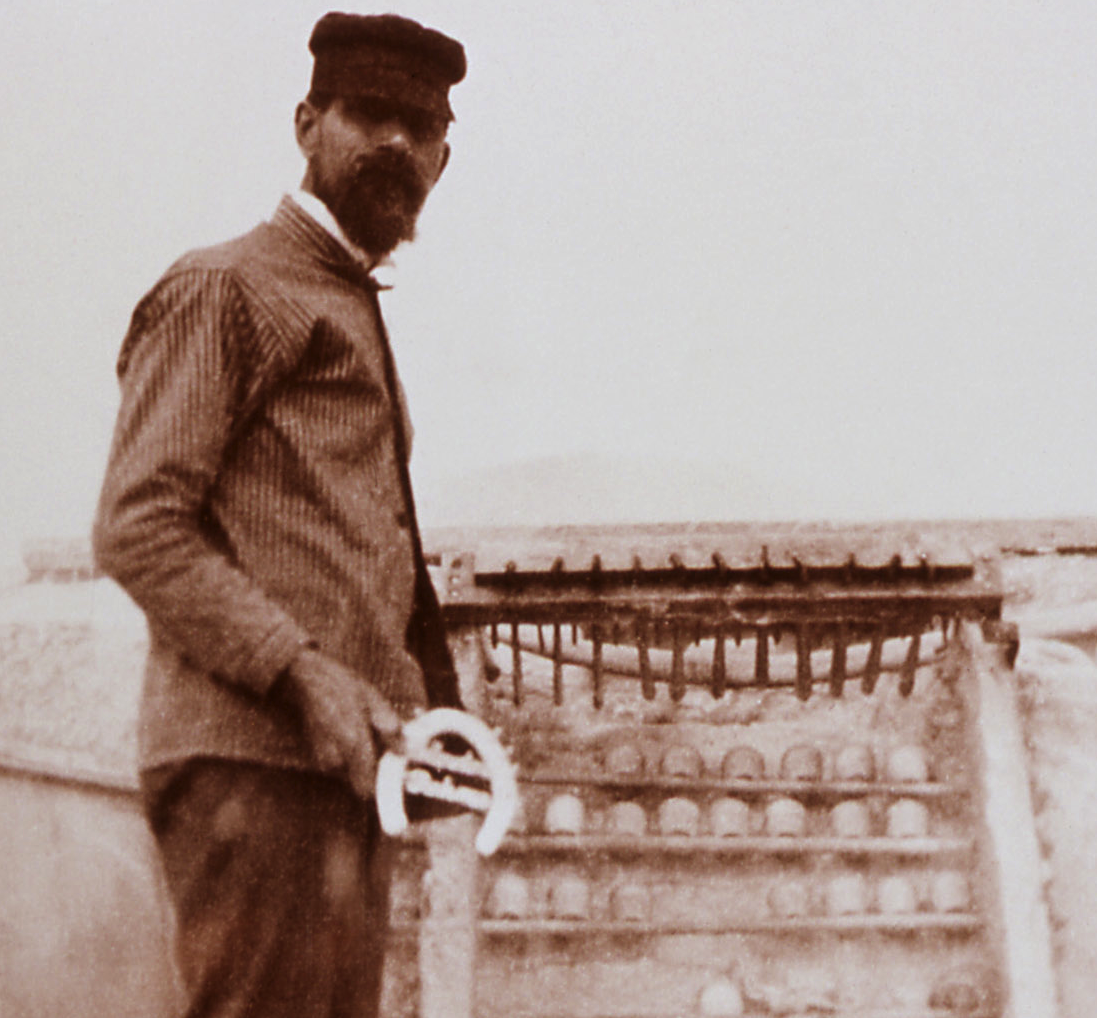
    Coating souvenirs at Mammoth Hot Springs

    Mabel Cross Osmond was just six and half years old when she first went to Yellowstone Park with her parents in 1874. Mabel’s father Captain Robert Cross was a Civil War veteran who came to Montana to be the post trader at Crow Agency, which was then located nine miles east of the present Livingston, Montana.

    Mabel wrote her memoir more that fifty years after her trip, but she still had vivid memories of it including such details as the saddle she rode. “The blacksmith,” she said, “taking a man’s saddle, fastened a covered iron rod from the pommel around on the right side to the back. This rod and the seat were well padded with blankets.  A covered stirrup, wide enough for my two feet was hung on the left side and across this open side from the pommel to the rod in back was attached a buckled leather strap so that, when mounted, I sat as a child in a high chair.”

    Mabel of rode an Indian pony she called “Dolly” that she said saved her life “by instantly stopping when, while descending a steep trail my saddle turned, leaving me hanging head downward, helplessly strapped in until the others could reach me.”

    The Crosses had an army escort to see them though Indian country until they reached the Bottler ranch.  Mabel recalled the stop clearly.

    “We enjoyed one of Grandma Bottler’s good dinners. I remember the cute little roast Pig with an ear of corn in its mouth, and also being awakened during the night by hearing her shrilly shouting — “Fredereek, Fredereek, the skunk is after the chickuns.” Though eighty years old, she kept her ‘store teeth’ put away —‘fearing to wear them out’ — she told us.”

    At Mammoth Hot Springs, Mabel’s father made a basket out of her mother’s corset stays and laid it in one of the pools.   The running waters encrusted the item with white mineral deposits making a souvenir that Mabel still had when she wrote her memoir.

    The Crosses traveled along Indian trails and through timber so thick that it hid the sky and pack mules had difficulty carrying their wide loads between the trees.  They camped at the geyser basins for several days, plenty of time to see most of the geysers play.

    When the Crosses got the Yellowstone Lake, Mabel took a ride on the boat that Sarah Tracy had named  “The Sally” just weeks earlier.  Mabel sailed to a small island where she feasted on gooseberries and ripe red raspberries, but she attributed the seasickness she got on the return trip to rough waters.  She said her hosts named an Island for her, but it didn’t stick.

    ∞§∞

    — Adapted from Mabel Cross Osmond, Memories of a Trip Through Yellowstone National Park in 1874. Typescript, Pioneer Museum of Bozeman.

    — Photo, Yellowstone Digital Slide.

  • A Tale: An Optimistic Prospector — 1863

    Walter Washington DeLacy

    After gold was discovered near Bannack, Montana, in 1862, prospectors scoured every gully and creek searching for the next bonanza. In 1863, Walter Washington DeLacy led a 40-man expedition that explored the Snake River to its source. The party didn’t find enough “color” for a paying proposition, but they did bring back a wealth of information about the Yellowstone Plateau. DeLacy included that information in his famous 1865 map of the Montana territory. DeLacy was a civil engineer and his account of the Snake River expedition is one of few prospector accounts by an educated man. At time when a man could make a fortune from a few gold pans of dirt, prospectors were ever hopeful of striking it rich. In the virtually lawless territories prospecting parties made their own rules to assure that everybody has a fair chance. Here’s DeLacy’s description of an effort to draft some “miner’s laws.”

    ∞§∞

    I halted the men at the creek as they came up, and when all had arrived I suggested to them that we should go on to the next water, pick out a good camp, and remain some days and prospect the different streams, which were in sight. This was agreed to, and we went forward about three miles to the next creek, near the outlet of Lake Jackson and established ourselves where wood, water, and grass were abundant.

    After unpacking and staking the animals out, another meeting was called in order to decide upon our future action. It was decided to build a “corral,” to put the horses in at night that should be left in camp, and that four parties should be formed: one to remain in camp as a guard, and three others to prospect the streams in sight.

    The men were then detailed for the different expeditions, and it was suggested, that as there was a strong probability of finding good “diggings,” we should adopt some mining laws for them.

    We therefore organized ourselves into a “miners’ meeting,” and, after appointing a chairman, etc., one of the members moved, and another seconded the motion, that the following regulations should be adopted:

    1. That every person present should be regarded as a discovered in each and every gulch found by any party or member of a party.

    2. That each member, as discoverer, should be entitled to five claims of two hundred feet each along the gulch, viz., a discovery claim, and a pre-emption claim in the main gulch, a bar claim, a hill claim, and a patch claim. (I never knew exactly what a patch claim was, but I think that it meant all that you could grab, after you got the other four claims.)

    These liberal and disinterested regulations were voted in the affirmative with gratifying unanimity, and the chairman was just about to put the question to the meeting whether there was any more business before it, when a big, burly Scotchman named Brown, who had apparently been turning the subject over in his mind, jumped up, and inquired with great earnestness, “But, Mr. Chairman, what shall we do with the rest of it.”

    ∞§∞

    — Adapted from “A Trip up the South Snake River in 1863.” Walter W. DeLacy, Contributions to the Historical Society of Montana, Vol. 2, 1896.

    — Photo, Yellowstone Digital Slide File

    — For more funny stories click on “Humor” under the “Categories” button on the left side of this page.

  • A Tale: An October Snow Storm at Yellowstone Canyon — 1880

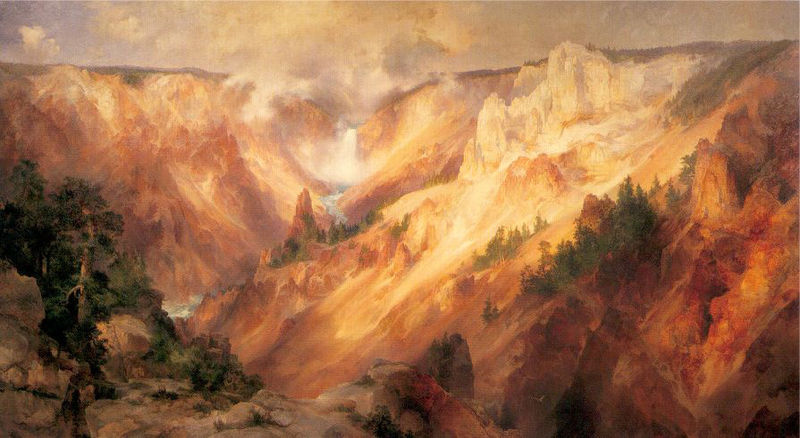
    Thomas Moran, The Grand Canyon of the Yellowstone


    Carrie Strahorn was an adventurous woman who insisted on traveling with her husband  Robert  (she called him “Pard”) as he traveled the country searching for destinations for the Union Pacific Railroad. Carrie wrote newspaper columns about her adventures and eventually collected them in a book,
    Fifteen Thousand Miles by Stage.

    Despite warnings about winter storms, the Strahorns decided to visit Yellowstone Park in October 1880. Their guide was George Marshall, who operated a stage line between Virginia City, Montana, and a hotel he built at the Lower Geyser Basin. Also, Park Superintendent Philetus Norris accompanied the Strahorns during  part of their trip.

    The weather was fine when the Strahorns began, but as they returned to Marshall’s hotel after visited the Mammoth Hot Springs, a snow storm caught them. Here’s Carrie’s story about that.

    ∞§∞

    The rain changed to snow, and through the storm we saw the disconsolate face of Mr. Marshall, as he stood near the smoldering campfire muttering to himself as if he had become demented. Upon inquiring the cause of his trouble, he said as soon as he saw the snow he went to look for the horses—and they were gone.

    “Gone!” we all exclaimed in unison and despair. The horses were gone and we were at the end of our rations with a big storm upon us. The many warnings not to go into the park so late went buzzing through our minds like bumblebees. The snow was several inches deep and falling faster every minute.

    As soon as daylight came the men started in search of the horses. I was left all alone in the camp for several hours waiting with my rifle in hand, until after a hard and hurried chase the horses were overtaken and brought back. We knew that we should hurry home as quickly as possible—but to be within five miles and not to see the falls was asking too much. With the return of the horses we resolved at once to go on.

    Superintendent Norris thought it was not best for me to go to the falls. The trip must be a hasty one, and the start home not to be delayed longer than possible for fear of continued storm. The snow ceased falling soon after daylight, but the sun did not appear and there was every indication of more snow. Pard was reluctant to leave me, and knew what disappointment lurked in my detention, but he was overruled. With Mr. Norris he started off leaving me with Mr. Marshall—who was to have everything ready for the return to Fire Hole Basin on their return.

    The more I meditated the more I felt that I could not give up seeing the canyon and falls. To be balked by a paltry five or ten miles was more than I could stand. I called to Mr. Marshall to saddle my horse at once for I was going to the falls.

    He laughingly said “all right,” but he went right on with his work and made no move toward the horse. I had to repeat the request the third time most emphatically and added that I would start out on foot if he did not get my horse without more delay.

    He said I could not follow them for I would not know the way, but I reminded him of the freshly fallen snow, and that I could easily follow the trail. He was vexed with my persistence as I was with his resistance, and he finally not only saddled my horse but his own, and rather sulkily remarked that if the bears carried off the whole outfit I would be to blame. When well on our way I persistently urged him to return to the camp and he finally did turn back, but waited watched me until I turned out of sight.

    Alone in the wild woods full of dangerous animals my blood began to cool, and I wondered what I should do if I met a big grizzly who would not give up the trail. The silence of that great forest was appalling and the newly fallen snow made cushions for the horse’s feet as I sped noiselessly on. It was a gruesome hour, and to cheer myself I began to sing, and the echoing voice coming back from the treetops was mighty good company.

    The five miles seemed to stretch out interminably. When about a mile from the falls other voices fell on my ear, and I drew rein to locate the sound, then gave a glad bound forward for it was Pard on his way back. Mr. Norris said anyone might think that Pard and I had been separated for a month, so glad were we to see each other.

    Pard could not restrain his joy that I had followed, and sending the superintendent on to the camp he at once wheeled about and went with me to the falls and canyon that I came so near missing. Up and down o’er hills and vales we dashed as fast as our horses would carry us until the upper falls were reached where we dismounted and went up to the edge of the canyon to get a better view.

    These falls are visible from many points along the canyon, and. the trail runs close to them and also by the river for several miles, the tourist many glimpses of grandeur. Above the upper falls the river is a series of sparkling cascades, when suddenly the stream narrows to thirty yards, and the booming cataract rushes over the steep ledge a hundred and twenty feet and rebounds in fleecy foam of great iridescence. The storm increased and the heavens grew darker every hour, but we pushed on.

    Moran has been chided for his high coloring of this canyon, but one glimpse of its rare, rich hues would convince the most skeptical that exaggeration is impossible. We longed to stay for days and weeks and hear this great anthem of nature and study its classical and noble accompaniment, but there was a stern decree that we must return, and that without delay.

    There was no hope for sightseeing as we kept on our way back to the Lower Geyser Basin. Without giving our horses or ourselves over half an hour to rest at noon, we rode on and on, up hill and down, through woods and plains, fording the Fire Hole River again and again, until at last the lights of Marshall camp were in sight. The storm had continued all day, turning again from snow to rain in the valley. How tired I was when we rode up to the door. Our forty-mile ride was ended at seven o’clock, but it took three men to get me off my horse.

    ∞§∞

    — Adapted from Carrie Adell Strahorn, Fifteen Thousand Miles by Stage, 1911.

    — Image, Yellowstone Digital Slide File.

    — You might also enjoy “Big Boots to Fill” by Carrie Strahorn.

    — Read more of Carrie’s story in my book,  Adventures in Yellowstone.

  • A Tale: The First Written Description of Yellowstone Geysers — Daniel T. Potts, 1827


    By the early 1800’s trappers were scouring the Rocky Mountains  for beaver. Evidence of  their travel is sketchy, but we know that trapper brigades reached the Yellowstone Plateau by 1826.

    In 1947, two elderly ladies offered to sell the National Park Service three letters that were then 120 years old. A fur trapper named Daniel T. Potts had sent one of them to his brother in 1827. It is thought to be the first written description of the thermal features of the Upper Yellowstone by someone who actually saw them. Here’s the famous “Letter from Sweet Lake.”

    ∞§∞

    Sweet Lake
    July 8th 1827

    Respected Brother,

    Shortly after writing to you last year I took my departure for the Blackfoot Country. We took a northerly direction about fifty miles where we cross Snake River or the South fork of Columbia—which heads on the top of the great chain of Rocky Mountains that separate the water of the Atlantic from that of the Pacific. Near this place Yellowstone South fork of Missouri and the Henrys fork head at an angular point. The head of the Yellowstone has a large fresh water lake on the very top of the mountain—which is about one hundred by forty miles in diameter and as clear as crystal.

    On the south borders of this lake is a number of hot and boiling springs—some of water and others of most beautiful fine clay. The springs throw particles to the immense height of from twenty to thirty feet in height. The clay is white and of a pink. The water appears fathomless; it appears to be entirely hollow underneath.

    There is also a number of places where the pure sulphur is sent forth in abundance. One of our men visited one of those whilst taking his recreation. There at an instant the earth began a tremendous trembling. With difficulty he made his escape when an explosion took place resembling that of thunder. During our stay in that quarter, I heard it every day.

    From this place by a circuitous rout to the northwest, we returned. Two others and myself pushed on in the advance for the purpose of accumulating a few more Beaver. In the act of passing through a narrow confine in the Mountain, we where met plumb in face by a large party of Blackfeet Indians. Not knowing our number, they fled into the mountain in confusion—and we to a small grove of willows. Here we made every preparation for battle. After finding our enemy as much alarmed as ourselves we mounted our Horses which where heavily loaded we took the back retreat.

    The Indian raised a tremendous yell and showered down from the mountaintop. They had almost cut off our retreat when put whip to our horses. They pursued us in close quarters until we reached the plains where we left them behind.

    Tomorrow I depart for the west. We are all in good health and hope that this letter will find you in the same situation. I wish you to remember my best respects to all enquiring friends particularly your wife.

    Remain yours most affectionately.

    Daniel T. Potts

    ∞§∞

    — Original manuscript, Yellowstone National Park Research Library.

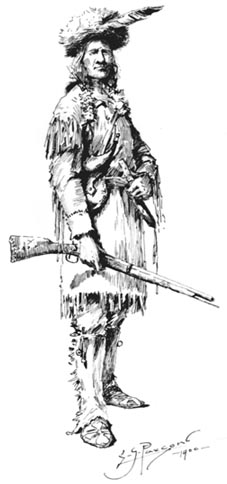
    — Sketch by E.S. Paxson, Montana Historical Society

    — You might also enjoy:

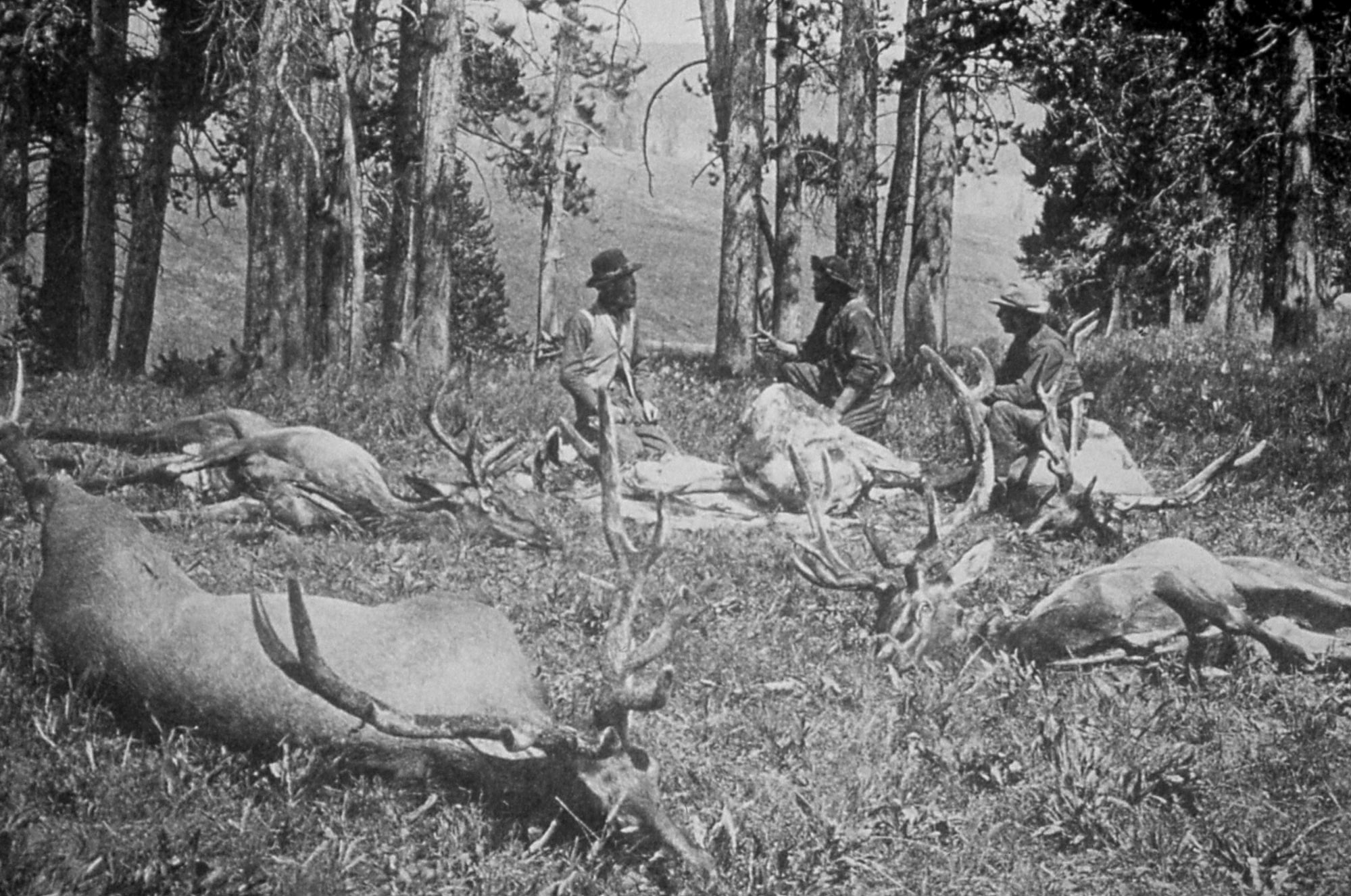
  • A Tale: Wapiti Are The Stupidest Brutes — 1874

    Most early Yellowstone tourists came from the adjacent territories because getting to the park was too expensive for other people. But a few wealthy adventurers from distant places found the time and money to make the long trip. Hunting, which was perfectly legal until the Army took over administration of Yellowstone Park in 1886, was a prime attraction.

    One such traveler was Windham Thomas Wyndam-Quin, the fourth Earl of Dunraven. A fabulously wealthy Irish nobleman, Lord Dunraven hired several men to accompany him. One of them was Fredrick Bottler, a rancher who settled in the Paradise Valley on the Yellowstone River in 1868. Bottler was familiar with Yellowstone’s wonders and served as an outfitter, guide and hunter for several early expeditions.

    Dunraven, who had been a war correspondent for British newspapers, was an astute observer with a droll wit. In addition to his stories about watching geysers and hunting big game, he offers humorous advice on how to pack a mule, and tells about roasting fresh elk meat over a campfire.

    He wrote several books about his travel adventures. Here’s his description of Elk Hunting from The Great Divide, one of his most popular.

    ∞§∞

    We wound our way towards the head of the valley, half asleep, for the day was very hot. Before long I jerked my horse on to his haunches and slid quietly off. The others followed my example without a word, for they too had caught a glimpse of the dark brown forms of some wapiti feeding quietly in the wood. Bottler, in his enthusiasm, seized me violently by the arm and hurried into the timber, ejaculating at every glimpse of the forms moving through the trees.

    “There they go! There they go! Shoot! Now then! There’s a chance.” At the time he was dragging me along, and I could no more shoot than fly. At last I shook myself clear of him, and, getting a fair easy shot at a large fat doe, fired and killed her.

    Wapiti are the stupidest brutes in creation; and, instead of making off at once, the others all bunched up and stared about them, so that we got two more before they made up their minds to clear out. There was a fine stag in the herd, but, as is usually the case, he managed to get himself well among the hinds out of harm’s way, and none of us could get a chance at him.

    Bottler and I followed his tracks for an hour, but could not come up with him; and, finding that he had taken clear up the mountain, we returned to the scene of action. There we found the rest of the party busily engaged in cutting up the huge deer. One of them was a hind, in first-rate condition and as fat as butter. We were very glad of fresh meat, and, as the ground was very suitable, determined to camp right there, and send some of the flesh down to the main camp in the morning. We pitched our Lilliputian tents at the foot of one of a hundred huge hemlocks, set a fire, and proceeded to make ourselves comfortable for the night.

    We were all smoking round the fire—a most attentive audience, watching with much interest the culinary feats which Bottler was performing—when we were startled by a most unearthly sound.

    Bottler knew it well, but none of us strangers had ever heard a wapiti stag roaring before, and it is no wonder we were astonished at the noise. The wapiti bellows forth one great roar, commencing with a hollow, harsh, unnatural sound, and ending in a shrill screech like the whistle of a locomotive.

    In about ten minutes this fellow called again, a good deal nearer, and the third time he was evidently close to camp, so we started out. Advancing cautiously, we presently, through a bush, distinguished in the gloom the I saw body and antlered head of a real monarch of the forest as he stalked out into an open glade and stared with astonishment at our fire.

    He looked perfectly magnificent. He was a splendid beast, and his huge bulk, looming large in the uncertain twilight, appeared gigantic. He stood without betraying the slightest sign of fear or hesitation; but, as if searching with proud disdain for the intruder that had dared to invade his solitude, he slowly swept round the branching spread of his antlers, his neck extended and his head a little thrown back, and snuffed the air.

    I could not see the fore sight of the little muzzle-loader, but luck attended the aim, for the bullet struck high up the shoulder; and, shot through the spine, the largest wapiti stag that I had ever killed fell stone-dead in his tracks.

    It was early in the season, and his hide was in first rate condition, a rich glossy brown on the sides and jet black along the back and on the legs; so we turned to, cut off his head and skinned him; and, by the time we had done that and had packed the head and hide into camp, it was pitch dark, when we were ready for supper and blankets.

    ∞§∞

    —From Dunraven, The Great Divide, 1875.

    —William Henry Jackson Photo, Yellowstone Digital Slide File.

    — To see more stories by this author, click on “Dunraven” under the “Categories” button to the left.