Month: April 2012

  • An Event: Preparing a Stone Soup Story for Sheridan, Montana

    I’ve been assembling a stone soup story to present on April 29 in Sheridan, Montana. It will be my Humanities Montana talks entitled Sidesaddles and Geysers at the Sheridan Public Library beginning at 5:30 p.m.

    I’m building my presentation around stories my grandmother told me when I was a little boy about her trip to Yellowstone Park in 1909. I real don’t know much about that trip, so I’ve been checking my files for accounts of trips to the park at the dawn of the Twentieth Century and historic photos to illustrate those accounts. I’ll put together bits and pieces from those accounts to assemble a description of what Grandma’s trip must have been like. That’s what I mean by a “stone soup story.”

    Grandma went to the park with her Aunt Elvina Redfield, seven of Elivina’s eleven children, and two of her brothers whose last name was Mercer. The Redfield-Mercer party had a surrey for Elvina and the younger children, a wagon for supplies, and four saddle horses. They left the family ranch near the Point of Rocks west of Twin Bridges in early August and were gone for four weeks. That’s about all I know about the trip.

    I’ll model my reconstruction of the trip after Florence Strebb Fassler’s diary of her trip to Yellowstone Park in 1910, which probably was very like my grandmother’s a year earlier. Florence started in Melrose, a town west of Twin Bridges, on August 1. She provides good descriptions of the route she and her companions and the sights they saw.

    Florence’s first stop was Twin Bridges where she spent the first night and then toured the state orphans home the next morning. After that,  she headed down the Jefferson Valley traveling about twenty miles a day. She and her companions fished for food and stopped by farmhouses to buy bread, butter, milk and fresh vegetables.

    Florence was impressed by her stop in Bozeman where she saw streetcars and electric lights for the first time. She also took a tour of Nelson Story’s massive new flourmill—and got to meet Mr. Story himself.

    Two days later, Florence was at Yankee Jim Canyon where she met the famous toll road operator. Yankee Jim had stopped taking tolls by then, but he was still spinning tall tales for passing tourists and telling fortunes.

    The next day Florence entered the park and stopped at Mammoth Hot Springs for a couple of days. Then her group traveled to the lush meadows south of Mammoth to let their horses rest and graze for a couple of days.

    After describing travel to Yellowstone Park, I’ll turn to other traveler’s descriptions of adventures that they had about the time the Redfield-Mercer party went there:

    After reading the stories, I’ll tell about heading down the Madison River and exiting the park at West Yellowstone. Florence’s diary ends there. That should leave time for me to answer questions and sigh copies of my book, Adventures in Yellowstone.

    I think the presentation will give a good ideas of what it would have been like to tour Yellowstone Park a hundred years ago. I know I’ll enjoy being in Sheridan.

    ∞§∞

  • An Event: Getting Ready for My Northwest Montana Tour

    I’ve prepared a slide show and script for my presentations in northwest Montana next week. I’ll be at the Troy Public Library on Tuesday, April 24, at 6:30 p.m., and at the Lincoln County High School Auditorium in Eureka on Wednesday, April 25, at 7 p.m. I’ll be doing  my Humanities Montana program, “Sidesaddles and Geysers: Women’s Adventures in Early Yellowstone.”

    Troy and Eureka are 90 miles apart so I decided to prepare one slide show for both. Of course, my presentations are largely ad libbed so no two of them are the same.
    I always read a few stories from my collection of more than 300 first-person accounts of early trips to Yellowstone National Park. It’s always a challenge to choose a stories that work well together and illustrate the variety of adventures people had on the Yellowstone vacations, but that’s the fun of it. I truly enjoy reviewing the stories I’ve collected. It gives me a chance to examine new additions to my still growing collection and to see how they fit with the old friends.

    I’ll begin both nights by introducing myself and explaining how I became interested in early travel to Yellowstone Park. That gives me an excuse to recount the stories my grandmother told me when I was a little boy. Grandma went to the park in 1909 with her aunt, seven cousin and two brothers. Family lore says they took a milk cow to provide for the younger children. Grandma told stories about churning butter by tying a bucket of cream under the wagon axle, cooking fish still on the hook in a hot spring, and dying geysers pink by tossing red flannel underwear in them.

    Then, I’ll tell about the first women to visit the park in the 1870’s when it was a remote roadless wilderness. I’ll follow that with Emma Cowan’s chilling story of being taken captive by fleeing Nez Perce Indians in 1877. To lighten things up, I’ll read excerpts from Eleanor Corthell’s adventures taking her seven children to the park in 1903 and read the story of a women nearly falling in the Grand Canyon of the Yellowstone in 1911. I’ll end with the sad tale of a sedate group of tourists saying goodbye to new friends they made while traveling through the park in comfortable coaches and staying in world-class hotels.

    That should leave time for questions and comments from the audience, which I really enjoy. And, if the audience wants an encore story, I’ll have one ready.

    Of course, I’ll stay after the presentation to chat and sign copies of my book, Adventures in Yellowstone: Early Travelers Tell Their Tales.

    ∞§∞

    — To find the stories listed above, click “Women’s Stories” under the categories button to the left.  Explore this blog for all kinds of tales of early travel to Yellowstone Park.

  • A Tale: Lone Outlaw Holds Up Seventeen Stagecoaches — 1908

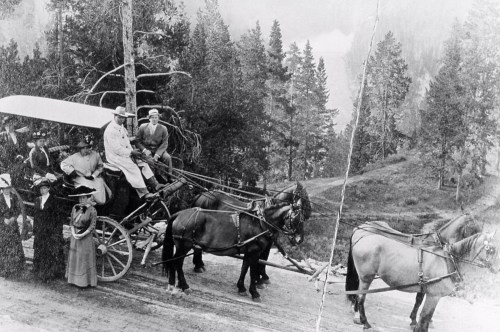
    A Wylie Way Coach, 1908.

    What was probably the greatest stagecoach robbery of the Twentieth Century in terms of people (174)  and coaches (17) occurred in Yellowstone Park on August 24, 1908, but the bandit grossed only about $2,000 in cash and jewelry.  The holdup man was never caught. A similar robbery of 14 coaches occurred on July 29, 1914, but the holdup man was caught.  Here’s how the park superintendent described the events of 1908.

    ∞§∞

    The unfortunate event, the hold-up of seventeen coaches, surreys, and spring wagons on August 24, and the robbery by one man or many of the passengers therein at a point on the main road between Old Faithful Inn and the Thumb of Lake Yellowstone, and about 4 1/4 miles distant from the former, took place about 9 a. m. on August 24.

    In accordance with the established time schedule, the first coach of Yellowstone Park Transportation Company loads at Old Faithful Inn at 7.30 o’clock in the morning; after all coaches of that company have been loaded, the Monida and Yellowstone Company coaches are loaded at same point and follow after. These are followed in turn by the coaches of the Wylie Permanent Camping Company—all on the road eastward toward the Thumb.

    This was the order of travel on morning of August 24. As a precaution against dust and against accident on grades, drivers are instructed to maintain a distance of approximately 100 yards between coaches. On the morning in question eight vehicles were not molested by the robber. It appears that the trooper on patrol passed the point where the robbery took place ahead of the first coaches. The interval between the eighth and ninth coaches in order of travel was rather extended, with an angle of the road intervening in a narrow defile, thickly wooded on either side. The ninth vehicle was stopped by the robber with repeating rifle at a ” ready; ” and in vulgar, blasphemous language he ordered a young man down from the box seat and made him carry a sack alongside the coach—into which passengers were commanded to deposit their money and jewelry. This was repeated with each of the sixteen vehicles following. No one received physical injury excepting one passenger, whose actions did not suit the robber and who was disciplined by a stroke on the head with the gun, which was discharged at the same time. The injury was not reported serious. Four of the looted coaches belonged to the Yellowstone Park Transportation Company, five to the Monida and Yellowstone Stage Company, and eight to the Wylie Permanent Camping Company. As near as can be learned by the separate memoranda handed in by the passengers the losses sustained by them in the robbery aggregated $1,363.95 cash and $730.25 in watches and jewelry. Upon being liberated the first coach of those robbed drove rapidly to the camp of the road sprinkling crew, located about 2 miles east of the hold-up point, where notice was given and a messenger dispatched to Old Faithful Inn—distant 6 miles—with news of the robbery.

    The agent of the Yellowstone Park Transportation Company at the inn telegraphed the news to all stations in the park and notified the detail of soldiers stationed at Upper Geyser Basin, within a few hundred yards of the inn. He also states that he notified the officer in command of a troop of cavalry camped in the Lower Basin, about 9 miles distant by the old road. Telegraphic notice was received at Mammoth Hot Springs Hotel and immediately transmitted to my office by telephone. The message was repeated to Major Allen, who was up in the park, and he was requested to give the matter his personal attention. All guard stations were warned and instructed and two scouts present at Mammoth were dispatched to the scene. They made the ride (49 miles) in four hours. Major Allen, who was in the park with General Edgerly, came into Mammoth the same evening, and on the following morning reported that he had given the necessary orders to his troops by telephone and telegraph from Norris. The robber was on foot, and disposed of a few pocketbooks and purses near the scene of the robbery, where they were found in a clump of bushes. One of these contained valuable papers and all were returned to their respective owners.

    The trail could only be followed a short distance. The robber had apparently taken off his shoes and passed into a densely wooded region. All United States marshals, sheriffs, and peace officers in surrounding States, counties, and towns were duly notified and given description of the robber, as nearly as could be ascertained from tourists and drivers in the hold-up.

    All passengers in their excitement blamed the soldiers. The character of the country is such that the entire Army of the United States could not prevent an evil-disposed man from entering the park with a gun.

    On the date of the hold-up one troop was on practice march in the park and was camped within 10 or 12 miles from Old Faithful Inn. One troop has been camped in Lower Geyser Basin all the season and one troop has been camped on Yellowstone River within a mile of Lake Hotel all the season.

    So far it has been impossible to locate an escaped criminal who was convicted of poaching in the park and escaped from confinement in the military prison at Fort Yellowstone in October last. There seems to be a well-grounded suspicion that he is the perpetrator of this daring highway robbery. It is a slow and difficult task to conduct a systematic search for this criminal, without funds for expenses, by correspondence alone. The detectives in adjacent States, with whom I have corresponded since the robbery, work for a per diem and expenses and not for rewards offered, and although they have been informed that this office has no money for that purpose, they have never hesitated to give any information in their possession in regard to this particular matter.

    ∞§∞

    — Report of the Superintendent of Yellowstone National Park. Department of Interior, Yellowstone Park, Wyoming, October 15, 1908.

    — Photo, Yellowstone Digital Slide File.

    — You might also enjoy.

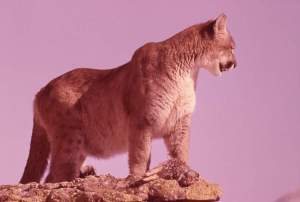
  • A Tale: Hunting a Yellowstone Lion

    The story below was included as an example of student writing in a 1914 composition textbook for college freshmen. The textbook authors didn’t give the student’s name or the year the piece was written, but apparently it was after the army took over administration of Yellowstone in 1886.

     The Secretary of Interior promulgated a regulation in 1883 that prohibited hunting in Yellowstone Park, but that was generally interpreted as not applying to predators. In fact the general policy toward predators—cayotes, wolves, bears, wolverines, and mountain lions—was “shoot on sight.” Predators weren’t protected in the park until the 1930s.

    The textbook authors praise this account as an “ambitious and  effective narrative theme.”  I agree.

    ∞§∞

    “Whoa there! Back into the road, you black brute! What are you shyin’ at?” yelled the driver of a sightseeing coach in the Yellowstone.

    He glanced across the bridge and immediately learned the reason for the strange behavior of one of his leaders. There, in a leather-wood thicket, crouched the long, lithe form of a mountain lion. Its wicked yellow eyes challenged his right to the passage, and its long slender tail writhed among the bushes. The driver pulled up his horses, uncertain of the lion’s intentions; but the great cat, finding himself unmolested, slipped through the bushes and disappeared among the jagged rocks on the mountain slope.

    As the coach was discharging its passengers at the next stopping place, the driver yelled to a camp boy, “Go over and tell the guards I saw that big lion they’ve been looking for, down by the last bridge. Tell ’em they’d better hurry before he leaves the country.”

    The boy lost no time; and soon two of the soldiers were at the bridge, carefully examining the tracks of the great beast from the impressions in the loose dirt. They quickly learned that this lion was the very one with which they had been having a great deal of trouble, the one which had invaded camps during the night, and had terrified tourists with his long-drawn, almost human wail from the forests.

    Clambering over the great grey rocks, and sliding in the loose gravel of the slope, the two soldiers made their way slowly up the mountain side. When they reached the first promontory they stopped to rest and look about them. Far to the left and a mile below them, still shrouded by the evening mists yet tinted now by the morning sun, lay the magnificent and awe-inspiring Yellowstone Gorge. They gazed at the green thread winding along the floor of the great chasm and tried to hear what they knew to be the roar of its rushing waters.

    “It’s a great sight, Judd! We don’t realize it, bein’ here all the time. But come on. Let’s hit the trail again.”

    “Wait a second.” replied the other. “Help me tighten this bandage on my hand. It’s come loose.”

    The men, intent upon the loosened bandage, failed to see that, from the edge of an overhanging rock above them, two pale green eyes were watching their every move. Behind the eyes, the sinewy form of a great cat was stealthily adjusting itself for a leap.

    Having tightened the bandage, the men straightened up and at the same time stepped back a pace. Their feet, imbedded in the loose gravel, began to slide, and together the two soldiers rolled back under the overhanging rock. At the same instant a great tawny streak flashed over their heads, and the huge form of the mountain lion crashed into the rocks at the very place upon which they had been standing.

    They jumped to their feet and, with startled eyes, watched the great ball of yellow fur as it bumped and rolled down the steep incline. The lion tore madly at the rocks and bushes as he fell, but tried in vain to secure a footing in the sliding gravel. A hundred feet below, he stopped with a thud against a fallen tree trunk; but before he could move, two bullets crunched their way through his body, and, with a gasp, he straightened out, dead.

    ∞§∞

    Anonymous, “A Yellowstone Lion,” pages 561-562 in Frances Berkeley Young and Karl Young, Freshman English: A Manual. New York: Henry Holt and Company, 1914. Pages 561-562.

    — Coppermine Gallery Photo.

  • A Tale: Teddy Roosevelt Bags an Elk on Two Ocean Pass — 1891

    There was no greater supporter of Yellowstone National Park than Theodore Roosevelt. TR was an avid hunter, but he favored prohibition of hunting inside Yellowstone National Park. The idea was that keeping hunters out would make the Park an endless well of trophy animals that could be hunted when they strayed outside its boundaries.

    And Roosevelt knew that areas near the park provided marvelous hunting. Here’s his description of one of his kills while on a hunting expedition in 1891 to the Two Ocean Pass, an area just outside Yellowstone’s southern border.

    ∞§∞

    The weather became clear and very cold, so that the snow made the frosty mountains gleam like silver. The moon was full, and in the flood of light the wild scenery round our camp was very beautiful. As always where we camped for several days, we had fixed long tables and settles, and were most comfortable; and when we came in at nightfall, or sometimes long afterward, cold, tired, and hungry, it was sheer physical delight to get warm before the roaring fire of pitchy stumps, and then to feast ravenously on bread and beans, on stewed or roasted elk venison, on grouse and sometimes trout, and flapjacks with maple syrup.

    Next morning dawned clear and cold, the sky a glorious blue. Woody and I started to hunt over the great tableland, and led our stout horses up the mountainside, by elk trails so bad that they had to climb like goats. All these elk-trails have one striking peculiarity. They lead through thick timber, but every now and then send off short, well-worn branches to some cliff-edge or jutting crag, commanding a view far and wide over the country beneath. Elk love to stand on these lookout points, and scan the valleys and mountains round about.

    Blue grouse rose from beside our path; Clarke’s crows flew past us, with a hollow, flapping sound, or lit in the pine-tops, calling and flirting their tails; the gray-clad whiskyjacks, with multitudinous cries, hopped and fluttered near us. Snow-shoe rabbits scuttled away, the big furry feet which give them their name already turning white. At last we came out on the great plateau, seamed with deep, narrow ravines. Reaches of pasture alternated with groves and open forests of varying size.

    Almost immediately we heard the bugle of a bull elk, and saw a big band of cows and calves on the other side of a valley. There were three bulls with them, one very large, and we tried to creep up on them; but the wind was baffling and spoiled our stalk. So we returned to our horses, mounted them, and rode a mile farther, toward a large open wood on a hill-side. When within two hundred yards we heard directly ahead the bugle of a bull, and pulled up short.

    In a moment I saw him walking through an open glade; he had not seen us. The slight breeze brought us down his scent. Elk have a strong characteristic smell; it is usually sweet, like that of a herd of Alderney cows; but in old bulls, while rutting, it is rank, pungent, and lasting. We stood motionless till the bull was out of sight, then stole to the wood, tied our horses, and trotted after him. He was travelling fast, occasionally calling; whereupon others in the neighborhood would answer. Evidently he had been driven out of some herd by the master bull.

    He went faster than we did, and while we were vainly trying to overtake him we heard another very loud and sonorous challenge to our left. It came from a ridge-crest at the edge of the woods, among some scattered clumps of the northern nut-pine or pinyon—a queer conifer, growing very high on the mountains, its multi-forked trunk and wide-spreading branches giving it the rounded top, and, at a distance, the general look of an oak rather than a pine.

    We at once walked toward the ridge, up-wind. In a minute or two, to our chagrin, we stumbled on an outlying spike bull, evidently kept on the outskirts of the herd by the master bull. I thought he would alarm all the rest; but, as we stood motionless, he could not see clearly what we were. He stood, ran, stood again, gazed at us, and trotted slowly off.

    We hurried forward as fast as we dared, and with too little care; for we suddenly came in view of two cows. As they raised their heads to look, Woody squatted down where he was, to keep their attention fixed, while I cautiously tried to slip off to one side unobserved. Favored by the neutral tint of my buckskin hunting-shirt, with which my shoes, leggins, and soft hat matched, I succeeded. As soon as I was out of sight I ran hard and came up to a hillock crested with pinyons, behind which I judged I should find the herd.

    As I approached the crest, their strong, sweet smell smote my nostrils. In another moment I saw the tips of a pair of mighty antlers, and I peered over the crest with my rifle at the ready. Thirty yards off, behind a clump of pinyons, stood a huge bull, his head thrown back as he rubbed his shoulders with his horns. There were several cows around him, and one saw me immediately, and took alarm. I fired into the bull’s shoulder, inflicting a mortal wound; but he went off, and I raced after him at top speed, firing twice into his flank; then he stopped, very sick, and I broke his neck with a fourth bullet.

    The elk I thus slew was a giant. His body was the size of a steer’s, and his antlers, though not unusually long, were very massive and heavy. He lay in a glade, on the edge of a great cliff. Standing on its brink we overlooked a most beautiful country, the home of all homes for the elk: a wilderness of mountains, the immense evergreen forest broken by park and glade, by meadow and pasture, by bare hill-side and barren tableland.

    ∞§∞

    — Excerpt from Theodore Roosevelt “An Elk Hunt at Two Ocean Pass.”  Pages  177-202 in The Wilderness Hunter: An Account of Big Game in the United States.  Putnam’s Sons: New York, 1902.

    — Photo from The Wilderness Hunter.

    — For other stories about tracking game, click on “Hunting” under the Categories button to the left.