Month: May 2012

  • A Tale: A Bear Fight in the Yellowstone Park — 1903

    By the dawn of the Twentieth Century, watching the antics of bears at hotel garbage dumps became one of the most popular activities in Yellowstone Park.  Here’s a colorful description.

    ∞§∞

    The transportation company’s stages had emptied their loads of dust covered sightseers at the open doors of the Fountain House, and the ink on the register was not yet dry wherewith the newcomers had written their names, when the Fountain geyser began to grumble, hiss and send up clouds of steam, promising an early eruption. Following suit, all the finger holes and cracks in the formation, the hot springs and the baby geysers shot out jets of steam. The Mammoth Paint Pot began to plop, plop, plop! And throw up gobs of pink, white and yellow mud into the air from its bowl full of scalding clay. All this hubbub was a vain attempt to attract the tourist attention.

    The Dante’s Inferno in front of the hotel might have saved its steam and sulpher for another occasion, as it was unnoticed by the guests. The new arrivals were following the layovers in a stampede for the garbage heap on the white geyserite formation back of the house. Suddenly the crowd came to a halt.

    “Gee!” exclaimed a small boy, as he pushed the button on his Kodak.

    “Waught! Waugh! Shouted the pilgrims from Medicine Hat and Rat Portage.

    “Hey! May be rubberneck, what?” laughed the man from Moose Jaw.

    ‘Say! She’s a tough proposition, an’ she wears the straps all right,” cried the guide; while the doctor from Chicago, the broker from New York, the office holder from Ohio, the colonel from Kentucky and the dude from Honolulu all clapped their hands with delight.

    Having dumped its load of table leavings and tin cans the hotel garbage wagon was rumbling back over the formation to the stables, but it was not the wagon, team, driver or load of food scraps which called forth the applause and exclamations of pleasure from the guests of the Fountain House; it was nine great black bears that interested us.

    To the delight of the spectators, the bears had given a short exhibition of their skills as boxers. It was a hot fight; but it did not last long. In fact, it was a mistake in the first place; an impromptu affair not down on the menu. This is the way it happened.

    A long legged cinnamon bear snatched the remains of some ribs of beef from under the nose of a big mother black bear at the moment she was calling her two little cubs to partake of the roast. A benevolent looking bruin, with a glossy black coat covering rotund body, was busily engaged in pawing over the garbage near by, when the indignant mother lifted her paw for a swinging blow, missed the culprit and landed with a resounding swat on the jowl of her benevolent appearing neighbor.

    “Ough-oo-oo-ee-ee-eah!” cried Fatty, in a rage, as he rose on his hind legs and let go at the solar plexus of Old Spot. He had gained his name by breaking through the crust near the Paint Pot and covered on black wide with white mud. Spot’s temper had be none of the best since that day, and in less time than it takes to tell it, he let fly with his left and right at his nearest neighbor, and it became a free-for-all fight accompanied by a continued ought-oo-eahing in various keys.

    During the melee the cinnamon bear who caused the riot was quietly eating the remains of the roast beef, gnawing the bones within 10 feet of the gallant Kentucky colonel, to the latter’s great amusement.

    Although nearly all the men present had cameras, only women and children took advantage of the sunlight and clear sky to photograph the scrapping bears. The sport-loving men stood around in a semicircle, with pleased grins on their faces, too much engaged in applauding the hairy gladiators to waste a thought on the black boxes under their arms.

    Scarcely had the women and children time to wind up their films when the brown bear, elated over his former success, made another attempt to slip up unobserved to the garbage pile. To the casual onlooker it would appear that the black bears were all too busy seeking their own dinner to heed the brown’s approach; but a close observer could not fail to notice that the beadlike eyes of the blacks were keenly alert. No sooner did Brownie come within reach than biff! biff! biff! came the great black paws on his unprotected head.

    An elderly spinster, who seemed deeply interested in the zoological show, stood within 15 feet of the feeding brutes and directly in front of the cinnamon bear, when, with open mouth, it made a dash for safety. With a quick movement the frightened spinster gathered up her skirts, there was a flash of white petticoats, a twinkling of feet, and she was gone, never once looking back until she slammed the hotel door behind her.

    The astonishingly rapid gait at which the terror stricken lady made her 100-yard dash called forth the wildest enthusiasm from the spectators, and the colonel pushed the button of his pocket camera three times without once winding up the film.

    Of course, the brown bear turned aside into the woods the moment he was out of reach of the powerful blows of his relatives, but it was of no use telling that to the spinster. She will always believe that the brute followed her to the hotel door.

    ∞§∞

    — Text and image from Dan Beard, “A Bear Fight in the Yellowstone Park,” Recreation 18(2):85-87 (February 1903).

    — You might also enjoy:

    — You can read Ernest Thompson Seton’s “Johnny Bear” in my book, Adventures in Yellowstone…Early Travelers Tell Their Tales.

    — To find more stories about bears, click on “Bears” under the “Categories” button to the left.

  • A Tale: TR Seeks the Thrill of Killing Endangered Bison — 1889

    American bison once numbered 30 million or more, but by the middle of the 1880’s commercial hunters had decimated the herds that once darkened the prairies. But the fact that bison were nearing extinction didn’t deter sportsmen from pursuing the thrill of killing one of the magnificent animals.

    Even Theodore Roosevelt, who is renowned for his role in the American conservation movement and environment preservation, could not resist the temptation of bison hunting. Here’s how he described the experience.

    ∞§∞

    In the fall of 1889 I heard that a very few bison were still left around the head of Wisdom River. Thither I went and hunted faithfully; there was plenty of game of other kind, but of bison not a trace did we see. Nevertheless a few days later that same year I came across these great wild cattle at a time when I had no idea of seeing them.

    We had gone out to find moose, but had seen no sign of them, and had then begun to climb over the higher peaks with an idea of getting sheep. The old hunter who was with me was, very fortunately, suffering from rheumatism, and he therefore carried a long staff instead of his rifle; I say fortunately, for if he had carried his rifle it would have been impossible to stop his firing at such game as bison, nor would he have spared the cows and calves.

    About the middle of the afternoon we crossed a low, rocky ridge, above timber line, and saw at our feet a basin or round valley of singular beauty. The ground rose in a pass evidently much frequented by game in bygone days, their trails lying along it in thick zigzags, each gradually fading out after a few hundred yards, and then starting again in a little different place, as game trails so often seem to do.

    We bent our steps toward these trails, and no sooner had we reached the first than the old hunter bent over it with a sharp exclamation of wonder. There in the dust were the unmistakable hoof-marks of a small band of bison, apparently but a few hours old. There had been half a dozen animals in the party; one a big bull, and two calves.

    We immediately turned and followed the trail. It led down to the little lake, where the beasts had spread and grazed on the tender, green blades, and had drunk their fill. The footprints then came together again, showing where the animals had gathered and walked off in single file to the forest

    It was a very still day, and there were nearly three hours of daylight left. Without a word my silent companion, who had been scanning the whole country with hawk-eyed eagerness, besides scrutinizing the sign on his hands and knees, took the trail, motioning me to follow. In a moment we entered the woods, breathing a sigh of relief as we did so; for while in the meadow we could never tell that the buffalo might not see us, if they happened to be lying in some place with a commanding lookout.

    The old hunter was thoroughly roused, and he showed himself a very skilful tracker. We were much favored by the character of the forest, which was rather open, and in most places free from undergrowth and down timber. The ground was covered with pine needles and soft moss, so that it was not difficult to walk noiselessly. Once or twice when I trod on a small dry twig, or let the nails in my shoes clink slightly against a stone, the hunter turned to me with a frown of angry impatience; but as he walked slowly, continually halting to look ahead, as well as stooping over to examine the trail, I did not find it very difficult to move silently.

    At last,  we saw a movement among the young trees not fifty yards away. Peering through the safe shelter yielded by some thick evergreen bushes, we speedily made out three bison, a cow, a calf, and a yearling. Soon another cow and calf stepped out after them. I did not wish to shoot, waiting for the appearance of the big bull which I knew was accompanying them.

    So for several minutes I watched the great, clumsy, shaggy beasts, as all unconscious they grazed in the open glade. Mixed with the eager excitement of the hunter was a certain half melancholy feeling as I gazed on these bison, themselves part of the last remnant of a doomed and nearly vanished race. Few, indeed, are the men who now have, or ever more shall have, the chance of seeing the mightiest of American beasts, in all his wild vigor, surrounded by the tremendous desolation of his far-off mountain home.

    At last, when I had begun to grow very anxious lest the others should take alarm, the bull likewise appeared on the edge of the glade, and stood with outstretched head, scratching his throat against a young tree, which shook violently. I aimed low, behind his shoulder, and pulled trigger. At the crack of the rifle all the bison, without the momentary halt of terror-struck surprise so common among game, turned and raced off at headlong speed.

    The fringe of young pines beyond and below the glade cracked and swayed as if a whirlwind were passing, and in another moment they reached the top of a very steep incline, thickly strewn with boulders and dead timber. Down this they plunged with reckless speed; their surefootedness was a marvel in such seemingly unwieldy beasts. A column of dust obscured their passage, and under its cover they disappeared in the forest; but the trail of the bull was marked by splashes of frothy blood, and we followed it at a trot.

    Fifty yards beyond the border of the forest we found the stark black body stretched motionless. He was a splendid old bull, still in his full vigor, with large, sharp horns, and heavy mane and glossy coat; and I felt the most exulting pride as I handled and examined him; for I had procured a trophy such as can fall henceforth to few hunters indeed.

    ∞§∞

    — Abridged from Theodore Roosevelt. “The Bison or American Buffalo,” pages 3-36 in Hunting the Grisly and Other Sketchs. New York: The Review of Reviews Company, 1915.

    — Photo from Wikipedia Commons.

    — For more stories about hunting in or near Yellowstone Park, click on “hunting” under “Categories” to the left.

  • An Event: Ready To Present at the Jefferson County Museum.

    I love Montana’s many small museums because the do such a good job of preserving history and promoting community spirit. I’m looking forward to presenting “Sidesaddles and Geysers” Saturday, May 19, at the Jefferson County Museum in Clancy.  I’ve been there before and I plan to arrive early so I can see the wonderful exhibits.

    I’ll begin my presentation, which is supported by Humanities Montana, with stories my grandmother used to tell me about her trip to Yellowstone Park in 1909.  I built a “stone soup story” around that trip for my presentation at the Sheridan, MT, Public Library a couple of weeks ago.  You can read about that here.

    Then I’ll tell stories about the first women to visit Yellowstone Park. These brave ladies literally rode sidesaddle through the then roadless wilderness in the 1870’s. One of the most chilling stories is Emma Cowan’s tale of being captured by Indians in the Park.  Emma and her family went there in the summer of 1877, the year the Nez Perce fled the homeland in hopes of finding freedom in Canada.

    Emma wrote a gripping account of watching Indians shoot her husband, George, in the head, and, leaving him for dead, and then taking her and her sister and brother captive. After the Nez Perce release the trio, Emma made her way home where she awaited word of her husband’s fate. Word finally arrived that George was alive, but Emma didn’t know if the army would send him to Virginia City or Bozeman, so she waited near the telegraph office in Helena to find out. As soon Emma heard that George was being taken to Bozeman, she rented a wagon and set out to meet him.

    For my presentation in Clancy, I’ll read the account I wrote about Emma’s epic ride to be by George’s side for my upcoming book, Encounters in Yellowstone. Emma traveled 175 miles over rough roads in 31 hours, a trip that generally took four days.

    Then I’ll slow the pace with a different kind of adventure: Eleanor Corthell’s account of her 1903 trip to Yellowstone Park. By then roads were good and there was no danger from Indians, but Eleanor still had plenty to deal with while she watched her seven children frolic near geysers and drove bears from her camp.

    I’ll end the presentation with a bit of humor, Louise Elliott’s story of how a camp assistant for a tour company gets even with a supercilious guest who has been making her life miserable.

    ∞§∞

    — Photo from the Jefferson County Museum Web Site.

  • A Tale: A Narrow Escape from the Nez Perce — Ben Stone, 1877

    McCartney’s “Hotel” at Mammoth Hot Springs

    Ben Stone was an African American hired to cook for a group of men from Helena who toured Yellowstone in August 1877, the year the Nez Perce passed through there. The Helena Party fought a couple of gun battles with Nez Perce scouts. Leaving the body of one of their companions behind, several members party made their way to Mammoth Hot Springs where there was an incipient resort.

    When two young men failed to show up at Mammoth, two others went to search for them, leaving Stone, a music teacher named Dietrich, and a wounded man named Stewart to wait for a ride. Here’s how Stone described what happened then.

    ∞§∞

    No more of our party, having shown up in the three days after arriving at the Springs, we were alarmed about them, and Andy Weikert concluded to go and see if he could find anything of them. James McCartney, proprietor of the Mammoth Hot Springs, kindly volunteered to go with him.

    The next day after they left an ambulance arrived to take Stewart, Dietrich, and myself to Bozeman. The boys with the ambulance begged Dietrich to go with them, but he said, with tears in his eyes, “My God! What will Mrs. Roberts say if I go and leave Joe?” Through my inducement he came. “What shall I say when I meet his mother, when she asks me where Joe is?”

    Dietrich and I concluded to remain until we heard from Weikert and McCartney. If Joe or any of the rest of the party were brought in, we wished to be there to care for them, in case they were wounded. One of the party, with the ambulance (Jake Stoner), remained with us.

    Dietrich and Stoner went down to Gardiner’s River fishing, not returning until three in the afternoon, leaving me to keep house alone at the Springs. After they returned, I cooked dinner and, after eating, Dietrich and I concluded to go up and take a bath. Stoner said he would go along to look at the Springs, and took his gun with him, as he said, “To knock over a grouse, as grub was getting scarce.”

    After taking our bath and drinking some of the water out of the Hot Springs, we went back to the house.

    Dietrich said: “I’ll go down and water and stake the mare for the night.

    “All right,” I answered, “and while you’re gone, I’ll keep house.

    Taking a seat in the doorway, I felt uneasy. On glancing towards the Springs, I saw Jake Stoner running to the house. I smilingly asked him if he had caught any grouse.

    He said: “No, but I’ve caught something else.”

    I inquired of him what he had caught, when he said that, while up on top of the Springs, he had caught sight of a large party coming this way.

    I replied: “You did! That must be white men. How many did you see?”

    “I saw two parties, with about ten persons in each nearly forty yards apart, and traveling very slowly.”

    I said: “They must be white men. Andy and McCartney have found the boys, and are bringing them in. Of course, they are wounded, and have to travel slowly. I’ll go in the house, make a fire, and have grub ready for the boys by the time they get here.

    “No,” said Jake: “don’t do that. We had better cache ourselves in the timber until we know whether they are white men or not.”

    I replied: “That’s a good idea—we’ll do that.”

    He then asked for Dietrich, saying, “I’ll warn him, so he can take to timber too.”

    I told him where Dietrich was, and he went down the flat towards him. I started up the gulch to cache myself. After advancing twenty-five or thirty yards, I took to the timber on my right, and went up in it to a point of rocks overlooking the house, and where I could see both trails approaching the house. After waiting there fifteen or twenty minutes, and the parties not coming, I began to think the boys were a long time coming. Looked out, but could not see anything.

    Sat down and waited ten minutes—nothing in sight. I exposed myself in trying to find out if the parties were coming. When I got to where I could see, I descried an object in the distance, in what appeared to be a long white blanket. He dodged around out of sight, as if intending to go behind the Springs. Another appeared closer to me, in what also appeared to be a blanket. He dodged around in the same manner as the former one.

    Another soon appeared. I had no doubt that he was an Indian, and I said to myself: “Mr. Stone, it’s about time you were traveling!” I “lit out” for timber about one hundred yards up the gulch. While I was waiting to see who were coming, the Indians had worked around and got into the gulch I had to go up, and get to the timber. I had to go within five or six yards of them through the brush. Moving as fast and cautiously as I could, I accidentally stepped on a piece of dead brush, which broke with a loud crash. Some of the Indians heard and one made for me. I then moved very fast, for I knew I had to work for my life, if I did not get to timber soon, I was a dead man.

    In a few moments, I found that the Indian would cut me off, as from the crash of breaking twigs I knew he was close to me. I thought I was a dead man, sure, and said: “My God! What shall I do!” Just then, I chanced to run under a tree, with low branches. I took hold of the branches and hoisted myself in, without any expectation of saving my life. I had no more than got into the tree, before an Indian on horseback dashed under it, gazing in every direction for me, and seeming surprised at not seeing the object that made the noise.

    After going about ten yards, he stopped his horse, raised his gun up on his arm, and listened for an instant. He then went through an opening out of sight.

    I now considered myself perfectly safe, but remained in the tree about two hours.

    While in the tree I heard several shots at the house, and saw they had made fires there. Suppose they had burned the buildings.

    ∞§∞

    After the Indians left, Stone decided to make for a ranch north of the Park.  On the way, he met a group of soldiers who were pursuing the Indians. Later he learned that the Indians had killed Dietrich and other members of the party were safe.

    ∞§∞

    —  Abridged from “Two Narrow Escapes from the Clutches of the Red Devils in 1877: His Own Story Told by Benjamin Stone.” The Avant Courier, Bozeman, September 6, 1877.

    — Photo from the Yellowstone Digital Slide File.

  • A Tale: A Yellowstone Tour Proves the Value of Bicycles — 1896

    At the end of the Nineteenth Century, the bicycle was being touted as a great innovation in transportation. An army tour of Yellowstone Park was the ultimate test of their versatility and durability.
    ∞§∞

    Fort Missoula, Mont.

    Oct. 15, 1896.

    Messrs A G. SPALDINC & BROS.

    Gentlemen:

    In testing the practicability of the bicycle for military purposes in a mountainous country, the Twenty-fifth U.S. Infantry Bicycle Corps, consisting of eight soldiers commanded by myself, has used Spalding Bicycles exclusively. In making our experiments we have ridden about 1,400 miles, the greater part being over some of the worst roads in the United States. On our 800-mile trip to Yellowstone Park, the Main Divide over the Rocky Mountains was crossed twice, the first time over “The Summit, near the Mullan Tunnel, and the second time over the old Mullan Stage Line, now little more than a mere trail, and without doubt one of the worst roads in this country.

    As it was our object to thoroughly test the matter under all possible conditions we made and broke camp in the rain; we traveled through mud, water, sand, dust, over rocks, ruts, etc.; we crossed and re-crossed mountain ranges and forded streams, carrying our rations, rifles, ammunition, tents, blankets, extra underwear, medicine, tools, repairing material, cooking utensils and extra bicycle parts. The heaviest bicycle, packed, weighed 86 lbs., and the rider 186 lbs.; total. 272 lbs. The lightest bicycle, packed, weighed 67 lbs., and the rider 135 lbs.; total, 202 lbs. The average weight of the bicycles, packed, was 79.7 lbs.*, the riders, 157.4 lbs.; the bicycles and riders, 237.1 lbs.

    The test was of a most severe nature, and it affords me great pleasure to be able to state the bicycles stood the work extraordinarily well, and are without doubt very fine machines.

    Very truly yours,

    JAMES A. MOSS,

    Second Lieutenant Twenty-fifth U. S. Infantry, Commander Twenty-fifth V. S. Infantry Bicycle Corps.

    ∞§∞

    — This advertisment appeared in League of American Wheelmen Bulletin and Good Roads. January 29, 1897.   25(5):121.

    — Image from the U.S. Library of Congress.

    — You might also enjoy:

  • An Event: Ready To Tell “Smart Women” About The Nez Perce In Yellowstone

    The big event on my schedule this week is my presentation, “The Nez Perce in Yellowstone,” to Smart Women on Wednesday at 3 p.m. at Aspen Point, an assisted living facility in Bozeman. I’m still working on my slides and script, but it’s taking shape in my mind.

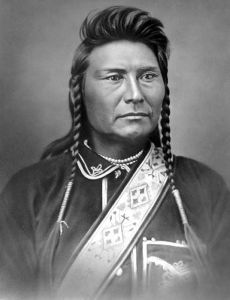
    Chief Joseph

    I’ll begin with an overview of the flight of the Nez Perce who generally lived peacefully with whites for most of the 1800’s. After gold was discovered on Nez Perce land in 1853, settlers began moving in and in 1877 the Indians were ordered onto a tiny reservation. Rather than comply with the order, they decided to flee to the buffalo country on the plains. Most accounts of the flight of the Nez Perce emphasize things that happened outside of Yellowstone Park like broken treaties and battles, but I’ll reverse that pattern and focus in the human drama of the Indians’ encounters with tourists.

    Then I’ll talk about what I call “The Joseph Myth,” the common belief that Chief Joseph was a great general whose genius allowed him to outmaneuver the U.S. Army for months. Joseph was the chief of one of the five bands that led the army on its merry chase, but he was never the principal chief. I’ll speculate on reasons the Joseph Myth was born and why it persistes: (1) Joseph was an important chief who had a conspicuous role in negotiations with whites before the Nez Perce decided to leave and he was the last remaining chief at the Battle of Beartooth so he negotiated the surrender. These things made him the apparent leader. (2) The Army Officers needed a genius opponent, otherwise they would look like fools for letting a band of Indians that included old men, women and children—and 1,600 hundred horses and cow—elude them for months, (3)After the conflict Indian sympathizers needed an Indian hero who sought peace to bolster their case, and (4) Joseph was indeed a noble man who devoted his life to obtaining justice for his people. All true, but he wasn’t a military genius.

    I’ll talk about the Radersburg Party’s trip to the park and read Emma Cowan’s description of her being taken captive by the Nez Perce, which ended with her watching an Indian shoot her husband in the head.

    To slow things down, I’ll talk about “Skedaddlers,” tourists who visited the park in the summer of 1877, but left before the Indians arrived. These include: the famous Civil War General William Tecumseh Sherman; Bozeman Businessman Nelson Story; English Nobleman and park popularizer, The Earl of Dunraven and his companions, Buffalo Bill’s sometime partner, Texas Jack Omohundro, and Dunraven’s friend, George Henry Kingsley, a physician who patched up the Nez Perce’ victims at Mammoth Hot Springs.

    I’ll talk about the Helena Party’s trip and contrast the all-male group that entered the park from the north with the co-ed Radersburg Party that entered from the west. Then I’ll read Andrew Weikert’s description of his gun battle with the Nez Perce.

    Then I’ll describe how survivors of encounters with the Nez Perce were either rescued by soldiers looking for the Indians or made their way to Mammoth Hot Springs. I’ll explain that after Emma Cowan, her sister, and several wounded men left Mammoth for civilization, three men stayed there to see if their missing companions would appear. Then I’ll read Ben Stone’s description of the Indian attack at Mammoth that left another man dead.

    I’ll end with my synthesis of accounts of Emma Cowan’s overnight ride from Helena to Bottler’s Ranch in the Paradise Valley to join her husband who had survived three gunshot wounds and was rescued by the army. That will give me an opportunity to talk about Encounters in Yellowstone, a book I’m writing now.

    ∞§∞

    — The presentation is free and open to the public.  Please tell your friends.

    — You can read about my 2011 presentation to Smart Women.

    — Public Domain Photo.

  • A Tale: Early Hotels Offered Crude Accommodations — 1883

    In August of 1883 Yellowstone Park was overrun with parties of dignitaries including President Chester A. Arthur. Still, that’s when a 58-year-old school teacher, Margaret Cruikshank took new Northern Pacific train to Yellowstone. Miss Cruikshank said her guidebooks were far too lavish in praising the natural wonders of the Park, and she was quick to condemn the accommodations. Here’s her description of Marshall’s Hotel at the Lower Geyser Basin.

     ∞§∞

    Marshall’s Hotel

    We went on a rather monotonous day’s journey till the early afternoon brought us to the Forks of Firehole—Marshall’s.

    Marshall is a man who, having no park permit, has chosen to assume that he could keep such a house of entertainment, that the Yellowstone Park Company would be glad to let him stay.

    When only rough teamsters and hunters visited the Park I suppose he gave satisfaction. But now that crowds throng there and are of a more fastidious sort, Marshall won’t do. Marshall must go.

    The effective force here is only three—Marshall, his wife, and a Chinaman—and they are all overworked and all cross. Not being forethoughted and forehanded as to providing and not having very high standards. I cannot praise their results.

    We had a tolerably good supper, which I enjoyed. Part of the reason was that our party got in early and the over‑worked cook was not so rushed. We had fish nicely fried and quite tolerable coffee. I often found it difficult when things were at their worst at Marshall’s to force down enough food to sustain nature, such abominable messes were served up to us.

    Above the square part of the building was a great loft, and this was elegantly subdivided into cells by burlap partitions reaching rather more than half‑way up. Judging by their size I thought that there must have been more than a dozen of these little cubbyholes, dark and stifling! Into these most of us were stowed. Beyond beds, the less said about our accommodations the better. Many slept on the floor.

    Our room was in the southeast comer upstairs and had two beds in it, one at each end. Mrs. Gobeen was our roommate.

    It fell to my lot to sleep where the eaves came down over me like the crust over the blackbird in the pie. Mrs. Gobeen objected to having the window open. The bed was stuffed with sagebrush and had a horrid medicinal, quininey smell. And though the bedclothes may have been clean, I fancied that they had covered every teamster in the valley, beside being washed in that hot spring till the blankets were perfect felt. Moreover, with the sagacity usually exhibited by the lower classes in bed making, every double blanket had its fold up towards the head, so that if you were too warm you had to throw off both thicknesses—or neither.

    ∞§∞

    — Margaret Cruikshank’s journal is at the Yellowstone Research Center in Gardiner, Montana.

    — Photo from a  stereopticon view, Yellowstone Digital Slide File.

  • An Event: Northwest Montana Tour Was Great Fun

    The drive to northwest Montana last Tuesday was gorgeous. Fluffy white clouds sailed across a blue sky above snow capped mountains. Deep blue pine forests in the distance were covered with patches of snow that make them look like acid bleached denim. Rivers, full with spring rain and snow melt, ran aquamarine except where side streams poured in brown water.

    Eureka Historic Village store and church.

    After driving nearly 400 miles, I arrived in Troy in time to relax and have a sandwich before making my “Sidesaddles and Geysers” presentation to a small but lively audience for the public library. Then I drove 20 miles to Libby for the night.

    In the morning, I met Brian Sherry of WVRZ community radio and he took me to the community station’s makeshift studio where we chatted about early travel to Yellowstone Park and my work as an author. (I’ll see if I can post a link to the interview later.)

    Then I drove 70 miles through stunning mountain scenery to Eureka. In the afternoon, Scott Baney, a descendent of Tobacco Valley pioneers, guided me through the Eureka Historic Villiage—a collection of historic buildings including a store, chuch, school, and a hand-hewn cabin built by Scott’s ancestors. I had a great time reminiscing over the antique farm machinery with Scott.

    Eureka auther Darris Flanagan arrived and showed the inside of the buildings where the local historical society has created displays. My favorite was on logging, an activity that I don’t know well.

    In the evening, I presented “Sidesaddles and Geysers” to a lively audience at the Lincoln County High School Auditorium under the auspices of the Sunburst Foundation. Scott and Darris were in the audience.

    On Thursday, I decided to take the scenic route back to Bozeman. I traveled mostly on two-lane roads past Seeley and Swan Lakes.  I arrived home about 5 p.m. after driving nearly 900 miles in three days.  It was great fun.

    ∞§∞