Month: June 2015

  • Western Girls Don’t Need Chaperones — Alice Richards, 1898.

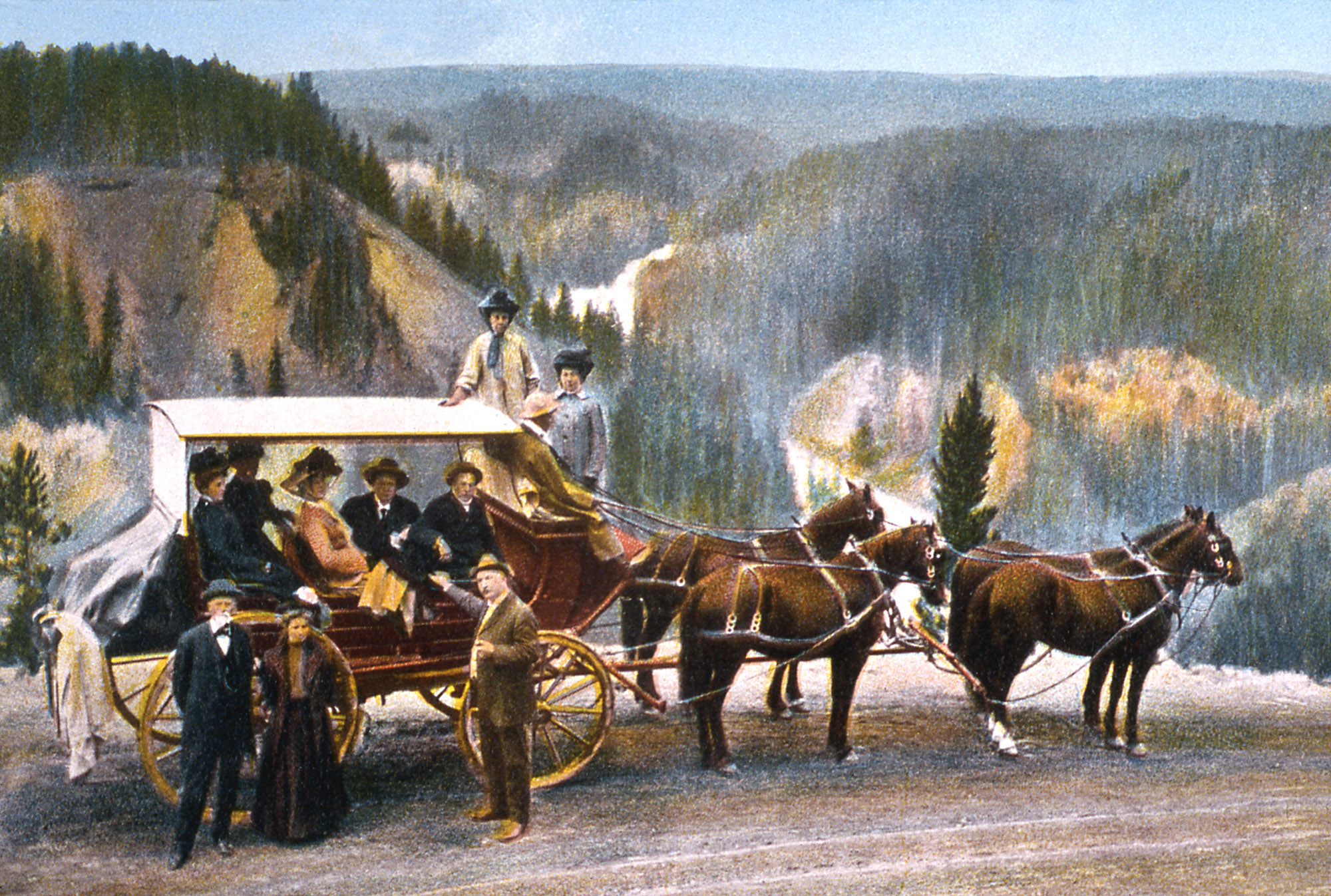
    Postcard of a stagecoach near the Upper Falls of the Yellowstone River; Frank J Haynes; No date
    Postcard of a stagecoach near the Upper Falls of the Yellowstone River.

    Alice Richards was the daughter of Wyoming’s first state governor, William A. Richards. In 1898, S.S. Huntley, General Manager of the Yellowstone National Park Transportation Company, invited her to tour the Park as his guest. Alice eagerly organized a party of three other young women, but she couldn’t find an older person to serve as chaperone. Undaunted, the party resolved to be on their best behavior and take the trip without an escort. Here’s Alice’s story.

    ∞§∞

    Mr. Huntley said that not enough people from Wyoming were visiting the park and if I would get up a party, he would provide transportation through the Park. I was greatly interested and began to talk about such a trip as soon as I reached home. I had expected to find it easy to get older friends to join me, but no one was interested though the expense at hotels we knew was not very high.

    When I was about to give up on the idea, my father said he wanted my sister Ruth and myself to go. He spoke to Jesse Knight, the Judge of the State Supreme Court, who said his daughter, Harriet, could go. She found that a university friend of hers, Harriet Fox, would like to make the trip—so the plans were made and we four left Cheyenne on July 30th, via the Cheyenne and Northern Railroad.

    We had a gay time on the trip because we were allowed the freedom of the train and rode on the engine, on the rear platform, and in the baggage car. I think Hattie Fox knew the engineer. We met several people whom we knew and had a generally good time — but we always remembered we were “ladies.” I was 21 and a half years old; the Hatties were a little younger and Ruth was 15.

    From Livingston, which is on the main line of the Northern Pacific Railroad, we took a branch, which runs 51 miles south to the town of Cinnabar, Montana. Here we were met by Park employees who took charge of us. “Tourists are conveyed in six-horse tally-ho coaches to the Mammoth Hot Springs Hotel, seven miles from Cinnabar

    The other tourists were “conveyed” by stagecoach, but the four of us were taken in charge by, put in the Park wagon with two seats behind the driver. Four schoolteachers from Brooklyn wanted a wagon also. They said: “We do not see why those giddy girls have a wagon when we can’t have one.” So, right there, easterners began to be critical of “those western girls.”

    Maybe here is the place to say that they finally changed their minds. Even the teachers said they wished eastern girls had the high spirits and courtesy of us giddy western girls. We were full of fun, but we were always polite and courteous to others and didn’t do anything out of the way. However, after we had been on the way a day or two, Mrs. Meyer from Red Lodge, Montana, suggested to me that some of us ride in their somewhat larger wagon while she or her husband rode with us.

    She said, “You do not need chaperones as you behave well, but those easterners do not understand our ways and will take away a better report if you seem to be of our party.” Being loyal westerners we agreed—I remember I was very glad for I did feel the responsibility of my party.

    At Cinnabar, we were approached by an emissary from Mr. Huntley who ushered us over to the Park wagon mentioned above. The baggage was out in with us and we started out with Mr. Murphy as driver to get our first view of Wonderland ahead. In a note to me, Mr. Huntley had said that he would try to find an honest driver for us, but quite soon Mr. Murphy began telling quite tall tales of the rather rough country through which we were passing.

    We didn’t “ah” and “oh” quite enough to suit him and pretty soon he turned to us and said, “ Just were are you girls from?” We tried to say we were tenderfeet—but it didn’t suit him. When he found that the Hatties were from the University of Wyoming, and Ruth and I from Cheyenne, he was quite abashed. “Why didn’t Mr. Huntley tell me I was driving western girls? I thought I was going to have some nice innocent girls from the east.”

    Later he said, “I was taking someone else’s place today but I am going to ask Mr. Huntley to let me take you all the way through the Park—even though I can’t tell my tall tales.” We assured him we would gladly listen and would be glad to have for all the trip—which we did and found him a very good driver and a kind friend.

    The first stop on the trip after leaving the railroad is the Mammoth Hot Springs—which fully lived up to their name. However, this is not a tale of the Park, but of four girls who managed their own trip—with the help of Park employees. The people were the greatest item of interest. There were many easterners, and others from many parts of the country.

    Everything went smoothly, we all behaved as well as if we had been chaperoned—perhaps better. The first few days the other tourists were inclined to be critical, but when they could find nothing to really criticize, they one and all decided that western girls were pretty nice people after all.

    ∞§∞

    • Compiled from the correspondence, notes and diary of Alice Richards McCreery. Originals are in the Wyoming Historical Society’s Richards locker in Cheyenne.
    • F.J. Haynes Postcard, Yellowstone Digital Slide File.
  • An Introduction to Yellowstonese.

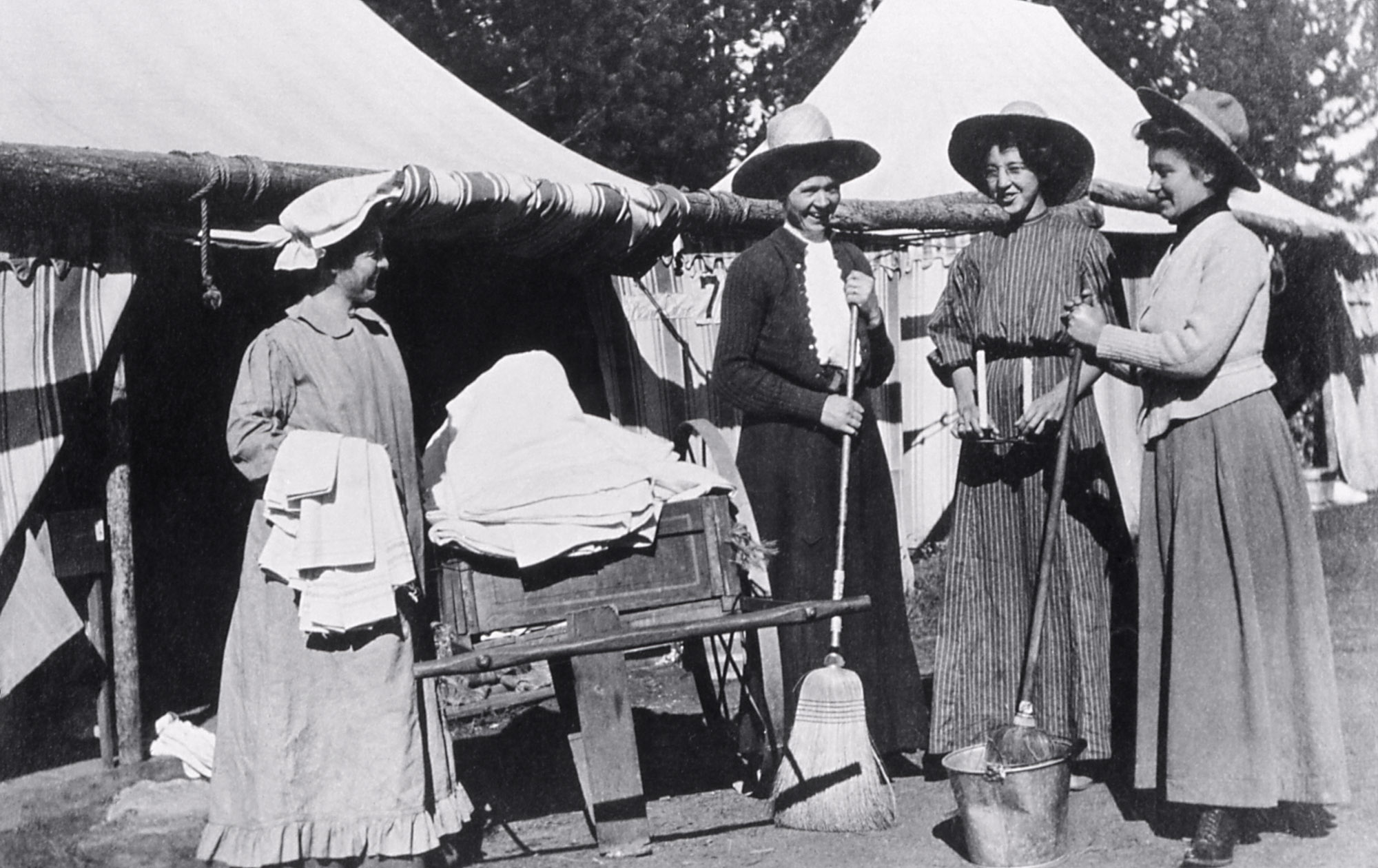
    Wylie camp maids with brooms; Photographer unknown; Around 1908
    “Bed Bugs” at a Wylie Way Camp Around 1908.

    As Yellowstone Park became a popular tourist destination, a colorful terminology emerged to label the people who worked and visited there. The excerpt below from a newspaper describes that terminology as it existed in 1922. But it misses earlier usage and some categories of people.

    The article says “savages” was the term used to label all the people working in the park, but that wasn’t always the case. In fact, savages were a very specific group of employees in the 1880s and 90s. The term applied exclusively to the drivers of the six-horse teams on Tallyhos, the huge stagecoaches that carried thirty or more passengers from the railroad station at the end of the line to the hotel at Mammoth Hot Springs.

    It took highly skilled teamsters to drive the giant coaches up the crooked, rocky and steep road. Men who could do the job were hired for their driving ability, not their civility. Apparently  such men often had crude manners and profane speech. That’s why they were called “savages.”

    In 1915 cars were allowed in the park and buses soon replaced the tallyhos. The buses had transmissions that were difficult to shift, so their drivers became known as “gear jammers,”—and everybody who worked in the park became known as “savages.

    The excerpt implies that all park visitors were called “dudes,” but that wasn’t true, even when the article was written. At that time “dude” referred exclusively to the guests of hotels and touring companies. People who provided their own transportation and shelter were called “sagebrushers” because they often had to pitch their tents in sagebrush flats when the park was crowded.

    The term “sagebrushes” survived even after the Park Service began providing free campgrounds and people toured in their own cars. Another term missed in the excerpt below is “swaddies,” a label applied to the soldiers who managed the park from 1886 to 1916. Swaddie apparently was a corruption of the British-Indian army’s “swattie.” For decades swaddie bands provided music for dances at Yellowstone hotels where dudes and sagebrushes mingled.

    Here’s a description of “Yellowstonese” as it was used in 1922.

    ∞§∞

    “Hello! You Dudes; how do you do?
    It’s been a long time since we’ve seen you.
    Oh, how we like to see you smile,
    And we like to sing to you.
    Hello, you Dudes; how do you do.”

    Have you ever been a dude? If you have you’ll remember the happy times when your gear-jammer rolled you up before a big rustic camp building, and while the pack rats scurried with the baggage you were greeted with this pawn of welcome by a flock of pretty savages from their roost atop a high log.

    But if you have never been a dude you’ll probably not understand what all the foregoing is about; for the language is pure Yellowstonese, and in it “dude’ means a traveler through the great playground, which this year is celebrating its golden anniversary.

    A “savage,” generically speaking, is anyone who works there, but in actual use of Yellowstonese more minute classifications are made. The “gear jammer” is the driver of your big yellow bus, the “pack rat” is one of the college boys who work as porters, and when you speak of a “savage” you usually are referring to one of that merry band which has become as celebrated in the Yellowstone as Old Faithful itself—the college girls who earn books and tuition during the summer as guides, waitresses and tent girls in the Yellowstone camps and who keep the great wonderland lively with their songs, plays and adventures.

    She is a happy and self-reliant creature, the savage, and the best hype of American girl. Should you change to go up to old Yellowstone celebrate its fiftieth year as a national park you’ll meet her on every hand. She’ll sing you in, she’ll feed you. Your tent in camp will be spotless and neat under her capable hands, and when you hike she’ll tell you what makes the geyser gyse and introduce you to the bears. She’ll sing to you the quoin Yellowstone songs around the campfire at night, and if you look credulous, relate or two of the weird and wonderful Yellowstone stories invented particularly for dude consumption.

    And in her leisure hours you’ll find her everywhere. She’ll be climbing or hiking or fishing, holding a fish-fry by the river or a marshmallow roast on the mountain side, adventuring everywhere, and then turning up fresh as a daisy to take up her camp duties or help stage a dance or an entertainment for the park’s guests.

    Real girls! And when you are told that out of all the applications that pour in only the first six thousand are considered, and out of that number four hundred-odd girls are finally selected, then you commence to realize what a picked, genuinely representative group of the best young American womanhood the savages really are. And when you find a Chi Omega from Vassar serving your hot cakes and a Kappa Epsilon from California showing you the geysers or falls you begin to grasp the fact that here are representatives of colleges and national sororities from every portion of the country.

    The savages’ summer commences at Salt Lake City when the “Savage Special,” a real limited pulls out of the station and heads north for west Yellowstone in June. It is an unusual train. Old Acquaintances belong renewed and all the old park yard being tried out on new girls keep things in a gale of fun. Ukuleles and unlimbered and every station is serenaded right up to the park entrance itself, where, piling into waiting busses, the savages scatter to the various camps.

    Some of them will become waitresses, and here you learn some more Yellowstonese, for then the savages are known as “heavers.” The girls who draw the dishwashing jobs become “divers” and to the tent girls immediately accrues the euphemistic title of “bedbugs” among their fellows. Then, every week they all change around, the “bedbugs” become “divers”,” these change to “heavers” and the erstwhile “heavers” draw the coveted detail of making up beds. The latter is the soft job. Its holders are off for the day in their particular row is made up, and their fun begins.

    ∞§∞

    • Excerpt from Eyre Powell, “The Sophisticated Savage of Yellowstone.” New York Tribune, July 16, 1922. (Pages 5-6)
    • National Park Service Photo, Yellowstone Digital Slide File.
  • This blog is credible — Wikipedia makes it official

    While checking to see how my blog was doing yesterday, I noticed that one of my hits came from Billings author Craig Lancaster’s Wikipedia page. “That’s strange,” I thought. So I checked it out.

    1511503_10152546053470732_1055554674280243801_n
    Craig Lancaster

    Sure enough! There it was in footnote number 10, a citation to my post of March 1, 2011, “Reading Hemingway in Yellowstone by Craig Lancaster.”

    We all know that Wikipedia guards its credibility zealously and insists that citations come only from reliable sources. That makes official what readers of this blog already knew—everything here is reliable.

    And we know the information in the post is solid. After all, Craig wrote it. That struck me as a bit odd. After all, Wikipedia once refused to accommodate renowned author Phillip Roth’s request to change an entry about one of his novels on the grounds that Roth was not a credible source concerning the basis for a character in one of his novels. The incident was described by the BBC, which cited Roth’s long letter to The New Yorker. 

    When I checked the other citations in Craig’s Wikipedia Entry, I was delighted to find I was in good company including Jenny Shank of PBS, David Crisp of The Billings Outpost, David Moore and Lisa Simon of Reflections West, The Dallas Morning News and the Billings Gazette.

    I’ll be even happier when I get my very own copy of Craig’s new book, This is What I Want. You can read all about it on his website, or even better, order your own copy.

    ∞§∞