I’ve been getting ready to present my Humanities Montana program “Sidesaddles and Geysers” at the Madison Valley Library in Ennis. I’ll be at the library at 210 East Main beginning at 11 a.m. on Saturday, March 24
William Ennis
I always tailor my presentations to the local audience, so I’ve been looking for information about the trip the town’s founder, William Ennis, took to Yellowstone Park. Here’s everything I found: “In 1873, when Mr. Ennis and his family made a trip to the Yellowstone National Park, his were the first children who visited this ‘wonderland’.”
With that paucity of information, I’ll have to do what I call a “stone soup story.” Like the folk tale about a man who was told all the cupboards were bare, I’ll get a piece from here and a bit from there, boil them all together to get a hearty soup.
The assertion that the Ennis children were the first to visit Yellowstone Park is wrong. That provides me a segue to talk about Sidford Hamp’s amazement at seeing a baby at Mammoth Hot Springs in 1872 and Hyrum and Emma Stone’s taking their two sons through the park that same year. Then I can read Mabel Cross Osmond’s reminiscence about her tour of the park as a six-year-old in 1874.
Since Ennis was talking his family, doubtless he would want to travel by team and wagon. The only road to the geysers in 1873 detoured around the Madison Canyon and went by Henry’s Lake, so I’ll describe that route and the sights there. One of the best descriptions of staying at Henry’s Lake is Emma Cowan’s so I’ll talk about her description of this place.
Of course, I can’t talk about Emma Cowan without reading the story of her watching the Nez Perce shoot her husband in the head and then take her captive. After a few more comments and time for questions, I’ll have an hour presentation done.
The audience will learn a lot about what William Ennis’s trip must have been like although I know almost nothing about it directly. Maybe my stone soup story will inspire an audience member to dig through family papers and find a description William Ennis’s trip. If someone does that, I hope they’ll share it with me.
∞§∞
— Image and direct quotation from Progressive Men of the State of Montana. A.W, Bowen and Co.: Chicago.
— For more information about my book signings and presentations, click on “Events” under the Categories Button to the left.
Early travelers to the area that became Yellowstone National Park found fish were abundant in the Yellowstone River and Lake and their tributaries, but many other lakes and streams were devoid of fish. At first, people thought heat and chemicals from geothermal features killed fish in some places. Then geologists offered another explanation.
The Yellowstone plateau, geologists said, was a huge sheet of volcanic rock left by a super volcano. Across eons, a giant glacier formed over the volcanic rock. When the ice age ended, the glacier melted washing away soft material but leaving hard volcanic rock. This formed a circle of waterfalls and cascades that fish couldn’t get over to populate the plateau.
The geologists’ theory explained the fishless waters, but it left a deeper mystery: How did fish get into upper Yellowstone and its tributaries? Certainly, they didn’t do it by climbing the 300-foot lower fall of the Yellowstone.
Then, people remembered Mountain Man Jim Bridger’s tale of the “Two Ocean Pass,” a place on the headwaters of the Yellowstone where creeks crossed the continental divide. Explorers had documented the existence of the pass, but it wasn’t until 1891 that the U.S. Fish Commission sent an ichthyologist to the area.
Here’s how Dr. Barton Warren Evermann described what he found at the Two-Ocean Pass.
∞§∞
We stood upon the bank of either fork of Atlantic Creek, just above the place of the ”parting of the waters,” and watched the stream pursue its rapid but dangerous and uncertain course along the very crest of the “Great Continental Divide.” A creek flowing along the ridgepole of a continent is unusual and strange, and well worth watching and experimenting with.
We waded to the middle of the North Fork, and, lying down upon the rocks in its bed. We drank the pure icy water that was hurrying to the Pacific, and, without rising, but by simply bending a little to the left, we took a draught from that portion of the stream which was just deciding to go east, via the Missouri-Mississippi route, to the Gulf of Mexico.
And then we tossed chips, two at a time, into the stream. Though they would strike the water within an inch or so of each other, not infrequently one would be carried by the current to the left, keeping in Atlantic Creek, while the other might be carried a little to the right and enter the branch running across the meadow to Pacific Creek; the one beginning a journey which will finally bring it to the Great Gulf, the other entering upon a long voyage in the opposite direction to Balboa’s ocean.
Pacific Creek is a stream of good size long before it enters the Pass, and its course through the meadow is in a definite channel; but not so with Atlantic Creek. The west bank of each fork is low, and the water is liable to break through anywhere, and thus send a part of its water across to Pacific Creek. It is probably true that one or two branches always connect the two creeks under ordinary conditions, and that, following heavy rains, or when the snows are melting, a much greater portion of the water of Atlantic Creek finds its way across the meadow to the other.
It is certain that there is, under ordinary circumstances, a continuous waterway through Two-Ocean Pass of such a character as to permit fishes to pass easily and readily from Snake River over to the Yellowstone, or in the opposite direction. Indeed, it is possible, barring certain falls in Snake River, for a fish so inclined to start at the mouth of the Columbia, travel up that great river to its principal tributary, the Snake, thence on through the long, tortuous course of that stream, and, under the shadows of the Grand Tetons, enter the cold waters of Pacific Creek, by which it could journey on up to the very crest of the Great Continental Divide to Two Ocean Pass; through this Pass it may have a choice of two routes to Atlantic Creek, in which the down-stream journey is begun. Soon it reaches the Yellowstone, down which it continues to Yellowstone Lake, then through the lower Yellowstone out into the turbid waters of the Missouri. For many hundred miles, it may continue down this mighty river before reaching the Father of Waters, which will finally carry it to the Gulf of Mexico—a wonderful journey of nearly six thousand miles, by far the longest possible fresh-water journey in the world.
We found trout in Pacific Creek at every point where we examined it. In Two-Ocean Pass, we obtained specimens from each of the streams, and in such positions as would have permitted them to pass easily from one side of the divide to the other. We also caught trout in Atlantic Creek below the Pass, and in the upper Yellowstone, where they were abundant.
Thus it is certain that there is no obstruction even in dry weather to prevent the passage of trout from the Snake River to Yellowstone Lake; it is quite evident that trout do pass over in this way; and it is almost absolutely certain that Yellowstone Lake was stocked with trout from the west, via Two-Ocean Pass.
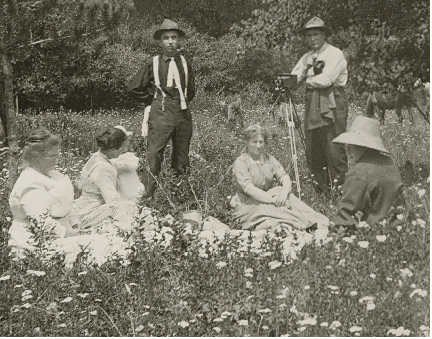
The final installment of HWS’s chronicle of her Yellowstone adventure begins at the edge of the Grand Canyon of the Yellowstone. Then a photographer takes her picture on Foxey and she visits Yellowstone Lake and the Upper Geyser Basin. Then she starts home.
The lads of our party found great delight in starting enormous fallen trees down the awful incline, and watching them crash their way with a fearful swiftness to the river’s brink. Any mother will know how that made me feel, especially when I add that no doctor could be procured in that region under seven days at the very least, and that we had neither houses nor beds, nor anything considered necessary in sickness. I confess I was thankful every minute that our family did not possess a country seat on the banks of the Yellowstone Canyon!
Near us was camped a photographer, and of course we were taken, guides, pack train, colts, dogs and all. They put me, mounted on Foxey, in the very forefront of the picture, and beside me an old blind pack-horse with our store on his back, choosing this position for us, no doubt, because we were the two queerest looking objects in the whole train. We have since heard that this picture is to be put in a panorama amongst other objects of interest in the Park, and that we shall be magnified to the size of fifteen feet and perfectly recognizable!
One of our chief difficulties arose from the impurity of the water and its impregnation with mineral substances, yet the whole of our party went through the trip without suffering any bad effects, and even grew stronger and better, though not a drop of any stimulant was touched by any of us.
The Yellowstone Lake lies 7,780 feet above the sea, almost on the top of the Rocky Mountains, and covers 300 square miles, being the fourth in size, which lies entirely within the limits of the United States. Its pure, cold waters, in some places 300 feet deep, are the rich blue color of the open sea, and swarm with trout, while it is the summer home of white swan, pelicans, geese, snipe, ducks, cranes, etc., and its shores furnish feeding grounds for elk, antelope, black and white tailed deer, bears, and mountain sheep.
Scattered along its shores are many clusters of hot springs and small geysers. It is surrounded on every side but one with snowy mountains, and was long considered to be entirely mountain-locked and inaccessible. The guides told us that it was literally true that a man could stand at one point on the shore of the lake and catch fish on one side of him, which he could swing over and cook in a boiling spring on the other side!
Leaving these high elevations, we went to see the Upper and Lower Geyser Basins. We had dismounted and unloaded our horses and buggy, and were looking for the best sites for our tents, when the cry was heard, “There goes a geyser!” and we dropped everything and ran. The sight was truly a glorious one. At the far end of the basin, Old Faithful was playing his wonderful fountain, and we saw what looked to us a river of water shooting up into the sky.
Our guides told us it was only 150 or 200 feet high, but to us it seemed to reach the clouds, and on one side of it was a lovely soft rainbow that came and went with the blowing spray. It spouted for five or ten minutes and then subsided. Old Faithful is the only geyser whose performances can be depended upon. He spouts regularly every sixty-seven minutes, and has done so ever since the discovery of the Park.
The crater looks like a great mound of coral or petrified sponge, surrounded by terraced basins at all shapes and sizes, and of the most lovely colors. The whole mound is convoluted in the most beautiful fashion, and every one of the little basins around it is rimmed with exquisite scalloping and fluting. The Grand Geyser, the Giant, the Grotto, the Splendid, the Riverside, and the Fan, complete the list of large geysers in this basin, and each one has a marvelous and distinct beauty.
As we were quietly sitting in camp the day after our arrival, I noticed a great steam in the direction of the Grand Geyser, and called out to one of our guides, “George, is old Grand doing anything?” He looked a moment, and then, dropping everything, began to run, shouting out at the top of his voice, “Old Grand is spouting! Old Grand is spouting!”
In a second of time our camp was deserted, every thing was left in wild confusion, and we were all running at the top of our speed to see the display. It was perfectly glorious! As it sent up its grand water rockets 250 feet into the air, shooting out on every side, we all involuntarily shouted and clapped our hands, and Sam took off his hat and swung it over his head in a perfect enthusiasm of delight!
It was like a grand oration, and a wonderful poem, and a beautiful picture, and a marvelous statue, and a splendid display of fireworks, and everything else grand and lovely combined in one. Then all would subside, and the pool would be quiet for a moment or two; then again, it would heave and swell, and the glorious fountain would suddenly burst up again into the blue sky! Seven times this took place, and then all the water was sucked down, down, down into the abyss, and we climbed part way into the steaming crater, and picked up specimens from the very spot where just before had been this mighty fountain.
The Giant, too, gave us a grand performance while we were in the Basin. We thought it the grandest and most beautiful of all. It shoots up a column of water at least seven feet thick to the height of 250 feet, the steam rising far higher. It played for nearly an hour, and flooded the whole basin around with boiling water, doubling the volume o water in the river.
The internal rumblings and roarings meanwhile were perfectly deafening. I could not help feeling as I gazed on these wonders that there was a lesson in it all. Nothing but heat could bring forth such beauty as we see here at every step, and I thought that thus also did the refining fire of God bring forth in our characters forms and colors as beautiful after their fashion as these.
On the 19th, we broke camp and started for our homeward journey. And so, in due time, our trip was over, and the “Mystic Wonderland” lay behind us; but we all felt that we had stored up while there a treasure of fascinating memories of which no time nor distance could rob us. Some of us felt also that we had learned to know our God and His greatness as we had not known Him before, while living amid such displays of His creating and sustaining power, and realized that never again could we doubt His love and care.
∞§∞
— From H. W. S., “A Lady’s Visit To The Geysers Of The Yellowstone Park.” Friends Intelligencer May 19, 1883. Pages 218-221, and May 27, Pages 234-237.
— Detail from a photo in the collection of the Pioneer Museum of Bozeman.
The day we left the Mammoth Hot Springs, we had an accumulation of all the miseries of camping-out life. Fierce heat succeeded by torrents of wind and rain, and, to add to everything else, perfect swarms of mosquitoes. But we were repaid by the sight of Tower Creek, which rises in the high divide between the valleys of the Missouri and Yellowstone, and flows for ten miles through a cavern so deep and gloomy that it is called the Devil’s Gorge.
About two hundred yards before entering the Yellowstone River, it dashes over an abrupt descent of 156 feet, forming a very beautiful waterfall. All around are columns of volcanic breccia, some resembling towers, some the spires of churches, and some are almost as slender and graceful as the minarets of a mosque. But, alas, one sad fatality spoiled the scene for me.
It was impossible to take the wagon any further, and there was no alternative but to mount one of those wild beasts named by Adam a horse. The guides picked me out a sober old creature named Foxey, used to carry a pack, and likely therefore to be equal to my weight, and unlikely to be frisky or foolish. On the morning of the 9th of August, we started a long train of twenty-six horses, two dogs, and three colts, for the Yellowstone Falls and Canyon.
As I was quite determined never to go out of a walk, on account of the tendency to slip off, I took the tail end of the pack train, and plodded on very contentedly for a while. But, alas, my comfort was of short duration, for, when we stopped to lunch, Foxey lost sight of the pack, to which he felt he rightfully belonged, and getting either bewildered or angry, he began to behave in the most unaccountable manner. He backed and forwarded and sidled and turned round and round and neighed, and completely mastered me, till our of the guides came up and fastened a rope to his bridle and led him the rest of the way.
It is beyond my power to depict the grandeur and beauty of the mystic river, and its falls and canyon. There are two falls, half a mile apart; the upper is 140 feet high, and the lower 397. The water is compressed into a mass about 100 feet wide, and from four to six feet deep, and falls over the precipices in one apparently solid mass of glorious emerald, into its marvelous canyon below. This canyon is one of the Park’s greatest wonders.
It is a stupendous chasm about twenty-five miles long and from 1,000 to 3,000 feet high. It can only be seen from the top, as its sides are inaccessible except in one place six miles below the falls. The river has cut its way through a material largely composed of soft clays, sand, tufa, volcanic ash and breccia, with occasional layers of basalt, and has wrought out for itself a wonderful channel.
Towers and turrets and dykes and castle walls of all shapes and sizes are crowded together throughout its whole length in wild confusion. Here and there a single tower stands out in solitary grandeur, isolated from all its fellows, with perhaps a lonely fish hawk’s nest on its top, and little birds stretching out their open mouths towards the mother, who was circling in the grand and awful chasm over the river. But wonderful as these walls are for their height, and the grotesque and beautiful forms into which they are eroded, they are vastly more so for their color.
From their lofty tops to the very edge of the water, they are dyed with an endless variety of the most vivid and delicate coloring. They are a mass of yellows and red and coal black and snow-white and cream and buff and brown and gray and olive, mingled together in richest confusion, while at the bottom runs the river, a glorious roaring torrent of purest emerald green, embroidered with silvery foam, between slopes decorated with velvet grass. The effect is indescribable.
∞§∞
— From H. W. S., “A Lady’s Visit To The Geysers Of The Yellowstone Park.” Friends Intelligencer May 19, 1883. Pages 218-221, and May 27, Pages 234-237.
I’ve been getting ready to present my Humanities Montana program “Sidesaddles and Geysers” on Tuesday, March 6, at the Danforth Gallery in Livingston. I’ll be at the gallery at 106 North Main beginning at 6:30 p.m. under the sponsorship of the Park County Friends of the Arts.
I always tailor my presentation to the local audience. That lets people see me more than once without a lot of repetition. It also motivates me to re-examine my collection of more than 300 first-person accounts of early travel to Yellowstone Park. I always find something new.
I’ll open with Hester Henshall’s description of taking the train from Bozeman to Livingston in 1903. Hester does a nice job of describing the railroad depot and town. I’ll provide a bit of history of Livingston, which was a point where early Yellowstone travelers switched from the Northern Pacific main line to the Park Branch.
Then I’ll note that the first Yellowstone tourists went to the park by Trail Creek Pass and didn’t go to Livingston at all. That’ll let me segue into stories about Emma Stone, who in 1872, became the first woman to take a complete tour of Yellowstone Park, and Sarah Tracy, who wrote a charming diary of her trip there in 1874.
From there, I’ll read a few other stories. Probably one will be a well-tested tale like Emma Cowan’s chilling story of watching Indians shoot her husband in 1877. And, I’ll include as story I’ve never read to an audience before, perhaps Mary Townsend’s description of fishing the Firehole River in 1897.
I’ll be ready with a couple more stories if time allows: maybe Henry Merry’s hilarious story of trying to race his Winton car past park rangers in 1902 when automobiles were forbidden there, or Louise Elliott’s tale of a camp tender taking revenge on a supercilious guest by letting the air out of her mattress.
I’ll finish by returning to Hester Henshall’s story. Hester and her husband befriended an elderly lady during the trip, and when they got back to Livingston, all the hotels in town were full. Hester’s husband found the lady some locals to stay with. That anecdote will bookend the presentation with Henshall stories and leave the audience with a warm feeling.
Our route lay for two days through the Parks of the Rocky Mountains. These are so wonderfully beautiful that I feel as if I wanted to make everybody see them.
Obsidian Cliff
Imagine an English nobleman’s country seat set right down in the midst of these mountains, with great stretches of greenest grass, groups of beautiful trees, beds of brightest flowers, a winding, dashing mountain river, tiny lakes, slopes of turf, fantastic rocks scattered in the most romantic confusion, and around it all a girdle of grandest mountains, often flecked with snow, and changing continually from sunshine to storm, one hour covered with clouds, and the next standing out in clear cut beauty” and sublimity against the deep blue sky.
I confess that it stands out in my memory as the emblem of all that this world can give of peace and beauty and perfect rest; and to remember that these rugged mountains are full of such quiet nooks gives one a blessed sense of the sweetness of God’s almighty power, which has delighted itself in such lovely bits of creation.
We traveled over a road made of obsidian, which is a sort of volcanic glass, of a reddish black color, and glistened beautifully in the sun. We picked up some specimens, and found it was very much like the lumps that are thrown out of the melting pot in a glass factory when a pot breaks. It is very evident that the whole mountain was at one time a molten mass. It is one of the boasts of the Yellowstone Park that it possesses the only glass mountain and glass road in the world.
The road was made by building great fires on the glass mountain, upon which, after a thorough heating, cold water was dashed, thus cracking off large masses of glass, which were afterwards broken into small fragments with small picks and sledges. But I confess that I walked along that wonderful road, and looked up at that cliff in a very commonplace frame of mind. For the fact was I had been so unmercifully jolted over the stumps of trees and small rocks of which our “excellent carriage road” was composed that every bit of sentiment except fatigue had been shaken out of me, and I could not help thinking as much of the jolts that had been and the jolts that were to be as of the obsidian mountain.
At one of the hot springs along the bed of which we passed, some of our young people barely escaped a serious accident. They had dismounted, and gone down to get a drink at the river, when they saw a hot spring bubbling up in the edge of it, and crowded round it to see the curious phenomenon of a hot spring in a cold river. A crust of geyserite had been formed on the bank, and they rashly ventured upon it, when, to their dismay, it crashed through, and let them all down into the water! Fortunately, it was neither very deep nor very hot, as it was tempered by the cool water of the river, and no harm came of it but a temporary wetting.
When we reached the celebrated Mammoth Hot Springs, we felt that we were fully repaid for all our journey. The first impression on beholding it is that of a snow mountain, beautifully terraced into exquisitely shaped and colored basins, and with frozen cascades projecting on each side. At the top of this snowy hill, there is a large lake of boiling springs, which is exquisite in coloring, and full of most beautiful formations. It shades off from a deep crimson rim to a snowy white, and then to a deep emerald centre, and seems to be filled with bunches of the finest spun glass, and with thousands of sinter ferns and mushrooms, and stalactites and flowers of all shapes and colors.
From this lake the water falls gently and quietly down the hill, dropping as it goes into a series of terraced basins, from a few inches to six or eight feet in diameter, and from one inch to several feet in depth. The margins of these basins were exquisitely fluted and scalloped, with a finish resembling the finest beadwork. Some were a delicate pink, some a lovely lemon, then an ultramarine blue, dark red emerald green, bright yellow, or a rich salmon; each basin perfectly distinct in form and color. The whole formed a scene that baffles description. When we reached the summit it was just sunset and the evening glow was over it all. The quiet water of the hot lake was rendered lovelier still by the sunset clouds that were reflected in its depths, and far off in the horizon lofty snowy mountain ranges bounded the view, with green valleys and dark canyons making rifts in their rugged sides—it was a dream of beauty! But there is no escaping the stern realities of life, and a camping-out tour has its drawbacks to the unmitigated enjoyment of the female head of the company, who feels the responsibility of having things moderately respectable.
As it may interest any other old lady who thinks of making such a trip, with a party of young people, to know what lies before her, I will describe my various grapples each day, beginning with the morning. We slept mostly, as I have said, right flat out in the middle of the plain, with generally not even a shrub to creep behind, and as we all kept near together for protection, it became a matter requiring no small skill to manage our times for getting up and going to bed satisfactorily, so as to create privacy where there was no material for it. Then came breakfast.
Tin Lee made delicious “flappee jacks,” as he called them, and all the young folks were “devoted” to them. And to keep account of whose turn it was to have one, and of the amount of honey, jam, or molasses that could be allowed to each, was a wonderful grapple. Next came the packing up for our start. First, the bedding of each one had to be rolled up into as complete a bundle as possible, and securely strapped, for the horses’ backs; and to collect all the multitudinous wrappings, and superintend the rolling them up, required more vigilance and energy than any one could think who has not tried it.
Then the young people had to be marshaled, and their shawls and overcoats and waterproofs tied on to the backs of their saddles, and all the contingencies of weather—hot and cold, wet and dry— to be provided for; for after our pack train, with our baggage, once started in the morning, we never saw it again till we went into camp at night. Then the lunch for our whole party had to be provided and packed; and afterwards followed the grapples of the day’s journey, the finding the trail, and the grappling with the rocks and roots and stumps and swamps over which it generally pursued its course; the fording of streams, the climbing of mountains, the crossing of gullies, the going down the steepest of hill sides, all in a continuous succession, one after another.
And to make matters worse for those of us who occupied the wagon, the trails often led along the sides of hills, and being simply ” natural roads,” t. e., not graded in the least, they, of course, slanted sideways, and kept us continually jumping from one side of the wagon to the other to make it balance, and keep it from toppling over. Then, as noon drew near, and cries for lunch began to come from our hungry equestrians, there was the necessity of finding out a pleasant lunching place, where shade and water could be secured.
After this would come the grapples of the afternoon journey and as evening drew on there would be the search for a good camping place, combining grass for our horses, wood for our fires, and water to drink for both man and beast. And lastly came the grapple for our night arrangements. A soft spot would have to be found for our sleeping, sheltered from the wind if possible, and then I would dig the small holes I spoke of, which so largely added to our comfort. All this had to be done, regardless of the holes and humps of all sorts and sizes, evidently the homes of wild creatures of various kinds, on the top of which our beds had to be spread. It was often a matter of speculation with me, when we lay down at ten o’clock, as to how we should grapple with any of these wild creatures, if they should take a notion to try and get out of their holes during the night. But I am thankful to say that, discouraged no doubt by our superincumbent weight, none of them ever did so.
Finally, all the merry singing party had to be coaxed, or scolded, or inveigled into bed, which was no small grapple, as any mother will know. Besides all this, there was our ” wash” to be attended to, for, be as economical as we would, still handkerchiefs and towels would get soiled, and even camping out did not render us entirely indifferent to cleanliness. I, as the oldest member of the party, had to keep up a continual grapple with wet feet, cuts, bruises, sunburn, etc., until sometimes I felt as if life was all one long grapple. Reading or meditating is pretty much out of the question in a trip like this, and for this reason it is an invaluable remedy for over-tasked brains and nerves. I felt as if we were all a party of cabbage-heads struggling for existence under most unfavorable circumstances.
∞§∞
— From H. W. S., “A Lady’s Visit To The Geysers Of The Yellowstone Park.” Friends Intelligencer May 19, 1883. Pages 218-221, and May 27, Pages 234-237.
Last Saturday I spent the day at Chico Hot Springs with other members of the Montana Book Award choosing this year’s winner and honor books. The news release below reports the results of our deliberations.
∞§∞
The 2011 Montana Book Award winner is Raptors of the West by Kate Davis, Rob Palmer and Nick Dunlop, published by Mountain Press. This annual award recognizes literary and/or artistic excellence in a book written or illustrated by someone who lives in Montana, is set in Montana, or deals with Montana themes or issues.
Presentations and a reception with the winning authors will take place in April, during the Montana Library Association Conference at Big Sky.
Raptors of the West, the latest collaboration by award-winning photographers Rob Palmer and Nick Dunlop and author/photographer Kate Davis, is a glorious photographic ode to the forty-five birds of prey that roam the skies of the American West. The book is arranged by the habitat type which gives a great way to identify many birds in one area. While the 430 stunning color photographs are enough to set this book apart on their own, Davis’s informative and entertaining captions make this a perfect guide for all age groups.
Four honor books were also chosen by the 2011 Montana Book Award Committee:
Beautiful Unbroken: One Nurse’s Life by Mary Jane Nealon, published by Graywolf Press. As a child, Mary Jane Nealon dreams of growing up to become a saint or, failing that, a nurse. Beautiful Unbroken details Nealon’s life of caregiving, from her years as a flying nurse, untethered and free to follow friends and jobs from the Southwest to Savannah, to more somber years in New York City, treating men in a homeless shelter on the Bowery and working in the city’s first AIDS wards. In this compelling and revealing memoir, Nealon brings a poet’s sensitivity to bear on the hard truths of disease and recovery, life and death.
Conjugations of the Verb To Be by Glen Chamberlain, published by Delphinium Books. In her debut collection of short stories, Glen Chamberlain stakes out her own distinct, well-imagined parcel of Montana land. Set in the fictional town of Buckle–“an informal little dot on the map”–these stories are populated with salt-of-the-earth ranchers, schoolteachers, nurses, lovers and dreamers.
Hand Raised: The Barns of Montana by Chere Jiusto, and Christine Brown with photographs by Tom Ferris, published by Montana Historical Society Press. Beyond their utilitarian functions, barns are simply beautiful. The historic barns pictured in this book present the best, most unique, most significant, and most beautiful across the state. Photographer Tom Ferris explored barns inside and out across Montana, and authors and
architectural historians Chere Jiusto and Christine Brown help readers understand the significance of what they are looking at and tell the stories of the individual barns.
Where Elk Roam: Conservation and Biopolitics of Our National Elk Herd by Bruce L. Smith, published by Lyons Press. This book provides an inside look at the field studies and conservation work of a federal wildlife scientist who for twenty-two years served as the National Elk Refuge’s wildlife biologist, coordinating winter feeding of 8,000 elk and tracking their births, deaths, and annual migrations throughout the Greater Yellowstone Ecosystem.
The Montana Book Award was founded by the Friends of the Missoula Public Library in 2001 and winners are selected by a committee of individuals representing areas throughout Montana.
Members of the 2011 Montana Book Award committee included Honore Bray, Missoula; Adam Kish, Twin Bridges; Mark Miller, Bozeman; Carole Ann Clark, Great Falls; Jill Munson, Fort Benton; Gordon Dean, Forsyth; and Sarah Daviau, Libby.
∞§∞
Saturday’s meeting was my last as a member of the MBA selection committee. During my four-year term I read some great books, many good ones, and a few not so good. It’s been great fun, but I’m happy to regain control over my reading list. Tamara Miller will succeed me as the Bozeman representative on the committee.
— You can read the item I posted last year about Montana Book Award procedures—and the heady experience of serving on the selection committee here.
— The Montana Book Award Logo is a woodcut by Claire Emory.
— To find out more about my work with the Montana Book Award look under the “Categories Button” on the right.
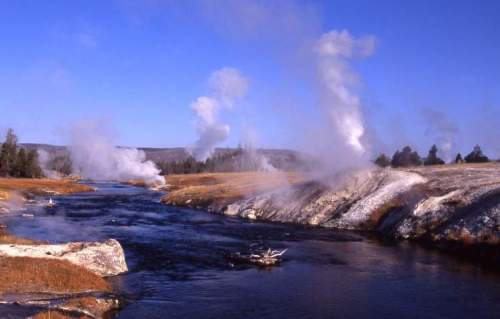
On the 3d of August we entered the Park. The first point we reached is what is called the Firehole, or the Lower Geyser Basin. It is a flat meadow, 7,000 feet above the sea, through which runs the Firehole river, and part of it is covered with beautiful grass, while part of it is the white sinter formation of the hot springs and geysers.
Setting Tin Lee to work at his stove preparing supper, we rode about a mile on the edge of the pine forest that skirted the weird, desolate plain of the geyser basin. It was one glare of white geyserite, with sulphur and iron and alum springs bubbling up all over it, and little steaming funnels everywhere, giving evidence of the internal fires beneath.
Standing or lying about this plain are trees killed by the hot, siliceous waters. Nothing in nature could be more spectral than these naked trunks of trees, stripped of bark and bare of branches, and bleached white as snow, looking like the ghosts of the groves and forests, which are undoubtedly buried beneath the constantly accumulating mass of deposit.
It was a scene of absolutely uncanny desolation, and as we looked at it we ceased to wonder at the names bestowed upon it by its first discoverers, such as “Devil’s Paint Pots,” “Hell’s Half-acre,” etc. One of our guides told us in graphic language of his first sight of this region.
“You see,” he said, “a party of us were out prospecting for mines, and we had traveled all day through pretty thick forests, and were pushing towards an opening we could dimly see through the trees, where, we hoped to make a comfortable camp for the night. We were very tired, and were hurrying to get into camp, when suddenly, just as we reached the edge of the forest without a moment’s warning, we heard a most awful rumbling, the ground shook under our feet, and there burst into the air a column of water and steam that looked as if it reached the skies.
“We just fairly lost our senses, and never stopped to take a second look, but wheeled about in an instant, put spurs to our horses, and crushed away through the underbrush and tree-trunks as if the Evil One himself were after us.
“And the fact is,” he added, “we did not know but that he was. For what else, we asked ourselves, could such goings-on mean, but that we were on the very edge of the lower regions? We never rested till we had put miles between us and that awful place, and for years we never spoke of it for fear the fellows should think we had really been to hell, and were sold to the old fellow who lives there.”
We could not wonder at the fright of men who had probably never heard of geysers or volcanoes, and who had no more expectation of coming across such phenomena in that quiet and lonely region than we in Philadelphia have of seeing them in our sober Fairmount Park.
This is considered to be the most wonderful geyser region in the whole world. The far-famed geysers of Iceland are tame fountains compared to some here. It is estimated by Professor Hayden that within an area of thirty-five or forty square miles there are at least 2,000 hot springs, steam-jets, geysers, and mud fountains; and in the whole Park there are supposed to be not less than 10,000.
Many of the geysers spout to the height of fifty or a hundred feet, some two or three hundred, and our guides even told us of one which has only been known to spout twice, but which, when it does perform, reaches, they declared, the stupendous height of seven hundred feet. But as we did not see this one we felt a little dubious.
The geysers seem to have all sorts of openings. Some of them have formed craters around their mouths twenty or thirty feet high, that have assumed curious fantastic shapes and are constantly sending out between their eruptions great puffs of steam, and little jets of scalding spray, while there is all the time a sound of fierce boiling water below. In others the hot water stands, a marvelously transparent pool, in saucer-shaped basins, from ten to one hundred feet across, at the bottom of which is the well or tube from which the eruption issues.
No language can adequately describe the gracefully curved and scalloped forms of the deposits which line the apparently bottomless sides of these openings, nor the countless vivid and delicate colors with which they are dyed, shading from a deep crimson, on the edge of the pool, to a glorious emerald green or sapphire blue in the centre. To look down into the pure depths of these wonderful basins, with their fantastic forms and exquisite colors, is like looking into fairyland. Then suddenly, without a moment’s warning, or any apparent cause, the quiet water will begin to heave, and boil, and spurt, and will dash into a marvelous cataract, apparently instinct with life; leaping towards the skies, just as a cataract leaps downward; breaking into rockets of milk-white spray, each of which sends out a burst of steam, and then falls to the white rocks below in showers of shining jewels, tinted with all the colors of the rainbow. A geyser eruption is not in the least like an artificial fountain, but more like an inverted cataract, filled with a mighty life, every instant changing its shape and its height, and is always enveloped and surmounted by vast clouds and pillars of steam that sway with the wind, the whole being crowned and tinged with rainbows.
These marvelous displays take place with one or two geysers at regular intervals, but most of them are very irregular in their times of action, varying from three or four hours to several days, or even two or three weeks. They seem sometimes to die out altogether, and new ones to break out in fresh places.
It would seem, therefore, that while the amount of geyser action continues about the same, its centers of activity are constantly changing . . .. We were now a party of eleven, three sober middle-aged grown-ups, and eight young people, full of life and energy, and ready for any fun or adventure that came in their way. Our campfires at night were scenes of great merriment. As soon as we would get into camp all but the lazy ones would go to work gathering sagebrush or wood for the fire. We would choose a spot with dry sand or grass, and piling up our fuel and lighting it, would all gather round it on our rugs and buffalo robes, and tell stories and sing songs until bedtime.
Tin Lee, our Chinese cook, was a great feature in these entertainments. He seemed such an innocent, guileless sort of creature, that one’s heart was quite attracted to him, although all of us believed it was only the innocence and guilelessness of deepest cunning. He would come up to the fire with a smile that was almost as childlike and bland as that of the immortal “Ah Sin,” and take his place among us as innocently as though he belonged to us, and had a right to share all our pleasures. Sometimes we would get him to sing us a Chinese song—he called it “songing a sing “—and a sadder, more pathetic tune I never heard anywhere. It was always the same, and had no variations, and it seemed to embody in its sad refrain all the grief of a hopeless helpless race. It almost brought tears to my eyes every time I heard it. But I fear that our young people felt none of this, for they had persuaded the unsuspecting Tin Lee that he had a very fine tenor voice, and they would go into uncontrollable fits of laughter over the high falsetto quavers produced.
These nightly campfires are the chief delight of the trip. The air is always cool enough to make the warmth agree able, and the deliciousness of lying stretched out on one’s buffalo robes under the open sky, around a high roaring fire, can only be understood by experience. It seems, too, as if every one’s wits were sharper than usual under such circumstances, and our young party had many a grand night of it, that gave the three quiet elders almost as much delight as themselves.
The only drawback would be the inevitable coming of ten o’clock, when the sound of my “Now, daughters, it is bedtime,” was almost as dreaded as the cry of the panther would have been. There was only one other sound that spread greater consternation, and that was the call of Tin Lee in the morning when breakfast was ready, and he would wake us up from our delicious naps by playing a tattoo on a tin pan, and calling out to us at the top of his funny squeaky voice, ” Hi there! Bleakfast! Flappee Jack! Flappee Jack! Him all done!”
∞§∞
— In Part 4, HWS describes the wonder of a glass mountain, the “grapples” of traveling in a wagon over crude roads and managing rambunctious young travelers.
— From H. W. S., “A Lady’s Visit To The Geysers Of The Yellowstone Park.” Friends Intelligencer May 19, 1883. Pages 218-221, and May 27, Pages 234-237.
— Photo from Coppermine Gallery
— For more on women’s adventures in Yellowstone Park click on “Women’s Stories” under the Categories button to the left.
After reaching the end of the railroad line, HWS travels with a pack train through scorching days and freezing nights across Idaho to the edge of Yellowstone National Park.
We were met on the little railroad platform at Camas by our guides, three fine looking mountaineers, who informed us that they had a train of twenty-six horses and mules ready for our trip. We had also engaged a Chinese cook at Ogden, named Tin Lee, a very obliging fellow, and excellent in his profession.
So far things looked promising, but it was perfectly hot, and the wind blew almost a hurricane all the time, and the sand was whirled in through every crack in such quantities as absolutely to necessitate closed doors and windows, and all day long it was simply unmitigated discomfort. They told us it had only rained twice there in four years, and we could almost believe it, though we could not but suspect that this was one of the stories told to “tenderfeet,” as all new comers in the West are called.
We wore through the day, somehow, however, and at night were repaid for all our troubles. The storekeeper allowed us to spread our bedding in his hay-yard the air cooled off rapidly with the going down of the sun, and with the sweet, soft hay beneath us, and the glorious clear sky above us, we felt we had beds that a monarch might envy. No physical sensation in the world appears to me to be more delightful than that of sleeping in the open air on a clear, cool night, with plenty of blankets and buffalo robes around and underneath one.
To have all the wide universe to breathe into, and the infinite sky to gaze upon, seems to lift one out of this ordinary everyday world into a region of glorious possibilities and undreamed of triumphs. Next morning the guides brought the riding horses up to the store, and we all went out and tried them, in order to find out those, which would best suit our individual likings.
This was fun to the young people, but I am free to confess it was misery to me, for I had not been on the back of a horse for years, and had long ago decided that, being in my fiftieth year, and rather stout, my time for horseback riding was over. I tried several, but found them all so slippery that I experienced a great tendency to fall off their backs the moment they undertook to go out of a walk, especially as we had to use Spanish saddles, with only a high peak in front. The prospect began to look very dreary to me, as the guides said we should have five or six hundred miles to travel in this way.
I began to ask myself if even the “Mystic Wonderland” would pay for such a journey. But of course, the party could not be stopped by any whim of mine, so I made up my mind to say nothing, and just “grin and bear it.” However, at last we found a light two-seated wagon in the town, which we bought with the hope of selling it again on our return, and two of our pack-mules were found to pull it, so that this difficulty was surmounted for the time, though our guides seemed to think it very doubtful whether a wagon would be able to travel over the rough trails into the Park.
We made an imposing appearance as we started off with our long train of three guides, ten packhorses, nine horseback riders, the wagon with its occupants, two dogs, and three little colts, who were accompanying their mothers on the trip. The next morning, however, we were greeted with the intelligence that our horses and mules had strayed away during the night and were lost! The search for them occupied several hours, and after we had resumed our journey, the wagon made our route much more perplexing on account of the difficulty of fording the streams.
The sun seemed to scorch like a fire, and the wind, which might have been a comfort had it been moderate, seemed to take away our breath by its fierceness. We wondered if there was any comfort possible in a country that is both hot and windy at once. No one can have an idea of these winds who has not felt them. They seem to blow you back in your life somehow, and you have to use all your energies to catch up again. Our night experiences were peculiar. We had to go to bed and get up in the midst of a vast airy space, with no shelter for anything. Of course no one thought of undressing much, but the little we did need to do for comfort’s sake was an affair of highest art, as may readily be imagined.
Though the days were so sultry, the nights were bitterly cold, and it was quite a common thing for us to find ice half an inch or an inch thick in our basins or buckets when we woke in the morning; and this in August! This extreme change of temperature is caused by the excessively dry air, which does not retain heat like a moist atmosphere; in consequence of which it cools off the moment the sun’s rays leave it. The lower layers of atmosphere, rarefied with the day’s heat, all rise, and the cold winds from the mountains rush in to fill their place. For two days, we had not seen a single human being, and not even a dog, or horse or cow. On the third day, however, to our delight, we met a man and his wife, traveling with all their household goods from Montana to Ogden, and they gave us some information about the route.
We camped that night in a beautiful green meadow, and though we tried to toast our poor cold feet at our fire before going to bed, we arose in the morning shivering with cold,
Mr. S having dreamed that he was asleep in an icehouse, and all the rest of us having had equally delightful sensations. Our slumbers were also disturbed by a stampede of our horses, which were frightened by a flock of wild swans, and came tearing and racing almost over our very beds, but were fortunately turned off in another direction by two of our young men jumping out at them, and they were finally quieted by our guides.
∞§∞
— From H. W. S., “A Lady’s Visit To The Geysers Of The Yellowstone Park.” Friends Intelligencer May 19, 1883. Pages 218-221, and May 27, Pages 234-237.
— Library of Congress Photo.
—In Part 3,HWS describes the wonders of geyserland and the joys of evenings around the campfire.
On Friday afternoon, while I was doing my usual shift as a volunteer at the Pioneer Museum of Bozeman, I saw that the new edition of the Pioneer Museum Quarterly was out. Of course, I immediately went through it to look at my article on Gillman Sawtell. It’s a companion piece to the one I published last summer on Fred Bottler.
Sawtell's buildings at Henry's Lake.
Sawtell and Bottler were pioneer ranchmen who in the 1860s staked out claims on the edges of what was to become Yellowstone Park—Bottler in the Paradise Valley north of the park, Sawtell at Henry’s Lake to the west. Their ranches became stopping points for early Yellowstone explorers and tourists and both were park guides. Here’s a excerpt from the Quarterly article on Sawtell.
∞§∞
Sawtell staked his claim on the northwest edge of Henrys Lake and launched a group of enterprises that included ranching, commercial hunting and guiding tourists.
Sawtell’s main business was harvesting and selling fish, as many as 40,000 of them a year. He reportedly caught as many as 160 trout an hour, averaging two and a half pounds each, with a hook and line. In winter when the lake froze over, springs kept open a small area near Sawtell’s compound. Fish swarmed the open water and Sawtell harvested them with a spear.
Sawtell sawed blocks of ice from the lake in winter and stored them packed in sawdust in a sturdy thick-walled icehouse he built of logs. He stored his catch in the icehouse until he had enough to fill his wagon. As late as 1896, Sawtell was hauling fish to Monida where they were loaded into railroad cars for sale in Butte and Ogden, Utah.
While launching his enterprises, Sawtell built a veritable village. He had six sturdy log buildings: a residence, a blacksmith shop, a stable, a storage shed for hides and game, and his icehouse. He apparently had guests in mind when he built the compound. His whitewashed house was big enough to accommodate 20 people and had numerous bedsteads, stools, and tables. He kept enough stoneware to serve that many.
Sawtell kept tamed antelope and elk at his ranch. In 1871, he used a rowboat to run down several baby swans. He raised the signets until they were big enough to travel (about the size of domestic geese) and shipped them to New York City for Central Park.
In 1871, Sawtell guided a group of men from Virginia City and Deer Lodge on a tour that covered the geyser basins, Yellowstone Lake, and the Grand Canyon of the Yellowstone. Because of this trip, Sawtell is credited with being the first commercial Yellowstone guide.
∞§∞
—Excerpt from M. Mark Miller, “Gilman Sawtell: Yellowstone Pioneer at Henry’s Lake,” Pioneer Museum Quarterly, Winter 2012, pp. 13-15.
— You can read the rest of my article about Gilman Sawtell by buying a copy of the Quarterly at the Pioneer Museum of Bozeman. Better stil, join the Gallatin Historical Society and get a free subscription.
— You might also enjoy my story about Fred Bottler, who settled in the Paradise Valley north of Yellowstone Park in 1867.
— Detail from an 1872 William Henry Jackson photo.


 The final installment of HWS’s chronicle of her Yellowstone adventure begins at the edge of the Grand Canyon of the Yellowstone. Then a photographer takes her picture on Foxey and she visits Yellowstone Lake and the Upper Geyser Basin. Then she starts home.
 I’ve been getting ready to present my Humanities Montana program “

 cook at Ogden, named Tin Lee, a very obliging fellow, and excellent in his profession.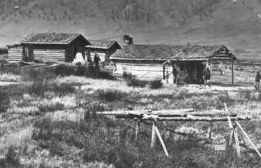
 M. Mark Miller, Author