Author: mmarkmiller

  • Blog/Webpage Update

    After I sent the manuscript for Rediscovering Wonderland to my publisher a few weeks ago, I just coasted for a while. But as soon as I felt rested, I began noticing all the things I had neglected during three years of being focused on writing. In that time, I finishing Encounters in Yellowstone and Sidesaddles and Geysers in addition to Rediscovering Wonderland. (How’s that for humblebrag?)

    Fixing my long-neglected blog and webpage were high priorities, but I soon discovered that my management skills for such things had atrophied and become obsolete. I decided to merge my blog and webpage so I wouldn’t need to learn two management systems. My son-in-law, a software development specialist at Argonne National Laboratory, helped me put every thing under WordPress, but I still had to figure out the tasks of learning its management system and redesigning things.

    I passed though the event horizon from the age of intuitive computer operation to bewilderment several decades ago, but I sallied forth with an ample swear vocabulary, a bottle of good whisky and a willingness to flail away. After many hours of trail- and-error I have made things presentable. (I hope.)

    I’ve tried to preserve everything from my old blog, make new posts accessible and highlight my books. I’d be grateful if you would take a look at things and let me know if I’ve succeeded. I’m sure there are thousands of little things that need fixing and I’ll work on those. But for now I’m focusing on big stuff. So let me know if you see any disasters. Thanks!

    I plan to post regularly so watch this space.

    ∞§∞

  • Introducing Free Reads

    I’ve used this blog to post stories I’ve found about early travel to Yellowstone Park and occasionally other stories. Also, I like to let people know about my other a ctivities: writing, speaking and occasional personal notes. Of course, I’ll keep doing those things, but with some new twists.

    Yellowstone travel stories are getting harder to find. I’ll keep an eye out and post stories when I see them, but I’l going to add what call “Free Reads.” That is, book, articles and reports that are available on the internet at no cost. I’ll provide links so you can read them whenever you want to learn more about Yellowstone Park Adventures

    I’ll begin with the Earl of Dunraven’s book, The Great Divide, which chronicles his trip to Yellowstone Park in 1874. The Earl was a wealthy Irish lord who loved adventure, hunting and fishing. He had been a newspaper correspondent and was a skilled writer. He could describe his adventures in bone-chilling detail or with wit and humor. His book is the source of many posts on this blog that you can see by selecting the “Dunraven” button at the left of this page.

    You can find complete copies The Great Divide online in several locations. I like seeing page-image versions like the one available at the Internet Archive.  Seeing what the book looked like gives a feel of authenticity and the illustrations can be great. They are in this book. Google Books is another internet site where you can get a copy of The Great Divide.

    So grab yourself a free copy of The Great Divide or read it on line. If you find anecdotes or stories in it that would make good additions to this blog, please let me know. Remember you can check to see if I’ve already published them by checking for “Dunraven” under the Categories Button to the left of this page. 

    I’ve added “Free Reads” under the Category Button and plan to add items there regularly. You should watch for them.

  • MY BLOG IS COMING BACK

    This blog as been dormant for a long time, but I’m planning to begin posting regulary again. I’ve been busy — finished three books in the last two years. Rediscovering Wonderland: The Expedition That Launched Yellowstone Park just when to the publisher. It tells the story of the Washburn Expedition explored the upper Yellowstone and Madison Rivers in 1870 and its members efforts to create the .park.

    Sidesaddles and Geysers: Women’s in Old Yellowstone came out in November 2020. It’s an anthology of stories by adventurous women ranging in age from 6 to, well, much older.

    Encounters in Yellowstone: The Nez Perce Summer of 1877 came out in November 2019, and was a finalize in Literary Nonfiction for the High Plains Book Award. It tells the stories of tourists who ran afoul of Indians in Yellowstone Park.

    I also sent the manuscript for Rediscovering Yellowstone: The Expedition That Launched Yellowstone Park to my publisher. It tells the story of the Washburn Expedition of 1870. This expedition was composed of prominent Montana government officials and entrepreneurs. Their word could not be doubted like that of trappers and prospectors whose descriptions were usually dismissed as tall tales. When the Washburn Expedition returned to civilization, several of its members began promoting the idea of setting aside the world’s first national park — and they succeeded. Rediscovering Wonderland will be out in 2022 for the 150th anniversary of the establishment of Yellowstone Park.

  • Reconnecting Brian Persha and “The Thinker”

    Reconnecting Brian Persha and “The Thinker”

    screen-shot-2016-11-20-at-2-51-18-pm
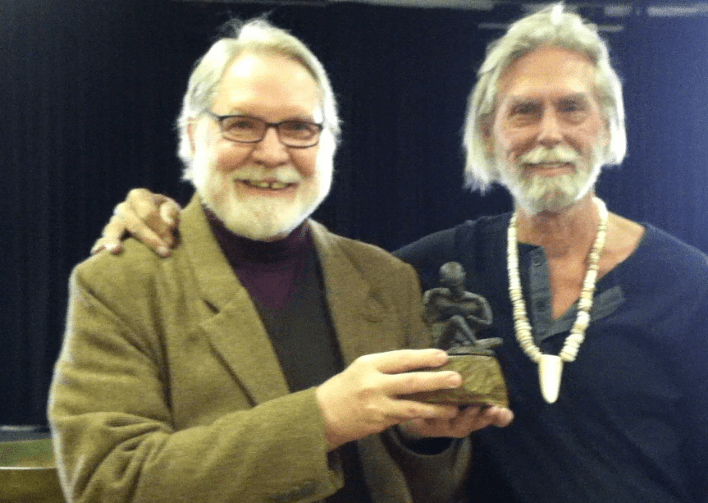
    Me, “The Thinker,” and Brian Persha

    In the spring of 1965 I was looking for a wedding present for my brother when I bumped into Brain Persha in the student union at the University of Montana. Brian was completing his MFA in ceramics under the famous Rudy Autio. Brian said he had some pieces that might do the trick, so we went to his place to check them out.

    I bought a piece called “Protocol Reversed” for my brother and his wife. It’s a lovely bronze about eight inches tall in the manner of Henry Moore. It shows a man kneeling before a woman — just the thing for a wedding present, I thought.

    But the piece that really captured my heart was one called “The Thinker,” a seated male nude. The Thinker’s emaciated form reminds me of Alberto Giacometti statues, although it lacks that artist’s elongated limbs.

    I recall commenting on Brian’s statue having no hands, and Brian telling me: “a thinker needs no hands.”

    I spent my last money on “The Thinker.” I remember wondering if I had enough cash left to buy gas and get home. I then went back to Silver Star to spend the summer working on the family ranch. I gave Protocol to the newly weds and kept The Thinker for myself. I have treasured it now for more than 50 years.

    When I heard that Brian was showing his work at the Eagle’s Club in Bozeman today, I couldn’t resist the temptation to reunite the statue with him. I walked up to where he was standing and said, “I have something to show you.”

    He called me by name and said, “Yes, you do.”

    He hefted the statue, inspected in from several angles and showed me his initial on its side. He then provided a detailed explanation of how it was cast in bronze from a wax model—an elaborate and delicate casting process that took hours.

    Brian said he remembered the day I bought the statues well. He said my enthusiasm for his work and my willingness to pay for it gave him confidence to pursue a career as an artist. He’s made his living as a studio artist ever since. It’s flattering to think I had something to do with that.

    ∞§∞

    P.S., My brother says he can’t locate “Protocol Reversed.” I do hope he finds it.

  • An Event: “An Ursine History of Yellowstone Park” in Cooke City


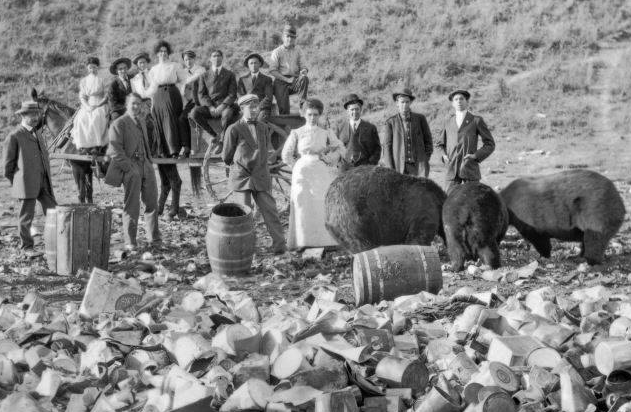
    Bears at Dump 2 MHS Photo
    Yellowstone tourists watching bears at a hotel dump.

    I’ve been preparing a talk titled “An Ursine History of Yellowstone Park: Stories of People and Bears” to present at the Cooke City Museum on Thursday, July 21, at 6 p.m.. It’s part of the Museum’s “Joe’s Campfire Talks,” an outdoor summer series. I’ve presented there twice before and really enjoy the venue.

    “Ursine History” is a topic I’ve been thinking about for several years and I’m glad for the opportunity to dig through my files and organize my thoughts on it. I always discover new things when I take a fresh look at my collection of more than 300 first-person accounts by Yellowstone travelers.

    Bears are resilient animals that adapt quickly to changes in their surroundings so their behavior provides an interesting way of looking at Yellowstone Park history. Examine how tourists interacted with bears across time reveals a lot about how attitudes toward wildlife and nature have changed.

    The first Euro-Americans to visit Yellowstone park were mountain men who scoured the area to trap beaver and other fur bearing animals. For them bears were a source of food —and bear grease that they used for everything from lubricants for their guns to laxatives. I like to enliven my presentations by reading first-person accounts by Yellowstone travelers, so I’ll read an excerpt from Osborne Russell’s Journal of a Trapper for this section of my talk. In the excerpt, Russell learns just how dangerous a grizzly can be when he decides to track a wounded animal.

    The congressional act that established Yellowstone Park in 1872 explicitly allowed hunting so visitors to the remote roadless wilderness could hunt for sustenance. That led to an era that some writers have called a holocaust when the population of large animals in Yellowstone was decimated. Bear hunters were among those who came to the park to bag trophies. I’ll read Jack Bean’s hilarious account of a neophyte hunter’s adventure bagging his first bear.

    When they were hunted, bears learned that humans meant danger and sightings of them became rare. But after the Army took over administration of the Park in 1886 and outlawed guns, they began to reappear. In fact, they became pests patrolling campground for garbage and unattended picnic baskets. Then hotels created dumps for kitchen garbage in nearby woods and watching bears in them became a signature experience for Yellowstone travelers.

    Bears didn’t approach horse-drawn conveyances, but with the coming of the automobile, they rapidly became accomplished roadside beggars, and bear jams backed up traffic for miles. In the 1960s park rangers began locking up garbage containers and enforcing “do not feed the bears” rules. Soon, bear sightings became rare again.

    That’s an outline of my presentation. I’m looking forward to giving it. If you’re looking for something to do on Thursday, come to the Cooke City Museum and hear “An Ursine History of Yellowstone Park.”

    ∞§∞

    • Photo from the Montana Historical Society.


  • Dangerous Adventures with Hot Spring and Geysers

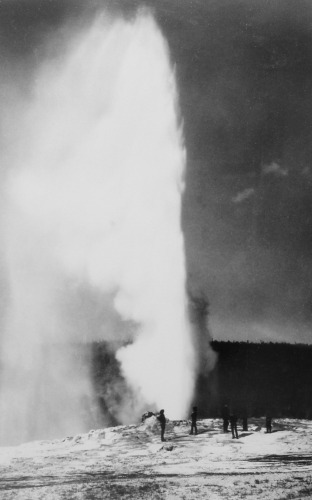
    oldfaithful-by-jackson-1871
    Explorers inspect Old Faithful. — William Henry Jackson Photo, 1871.

    Over the last few weeks there have been several stories about injuries and deaths caused by ignoring the rules in Yellowstone National Park. Here a good example from The Billings Gazette. The coverage reminded me that I have posted several stories about tourists’ encounters with hot springs and geysers. I decided to reprise some of them.

    A couple of important points about these stories: First, they are survivors’s stories. Dead men tell no tales. Second, they are from different times. Today we know better than to do the things described. When you visit Yellowstone Park, you should obey all the rules. The Park Service has posted a nice summary of them and some good advice.

    I hope you enjoyed these stories. If you did, you can look for others on this blog. Even better, buy my books:

    • Adventures in Yellowstone: Early Travelers Tell Their Tales. — A dozen classic tales in the words of the people lived the adventures including: Mountain Man Osborne Russell’s tales of tangling with Indians and seeing geysers for the first time; N.P. Langford’s diary of the expedition that first brought Yellowstone’s wonders to public attention, and Emma Cowan’s chilling account of being taken captive by Indians.
    • The Stories of Yellowstone: Adventure Tales From the World’s First National Park.— Seventy-two short stories suitable for quick reading by the evening campfire. Everything from Jim Bridger’s early descriptions of Yellowstone’s wonders, to being treed by a lion, to feeding bears (don’t do it).
    • Macon’s Perfect Shot: A Yellowstone Adventure. — A mid-grades novel about a 14-year-old boy’s adventures in the Park in the 1870s. Macon has to grow up fast when his partner falls into a geyer, and he has to get the scalded man home.

    I hope you enjoy reading early traveler’s adventures in the world’s first national park. Learning more about it’s history will enhance your enjoyment when you visit there.

    ∞§∞


  • Distinctly Montana Publishes “Tales of the Begrade Bull.”

    Distinctly Montana published my article “Tales of the Belgrade Bull” in its Spring 2016 issue.  It’s the boisterous tale about the son of a Holstein dairy cow that nobody could ride. The bull was “discovered” on a ranch north of Belgrade, Montana, where he learned to buck off children who attempted to ride him after Sunday school. When a threshing crew member mounted him as a full-grown bull in the fall of 1892, it set off a series of wild rides.

    DM_main belgrade bull_0

    An enterprising pair of brothers bought the bull, took him to Belgrade and offered a $25 reward to anyone who could stay on him. Soon cowboys were coming  for hundred of miles to try try their luck — only to be sent sprawling.

    By 1894 the Belgrade Bull’s fame had spread and he went on tour to Anaconda, Butte and Helena where he took on all challengers. A wild west show bought bought him and took him back east. The show went broke in Indiana and sold the bull to a farmer. Apparently, the bull lived out his days as a herd sire.

    I became interested in the story of Belgrade Bull when Ann Butterfield showed me a letter she found in the research collections of the Pioneer Museum in Bozeman.  Ann, who was then associate director of the museum, thought maybe I could write an article based on it.  I love piecing together stories out of the detritus of the past, so I decided to give it a try.

    The bull has been legendary around Belgrade for more than a hundred years and soon I was buried under a treasure trove of newspaper clippings, letters and reminiscences. From them, I assembled an article that was published in the Spring 2009 issue of  The Pioneer Museum Quarterly (now The Gallatin History Museum Quarterly). You can read the unabridged version that appeared there on this blog.  Begin with Part 1 and follow the links.

    You can read the Distinctly Montana version on the link above, but I urge to you buy the magazine. It’s easier to read, and the double-page illustration looks much better. You could get a copy of the longer version by buying a copy of Spring 2009 issue of The Pioneer Museum Quarterly at the Gallatin History Museum, 317 West Main, in Bozeman, MT.

    ∞§∞

  • Distinctly Montana Publishes “Yankee Jim Tangles With Rudyard Kipling.”

    Distinctly Montana Publishes “Yankee Jim Tangles With Rudyard Kipling.”

    Distinctly Montana published my article”Yankee Jim Tangles With Rudyard Kipling” in its Winter 2016 issue. It’s a rib-tickling tale about how sparks flew when the Nobel winning English author encountered the crusty old Indian fighter who ran a toll road on the way to Yellowstone Park in 1889. Kipling

    The erudite young Englishman said he thought he might match Yankee Jim’s talent for telling tall tales, but he had to admit he’d met his match.

    “Yankee Jim,” Kipling said, “saw everyone of my tales and went 50 better on the spot. He dealt in bears and Indians — never less than 20 of each; had known the Yellowstone country for years, and bore on his body marks of Indian arrows; and his eyes had seen a squaw of the Crow Indians burned alive at the stake. He said ‘she screamed considerable.’”

    Yankee Jim found out about the description of him when a newspaper publisher sent him a copy of Kipling’s  1900 book, From Sea to Sea, which described the author’s around-the-world travels. He was not pleased.

    In 1902 a young travel writer named Lewis Ransom Freeman, who had read Kipling’s book, decided stop by Yankee Jim’s cabin and ask him to retell the story about burning the Indian woman. Jim was enraged.

    “Young man, do I look like a man who would let a woman — white or Indian — be burned at the stake before me?” he demanded. “Why my old Colt would have shot someone all of itself at such an outrage”

    After I read Freeman’s story, I looked up Kipling’s version and researched both men. Then I braided together an account of the fiery encounter and published it in the summer 2012 issue of The Pioneer Museum Quarterly. Valerie Harms, the editor of Distinctly Montana, saw the Quarterly article and asked me for a condensed version.

    Although you can read the Distinctly Montana version on the link above, I urge to you buy the magazine. It’s easier to read, and the illustration looks much better. You could get a copy of the longer version by buying a copy of summer 2012 issue of The Pioneer Museum Quarterly (since renamed The Gallatin History Museum Quarterly) at the Gallatin History Museum, 317 West Main, in Bozeman, MT.

    If you’d like to read more about Yankee Jim or Rudyard Kipling, you can find a lot by searching for their names on this blog site. One of my favorites is Lewis Ransom Freeman’s “Crashing through Yankee Jim Canyon on a Wooden Boat.”

    ∞§∞

    — Distinctly Montana illustration by Rob Rath.

  • An Event — Reading at the Museum for the Bozeman Stroll

    12295446_932919083448395_1155562728566614350_n

    I agreed to read from my books at the Gallatin History Museum Kid’s Day — part of the Annual Bozeman Stroll — tomorrow afternoon from 1 to 3. The Museum will be open to families for some holiday treats, stories, and holiday picture opportunities in the jail cells.  Representatives from the Gallatin County Sheriff’s department will be on hand, and kids can check out a real patrol car. The event is free and all are welcome.

    Of course, I’m always eager to read from my books, but usually I’m addressing an adult audience so I’ll have to adjust thing a bit. Fortunately one of my books, Macon’s Perfect Shotis a middle-grades novel.

    Macon tells the story of a 14-year-old boy’s trip Yellowstone Park in the 1870s. The description on the back cover says:

    [Macon]must earn enough money so his widowed mother won’t have to give up his baby sister for adoption. He sees a chance when Uncle Bird Calfee offers him a job caring for art equipment on a trip to the brand new macons perfect shot front coverYellowstone Park. Macon’s mother fears marauding Indians, boiling geysers and ferocious bears, but Uncle Bird promises her he’ll stay on routes that avoid danger, and he’ll teach Macon to shoot his father’s rifle. Macon learns to be a sharpshooter while he and Uncle Bird travel meeting colorful characters and seeing hot springs, waterfalls, and canyons. This new skill becomes crucial after Uncle Bird falls into a geyser and Macon has to figure out how to get his scalded friend home. The only way is to head straight toward a band of murderous horse thieves.

    Macon has plenty of adventures to choose from, and I’ve been going through the book picking some of them to read tomorrow. A thing that struck me as I made my choices is how many of the chapters in Macon are based directly on stories from my collection of more than 350 first-person accounts of early travel to Yellowstone Park. Some examples:

    Of course, there are many more examples. I think one of the best things about Macon is that it provides a realistic portrayal of what it was like to visit Yellowstone Park in the 1870s when it was still a remote wilderness. That’s because the book is based on a full decade of research.

    Another interesting thing about choosing readings for the event tomorrow is that it gave me the opportunity to think about differences between fiction and non-fiction. stories front coverMany of the adventures in Macon are based on stories published in my other two books, Adventures in Yellowstone and The Stories of Yellowstone so I could compare them directly.  In fact, the general plot of Macon is patterned after Henry “Bird” Calfee’s tale of his trip to the park. Like the fictional Macon, Calfee travelled to Yellowstone when the park was brand new with a single companion, his companion fell into a geyser trying to rescue a deer, and the pair encountered a murderous band of horse thieves while they made their way home.

    Of course, the fictional Macon had even more adventures than his real life counterparts, and the opportunity to combine the stories of several people into a singleimage0018 character allows fiction to have larger and more complex stories than real life.

    Perhaps more important, fiction allows an author to imagine a characters’ inner lives — their feelings, emotions and motivations — things that real people often leave out of the stories they tell about themselves. Some people say this imagining lets the fiction writer provide a truer picture of life that a writer who sticks to the facts.

    I don’t know about that, but I do know it’s fun to compare the versions of stories that people who lived the adventures told about themselves with the versions I imagined for them as a fiction writer. And, while I didn’t plan to do it, I’ve provided opportunities for you to decide for yourself.

    All three of my books are for sale at the Gallatin History Museum Bookstore (and at your favorite bookseller, on line or brick and motor). Buy them for yourself and start comparing different versions of the same stories. And remember, buy them for your family and friends. They make great holiday gifts.

    I’d be delighted to sign copies at the Bozeman Stroll on Saturday and hope to see you there. If you miss it, don’t worry.  I’ll be back to sign books at the Gallatin History Museum author event on Sunday.

    12308512_932915040115466_6838633348210481153_n


    ∞§∞

  • Happy Thanksgiving, Everybody!


    TR Truch Punch 1905.png
    Teddy Roosevelt calls a Thanksgiving Truce — Punch 1905

    There was no greater supporter of Yellowstone Park than Theodore Roosevelt. In fact, many people think he was the founder of the Park. Perhaps that’s because of the Roosevelt Arch, a rustic stone structure at the north entrance near Gardiner, Montana. Indeed, Roosevelt laid the cornerstone for the arch in 1903, but that was 30 years after President Ulysses S. Grant signed the congressional act that created the Park.

    The top of the arch is inscribed with a quote from the Organic Act of 1872, the legislation that created Yellowstone. It reads “For the Benefit and Enjoyment of the People,”  but it’s also for preservation of the wildlife and other natural wonders.

    TR was a great fan of the Park, visited there many times and supported laws forbidding hunting there. But he was also an avid hunter who thought one of the Park’s main functions was to serve as an endless well spring of trophy game animals that could be harvested just outside its boundaries.  In fact, he hunted near the Park many times and killed animals of all kinds. But the cartoon above shows TR calling a truce with the animals to celebrate Thanksgiving.

    So, Happy Thankgiving Everybody!  And add America’s wonderful national parks — and the people with the foresight to preserve them — to your list of things to be grateful for.

    ∞§∞

    • Image from the U.S. Library of Congress.

    You might also like:

    Remember!  You can read many more stories about early travel to Yellowstone Park in my books — available now at your favorite book store or on the web.

    Macon’s Perfect Shot — A mid-grades novel about a 14-year-old boy’s adventures in Yellowstone Park in the 1870s. Based on the author’s extensive research Macon’s Perfect Shot provides an authentic picture of the world’s first national park when it was still an untamed wilderness.

    Adventures in Yellowstone — A dozen gripping stories of the early years of America’s most cherished national park in the words of the people who lived the adventures. Includes classic tales like Truman Everts’ account of being lost alone in the Yellowstone wilderness for 37 days, and Emma Cowan’s story of being captured by Indians.

    The Stories of Yellowstone — Seventy-two short stories designed to be read in a single sitting. The stories in the book span the period from 1807, when John Colter first discovered the wonders of the Yellowstone plateau to the 1920s when tourists sped between luxury hotels in their automobiles