General George W. Wingate, a wealthy New Yorker, took his wife and 17-year-old daughter to Yellowstone Park in 1885. Although there were roads by then, the Wingates decided to travel on horseback and the women rode sidesaddle. Here’s General Wingate’s description of an incident that occurred while the ladies were riding through the Paradise Valley north of Yellowstone Park.
∞§∞
Hemmed in on every side by high mountains every breath of air was excluded, while the sun beat into it like a furnace; consequently the ride was very hot and tiresome. The heat was so great that the ladies got out their umbrellas from the wagon and raised them, but slowly with great care, for fear of stampeding the ponies who were not familiar with those refinements. The horses, however, were tired and languid from the heat and paid no attention to them so the rode forward in comfort.
As we reached the end of the valley, where the Park branch of the Northern Pacific terminates, a dashing young ranchman rode out from behind some buildings. He had a spirited horse and rode well—and he knew it. Ladies were scarce in the valley, and the opportunity to display his horsemanship and personal graces to two at once was not to be thrown away. So he swung his horse around and rode towards us, making his steed curvet and prance, while he swayed to the motion as easily and gracefully as if in an armchair.
While we were admiring him, a sudden gust of wind came whirling out of a canyon. It caught my daughter’s umbrella and instantly turned it inside out, with a loud “crack.” At the unwonted sight and sound, our horses roused from their lethargy, simultaneously reared, snorted and bolted in different directions, and at their top speed.
The steed of our gallant ranchman was even more frightened that ours. It ran half a mile with him, and as we last saw him he had all he could do to keep it from dashing into a barbed wire fence. The change from his jaunty air to that of anxiety to keep the horse out of the fence was sudden and ludicrous. I fear his pride had a sad fall.
We could do nothing with the horses until May threw away her unbrella, and even then none of our steeds would approach it. As [our guide] Fisher said, “umbrellas and cayuses don’t agree.”
∞§∞
— Text adapted from Through Yellowstone on Horsback by George W. Wingate, 1886
— Detail from illustration in Wingate’s book.
— You also might enjoy “Little Invulnerable,” N.P. Langford’s description of the antics of an undersized horse.
A front-page article in the Bozeman Daily Chronicle reported this morning that a group of tourists had been caught on video standing within a few feet of the famous Old Faithful Geyser. Chronicle Staff Writer Daniel Person reported: “The outrageous incident was captured by a webcam that broadcast live footage of Old Faithful and is unlike anything park officials have seen in recent times.”
Explorers Near Old Faithful, August 1871
I was struck by the similarity between the new picture and famed Yellowstone Photographer William Henry Jackson’s 1871 photo of Old Faithful. Jackson’s photo shows members of the government sponsored Hayden Expedition standing closer to the geyser than did the 2011 visitors. Certainly, Jackson’s photo, which is thought to be the first taken of the famous geyser, doesn’t document “outrageous” behavior. It shows that over the last 140 years people have learned how to protect themselves and the wonders of Yellowstone.
My collections of first-person accounts of early travel to Yellowstone Park includes reports of all kinds of things that would be considered outrageous today like gathering mineral specimens by the wagon load, hunting bald eagles for sport, and dumping rubble in Old Faithful just to see what would happen.
We can be glad that such activities are now considered to be outrageous.
∞§∞
— Color photo, frame capture from NPS live website camera at Old Faithful.
— William Henry Jackson photo, Yellowstone Digital Slide File.
After the Washburn Expedition got home in 1870, the news stimulated enormous excitement in Montana. Bozeman artist and photographer Henry “Bird” Calfee and his friend, Macon Josey, decided to see the wonders.
Henry "Bird" Calfee
Calfee’s account of their trip was found at the Pioneer Museum of Bozeman in a clipping from an unidentified newspaper, which apparently was published about than twenty years after the trip. Calfee said the trip took place in 1871, but that must be in error because he recounts things that didn’t occur until 1872—like an encounter with the notorious Harlow gang of horse thieves.
Calfee was so impressed with the park that he returned often, and eventually started a business selling Yellowstone photographs. Here’s an excerpt from his reminiscence that tells about Josey falling in a geyser, an incident I fictionalized in my middle-grade novel, Macon’s Perfect Shot.
∞§∞
While out exploring and gathering specimens on a tributary of the Firehole River we scared a dear out of a small bunch of timber. In its frightened condition, it attempted to bound over a large open geyser that was in its line of retreat. Failing to land with its hind feet on the farther edge of the formation, it fell backwards into the boiling caldron. We hastened to its rescue and attempted to raise it out by thrusting a long pole under its belly. The formation gave way with us, my companion going down with it into the horrible seething pool. I narrowly escaped by falling backward into the solid formation.
I assisted my companion it quickly as possible, but in one half minute he was scalded from his waist down. He was so a badly scalded that when I pulled his boots and socks off the flesh rolled off with them. I managed to get him back to camp and put what little remaining flour we had on his raw and bleeding burns.
I began immediately making preparations for an early start the next morning for the settlement on the Madison River below. I expected to reach them in two days, but so slow was our progress that we were scarcely out of sight of the lower geyser basin at the end of that time. I hastily constructed a travois after the Indian style, in which Josey could ride.
I then went up to the old Faithful geyser to whom we had delivered our washing the morning before. I found it all nicely washed and lying on his pearly pavement ready for delivery. Our linen and cotton garments, which had been stiff and black with dirt, lay there as white as the driven snow, and our woolen clothes were as clean as could be. But oh my, imagine them in that mammoth unpatented washing machine boiling for one solid hour and then imagine my one hundred and sixty-five pound carcass inside of a suit of underwear scarcely large enough for a ten-year-old boy. I said to Old Faithful, you are a mighty good laundryman but you will not do up my flannels any more. I went back to camp regretting that we couldn’t stay in this vicinity long enough to patronize him again.
Early next morning I got up and got breakfast, which was not a very laborious job as it consisted of elk, straight. I saddled and packed up got Josey into his travois and started down the river reluctantly leaving behind us the world’s most marvelous wonders, many of which were yet to be won by human eye. I here resolved to return as soon as circumstances would permit.
We were all day getting into the lower geyser basin, all of ten miles. We camped near the Fountain geyser and as we were leaving next morning it began spouting. Josey asked me to lead his horse around where he could have a good view of the eruption that continued at least a half hour. Josey declared he could have lain there all day, suffering as he was, and watch such displays of natural magnificence and grandeur. I doubt whether distress and pain could relieve him of all desire for such displays of natural beauty. We bade goodbye to the fountain, started on our journey.
The next day we traveled along at a better speed. That afternoon we passed through the portals of that picturesque valley of the Madison and shook hands with a hardy pioneer, George Lyon, whose latch string hung outside of his dirt covered mansion. As we rode up he stood in his yard with his ax in his had silently gazing, full of wonder and amazement at the appearance of such a looking caravan.
Josey perched on his eminence with his head bundled up for protection from mosquitoes with his legs crossed resembling an Arab more than a geyser crippled shoemaker. And I, with my geyser done up clothes, presented a spectacle, which Lyon had never seen before.
We were welcomed, thrice welcomed, to the hospitalities of our host and we were soon off our horses and at home. About the first thing I did was to introduce Josey to a cake of soap and a trough of water, after which there was little resemblance to the man that started out with me in the spring to explore the wonders of Yellowstone.
Our landlord soon spread out a bountiful supper—the best that a bachelor’s culinary affords. After supper we sat around his open fireplace and narrated for the first time our perilous adventures. He listened attentively to all we said and pronounced us lucky to be alive.
∞§∞
— Abridged from “Calfee’s Adventures” by Henry “Bird” Calfee. Clipping of unknown origin, Pioneer Museum, Bozeman.
After the Montana gold rush of 1863, groups of prospectors began scouring the area that became Yellowstone Park for gold. Occasionally their reports appeared in territorial newspapers. According to conventional wisdom, however, newspapers in the states (as opposed the the territories) were always skepical about reports of wonders on the upper Yellowstone until the famous of Washburn Expedition of 1870. This report from the September 14, 1867, issue of The New York Times proves that wasn’t always the case, although the reports of “blue flame” and “molten brimstone” don’t match any known features of the area today and show that some skepticism was in order.
∞§∞
The Montana Post says that an exploring party, which has been to the headwaters of the Yellowstone River, has just returned and reports seeing one of the greatest wonders of the world. For eight days, the party traveled through a country emitting blue flame and a living stream of molten brimstone. The country was smooth and rolling, a long level plain intervening between roiling mounds. On the summits of the roiling mounds were craters for 4 to 6 inches in diameter, from which streamed a blaze and constant whistling sound. The hollow ground resounded beneath our feet as they traveled and every moment seemed to break through. Not a living thing was seen in the vicinity. The explorers gave it the significant appellation of hell.
In 1909 travel writer F. Dumont Smith published this account of his hike to the base of the Lower Yellowstone Fall. Smith went down the canyon with two friends, Dudgeon and a man he called “the Banker.” Apparently, there were no stairs there at the time.
∞§∞
We found the little path that descends to the bottom of the gorge, tied our horses, and started down. At the brink there was a sign that remarked, in the most casual way, “Danger.” Dudgeon and I had a discussion as to whether it meant bears or female tourists, Dudgeon holding to the latter view. In the meanwhile, the Banker had plunged down and we followed.
If I had been in the lead, I should have abandoned the expedition right there; but Dudgeon and the Banker had gone and I was ashamed not to follow. At the bottom of the cleft there was a sheer descent.
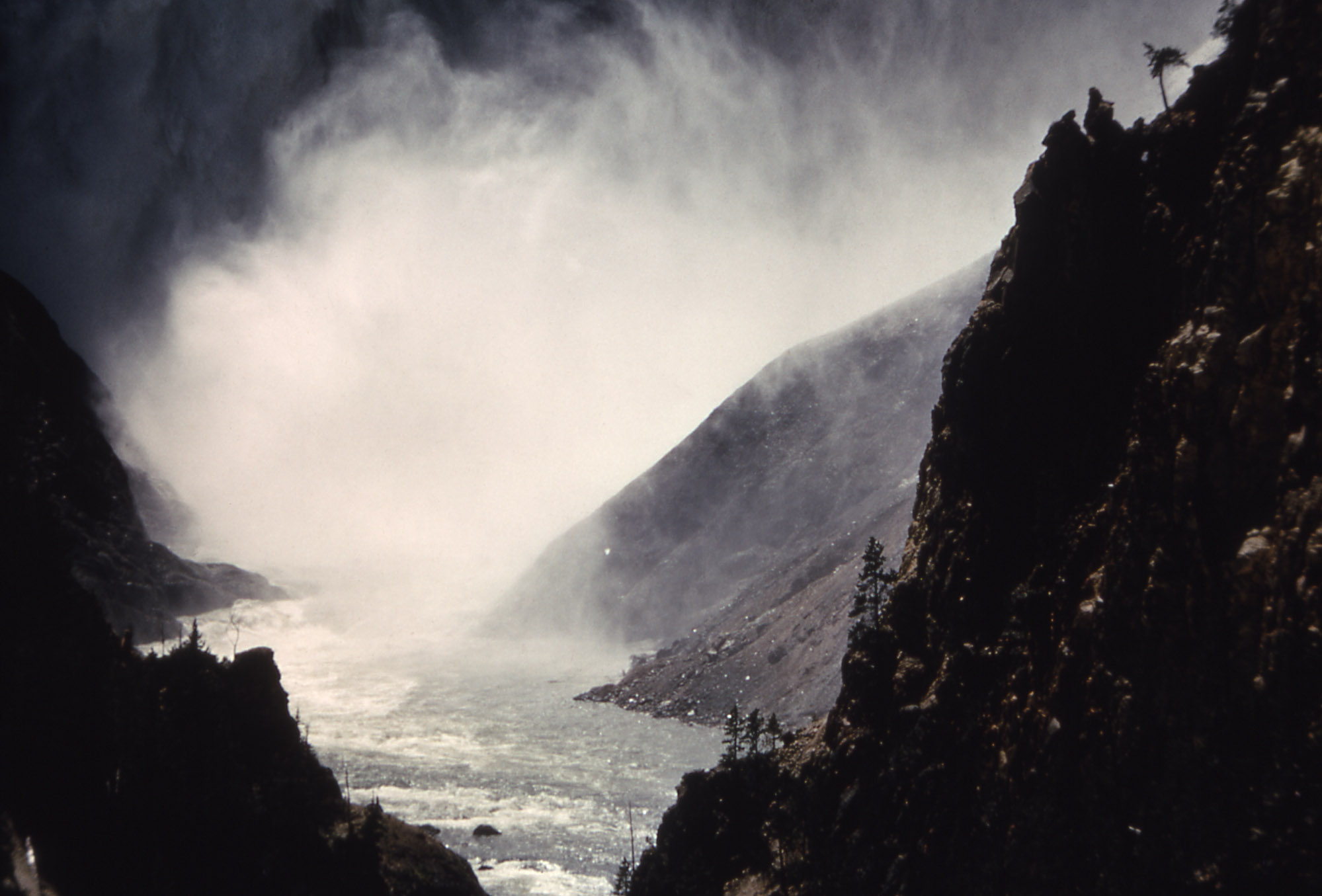
At the bottom, we found a long ridge, fifty feet above the water that envisaged the fall. For myself, I was content to rest there while Dudgeon and the Banker pursued a path of slippery granite to the bottom of the gorge, where the water ran blue and white, full of foam from its mad descent above. While it frothed and fumed and made much of itself, it was not alarming for the Yellowstone seems but a shallow brook there, between those vast walls, dwarfed by the fall and the great canyon.
From the very bottom springs one great wonderful rainbow, a perfect arch, as steadfast as though it were of steel, one foot resting on the whirlpool and the other on the rock at the right. And two hundred feet above, where one little spurt of spray strikes a jut of stone, is a baby rainbow that comes and goes.
Above me loomed that awful chasm that must be climbed. It hung over me—settled on my spirits. I tried to smile; to admire the falls; I tried to enjoy that wonderful gorge, with its coloring, its beauty, its charm. I watched an eagle leave his eyrie on the very edge of the canyon and soar above me, wings atilt, without movement, and I led my companions into a discussion of flying machines and the problem of aviation. I drew their attention to a place on the rocks opposite, where the continuous spray had mottled its somber brown with a living green of moss.
I did everything that would hold their attention and postpone the hour when I must start back. At last, every subject exhausted, the Banker suddenly started upward. From our little cliff that overhung the maelstrom, the path led up a bare rock. When I looked at it in cold blood, I wondered how I ever descended it without wings. I knew in my heart that I could never get back, but the Banker started.
It was a sheer cliff, with here and there a crack, a toe-hold, or finger-hold as far apart as one could reach. I saw him toilsomely reach from one to the other, spread-eagled against the rock face. At one place, a rock, that he grasped with his right hand, as he threw his weight on it, gave way, glanced over his arm, and just missed his head. He swung far outward and I shuddered. I thought he was gone, and his body a mangled mass on the rocks a hundred feet below. By a miracle, his left hand held, and he still pursued his way, inch by inch.
I said to Dudgeon, “I never can make that, but you must stay below and catch me if I slip.” And Dudgeon smiled.
Like most men, I am a coward when there is no one around. Here were no admiring crowds to see me risk my life. No one but Dudgeon. How I scaled that awful cliff, I shall never know. I think I was years doing it. I hung there, sometimes by two fingers of each hand, my toes inserted into some tiny crack, panting for breath, benumbed, speechless, sweating at every pore. Sometimes it seemed hours before I could move.
I was safe enough as long as I stood still. My body in my anguish put out spores and tentacles that grasped the rock. I was for a time a limpet, one of those intermediate forms of life that cling and cling and never move.
It was when I tried to progress that the strain became too great. The Banker had vanished. Dudgeon was somewhere far above me whistling “My Bonnie,” and there I clung, a mere gastropod. I doubt if, in those awful moments, I had any more intelligence than a vegetable. All I felt was fear—fear of those spear-like rocks down there below me.
What a curious thing pride is! If I had been alone with Dudgeon I should have called for rope and tackle and a hoisting engine. But the Banker had passed before me, and so, however Dudgeon smiled, I could not quit.
I knew that, at the very top, awaited me that terrible rocky slide, almost perpendicular and slimed with past ages of moisture. When I thought of that I was ready to die, but when I had attained it, there, hanging from the top of the path, was a rope.
Somehow I grasped that rope. Somehow I scrambled up that rocky slide by its aid and sank half fainting at the top. There was not air enough in the universe to satisfy me. The wide scope of the heavens, of the starry skies, did not contain enough atmosphere to fill my starved and laboring lungs.
Slowly and painfully the Banker and I climbed the rest of the hill. Slowly and painfully we got into our surrey. Meanwhile Dudgeon had danced and jigged his way up those slopes, whistling “My Bonnie,” and, when we finally seated ourselves in the surrey, he was as unbreathed as though he had just finished a two-step.
If you go down the corridor of the Canyon Hotel, and turn to the right, at the second door you can find something in a glass with ice in it; and there once more Dudgeon smiled.
∞§∞
— Abridged from F. Dumont Smith, The Summit of the World: A Trip Through Yellowstone Park, 1909.
One of the best-known photographs of Yellowstone Park shows eight uniformed men standing with their bicycles on Minerva Terrace at Mammoth Hot Springs in 1896. They were members the 25th Infantry, U.S. Army Bicycle Corps, a unit of African-American soldiers with white officers.
The unit from Fort Missoula was on maneuvers to test the utility of bicycle soldiers. By the time they reached Mammoth, the soldiers had already set up relays to demonstrate they could move messages quickly, and sneaked up on an army camp to show they could spy silently. They had traversed primitive roads, forded streams, climbed fences and traveled up to 90 miles a day—with each man hauling more than 70 pounds of food and equipment.
The Lieutenant in charge said the maneuvers demonstrated the “practicability of the bicycle for military purposes, even in a mountainous country. The matter was most thoroughly tested under all possible conditions—we made and broke camp in the rain; we traveled through mud, water, sand, dust, over rocks, ruts, etc.; for we crossed and recrossed mountain ranges, and forded streams, carrying our rations, rifles, ammunition, tents, blankets, extra underwear, medicines, tools, repairing material, cooking-utensils and extra bicycle parts.”
∞§∞
— Information from “Recent Experiments in Infantry Bicycling Corps,” by Lieutenant James a Moss, Outing: An Illustrated Monthly Magazine, 1896-97.
It was a gorgeous spring evening when I parked my car in a city lot last night and headed to Country Bookshelf on Main Street. Although my inner cynic reminded me that we will probably get more snow in Bozeman, I couldn’t help being buoyed by the warm evening.
When I arrived at the store, I was pleased to see a window display promoting my talk. A large poster announced that a discussion of the 2010 Montana Book Award by Bozeman author and member of the selection committee—me. The latest winner and the four honor books were displayed conspicuously. That—along with the nice advertisement in this morning’s newspaper—will surely draw an audience, I thought.
When I stepped inside, the clerk greeted me with a smile. (They always greet you with a smile at Country Bookshelf.) There was another poster beside the cash register.
We chatted amiably. Then I explained that I was planning to do brief readings from each of the books, so I needed a few minutes to mark the spots I had chosen with post-it notes. Then I made my way to the mezzanine where there was another display of the MBA winners.
I was finding the selected spots in the books, when an acquaintance came in and began asking questions. I answered as well as I could while searching the books.
When the appointed hour arrived, only three people were there and that included the storeowner and a clerk. As I was deciding what to do, a woman arrived and hope flickered for a moment.
With such a small group, we re-arranged the chairs. I abandoned the lectern, sat by the book display, and we began. It was magic. I had everything I needed: a topic I love (good books) and an attentive (albeit small) audience.
I outlined the history of the Montana Book Award and described how it works. (I’ve blogged about that here.) Then I launched into a discussion of each of the books. I said that reviewers usually neglect books’ connections to Montana history and culture and tried to correct that. I described their literary merits in terms of research, writing, and ability to engage readers. And I read short excerpts.
Here’s a list of titles with links to reviews I posted earlier:
I paused now and then to answer questions and let the presentation amble wherever the audience wanted to take it. All too soon, it was done. I read a short excerpt from my book, Adventures in Yellowstone, and signed copies to leave at the store.
I am grateful to the owner of Country Bookshelf, Ariana Paliobagis, and her staff. They did everything they could to make the evening a success—and it was, at least for me.
I only wish I had drawn a larger audience of book lovers—and book buyers. I hope you’ll do yourself a favor by rushing to Country Bookshelf and buying Montana Book Award winners. The store and the books deserve your support.
Ruth McLaughlin, Don Flores, Barbara Theroux (MBA organizer), Susan Resnick
It’s good to be home after an intense few days of Montana Book Awards events in Billings at the combined Montana Library Association/Mountain Plains Library Association meeting. I had a great time.
On Wednesday evening I “opened out of town” with my talk on the MBA Book Awards at Hastings Book Store in Billings. I’m sure the warm up will help me do a better job when reprise the talk at the Bozeman’s Country Bookshelf on Tuesday at 7 p.m. Here’s the announcement of the Bozeman event.
More important, I got to meet three of the winning authors at the MBA presentation ceremony on Thursday. It’s always fun to compare notes with fellow writers.
I had a long chat with Ruth McLaughlin, who won the 2010 award for her marvelous book, Bound Like Grass. We compared notes on growing up on Montana ranches, she on the east side of our vast state, I on the west side. Our biographies have some interesting parallels in addition to growing up rural in the 50s and 60s. We both used the University of Montana as our escape route to the larger world; we knew some of the same professors, and—most important—we met our spouses there. My wife, Tam, and her husband, Mike, were classmates at Great Falls High School and they seemed to enjoy reminiscing.
I also discovered a small connection with Dan Flores, who wrote the MBA Honor Book, Visions of the Big Sky. It’s a beautiful book with 140 plates representing art portraying the Northern Rockies. All the MBA judges reported the same reaction when they first saw it: “Oh no! Now I’ve got to read a coffee table book.” But they hastened to add that when they began to read it they got hooked on Dan’s erudite and expansive essays.
I asked Dan how he happened to write it. He told me that he used to write a column for The Big Sky Journal called “Images of the West” and the book is largely a compilation of those pieces. Dan stopped being a regular columnist for the magazine, but the editor decided to retain the column title. I wrote an article under the label entitled “Entrepreneurs on the Edges of Yellowstone.”
Susan Kushner Resnick came to Billings all the way from Boston to accept an Honor Book designation for Goodbye Wifes and Daughters, a marvelous account of the mine disaster that killed nearly 80 men at Bear Creek, Montana, in 1943. I wish I had found more time to talk to her about weaving together disparate strands of research into a compelling narrative. I’m sure she could have offered me some good tips on how to approach my next book, Encounters in Yellowstone.
I’m sorry I didn’t get a chance to meet Kevin Canty, who won an Honor Book designation forEverything: A Novel. Kevin’s car broke down in Bozeman and he didn’t make it to the ceremony. I would have loved to talk to him about how he makes writing about running water and jumping fish come to life.
I just got back from Author Series: A Literary Potpourri, a set of presentations by Montana authors at the joint meeting of the Montana Library Association and the Mountain Plains Library Associations in Billings.
If anyone needed a reminder that the Montana literary scene has deep roots in every corner of the state, this was it. The quality and scope of the presentations was tremendous.
My good friend, Billings author Craig Lancaster led off with a reading from his 2009 Montana Book Award honor book, 600 Hours of Edward. Craig read a hilarious section from the book where Edward, who has Aspersers Syndrome, obsessively contemplates the possibility of having sex on a first date he has finally arranged. (It’s okay to call it hilarious; Craig said the audience laughed in all the right places). Craig also read a scene from his new book, Summer Son, where the main character, Mitch Quillen, tries to figure out why his father keeps telephoning but refuses to talk.
Ruth McLaughlin, who now lives in Great Falls, read from the 2010 Montana Book Award winner, Bound Like Grass, a memoir about her growing up on a ranch in Eastern Montana. She read a section called “Hunger” that sweeps across three generations of hardscrabble existence including tales of her father fainting from hunger in school, her parents feeding their family bologna while saving grass fed beef for sale, and her own gorging on ice cream when she escaped to Missoula for college. I can’t overstate the admiration I have for Ruth’s ability to blend such disparate tales into a seamless whole.
Montana Poet Laureate Henry Real Bird read new work from typescript he held in hands, selections from his book, Horse Tracks, and recited other poems from memory. Henry’s mesmerizing recitations would have been hard to tell from his afterwords if he didn’t end with the phrase “and that’s how that one goes.” He was born and raised on the Crow Reservation and still speaks Crow as his primary language and his poetry springs from deep roots.
Outdoor and western writer Dan Aadland, like Real Bird, is a rancher who raises horses and writes, but his writing has the crisp precision you’d expect from person who holds a doctoral degree. That’s not to say Aadland’s writing isn’t personal and compelling—it is. He read from his book, Montana Hunter’s Journey, which chronicles his quest to learn about Theodore Roosevelt by riding through and hunting in the same land the great President visited.
In a few minutes, I’ll make my way over to the library at Montana State University—Billings, to take part in the Montana Book Award presentation ceremony. I get to present an original piece by Montana artist Dana Boussard to the 2010 MBA Winner, Ruth McLaughlin. I’m thrilled!
A few days ago, I posted Andrew Weikert’s story about his first encounter with the Nez Perce in Yellowstone Park. It drew a lot of attention and this comment from Danny O’Keefe:
Methinks Mr. Weikert may have been a bit prone to exaggeration judging by the litheness expressed about being able to bound into the saddle. I also doubt the Nez Perce were such poor shots. Other, more sober and historical, reports indicate they were highly accurate. Imagine the state of mind of a people on the run and fearing oblivion. The decency they exhibited in most instances stands in contrast to the treatment they received.
I began to respond to Danny, but soon discovered I had so much to say that I flooded the reply box. I decided to gather my thoughts and use them for a blog post.
The most important thing to say is that I agree with Danny’s statement about the Nez Perce: “The decency they exhibited in most cases stands in contrast to the treatment they received.” That’s the consensus now and everything I see in the historical record supports it. But the phrase “in most cases” is important.
Overall, the Nez Perce behaved in an honorable fashion, but the historic record is mixed. Emma Cowan, who was taken captive by the Nez Perce, said this: “they were kind to us, a handful of the hated oppressors. Think of it, you who assume to be civilized people! Less than ten days had elapsed since the Big Hole fight in Montana, in which women and children, as well as warriors, were killed by the score. A number, badly wounded, were in camp while we were there. Yet were we treated kindly, given food and horses, and sent to our homes.”
On the other hand, a party of Nez Perce scouts did indeed attack the camp where Weikert and Wilkie’s friends were hiding, and later Indians shot an unarmed music teacher dead when he stepped into view at a cabin door.
We’re all heroes in the stories we tell about ourselves, so I don’t doubt that Weikert embellished his recollections. But it’s certain that the Nez Perce attacked him and his friends. He had the dead bodies to prove it.
I don’t know where Danny gets the ideas about Weikert’s “litheness expressed about being able to bound into the saddle.” Weikert clearly said, “I was riding ahead when I saw them [the Indians].” He was already mounted and quickly hunched over to make a smaller target. Doubtless, the Nez Perce were fine shots, but it’s very difficult to shoot a man on a moving horse. The best evidence that Nez Perce weren’t the sharpshooters Danny says they were is that Weikert and Wilkie both lived.
I’m still working my way through the mountains of material that have been written about the flight of the Nez Perce and I could already write thousands of words about such things as the failure of whites to understand their culture, writer’s motivations to portray them either as “Red Devils” or “Noble Savages,” and why the events of the summer of 1877 led to alternating periods of peace and violence. But I’ll save those explanations for my book.
The items I put on my blog are stories, not historical documents. I collect, edit and post them in hopes that readers will find them interesting and fun.
I am a storyteller, not a historian. I choose well told accounts that describe interesting experiences. I don’t fret over their literal truth. No doubt, many stories contain exaggerations and embellishments. When I think stories contain outright fabrications, I provide caveats. But I trust my readers to take things with the proverbial “grain of salt.”
My sincere thanks to Danny for his comment. It forced me to think through a lot of important issues—far more than I could discuss here. That will make this blog—and all my work—better.
 General George W. Wingate, a wealthy New Yorker, took his wife and 17-year-old daughter to Yellowstone Park in 1885. Although there were roads by then, the Wingates decided to travel on horseback and the women rode sidesaddle. Here’s General Wingate’s description of an incident that occurred while the ladies were riding through the Paradise Valley north of Yellowstone Park.




 M. Mark Miller, Author