I left my motel half an hour before the scheduled time for Sherman Alexie’s reading—plenty of time, I thought, to walk two blocks to the Wilma Theater and get a good seat. As I turned the corner I saw the line stretched back three quarters of a block.
When the pedestrian light changed I rushed across the street and got in line just ahead of busloads of high school kids. I turned and asked them: “Where are you from?”
“Everywhere,” the said, “Polson, Arlee, Ronan.” I recognized the names; they are the rez towns north of Missoula.
Many of the kids carried books, sometimes two or three books, so they collect Alexie’s autograph. They were laughing, smiling, happy that they would get to see a person they truly admire
I left the kids behind and pushed my way through the lobby. I’d better get a seat, I thought. Those kids could stand, but my new hip and arthritic knees needed for me to sit.
I made a circuit of the main floor of the ornate old theater, but every empty seat I spotted was already claimed—and guarded by person who glared at me when I looked at it longingly. I made for the balcony.
As I looked up the rows of balcony seats I saw a man asking four women if the two seats at the end of their row next to the stairway were taken. When they said, “no,” and made room for him to pass, I stepped forward and followed him to the precious seats.
I waited and watched while ushers scouted out empty seats and directed late comers to them. Then the lights dimmed; welcoming speeches and introductions were made, and Sherman Alexie took the stage.
I won’t every try to report Alexie’s remarks. Like they say, “you had to be there.” He was hilarious and serious, insulting and ingratiating, happy and sad. Like I said, “you had to be there.
If you get a chance to hear Sherman Alexie, don’t miss it. DON’T MISS IT.
As i made my way out of the theater, I saw the high school kids from the rez towns waiting to get their books autographed. I’m sure they did.
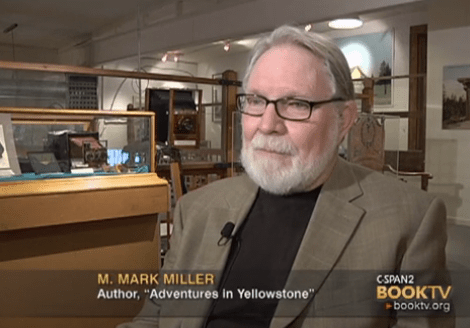
Discussing “Adventures in Yellowstone” at the Pioneer Museum of Bozeman
Color me excited. Over the weekend, C-SPAN broadcast a story about my book, Adventures in Yellowstone, on Book TV. You can watch it on their 2013 Cities Tour Page. You’ll need to scroll down to find my segment. If you’d rather, you can view it on YouTube.
I’m impressed with the power of appearing on national television. By mid-afternoon Sunday, Amazon ranked Adventures just over 12,500. That may not sound like much, but it put my book ahead of Ivan Doig’s new novel, Sweet Thunder. I don’t expect my position to hold, but it sure is nice to be ranked ahead of an established author like Doig, if only for a while.
It all began about a month ago. I was working at my desk when the phone rang.
“I’m Tiffany Rocque, an associate producer for C-SPAN,” said the voice on the line. “We’d like to interview you about your book, Adventures in Yellowstone.”
“Yeah, right,” I thought, but something told me to resist the temptation to hang up.
Tiffany explained that she was coming to Billings as part of C-SPAN’s 2013 Cities Tour and spending a day in Bozeman to interview authors for Book TV. I pretended I knew what she was talking about and said I’d be glad to participate. We exchanged phone numbers and email addresses and set September 11 as the date for the interview.
As soon as we hung up, I googled “Tiffany Rocque.” Sure enough, there was a C-SPAN producer by that name, so I began searching the C-SPAN webpage for Book TV programs. I discovered the network posts Cities Tour segments on YouTube and watched several of them until I was confident that I knew what to expect.
A few days before the interview, I asked my friend, Margie Peterson, if she would interview me for a practice session. Margie and I work together as volunteers at the Pioneer Museum of Bozeman so I knew she would do a good job of posing questions.
We met at a coffee shop, talked about what to expect, and Margie began pitching questions. I found I could answer most of Margie’s questions and could gracefully get around others when I didn’t know the answers. The practice session was very helpful and I owe Margie big time.
A couple of days before the interview, Tiffany, who was always a consummate professional, called to set up an exact time and location for the interview. We decided on 11 a.m. at the Pioneer Museum of Bozeman because it’s where I did a lot of my research for Adventures in Yellowstone and it could provide interesting backdrops for the interview.
On the appointed day, I met Tiffany and we wandered about the museum looking for a good place for the shoot. She chose a display case filled with antique cameras like those photographers would have used in the Nineteenth Century to take pictures in Yellowstone Park.
Tiffany began setting up her equipment and told me to choose stories to read from my book. I wished she had told me to do that sooner, but it gave me something to do to calm my nerves while she set up cables, lights, and microphones.
When she was ready, Tiffany sat me in a chair and told me to count to ten. After the sound check, she asked “When was Yellowstone Park established?” and we were rolling.
The interview lasted about 40 minutes with me describing the adventures of early travelers to Yellowstone Park and reading excerpts from my book. I stumbled a few times, but Tiffany just smiled. told me to go on and pitched another question.
After Tiffany packed up her equipment, we went to the Pioneer Museum Research Center. There Rachel Phillips, the Research Director, helped us with a computer search of the museum’s collection of 20,000 photographs. Tiffany chose several photos to illustrate my segment and other stories she was working on.
While I walked Tiffany to her van, I asked if she could edit out my mistakes.
She smiled and said, “If you look good, I look good.”
I think we both look great.
∞§∞
You can watch the Adventures in Yellowstone segment on:
I’ve been getting ready to reprise my presentation “The Montana Gin Marriage Law of 1935” to Smart Women on Wednesday, October 9, at 3 p..m. at Aspen Point in Bozeman. I talked about the controversial law on September 28 last year at the Pioneer Museum of Bozeman and I’ve been revising my notes. The law, which went into effect on July 1, 1935, required couples to get a health certificate signed by a doctor, and wait three days to get a marriage license. When doctors refused to sign the certificates, Montanans discovered it was nearly impossible to get a marriage license.
When I made my presentation last year, I speculated that my parents may have had the only August wedding in Montana in 1935. Since then Myrna Rytl of Bozeman told me her parents, Albert Sidney Brubaker and Ivy Marjory Fluss, were married on Aug. 11, 1935, at the family ranch in Prairie County, Montana, about 18 south of Terry. Myrna says her parents found a doctor who was willing to sign the required health certificate.They’re the only people I know of who complied with the letter of the Gin Marriage Law.
My parents got around the law by buying their marriage license in June and holding onto it until the August wedding date that they had been planning for several months. That was perfectly legal. Many couple had July weddings with licenses they bought in June, but few waited until August.
In the 1920s and 30s, many states passed Gin Marriage Laws, which got their name because they were designed to keep drunken couples from marrying after gin parties during prohibition. But Montana’s law was far more rigid than most and set off a complicated chain of events including couples traveling out of state to get married, a petition drive and a referendum election to get the law repealed.
You can read about it here. Better still, come to my presentation.
Because I write about travel to Yellowstone Park in the Nineteenth Century, I’m always on the lookout for travelers’ accounts of their trips there. I have no problem finding descriptions of unusual sights like geysers and canyons or dramatic events like bear hunting and winter storms. But few writers tell about mundane activities like pitching tents or cooking meals. Ernest Ingersoll is one of the few who does.
Ingersoll was a naturalist and journalist who signed on as a zoologist with expeditions led by the famous Yellowstone explorer Ferdinand Vandeveer Hayden. Apparently Ingersoll was not a member of Hayden’s Yellowstone expeditions in 1871 and 72, but he knew what life must have been like for the people who were. Here’s Ingersoll’s description of camp life and having breakfast on a frigid morning.
∞§∞
Dr. Hayden’s survey was divided into several working divisions of five to seven persons, each of which had a cook, and spent the season in a field of work by itself. Whether or not one thinks these cooks had a hard time of it depends on one’s point of view. It seems to me they had, because they had to rise at such an unearthly hour in the morning; but, on the other hand, they were not obliged to climb snowy and backbreaking peaks, nor to half freeze on their gale-swept summits in” taking observations,” nor to chase a lot of frantic mules and horses that chose to be ugly about being caught up. However, upon having a fairly satisfactory cook depends a large portion of your good time.
The camp cook presents himself in various characters. There are not many colored men in the West in this capacity, and few Frenchmen; but many Americans have picked up the necessary knowledge by hard experience, not one of whom, perhaps, regards it as a ” profession,” or anything better than a make-shift. It is considered by the ordinary mountaineer as a rather inferior occupation, and, as a rule, it falls to the lot of inferior men, who have tried and failed in more energetic, muscular and profitable pursuits. Of course there are exceptions, but, as a rule, they are men who are not even up to the level of picturesque interest, and are worthy of small regard from the observer, unless he is hungry. We are hungry, therefore we pursue the subject.
Roads being non-existent in the days whereof I am speaking—to a great extent it is still so—and it often being necessary to go boldly across the country without any regard for even Indian trails, the cuisine, like everything else, had to accommodate itself to the backs of the sturdy mules, on whose steady endurance depends nearly all hopes of success. The conditions to be met by kitchen and larder are, ability to be stowed together in packages of small size, convenient shape, and sufficient strength to withstand, without injury, the severest strain of the lash-ropes, and the forty or more accidents liable to happen in the course of a thousand miles of rough mountain travel.
The only sort of package that will meet these requirements is the bag. When it is full it is of that elongated and rounded shape which will lie well in the burden. As fast as it is emptied space is utilized and the weight remains manageable. In bags, then, are packed all the raw material except the few condiments, in bottles and flasks, for which, with other fragile things, a pair of paniers is provided. Even the few articles of iron-ware permitted to the camp cook are tied up in a gunny-sack.
Concerning the preparation of breakfast, I must confess almost entire ignorance. My first intimation of the meal was usually a rough shake, with a loud “Breakfast is just ready, sir. Sorry, sir, but you must get up.”
Oh, those mornings! If Ben Franklin and all the rest who so fluently advise early rising could have spent a few nights under the frosty stars of the high Rockies, they would have modified their views as to the loveliness of dawn. (Sunset glories for me!) The snow, or the hoarfrost, is thick on the grass beside your couch, and possibly your clothes, carefully tucked under the flap of your canvas coverlid last night, have been elbowed outside and are covered with as much rime as the beard of St Nicholas, while your boots are as stiff as iron, and twice as cold.
Having groaned your way into them, you hobble to the neighboring stream, duck your head in icy water, and wipe your face on a frozen towel. Usually, you must next seize a rope that has been trailing all night through the frosty grass and painfully tie up your horse, which has just been brought in, so that by the time you do kick a boulder loose and lug it up to the table for your breakfast-chair, your teeth chatter until you can hardly take a voluntary bite, and your fingers are too numb to pass the bacon to the next invalid.
This frigid condition of things was not invariable, but it was in this way that most of our breakfasts were eaten among the peaks. The matutinal meal over, we felt more limber. Overcoats were thrown aside, and every one hastened to roll up his bedding, strike the tents—if any had been erected—and help saddle and pack the mules. By the time this was accomplished the cook had washed his dishes, strapped up his “munitions of peace,” and announced that he was ready for the kitchen mule, which was the last one to be packed. This completed, he mounted the bell-mare and started off, the train of pack animals filed along behind, and we began another morning’s work before the day was well aired.
This is the little I can remember concerning breakfast.
∞§∞
— Excerpt abridged from Ernest Ingersoll, “Rocky Mountain Cookery,” Scribner’s Monthly 29(1) 125-132 (May 1880).
— Illustration from Ingersoll’s book, Knocking Around the Rockies. Harpers: New York, 1882.
When the famous Washburn Expedition of 1870 explored the area that later became Yellowstone National Park, they wanted to bring back specimens to prove that the geological wonders they reported weren’t just tall tales. Locating remarkable features like geysers, hot springs and paint pots wasn’t hard, but collecting tangible evidence could be dangerous. Here’s Nathaniel P. Langford’s description of gathering a specimen.
∞§∞
Entering the basin cautiously, we found the entire surface of the earth covered with the incrusted sinter thrown from the springs. Jets of hot vapor were expelled through a hundred natural orifices with which it was pierced, and through every fracture made by passing over it. The springs themselves were as diabolical in appearance as the witches’ caldron in Macbeth, and needed but the presence of Hecate and her weird band to realize that horrible creation of poetic fancy.
They were all in a state of violent ebullition, throwing their liquid contents to the height of three or four feet. The largest had a basin twenty by forty feet in diameter. Its greenish-yellow water was covered with bubbles, which were constantly rising, bursting, and emitting sulphurous gas from various parts of its surface. The central spring seethed and bubbled like a boiling caldron. Fearful volumes of vapor were constantly escaping it.
Near it was another, not so large, but more infernal in appearance. Its contents, of the consistency of paint, were in constant, noisy ebullition. A stick thrust into it, on being withdrawn, was coated with lead-colored slime a quarter of an inch in thickness. Nothing flows from this spring. Seemingly, it is boiling down.
A fourth spring, which exhibited the same physical features, was partly covered by an overhanging ledge of rock. We tried to fathom it, but the bottom was beyond the reach of the longest pole we could find. Rocks cast into it increased the agitation of its waters. There were several other springs in the group, smaller in size, but presenting the same characteristics.
The approach to them was unsafe, the incrustation surrounding them bending in many places beneath our weight—and from the fractures thus created would ooze a sulphury slime of the consistency of mucilage.
It was with great difficulty that we obtained specimens from the natural apertures with which the crust is filled—a feat which was accomplished by one only of our party, who extended himself at full length upon that portion of the incrustation which yielded the least, but which was not sufficiently strong to bear his weight while in an upright position, and at imminent risk of sinking into the infernal mixture, rolled over and over to the edge of the opening, and with the crust slowly bending and sinking beneath him, hurriedly secured the coveted prize.
∞§∞
— Excerpt and illustration from Nathaniel P. Langford, “The Wonders of the Yellowstone,” Scribner’s Monthly 2(1):1-27 (May 1871).
— To see other stories by this author, click “Langford” under the Categories button.
— An abridged version of Langford’s 1905 book, The Discovery of Yellowstone Park—Diary of the Washburn Expedition to the Yellowstone and Firehole Rivers in the Year 1870, is available in my book, Adventures in Yellowstone.
In 1896, naturalist and writer Ernest Thompson Seton went to Yellowstone Park to inventory animals there for a magazine assignment. He spent a day watching bears at the Fountain Hotel dump near the Lower Geyser Basin. Such bear watching was common then.
Seton saw a momma black bear called “Grumpy” pick a fight with a huge grizzly called “Wahb” to protect her sickly cub. After the battle, Seton interviewed hotel employees to find out as much as he could about the bears. Based on his research, Seton wrote his famous story, “Johnny Bear,” and a book, Biography of a Grizzly.
The most memorable incident in “Johnny Bear,” is the battle between Grumpy and Wahb, but in it Seton described other adventures like Grumpy’s encounter with an even more formidable foe.
∞§∞
Grumpy herself was fond of plum jam. The odor was now, of course, very strong and proportionately alluring; so Grumpy followed it somewhat cautiously up to the kitchen door. There was nothing surprising about this. The rule of “live and let live” is so strictly enforced in the park that the bears often come to the kitchen door for pickings, and on getting something, they go quietly back to the woods. Doubtless Johnny and Grumpy would each have gotten their tart but that a new factor appeared in the case.
That week the Hotel people had brought a new cat from the East. She was not much more than a kitten, but still had a litter of her own, and at the moment that Grumpy reached the door, the cat and her family were sunning themselves on the top step. Pussy opened her eyes to see this huge, shaggy monster towering above her.
The cat had never before seen a bear—she had not been there long enough; she did not know even what a bear was. She knew what a dog was, and here was a bigger, more awful bobtailed black dog than ever she had dreamed of coming right at her. Her first thought was to fly for her life. But her next was for the kittens. She must take care of them. She must at least cover their retreat. So, like a brave little mother, she braced herself on that doorstep, and spreading her back, her claws, her tail, and everything she had to spread, she screamed out at the bear an unmistakable order to, “STOP!”
The language must have been “cat,” but the meaning was clear to the bear; for those who saw it maintain stoutly that Grumpy not only stopped, but she also conformed to the custom of the country and in token of surrender held up her hands.
However, the position she thus took made her so high that the cat seemed tiny in the distance below. Old Grumpy had faced a Grizzly once, and was she now to be held up by a miserable little spike-tailed skunk no bigger than a mouthful? She was ashamed of herself, especially when a wail from Johnny smote on her ear and reminded her of her plain duty, as well as supplied his usual moral support.
So she dropped down on her front feet to proceed.
Again the cat shrieked, “STOP!”
But Grumpy ignored the command. A scared mew from a kitten nerved the cat, and she launched her ultimatum, which ultimatum was herself. Eighteen sharp claws, a mouthful of keen teeth, had Pussy, and she worked them all with a desperate will when she landed on Grumpy’s bare, bald, sensitive nose, just the spot of all where the bear could not stand it, and then worked backward to a point outside the sweep of Grumpy’s claws. After one or two vain attempts to shake the spotted fury off, old Grumpy did just as most creatures would have done under the circumstances; she turned tail and bolted out of the enemy’s country into her own woods.
But Puss’s fighting blood was up. She was not content with repelling the enemy; she wanted to inflict a crushing defeat, to achieve an absolute and final rout. And however fast old Grumpy might go, it did not count, for the cat was still on top, working her teeth and claws like a little demon. Grumpy, always erratic, now became panic stricken. The trail of the pair was flecked with tufts of long black hair, and there was even blood shed. Honor surely was satisfied, but Pussy was not. Round and round they had gone in the mad race. Grumpy was frantic, absolutely humiliated, and ready to make any terms; but Pussy seemed deaf to her cough-like yelps, and no one knows how far the cat might have ridden that day had not Johnny unwittingly put a new idea into his mother’s head by bawling in his best style from the top of his last tree, which tree Grumpy made for and scrambled up.
This was so clearly the enemy’s country and in view of his reinforcements that the cat wisely decided to follow no farther. She jumped from the climbing bear to the ground, and then mounted sentry guard below, marching around with tail in the air, daring that bear to come down. Then the kittens came out and sat around, and enjoyed it all hugely. And the mountaineers assured me that the bears would have been kept up the tree till they were starved, had not the cook of the Hotel come out and called off his cat—although his statement was not among those vouched for by the officers of the Park.
∞§∞
— Excerpt condensed from “Johnny Bear” by Ernest Thompson Seton, Scriberner’s Magazine 28(6):658-671 (December 1900). Illustration by Seton from the magazine.
Dignitaries in a White Motor Company car lead the official automobile entourage in Yellowstone Park on August 1, 1915.
The story below claims to describe the trip by the first automobiles admitted to Yellowstone National Park. I’ve learned to be skeptical of such claims so I checked it out in Aubrey Haines’ definitive history, The Yellowstone Story.
According to Haines, Henry G. Merry sneaked in his 1897 Winton in 1902 making it the first car to enter the park. As Merry’s son told the story, his father raced his car past the mounted guards at the Gardiner Entrance. The cavalrymen gave chase on horseback and caught the machine when slowed on steep hill. They tied ropes to the the Winton and dragged it to park headquarters at Mammoth where the park superintendent ordered it out of the park—after demanding a ride.
People feared that automobiles would frighten horses and wildlife, so the park superintendent issue a general order forbidding cars. Hains says several vehicles entered the park by accident or contrivance before the order was lifted in 1915.
Political pressure from motorists increased until the Secretary of Interior decided in April 1915 to admit cars on August 1 of that year. However, the park superintendent wasn’t sure that cars could make the trip so he allowed two cars, a Buick and a Franklin, to drive a two-day circuit in June. Then a group of congressmen and government officials motored from the East Entrance to the Lake Hotel on July 4. The new regulation allowing cars was to go into effect on August 1, but the superintendent feared congestion so he issued seven permits on July 31.
Haines says that officials of the White Motor Company thought one of their cars was the first officially allowed in the park and issued a news release to that effect. The news release apparently was the basis for the story below. A magazine editor asked for clarification from the park superintendent who told him that a Ford had been issued permit number one the day before the White led the official entourage.
For the first year, private cars shared park roads with touring coaches pulled by four-horse teams, but in 1916 commercial tour busses were admitted. Those buses were made by the White Motor Company.
∞§∞
The first car entered the park at 6 o’clock on the afternoon of July 31, when a party of government officials, riding in a White car, passed through the lava arch at Gardiner, Montana, followed by a large cavalcade of motorists who were waiting for the honor of entering the park on the first day.
In the official car were Colonel Lloyd M. Brett, U. S. A., acting superintendent of the park, Major Amos A. Fries, U. S. A., chief of the park engineers, H. W. Child, president of the Yellowstone Park Hotel and Transportation Companies, and Robert S. Yard, of the Department of the Interior. The car, followed by the procession of motorists, led the way to the Mammoth Hot Springs Hotel, where the night was spent. The following day it led to a tour of the entire park.
From the seat of a comfortable motorcar it is possible to see Yellowstone in a way that no other mode of transportation affords. Entering the park at Gardiner, the official car covered a five-mile stretch of road, winding around beautiful hills and high cliffs and skirted by the rugged, foaming Gardiner river. This road brought the party to the Mammoth Hot Springs Hotel.
Promptly at 7 the next morning, the official White left Mammoth Hotel for a complete circuit of the park. The road requires a sharp ascent and soon overlooks the gleaming white formation of the Mammoth Hot Springs, 6,264 feet, which had appeared as a small mountain when viewed from the porch of the hotel. Three miles farther, Silver Gate and the Hoodoos, massive blocks of travertine, are passed at an altitude of 7,000 feet. One-half mile farther, one of the prettiest spots on the trip is reached. This is Golden Gate, 7,245 feet, a curving road on the side of a deep canyon. A fine concrete viaduct here shows great engineering skill.
Golden Gate canyon then emerges into picturesque Swan Lake basin. From this mountain valley can be seen Electric peak, Quadrant mountain, Bannock peak, Antler peak, The Dome, Trilobite point and Mount Holmes. Ten miles from Mammoth Hot Springs, Appollinaris Spring is reached. Two miles farther Obsidian cliff is reached.
Roaring mountain, fifteen and one-half miles from Mammoth Hot Springs, is the next interesting place. Passing from here Twin Lakes is almost immediately reached. Here are two small lakes of entirely different color, but joined together by a small strip of water. Then comes the Frying Pan, eighteen miles from Mammoth Hot Springs, with an altitude of 7,500 feet. This is a hot spring, which stews and sizzles year in and year out, reminding one of a hot griddle all ready for business.
At the crossing of the Gibbon River, the tourist comes to the first soldier station, and from there it is only a half mile to Norris Geyser basin, where Norris hotel is located. As the official car pulled up to the steps of the hotel a great crowd collected to see the first motorcar that had ever visited the hotel.
A great deal of time can be well spent at this point viewing the many geysers— Constant geyser, Whirligig geyser, Valentine geyser, Black Growler, Bathtub, Emerald pool and some small paint pots.as the vari-colored thermal pools are called.
The official car left Norris at 9:15 a. m., after a brief stop. The next hotel stop is Fountain Hotel, twenty miles farther into the park. Approaching Fountain Hotel another geyser basin is seen. This is the largest in area of the park geyser basins, but the geysers here are scattered and are not of as much importance as others along the route. Fountain Hotel was passed at 11:00 a. m., and after a short ride Mammoth Paint Pots were reached.
The official party reached Upper geyser basin at 12:00 o’clock, and stopped two and one-half hours for lunch at the beautiful Old Faithful Inn. The stop gave time for a leisurely visit to the area of geysers here, which contains the largest and finest geysers in the world. Of course the center of attraction is Old Faithful geyser, which nearly every one has heard of, and the Giant geyser, the greatest of them all.
Leaving Old Faithful Inn at 2:30, the official car sped on and began the long climb to the Continental Divide, first along the Fire Hole river and then up Spring Creek canyon. Two miles from the hotel a stop was made to view the beautiful Keppler cascades. The first crossing of the Continental divide is made at an altitude of 8.240 feet, eight and one-half miles from Old Faithful Inn. The road leads down Corkscrew hill, where good brakes and a substantial steering gear come in handy.
Lake hotel was reached at 6:15 p. m., and it seemed a pity that the schedule required the party to push on to Canyon Hotel without much time to spend enjoying the wonderful view across the Yellowstone lake from the veranda of the Lake Hotel. However, there was a slight delay here, while the White ran back seven miles to rescue the press car, which had stalled and refused to start on one of the long, tortuous hills.
Starting after dinner from the Lake Hotel at 7:30 p. m., the seventeen miles of road to Canyon Hotel were covered in one and one-half hours, over soft, slippery roads which, added to the frequent turnings, scarcely warranted the speed that “was made. It had rained all of Saturday night and the car was covered with mud. The night was spent at Grand Canyon Hotel.
Beautiful sights were seen on the morning run from the Canyon Hotel to Tower falls by way of Dunraven pass, 8,800 feet. There is a road that leads to the top of Mt. Washburn, but since the roads in this vicinity were found particularly wet, narrow and slippery, this route was avoided.
About half way around Mt. Washburn, a brand new auto station built of logs has just been erected, on the outside of the road. Soldiers are stationed here, as elsewhere through the park, to check passing autos and make sure that motor tourists are observing the regulations.
Leaving Mt. Washburn, the road steadily descends to Tower creek, whose altitude is 6,400 feet. The road along here provides wonderful scenery, as is runs along high above the rock-strewn Yellowstone river. After the long, descending road from Mt. Washburn another soldier station is passed and, by turning off the main road a half mile, the Petrified Trees may be reached. The sight is well worth the slight detour.
Approaching the end of the trip a fine view is obtained of the valley in which Fort Yellowstone and Mammoth Hotel are located. The sight of this great group of buildings, flanked by hills and mountains and the white terraces of the Mammoth Hot Springs, is a fitting end to a most remarkable journey. The official car unloaded its passengers in front of the residence of Colonel Brett at 11:15 on August 2, and the first tour of Yellowstone Park ever made by Automobile had been completed in less than one and one-half days.
However, no one wishing to really enjoy the scenery of Yellowstone Park should make the trip in less than four days. Overnight stops should be made at Mammoth Hot Springs Hotel, Old Faithful Inn, the Lake Hotel and at the Grand Canyon Hotel. While all motor tourists would be required to make the regular schedule between the checking stations, the regulations permit them to lay over at hotels and other points of interest until they are ready to proceed, which may be done when the next schedule of motor cars passes their location.
At present the privileges of the park are only extended to privately owned motor cars. The present tourist service through the park will be maintained by horse-drawn vehicles operated by the regular transportation companies as heretofore. All regular traffic will move in one general direction in going through the park. Motor cars will leave one-half hour before the stages, from the entrances or from the controls where they are checked in during the journey through the park. The speed at which cars may travel is stated in the regulations and varies according to the requirements of safety in various localities. Fines will be imposed on motorists who arrive or leave the controls not according to schedule.
A special telephone service has been installed to enable motor tourists to keep in touch with headquarters if breakdowns occur. In such emergencies, if motor cars are unable to reach the next control on time, they must be parked off the road or on the outer edge of it, and wait for the next schedule of motor cars passing that point or, until special permission to proceed is obtained from the park guards.
Motorists who intend to tour Yellowstone Park should thoroughly familiarize themselves with the rules and know the penalties imposed for any infractions. It is also important to plan the trip before entering the park, so as not to miss any points of interest which one might wish to return to. This cannot be done except by encircling the park and entering again, since travel moves only in one direction.
Yellowstone Gate, an on-line magazine that covers all the news from Yellowstone and Grand Teton National Parks, has published a very nice article about me and my writing. You can also see selections from my collection of first-person accounts of early travel to Yellowstone Park by scrolling under “History.”
Any fan of Yellowstone and Teton Parks should read Yellowstone Gate regularly. Ruffin Prevost and his staff do a marvelous job of keeping up with all the latest park news, providing gorgeous photographs and interesting features.
I’ll return to Old Faithful Inn this weekend to sign copies of my book, Adventures in Yellowstone: Early Travelers Tell Their Tales. I’ll be in the lobby of the Inn Saturday and Sunday (Aug. 17-18) from 11 a.m. to 2 p.m. and and 3 to 5 p.m. If you’re in the area, stop by my table for a chat. I’d love to sigh a copy for you.
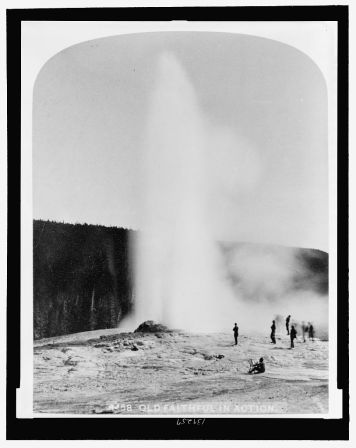
I also hope I’ll get a chance to watch Old Faithful Geyser play again. I never get tired of that. I always remember the first time I saw it as a little boy when you could stand much closer than you can today. And I wonder what it was like in the 1800s when you could walk right up to the geyser like these people in an 1883 photo by the famous Yellowstone photographer, F. Jay Haynes.
I’ll be signing copies of my book, Adventures in Yellowstone: Early Travelers Tell Their Tales, at the Old Faithful Inn on two weekends in August. I’ll be in the lobby of the world famous hotel on Aug. 10-11 and Aug. 17-18 from 11 a.m to 2 p.m. and 3 to 5 p.m.
This will be the fourth summer I’ve signed books at the world famous hotel, and I’ve blogged about the experience several times.
Adventures in Yellowstone contains a dozen first-person accounts of early travel to the park. Several of the stories are about adventures the Yellowstone guides and road signs still talk about. Here’s a list of examples with links to excerpts:
I got the idea for my next book, Shorter Stories of Greater Yellowstone, while talking to people at my earlier book signings. People told me they want a collection that contains short stories they can finish around the campfire at night or while driving between sights. When I heard that, I decided to compile such a book.
Shorter Stories will contain about sixty stories of 400 to 2,000 words. The first-person accounts will be organized in twelve parts with titles like “Mountain Men,” “Hunting,” and “Bear Stories.” The entire book will be about 60,000 words including introductions for each part and story. I expect to be signing copies of it at Old Faithful Inn in the Summer of 2014.


 so strictly enforced in the park that the bears often come to the kitchen door for pickings, and on getting something, they go quietly back to the woods. Doubtless Johnny and Grumpy would each have gotten their tart but that a new factor appeared in the case.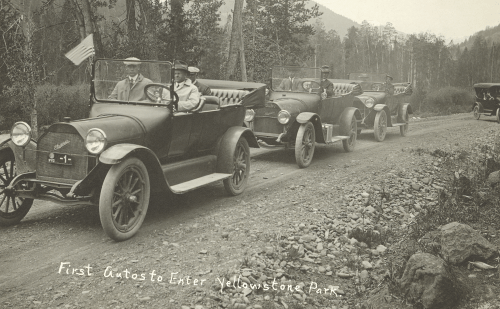

 I’ll return to Old Faithful Inn this weekend to sign copies of my book,
 M. Mark Miller, Author