Author: mmarkmiller

  • A Tale: Guarding the Horses — Rossiter Raymond, 1871


    Early travelers to Yellowstone Park often woke up in the morning to discover that their horses and wandered away in the night. That’s because the tourists faced a dilemma. Their horses needed to graze to keep up their strength, so the travelers had to give them some freedom. But with too much freedom, the animals would wander away leaving the travelers afoot in the remote wilderness.

     Rossiter Raymond, who led the first group of tourists to visit Yellowstone Park in 1871, solved the problem by picketing his men’s horses and posting a guard to keep their roped untangled. His Raymond’s description of what it was like to be on guard duty.

    ∞§∞

    grazing horsesOur practice, at night was to pour water on the fire after supper, and picket the animals close around us where we lay on the ground. After reaching the Upper Madison we took turns in standing guard, to watch again possible stealing or stampeding of the stock and also, from time to time, to see to it that the picket-ropes were clear.

    When you want to pasture one horse for one night on an ample lawn, the business is easy enough. You drive your picket pin deep enough to hold, and leave enough of it above ground to permit the firm fastening of the rope, but not to permit the winding up of the rope oil the pin by possible circular promenades on the horse’s part; after which, you bid the horse, and all care on his behalf, goodnight.

    Unless he is a very raw recruit at picket-duty, he will move about with perfect freedom over the whole circle of which the rope is the radius; and you will hear him nibble and crunch the squeaking grass at all hours of the night. But, when you apprehend Indians you can’t afford to hunt up a smooth lawn for each horse. As the higher mountains are entered, the grass grows scanty, and it is necessary to make the best of such patches as occur.

    So the animals get picketed where bushes interfere with the free circulation of the ropes, or so near together that they can (and accordingly do) get up mutual entanglements. Every such performance shortens the radius, and the realm of food. An experienced picketer generally makes one or two attempts to disentangle himself, by traveling around in the direction that first occurs to him. If this happens to be the right one, he may work out again to the, full arc of his destined supper: otherwise he winds himself up, and then (unlike a clock) stops going.

    It is the duty of the guard to go out, unwind him, and start him again, lest, standing in patient disgust all night, he be found in the morning empty of grass and of spirit for the day’s work. It is solemnly amusing to march in a moony midnight hither and thither, followed by a silent steed, through all the intricacies of the knot he has tied, with the aid of stumps, bushes, his own legs, and his neighbor’s rope. Fancy yourself unraveling a bad case of shoestring, and obliged to pull a horse through every loop at the end of the string. The Lancers ” is nothing to it. For a real mazy dance, to puzzle the floor-committee, give me the nine-horse pick picket cotillion.

    At daylight the animals are let loose, and stray about, trailing their long ropes, in search of untrampled grass for breakfast. It is easy to catch them by means of the ropes, though now and then an experienced old fellow has learned the exact length of his lariat, and will not let you get near enough to clutch the end of it.

    This keeping guard at night without the companionship of the campfire is a chilly and dispiriting affair. The first watch is not very lonely. There is generally some wakeful comrade who sits up in his bed to talk; or perhaps the whole party linger around the flameless embers, exchanging stories of adventure. But he who “goes on” from midnight till dawn, surrounded only by mummies rolled in blankets on the ground, is thrown upon his thoughts for company.

    The night-noises are mysterious and amazingly various, particularly if the camp is surrounded by woods. There are deer and elk going down to the water to drink; there are unnatural birds that whistle and answer, for the world, like ambuscading savages; there are crackling twigs; the picket-ropes crawl through the grass with a dreadful sound; the grass itself squeaks in an unearthly way when it is pulled by the horses’ mouths.

    The steady crunching of their grinders is a re-assuring, because familiar sound; but ever and anon it stops suddenly, all the horses seeming to stand motionless, and to listen. Their ears are quicker than yours: they hear something moving in the forest, -doubtless the wily Sioux. You glide from tree to tree, revolver in hand, until you get near enough to see that they are all asleep. Old Bony is dreaming unpleasantly besides: it is an uncanny thing—a horse with the nightmare. You make the rounds. They all wake and go to eating again: so you know they were not scared except the blooded bay, who mistakes you for an Indian, and snorts and cavorts furiously.

    I remember well such a night, near the banks of the Yellowstone Lake, when we were doubly suspicious, because we had heard a rifle-shot close by our camp, not fired by any member of our party. I was on guard at about 1 a.m., and keenly alive to all the blood-curdling sensations I have mentioned, when suddenly the trees above and the ground beneath were shaken by a brief but unmistakable earthquake. The shock was in the nature of a horizontal vibration; and the emotion produced by the experience at such an hour, in the solemn woods, was a unique combination of awe and nausea. I was not sorry that one or two of the party were waked by it: under the circumstances, I was grateful for a little conversation.

    ∞§∞

     — Pages 173-176 in  Rossiter W. Raymond, Camp and Cabin. New York: Ford Howard and Hulbert, 1880.

    — B.H. Alexander Postcard, Pioneer Museum of Bozeman.

    — You might also enjoy these tales about Raymond’s expedition.

  • A Tale: Traveling to Yellowstone with a Mule Train — John Mortimer Murphy, c. 1879

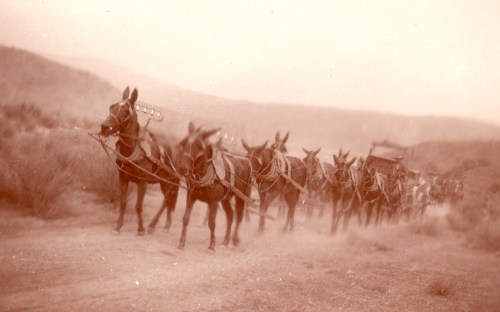
    Charles D. Loughrey Mule Train PMB

    When John Mortimer Murphy went to Yellowstone Park in the 1870s, he decided to take part of the trip from Utah to Montana by mule train. Such trains, which supplied Montana gold rush towns in the 1860s and 70s, had teams of as many as 20 mules. Here’s Murphy’s tale about traveling with the hardy teamsters who drove the huge teams.

    ∞§∞

    After a tediously slow journey the train reached Corinne, the only gentile settlement in Utah, and therefore a perfect Babylon of wickedness in the eyes of Mormons. This place was formerly unusually prosperous and enterprising, as it was the head-quarters for the numerous prairie schooners that transported goods into Montana; but since the construction of the Utah Northern Railroad it has lost its commerce and prestige, and is now only a sleepy village of 700 inhabitants.

    I left there for a small town called Franklin, in Idaho, 100 miles distant, via railroad, which is now the head-quarters for the hundreds of large wagons or prairie schooners that take manufactured articles into Montana, and return laden with the products of that extensive region. From Franklin all travel northward is by stage or horseback, and he who chooses the latter may rely upon jolting enough to dispel all symptoms of indigestion, as the country to be traversed is very hilly, and the roads are mere trails.

    I secured a seat in one of the “schooners,” as I wished to see the sort of life led by those captains of the plains who drive the mules, and I thoroughly enjoyed the novelty of the trip. The genial fellow with whom I booked as a free passenger led a line of perhaps thirty wagons, and by this leading advantage escaped the clouds of dust, which enveloped those in the rear. His team consisted of eight pairs of mules and two “bell mares,” whose jingling cadence soothed the feelings of the obstinate long-eared quadrupeds so much that they toiled and struggled all day without an effort at a display of stubbornness.

    Our route led back through Idaho, and carried us through the fertile valley of the Beaver River, where Mormons were quite thickly settled. Their substantial houses, well-kept farms, and crowds of tow-headed children were seen in every direction, and gave the country a cultivated appearance most pleasing to behold.

    The long line of wagons rumbled onward all day, and in the evening encamped together in an open plain. Fires were then lighted, and a supper, consisting of fat bacon, bread made out of self-raising flour and baked in a pan, and hot strong coffee was partaken of by the drivers with a relish which can be enjoyed only by those who toil hard and have their appetites sharpened by the bracing air of the plains.

    After this was over the teamsters paid each other, friendly visits, but I noticed that the inquiries made were usually about the draught animals, and their good conduct during the day. If the answers were not satisfactory on the latter point, a dozen recipes would be given for bettering it, and some would go so far as to advise the death of that “Yaller Jim,” “Black Bill,” or “Wall-eyed Virginia,” as nothing else could cure them of their ill temper.

    The last spree in Franklin, Bozeman, or Helena was related with the most minute exactness, and the fight that Piegan Jack had with Hiel Southard discussed in all its bearings—and the cause of the death of the latter analyzed in the most tediously detailed manner.

    When the time for retiring came each muleteer spread a roll of blankets under his wagon, rolled himself up in it, and was soon fast asleep. At daybreak the next morning the animals were fed, a repast of the same character as the previous dinner eaten, and the long line resumed its march.

    These teamsters are a hardy, rough-and-ready class, who seem impervious alike to fear and the vicissitudes of the weather; and it would be difficult to find any persons more hospitable than they are. Their mode of life prevents them from enjoying many of the advantages of education, yet few are met who cannot read and write; and all can discuss local and national politics with a terseness and emphasis that would do credit to a professional politician.

    The individual among them who is not brave, or, as they term it, “has no sand in him,” is rare indeed, as the majority of them have had to fight Indians many a day, and being adepts with the rifle and revolver, the body of men that could defeat them is difficult to find. Every one carries arms in his wagon, and not a few wear revolvers in their belts, so that they are prepared for emergencies at all times.

    Many drive their own teams, but several are employed by transport companies at sums varying from 100 to 200 dollars per mouth, according to the dangerous character of the route they traverse, or the heavy work they have to do. Whenever a body of Indians takes to the war path the caravanseries are the first objects of assault, if plunder is desired, but the occasion is very rare when the attack is successful, if the teamsters are in any numbers, or have received an intimation of their danger.

    I stayed with the caravan until it reached Fort Hall, in Idaho, and there bidding my kind host a farewell, I booked as a passenger in the stage that ran through Montana, then distant some 200 miles. The route over which it travelled was but sparsely settled, and wandering Indians even were seldom seen.

     ∞§∞

    — John Mortimer Murphy, Rambles in Northwestern America, London: Chapman and Hall, 1879. (pages 195-197)

    — Charles D.Loughrey Photo, Pioneer Museum of Bozeman.

    — You might also enjoy General W.E. Strong’s story about traveling to Montana by stagecoach, “One Good Square Drink.”

  • A Tale: Face to Face With a Hungry Mountain Lion — Turrill, 1898

    Lion 2 YDSF

    By the time Gardner Stillson Turrill toured Yellowstone Park in 1898, the Army had outlawed hunting there and made tourists either leave their guns in storage or have them sealed when they entered the park. Despite the gun regulations, hunters still were drawn to the area. In fact, conservations like Theodore Roosevelt promoted the idea that protecting game animals inside park boundaries would make for to abundant hunting on the periphery.

    Turrill and his companions not only were avid hunters, they also entertained each other buy telling hunting stories. Here’s a tale one of Turrill’s friends told about an adventure he had while staying with an old man in a cabin high in the Wyoming Mountains.

    ∞§∞

    One night I was awakened by a shuffling noise overhead and the heavy footfall of some large animal that was evidently on the cabin roof. I got out of bed to make sure the door and window were securely fastened, and, as additional precaution, I set my rifle at the head of the bunk and piled some dry pine knots on the fire.

    I heard nothing more that night, but the next morning I saw the tracks of an extra large mountain lion on all sides of the house as well as in the snow on the roof. After breakfast I told the old man that I was going out for a little hunt and warned him not to be uneasy if I were gone several hours.

    I followed the tracks of the big cat as he had made his way to the creek. I was fond of adventure and was determined to have a shot at the animal if I could possibly overtake him.

    The snow was soft, but with snowshoes I was able to make good time. In places I noticed where the lion had broken through into deep drifts and the way they were ploughed and scattered by the beast in his efforts to flounder through one could almost imagine that a horse had been forcing his way across. The animal surely must have been hungry to go so far from his lair in the deep snow!

    I soon reached the creek and followed the tracks on over to the other side. The trail now wound here and there among the trees. up the hillside toward a bold bare bluff that towered above the trees several hundred yards ahead of me. I had been advancing with the utmost caution, but now decided that the animal had surely gone to his den somewhere along the base of the cliff

    “Very good.” I thought to myself. ” I will follow the tracks to the den, then climb a tree and shoot Mr. Catamount at my leisure whenever he sees fit to come out. The animal will soon be mine now and I will have a fine skin for my morning’s walk.

    Occupied with these pleasing reflections I shouldered my gun and, as I walked along, looked away through the trees at the precipitous bluff that was my objective point. But suddenly I came to my senses with a start. The panther trail had disappeared.

    I retraced my steps a few rods till I came again to the huge cat-like tracks that I had been following. They seemed to end right there. It was very strange. Did the creature have wings? ‘I pursed my lips to fetch a dismayed whistle, but that whistle was never uttered.

    Quicker than lightning the truth flashed over me. The animal had taken to a tree. and was even then, very likely, making ready for a spring. If I had been experienced I would not have walked into such a trap.

    My heart seemed to stop beating and my blood appeared to be frozen in my veins. A feeling of deadly weakness came over me, but only for a second. Hastily I grasped the gun and looked up. To run would be to court instant death. My only hope was that I might see the beast before he sprang.

    Eagerly I scanned the branches above me but could discern nothing. A moment of breathless suspense, and then I heard a soft patting sound which could be nothing else than the beast’s tail striking against a branch, as he switched it to and fro. The sound seemed to come from a huge spruce just in front of me.

    Looking closely I was able to make out the dark indistinct form lying along one of the main branches in the shadow of the thick foliage. To hesitate was fatal and to miss my mark would be equally so. I hastily threw the gun to my shoulder and pulled the trigger.

    The report of the rifle was followed by a shrill scream as the lion hurled himself at me through the air. But my bullet had taken effect in his shoulder and he fell short.

    I tried to shoot again, but the lever caught for some cause. and the beast came at me snarling and spitting in a terrible fury. The instinct of self-preservation was strong and mustering all my strength. I shoved the muzzle of the gun right into those cruel red jaws.

    The panther gagged, bit at the barrel of the gun and tried to get at me. The next second I gave a jerk on the lever, disengaged it and shoved a cartridge into place. Just as I felt my strength leaving. I pulled the trigger; the old gun roared and the panther fell at my feet with its head literally torn to pieces.

    It was a very weak and humble hunter that pulled himself together. walked back across the creek and up the mountain side to the little cabin. I have never shot a mountain lion since, and I hope that I will never again have occasion to do so.

    ∞§∞

     — Pages 49-52 in Gardner Stillson Turrill, A Tale of the Yellowstone. Jefferson, Iowa: G.S. Turrill Publishing, 1901.

    — You might also enjoy:

    For more hunting tales, click “Hunting” under the Categories button.

  • A Tale: “The worst nuisance in the way of wild varmints is the bears.” Clifton Johnson, 1919.

    Model T tourists and bears YDSF

    Sometime in the nineteen teens, Clifton Johnson took a walking tour of Yellowstone Park. He visited the area in May before the tourist season, so about the only people he encountered were winter keepers, men who cleared the roofs of park buildings to keep mountains of snow from crushing them. Johnson had long conversations with the winter keepers and collected their stories.

    One of the people Johnson interviewed was the winter keeper at Norris Geyser Basin, a man who had lived in the park since 1883 before the Army took over administration there. The Army forbid hunting and ended the decimation of park wildlife that had made seeing large animals like elk and bison rare. The soldiers lacked today’s notion of ecological balance so they continued killing large predators like wolves and mountain lions in hopes of protecting other animals.

    By the time Johnson visited Yellowstone Park, most animals had made a comeback so he saw many of them and their tracks in fresh snow as he trudged along. Here’s what the winter keeper at Norris said about Yellowstone animals.

    ∞§∞

     I spoke to the keeper about some of the animals I had seen, and of the numerous foot prints of wild creatures I had observed in the snow and mud. “Yes,” he said, “we have here about every animal that’ll live in a cold climate—bears and buffaloes, moose, wildcats, lynx, badgers, big-horns, red, black, blue, and silver foxes, mountain lions, eagles, and lots of other creatures. They claim there ain’t any wolves; but I think I saw one once. He snapped his jaw at me and run off, but it was in a snowstorm, and I didn’t see him real plain.

    The government tries to kill off any such animals that are very destructive to the other creatures. Mountain lions are bad that way. They ketch a good many of our deer and elk. I suppose there’s quite a lot of ’em in the park; but you might stay here a hundred years and never see one—they’re just that sly. However, they see you and will follow you, stopping when you stop and going on when you go on.

    “Nearly all the animals are much more plenty than they were when I began living in the Park in 1883. I didn’t see any deer for a long time. They were so wild they kept back in the woods. Now they’re so tame I often feed ’em out of my hand.

    One of the most interesting things I know of is to see a deer kill a snake. It will leap into the air, put all four feet within a few inches of each other and light on the snake so quick that the snake don’t know what’s happened. The deer is off at once, and then makes the same kind of a jump again and again, till its sharp hoofs cut the snake right in two. A deer will kill every snake it comes across.

    “One queer creature we have in the Park is a wood rat—a tremendous big fellow with a flat tail as large around as your finger. It likes to beat on the floor with that tail, and makes as much noise as you could with a stick. For a nesting place it prefers some dark loft where it uses all sorts of rubbish in building a nest that would fill a barrel. Whatever it can get hold of that is not too heavy or bulky it carries off. We might leave our shoes and socks here by the stove, and perhaps one of those rats would carry ’em off. But the chances are, if it wasn’t disturbed, it would bring ’em back the next night.

    “The worst nuisance we have though in the way of wild varmints is the bears. They’re raising Cain all the time, and there’s getting to be lots of ’em. The grizzlies are the bosses. When a bunch of the cinnamons and blacks are together at a hotel garbage heap they all get up and run fit to kill themselves if a grizzly comes around. Some of the bears are big fellows that have a footprint the size of a pan. About this time of year they’re beginning to fish in the small streams. They’ll lie down at the edge of the water and watch perfectly still, and then give a slap that’ll throw a trout way out on the land.

    “They make lots of trouble for tourists with tents and wagons. I was camping in the Park one time, and a bear smelt my provisions and come right after ’em. It was night and dark, and every time I heard the bear prowling around I’d throw something at it, and I had to spend all the next day picking up the articles I’d used for bombarding the creature.

    “I used to have a mule that liked nothing better than to chase a bear up a tree. Then he’d back up to the into a path made by two bears which had followed the road, one behind the other, almost the entire distance to the Canyon. The imprint of their broad feet was clearly marked and had a savagely human aspect. I decided to give the creatures the road if I chanced to meet them, and that I would climb a tree if they were inclined to cultivate my acquaintance. But probably they would have made as hasty a detour as any I contemplated. At least, two grizzlies which I attempted to approach one evening in the neighborhood of the hotel where I was stopping, promptly scampered off into the brush with just such snorts of alarm as a hog makes when suddenly frightened into flight.

    ∞§∞

    — “May in the Yellowstone, Pages 215-231 in Clifton Johnson, Highways and Byways of the Rocky Mountains.  New York: MacMillan, 1919.

    — Photo, Yellowstone Digital Slide File.

    — You might also enjoy  this tale about “Hunting a Mountain Lion.”

    — To see more stories like this click “Bears” under the Categories Button.

  • A Tale: An Englishman Describes the Fourth of July at Mammoth Springs — Rudyard Kipling, 1889

    cottage hotel mammoth 1885 YDSF
    Cottage Hotel built at Mammoth Hot Springs in 1885.

    The British Empire was at its pinnacle when the famous author Rudyard Kipling visited Yellowstone Park in 1889. The 24-year-old Kipling often let his smug superiority show when he wrote about the people and places he saw while touring America that year. Here’s his description of a Fourth of July celebration at Mammoth Hot Springs.

    ∞§∞

    When we struck the Mammoth Hot Spring Hotel, a signboard informed us that the altitude was six thousand two hundred feet. The Park is just a howling wilderness of three thousand square miles, full of all imaginable freaks of a fiery nature. An hotel company, assisted by the Secretary of State for the Interior, appears to control it; there are hotels at all the points of interest, guide-books, stalls for the sale of minerals, and so forth, after the model of Swiss summer places.

    The tourists—may their master die an evil death at the hand of a mad locomotive!—poured into that place with a joyful whoop, and, scarce washing the dust from themselves, began to celebrate the Fourth of July. They called it “patriotic exercises,” elected a clergyman of their own faith as president, and, sitting on the landing of the first floor, began to make speeches and read the Declaration of Independence. The clergyman rose up and told them they were the greatest, freest, sublimest, most chivalrous, and richest people on the face of the earth, and they all said Amen. Another clergyman asserted in the words of the Declaration that all men were created equal, and equally entitled to Life, Liberty and the pursuit of Happiness.

    I should like to know whether the wild and woolly West recognizes this first right as freely as the grantors intended. The clergyman then bade the world note that the tourists included representatives of seven of the New England States; whereat I felt deeply sorry for the New England States in their latter days. He opined that this running to and fro upon the earth, under the auspices of the excellent Raiment, would draw America more closely together, especially when the Westerners remembered the perils that they of the East had surmounted by rail and river. At duly appointed intervals the congregation sang ‘My country, ’tis of thee,’ to the tune of’ God Save the Queen’ (here they did not stand up) and the’ Star-Spangled Banner’ (here they did), winding up the exercise with some doggerel of their own composition to the tune of ‘John Brown’s Body,’ movingly setting forth the perils before alluded to. They then adjourned to the verandahs and watched firecrackers of the feeblest, exploding one by one, for several hours.

    What amazed me was the calm with which these folks gathered together and commenced to belaud their noble selves, their country, and their ‘institootions’ and everything else that was theirs. The language was, to these bewildered ears, wild advertisement, gas, bunkum, blow, anything you please beyond the bounds of common sense. An archangel, selling town-lots on the Glassy Sea, would have blushed to the tips of his wings to describe his property in similar terms. Then they gathered round the pastor and told him his little sermon was ‘perfectly glorious,’ really grand, sublime, and so forth, and he bridled ecclesiastically. At the end a perfectly unknown man attacked me and asked me what I thought of American patriotism. I said there was nothing like it in the Old Country. By the way, always tell an American this. It soothes him.

    Then said he: ‘Are you going to get out your letters—your letters of naturalization?’

    ‘Why?’ I asked.

    ‘I presoom you do business in this country, and make money out of it—and it seems to me that it would be your dooty.’

    ‘Sir,’ said I sweetly, ‘there is a forgotten little island across the seas called England. It is not much bigger than the Yellowstone Park. In that island a man of your country could work, marry, make his fortune or twenty fortunes, and die. Throughout his career not one soul would ask him whether he were a British subject or a child of the Devil. Do you understand?’

    I think he did, because he said something about ‘Britishers’ which wasn’t complimentary.

    ∞§∞

    — Pages 70-72 in Rudyard Kipling, From Sea to Sea, Garden City, New York: Doubleday, Page and Co., 1914.

    — Photo from the Yellowstone Digital Slide File.

    — You also might enjoy:

  • A Tale: “Mr. Dooley, Her Story.” The Tragic Tale of a Captive Grizzly — Dan Beard, 1907

    Today most people know it’s not wise to capture young animals and try to tame them. Such “adoptions” may seem like acts of kindness, but they usually end in tragedy. Sometimes when people discover that baby animals are hard to care for, they return them to place where they found them, but the youngsters fail to re-connect with the mothers and die. 

    Mr. Dooley
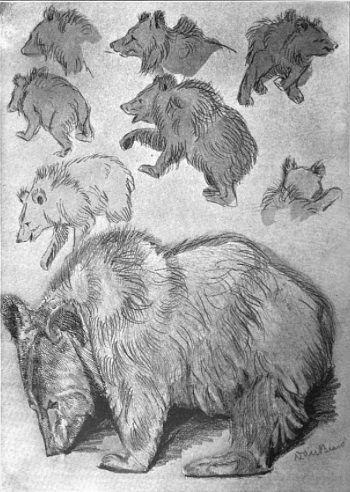
    Sketches of “Mr. Dooley” by Dan Beard.

    Even if the animals seem tame when they are young, when they grow up they can become dangerous. Often they run away, but because they’ve lost their fear of humans, they’re vulnerable to hunters.

    A century ago, people were far less sensitive to these problems as is demonstrated by this story published by Dan Beard in 1907. Beard was a famous author and illustrator, who founded the Sons of Daniel Boone in 1905 and merged the group with the Boy Scouts of America in 1910.

    Beard loved the animals he wrote about and illustrated. Here’s his story about the tragic life of Mr. Dooley, a grizzly captured in Yellowstone Park

    ∞§∞

    A few years ago, Mr. Walker, of the Yellowstone Park, while on horseback, ran down a silvertip cub, and when I sketched it the cub was fastened to a tree.

    The cub was named Mr. Dooley, but there was some mistake in this, as the young monster was not a mister, as it appears “he” was a she.

    I placed my sketching stool just out of reach of the cub, and, while I worked with my pencil, Mr. Dooley spent her time scraping the dirt with her paws, making long canals in the loose earth as she backed away, but all the time keeping her wicked little pig eyes fastened on me.

    Every once in a while she would make a sudden savage rush at me and end it with a half-strangled, gurgling growl.

    When the season was over, the commander of the post stated that he intended to send Mr. Dooley to the Washington Zoo. This grieved Mr. Walker, until the late Major Bach innocently asked if Dooley never escaped, and the next morning it was discovered that Dooley had escaped.

    In the following spring, when Mrs. Walker arrived with her husband at the canyon, to open the hotel, Dooley was waiting to greet them on the broad veranda.

    Time rolled on, and Dooley became a favorite visitor at the camps, and it was not an unusual sight to see a great, hulking, silver-tip bear wrestling with the guides and enjoying the fun as much as the astonished spectators.

    Dooley, although a very, very bad little cub, broadened both in mind and body as she grew older, and adopted the Golden Rule as her moral code; but this was a sad mistake on the bear’s part. There perhaps never was a more gentle, better-hearted bear than Mr. Dooley, the great grizzly of Yellowstone Park. Far better would it have been for the lady bear with a gentleman’s name if she had adhered closely to the traditions of her race and developed into a surly, gruff, dangerous old girl, in place of the gentle, sweet-tempered creature she really made of herself. True, she would not have been petted and fed with prunes and sweetmeats, but she would have been much happier than she now is, poor thing!

    The trouble with Mr. Dooley is that she made the mistake of applying the Golden Rule to human beings, and the human beings did not appreciate the generous nature of the bear.

    Human beings are all right when they preach and when they write, but their brothers in fur will do well not to trust to the sincerity of the two-legged creatures’ sentiments.

    Because the gentle grizzly of Yellowstone Park was guileless and unsuspicious, she (Mr. Dooley) was led into captivity, and is now imprisoned in a narrow iron-barred cell in the Washington Zoo.

    And when the readers visit Washington, and see a big grizzly with its tongue lolling out of its mouth, and a far-away look in its eyes, they may know that it is the lady bear, known as Mr. Dooley, of Yellowstone Park, and that the poor girl is dreaming of her free life in the mountains, or her real friends, the guides and cooks of the camps, and Mr. and Mrs. Walker of the Canyon Hotel.

    It is hoped that the visitors will take with them some little green thing—turnips, apples, or any vegetable, which will gladden the heart of the lady bear who trusted man to her sorrow.

    ∞§∞

    — Text and illustration from “Mr. Dooley: Her Story” Pages 269-273 in Daniel Carter Beard, Dan Beard’s Animal Book and Campfire Stories. New York, Moffat, Yard and Company, 1907.

    — For more stories like this, click on “bears” under the Categories button to the left.

  • A Tale: A Circuit Rider Describes the Upper Geyser Basin — Edwin J. Stanley, 1873

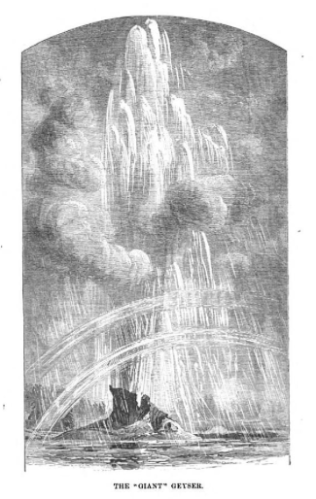
    As a Methodist circuit rider, Edwin J. Stanley traveled extensively throughout Montana in the late 1800s. Following a trip to Yellowstone Park Giant Geyser from Stanleyin 1873, Stanley published a series of letters about his experiences there in what he described as “a leading newspaper of the West.” In 1882, he published a compilation of those letters in his book, Rambles in Wonderland.
    Stanley supplemented his observations with extensive reading so his book provides a comprehensive summary of what people knew about the park then. Here’s a condensed version of his description of the Upper Geyser Basin.

    ∞§∞

    There are hundreds of springs in the basin, all differing more or less in some particular. There are about twenty regularly acting. On a calm, clear morning, at or just before sunrise, when all the springs are sending up their columns of steam of every magnitude, and all boiling and fussing and splashing away, as if trying each to attract the greatest share of attention, and while one or two of the larger geysers are piercing the heavens with their stupendous columns, the basin presents a lively and interesting spectacle.

    The eruptions as witnessed by moonlight are truly sublime, though deprived of much of their glory, as it is difficult to distinguish between water and steam. Some of the party built bonfires and watched the eruptions by firelight, which were very fine, giving the rising volumes the appearance of fiery liquid hurled forth from the crater of a volcano.

    It is not the most quiet and agreeable place for sleeping. One is frequently disturbed during the night by the alarming detonations and subterranean thunder, making an almost constantly rumbling noise as of heavy machinery in motion, the come and go of ponderous freight trains, the hiss and rush of escaping steam, and the loud plash of falling torrents, as the geysers, the ever vigilant sentinels on the outposts of old Pluto’s infernal regions, sound the alarm and spout forth in the darkness. This is more sensibly realized by sleeping on the ground, and, rest assured, the sensations are not always of the most desirable character.

    A Catholic priest was standing near a hot spring, when the crust gave way, and let him into the seething caldron. The accident would doubtless have proved fatal, but that a strong man who was at his side, and happened to be standing on solid ground, seized him by the collar and saved him from a horrible death. Though he escaped without any injury whatever, imagine his surprise at the appearance in an Eastern paper of a vivid account of his untimely death, together with an illustration showing a party of men dragging the lifeless body of a monk “all shaven and shorn,” and attired in priestly robes, from one of the geysers! He still asserts that it is a mistake, notwithstanding the statements of the newspapers to the contrary.

    Whenever railroads come within reach, or even passable wagon and stage roads are completed through the Park, this will become a favorite place of resort for people from every part of the world, though I prefer going in true pioneer style on horseback, with a pack-horse on which to carry provisions and baggage. A wagon-road is now completed from Virginia City up the Madison to the Lower Basin. But don’t go until you can make the grand rounds, for the geysers, in all their glory, are only part of the wonders of the National Park.

    While here we met with persons from various portions of the Territory, among them a number of friends; and quite a sociable time we had the two evenings spent in the basin. After the sight-seeing of the day was over, we gathered around our brilliant camp-fire, and passed the time relating incidents and anecdotes of a pleasant character; while Miss Clark, a young lady from Chicago, with vocal gifts that all admired, charmed us with some excellent music, presenting quite a contrast as the charming melodies floated out upon the nightwind, and mingled with the hissing reports of a hundred noisy, spouting springs, the wild, weird appearance of everything adding greatly to the novelty of the surroundings.

    ∞§∞

     — Exerpt condensed form Chapter 13 (pages 118-123) in Edwin J. Stanley, Rambles in Wonderland or Up the Yellowstone. New York: Appleton and Company, 1883.

    — Illustration from the book.

    — You might also enjoy:

    For more descriptions click “Geysers” under the Categories button above.

  • A Tale: A General Visits the Park During Indian Troubles — William Tecumseh. Sherman, 1877

    During the summer of 1877, William Tecumseh Sherman, who was then commanding general of the U.S. Army, decided to tour the forts along the proposed route of the Northern Pacific Railroad. That was just one year after a coalition of Sioux and Cheyenne decimated the Seventh Cavalary under George Armstrong Custer at the Battle of the Little Big Horn. In fact, the army was still patrolling the northern plains after the Sioux Chief Sitting Bull fled toi Canada. In addition, several bands of Nez Perce refused to move to a reservation in Washington and were headed to Montana.

    WAR AND CONFLICT BOOK ERA:  CIVIL WAR/LEADERS
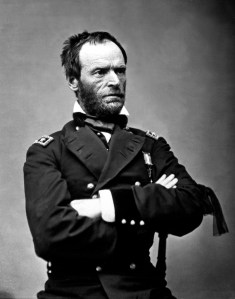
    General William Tecumseh Sherman

    Like many military officers, Sherman was fascinated with Yellowstone Park and had read several army and civilian reports about it. He knew about the Nez Perce troubles, but he decided to take a side trip to see the wonders of Yellowstone Park anyway. He was convinced that the Indians would not enter the park because they feared the geothermal features so he traveled with a small party of about a dozen men. After a 15-day tour, Sherman and his companions returned to Fort Ellis, near Bozeman, Montana, just a few days before the Nez Perce entered the park.

    Here’s an abridged version of Sherman’s report of his trip to Yellowstone Park.

    ∞§∞

    I suppose you want to hear something of the National Park, or “Wonderland,” as it is called here. As you know, I came from the Big Horn here with two light spring-wagons and one light wagon, with six saddle horses. Here we organized the party: Colonels Poe, Bacon, my son and self, three drivers, one packer, four soldiers, and five pack mules; making four officers, four soldiers, one citizen, and twenty-three animals. The packer was also guide.

    Our rate of travel was about 20 miles a day or less. Our first day’s travel took us southeast over the mountain range to the valley of the Yellowstone; the next two days up the valley of the Yellowstone to the mouth of Gardner’s River. Thus far we took our carriages, and along the valley found scattered ranchos, at a few of which were fields of potatoes, wheat, and oats, with cattle and horses.

    At the mouth of Gardner’s River begins the park, and up to that point the road is comparatively easy and good, but here begins the real labor; nothing but a narrow trail, with mountains and ravines so sharp and steep that every prudent horseman will lead instead of ride his horse, and the actual labor is hard.

    The next day is consumed in slowly toiling up Mount Washburn, the last thousand feet of ascent on foot. This is the summit so graphically described by Lord Dunraven in his most excellent book recently published under the title of the “Great Divide.” The view is simply sublime, worth the labor of reaching it once, but not twice. I do not propose to try it again.

    Descending Mount Washburn, by a trail through woods, one emerges into the meadows or springs out of which Cascade Creek takes its water; and following it to near its mouth you camp, and walk to the Great Falls and the head of the Yellowstone Canyon. In grandeur, majesty, coloring, &c., these probably equal any on earth. The painting by Moran in the Capitol is good, but painting and words are unequal to the subject. They must be seen to be appreciated and felt.

    The next day, eight miles up from the falls, we came to Sulphur Mountain, a bare, naked, repulsive hill, but of large extent, at the base of which were hot bubbling springs, with all the ground crisp with sulphur; and six miles farther up, or south, close to the Yellowstone, we reached and camped at Mud Springs.

    From the Mud Springs the trail leads due west, crosses the mountain range to the Lower Geyser Basin. It would require a volume to describe these geysers in detail. It must suffice now for me to say that the Lower Geyser Basin presents a series of hot springs or basins of water coming up from below, hot enough to scald your hand, boil a ham, egg, or anything else; clear as crystal, with basins of every conceivable shape, from the size of a quill to actual lakes a hundred. Yards across. In walking among and around them, one feels that in a moment he may break through and be lost in a species of hell.

    Six miles higher up the West Madison is the Upper Geyser Basin—the “spouting geysers,” the real object and aim of our visit. To describe these in detail would surpass my ability, or the compass of a letter. They have been described by Lieutenant Doane, Hayden, Strong, Lord Dunraven, and many others. The map by Major Ludlow, of the Engineers, locates the several geysers accurately. We reached the Upper Geyser Basin at twelve noon, one day, and remained there till 4 p.m. of the next. During that time we saw the ” Old Faithful” perform at intervals varying from 62 minutes to 80 minutes.

    Each eruption was similar, preceded by about live minutes of sputtering, and then would arise a column of hot water, steaming and smoking, to the height of 125 or 130 feet, the steam going a hundred or more feet higher, according to the state of the wind. It was difficult to say where the water ended and steam began; and this must be the reason why different observers have reported different results. The whole performance lasts about five minutes, when the column of water gradually sinks, and the spring resumes its normal state of rest.

    This is but one of some twenty of the active geysers of this basin. For the time we remained we were lucky, for we saw the Beehive twice in eruption, the Riverside and Fan each once. The Castle and Grotto were repeatedly in agitation, though their jets did not rise more than 20 feet. We did not see the “Giant” or the ” Grand ” in eruption, but they seemed busy enough in bubbling and boiling.

    In our return trip we again visited points of most interest and some new ones. The trip is a hard one and cannot be softened. The United States has reserved this park, but has spent not a dollar in its care or development. The paths are mere Indian trails, in some places as bad as bad can be. There is little game in the park now; we saw two bear, two elk, and about a dozen deer and antelope, but killed none. A few sage-chickens and abundance of fish completed all we got to supplement our bacon.

    We saw no signs of Indians, and felt at no moment more sense of danger than we do here. Some four or five years ago parties swarmed to the park from curiosity, but now the travel is very slack. Two small parties of citizens were in the park with us, and on our return we met several others going in, but all were small.

    ∞§∞

    — Abridged from Reports of the Inspection Made in the Summer of 1877 by Generals P.H. Sheridan and W.T. Sherman. Washington: U.S. Government Printing Office, 1878. (Pages 34-37)

    — Photo from Wikipedia Commons.

    — For related stories click “Nez Perce” under the Categories button.

  • A Tale: Early Travelers Confuse Geyser Basins — Rossiter Raymond, 1871

    In the summer of 1871, U.S. Commissioner of Mines Rossiter Raymond was in Virginia City, Montana, when he decided to organize a group to tour the area that would become Yellowstone National Park the next year. Of course, nobody had published any guidebooks by then, so Raymond and his companions decided to take copies of N.P. Langford’s descriptions of wonderland that Scribner’s Monthly published in its May and June 1871 issues.

    1116-7
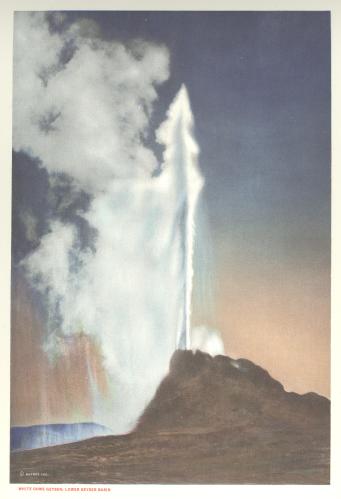
    White Dome Geyser, Lower Geyser Basin

    There were no signs in the roadless Yellowstone wilderness, so it was easy for travelers to become confused about the things they were seeing. When Augustus F. Thrasher, a photographer on the expedition, compared the Lower Geyser Basin to Langford’s descriptions of the Upper Basin, he became convinced that Langford’s description of geysers were exaggerations and decided to use his camera to prove it. 

    Raymond said, “Thrasher invests the profession of photography with all the romance and adventure . . ..  No perilous precipice daunts him, if it’s just the place for his camera.”  Given Thrasher’s passion, he must have taken some marvelous photographs, but, unfortunately, none of them are known to have survived.

     Here’s Raymond’s description of his expedition’s confusion over geysers.

    ∞§∞

    We approached the geyser basin with our expectation at the boiling-point, and ready to discharge; for we had among the baggage two copies of Scribner’s, containing Mr. Langford’s account of the wonders of the region, as seen by the Washburn exploring party. His article occupied two numbers, and we had two copies of each: so four persons could be accommodated with intellectual sustenance at one time. For the other two, it was, as one of them mournfully observed, “Testaments, or nothin’.”

    Mr. Langford’s articles were vivid and fascinating; and we found them, in the end, highly accurate. At the outset, however, we were inclined to believe them somewhat exaggerated; and Thrasher was divided between his desire to catch an instantaneous view of a spouting column two hundred and fifty-six feet high, and his ambition to prove, by the relentless demonstration of photography, that these vents of steam and hot water were not half as big as they had been cracked up to be.”

    We were not at first aware that there are two geyser basins on the Fire-Hole River; the upper one, ten miles above the other being the smaller, but containing the largest geysers. It was this one, which Washburn’s party, coming from Yellowstone Lake, first stumbled upon, and, after viewing its splendid display, naturally passed by the inferior basin with little notice. But we, emerging from the forest, and finding ourselves on the border of a great gray plain, with huge mounds in the distance, from which arose perpetually clouds of steam, supposed we had reached the great sensation, and prepared to be enthusiastic or cynical as circumstances might dictate.

    Rositer Raymond Wikipedia
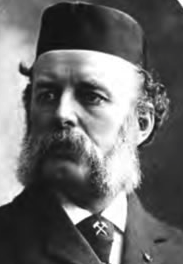
    Rossister Raymond

    We rode for a mile across the barren plain picking our way to avoid the soft places. This is quite necessary in the neighborhood of the hot springs. Where they have deposited a white, hard crust, it is generally strong enough to bear horse and man; but, over large areas, the ground is like what we call, in the East, “spring-holes;” and the treacherous surface permits uncomfortable slumping through, haply into scalding water. It is not very deep; but a small depth under such circumstances is enough to make a fellow “suffer some,” like the lobster in the lobster pot. ”

    The plain contains a few scattered springs; and along the river, its western border, there are many in active ebullition. The principal group of geysers is at the upper or southern end extending for some distance up the valley of a small tributary from the east. With cautious daring, we rode up the side of the great white mound, winding among the numerous fissures, craters, and reservoirs that on every side of us hissed, gurgled, or quietly vapored, with now and then a slight explosion, and a spurt to the height of a dozen feet or more. Sawtell’s dog nosed suspiciously around several of the basins, until, finding that seemed not too hot for a bath, be plunged in, and emerged in a great hurry, with a yelp of disprobation.

    A couple of dead pines stood, lonesome enough, in the side of the hill, “whence all the rest had fled.” They had died at their posts, and to the said posts we made fast our horses, and ascended a few rods farther, until we stood by the borders of the summit springs. There were two or three large vents at the bottom of deep reservoirs or intricate caverns. It gives one an unpleasant thrill, at first, to bear the tumult of the imprisoned forces, and to feel their throes and struggles shaking the ground beneath one’s feet; but this soon passes away, and the philosopher is enabled to stand with equanimity on the rim of the boiling flood, or even to poke his inquisitive nose into some dark fissure, out of which, perhaps in a few moments more a mass of uproarious liquid and vapor will burst forth.

    We lingered much longer in this basin than my brief notice of it indicates; for, you see, we thought we had found the geysers; and oh the hours that we spent “identifying” the individual springs that Langford had described! Since, the largest eruptions we observed did not exceed forty-five feet in height, we set down his account as hugely overdrawn, and were deeply disgusted at the depravity of travelers. But Sawtell remarked, in his quiet way, that, “if it were not for that there article in that there magazine, these yer springs would be considered a big thing, after all, and perhaps it was just as well to let the magazine go to thunder, and enjoy the scenery.”

    This sensible advice we followed with much profit and pleasure; and we are all now ready to admit that our happening upon the wrong lot of geysers first was a most fortunate occurrence, since we should otherwise have been tempted to pass them by as insignificant. The truth is that in some of the elements of beauty and interest the lower basin is superior to its more thrilling rival. It is broader, and more easily surveyed as a whole; and its springs are more numerous though not so powerful. Nothing can be lovelier than the sight at sunrise, of the white steam-columns tinged with rosy morning ascending against the background of the dark pinewoods and the clear sky above. The variety in form and character of these springs is quite remarkable.

    ∞§∞

    — Excerpt from Rossiter Raymond, “Wonders of the Yellowstone.” Pages 153-207 in Camp and Cabin, New York: Fords, Hubbard & Howard, 1880.

    — Geyser postcard, Pioneer Museum of Bozeman; Raymond photo, Wikipedia Commons.

    — You might also enjoy Calvin Clawson’s tale about “First Blood” on the Raymond Expedition.

    — Find out more about Yellowstone’s first tourist guide, Gilman Sawtell.

    — For tales by N.P. Langford, click “Langford” under the Categories button above.

  • A Tale: Trappers Encounter Peaceful Indians on the Yellowstone Plateau — Osborne Russell, 1834

    When I was a boy my father told me that Indians never went into the Yellowstone Park area because they were afraid of the geothermal features. But that’s not true. Archeological evidence shows that Indians traveled through the area and hunted there for at least 11,000 years. The erroneous assertion appears to have been started by officials to assure early tourists they could travel safely to the park.

    Alfred_Jacob_Miller_-_Ma-wo-ma_-_Walters_37194035
    Ma-wo-ma, a 19th-century Snake leader

    At least one band of Shoshone Indians, the Sheep Eaters, were permanent residents of the area. The mountain man Osborne Russell told about meeting a group of them in 1834 in his famous Journal of a Trapper. (He referred to them by the more generic term “Snake Indians,” which was what early travellers called several tribes that lived around the Snake River.)

    Russell found the Sheep Eaters (so-called because bighorn sheep made up a large portion of their diet) when he traveled up the Snake River to the Yellowstone Plateau in 1834. Here’s his description.

    ∞§∞

    We crossed the mountain in a westerly direction through the thick pines and fallen timber, about twelve miles, and , encamped in a small prairie about a mile in circumference. Through this valley ran a small stream in a northerly direction, which all agreed in believing to be a branch of the Yellowstone.

    We descended the stream about fifteen miles through the dense forest and at length came to a beautiful valley about eight miles long and three or four wide, surrounded by dark and lofty mountains. The stream, after running through the center in a northwesterly direction, rushed down a tremendous canyon of basaltic rock apparently just wide enough to admit its waters. The banks of the stream in the valley were low and skirted in many places with beautiful cottonwood groves.

    Here we found a few Snake Indians comprising six men, seven women and eight or ten children, who were the only inhabitants of the lonely and secluded spot. They were all neatly clothed in dressed deer and sheep skins of the best quality and seemed to be perfectly contented and happy.

    They were rather surprised at our approach and retreated to the heights, where they might have a view of us without apprehending any danger, but having persuaded them of our pacific intentions we succeeded in getting them to encamp with us. Their personal property consisted of one old butcher knife nearly worn to the back, two old, shattered fusees which had long since become useless for want of ammunition, a small stone pot and about thirty dogs on which they carried their skins, clothing, provisions, etc., on their hunting excursions.

    They were well armed with bows and arrows pointed with obsidian. The bows were beautifully wrought from sheep, buffalo and elk horns, secured with deer and elk sinews, and ornamented with porcupine quills, and generally about three feet long. We obtained a large number of deer, elk and sheep skins from them of the finest quality, and three large, neatly dressed panther skins, in return for awls and axes, kettles, tobacco, ammunition, etc.

    They would throw the skins at our feet and say, “Give us whatever you please for them and we are satisfied; we can get plenty of skins but we do not often see the Tibuboes” (or “People of the Sun”). They said there had been a great many beavers on the branches of this stream, but they had killed nearly all of them, and, being ignorant of the value of fur had singed it off with fire in order to drip the meat more conveniently. They had seen some whites some years previous who had passed through the valley and left a horse behind, but he had died during the first winter.

    They are never at a loss for fire, which they produce by the friction of two pieces of wood which are rubbed together with a quick and steady motion.

    One of them drew a map of the country around us on a white elk skin with a piece of charcoal, after which he explained the direction of the different passes, streams, etc. From these we discovered that it was about one day’s travel in a southwesterly direction to the outlet or northern extremity of the Yellowstone Lake, but the route, from his description being difficult, and beaver comparatively scarce, our leader gave up the idea of going to it this season, as our horses were much jaded and their feet badly worn.

    Our geographer also told us that this stream united with the Yellowstone after leaving this valley half a day’s travel in a westerly direction. The river then ran a long distance through a tremendous cut in the mountain in the same direction and emerged into a large plain, the extent of which was beyond his geographical knowledge or conception.

    ∞§∞

    —   Excerpt from “In the Yellowstone Country—A Garden of Eden Inhabited by a Small Party of Snake Indians.” Pages 31-34 in Osborne Russell and Lem A York, Journal of a Trapper 1834-1843. Boise, Idaho: Syms-York Co. 1921.

    — Painting by Alfred Jacob Miller, Wikipedia Commons.

    — You might enjoy other tales by Osborne Russell.  To find them just insert his name in the Search box above.