Author: mmarkmiller

  • A Tale: Tall Tales of Yellowstone Park — Reau Campbell, 1909

    Fanciful descriptions of places and events in Yellowstone Park apparently began in early in the 1800s when mountain men spun tall tales around their campfires to amuse each other. Bus drivers continue the tradition today as they drive their charges between sights. The tradition probably peaked at the dawn of the the 20th Century when carriage drivers tried to maximize their tips by telling tall tales. These tales were such an important part of the Yellowstone experience that travel writer Reau Campbell included a chapter on them in his 1909 travel guide.  Here it is.

    ∞§∞
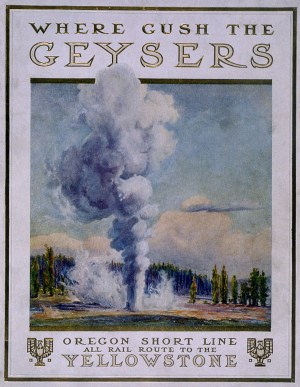
    Cover of the Oregon Short Line Brochure "Where Gush the Geysers"; Haynes; 1910I think the Yellowstone Park was so far west that it escaped any semblance of a legend, but nothing can ever be too far west to escape a joke. There are in the Park precipitous cliffs in plenty, but none from which forlorn Indian maidens have deliberately and with malice aforethought thrown their more or less tawny and symmetrical selves into the depths below, because their perverse papas insisted on the acceptance of some peculiarly painted chief as against the already, heretofore, selected young athlete of a Hiawatha, who had brought beads and feathers along with his pretty and unpronounceable love words whispered on the dark side of the tepee.

    Hence this chapter must be more of the joke than the legend, and as a matter of fact the Yellowstone Park was regarded as a joke in the first place. It was so considered from the time John Colter told his story till Jim Bridger related his yarns, and it was long afterwards found out that they were true stories after all.

    Jim Bridger had seen the hot springs and the geysers and he knew no one would believe even the truth, and, further, he knew that any story he might tell was not likely to be disproved, so he mixed his stories up, fact and fiction in equal parts with good grounds for both sides of the story.

    The story of catching a fish in the cold water of the lake and cooking it in a hot water pool alongside originated with Mr. Bridger, only the old man’s version was that he caught the fish in deep water that was hot near the surface and the fish was cooked on his way out. The truth is, any one may, at many places in the Park, catch a fish, and without moving, or taking the fish off the line, cook it in a nearby hot water pool. One place like this is in the Yellowstone Lake at the Thumb Lunch Station.

    Shakespeare says: “Travelers ne’er do lie, but folks at home condemn’ em —and Mr. Bridger was no exception to that rule, but his fault was mostly in exaggeration; he was not content to tell of the petrified trees, but must add petrified grass, petrified flowers and even petrified birds still singing petrified songs in the petrified trees, and his horses and mules had rather a hard feed on the brittle grass turned to stone. When Mr. Bridger came to show these things, behold! the petrified trees were there to prove that he had not prevaricated (“not to use a shorter and harsher word”).

    The story of the transparency or rather mirror-like composition of Obsidian Cliff was one of Mr. Bridger’s exaggerations. He told of this mountain of volcanic glass and illustrated it with a hunting incident of his own; he saw near the cliff what seemed to be an elk quietly feeding along its rugged sides; he just naturally fired at it, once, then again and again, but the elk never moved; he crept up cautiously without disturbing the animal, then he found out that he had been seeing right through a glass mountain and the elk was on the other side of it, and it was not only not plain everyday glass, but of telescopic quality, and the elk he shot at was twenty-five miles away.

    A latter day story of Obsidian Cliff that has more of the element of probability, is that the engineers on the Circuit Road found the composition so hard that it was impossible to drill into a part of the cliff jutting into the way of the road, and they could not blast it out, so they built fires against it, then threw cold water over the sides and the glass “broke away in great chunks,” so the narrator told me.

    A newcomer to the Park region once asked Mr. Bridger how long he had been there? “Why,” said the old man, “do you see that butte over there? Well, when I came here that butte was a hole in the ground.”

    All others came after, but their stories were as full of local color. Bridger started the alum creek “puckering yarns,” but E. C. Culver, the popular train agent and lecturer, put on a polish that made the old stories look like new. He, Mr. Culver, was going through the Livingston-Gardiner train one day delivering his usual lecture about in these words:

    We first pass through the Lower Canyon of the Yellowstone. Only a short ride, when we enter Paradise Valley, in which we ride for about twenty-five miles; the Absaroka range of mountains on our left are from eight to ten thousand feet high, the snow remaining frequently through the month of July.

    After leaving the beautiful valley we soon enter the middle of ‘Yankee Jim’ Canyon, so called because James George, better known as ‘Yankee Jim,’ came here in the early seventies and built the first wagon road to the Yellowstone Park. He is now an old man, still resides in the Canyon and is a famous storyteller. He tells of having a fine pair of field glasses and a good gun. In the cool of the evening he takes his glasses and looking up the mountainside he sees a bear, a deer, or an elk; taking his gun he shoots it, when it rolls down the mountainside to his feet. The distance is so long and the friction so great that in rolling down it tans the hide and cooks the meat; this is the way he lives.

    You smile with incredulity. Don’t you know you are entering Wonderland, where you must be sure to have your driver point out to you the most remarkable geyser in the world, for it throws up hot blocks of ice.

    On your fourth day’s coaching from Mammoth Hot Springs you will have a beautiful ride across Hayden Valley, crossing Alum Creek. You know alum will pucker and shrink anything, which comes in contact with it. A long time ago a man came along there driving four very large horses with a big wagon and he forded this creek; when he came out on the opposite side he found the alum water had shrunken his outfit to four Shetland ponies and a basket phaeton.

    A lady from Chicago heard of this wonderful water and immediately went there wearing number eight shoes, bathed her feet twice and went away wearing number ones.” In telling a party about it there happened to be a Chicago lady in the party who sarcastically advised the narrator to go and soak his head in that creek.

    Jim Bridger told of mountain streams having their source in the snow of the summit and ran down so fast that the water became hot from friction by the time it reached the foot of the mountain. As a matter of fact, the stones in the bed of the Yellowstone River below the Great Falls, where the cold water runs very rapidly, are hot, so hot that one can hardly bear the contact with the hand.

    “Slim,” a driver (I don’t know his other name, but he was a jolly good fellow), told me that when he came to the Park that Beaver Lake “was just crowded full of beavers, but they took so many of them to Washington that there wasn’t hardly any left now.”

    At the risk of being caught in some sort of joke, I just naturally inquired why they wanted to send beavers to Washington. “Oh,” Slim said, “they wanted ’em for the theological garden.” I had not thought of such a contingency, and at first I was inclined to be wroth at the idea of removing any animals from the Park, but Slim’s explanation tended to soothe my somewhat enraged feelings.

    Larry Matthews was the champion jokester of the Park for years at Norris and the Upper Basin.

    “Larry” was a constant source of wonderful stories, a well of information.

    Larry told me that the night Bob Ingersoll died, every geyser in the Park went into most violent eruption.

    I heard a grouchy old fellow complain to Larry one day about the turkey they had for lunch, and in accents wild asked Larry where they came from. Larry whispered as low as the “groucher” had talked loud, “They came over in the Mayflower and walked here.”

    Larry had amiability and wit combined. He could all in the same moment tell you a funny story and turn on a geyser.

    There are laughing waters, many, but not a hint of romantic story, not a Minnehaha anywhere.

    ∞§∞

    — Excerpt from Reau Campbell,  “Jokes and Legends.”  Pages 80-83 in Campbell’s New Complete Guide and Descriptive Book of the Yellowstone Park. H.E. Klamer, Upper Geyser Basin, Yellowstone Park, 1909.

    — Image of the Oregon Short Line brochure cover is from the Yellowstone Digital Slide File.

    — You might also enjoy:

  • A Tale: Encountering Irish Wit at a Lunch Station — John L. Stoddard, 1896

    Larry's Lunch Station
    Larry Mathews, center, holding court at Norris Lunch Station.

    The developers of Yellowstone Park located their grand hotels at major sights a day’s drive apart by horse and buggy. That necessitated construction of lunch stations about halfway between the hotels to provide mid-day meals.  

    The manager of the Norris Lunch Station, Larry Mathews, was a colorful character who found a place in many traveler’s journals. An Irish immigrant with a broad accent, Mathews was famous for his jocular manners and his ability to entertain customers as he rushed them through their sparse meals.

    The famous writer and lecturer, John L. Stoddard, met Larry at the Norris Lunch Station in 1896. Here’s how Stoddard described the encounter in Volume 10 of his famous set of travelogues, Stoddard’s Lectures.

    ∞§∞

    John L. Stoddard
    John L. Stoddard

    For half an hour we had been hearing, more and more distinctly, a dull, persistent roar, like the escape of steam from a transatlantic liner. At last we reached the cause. It is a mass of steam which rushes from an opening in the ground, summer and winter, year by year, in one unbroken volume. The rock around it is as black as jet; hence it is called the Black Growler. Think of the awful power confined beneath surface here, when this one angry voice can be distinctly heard four miles away. Choke up that aperture, and what a terrible convulsion would ensue, as the accumulated steam burst its prison walls! It is a sight which makes one long to lift the cover from this monstrous caldron, learn the cause of its stupendous heat, and trace the complicated and mysterious aqueducts through which the steam and water make their way.

    Returning from the Black Growler, we halted at a lunch station, the manager of which is Larry. All visitors to the Park remember Larry. He has a different welcome for each guest: “Good. day, Professor. Come in, my Lord. The top of the morning to you, Doctor.” These phrases flow as lightly from his tongue as water from a geyser. His station is a mere tent; but he will say, with most amusing seriousness: “Gintlemen, walk one flight up and turn to the right. Ladies, come his way and take the elevator. Now thin, luncheon is ready. Each guest take one seat, and as much food as he can get.”

    “Where did you come from, Larry?” I asked.

    “From Brooklyn, Sor,” was his reply, “but I’ll niver go back there, for all my friends have been killed by the trolley cars.”

    Larry is very democratic. The other day a guest, on sitting down to lunch, took too much room upon the bench.

    “Plaze move along, Sor,” said Larry. The stranger glared at him. “I am a Count,” he remarked at last.

    “Well, Sor,” said Larry, “here you only count wun!” “Hush!” exclaimed a member of the gentleman’s suite, “that is Count Schouvaloff.”

    “I’ll forgive him that,” said Larry, “if he won’t shuffle off this seat.” Pointing to my companion, Larry asked me: “What is that that gentleman’s business?”

    “He is a teacher of singing,” I answered.

    “Faith,” said Larry, “I’d like to have him try my voice. There is something very strange about my vocal chords. Whenever I sing, the Black Growler stops. One tourist told me it was a case of professional jealousy, and said the Black Growler was envious of my forte tones. ‘I have not forty tones,’ I said, ‘I’ve only one tone.’ ‘Well,’ says he, ‘make a note of it!’”

    Only once in his life has Larry been put to silence. Two years ago, a gentleman remarked to him: “Well, Larry, good. by; come and visit me next winter in the East. In my house you shall have a nice room, and, if you are ill, shall enjoy a doctor’s services free of all expense.”

    “Thank you,” said Larry, “plaze give me your card.”

    The tourist handed it to him; and Larry, with astonishment and horror, read beneath the gentleman’s name these words: “Superintendent of the Insane Asylum, Utica, New York.”

    ∞§∞

    — From “Yellowstone Park,” pages 207-304 in Volume 10 of Stoddard’s Lectures, Chicago: John L. Schuman & Co., 1898,

    — Lunch station photo from Stoddard’s Lectures. Stoddard photo from Wikipedia Commons.

    — You might also enjoy Stoddard’s description of Fountain Geyser.

  • A Tale: Finding a Goldilocks Pool at Mammoth Hot Springs — John W. Barlow, 1871

    Reports from the Washburn Expedition of 1870 stimulated so much interest in the Upper Yellowstone that the U.S. Government decided to send two expedition to explore the area systematically the next year. One was under the direction of Dr. Ferdinand V. Haden of the U.S. Geological Survey, and another was under Colonel John W. Barlow of the Army Corp of Engineers. The two expeditions worked in tandem to measure and map the wonders of the area. One of those wonders was “Soda Mountain,” what is now known as Mammoth Hot Springs.

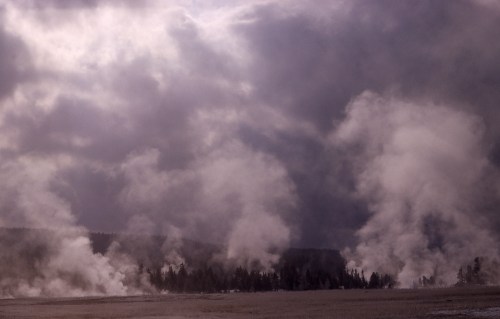
    Bath Pools from Whylie by CalfeeIn an era when water for bathing often was heated in a teakettle, the copious amount of hot water flowing down the mountainside at Mammoth Hot Springs intrigued the explorers. Here’s how Colonel Barlow described it.
    ∞§∞

    A system of hot springs of great beauty, flowing from the top and sides of a large hill of calcareous deposit, and called Soda Mountain, is found five miles up the left bank of Gardners River. Here, at the foot of this curious white mountain, we encamped, and remained until the 24th [of July], examining the wonderful spring formation of this region, and the country around it.

    The central point of interest is the Soda Mountain, occupying an area of a hundred acres, and rising like the successive steps of a cascade, to the height of over 200 feet above the plateau at its base. The upper surface is a plain, composed of many hot springs, constantly sending up volumes of vapor slightly impregnated with sulphurous fumes.

    The sides of the hill down which the waters of these hot springs flow have become terraced into steps of various heights and widths, some twelve inches in dimension, while others are as many feet. In each terrace there is generally a pool of water, standing in a scalloped basin of gypsum, deposited at the edges by the water as it becomes cooler. These basins are often tinged with pink, gray, and yellow colors, giving to the whole a very beautiful effect.

    The rock in all directions has evidently been deposited in the same manner as the Soda Mountain is now being built up. When the formation ceases from a change in the course of the water, the rock becomes friable and disintegrates. After a time vegetation springs up and covers the surface. Many of the basins have the size and shape of bathtubs, and were used by members of the party for bathing purposes. The temperature varies in the different pools from fifty degrees all the way up to one hundred and eighty, so there is no difficulty in finding a bath of suitable temperature.

    [A few days later, Barlow left Mammoth Hot Springs to explore the area. When he returned in again enjoyed the hot water again.]

    Toward evening I enjoyed a bath among the natural basins of Soda Mountain. The temperature was delightful, and could be regulated at pleasure by simply stepping from one basin to another. They were even quite luxurious, being lined with spongy gypsum, soft and pleasant to the touch. I walked over a part of the hill by the faint light of the new moon, which gave to its deep-blue pools of steaming water a wild and ghostly appearance. The photographer has taken numerous views of these springs and the country in their vicinity, which will serve to convey a much more definite idea of their beautiful formation than can be given by any written description. A special survey was made of this locality, and careful observations of its latitude and longitude.

    ∞§∞

    —Excerpts from Colonel John W. Barlow, Report of a Reconnaissance of the Basin of the Upper Yellowstone in 1871, U.A. 42d Cong. 2d sess. Senate Ex Doc. 66, 1871, pp. 2-43.

    — Illustration from William Wallace Wylie, Yellowstone Park, or The Great American Wonderland. Kansas City, Missouri: Ramsey Millett & Hudson, 1882. Based on a Henry B. Calfee photograph.

    — You might enjoy:

  • A Tale: Prospectors Say They Have Seen the Fires of Hell — Montana Post, 1867

    Midway geyser basin YDSF
    Midway Geyser Basin

    The first indication of startling geothermal features on the Upper Yellowstone was a buffalo hide map that was sent to President Thomas Jefferson in 1805 by James Wilkinson, governor of the newly purchased Louisiana Territory. Governor Wilkinson said of the map, “a volcano is distinctly described in the Yellowstone River.” 

    About 1809 John Colter told his old boss, Captain William Clark of the Lewis and Clark Expedition, about the “Hot Spring Brimstone” he had seen along the shore of Lake Yellowstone, and Clark published a map containing that information information in 1814. 

     Eastern newspapers reported startling geothermal features in the area that became Yellowstone Park as early and early as 1827. Following that, there a steady stream of accounts in newspapers, government reports, journals and reminiscence. 

     But these reports did little to affect public awareness. In fact, William Wallace Wylie, in his guidebook published in1882, marveled that the area had been known for only a short time. Wylie, who invented the Wylie Way method of touring the park with stops permanent camps, searched Montana territorial newspapers and concluded this article published by The Montana Post in 1867 was the first one describing the area’s geothermal features. 

     ∞§∞

    It is indeed strange that this remarkable portion of country, now set apart by our Government as National pleasure-grounds, has been known to the world for so short a time. It may be authentically stated that the Park has been known to the general public for the short period of eleven years.

    Although trappers and prospectors had at different times passed through and seen some portions of the Park, and had tried to convince others of what they beheld, yet their stories were received as characteristic lies, and the general public lived on in ignorance of the fact that the greatest natural wonders of the world existed within the borders of our republic.

    The first published statement of these wonders, that the author could find, is that given below, taken from the Montana Post. The communication was dated Yellowstone City, Montana, August 18, 1867. Yellowstone City was a thriving mining village, nearer the boundary of the Park than any town at present is. The communication was written by Davis Willson, now of Bozeman, Montana. As will be seen, his information was obtained second-handed. The article is given entire for the purpose of showing how exaggerated were the ideas then obtained of what is now so well known: —

    A portion of the Bear Gulch stampeders has returned. They have been to the Lake at the head of Yellowstone, and report the greatest wonder of the age.  For eight days they traveled through a volcanic country emitting blue flames, living streams of molten brimstone, and almost every variety of minerals known to chemists. The appearance of the country was smooth and rolling, with long level plains intervening.

    On the summits of these rolling mounds, were craters from four to eight feet in diameter; and everywhere upon the level plains, dotting them like prairie-dog holes, were smaller ones, from four to six inches and upwards.

    The steam and blaze were constantly discharging from these subterranean channels, in regular evolutions or exhaustions, like the boilers of our steamboats, and gave the same roaring, whistling sound. As far as the eye could trace, this motion was observed.

    They were fearful to ascend to the craters, lest the thin crust should give way and swallow them. Mr. Hubbel (one of the party), who has visited this region before, ventured to approach one of the smaller ones. As he neared its mouth, his feet broke through, and the blue flame and smoke gushed forth, enveloping him. Dropping upon his body, he crawled to within a couple of feet of the crater, and saw that the crust around its edge was thin, like a wafer.

    Lighting a match, he extended it to the mouth and instantly it was on fire. The hollow ground resounded beneath their feet as they traveled on, and every moment it seemed liable to break through and bury them in its fiery vaults. The atmosphere was intensely suffocating, and they report that life could not long be sustained there.

    Not a living thing—bird or beast—was seen in the vicinity. The prospectors have given it the significant name—’Hell!’ They declare they have been to that ‘bad place,’ and even seen the ‘Devil’s horns;’ but through the interposition of Providence (not to speak profanely), their ‘souls have been delivered,’ and they emphatically aver, if a ‘straight and narrow’ course, during their sojourn on the Yellowstone, will save them, they will never go there again.

    This article was copied throughout the country by other papers, and doubtless served to awaken an interest concerning this unknown land; yet the general public were indebted for their first knowledge of the marvels of this region.

     ∞§∞

     — Text from “Earliest Publications Concerning Yellowstone Park,”  pages 74-77 in William Wallace Wylie, Yellowstone Park, or The Great American Wonderland. Kansas City, Missouri: Ramsey Millett & Hudson, 1882.

    — Photo from the Yellowstone Digital Slide File.

    — You might be interested in The New York Times story apparently based on this report.

  • A Tale: “Bear That Killed Man Blown to Pieces” — 1917

    Values change. While searching for stories to post here, I frequently find reports of behavior that would outrage today’s sensibilities. Here’s an example published in Popular Mechanics in 1917.

    ∞§∞

    A bear that had severely mauled a government teamster in Yellowstone National Park was blown to pieces by dynamite recently, while the teamster died of his injuries in the hospital at Mammoth Hot Springs.Screen Shot 2013-04-07 at 8.02.58 AM The man was asleep under a supply wagon in the park when he was attacked by the bear. Two companions drove the animal away, after serious injuries had been inflicted on their mate, and when the latter had been removed to the hospital they prepared a warm reception for the bear, knowing it would return. Dynamite, connected with a small electric battery, was placed under a bait of army bacon a short distance from the camp. When the bear came back under cover of darkness and nosed the bait, the mine was sprung and the dynamite did its work most effectively. Bruin disappeared in sections, and the unlucky teamster was avenged.

    ∞§∞

    —  Text and illustration from “Bear That Killed Man Blown to Pieces,” Popular Mechanics, 27(4):561 (1917).

  • — Happy Easter —

    glacier lilly YDSF
    Erythronium grandiflorum blooming in Yellowstone National Park.

    Hiram Martin Chittenden arrived at Yellowstone Park in 1891 to take command of the Army Corps of Engineers unit that was in charge of making improvements there. Chittenden left his mark on the park in many ways including the figure-eight pattern of roads called the “Grand Loop,” the Roosevelt Arch at the north entrance, and the single arch Chittenden Bridge across the Yellowstone River.

    Chittenden was also a historian whose works include a two-volume history of the American fur trade in the west, a history of steamboats on the Missouri River, and first definitive history and description of Yellowstone Park. Here’s Chittenden’s description of a wild “Easter Lily” that grows in the Park.

    ∞§∞

    One of the daintiest of all the flowers, and one somewhat resembling the Columbine in grace of form, is the yellow Adder’s Tongue (Erythronium). This has been called the Dogtooth Violet, surely a gross misnomer. In California it is most appropriately called the Easter Lily, but Easter has long passed before it makes its appearance in the Park. There is no gayer sight than a mass of these yellow lilies, as one comes upon them in the woods under some spreading tree—as “jocund company” as are the daffodils which inspired Wordsworth’s immortal lines.

    ∞§∞

    — Text from Hiram Martin Chittenden, Yellowstone Park: Historical and Descriptive, Cincinnati:Stewart & Kidd Company, 1917 (Page 233).

    — Photo from the Yellowstone Digital Slide File

  • Moran’s Legacy 3: The Grand Canyon of the Yellowstone — Text by F.V. Hayden

    Thomas_Moran_-_Grand_Canyon_of_the_Yellowstone_-_SmithsonianProbably Thomas Moran’s most famous painting is his 7-by-12-foot depiction of the Yellowstone Canyon and Falls. It hung in the U.S. Capitol for decades and now resides in the Smithsonian. There is an excellent full-size reproduction at the Caynon Visitor Center in Yellowstone Park.
    Moran spent three full days, July 28-30, sketching the canyon and fails while accompanying F.V. Hayden’s expedition to explore and documents the wonders of the upper Yellowstone in 1871. These sketches served as the basis for several full fledged paintings of the canyon and falls over the next few years.

    Moran’s journal entries for his days at the canyon are extremely sparse. His July 30 entry is typical; it said simply: “photographing and sketching around Falls and Canyon.” Fortunately, F.V. Hayden offers more detail. Here’s Hayden’s description of the falls and canyon, and Moran at work there.

    ∞§∞

    Standing near the margin of the Lower Falls, and looking down the caynon, which looks like an immense chasm or cleft in the basalt, with its sides 1,200 to 1,500 feet high, and decorated with the most brilliant colors that the human eye ever saw, with the rocks weathered into an almost unlimited variety of forms, with here and there a pine sending its roots into the clefts on the sides as if struggling with a sort of uncertain success to maintain an existence—the whole presents a picture that it would be difficult to surpass in nature.

    Mr. Thomas Moran, a celebrated artist, and noted for his skill as a colorist, exclaimed with a kind of regretful enthusiasm that these beautiful tints were beyond the reach of human art. It is not the depth alone that gives such an impression of grandeur to the mind, but it is also the picturesque forms and coloring. Mr. Moran is now engaged in transferring this remarkable picture to canvas, and by means of a skillful use of colors something like a conception of its beauty may be conveyed.

    After the waters of the Yellowstone roll over the upper descent, they flow with great rapidity over the apparently flat rocky bottom, which spreads out to nearly double its width above the falls, and continues thus until near the Lower Falls, when the channel again contracts, and the waters seem, as it were, to gather themselves into one compact mass and plunge over the descent of 350 feet in detached drops of foam as white as snow; some of the large globules of water shoot down like the contents of an exploded rocket.

    It is a sight far more beautiful, though not so grand or impressive as that of Niagara Falls. A heavy mist always arises from the water at the foot of the falls, so dense that one cannot approach within 200 or 300 feet, and even then the clothes will be drenched in a few moments. Upon the yellow, nearly vertical wall of the west side, the mist mostly falls, and for 300 feet from the bottom the wall is covered with a thick matting of mosses, sedges, grasses, and other vegetation of the most vivid green, which have sent their small roots into the softened rocks, and are nourished by the ever-ascending spray. At the base and quite high up on the sides of the canyon, are great quantities of talus, and through the fragments of rocks and decomposed spring deposits may be seen the horizontal strata of breccia.

    ∞§∞

    — F.V. Hayden, Preliminary Report of the United State Geological Survey of Montana. Washington: U.S. Government Printing Office, 1872.

    — Coppermine Photo Gallery image.

    — For more on this topic, select “Thomas Moran” under the Categories button to the left.

  • A Tale: Montana Women Held Elective Office Before They Could Vote

    March is Women’s History Month so I decided to post something in observance of that here. Of course, this blog contains dozens of stories by and about women who visited Yellowstone Park long ago, but I wanted to post something visitors hadn’t seen before. Checking my files, I came across my article about Adda Hamilton, who was elected School Superintendent of Gallatin County, Montana, in 1884. I published it in The Pioneer Museum Quarterly in Spring 2007.

    I came across Adda’s story General George W. Wingate’s book about his trip to Yellowstone Park in 1885. Like General Wingate, I was intrigued to find out that women were winning elections in Montana before they could vote, so I researched Adda’s story and submitted it for publication. Here it is.

    ∞§∞

    When General George W. Wingate visited Bozeman in 1885, he was amazed that a woman held political office.[1] Wingate was talking about Adda Hamilton who was elected Gallatin County School Superintendent in 1884.

    Wingate said he was glad that she won her election by a large majority. “For this” Wingate said, “she seems to have been greatly indebted to her opponent.” As Wingate told the story:

    “Miss Hamilton’s opponent had occupied the position for which she was a candidate for several years, and was enraged at the thought that a woman should have the audacity to oppose his re-election. In a speech made shortly before the election to a crowded meeting, composed largely of his own adherents, . . . he forgot himself so much as to sneer at Miss Hamilton as a ‘school marm who had come to the territory a few years ago without a dollar in her pocket.’”

    “He was continuing in this strain when an Irishman in the audience stood up and interrupted him with a stentorian shout — ‘Boys lets give three cheers for Miss Hamilton;’ whereupon every man in the audience stood up in his place, waved his hat and cheered for Miss Hamilton at the top of his lungs.”

    Most likely the man who abused Miss Hamilton was the Republican William Wallace Wylie. In 1878, Wylie was recruited to be Bozeman’s first superintendent of schools, a position he held for three years. Then he was principal of the Bozeman Academy for four years. After he lost his election to Miss Hamilton, he was named Superintendent of Schools for Montana Territory.

    Wylie was described in Progressive Men of Montana as “being inflexibly opposed to the liquor traffic and standing true to his convictions in 1888 transferred his allegiance to the Prohibition Party.” He was also an elder in the Presbyterian Church. Wylie was an author and lecturer about Yellowstone National Park and founded a large company that provide guided carriage tours and lodging in permanent tent camps.[2]

    When Adda Hamilton announced that she was running for school superintendent as an independent, The Bozeman Avant Courier described her as “a young lady of pleasant address, excellent educational attainments and experience as a teacher and is doubtless qualified for the position to which she aspires.”[3]

    The Avant Courier said her name had been submitted for nomination at the Democratic Party Convention, which chose another candidate. “Some persons may question the propriety or wisdom of her present course in running as an independent,” the article continued, “but this is a matter that must be left to the young lady’s own judgment, and she doubtless is actuated by the best of reasons and or purest motives.” In Miss Hamilton’s formal announcement, she said she decided to seek office “at the earnest solicitation of many citizens.”

    Hamilton wasn’t the only woman to run in Montana in 1884. The Avant Courier republished an article from the Dillon Tribune that reported “The girl candidates for Superintendent of Public Instruction in many of the counties of Montana are going to win.”[4]

    In Meagher County, the article said, “two girls are pitted against each other, and the fight for the position is quite lively. Miss Darcy is the candidate for the unwashed Democrats and Miss Nichols musters with the Republican boys.” Miss Clark of Lewis and Clark County was described as “a talented young woman” and “an accomplished politician. The Tribune expected Miss Clark to win.

    The Tribune said that as an independent, Miss Hamilton “enters the field against the odds of regular party nominees.” Describing her as a candidate “with sand,” the paper added, “Hamilton should be elected.” Among her virtues, the paper said, “she says she isn’t afraid of road agents,” which “would afford the pleasure to hop around from one county school house to another. The men of Gallatin Country would be confounded mean if they don’t run Hamilton in.”

    On Election Day, Miss Hamilton won the election with 1485 men’s votes. The Republican candidate got 1051 and the Democrat, 487.[5] That, as General Wingate said, “shows what comes of abusing a woman in Montana.” Montana didn’t grant the vote to women for another twenty-five years.

    ∞§∞

    —   This article first appeared in The Pioneer Museum Quarterly, Summer 2007, page 4.

    —   To find stories about women’s adventures in Yellowstone Park, click on “Women’s Stories” under the “Categories” button to the left.

    Footnotes

    1. George W. Wingate, Through Yellowstone Park on Horseback, Moscow, Idaho: University of Idaho Press, 1999.
    2. Progressive Men of the State of Montana. A.W. Bowen, Chicago, 1901.
    3. Avant Courier, Bozeman, MT., October 9 1884.
    4. Avant Courier, Bozeman, MT., October 30, 1884.
    5. Avant Courier, Bozeman, MT., December 6, 1884.
  • A Scene: Watching Deer in Yellowstone Canyon — Harrison Smith, 1914.

    Mule dee in velvet YDSF
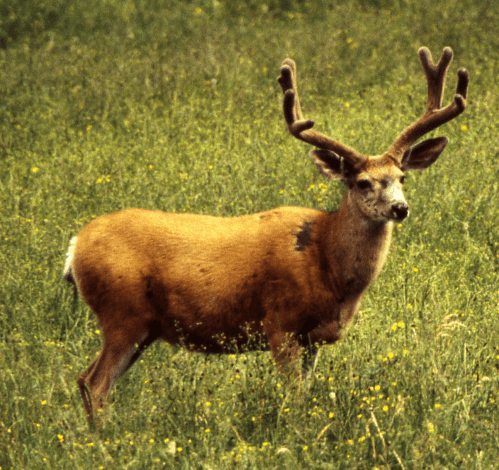
    A mule deer in velvet.

    When Harrison Smith visited Yellowstone Park in the nineteen teens, he was most impressed the Grand Canyon of the Yellowstone. After marveling at the views from the rim, Smith hired a guide to take him to the canyon floor. There he got another thrill.  Here’s his story.

    ∞§∞

    The wonders of the Park are inexhaustible; there are underground caverns to explore, geysers of mud, boiling pools of colored clay, and hot springs, the basins of which are as delicately and beautifully colored as if they had been inlaid with precious stones. But the deep chasm into which the thundering flood of the Yellowstone River plunges, remains forever undimmed in the recollections of all who have seen it. It ranks with Nature’s great masterpieces.

    Before it reaches the Canon, this river flows through Yellowstone Lake, a magnificent sheet of water of one-hundred , and forty square miles lying almost eight thousand feet above the sea, dotted with forested islands and nearly surrounded by lofty snow-capped mountains. A few miles – below the lake, the river after a succession of cascades suddenly leaps over a cliff.

    This is the Upper Fall and half a mile lower down it thunders over the Lower Fall, which has a descent of three hundred and eight feet. Near this fall the river enters the Canon, which ranges in depth from six hundred to twelve hundred feet. Its depth is not tremendous compared with the Colorado Canon, but its precipitous and varied cliffs are so richly colored that it defies description.

    Imagine a great, wedge-shaped gash in the earth, with a foaming white river rushing along at the bottom, and at one end, a torrent pouring over the brink of a precipice. Then imagine that the volcanic rocks that make the walls of the Canon are painted every imaginable color, with orange, red and purple hues predominating. With the cloudless blue of the sky overhead, and the riot of colors below, accentuated by the fan-like spread of the white falls, and the foaming river, the whole scene might well be a fantastic dream.

    Crawling out on a projecting ledge that the gnarled roots of an ancient pine had kept from tumbling into the abyss, I leaned far over the edge. The only sound that marred the intense quiet came from the high and narrow gate-way from which the river leaped to freedom far below. Even that was soft and mellow and in keeping with Nature’s peaceful strength.

    In spite of the distance I could see the double rainbow that curved up from the base of the falls, while hovering over the center of the canon with wings wide-spread in the thin air, an eagle floated, the guardian spirit of the scene. I felt that I was merely a brief intruder, and that here was the true master and ruler of this splendid domain. For the moment I would willingly have given up my kinship with man, for the ability to soar down between those gleaming walls, and fly, winter and summer about the white mountain peaks that circled the horizon, and over the broad emerald lake to this paradise of color and beauty that the river had carved out for its treasure house.

    It is possible to scramble to the bottom of the canon by a winding trail and to walk through its entire length among the pines that border both sides of the river. But although the magic colors of the cliffs gain in splendor on a closer inspection, the feeling of spaciousness that you get in your first bird’s-eye glimpse over the top of the precipice is entirely lost.

    With a guide and three of the more adventurous of my fellow travelers, we tramped almost twenty miles along the river bank. It was difficult and dangerous work, climbing the great boulders and skirting steep precipices, that had been hurled down by the frost from some lofty crag. That night we camped beside a small river that branched into the Yellowstone.

    About a mile away from the camp, the guide discovered deer tracks on a shelving bank of the Yellowstone. Before the shadows of evening had turned into night we were posted on a ledge about one-hundred feet above the river, silently waiting.

    We had been there only a few minutes when the guide pointed excitedly down to the right of the spot we were watching. There, with their front legs sunk in the black water up to their knees, stood two fawns, eagerly drinking. Beside them their mother anxiously looked around, as if she suspected some hidden danger, and then, satisfied that they were safe, followed their example. They stole away as silently as they had come, and melted into the black shadows of the pines.

    An hour later we heard a slight crashing through the trees, and although it was almost too dark to make him out, watched an antlered stag daintily step to the brink of the river. He had been drinking only a moment, when in shifting my position, I dislodged a pebble; it sounded in the deathly stillness like a small avalanche. I caught one glimpse of the lordly up-lifted head of the stag; there was a crash of loose stones under his feet and he turned and fled into the friendly depths of the forest.

    We made our way back to camp; and soon fell asleep with the sound of rushing water in our ears and with the brilliant stars and the black night for our canopy.

    ∞§∞

    — Excerpt from Harrison Smith, “The Yellowstone National Park.”  Pages 144-153 in North America, New York: The Century Co., 1914.

    — Photo from the Yellowstone Digital Slide File.

  • A Tale: Adventurers Run Out of Grub at Old Faithful — Seth Bullock, 1872

    It was natural that Seth Bullock would want to visit Yellowstone. After all, he was the delegate to Montana Territorial Senate who in December 1871 wrote the “memorial” asking the federal government to establish the park. The next summer, he became one of the first tourists to visit there.

    Bullock2
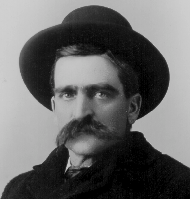
    Seth Bullock

    Bullock was a colorful man whose real life biography inspired the tough sheriff character in the HBO series “Deadwood.” A newspaper once described him as “a man with a cold, grey eye, a nerve that never wavered, and a gun that never missed. “It has been said of him” the article continued, “he was a silent, cold man, and at times he seemed to have lost his power of speech. One writer referred to him as a ‘Man killer,’ and when this was called to his attention, Bullock broke his silence to remark: ‘They say I’ve killed forty-seven men. Son, I’ll tell you what. I’ve never killed but two, and I did not kill them soon enough.’”

    Teddy Roosevelt once called Bullock “the finest kind of frontiersman” and appointed him U.S. Marshall for South Dakota. Bullock began his career as a businessman and lawman in Helena, Montana. Later he moved to South Dakota where he died on his ranch in 1919.

    He was barely 22 when he was elected to the territorial legislature in 1871. Bullock said he never intended the journal of his Yellowstone for publication, but it’s a well written description of what was probably a typical trip at the time.

    Bullock left Helena for the park on horseback August 23, 1872, with three friends named A. J. Teller, Dick White, and Jack Langrishe.

    They led a packhorse that they named “Judge Clancy” after the man Bullock bought him from. The men counted on finding fish and game for food on their trip — a plan that didn’t always work.

    On the second night out, lightening spooked their horses, but they were able to catch a rope on Judge Clancy and stop the stampede. Lost horses were a common occurrence for Yellowstone travelers all through the period when they the primary means of transportation. Since the travelers carried little food for their horses, the animals needed to graze over and sometimes they wandered off. Often travel was delayed to search for horses which were sometimes found miles away.

    Here are some excerpts from Bullock’s journal.

    ∞§∞

    MONDAY, AUGUST 26th –  [The Gallatin Valley]

    Broke camp at 4 A. M. Teller grumbled a great deal at having to get up so early. For me, the day had a special interest. We were to travel through the Gallatin Valley.

    I anticipated a fine stretch of country, but was totally unprepared for the surprise that awaited me. Well has the Gallatin Valley been named the Garden-Spot of Montana. We were charmed and delighted. Stretching before us with mountains on each side was a magnificent plateau of fine rolling prairies, interwoven with two fine streams of silver whose beautiful shimmering sheen could be seen for very beautiful fields of ripe golden grain, greet the eye on every side. Substantial houses and good buildings are the rule and not the exception.

    Traveling through this beautiful valley — one of God’s dimples — as we did on this fine August day, it was impossible not to become a firm believer in the future and prosperity of this section of Montana.

    At 11 a.m. we arrived in Bozeman and camped on Bozeman Creek. A fine stream that skirts the town. After enjoying our Bedouin repast, we took a look at the town, which strikes one as a thrifty place. Evidence of future prosperity exists in the well-known agricultural resources of the valley and the pluck, business energy and shrewdness of the citizens. The town is nicely laid out with wide streets, looks very much like Deer Lodge. The people are all good boys.

    [five days later]

    SATURDAY, AUGUST 31st – [Mammoth Hot Springs]

    Here we are, at the famous springs, encamped in a little ravine, about 100 yards from the springs. Pen cannot describe, nor tongue tell, the wonders of this place. Large, white mountain and plains of icy whiteness cut into fantastic shapes meet the eye.

    Found quite a colony of invalids here. All speak of the medicinal qualities of the baths in terms of praise. Passed the afternoon in resting and listening to amusing stories told by the old mountaineer of the bug-hunters, as they facetiously termed the Hayden party. Intend leaving tomorrow for the geyser country.

    [eight days later]

    SUNDAY, SEPTEMBER 8th –  [Lower Geyser Basin]

    Left prairie at 6 A. M. After floundering around through mud for over three hours, we succeeded in finding solid foundation on hillside and struck out down creek for Lower Geyser Basin. Two pilgrims got stalled in the mud and had to be roped out. Passed numerous hot springs and infant geysers.

    As you approach the lower basin you can imagine that you are overlooking a wharf where a number of steamers are blowing off steam. Camped for noon in Lower Geyser Basin and examined curiosities. Reached Upper Fire Hole Basin about 4 o’clock. Went into camp and started out to examine the geysers. Did not have time to examine but one or two before night.

    While we were eating supper, Old Faithful started its evening entertainment. The display was grand, beyond our highest expectation, the water being thrown about 100 feet high, five feet in diameter at the base to a fine silver thread at the top. Judging from the noises we hear, there must be a great number of geysers in this vicinity.

    We are getting short on grub. Nothing left but flour and coffee. White prepared for supper a new dish, called Geyser sauce.

    [The next day]

    MONDAY, SEPTEMBER 9th – [Upper Geyser Basin]

    Arose at 3 A. M.  Before breakfast, [we] visited a number of geysers. One called “Grand” breaks through a small mound, evidently formed by the geyser. Around the sides of the mound are the most beautiful colorings imaginable.

    Left for home at 12 M. Course down Fire Hole River.  … Weather fine, but cold. No game in sight. No fish. Bread and water all we had today.

    [six days later]

    SUNDAY, SEPTEMBER 15th – [At Bottler’s Ranch north of the Park]

    Left Packer’s Camp at 5 A. M. Lunched at Bottler’s and examined his ranch. Fifty acres of wheat, very good. About the only ranch on the whole Yellowstone River

    Walked into Bottler’s eggs, cream, butter, and “sich” in a way that looked bad for his winter’s grub supply. First civilized grub that we had for twenty days.

    [the next day]

    MONDAY, SEPTEMBER 16th –

    At noon, we started on for Bozeman through Rocky Canyon. Arrived at Bozeman at 4 P. M. A. J. Davis of Helena visited our camp, dined with us on trout and Yellowstone stories. Spent evening in Bozeman.

    ∞§∞

    — Seth Bullock’s journal of his trip to Yellowstone Park is in the collection of the Montana Historical Society.

    — Photo from Wikipedia Commons.