Category: Falls

  • Moran’s Legacy 3: The Grand Canyon of the Yellowstone — Text by F.V. Hayden

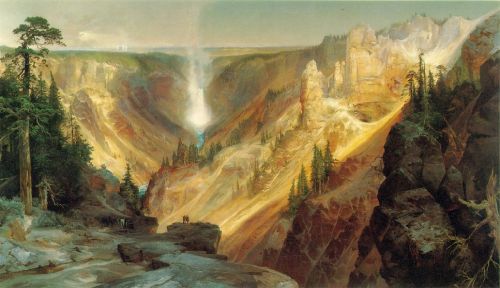
    Thomas_Moran_-_Grand_Canyon_of_the_Yellowstone_-_SmithsonianProbably Thomas Moran’s most famous painting is his 7-by-12-foot depiction of the Yellowstone Canyon and Falls. It hung in the U.S. Capitol for decades and now resides in the Smithsonian. There is an excellent full-size reproduction at the Caynon Visitor Center in Yellowstone Park.

    Moran spent three full days, July 28-30, sketching the canyon and fails while accompanying F.V. Hayden’s expedition to explore and documents the wonders of the upper Yellowstone in 1871. These sketches served as the basis for several full fledged paintings of the canyon and falls over the next few years.

    Moran’s journal entries for his days at the canyon are extremely sparse. His July 30 entry is typical; it said simply: “photographing and sketching around Falls and Canyon.” Fortunately, F.V. Hayden offers more detail. Here’s Hayden’s description of the falls and canyon, and Moran at work there.

    ∞§∞

    Standing near the margin of the Lower Falls, and looking down the caynon, which looks like an immense chasm or cleft in the basalt, with its sides 1,200 to 1,500 feet high, and decorated with the most brilliant colors that the human eye ever saw, with the rocks weathered into an almost unlimited variety of forms, with here and there a pine sending its roots into the clefts on the sides as if struggling with a sort of uncertain success to maintain an existence—the whole presents a picture that it would be difficult to surpass in nature.

    Mr. Thomas Moran, a celebrated artist, and noted for his skill as a colorist, exclaimed with a kind of regretful enthusiasm that these beautiful tints were beyond the reach of human art. It is not the depth alone that gives such an impression of grandeur to the mind, but it is also the picturesque forms and coloring. Mr. Moran is now engaged in transferring this remarkable picture to canvas, and by means of a skillful use of colors something like a conception of its beauty may be conveyed.

    After the waters of the Yellowstone roll over the upper descent, they flow with great rapidity over the apparently flat rocky bottom, which spreads out to nearly double its width above the falls, and continues thus until near the Lower Falls, when the channel again contracts, and the waters seem, as it were, to gather themselves into one compact mass and plunge over the descent of 350 feet in detached drops of foam as white as snow; some of the large globules of water shoot down like the contents of an exploded rocket.

    It is a sight far more beautiful, though not so grand or impressive as that of Niagara Falls. A heavy mist always arises from the water at the foot of the falls, so dense that one cannot approach within 200 or 300 feet, and even then the clothes will be drenched in a few moments. Upon the yellow, nearly vertical wall of the west side, the mist mostly falls, and for 300 feet from the bottom the wall is covered with a thick matting of mosses, sedges, grasses, and other vegetation of the most vivid green, which have sent their small roots into the softened rocks, and are nourished by the ever-ascending spray. At the base and quite high up on the sides of the canyon, are great quantities of talus, and through the fragments of rocks and decomposed spring deposits may be seen the horizontal strata of breccia.

    ∞§∞

    — F.V. Hayden, Preliminary Report of the United State Geological Survey of Montana. Washington: U.S. Government Printing Office, 1872.

    — Coppermine Photo Gallery image.

    — For more on this topic, select “Thomas Moran” under the Categories button to the left.
  • A Scene: Watching Deer in Yellowstone Canyon — Harrison Smith, 1914.

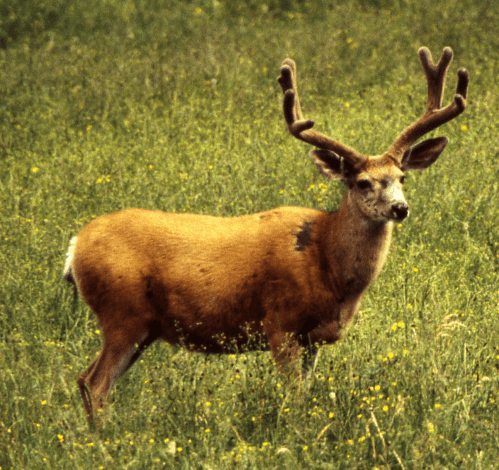
    Mule dee in velvet YDSF
    A mule deer in velvet.

    When Harrison Smith visited Yellowstone Park in the nineteen teens, he was most impressed the Grand Canyon of the Yellowstone. After marveling at the views from the rim, Smith hired a guide to take him to the canyon floor. There he got another thrill.  Here’s his story.

    ∞§∞

    The wonders of the Park are inexhaustible; there are underground caverns to explore, geysers of mud, boiling pools of colored clay, and hot springs, the basins of which are as delicately and beautifully colored as if they had been inlaid with precious stones. But the deep chasm into which the thundering flood of the Yellowstone River plunges, remains forever undimmed in the recollections of all who have seen it. It ranks with Nature’s great masterpieces.

    Before it reaches the Canon, this river flows through Yellowstone Lake, a magnificent sheet of water of one-hundred , and forty square miles lying almost eight thousand feet above the sea, dotted with forested islands and nearly surrounded by lofty snow-capped mountains. A few miles – below the lake, the river after a succession of cascades suddenly leaps over a cliff.

    This is the Upper Fall and half a mile lower down it thunders over the Lower Fall, which has a descent of three hundred and eight feet. Near this fall the river enters the Canon, which ranges in depth from six hundred to twelve hundred feet. Its depth is not tremendous compared with the Colorado Canon, but its precipitous and varied cliffs are so richly colored that it defies description.

    Imagine a great, wedge-shaped gash in the earth, with a foaming white river rushing along at the bottom, and at one end, a torrent pouring over the brink of a precipice. Then imagine that the volcanic rocks that make the walls of the Canon are painted every imaginable color, with orange, red and purple hues predominating. With the cloudless blue of the sky overhead, and the riot of colors below, accentuated by the fan-like spread of the white falls, and the foaming river, the whole scene might well be a fantastic dream.

    Crawling out on a projecting ledge that the gnarled roots of an ancient pine had kept from tumbling into the abyss, I leaned far over the edge. The only sound that marred the intense quiet came from the high and narrow gate-way from which the river leaped to freedom far below. Even that was soft and mellow and in keeping with Nature’s peaceful strength.

    In spite of the distance I could see the double rainbow that curved up from the base of the falls, while hovering over the center of the canon with wings wide-spread in the thin air, an eagle floated, the guardian spirit of the scene. I felt that I was merely a brief intruder, and that here was the true master and ruler of this splendid domain. For the moment I would willingly have given up my kinship with man, for the ability to soar down between those gleaming walls, and fly, winter and summer about the white mountain peaks that circled the horizon, and over the broad emerald lake to this paradise of color and beauty that the river had carved out for its treasure house.

    It is possible to scramble to the bottom of the canon by a winding trail and to walk through its entire length among the pines that border both sides of the river. But although the magic colors of the cliffs gain in splendor on a closer inspection, the feeling of spaciousness that you get in your first bird’s-eye glimpse over the top of the precipice is entirely lost.

    With a guide and three of the more adventurous of my fellow travelers, we tramped almost twenty miles along the river bank. It was difficult and dangerous work, climbing the great boulders and skirting steep precipices, that had been hurled down by the frost from some lofty crag. That night we camped beside a small river that branched into the Yellowstone.

    About a mile away from the camp, the guide discovered deer tracks on a shelving bank of the Yellowstone. Before the shadows of evening had turned into night we were posted on a ledge about one-hundred feet above the river, silently waiting.

    We had been there only a few minutes when the guide pointed excitedly down to the right of the spot we were watching. There, with their front legs sunk in the black water up to their knees, stood two fawns, eagerly drinking. Beside them their mother anxiously looked around, as if she suspected some hidden danger, and then, satisfied that they were safe, followed their example. They stole away as silently as they had come, and melted into the black shadows of the pines.

    An hour later we heard a slight crashing through the trees, and although it was almost too dark to make him out, watched an antlered stag daintily step to the brink of the river. He had been drinking only a moment, when in shifting my position, I dislodged a pebble; it sounded in the deathly stillness like a small avalanche. I caught one glimpse of the lordly up-lifted head of the stag; there was a crash of loose stones under his feet and he turned and fled into the friendly depths of the forest.

    We made our way back to camp; and soon fell asleep with the sound of rushing water in our ears and with the brilliant stars and the black night for our canopy.

    ∞§∞

    — Excerpt from Harrison Smith, “The Yellowstone National Park.”  Pages 144-153 in North America, New York: The Century Co., 1914.

    — Photo from the Yellowstone Digital Slide File.

  • Moran’s Legacy: Tower Fall — Text by N.P. Langford

    Tower Falls, Thomas Moran, 1875

    Thomas Moran began conjuring images of the upper Yellowstone before he even saw the place. Moran was an illustrator for Scribner’s Monthly and provided drawings for N.P. Langford’s article about the famous Washburn expedition of 1870.

    While learning to paint, Moran sought inspiration from literary works such as Longfellow’s “Hiawatha,” so it wasn’t hard for him to base his illustrations entirely on Langford’s words. The results were interesting (if sometimes inaccurate). Below is what Langford said about Tower Fall and how Moran pictured it.

    ∞§∞

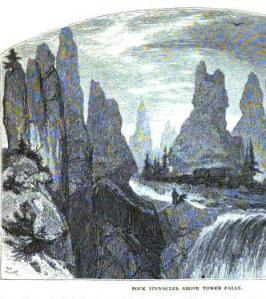
    Tower Falls Illustration from Scribner’s

    Tower Creek is a mountain torrent flowing through a gorge about forty yards wide. Just below our camp, it falls perpendicularly over an even ledge 112 feet, forming one of the most beautiful cataracts in the world. For some distance above the fall, the stream is broken into a great number of channels each of which has worked a torturous course through a compact body of shale to the verge of the precipice where they re-united and form the fall.

    The countless shapes into which the shale has been wrought by the action of the angry waters, add a feature of great interest to the scene. Spires of solid shale, capped with slate, beautifully rounded and polished, faultless in symmetry, raise their tapering forms to the height of from 80 to 150 feet, all over the plateau above the cataract. Some resemble towers, others spires of churches, and others still shoot up as lithe and slender as the minarets of a mosque.

    Some of the loftiest of these formations, standing like sentinels upon the very brink of the fall, are accessible to an expert and adventurous climber. The position attain on one of their narrow summits, amid the uproar at a height of 250 feet above the boiling chasm, as the writer can affirm, requires a steady hand and strong nerves; yet the view which rewards the temerity of the exploit is full of compensations.

    Below the fall the stream descends in numerous rapids, with frightful velocity, through a gloomy gorge, to its unions with the Yellowstone. Its bed is filled with enormous boulders, against which the rushing waters break with great fury. Many of the capricious formations wrought from the shale excite merriment as well as wonder. Of this kind especially was a huge mass sixty feet in height, which, from its supposed resemblance to the proverbial foot of his Satanic Majesty, we called the ‘Devil’s Hoof.’

    The scenery of mountain, rock, and forest surrounding the falls is very beautiful. Here too, the hunter and fisherman can indulge their tastes with the certainty of ample reward. As a halfway resort to the greater wonders still farther up the marvelous river, the visitor of future years will find no more delightful resting place. No account of this beautiful fall has ever been given by any of the former visitors to this region. The name of “Tower Falls,” which we  gave it, was suggested by some of the most conspicuous features of the scenery.”

    ∞§∞

    Moran’s 1871 field sketch of Tower Falls.

    Moran actually got to see Tower Fall in 1871 when he accompanied the government explorer, F.V. Hayden there. During the two days Moran spent at Tower Fall, he must have worked diligently making sketches from various vantage points in ink and watercolor. He used these en plain air studies later to produce several paintings in his studio.

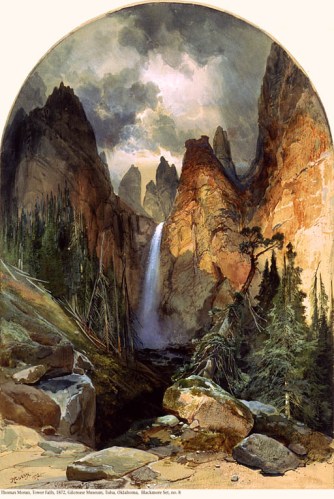
    Tower Fall, Thomas Moran, 1872.

    A year after the Washburn Expedition, Moran produced the full color rendition seen below. This piece reflects the Romantic Hudson River School that dominated American art at the time. It is characterized by aerial perspective, concealed brushstrokes and luminist techniques that made the landscapes seem to glow.

    In 1875, Moran offered the version of Tower Fall shown at the top of this post that is more impressionistic in that it juxtaposes elements in ways that can’t be seen from any actual viewpoint. Moran, who famously said, “I place no value upon literal transcripts from Nature,” was a Romantic who sought to reproduce the emotional rapture that some landscapes evoke.

    ∞§∞

    — The magazine illustration and N. P. Langford’s description are from his article “The Wonders of the Yellowstone.” Scribner’s Monthly, 2(1) 1-16 (May, 1871)

    — Other images are from the Coppermine Gallery.

    — For more on Moran’s Legacy, click on “Thamas Moran” under the Categories button to the left.

    — You might also enjoy N.P. Langford’s humorous tale about the naming of Tower Fall.

  • Two Ocean Pass and the Mystery of the Fishless Waters

    Parting of the Waters, Two Ocean Pass

    Early travelers to the area that became Yellowstone National Park found fish were abundant in the Yellowstone River and Lake and their tributaries, but many other lakes and streams were devoid of fish. At first, people thought heat and chemicals from geothermal features killed fish in some places. Then geologists offered another explanation.

    The Yellowstone plateau, geologists said, was a huge sheet of volcanic rock left by a super volcano. Across eons, a giant glacier formed over the volcanic rock. When the ice age ended, the glacier melted washing away soft material but leaving hard volcanic rock. This formed a circle of waterfalls and cascades that fish couldn’t get over to populate the plateau.

    The geologists’ theory explained the fishless waters, but it left a deeper mystery: How did fish get into upper Yellowstone and its tributaries?  Certainly, they didn’t do it by climbing the 300-foot lower fall of the Yellowstone.

    Then, people remembered Mountain Man Jim Bridger’s tale of the “Two Ocean Pass,” a place on the headwaters of the Yellowstone where creeks crossed the continental divide. Explorers had documented the existence of the pass, but it wasn’t until 1891 that the U.S. Fish Commission sent an ichthyologist to the area.

    Here’s how Dr. Barton Warren Evermann described what he found at the Two-Ocean Pass.

    ∞§∞

    We stood upon the bank of either fork of Atlantic Creek, just above the place of the ”parting of the waters,” and watched the stream pursue its rapid but dangerous and uncertain course along the very crest of the “Great Continental Divide.” A creek flowing along the ridgepole of a continent is unusual and strange, and well worth watching and experimenting with.

    We waded to the middle of the North Fork, and, lying down upon the rocks in its bed. We drank the pure icy water that was hurrying to the Pacific, and, without rising, but by simply bending a little to the left, we took a draught from that portion of the stream which was just deciding to go east, via the Missouri-Mississippi route, to the Gulf of Mexico.

    And then we tossed chips, two at a time, into the stream. Though they would strike the water within an inch or so of each other, not infrequently one would be carried by the current to the left, keeping in Atlantic Creek, while the other might be carried a little to the right and enter the branch running across the meadow to Pacific Creek; the one beginning a journey which will finally bring it to the Great Gulf, the other entering upon a long voyage in the opposite direction to Balboa’s ocean.

    Pacific Creek is a stream of good size long before it enters the Pass, and its course through the meadow is in a definite channel; but not so with Atlantic Creek. The west bank of each fork is low, and the water is liable to break through anywhere, and thus send a part of its water across to Pacific Creek. It is probably true that one or two branches always connect the two creeks under ordinary conditions, and that, following heavy rains, or when the snows are melting, a much greater portion of the water of Atlantic Creek finds its way across the meadow to the other.

    It is certain that there is, under ordinary circumstances, a continuous waterway through Two-Ocean Pass of such a character as to permit fishes to pass easily and readily from Snake River over to the Yellowstone, or in the opposite direction. Indeed, it is possible, barring certain falls in Snake River, for a fish so inclined to start at the mouth of the Columbia, travel up that great river to its principal tributary, the Snake, thence on through the long, tortuous course of that stream, and, under the shadows of the Grand Tetons, enter the cold waters of Pacific Creek, by which it could journey on up to the very crest of the Great Continental Divide to Two Ocean Pass; through this Pass it may have a choice of two routes to Atlantic Creek, in which the down-stream journey is begun. Soon it reaches the Yellowstone, down which it continues to Yellowstone Lake, then through the lower Yellowstone out into the turbid waters of the Missouri. For many hundred miles, it may continue down this mighty river before reaching the Father of Waters, which will finally carry it to the Gulf of Mexico—a wonderful journey of nearly six thousand miles, by far the longest possible fresh-water journey in the world.

    We found trout in Pacific Creek at every point where we examined it. In Two-Ocean Pass, we obtained specimens from each of the streams, and in such positions as would have permitted them to pass easily from one side of the divide to the other. We also caught trout in Atlantic Creek below the Pass, and in the upper Yellowstone, where they were abundant.

    Thus it is certain that there is no obstruction even in dry weather to prevent the passage of trout from the Snake River to Yellowstone Lake; it is quite evident that trout do pass over in this way; and it is almost absolutely certain that Yellowstone Lake was stocked with trout from the west, via Two-Ocean Pass.

    ∞§∞

    — Excerpt adapted from Barton Warren Evermann, “Two Ocean Pass,” Inland Educator 2(6): 299-306 (July 1896).

    — U.S. Forest Service Photo.

    — To learn more about Two Ocean Pass and fishing in Yellowstone in the 1870’s, check out my Big Sky Journal Article, “When All the Fish Were Natives.”

  • A Tale: Part 5: A Lady’s Visit To The Geysers Of The Yellowstone Park — HWS 1880

    Tower Creek, Thomas Moran, 1871

    HWS abandons her wagon and mounts “a sober old creature named Foxey” to cross the roadless wilderness to the Grand Canyon of the Yellowstone.

    Begin with Part 1

    ∞§∞

     The day we left the Mammoth Hot Springs, we had an accumulation of all the miseries of camping-out life. Fierce heat succeeded by torrents of wind and rain, and, to add to everything else, perfect swarms of mosquitoes. But we were repaid by the sight of Tower Creek, which rises in the high divide between the valleys of the Missouri and Yellowstone, and flows for ten miles through a cavern so deep and gloomy that it is called the Devil’s Gorge.

    About two hundred yards before entering the Yellowstone River, it dashes over an abrupt descent of 156 feet, forming a very beautiful waterfall. All around are columns of volcanic breccia, some resembling towers, some the spires of churches, and some are almost as slender and graceful as the minarets of a mosque. But, alas, one sad fatality spoiled the scene for me.

    It was impossible to take the wagon any further, and there was no alternative but to mount one of those wild beasts named by Adam a horse. The guides picked me out a sober old creature named Foxey, used to carry a pack, and likely therefore to be equal to my weight, and unlikely to be frisky or foolish. On the morning of the 9th of August, we started a long train of twenty-six horses, two dogs, and three colts, for the Yellowstone Falls and Canyon.

    As I was quite determined never to go out of a walk, on account of the tendency to slip off, I took the tail end of the pack train, and plodded on very contentedly for a while. But, alas, my comfort was of short duration, for, when we stopped to lunch, Foxey lost sight of the pack, to which he felt he rightfully belonged, and getting either bewildered or angry, he began to behave in the most unaccountable manner. He backed and forwarded and sidled and turned round and round and neighed, and completely mastered me, till our of the guides came up and fastened a rope to his bridle and led him the rest of the way.

    It is beyond my power to depict the grandeur and beauty of the mystic river, and its falls and canyon. There are two falls, half a mile apart; the upper is 140 feet high, and the lower 397. The water is compressed into a mass about 100 feet wide, and from four to six feet deep, and falls over the precipices in one apparently solid mass of glorious emerald, into its marvelous canyon below. This canyon is one of the Park’s greatest wonders.

    It is a stupendous chasm about twenty-five miles long and from 1,000 to 3,000 feet high. It can only be seen from the top, as its sides are inaccessible except in one place six miles below the falls. The river has cut its way through a material largely composed of soft clays, sand, tufa, volcanic ash and breccia, with occasional layers of basalt, and has wrought out for itself a wonderful channel.

    Towers and turrets and dykes and castle walls of all shapes and sizes are crowded together throughout its whole length in wild confusion. Here and there a single tower stands out in solitary grandeur, isolated from all its fellows, with perhaps a lonely fish hawk’s nest on its top, and little birds stretching out their open mouths towards the mother, who was circling in the grand and awful chasm over the river. But wonderful as these walls are for their height, and the grotesque and beautiful forms into which they are eroded, they are vastly more so for their color.

    From their lofty tops to the very edge of the water, they are dyed with an endless variety of the most vivid and delicate coloring. They are a mass of yellows and red and coal black and snow-white and cream and buff and brown and gray and olive, mingled together in richest confusion, while at the bottom runs the river, a glorious roaring torrent of purest emerald green, embroidered with silvery foam, between slopes decorated with velvet grass. The effect is indescribable.

    ∞§∞

    — From H. W. S., “A Lady’s Visit To The Geysers Of The Yellowstone Park.” Friends Intelligencer May 19, 1883. Pages 218-221, and May 27, Pages 234-237.

    — Coppermine Gallery Image.

  • A Tale: Rafting Across the Yellowstone to View the Canyon From Artist Point — Holmes, 1896.

    The View from Artist Point

    In 1896 the famous lecturer, film maker and writer, Burton Holmes, visited Yellowstone Park. Holmes, who coined the word “travelogues” wrote about his Yellowstone trip in Volume 6 of his ten-volume series by that name.

    After describing the Grand Canyon of the Yellowstone from several vantage points on the north rim, Holmes told this story about crossing the Yellowstone River on a crude raft made of logs to see the lower fall from “Artist Point.”

    ∞§∞

     Most travelers are content to view the canyon from the points to which I have already led you. Others remain unsatisfied until they have looked into the great chasm from “Artists’ Point,” the one perfect point of view, which is unfortunately on the other bank, and in 1896 was well nigh inaccessible.

    There was no bridge; the crossing of the river below the falls was utterly out of the question; but there remained the possibility of crossing far above the upper gorge, where the waters, although swift-flowing, present a level, navigable surface. But there has not been a boat upon the river since the last one, very fortunately empty, was swept away and dashed to pieces by the cataracts. No boat! No bridge!

    The river being now too deep and swift to ford, I turn in my difficulty to the gallant soldiers of Uncle Sam, who are stationed at the canyon. The sergeant in command at the little military camp enthusiastically comes to my assistance, and at sunrise next morning I find him a little way above the rapids, slowly poling upstream a raft, which he has built expressly for our excursion.

    Rafting Across the Yellowstone

    At last, we reach a point from which he deems it safe to put out into the current, where the waters, swift as those of a millrace, are gliding on in their eagerness to plunge into the yawning canyon, just one mile beyond. There was, of course, no actual danger, yet the thought was ever present that our raft, if left to its own devices, would at once follow unresistingly that treacherous flood, bound through the rapids and plunge over the first fall, then dash through the upper canyon, and finally meet annihilation in the whirlpools at the bottom of the great cataract.

    In safety, however, we arrive on the farther shore. Then we skirt the right bank through a thick growth of pine, and while we are walking through the forest, thundershowers come and go with great frequency and fury.  We are soon drenched to the skin, but pressing on we reach the edge of the forest; the earth appears to open at our feet, and the canyon yawns before us, deep and mysterious. Vapors are surging upward from its depths, but fortunately, the sun is beginning to break through the clouds above.

    A shaft of sunshine touches a portion of the opposing wall, and another brilliantly illuminates the pinnacles of white and gold, while others chase the vapors rapidly away. The fears that rain and fog will render our excursion fruitless are dispelled, as, reaching another point of view, we exchange salutes with friends on the other rim.

    We shout to them, they shout to us; but the sounds meet only halfway and then fall into the depths between. We cannot hear, nor are we ourselves heard. The river’s rumbling mocks our puny efforts to span the deep chasm with a bridge of vocal sound. We must attempt to span it with our gaze.

    Few of the great sights of this world have power to thrill us more than this vista of the canyon of the Yellowstone. We are unable to tell what most impresses us: the immensity of the great gulf, the infinite glory of its colored walls, the struggling river far below, the stately army of tall pines massed on the brink and pressing forward, apparently as eager as we to drink in all the splendor of the scene.

    All these things go to compose the scene, to form that indefinable majesty that inspires us—to hold our peace. Silence is the only eloquence that can avail us here. No man has yet found language to express the majesty of this abyss of color. But, we ask, will no voice ever perfectly express in words what we all feel but dare not, cannot speak? Will no great poet of the new world, inspired by these grandeurs, ever utter the immortal song in which our vaguest thoughts shall find interpretation? Great, great indeed must be the soul of him who would give adequate expression to the reverential awe inspired by a scene like this.

    But what is man that he should strive to utter the unutterable? The emotions that overwhelm us here can be expressed only in one language, and that is not a mortal language; it is the language of those to whom all mysteries have been revealed—the great eternal, wordless language of the soul: a language that we may not understand until the gates of death have closed behind us.

    ∞§∞

    —   From Burton Holmes Travelogues, Volume 6, The McClure Company: New York, 1905. (Pages 104-112)

    —   Artist Point Postcard by F.J. Haynes. Coppermine Photo Gallery.

    —  Photos of rafting across the Yellowstone River by Burton Holmes, Travelogues, Volume 6.

    — You might also enjoy:

  • A Tale: Rolling Boulders Down Gardiner Canyon — Wingate, 1885

    In the summer of 1885, General George W. Wingate took his wife and daughter through Yellowstone Park. Although the system of roads was complete by then, the Wingates decided to make their tour on horseback, the better to see the sights. The General, who was a civil war veteran and later president of the National Rifle Association, wrote a charming book about his adventures in the park. Here’s an excerpt.

    ∞§∞

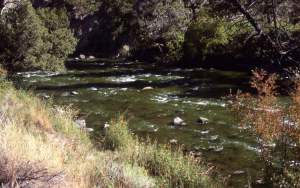
    The Gardiner River

    The 19th being Sunday, the ladies rested in camp, while I took our three men and rode to the Middle Falls of the Gardner. There was no road; merely a blazed trail through the woods, which we had to hunt up. This involved fording the river and considerable skirmishing among fallen timber, and in and out of places where I would never have dreamed at the East of venturing on horseback. Finally, the trail (probably an old elk runway) was found. It was just wide enough for a horse to get through, and led us up the mountain by a comparatively easy grade, but along a precipice, with yawning depths, to glance into which was sometimes quite startling. But we were rapidly becoming accustomed to that sort of thing and took it as naturally as our ponies did.

    After a steady climb of four miles, we found ourselves on the edge of a canyon overlooking the falls. It was a magnificent and most picturesque sight. Mr. Winson’s very accurate guide book gives the depth of the canyon at from 1,200 to 1,500 feet. I think this is an error as this would be deeper than the Great Canyon (which the same authority gives at 1,200 feet) and I should think the latter was considerably the deepest. But whatever the measurement, it is of appalling depth, about 500 yards wide at the top and very narrow at the bottom, not to exceed 150 feet. The sides drop from the brink above in almost perpendicular ledges, as steep as the Palisades on the Hudson River and four times their depth. Into this cleft in the rocks, the river plunges in one unbroken fall of over a hundred feet and then continues its fall in a scries of cascades to the bottom of the dark chasm. The white fall, the tumbling water, and the dark shadows of.the canyon, make a striking picture.

    After fully enjoying the scene, we amused ourselves by rolling large rocks over the cliff. It was wonderful to see a stone the size of a trunk leap into the air in a plunge of 200 or 300 feet, strike the shelf below as if thrown by a catapult, and with such tremendous force as to rebound twenty feet, and after a series of such terrific bounds, make another tremendous leap to the slope below, continuing in bound after bound until it reached the creek, growing smaller and smaller at each movement until it seemed no larger than a foot-ball.

    While indulging in this boyish sport a faint shout came up from below signifying that there was some one down in the canyon. It is unnecessary to say that we at once stopped the stone rolling. Looking down we saw a party of fishermen from the hotel dodging up the bottom of the canyon with great celerity and evident anxiety as to whether any more stones might be expected. So great was the depth, that they looked like children.

    While watching them, Horace’s hat blew off and lodged in the shelf at the foot of the cliff at the brink of which we were standing. It seemed only a short way down, and we undertook to fasten the picket ropes of the horses together so as to aid him to descend, but found they would not begin to reach the distance. Horace was determined to have his hat, and with regular western recklessness started to climb down.

    By selecting places where the fragments from the sides of the canyon had formed a slope, and clinging to the trees and shrubs, he managed to work his way to the shelf below, and up on that to his beloved head-gear. He had to go so far down that he appeared only half his natural size.

    The exploit was more hazardous than we imagined. Mr. Davis, of the Northern Pacific Railroad, as I was afterwards told, undertook to climb up near that very spot only a day or two before. The loose stone slid under his feet, as is common in mountain climbing, but which, though fatiguing, is not dangerous if one keeps moving. Finally, he climbed out on a large boulder, the size of a small house, to look around. Suddenly he discovered that it too was in motion. He slid along upon it for some distance expecting it would roll at every instant, when fortunately, it passed so near a tree that he was enabled to spring into the branches, while the boulder went crashing downwards for a thousand feet, snapping the trees like pipe stems in its course.

    ∞§∞

    — From George Wood Wingate, Through the Yellowstone Park on Horseback. Judd and Judd: New York, 1886. Pages 79-81.

    — Photo, Coppermine Photo Gallery.

    You might also enjoy:

  • A Scene: The Great Falls of the Yellowstone — Washburn, 1870

    For decades trappers and prospectors told about the wonders in the upper Yellowstone, but their reports usually were dismissed as tall tales and few people visited the remote area. But interest soared within a year of the Washburn Expedition’s return after their exploration in 1870.

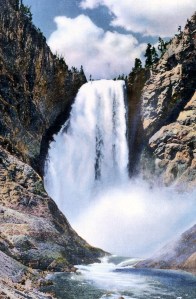
    Lower Falls of the Yellowstone

    Soon the race was on for tourists dollars with Bozeman businessmen building a road up Yankee Jim Canyon on the north and their Virginia City counterparts  doing the same over Targhee Pass on the west. Tourists began arriving before the roads were done. Also, entrepreneurs were building hotels and bathhouses and planning stagecoach service.  

    The reason the Washburn Expedition generated interest while earlier groups had failed was that it included prominent men whose word couldn’t be doubted—and several of them were skilled writers who published their reports immediately in Montana newspapers. One of these writers, was Henry Washburn himself. He was a distinguished Civil War officer and Surveyor General of Montana Territory. Here’s an excerpt describing the Great Falls of the Yellowstone from the report  Washburn wrote for the Helena Daily Herald just days after getting home.

    ∞§∞

    The party crossed over a high range of mountains and in two days reached the Great Falls. In crossing the range, from an elevated peak a very fine view was had. The country before us was a vast basin. Far away in the distance, but plainly seen, was the Yellowstone Lake: around the basin the jagged peaks of the Wind River, Big Horn, and Lower Yellowstone ranges of mountains; while just ever the lake could be seen the tops of the Tetons.

    Our course lay over the mountains and through dense timber. Camping for the night eight or ten miles from the falls, we visited some hot springs that, in any other country, would be a great curiosity, boiling up two or three feet, giving off immense volumes of steam, while their sides were incrusted with sulphur. It needed but a little stretch of imagination on the part of one of the party to christen them “Hellbroth Springs.”

    Our next camp was near the Great Falls, upon a small stream running into the main river between the upper and lower falls. This stream has torn its way through a mountain range, making a fearful chasm through lava rock, leaving it in every conceivable shape. This gorge was christened the’” Devil’s Den.” Below this is a beautiful cascade, the first fall of which is 5 feet, the second 20 feet. and the final leap 84 feet. From its exceedingly clear and sparkling beauty it was named “Crystal Cascade.”

    Crossing above the upper falls of the Yellowstone, you find the river one hundred yards in width, flowing peacefully and quiet. A little lower down it becomes a frightful torrent, pouring through a narrow gorge over loose boulders and fixed rocks, leaping from ledge to ledge, until, narrowed by the mountains and confined to a space of about 80 feet, it takes a sudden leap, breaking into white spray in its descent, 115 feet.

    Two hundred yards below, the river again resumes its peaceful career. The pool below the falls is a beautiful green, capped with white. On the right-hand side a clump of pines grows just above the falls, and the grand amphitheater, worn by the maddened waters on the same side, is covered with a dense growth of the same.

    The left side is steep and craggy. Towering above the falls, half-way down and upon a level with the water, is a projecting crag, from which the falls can be seen in all their glory. No perceptible change can be seen in the volume of water here from what it was where we first struck the river. At the head of the rapids arc four apparently enormous boulders, standing as sentinels in the middle of the stream. Pines are growing upon two of them. From the upper fall to the lower there is no difficulty in reaching the bottom of the canyon.

    The lower falls are about half a mile below the upper. where the mountains again, as if striving for the mastery, close in on either side, and are not more than 70 feet apart. And here the waters are thrown over a perpendicular fall of 350 feet.

    The canyon below is steep and rocky, and volcanic in its formation. The water, just before it breaks into spray, has a beautiful green tint, as has also the water in the canyon below. Just below, on the left-hand side, is a ledge of rock, from which the falls and the canyon may be seen. The mingling of green water and white spray with the rainbow tints is beautiful beyond description.

    The canyon is a fearful chasm, at the lower falls a thousand feet deep, and growing deeper as it passes on, until nearly double that depth. Jutting over the canyon is a rock 200 feet high, on the top of which is an eagle’s nest, which covers the whole top. Messrs. Hauser, Stickney, and Lieutenant Doane succeeded in reaching the bottom, but it was a dangerous journey. Two and a half miles below the falls, on the right, a little rivulet, as if to show its temerity, dashes from the top of the canyon, and is broken into a million fragments in its daring attempt.

    ∞§∞

    — From Henry Washburn, “The Yellowstone Expedition,” Helena Daily Herald, September 27 and 28, 1870.

    — Frank J. Haynes postcard, Yellowstone Digital Slide File.

    — You might also enjoy General Washburn’s description of geysers.

    — For more stories about the Washburn Expedition, click on “Washburn” under the “Categories” button to the left.

  • A Tale: Jim Bridger’s Descriptions of Yellowstone Wonders — Gunnison, 1852

    Conventional wisdom is that people just didn’t believe trappers’ tales of fountains of boiling water, mountains of glass and the other wonders of the upper Yellowstone. But that’s not entirely true, at least in the case of the famous Mountain Man, Jim Bridger. The U.S. Army apparently found Bridger reliable; they frequently hired him as a scout, included his descriptions in their reports and called him “Major.”

    Jim Bridger

    One of the officers who believed Bridger was John W. Gunnison, a lieutenant in the Army Corps of Topographers. When a severe winter kept Gunnison from doing surveys of the Great Salt Lake Valley in 1849-50, he used the time to do research on the people who lived there. He published a book in 1852 that included this description of Bridger.

    ∞§∞

    The builder of Fort Bridger is one of-the hardy race of mountain trappers who are now disappearing from the continent, being enclosed in the wave of civilisation. These trappers have made a thousand fortunes for eastern men, and by their improvidence have nothing for themselves.

    Major Bridger, or “old Jim,” has been more wise of late, and laid aside a competence; but the mountain tastes fostered by twenty-eight years of exciting scenes, will probably keep him there for life. He has been very active, and traversed the region from the head-waters of the Missouri to the Del Norte—and along the Gila to the Gulf, and thence throughout Oregon and the interior of California.

    His graphic sketches are delightful romances. With a buffalo skin and piece of charcoal, he will map out any portion of this immense region, and delineate mountains, streams, and-the circular valleys called “holes,” with wonderful accuracy; at least we may so speak of that portion we traversed after his descriptions were given.

    He gives a picture, most romantic and enticing, of the head-waters of the Yellowstone. A lake sixty miles long, cold and pellucid, lies embosomed amid high precipitous mountains. On the west side is a sloping plain several miles wide, with clumps of trees and groves of pine.

    The ground resounds to the tread of horses. Geysers spout up seventy feet high, with a terrific hissing noise, at regular intervals. Waterfalls are sparkling, leaping, and thundering down the precipices, and collect in the pool below. The river issues from this lake, and for fifteen miles roars through the perpendicular canyon at the outlet. In this section are the Great-Springs, so hot that meat is readily cooked in them, and as they descend on the successive terraces, afford at length delightful baths. On the other side is an acid spring, which gushes out in a river torrent; and below is a cave which supplies “vermilion” for the savages in abundance.

    Bear, elk, deer, wolf, and fox, are among the sporting game, and the feathered tribe yields its share for variety, on the sportsman’s table of rock or turf.

    ∞§∞

    — From Gunnison, J.W.,  A History of the Mormons. Philadelphia: Lippincott, Grambo  & Co., 1852.   p. 151

    — Photo, Wikipedia Commons.

    — You might also enjoy:

  • View: Thomas Moran Painted His Impression of the Grand Canyon of the Yellowstone

    “The Grand Canyon of the Yellowstone,” Thomas Moran

    In their journals, many tourists compared the experience of actually seeing the Yellowstone Falls and Canyon to viewing Thomas Moran’s famous painting, “The Grand Canyon of the Yellowstone.” They often disagreed on the question, ”did he get the colors right,” perhaps because the canyon looks different depending on cloud cover and sun angle. But few of them commented on other differences between viewing the painting and what they saw at the canyon.

    Moran said “I place no value upon literal transcripts from Nature . …  I did not wish to realize the scene literally, but to preserve and to convey its true impression.” To convey this “true impression,” he included several elements in the painting that could never have been seen at a single time and place.

    The painting is 12 feet wide and 7 feet tall making it impossible to see its details here, but one writer described Moran’s painting like this in 1872 when it was new:

    ∞§∞

    One of the last acts of Congress was the purchase of Mr. Thomas Moran’s “Grand Canyon of the Yellowstone,” for ten thousand dollars. It is to be placed above one of the great marble stairways in the Senate wing of the Capitol. It is the most magnificent painting we ever beheld, and we have seen Bierstadt’s “Yo Semite” and “Rocky Mountains.”

    Geyser Plumes Detail

    The Rocky Mountain range is just visible in the far distance, with the ” Tetons,” three snow covered peaks, rising above. Three of the largest geysers may also be seen in the distance and to the left of the Fall.

    The track of the river may be known by a long depression in the distant landscape. On a level plateau of purplish rock, or calcareous substance in the foreground, a few men and horses are standing.

    A dead deer or antelope lies near, and behind a cluster of huge pines, on a beetling rock, stands a large bear calmly surveying the scene. To the right in the foreground, the rocks are piled up rugged and high, and in the shadow are of a purplish-brown color.

    Just beyond this is a long smooth slope of gold color shaded to a pale primrose on one side, and to a very deep orange on the other, while still beyond rise the wonderful cliffs, which give to the scene a character distinct from any in the world.

    The coloring is pale gold in ground work, with lines and figures in violet, crimson, scarlet, deep amber and vermilion—just as if tinted by rainbows and sunbeams! This most strange and beautiful coloring is produced by the water oozing through the veins of the calcareous towers and domes, which are filled with iron and sulphur.

    One can readily imagine the tallest cliff to be a vast cathedral, with its outer walls painted in the fadeless colors of Pompeii, and with windows of deeply stained glass. The gorge or Canyon—worn to a great distance by the Fall—is, in the first broad light, of a yellowish gold; then in the deepening shadow is lavender, and lilac, and at the farthest point, deep purple.

    Here, two miles from the beholder, the Yellowstone River, blue as a summer sky, falls a distance of three hundred and fifty feet, over the gorgeous cliff, with the white mist rising, ever and always upward, like the prayer of a troubled soul, to the blue heavens above. It is too grand and wonderful for words to describe it, and none can ever judge of its wonders from any engraving or photograph in mere black and white.

    ∞§∞

    Among the “impressionistic” elements of the painting are:

    • There is no vantage where a person can see the Falls, The Grand Tetons, and geyser plumes simultaneously.

    Two Men Detail

    • It’s unclear who the small figures in the foreground are. Conjectures include Ferdinand Hayden, the head of the government expedition that Moran traveled with, and his executive officer, James Stevenson, or Moran himself and photographer William Henry Jackson, who was also on the expedition.

    • And, not visible here, a slaughtered deer and native American with his back turned to the canyon.

    Moran never offered any explanation of these things and was content to let the painting stand on its own. He probably would have agreed that seeing the painting was no substitute for the real thing. But then, seeing the real thing is no substitute for the painting.

    ∞§∞

    —  The description of Moran’s painting is from The Ladies’ Repository: Universalist Monthly Magazine,1872.

    — For more about Moran’s legacy, click “Thomas Moran” under the Catergories  Button.

    — See this link for a discussion of Moran’s view of art and his obligation to reproduce nature.