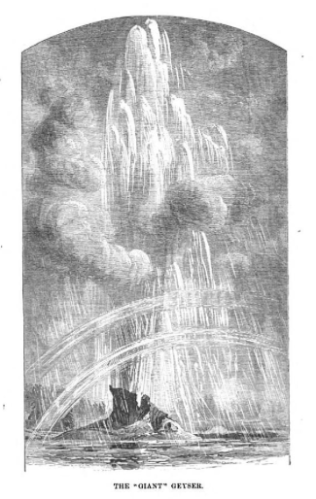
When it was a brand new magazine, Scribner’s Monthly hired Thomas Moran to illustrate N. P. Langford’s two-part report of the Yellowstone wonders he saw on the Washburn Expedition of 1870. Because Moran conjured the illustrations based soley on Langford’s descriptions, it’s particularly interesting to compare what the writer said to what the artist drew.
Here’s Langford’s description of Giantess Geyser and Moran’s conception of it. As you can see by comparing the illustration to the the photo above, Moran’s pagoda style geyser isn’t very realistic. But it is an interesting interpretations of Langford’s words.
∞§∞
Our search for new wonders leading us across the Fire Hole River, we ascended a gentle incrusted slope, and came suddenly upon a large oval aperture with scalloped edges, the diameters of which were eighteen and twenty-five feet, the sides corrugated and covered with a grayish-white silicious deposit, which was distinctly visible at the depth of one hundred feet below the surface.
No water could be discovered, but we could distinctly hear it gurgling and boiling at a great distance below. Suddenly it began to rise, boiling and spluttering, and sending out huge masses of steam, causing a general stampede of our company, driving us some distance from our point of observation. When within about forty feet of the surface it became stationary, and we returned to look down upon it. It was foaming and surging at a terrible rate, occasionally emitting small jets of hot water nearly to the mouth of the orifice.
All at once it seemed seized with a fearful spasm, and rose with incredible rapidity, hardly affording us time to flee to a safe distance, when it burst from the orifice with terrific momentum, rising in a column the full size of this immense aperture to the height of sixty feet; and through and out of the apex of this vast aqueous mass, five or six lesser jets or round columns of water, varying in size from six to fifteen inches in diameter, were projected to the marvelous height of two hundred and fifty feet.
These lesser jets, so much higher than the main column, and shooting through it, doubtless proceed from auxiliary pipes leading into the principal orifice near the bottom, where the explosive force is greater. If the theory that water by constant boiling becomes explosive when freed from air be true, this theory rationally accounts for all irregularities in the eruptions of the geysers.
This grand eruption continued for twenty minutes, and was the most magnificent sight we ever witnessed. We were standing on the side of the geyser nearest the sun, the gleams of which filled the sparkling column of water and spray with myriads of rainbows, whose arches were constantly changing—dipping and fluttering hither and thither, and disappearing only to be succeeded by others, again and again, amid the aqueous column, while the minute globules into which the spent jets were diffused when falling sparkled like a shower of diamonds, and around every shadow which the denser clouds of vapor, interrupting the sun’s rays, cast upon the column, could be seen a luminous circle radiant with all the colors of the prism, and resembling the halo of glory represented in paintings as encircling the head of Divinity.
All that we had previously witnessed seemed tame in comparison with the perfect grandeur and beauty of this display. Two of These wonderful eruptions occurred during the twenty-two hours we remained in the valley. This geyser we named “The Giantess.”
∞§∞
— Excerpt and illustration from N. P. Langford, “The Wonders of the Yellowstone,” Scribner’s Monthly 2(2)113-128 (June 1871).
— NPS Photo, Yellowstone Digital Slide File.
— For more about Moran’s legacy, click on “Thomas Moran” under the Catergories button.
Live Science reported yesterday that Yellowstone’s Giantess Geyser was erupting for the first time in two and a half years. When I heard the news, I immediately searched my files to see if I had a first-hand account by an early tourist who actually watched the geyser play. No luck.
Lots of people mention the Giantess in their description of the Upper Geyser Basin, but it seems they are usually borrowing from guidebook descriptions. Here’s an example from W. W. Wylie’s 1882 Yellowstone guidebook. It would be interesting to know if this year’s eruption follows the pattern Wylie described.
∞§∞
Giantess Geyser
The Giantess is upon the summit of the formation, about 100 yards to the northeast of the Bee-hive. It is a large oval aperture, with scalloped edges, the diameters of which are twenty-five and eighteen feet. This Geyser is very irregular, acting once in about fourteen days. The crater is usually full and boiling gently; gives no warning of an approaching eruption. The beautiful walls may be seen to a great depth through the wonderfully transparent water.
When this Geyser does act, the eruption at intervals of about forty minutes lasts for twelve to sixteen hours; so that, although it may begin in the night, it may be seen in daylight. When it begins an eruption, for some minutes it throws 250 feet high, but after this not eighty feet high. Its action is very much like that of the Splendid, in viewing which one finds a very good substitutejbr the Giantess.
∞§∞
— Page 36 in The Yellowstone National Park or the Great American Wonderland by William Wallace Wylie,Ramsey, Kansas City, MO.:Millett and Hudson, 1882.
Today tourists often stop at the Upper Geyser Basin just long enough to see Old Faithful, —just an hour or two—and then move on. But early travelers often camped near the basins for a week or more hoping to see ALL the geysers play and in all conditions: daylight, moonlight and firelight. Here’s how one man described what he saw in 1883.
∞§∞
There are hundreds of springs in the basin, all differing more or less in some particular. On a calm, clear morning, at or just before sunrise, when all the springs are sending up their columns of steam of every magnitude, and all boiling and fussing and splashing away, as if trying each to attract the greatest share of attention, and while one or two of the larger geysers are piercing the heavens with their stupendous columns, the basin presents a lively and interesting spectacle.
The eruptions as witnessed by moonlight are truly sublime, though deprived of much of their glory, as it is difficult to distinguish between water and steam. Some of the party built bonfires and watched the eruptions by firelight, which were very fine, giving the rising volumes the appearance of fiery liquid hurled forth from the crater of a volcano.
It is not the most quiet and agreeable place for sleeping. One is frequently disturbed during the night by the alarming detonations and subterranean thunder, making an almost constantly rumbling noise as of heavy machinery in motion, the come and go of ponderous freight-trains, the hiss and rush of escaping steam, and the loud plash of falling torrents, as the geysers, the ever-vigilant sentinels on the outposts of old Pluto’s infernal regions, sound the alarm and spout forth in the darkness. This is more sensibly realized by sleeping on the ground, and, rest assured, the sensations are not always of the most desirable character.
∞§∞
— Pages 118-123 in Edwin J. Stanley, Rambles in Wonderland or Up the Yellowstone. New York: Appleton and Company, 1883.
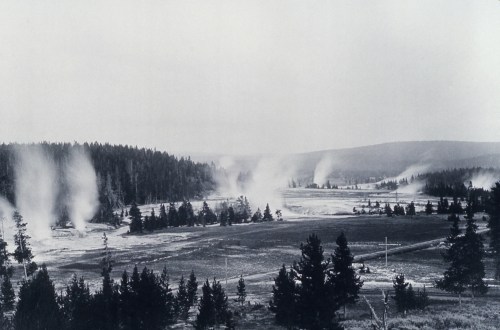
— National Park Service Photo, Yellowstone Digital Slide File.
As a Methodist circuit rider, Edwin J. Stanley traveled extensively throughout Montana in the late 1800s. Following a trip to Yellowstone Park in 1873, Stanley published a series of letters about his experiences there in what he described as “a leading newspaper of the West.” In 1882, he published a compilation of those letters in his book, Rambles in Wonderland.
Stanley supplemented his observations with extensive reading so his book provides a comprehensive summary of what people knew about the park then. Here’s a condensed version of his description of the Upper Geyser Basin.
∞§∞
There are hundreds of springs in the basin, all differing more or less in some particular. There are about twenty regularly acting. On a calm, clear morning, at or just before sunrise, when all the springs are sending up their columns of steam of every magnitude, and all boiling and fussing and splashing away, as if trying each to attract the greatest share of attention, and while one or two of the larger geysers are piercing the heavens with their stupendous columns, the basin presents a lively and interesting spectacle.
The eruptions as witnessed by moonlight are truly sublime, though deprived of much of their glory, as it is difficult to distinguish between water and steam. Some of the party built bonfires and watched the eruptions by firelight, which were very fine, giving the rising volumes the appearance of fiery liquid hurled forth from the crater of a volcano.
It is not the most quiet and agreeable place for sleeping. One is frequently disturbed during the night by the alarming detonations and subterranean thunder, making an almost constantly rumbling noise as of heavy machinery in motion, the come and go of ponderous freight trains, the hiss and rush of escaping steam, and the loud plash of falling torrents, as the geysers, the ever vigilant sentinels on the outposts of old Pluto’s infernal regions, sound the alarm and spout forth in the darkness. This is more sensibly realized by sleeping on the ground, and, rest assured, the sensations are not always of the most desirable character.
A Catholic priest was standing near a hot spring, when the crust gave way, and let him into the seething caldron. The accident would doubtless have proved fatal, but that a strong man who was at his side, and happened to be standing on solid ground, seized him by the collar and saved him from a horrible death. Though he escaped without any injury whatever, imagine his surprise at the appearance in an Eastern paper of a vivid account of his untimely death, together with an illustration showing a party of men dragging the lifeless body of a monk “all shaven and shorn,” and attired in priestly robes, from one of the geysers! He still asserts that it is a mistake, notwithstanding the statements of the newspapers to the contrary.
Whenever railroads come within reach, or even passable wagon and stage roads are completed through the Park, this will become a favorite place of resort for people from every part of the world, though I prefer going in true pioneer style on horseback, with a pack-horse on which to carry provisions and baggage. A wagon-road is now completed from Virginia City up the Madison to the Lower Basin. But don’t go until you can make the grand rounds, for the geysers, in all their glory, are only part of the wonders of the National Park.
While here we met with persons from various portions of the Territory, among them a number of friends; and quite a sociable time we had the two evenings spent in the basin. After the sight-seeing of the day was over, we gathered around our brilliant camp-fire, and passed the time relating incidents and anecdotes of a pleasant character; while Miss Clark, a young lady from Chicago, with vocal gifts that all admired, charmed us with some excellent music, presenting quite a contrast as the charming melodies floated out upon the nightwind, and mingled with the hissing reports of a hundred noisy, spouting springs, the wild, weird appearance of everything adding greatly to the novelty of the surroundings.
∞§∞
— Exerpt condensed form Chapter 13 (pages 118-123) in Edwin J. Stanley, Rambles in Wonderland or Up the Yellowstone. New York: Appleton and Company, 1883.
In the summer of 1871, U.S. Commissioner of Mines Rossiter Raymond was in Virginia City, Montana, when he decided to organize a group to tour the area that would become Yellowstone National Park the next year. Of course, nobody had published any guidebooks by then, so Raymond and his companions decided to take copies of N.P. Langford’s descriptions of wonderland that Scribner’s Monthly published in its May and June 1871 issues.
White Dome Geyser, Lower Geyser Basin
There were no signs in the roadless Yellowstone wilderness, so it was easy for travelers to become confused about the things they were seeing. When Augustus F. Thrasher, a photographer on the expedition, compared the Lower Geyser Basin to Langford’s descriptions of the Upper Basin, he became convinced that Langford’s description of geysers were exaggerations and decided to use his camera to prove it.
Raymond said, “Thrasher invests the profession of photography with all the romance and adventure . . .. No perilous precipice daunts him, if it’s just the place for his camera.” Given Thrasher’s passion, he must have taken some marvelous photographs, but, unfortunately, none of them are known to have survived.
Here’s Raymond’s description of his expedition’s confusion over geysers.
∞§∞
We approached the geyser basin with our expectation at the boiling-point, and ready to discharge; for we had among the baggage two copies of Scribner’s, containing Mr. Langford’s account of the wonders of the region, as seen by the Washburn exploring party. His article occupied two numbers, and we had two copies of each: so four persons could be accommodated with intellectual sustenance at one time. For the other two, it was, as one of them mournfully observed, “Testaments, or nothin’.”
Mr. Langford’s articles were vivid and fascinating; and we found them, in the end, highly accurate. At the outset, however, we were inclined to believe them somewhat exaggerated; and Thrasher was divided between his desire to catch an instantaneous view of a spouting column two hundred and fifty-six feet high, and his ambition to prove, by the relentless demonstration of photography, that these vents of steam and hot water were not half as big as they had been cracked up to be.”
We were not at first aware that there are two geyser basins on the Fire-Hole River; the upper one, ten miles above the other being the smaller, but containing the largest geysers. It was this one, which Washburn’s party, coming from Yellowstone Lake, first stumbled upon, and, after viewing its splendid display, naturally passed by the inferior basin with little notice. But we, emerging from the forest, and finding ourselves on the border of a great gray plain, with huge mounds in the distance, from which arose perpetually clouds of steam, supposed we had reached the great sensation, and prepared to be enthusiastic or cynical as circumstances might dictate.
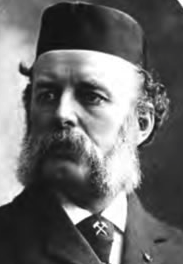
Rossister Raymond
We rode for a mile across the barren plain picking our way to avoid the soft places. This is quite necessary in the neighborhood of the hot springs. Where they have deposited a white, hard crust, it is generally strong enough to bear horse and man; but, over large areas, the ground is like what we call, in the East, “spring-holes;” and the treacherous surface permits uncomfortable slumping through, haply into scalding water. It is not very deep; but a small depth under such circumstances is enough to make a fellow “suffer some,” like the lobster in the lobster pot. ”
The plain contains a few scattered springs; and along the river, its western border, there are many in active ebullition. The principal group of geysers is at the upper or southern end extending for some distance up the valley of a small tributary from the east. With cautious daring, we rode up the side of the great white mound, winding among the numerous fissures, craters, and reservoirs that on every side of us hissed, gurgled, or quietly vapored, with now and then a slight explosion, and a spurt to the height of a dozen feet or more. Sawtell’s dog nosed suspiciously around several of the basins, until, finding that seemed not too hot for a bath, be plunged in, and emerged in a great hurry, with a yelp of disprobation.
A couple of dead pines stood, lonesome enough, in the side of the hill, “whence all the rest had fled.” They had died at their posts, and to the said posts we made fast our horses, and ascended a few rods farther, until we stood by the borders of the summit springs. There were two or three large vents at the bottom of deep reservoirs or intricate caverns. It gives one an unpleasant thrill, at first, to bear the tumult of the imprisoned forces, and to feel their throes and struggles shaking the ground beneath one’s feet; but this soon passes away, and the philosopher is enabled to stand with equanimity on the rim of the boiling flood, or even to poke his inquisitive nose into some dark fissure, out of which, perhaps in a few moments more a mass of uproarious liquid and vapor will burst forth.
We lingered much longer in this basin than my brief notice of it indicates; for, you see, we thought we had found the geysers; and oh the hours that we spent “identifying” the individual springs that Langford had described! Since, the largest eruptions we observed did not exceed forty-five feet in height, we set down his account as hugely overdrawn, and were deeply disgusted at the depravity of travelers. But Sawtell remarked, in his quiet way, that, “if it were not for that there article in that there magazine, these yer springs would be considered a big thing, after all, and perhaps it was just as well to let the magazine go to thunder, and enjoy the scenery.”
This sensible advice we followed with much profit and pleasure; and we are all now ready to admit that our happening upon the wrong lot of geysers first was a most fortunate occurrence, since we should otherwise have been tempted to pass them by as insignificant. The truth is that in some of the elements of beauty and interest the lower basin is superior to its more thrilling rival. It is broader, and more easily surveyed as a whole; and its springs are more numerous though not so powerful. Nothing can be lovelier than the sight at sunrise, of the white steam-columns tinged with rosy morning ascending against the background of the dark pinewoods and the clear sky above. The variety in form and character of these springs is quite remarkable.
∞§∞
— Excerpt from Rossiter Raymond, “Wonders of the Yellowstone.” Pages 153-207 in Camp and Cabin, New York: Fords, Hubbard & Howard, 1880.
— Geyser postcard, Pioneer Museum of Bozeman; Raymond photo, Wikipedia Commons.
— You might also enjoy Calvin Clawson’s tale about “First Blood” on the Raymond Expedition.
— Find out more about Yellowstone’s first tourist guide, Gilman Sawtell.
— For tales by N.P. Langford, click “Langford” under the Categories button above.
Reports from the Washburn Expedition of 1870 stimulated so much interest in the Upper Yellowstone that the U.S. Government decided to send two expedition to explore the area systematically the next year. One was under the direction of Dr. Ferdinand V. Haden of the U.S. Geological Survey, and another was under Colonel John W. Barlow of the Army Corp of Engineers. The two expeditions worked in tandem to measure and map the wonders of the area. One of those wonders was “Soda Mountain,” what is now known as Mammoth Hot Springs.
In an era when water for bathing often was heated in a teakettle, the copious amount of hot water flowing down the mountainside at Mammoth Hot Springs intrigued the explorers. Here’s how Colonel Barlow described it.
∞§∞
A system of hot springs of great beauty, flowing from the top and sides of a large hill of calcareous deposit, and called Soda Mountain, is found five miles up the left bank of Gardners River. Here, at the foot of this curious white mountain, we encamped, and remained until the 24th [of July], examining the wonderful spring formation of this region, and the country around it.
The central point of interest is the Soda Mountain, occupying an area of a hundred acres, and rising like the successive steps of a cascade, to the height of over 200 feet above the plateau at its base. The upper surface is a plain, composed of many hot springs, constantly sending up volumes of vapor slightly impregnated with sulphurous fumes.
The sides of the hill down which the waters of these hot springs flow have become terraced into steps of various heights and widths, some twelve inches in dimension, while others are as many feet. In each terrace there is generally a pool of water, standing in a scalloped basin of gypsum, deposited at the edges by the water as it becomes cooler. These basins are often tinged with pink, gray, and yellow colors, giving to the whole a very beautiful effect.
The rock in all directions has evidently been deposited in the same manner as the Soda Mountain is now being built up. When the formation ceases from a change in the course of the water, the rock becomes friable and disintegrates. After a time vegetation springs up and covers the surface. Many of the basins have the size and shape of bathtubs, and were used by members of the party for bathing purposes. The temperature varies in the different pools from fifty degrees all the way up to one hundred and eighty, so there is no difficulty in finding a bath of suitable temperature.
[A few days later, Barlow left Mammoth Hot Springs to explore the area. When he returned in again enjoyed the hot water again.]
Toward evening I enjoyed a bath among the natural basins of Soda Mountain. The temperature was delightful, and could be regulated at pleasure by simply stepping from one basin to another. They were even quite luxurious, being lined with spongy gypsum, soft and pleasant to the touch. I walked over a part of the hill by the faint light of the new moon, which gave to its deep-blue pools of steaming water a wild and ghostly appearance. The photographer has taken numerous views of these springs and the country in their vicinity, which will serve to convey a much more definite idea of their beautiful formation than can be given by any written description. A special survey was made of this locality, and careful observations of its latitude and longitude.
∞§∞
—Excerpts from Colonel John W. Barlow, Report of a Reconnaissance of the Basin of the Upper Yellowstone in 1871, U.A. 42d Cong. 2d sess. Senate Ex Doc. 66, 1871, pp. 2-43.
— Illustration from William Wallace Wylie, Yellowstone Park, or The Great American Wonderland. Kansas City, Missouri: Ramsey Millett & Hudson, 1882. Based on a Henry B. Calfee photograph.
The first indication of startling geothermal features on the Upper Yellowstone was a buffalo hide map that was sent to President Thomas Jefferson in 1805 by James Wilkinson, governor of the newly purchased Louisiana Territory. Governor Wilkinson said of the map, “a volcano is distinctly described in the Yellowstone River.”
About 1809 John Colter told his old boss, Captain William Clark of the Lewis and Clark Expedition, about the “Hot Spring Brimstone” he had seen along the shore of Lake Yellowstone, and Clark published a map containing that information information in 1814.
Eastern newspapers reported startling geothermal features in the area that became Yellowstone Park as early and early as 1827. Following that, there a steady stream of accounts in newspapers, government reports, journals and reminiscence.
But these reports did little to affect public awareness. In fact, William Wallace Wylie, in his guidebook published in1882, marveled that the area had been known for only a short time. Wylie, who invented the Wylie Way method of touring the park with stops permanent camps, searched Montana territorial newspapers and concluded this article published by The Montana Post in 1867 was the first one describing the area’s geothermal features.
∞§∞
It is indeed strange that this remarkable portion of country, now set apart by our Government as National pleasure-grounds, has been known to the world for so short a time. It may be authentically stated that the Park has been known to the general public for the short period of eleven years.
Although trappers and prospectors had at different times passed through and seen some portions of the Park, and had tried to convince others of what they beheld, yet their stories were received as characteristic lies, and the general public lived on in ignorance of the fact that the greatest natural wonders of the world existed within the borders of our republic.
The first published statement of these wonders, that the author could find, is that given below, taken from the Montana Post. The communication was dated Yellowstone City, Montana, August 18, 1867. Yellowstone City was a thriving mining village, nearer the boundary of the Park than any town at present is. The communication was written by Davis Willson, now of Bozeman, Montana. As will be seen, his information was obtained second-handed. The article is given entire for the purpose of showing how exaggerated were the ideas then obtained of what is now so well known: —
A portion of the Bear Gulch stampeders has returned. They have been to the Lake at the head of Yellowstone, and report the greatest wonder of the age. For eight days they traveled through a volcanic country emitting blue flames, living streams of molten brimstone, and almost every variety of minerals known to chemists. The appearance of the country was smooth and rolling, with long level plains intervening.
On the summits of these rolling mounds, were craters from four to eight feet in diameter; and everywhere upon the level plains, dotting them like prairie-dog holes, were smaller ones, from four to six inches and upwards.
The steam and blaze were constantly discharging from these subterranean channels, in regular evolutions or exhaustions, like the boilers of our steamboats, and gave the same roaring, whistling sound. As far as the eye could trace, this motion was observed.
They were fearful to ascend to the craters, lest the thin crust should give way and swallow them. Mr. Hubbel (one of the party), who has visited this region before, ventured to approach one of the smaller ones. As he neared its mouth, his feet broke through, and the blue flame and smoke gushed forth, enveloping him. Dropping upon his body, he crawled to within a couple of feet of the crater, and saw that the crust around its edge was thin, like a wafer.
Lighting a match, he extended it to the mouth and instantly it was on fire. The hollow ground resounded beneath their feet as they traveled on, and every moment it seemed liable to break through and bury them in its fiery vaults. The atmosphere was intensely suffocating, and they report that life could not long be sustained there.
Not a living thing—bird or beast—was seen in the vicinity. The prospectors have given it the significant name—’Hell!’ They declare they have been to that ‘bad place,’ and even seen the ‘Devil’s horns;’ but through the interposition of Providence (not to speak profanely), their ‘souls have been delivered,’ and they emphatically aver, if a ‘straight and narrow’ course, during their sojourn on the Yellowstone, will save them, they will never go there again.
This article was copied throughout the country by other papers, and doubtless served to awaken an interest concerning this unknown land; yet the general public were indebted for their first knowledge of the marvels of this region.
∞§∞
— Text from “Earliest Publications Concerning Yellowstone Park,” pages 74-77 in William Wallace Wylie, Yellowstone Park, or The Great American Wonderland. Kansas City, Missouri: Ramsey Millett & Hudson, 1882.
It was natural that Seth Bullock would want to visit Yellowstone. After all, he was the delegate to Montana Territorial Senate who in December 1871 wrote the “memorial” asking the federal government to establish the park. The next summer, he became one of the first tourists to visit there.
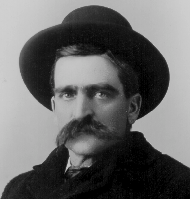
Seth Bullock
Bullock was a colorful man whose real life biography inspired the tough sheriff character in the HBO series “Deadwood.” A newspaper once described him as “a man with a cold, grey eye, a nerve that never wavered, and a gun that never missed. “It has been said of him” the article continued, “he was a silent, cold man, and at times he seemed to have lost his power of speech. One writer referred to him as a ‘Man killer,’ and when this was called to his attention, Bullock broke his silence to remark: ‘They say I’ve killed forty-seven men. Son, I’ll tell you what. I’ve never killed but two, and I did not kill them soon enough.’”
Teddy Roosevelt once called Bullock “the finest kind of frontiersman” and appointed him U.S. Marshall for South Dakota. Bullock began his career as a businessman and lawman in Helena, Montana. Later he moved to South Dakota where he died on his ranch in 1919.
He was barely 22 when he was elected to the territorial legislature in 1871. Bullock said he never intended the journal of his Yellowstone for publication, but it’s a well written description of what was probably a typical trip at the time.
Bullock left Helena for the park on horseback August 23, 1872, with three friends named A. J. Teller, Dick White, and Jack Langrishe.
They led a packhorse that they named “Judge Clancy” after the man Bullock bought him from. The men counted on finding fish and game for food on their trip — a plan that didn’t always work.
On the second night out, lightening spooked their horses, but they were able to catch a rope on Judge Clancy and stop the stampede. Lost horses were a common occurrence for Yellowstone travelers all through the period when they the primary means of transportation. Since the travelers carried little food for their horses, the animals needed to graze over and sometimes they wandered off. Often travel was delayed to search for horses which were sometimes found miles away.
Here are some excerpts from Bullock’s journal.
∞§∞
MONDAY, AUGUST 26th – [The Gallatin Valley]
Broke camp at 4 A. M. Teller grumbled a great deal at having to get up so early. For me, the day had a special interest. We were to travel through the Gallatin Valley.
I anticipated a fine stretch of country, but was totally unprepared for the surprise that awaited me. Well has the Gallatin Valley been named the Garden-Spot of Montana. We were charmed and delighted. Stretching before us with mountains on each side was a magnificent plateau of fine rolling prairies, interwoven with two fine streams of silver whose beautiful shimmering sheen could be seen for very beautiful fields of ripe golden grain, greet the eye on every side. Substantial houses and good buildings are the rule and not the exception.
Traveling through this beautiful valley — one of God’s dimples — as we did on this fine August day, it was impossible not to become a firm believer in the future and prosperity of this section of Montana.
At 11 a.m. we arrived in Bozeman and camped on Bozeman Creek. A fine stream that skirts the town. After enjoying our Bedouin repast, we took a look at the town, which strikes one as a thrifty place. Evidence of future prosperity exists in the well-known agricultural resources of the valley and the pluck, business energy and shrewdness of the citizens. The town is nicely laid out with wide streets, looks very much like Deer Lodge. The people are all good boys.
[five days later]
SATURDAY, AUGUST 31st – [Mammoth Hot Springs]
Here we are, at the famous springs, encamped in a little ravine, about 100 yards from the springs. Pen cannot describe, nor tongue tell, the wonders of this place. Large, white mountain and plains of icy whiteness cut into fantastic shapes meet the eye.
Found quite a colony of invalids here. All speak of the medicinal qualities of the baths in terms of praise. Passed the afternoon in resting and listening to amusing stories told by the old mountaineer of the bug-hunters, as they facetiously termed the Hayden party. Intend leaving tomorrow for the geyser country.
[eight days later]
SUNDAY, SEPTEMBER 8th – [Lower Geyser Basin]
Left prairie at 6 A. M. After floundering around through mud for over three hours, we succeeded in finding solid foundation on hillside and struck out down creek for Lower Geyser Basin. Two pilgrims got stalled in the mud and had to be roped out. Passed numerous hot springs and infant geysers.
As you approach the lower basin you can imagine that you are overlooking a wharf where a number of steamers are blowing off steam. Camped for noon in Lower Geyser Basin and examined curiosities. Reached Upper Fire Hole Basin about 4 o’clock. Went into camp and started out to examine the geysers. Did not have time to examine but one or two before night.
While we were eating supper, Old Faithful started its evening entertainment. The display was grand, beyond our highest expectation, the water being thrown about 100 feet high, five feet in diameter at the base to a fine silver thread at the top. Judging from the noises we hear, there must be a great number of geysers in this vicinity.
We are getting short on grub. Nothing left but flour and coffee. White prepared for supper a new dish, called Geyser sauce.
[The next day]
MONDAY, SEPTEMBER 9th – [Upper Geyser Basin]
Arose at 3 A. M. Before breakfast, [we] visited a number of geysers. One called “Grand” breaks through a small mound, evidently formed by the geyser. Around the sides of the mound are the most beautiful colorings imaginable.
Left for home at 12 M. Course down Fire Hole River. … Weather fine, but cold. No game in sight. No fish. Bread and water all we had today.
[six days later]
SUNDAY, SEPTEMBER 15th – [At Bottler’s Ranch north of the Park]
Left Packer’s Camp at 5 A. M. Lunched at Bottler’s and examined his ranch. Fifty acres of wheat, very good. About the only ranch on the whole Yellowstone River
Walked into Bottler’s eggs, cream, butter, and “sich” in a way that looked bad for his winter’s grub supply. First civilized grub that we had for twenty days.
[the next day]
MONDAY, SEPTEMBER 16th –
At noon, we started on for Bozeman through Rocky Canyon. Arrived at Bozeman at 4 P. M. A. J. Davis of Helena visited our camp, dined with us on trout and Yellowstone stories. Spent evening in Bozeman.
∞§∞
— Seth Bullock’s journal of his trip to Yellowstone Park is in the collection of the Montana Historical Society.
Apparently, the practice of soaping geysers to make them erupt began in the 1880s after a concessionaire decided that the naturally agitating Chinaman Spring would be the perfect place to do laundry. After tossing in clothing, the concessionaire added soap and the spring erupted spewing clothing over the landscape.
Soon tourists began stripping soap off of store shelves and taking it from hotel bathrooms so they could eliminate the tedium of waiting for geysers to play. Of course, officials soon banned the practice, but it was hard to control. Here’s Georgina Synge’s description of a clandestine soaping of Beehive Geyser.
∞§∞
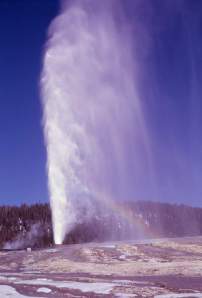
The geyser we set our hearts on seeing was the “Beehive,” just opposite our camp, the other side of the basin. The cone, which really has all the appearance of a bee-hive in the distance, is about three feet in height and is beautifully coated with beaded silica. Its action is different to any other geyser, as the water is projected with such force from its comparatively small vent-hole, that it goes up in one perfectly straight pillar to over two hundred feet; and, instead of falling in floods on each side like the others, seems to evaporate into wreaths of steam and vapor.
Now there is a sure and almost certain method for inducing a geyser to play out of its accustomed hours, and this is done by what is called “soaping” them! It may sound incredible, but it is a well known fact (which we attested on several occasions) that a bar or two of common yellow soap, cut up into pieces and slipped into a geyser cone, will have the desired effect in a very short interval. This is supposed to be partly caused by the soap creating a film on the water, which prevents the steam escaping. Smithson was as keen as we were tbat the “Beehive” should play. He assured us he had seen it soaped over and over again, with the most brilliant results.
So that night we sallied forth after all the world had gone to bed, armed with two large bars of Brown Windsor tied up in a pocket-handkerchief. The moon was shining fitfully behind the clouds, and now and then gleamed forth upon us, as, having crossed the river, we climbed up the white sloping sides of the ” Beehive.”
It was not due to play for several days, and as we peered down its dark funnel-like orifice, we could hear a soft peaceful gurgling, but nothing more; and even this quite ceased after we had slipped in the soap. We sat down then and watched. Presently it began to boil up—little by little—with a buzzing sort of noise as if it were hard at work. Every now and then it threw up a few squirts of water, and Smithson, who was getting very excited, laid his ” bottom dollar” it was going to play. But, alas, though it seemed to be trying with all its might, yet it never quite got off, and having watched for nearly an hour, we decided to send Smithson back to camp for some more soap.
Perhaps we had not put in enough, we thought, though Smithson assured us two bars was all it had ever wanted before. Well, in went the second lot, but with just the same result. It showed all the premonitory symptoms, boiled over, made a few gasps, and sent up a few small jets, and then gave it up. We got quite desperate at last. It was nearly twelve o clock, and very cold, as a sharp frost had set in. We thought, however, we would have one more try.
We hurried back to camp. There we found Elijah, stretched fast asleep before the smoldering embers of the fire. We cruelly awoke him, and made him produce the last piece of yellow bar, which we had hitherto thought necessary to leave for washing purposes. And to augment this, A. insisted on my bringing forth our few and treasured cakes of Pears. But no, even this last sacrifice was of no avail—that “Beehive” would not play! Smithson was furious, the first time it had ever refused for him; someone must have soaped it the day before, and if only we would wait it was sure to begin soon. But we decided we could not freeze there all night, even to see the “Beehive” display; and so dejectedly we made our way once more back to camp. Just as we were going off to sleep we heard a roar—something was “guising” at last, but we were too tired to stir even if it had been “Excelsior.” The next morning, however, just as we were dressed, we heard the roar again, like the sound of a sudden hurricane or of numberless distant guns. “She’s off —the ‘Beehive’s guisin’,” shouted Smithson, and off we dashed, helter-skelter, arriving breathless, but in capital time to see a grand eruption.
It was terrific. It seemed as if the whole hill-side must be blown out by the tremendous force with which it burst forth. Higher and higher it soared, in one great round perpendicular column of over two hundred feet, clouding the whole sky with masses of spray and steam. Presently a gust of wind blew up and carried the topmost wreaths in feathery masses over the valley, and we were able to stand quite close to lee of it without getting a drop upon us. It played for about twenty minutes, then wavered, trembled, and finally subsided with sundry gurgles and groans. As we came away, several people who had hurried out from their beds to see the sight, began making remarks on the curious fact of the “Beehive” playing before its proper time. “That’s been soaped,” said a man who belonged to the place, looking suspiciously round, at which we appeared innocently surprised.
∞§∞
— Excerpt from “Geyser-Land,” pages 48-70 in Georgina M. Synge, A Ride Through Wonderland. Sampson, Marston & Company. London, 1892.
About 1829 a nineteen-year-old trapper named Joe Meek camped along the Gallatin River in southwest Montana with a brigade of mountain men led by William Sublette of the Rocky Mountain Fur Company. When a group of Blackfeet attacked, the trappers scattered. Young Meek fled across the mountains and found geothermal features in what later became Yellowstone National Park.
Joe Meek
When the fur trade collapsed, Meek moved to Oregon where he helped organize the territorial government and became its federal marshal. In the 1860s, the historian Frances Fuller Victor interviewed him several times. She later published a book about Meek’s adventures. Here’s how Victor described Meek’s first look at geothermal features in Wonderland. Interestingly, there’s no mention of boiling fountains or geysers.
∞§∞
In November the camp left Missouri Lake on the east side of the mountains, and crossed over, still northeasterly, on to the Gallatin fork of the Missouri River, passing over a very rough and broken country. They were, in fact, still in the midst of mountains, being spurs of the great Rocky range, and equally high and rugged. A particularly high mountain lay between them and the main Yellowstone River. This they had just crossed, with great fatigue and difficulty, and were resting the camp and horses for a few days on the river’s bank, when the Blackfeet once more attacked them in considerable numbers. Two men were killed in this fight, and the camp thrown into confusion by the suddenness of the alarm. Capt. Sublette, however, got off, with most of his men, still pursued by the Indians.
Not so our Joe, who this time was not in luck, but was cut off from camp, alone, and had to flee to the high mountains overlooking the Yellowstone. Here was a situation for a nineteen-year-old raw recruit! Knowing that the Blackfeet were on the trail of the camp, it was death to proceed in that direction. Some other route must be taken to come up with them; the country was entirely unknown to him; the cold severe; his mule, blanket, and gun, his only earthly possessions. On the latter he depended for food, but game was scarce; and besides, he thought the sound of his gun would frighten himself, so alone in the wilderness, swarming with stealthy foes.
Hiding his mule in a thicket, he ascended to the mountaintop to take a view of the country, and decide upon his course. And what a scene was that for the miserable boy, whose chance of meeting with his comrades again was small indeed! At his feet rolled the Yellowstone River, coursing away through the great plain to the eastward. To the north, his eye follows the windings of the Missouri, as upon a map, but playing at hide-and-seek in amongst the mountains. Looking back, he saw the River Snake stretching its serpentine length through lava plains, far away, to its junction with the Columbia. To the north, and to the south, one white mountain rose above another as far as the eye could reach. What a mighty and magnificent world it seemed, to be alone in! Poor Joe succumbed to the influence of the thought, and wept.
Having indulged in this sole remaining luxury of life, Joe picked up his resolution, and decided upon his course. To the southeast lay the Crow country, a land of plenty—as the mountain-man regards plenty—and there he could at least live; provided the Crows permitted him to do so. Besides, he had some hopes of falling in with one of the camps, by taking that course.
Descending the mountain to the hiding-place of his mule, by which time it was dark night, hungry and freezing, Joe still could not light a fire, for fear of revealing his whereabouts to the Indians; nor could he remain to perish with cold. Travel he must, and travel he did, going he scarcely knew whither. Looking back upon the terrors and discomforts of that night, the veteran mountaineer yet regards it as about the most miserable one of his life. When day at length broke, he had made, as well as he could estimate the distance, about thirty miles. Traveling on toward the southeast, he had crossed the Yellowstone River, and still among the mountains, was obliged to abandon his mule and accoutrements, retaining only one blanket and his gun. Neither the mule nor himself had broken fast in the last two days. Keeping a southerly course for twenty miles more, over a rough and elevated country, he came, on the evening of the third day, upon a band of mountain sheep. With what eagerness did he hasten to kill, cook, and eat! Three days of fasting was, for a novice, quite sufficient to provide him with an appetite.
Having eaten voraciously, and being quite overcome with fatigue, Joe fell asleep in his blanket, and slumbered quite deeply until morning. With the morning came biting blasts from the north, that made motion necessary if not pleasant. Refreshed by sleep and food, our traveler hastened on upon his solitary way, taking with him what sheep-meat he could carry, traversing the same rough and mountainous country as before. No incidents nor alarms varied the horrible and monotonous solitude of the wilderness. The very absence of anything to alarm was awful; for the bravest man is wretchedly nervous in the solitary presence of sublime Nature. Even the veteran hunter of the mountains can never entirely divest himself of this feeling of awe, when his single soul comes face to face with God’s wonderful and beautiful handiwork.
At the close of the fourth day, Joe made his lonely camp in a deep defile of the mountains, where a little fire and some roasted mutton again comforted his inner and outer man, and another night’s sleep still farther refreshed his wearied frame. On the following morning, a very bleak and windy one, having breakfasted on his remaining piece of mutton, being desirous to learn something of the progress he had made, he ascended a low mountain in the neighborhood of his camp—and behold! The whole country beyond was smoking with the vapor from boiling springs, and burning with gasses, issuing from small craters, each of which was emitting a sharp whistling sound.
When the first surprise of this astonishing scene had passed, Joe began to admire its effect in an artistic point of view. The morning being clear, with a sharp frost, he thought himself reminded of the city of Pittsburg, as he had beheld it on a winter morning, a couple of years before. This, however, related only to the rising smoke and vapor; for the extent of the volcanic region was immense, reaching far out of sight. The general face of the country was smooth and rolling, being a level plain, dotted with cone-shaped mounds. On the summits of these mounds were small craters from four to eight feet in diameter. Interspersed among these, on the level plain, were larger craters, some of them from four to six miles across. Out of these craters issued blue flames and molten brimstone.
For some minutes, Joe gazed and wondered. Curious thoughts came into his head, about hell and the day of doom. With that natural tendency to reckless gayety and humorous absurdities, which some temperaments are sensible of in times of great excitement, he began to soliloquize. Said he, to himself, “I have been told the sun would be blown out, and the earth burnt up. If this infernal wind keeps up, I shouldn’t be surprised if the sun war blown out. If the earth is not burning up over thar, then it is that place the old Methodist preacher used to threaten me with. Any way it suits me to go and see what it’s like.”
On descending to the plain described, the earth was found to have a hollow sound, and seemed threatening to break through. But Joe found the warmth of the place most delightful, after the freezing cold of the mountains, and remarked to himself again, that “if it war hell, it war a more agreeable climate than he had been in for some time.”
He had thought the country entirely desolate, as not a living creature had been seen in the vicinity; but while he stood gazing about him in curious amazement, he was startled by the report of two guns, followed by the Indian yell. While making rapid preparations for defense and flight, if either or both should be necessary, a familiar voice greeted him with the exclamation, “It is old Joe!” When the adjective “old” is applied to one of Meek’s age at that time, it is generally understood to be a term of endearment. “My feelings you may imagine,” says the “old Uncle Joe” of the present time, in recalling the adventure.
∞§∞
— Text from Frances Fuller Victor, Eleven Years in the Rocky Mountains and Life on the Frontier. Harford Connecticut: R.W. Bliss and Company 1881. Pages 73-77.

 Our search for new wonders leading us across the Fire Hole River, we ascended a gentle incrusted slope, and came suddenly upon a large oval aperture with scalloped edges, the diameters of which were eighteen and twenty-five feet, the sides corrugated and covered with a grayish-white silicious deposit, which was distinctly visible at the depth of one hundred feet below the surface.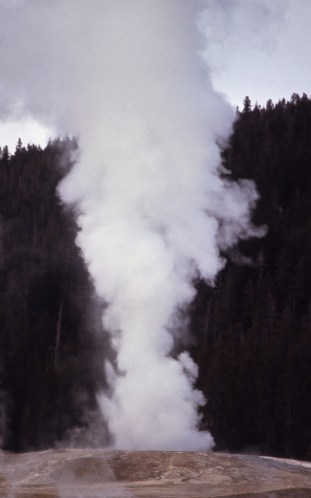
 in 1873, Stanley published a series of letters about his experiences there in what he described as “a leading newspaper of the West.” In 1882, he published a compilation of those letters in his book, Rambles in Wonderland.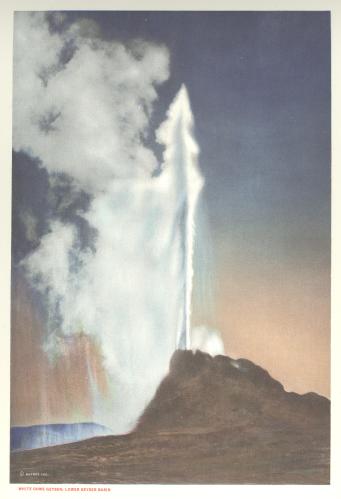
 In an era when water for bathing often was heated in a teakettle, the copious amount of hot water flowing down the mountainside at Mammoth Hot Springs intrigued the explorers. Here’s how Colonel Barlow described it.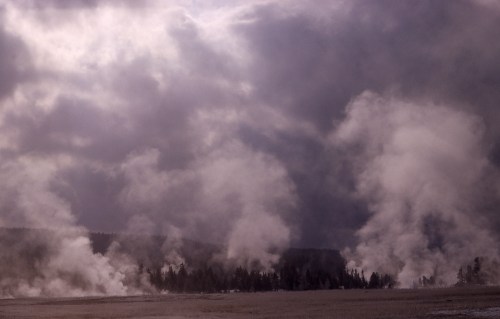
 in the distance, is about three feet in height and is beautifully coated with beaded silica. Its action is different to any other geyser, as the water is projected with such force from its comparatively small vent-hole, that it goes up in one perfectly straight pillar to over two hundred feet; and, instead of falling in floods on each side like the others, seems to evaporate into wreaths of steam and vapor.
 M. Mark Miller, Author