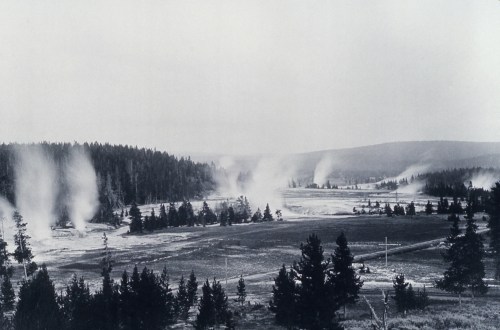
Today tourists often stop at the Upper Geyser Basin just long enough to see Old Faithful, —just an hour or two—and then move on. But early travelers often camped near the basins for a week or more hoping to see ALL the geysers play and in all conditions: daylight, moonlight and firelight. Here’s how one man described what he saw in 1883.
∞§∞
There are hundreds of springs in the basin, all differing more or less in some particular. On a calm, clear morning, at or just before sunrise, when all the springs are sending up their columns of steam of every magnitude, and all boiling and fussing and splashing away, as if trying each to attract the greatest share of attention, and while one or two of the larger geysers are piercing the heavens with their stupendous columns, the basin presents a lively and interesting spectacle.
The eruptions as witnessed by moonlight are truly sublime, though deprived of much of their glory, as it is difficult to distinguish between water and steam. Some of the party built bonfires and watched the eruptions by firelight, which were very fine, giving the rising volumes the appearance of fiery liquid hurled forth from the crater of a volcano.
It is not the most quiet and agreeable place for sleeping. One is frequently disturbed during the night by the alarming detonations and subterranean thunder, making an almost constantly rumbling noise as of heavy machinery in motion, the come and go of ponderous freight-trains, the hiss and rush of escaping steam, and the loud plash of falling torrents, as the geysers, the ever-vigilant sentinels on the outposts of old Pluto’s infernal regions, sound the alarm and spout forth in the darkness. This is more sensibly realized by sleeping on the ground, and, rest assured, the sensations are not always of the most desirable character.
∞§∞
— Pages 118-123 in Edwin J. Stanley, Rambles in Wonderland or Up the Yellowstone. New York: Appleton and Company, 1883.
— National Park Service Photo, Yellowstone Digital Slide File.
Erythronium grandiflorum blooming in Yellowstone National Park.
Hiram Martin Chittenden arrived at Yellowstone Park in 1891 to take command of the Army Corps of Engineers unit that was in charge of making improvements there. Chittenden left his mark on the park in many ways including the figure-eight pattern of roads called the “Grand Loop,” the Roosevelt Arch at the north entrance, and the single arch Chittenden Bridge across the Yellowstone River.
Chittenden was also a historian whose works include a two-volume history of the American fur trade in the west, a history of steamboats on the Missouri River, and first definitive history and description of Yellowstone Park. Here’s Chittenden’s description of a wild “Easter Lily” that grows in the Park.
∞§∞
One of the daintiest of all the flowers, and one somewhat resembling the Columbine in grace of form, is the yellow Adder’s Tongue (Erythronium). This has been called the Dogtooth Violet, surely a gross misnomer. In California it is most appropriately called the Easter Lily, but Easter has long passed before it makes its appearance in the Park. There is no gayer sight than a mass of these yellow lilies, as one comes upon them in the woods under some spreading tree—as “jocund company” as are the daffodils which inspired Wordsworth’s immortal lines.
∞§∞
— Text from Hiram Martin Chittenden, Yellowstone Park: Historical and Descriptive, Cincinnati:Stewart & Kidd Company, 1917 (Page 233).
Probably Thomas Moran’s most famous painting is his 7-by-12-foot depiction of the Yellowstone Canyon and Falls. It hung in the U.S. Capitol for decades and now resides in the Smithsonian. There is an excellent full-size reproduction at the Caynon Visitor Center in Yellowstone Park.
Moran spent three full days, July 28-30, sketching the canyon and fails while accompanying F.V. Hayden’s expedition to explore and documents the wonders of the upper Yellowstone in 1871. These sketches served as the basis for several full fledged paintings of the canyon and falls over the next few years.
Moran’s journal entries for his days at the canyon are extremely sparse. His July 30 entry is typical; it said simply: “photographing and sketching around Falls and Canyon.” Fortunately, F.V. Hayden offers more detail. Here’s Hayden’s description of the falls and canyon, and Moran at work there.
∞§∞
Standing near the margin of the Lower Falls, and looking down the caynon, which looks like an immense chasm or cleft in the basalt, with its sides 1,200 to 1,500 feet high, and decorated with the most brilliant colors that the human eye ever saw, with the rocks weathered into an almost unlimited variety of forms, with here and there a pine sending its roots into the clefts on the sides as if struggling with a sort of uncertain success to maintain an existence—the whole presents a picture that it would be difficult to surpass in nature.
Mr. Thomas Moran, a celebrated artist, and noted for his skill as a colorist, exclaimed with a kind of regretful enthusiasm that these beautiful tints were beyond the reach of human art. It is not the depth alone that gives such an impression of grandeur to the mind, but it is also the picturesque forms and coloring. Mr. Moran is now engaged in transferring this remarkable picture to canvas, and by means of a skillful use of colors something like a conception of its beauty may be conveyed.
After the waters of the Yellowstone roll over the upper descent, they flow with great rapidity over the apparently flat rocky bottom, which spreads out to nearly double its width above the falls, and continues thus until near the Lower Falls, when the channel again contracts, and the waters seem, as it were, to gather themselves into one compact mass and plunge over the descent of 350 feet in detached drops of foam as white as snow; some of the large globules of water shoot down like the contents of an exploded rocket.
It is a sight far more beautiful, though not so grand or impressive as that of Niagara Falls. A heavy mist always arises from the water at the foot of the falls, so dense that one cannot approach within 200 or 300 feet, and even then the clothes will be drenched in a few moments. Upon the yellow, nearly vertical wall of the west side, the mist mostly falls, and for 300 feet from the bottom the wall is covered with a thick matting of mosses, sedges, grasses, and other vegetation of the most vivid green, which have sent their small roots into the softened rocks, and are nourished by the ever-ascending spray. At the base and quite high up on the sides of the canyon, are great quantities of talus, and through the fragments of rocks and decomposed spring deposits may be seen the horizontal strata of breccia.
∞§∞
— F.V. Hayden, Preliminary Report of the United State Geological Survey of Montana. Washington: U.S. Government Printing Office, 1872.
— Coppermine Photo Gallery image.
— For more on this topic, select “Thomas Moran” under the Categories button to the left.
“Hot Springs of the Yellowstone,” Thomas Moran 1871
Mammoth Hot Springs was the first major feature Thomas Moran encountered when he toured Yellowstone Park in 1871 with the Hayden Expedition. Moron’s diary entries for the three days he spent at Mammoth contain not a word of description. Apparently he was content relying on his watercolor sketches.
Of course, many travelers did offer written descriptions of the springs. Here’s one by Edwin J. Stanley, a writer, historian, and Methodist minister, who visited Yellowstone Park in 1873.
∞§∞
I came suddenly out in full view of the far famed Hot Springs. Having read glowing descriptions of the place, and being rather despondent from the fatigue of travel, I felt somewhat disappointed, and feared my expectations would not be fully met; but all such impressions vanished at first view of the strangely-beautiful scene, and I felt that the half had not been told, though the sun was obscured by clouds, depriving me of much of the inspiration that the first view would otherwise have furnished.
The proprietors of the place, two young gentlemen from Bozeman, anticipating the value of these springs as a place of resort for pleasure-seekers and invalids, had taken possession of them before the passage of the bill including them in the National Park, and styled them the Mammoth Hot Springs. But Dr. Hayden, the United States Geologist, doubtless moved by the first impression made upon his mind on arriving here, gave them the title of White Mountain Hot Springs.
Both titles are quite appropriate, considering their mammoth proportions—surpassing anything of the kind yet discovered—and the vast mountain of white and yellowish deposit made from the mineral solutions contained in the immense volumes of water gurgling up from scores of boiling fountains. This immense calcareous formation, with its numberless and intricate phenomena, baffling all attempts at description, is the chief object of interest here.
The first impression on beholding it is that of a snowy mountain beautifully terraced, with projections extending out in various directions, resembling frozen cascades, as though the high, foam-crested waves, in their rapid descent over the steep and rugged declivity, were suddenly arrested and congealed on the spot in all their native beauty. There are fifty or sixty of these springs of greater and smaller dimensions, extending over an area of about a mile square; though there are remains of springs of the same kind for miles around, and mountains of the same deposit overgrown with pine-trees, perhaps hundreds of years old.
Most of the water is at boiling heat, and contains in solution a great amount of lime, sulphur, and magnesia, with some soda, alumina, and other substances, which are slowly deposited in every conceivable form and shape as the water flows along in its course down the mountain-side.
On each level, or terrace, there is a large central spring, which is usually surrounded by a basin of several feet in diameter, and the water, after leaving the main basin at different portions of the delicately-wrought rim, flows down the declivity, step by step, forming hundreds of basins and reservoirs of every size and depth, from a few inches to six or eight feet in diameter, and from one inch to several feet in depth, their margins beautifully scalloped with a finish resembling bead-work of exquisite beauty. The character of the formation depends upon the temperature and flow of the water, as well as upon the character of prevailing minerals at that particular place. Where the water flows slowly, and with but slight ebullition, the smaller basins and terraces are formed, one below the other, with their delicate partitions and beautifully-fringed borders; and where the volume and momentum are greater, the basins are larger and deeper, and the ornamentation proportionately coarser.
Where the water flows quite rapidly, the pools are filling up, leaving the deposit in wave-like forms, just like water congealed when flowing over a cascade. Underneath the sides of many of the basins are beautifully-arranged stalactites, formed by the dripping of the water; and, by digging beneath the surface at places where the springs are inactive, the most delicate and charming specimens of every character and form can be obtained—stalactites, stalagmites, grottoes, etc., all delicately arranged as the water filtrates through the crevices and perforations of the deposit. The larger pools, before the erection of bathing-houses, afforded a splendid opportunity to enjoy the luxury of bathing, as water of any temperature desirable could be secured. The sides of the mountain for hundreds of yards in extent are covered with this calcareous incrustation, formerly possessing all the ornamental attractions of the springs now in action. It is a scene sublime in itself to see the entire area with its numerous and terraced reservoirs, and millions of delicate little urns, sparkling with water transparent as glass, and tinged with many varieties of coloring, all glistening under the glare of a noonday sun. But the water is constantly changing its channel, and atmospheric agencies have disfigured much of the work, leaving a great portion of it only the resemblance of an old ruin.
Every active spring or cluster of springs has its succession of little urns and reservoirs extending in various directions. The largest spring now active, situated about half-way up the mountain on the outer edge of the main terrace, has a basin about twenty-five by forty feet in diameter, in the centre of which the water boils up several inches above the surface, and is so transparent that you can, by approaching the margin, look down into the heated depths many feet below the surface. The sides of the cavern are ornamented with a coral-like formation of almost every variety of shade, with a fine, silky substance, much like moss, of a bright vegetable green, spread over it thinly, which, with the slight ebullition of the water keeping it in constant motion, and the blue sky reflected in the transparent depths, gives it an enchanting beauty far beyond the skill of the finest artist. Here all the hues of the rainbow are seen and arranged.so gorgeously that, with other strange views by Which one is surrounded, you almost imagine yourself in some fairy region, the wonders of which baffle all attempts of pen or pencil to portray them.
Besides the elegant sculpturing of this deposit, imagine, if you can, the wonderful variety of delicate and artistically-arranged colors with which it is adorned. The mineral-charged fluid lays down pavements here and there of all the shades of red, from bright scarlet to rose-tint, beautiful layers of bright sulphur-yellow, interspersed with tints of green—all elaborately arranged in Nature’s own order. Viewed from the Tower Creek trail, which passes at the base, this section of the mountain has a very architectural appearance.
But descending the mountain from which we first beheld the springs, and where we left the reader, we come to the first level, or terrace, the base of the principal formation. There are several springs, the water of which is used by the scores of invalids already flocking here to be healed of their maladies. Here, also, are the small bath-houses erected by the proprietors, for the use of which a handsome sum is generally exacted. The medicinal properties of each fountain seem to be different, and the invalid can use that best adapted to his case. Just over there to our right, in the mouth of a little gorge, coming down from the mountain, by the side of the sparkling brook of snowwater, among the pine-trees, where the smoke is curling up from many fires, are the camps of the tourists and invabds who have come hither, and are abiding in rudely-constructed cabins, some in tents, enjoying all the luxuries of camp-life. Rather a motley, though quite a lively, group. Some remarkable cures have been effected here, mostly of diseases of the skin, and rheumatism. But I think that the invigorating mountain-air and the healthful influence of camp-life have much to do with many cures that are effected, as these are known to be wonderful remedies in themselves for many of the ills which flesh is heir to.
∞§∞
— From Edwin James Stanley, Rambles in Wonderland, Or Up The Yellowstone, New York: D. Appleton and Company, 1883. pages 54-58.
The Grand Canyon of the Yellowstone by Thomas Moran
This post begins a series on the legacy of Yellowstone images left by Thomas Moran. Moran accompanied the famous 1871 Hayden Expedition to the area that became Yellowstone National Park a year later. He did studies and water color sketches of more than thirty sights.
Later he produced dramatic oil paintings like “The Grand Canyon of the Yellowstone.” The U.S. Congress purchased this twelve-by-seven-foot painting and hung it in the U.S. Capital. It’s now on view at the Smithsonian.
Images by Moran (along with photographs by William Henry Jackson) were distributed to members of the U.S. Congress before the vote to make Yellowstone the world’s first national park. While Moran’s images are credited with stimulating the affirmative vote, he didn’t consider himself a documentarian. Here’s Moran’s description of his philosophy of art.
∞§∞
Thomas Moran
I place no value upon literal transcripts from Nature. My general scope is not realistic; all my tendencies are toward idealization. Of course, all art must come through Nature: I do not mean to depreciate Nature or naturalism; but I believe that a place, as a place, has no value in itself for the artist only so far as it furnishes the material from which to construct a picture.
Topography in art is valueless. The motive or incentive of my ‘ Grand Canon of the Yellowstone’ was the gorgeous display of color that impressed itself upon me. Probably no scenery in the world presents such a combination. The forms are extremely wonderful and pictorial, and, while I desired to tell truly of Nature, I did not wish to realize the scene literally, but to preserve and to convey its true impression.
Every form introduced into the picture is within view from a given point, but the relations of the separate parts to one another are not always preserved. For instance, the precipitous rocks on the right were really at my back when I stood at that point, yet in their present position they are strictly true to pictorial Nature; and so correct is the whole representation that every member of the expedition with which I was connected declared, when he saw the painting, that he knew the exact spot which had been reproduced.
My aim was to bring before the public the character of that region. The rocks in the foreground are so carefully drawn that a geologist could determine their precise nature. I treated them so in order to serve my purpose. In another work, ‘The Mountain of the Holy Cross,’ the foreground is intensely realistic also: its granite rocks are realized to the farthest point that I could carry them; and the idealization of the scene consists in the combination and arrangement of the various objects in it. At the same time, the combination is based upon the characteristics of the place.
My purpose was to convey a true impression of the region; and as for the elaborated rocks, I elaborated them out of pure love for rocks. I have studied rocks carefully, and I like to represent them.”
∞§∞
Thomas Moran quotation from G. W. Sheldon, American Painters: With Eighty-Three Examples of Their Work Engraved on Wood. New York: D. Appleton and Company, 1879. pages 125-126.
— Moran portrait is a detail from a Wikipedia Commons photo.
The Grand Canyon of the Yellowstone by Thomas Moran
This post begins a series on the legacy of Yellowstone images left by Thomas Moran. Moran accompanied the famous 1871 Hayden Expedition to the area that became Yellowstone National Park a year later. He did studies and water color sketches of more than thirty sights.
Later he produced dramatic oil paintings like “The Grand Canyon of the Yellowstone.” The U.S. Congress purchased this twelve-by-seven-foot painting and hung it in the U.S. Capital. It’s now on view at the Smithsonian.
Images by Moran (along with photographs by William Henry Jackson) were distributed to members of the U.S. Congress before the vote to make Yellowstone the world’s first national park. While Moran’s images are credited with stimulating the affirmative vote, he didn’t consider himself a documentarian. Here’s Moran’s description of his philosophy of art.
∞§∞
Thomas Moran
I place no value upon literal transcripts from Nature. My general scope is not realistic; all my tendencies are toward idealization. Of course, all art must come through Nature: I do not mean to depreciate Nature or naturalism; but I believe that a place, as a place, has no value in itself for the artist only so far as it furnishes the material from which to construct a picture.
Topography in art is valueless. The motive or incentive of my ‘ Grand Canon of the Yellowstone’ was the gorgeous display of color that impressed itself upon me. Probably no scenery in the world presents such a combination. The forms are extremely wonderful and pictorial, and, while I desired to tell truly of Nature, I did not wish to realize the scene literally, but to preserve and to convey its true impression.
Every form introduced into the picture is within view from a given point, but the relations of the separate parts to one another are not always preserved. For instance, the precipitous rocks on the right were really at my back when I stood at that point, yet in their present position they are strictly true to pictorial Nature; and so correct is the whole representation that every member of the expedition with which I was connected declared, when he saw the painting, that he knew the exact spot which had been reproduced.
My aim was to bring before the public the character of that region. The rocks in the foreground are so carefully drawn that a geologist could determine their precise nature. I treated them so in order to serve my purpose. In another work, ‘The Mountain of the Holy Cross,’ the foreground is intensely realistic also: its granite rocks are realized to the farthest point that I could carry them; and the idealization of the scene consists in the combination and arrangement of the various objects in it. At the same time, the combination is based upon the characteristics of the place.
My purpose was to convey a true impression of the region; and as for the elaborated rocks, I elaborated them out of pure love for rocks. I have studied rocks carefully, and I like to represent them.”
∞§∞
Thomas Moran quotation from G. W. Sheldon, American Painters: With Eighty-Three Examples of Their Work Engraved on Wood. New York: D. Appleton and Company, 1879. pages 125-126.
— Moran portrait is a detail from a Wikipedia Commons photo.
Our route lay for two days through the Parks of the Rocky Mountains. These are so wonderfully beautiful that I feel as if I wanted to make everybody see them.
Obsidian Cliff
Imagine an English nobleman’s country seat set right down in the midst of these mountains, with great stretches of greenest grass, groups of beautiful trees, beds of brightest flowers, a winding, dashing mountain river, tiny lakes, slopes of turf, fantastic rocks scattered in the most romantic confusion, and around it all a girdle of grandest mountains, often flecked with snow, and changing continually from sunshine to storm, one hour covered with clouds, and the next standing out in clear cut beauty” and sublimity against the deep blue sky.
I confess that it stands out in my memory as the emblem of all that this world can give of peace and beauty and perfect rest; and to remember that these rugged mountains are full of such quiet nooks gives one a blessed sense of the sweetness of God’s almighty power, which has delighted itself in such lovely bits of creation.
We traveled over a road made of obsidian, which is a sort of volcanic glass, of a reddish black color, and glistened beautifully in the sun. We picked up some specimens, and found it was very much like the lumps that are thrown out of the melting pot in a glass factory when a pot breaks. It is very evident that the whole mountain was at one time a molten mass. It is one of the boasts of the Yellowstone Park that it possesses the only glass mountain and glass road in the world.
The road was made by building great fires on the glass mountain, upon which, after a thorough heating, cold water was dashed, thus cracking off large masses of glass, which were afterwards broken into small fragments with small picks and sledges. But I confess that I walked along that wonderful road, and looked up at that cliff in a very commonplace frame of mind. For the fact was I had been so unmercifully jolted over the stumps of trees and small rocks of which our “excellent carriage road” was composed that every bit of sentiment except fatigue had been shaken out of me, and I could not help thinking as much of the jolts that had been and the jolts that were to be as of the obsidian mountain.
At one of the hot springs along the bed of which we passed, some of our young people barely escaped a serious accident. They had dismounted, and gone down to get a drink at the river, when they saw a hot spring bubbling up in the edge of it, and crowded round it to see the curious phenomenon of a hot spring in a cold river. A crust of geyserite had been formed on the bank, and they rashly ventured upon it, when, to their dismay, it crashed through, and let them all down into the water! Fortunately, it was neither very deep nor very hot, as it was tempered by the cool water of the river, and no harm came of it but a temporary wetting.
When we reached the celebrated Mammoth Hot Springs, we felt that we were fully repaid for all our journey. The first impression on beholding it is that of a snow mountain, beautifully terraced into exquisitely shaped and colored basins, and with frozen cascades projecting on each side. At the top of this snowy hill, there is a large lake of boiling springs, which is exquisite in coloring, and full of most beautiful formations. It shades off from a deep crimson rim to a snowy white, and then to a deep emerald centre, and seems to be filled with bunches of the finest spun glass, and with thousands of sinter ferns and mushrooms, and stalactites and flowers of all shapes and colors.
From this lake the water falls gently and quietly down the hill, dropping as it goes into a series of terraced basins, from a few inches to six or eight feet in diameter, and from one inch to several feet in depth. The margins of these basins were exquisitely fluted and scalloped, with a finish resembling the finest beadwork. Some were a delicate pink, some a lovely lemon, then an ultramarine blue, dark red emerald green, bright yellow, or a rich salmon; each basin perfectly distinct in form and color. The whole formed a scene that baffles description. When we reached the summit it was just sunset and the evening glow was over it all. The quiet water of the hot lake was rendered lovelier still by the sunset clouds that were reflected in its depths, and far off in the horizon lofty snowy mountain ranges bounded the view, with green valleys and dark canyons making rifts in their rugged sides—it was a dream of beauty! But there is no escaping the stern realities of life, and a camping-out tour has its drawbacks to the unmitigated enjoyment of the female head of the company, who feels the responsibility of having things moderately respectable.
As it may interest any other old lady who thinks of making such a trip, with a party of young people, to know what lies before her, I will describe my various grapples each day, beginning with the morning. We slept mostly, as I have said, right flat out in the middle of the plain, with generally not even a shrub to creep behind, and as we all kept near together for protection, it became a matter requiring no small skill to manage our times for getting up and going to bed satisfactorily, so as to create privacy where there was no material for it. Then came breakfast.
Tin Lee made delicious “flappee jacks,” as he called them, and all the young folks were “devoted” to them. And to keep account of whose turn it was to have one, and of the amount of honey, jam, or molasses that could be allowed to each, was a wonderful grapple. Next came the packing up for our start. First, the bedding of each one had to be rolled up into as complete a bundle as possible, and securely strapped, for the horses’ backs; and to collect all the multitudinous wrappings, and superintend the rolling them up, required more vigilance and energy than any one could think who has not tried it.
Then the young people had to be marshaled, and their shawls and overcoats and waterproofs tied on to the backs of their saddles, and all the contingencies of weather—hot and cold, wet and dry— to be provided for; for after our pack train, with our baggage, once started in the morning, we never saw it again till we went into camp at night. Then the lunch for our whole party had to be provided and packed; and afterwards followed the grapples of the day’s journey, the finding the trail, and the grappling with the rocks and roots and stumps and swamps over which it generally pursued its course; the fording of streams, the climbing of mountains, the crossing of gullies, the going down the steepest of hill sides, all in a continuous succession, one after another.
And to make matters worse for those of us who occupied the wagon, the trails often led along the sides of hills, and being simply ” natural roads,” t. e., not graded in the least, they, of course, slanted sideways, and kept us continually jumping from one side of the wagon to the other to make it balance, and keep it from toppling over. Then, as noon drew near, and cries for lunch began to come from our hungry equestrians, there was the necessity of finding out a pleasant lunching place, where shade and water could be secured.
After this would come the grapples of the afternoon journey and as evening drew on there would be the search for a good camping place, combining grass for our horses, wood for our fires, and water to drink for both man and beast. And lastly came the grapple for our night arrangements. A soft spot would have to be found for our sleeping, sheltered from the wind if possible, and then I would dig the small holes I spoke of, which so largely added to our comfort. All this had to be done, regardless of the holes and humps of all sorts and sizes, evidently the homes of wild creatures of various kinds, on the top of which our beds had to be spread. It was often a matter of speculation with me, when we lay down at ten o’clock, as to how we should grapple with any of these wild creatures, if they should take a notion to try and get out of their holes during the night. But I am thankful to say that, discouraged no doubt by our superincumbent weight, none of them ever did so.
Finally, all the merry singing party had to be coaxed, or scolded, or inveigled into bed, which was no small grapple, as any mother will know. Besides all this, there was our ” wash” to be attended to, for, be as economical as we would, still handkerchiefs and towels would get soiled, and even camping out did not render us entirely indifferent to cleanliness. I, as the oldest member of the party, had to keep up a continual grapple with wet feet, cuts, bruises, sunburn, etc., until sometimes I felt as if life was all one long grapple. Reading or meditating is pretty much out of the question in a trip like this, and for this reason it is an invaluable remedy for over-tasked brains and nerves. I felt as if we were all a party of cabbage-heads struggling for existence under most unfavorable circumstances.
∞§∞
— From H. W. S., “A Lady’s Visit To The Geysers Of The Yellowstone Park.” Friends Intelligencer May 19, 1883. Pages 218-221, and May 27, Pages 234-237.
There had been rumors of wonders in the upper Yellowstone for more than 50 years, but the Washburn Expedition of 1870 made it official. The place really did contain towering waterfalls, a huge inland sea and—most stupendous—boilding fountains that threw water hundreds of feet into the air.
There were several reasons Washburn and his companions captured the public imagination. First, the expedition was composed of prominent government officials and businessmen whose word could not be doubted. Second, the expedition included several skilled writers who published reports immediately after they returned from the wilderness. Third, there was a well developed communication system that included several Montana territorial newspapers and the telegraph to spread the news across the nation. Finally, the Northern Pacific Railroad, which was making its way westward, promoted the area in hopes of making it a tourist destination.
General Washburn himself was one of the skilled writers whose work was caught up in this fortuitous combination. Here’s his description of the geysers of the Upper Yellowstone.
∞§∞
Grand Geyser
On the south end of the lake is a very beautiful collection of hot springs and wells. In many the water is so clear that you can see down fifty or a hundred feet.
The lake is 8,000 feet above the level of the sea, a beautiful sheet of water, with numerous islands and bays, and will in time be a great summer resort; for its various inlets, surrounded by the finest mountain scenery, cannot fail to be very popular to the seeker of pleasure, while its high elevation and numerous medicinal springs will attract the invalid. Its size is about twenty-two by fifteen miles.
Leaving the lake, we moved nearly west, over several high ranges, and camped in the snow amid the mountains. Next day, about noon we struck the Fire Hole River. and camped in Burnt Hole Valley.
This is the most remarkable valley we found. Hot springs are almost innumerable. Geysers were spouting in such size and number as to startle all, and are beyond description. Enormous columns of hot water and steam were thrown into the air with a velocity and noise truly amazing. We classified and named some of them according to size:
No. 1. The Giant, 7 by 10 feet, throwing a solid column of water from £0 to 120 feet high.
No. 2. The Giantess, 20 by 30. throwing a solid column and jets from 150 to 200 feet high.
No. 3. Old Faithful, 7 by 8, irregular in shape, a solid column each hour, 75 feet high.
No. 5. Fan Tail, irregular shape, throwing a double stream 60 feet high.
No. 6 is a beautiful arched spray, called by us the Grotto, with several apertures through which, when quiet, one can easily pass, but when in action each making so many vents for the water and steam.
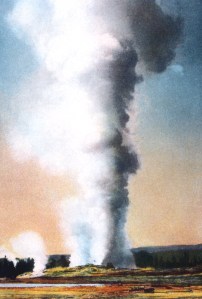
Upon going into camp we observed a small hot spring that had apparently built itself up about three feet. The water was warm but resting very quietly, and we camped within 200 yards of it. While we were eating breakfast this spring, without any warning threw, as if it were the nozzle of an enormous steam-engine, a stream of water into the air 210 feet, and continued doing so for some time, thereby enabling us to measure it, and then as suddenly subsided.
Surrounded by these hot springs is a beautiful cold spring of tolerably fair water. Here we found a beautiful spring or well, raised around it was a border of pure white, carved as if by the hand of a master-workman, the water pure. Looking down into it, one can see the sides white and clear as alabaster, and carved in every conceivable, shape, down, down, until the eye tires in penetrating.
Standing and looking down into the steam and vapor of the crater of the Giantess. With the sun upon our back, the shadow is surrounded by a beautiful rainbow; and, by getting the proper angle, the rainbow, surrounding only the head, gives that halo so many painters have vainly tried to give in paintings of the Savior.
Standing near the fountain when in motion, and the sun shining, the scene is grandly magnificent; each of the broken atoms of water shining like so many brilliants, while myriads of rainbows are dancing attendance. No wonder, then, that our usually staid and sober companions threw up their hats and shouted with ecstasy at the sight.
We bid farewell to the geysers, little dreaming there were more beyond. Five miles below Burnt Hole we found the “Lake of Fire and Brimstone.” In the valley we found a lake measuring 450 yards in diameter, gently overflowing, that had built itself up by a deposit of white sub-strata at least 50 feet above the plain. This body of water was steaming hot.
Below this was a similar spring, but of smaller dimensions while between the two, and apparently having no connection with either, was a spring of enormous volume flowing into the Madison, and is undoubtedly the spring about which Bridger was laughed at so much when he reported that it heated the Madison for two miles below. For some distance down the river we found hot springs and evidences of volcanic action.
∞§∞
— From Henry Washburn, “The Yellowstone Expedition,” Helena Daily Herald, September 27 and 28, 1870.
— Frank J. Haynes postcard, Yellowstone Digital Slide File.
In 1896 the famous lecturer, film maker and writer, Burton Holmes, visited Yellowstone Park. Holmes, who coined the word “travelogues” wrote about his Yellowstone trip in Volume 6 of his ten-volume series by that name.
After describing the Grand Canyon of the Yellowstone from several vantage points on the north rim, Holmes told this story about crossing the Yellowstone River on a crude raft made of logs to see the lower fall from “Artist Point.”
∞§∞
Most travelers are content to view the canyon from the points to which I have already led you. Others remain unsatisfied until they have looked into the great chasm from “Artists’ Point,” the one perfect point of view, which is unfortunately on the other bank, and in 1896 was well nigh inaccessible.
There was no bridge; the crossing of the river below the falls was utterly out of the question; but there remained the possibility of crossing far above the upper gorge, where the waters, although swift-flowing, present a level, navigable surface. But there has not been a boat upon the river since the last one, very fortunately empty, was swept away and dashed to pieces by the cataracts. No boat! No bridge!
The river being now too deep and swift to ford, I turn in my difficulty to the gallant soldiers of Uncle Sam, who are stationed at the canyon. The sergeant in command at the little military camp enthusiastically comes to my assistance, and at sunrise next morning I find him a little way above the rapids, slowly poling upstream a raft, which he has built expressly for our excursion.
Rafting Across the Yellowstone
At last, we reach a point from which he deems it safe to put out into the current, where the waters, swift as those of a millrace, are gliding on in their eagerness to plunge into the yawning canyon, just one mile beyond. There was, of course, no actual danger, yet the thought was ever present that our raft, if left to its own devices, would at once follow unresistingly that treacherous flood, bound through the rapids and plunge over the first fall, then dash through the upper canyon, and finally meet annihilation in the whirlpools at the bottom of the great cataract.
In safety, however, we arrive on the farther shore. Then we skirt the right bank through a thick growth of pine, and while we are walking through the forest, thundershowers come and go with great frequency and fury. We are soon drenched to the skin, but pressing on we reach the edge of the forest; the earth appears to open at our feet, and the canyon yawns before us, deep and mysterious. Vapors are surging upward from its depths, but fortunately, the sun is beginning to break through the clouds above.
A shaft of sunshine touches a portion of the opposing wall, and another brilliantly illuminates the pinnacles of white and gold, while others chase the vapors rapidly away. The fears that rain and fog will render our excursion fruitless are dispelled, as, reaching another point of view, we exchange salutes with friends on the other rim.
We shout to them, they shout to us; but the sounds meet only halfway and then fall into the depths between. We cannot hear, nor are we ourselves heard. The river’s rumbling mocks our puny efforts to span the deep chasm with a bridge of vocal sound. We must attempt to span it with our gaze.
Few of the great sights of this world have power to thrill us more than this vista of the canyon of the Yellowstone. We are unable to tell what most impresses us: the immensity of the great gulf, the infinite glory of its colored walls, the struggling river far below, the stately army of tall pines massed on the brink and pressing forward, apparently as eager as we to drink in all the splendor of the scene.
All these things go to compose the scene, to form that indefinable majesty that inspires us—to hold our peace. Silence is the only eloquence that can avail us here. No man has yet found language to express the majesty of this abyss of color. But, we ask, will no voice ever perfectly express in words what we all feel but dare not, cannot speak? Will no great poet of the new world, inspired by these grandeurs, ever utter the immortal song in which our vaguest thoughts shall find interpretation? Great, great indeed must be the soul of him who would give adequate expression to the reverential awe inspired by a scene like this.
But what is man that he should strive to utter the unutterable? The emotions that overwhelm us here can be expressed only in one language, and that is not a mortal language; it is the language of those to whom all mysteries have been revealed—the great eternal, wordless language of the soul: a language that we may not understand until the gates of death have closed behind us.
∞§∞
— From Burton Holmes Travelogues, Volume 6, The McClure Company: New York, 1905. (Pages 104-112)
— Artist Point Postcard by F.J. Haynes. Coppermine Photo Gallery.
— Photos of rafting across the Yellowstone River by Burton Holmes, Travelogues, Volume 6.
For decades trappers and prospectors told about the wonders in the upper Yellowstone, but their reports usually were dismissed as tall tales and few people visited the remote area. But interest soared within a year of the Washburn Expedition’s return after their exploration in 1870.
Lower Falls of the Yellowstone
Soon the race was on for tourists dollars with Bozeman businessmen building a road up Yankee Jim Canyon on the north and their Virginia City counterparts doing the same over Targhee Pass on the west. Tourists began arriving before the roads were done. Also, entrepreneurs were building hotels and bathhouses and planning stagecoach service.
The reason the Washburn Expedition generated interest while earlier groups had failed was that it included prominent men whose word couldn’t be doubted—and several of them were skilled writers who published their reports immediately in Montana newspapers. One of these writers, was Henry Washburn himself. He was a distinguished Civil War officer and Surveyor General of Montana Territory. Here’s an excerpt describing the Great Falls of the Yellowstone from the report Washburn wrote for the Helena Daily Herald just days after getting home.
∞§∞
The party crossed over a high range of mountains and in two days reached the Great Falls. In crossing the range, from an elevated peak a very fine view was had. The country before us was a vast basin. Far away in the distance, but plainly seen, was the Yellowstone Lake: around the basin the jagged peaks of the Wind River, Big Horn, and Lower Yellowstone ranges of mountains; while just ever the lake could be seen the tops of the Tetons.
Our course lay over the mountains and through dense timber. Camping for the night eight or ten miles from the falls, we visited some hot springs that, in any other country, would be a great curiosity, boiling up two or three feet, giving off immense volumes of steam, while their sides were incrusted with sulphur. It needed but a little stretch of imagination on the part of one of the party to christen them “Hellbroth Springs.”
Our next camp was near the Great Falls, upon a small stream running into the main river between the upper and lower falls. This stream has torn its way through a mountain range, making a fearful chasm through lava rock, leaving it in every conceivable shape. This gorge was christened the’” Devil’s Den.” Below this is a beautiful cascade, the first fall of which is 5 feet, the second 20 feet. and the final leap 84 feet. From its exceedingly clear and sparkling beauty it was named “Crystal Cascade.”
Crossing above the upper falls of the Yellowstone, you find the river one hundred yards in width, flowing peacefully and quiet. A little lower down it becomes a frightful torrent, pouring through a narrow gorge over loose boulders and fixed rocks, leaping from ledge to ledge, until, narrowed by the mountains and confined to a space of about 80 feet, it takes a sudden leap, breaking into white spray in its descent, 115 feet.
Two hundred yards below, the river again resumes its peaceful career. The pool below the falls is a beautiful green, capped with white. On the right-hand side a clump of pines grows just above the falls, and the grand amphitheater, worn by the maddened waters on the same side, is covered with a dense growth of the same.
The left side is steep and craggy. Towering above the falls, half-way down and upon a level with the water, is a projecting crag, from which the falls can be seen in all their glory. No perceptible change can be seen in the volume of water here from what it was where we first struck the river. At the head of the rapids arc four apparently enormous boulders, standing as sentinels in the middle of the stream. Pines are growing upon two of them. From the upper fall to the lower there is no difficulty in reaching the bottom of the canyon.
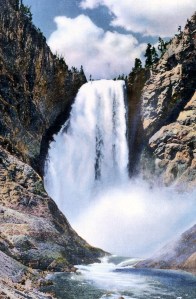
The lower falls are about half a mile below the upper. where the mountains again, as if striving for the mastery, close in on either side, and are not more than 70 feet apart. And here the waters are thrown over a perpendicular fall of 350 feet.
The canyon below is steep and rocky, and volcanic in its formation. The water, just before it breaks into spray, has a beautiful green tint, as has also the water in the canyon below. Just below, on the left-hand side, is a ledge of rock, from which the falls and the canyon may be seen. The mingling of green water and white spray with the rainbow tints is beautiful beyond description.
The canyon is a fearful chasm, at the lower falls a thousand feet deep, and growing deeper as it passes on, until nearly double that depth. Jutting over the canyon is a rock 200 feet high, on the top of which is an eagle’s nest, which covers the whole top. Messrs. Hauser, Stickney, and Lieutenant Doane succeeded in reaching the bottom, but it was a dangerous journey. Two and a half miles below the falls, on the right, a little rivulet, as if to show its temerity, dashes from the top of the canyon, and is broken into a million fragments in its daring attempt.
∞§∞
— From Henry Washburn, “The Yellowstone Expedition,” Helena Daily Herald, September 27 and 28, 1870.
— Frank J. Haynes postcard, Yellowstone Digital Slide File.

 Probably Thomas Moran’s most famous painting is his 7-by-12-foot depiction of the Yellowstone Canyon and Falls. It hung in the U.S. Capitol for decades and now resides in the Smithsonian. There is an excellent full-size reproduction at the Caynon Visitor Center in Yellowstone Park.




 M. Mark Miller, Author