Most of the time I think I’ll write my next book, Encounters in Yellowstone 1877, as narrative history, but when I hit a dead end in my research, I’m tempted to switch to historical fiction. That happened yesterday when I was trying to find out what the weather was like in Yellowstone Park on August 25, 1877.
One of the main characters in my book, George Cowan, woke up that morning after lying unconscious under a tree in his blood-soaked clothing. George was suffering from three gunshot wounds so severe that he could barely crawl, let alone walk. He hoped to drag himself on his elbows for five miles that day to a campsite where he might find food.
I’d like to write something like this: “An ominous gray sky greeted George . . ..” Or maybe: “The bright morning sun cast deep shadows that must have looked like canyons to George . . ..”
I don’t want to just say: “George awoke the next morning . . ..” But I may have to if I can’t find out what the weather was like. It might be easier to give up narrative history and convert to historical fiction. Then I wouldn’t have to ground every detail in the facts; I could just make stuff up.
That may sound like a no-brainer: don’t bother with the hard research; go with historical fiction, but it’s not that easy. When you tell your readers you’re writing fiction, you promise to provide compelling stories, fully formed characters, and gripping details that will bring your story to life. That can be as hard—maybe even harder—than sticking to the facts.
I’ve got myself persuaded. I’m sticking with narrative history—at least for now. I know it’s possible to write true stories that have all the compelling virtues of fiction. Laura Hillenbrand did it with Seabiscuit; Erik Larson with Devil in the White City; Timothy Egan, The Big Burn; David Laskin, The Children’s Blizzard—and there are many more examples.
If they can do it, maybe I can do it.
What do you think?
∞§∞
— To see related posts, click on “Narrative History” under the Categories Button on the right side of this page.
It describes the first intrepid entrepreneurs who tried to turn a dollar in Yellowstone Park. There’s Gilman Sawtell, a rancher and commercial fisherman who harvested thousands of fish from Henry’s Lake near the west entrance to the park. And Fred Bottler, who started ranching north of the park and hunted elk for their hides shipping them back east by thousands. Sawtell and Bottler were also the first park guides.
There are hotel and road builders and their first customers including women who rode sidesaddle through the roadless wilderness. Just click this link to read all about them.
When I was a little boy, my grandmother used to tell me stories about her trip to Yellowstone National Park in 1909. Grandma went to the park with her aunt, seven cousins, and two brothers. Great Aunt Elvina was recently widowed and her youngest daughter was born after her husband died. Family lore says that the baby is the reason they took a milk cow with them. Grandma said she would hang a bucket of cream under the wagon axle in the morning where the rocking motion would turn it to butter by evening.
At 20, Grandma was the eldest of the young people and she was responsible cooking and taking care of the camps. Aunt Elvina had her hands full with the baby and keeping track of the other small children.
Grandma’s 15- and 17-year-old male cousins probably drove the teams, took care of the horses, and milked the cow. The party had a surrey for Elvina and the small children, a covered wagon for supplies and equipment, and four saddle horses.
Grandma used to brag about making herself a split riding skirt and riding astride through the park. At that time proper young ladies rode side-saddle.
She told about making bread in a hot spring. She put dough in a lard can, tied it to a rope, and dropped it into the boiling water. After an appropriate length of time, she pulled it and found a palatable loaf, although it lacked a pretty brown crust.
Grandma also recounted stories her father told about working in the park in 1882. Grandma’s grandfather, Rodney Page, was a surveyor by profession and he got a contract to survey the northern border of Yellowstone. In fact, he apparently moved to Montana to take the job. He left his wife behind in Michigan to manage moving the family.
On Rodney’s survey crew were two young men, Fred Mercer and Harry Redfield, who enjoyed playing practical jokes. Grandma said they stole each other’s red flannel underwear and pitched it into a geyser. The next time the geyser played, it was colored pink from the dye.
Despite their pranks, Grandpa Rodney apparently approved of the two young men. After their work in the park, they returned home with him. Harry Redfiled married his daughter Elvina, and Fred Mercer, her sister, Evelyn. I descend from the Mercer line.
In addition to stories about her family, Grandma told about experiences every early Yellowstone traveler knew about like catching a fish and turning to drop it in a hot spring to cook where and angler without removing it from the hook. Grandma commented that she preferred to clean her fish before cooking them. Actually, there are several places in the park where you could do this: along the Firehole and Gardiner Rivers and the shore of Yellowstone Lakc. The Fishing Pot is probably the most well known.
I also remember Grandma’s telling about the Handkerchief Pool, a now defunct geothermal feature in the Upper Geyser Basin. The Handkerchief Pool looked like a large pot of boiling water and gave off clouds of steam and a sulphur smell. When someone dropped a hankie in the pool, it would swirls around for awhile. Then the pool would suck it out of sight. About the time spectators had given the hankie up for lost, it would pop to the surface. Then the owner could fish the freshly laundered item out with a stick.
As a small boy, I was fascinated by Grandma’s Yellowstone stories. As an adult, I wanted to know more, so I began researching early travel to Yellowstone. I now have a growing collection of about 300 first-person accounts of trips to the park.
I’m sad to say that Grandma never wrote about her trip.
After word spread about the magnificent big game in Yellowstone Park, hunters from the eastern United States and Europe began coming to bag a trophy. Even if they were skilled hunters where they came from, they needed someone to guide them in the rugged West. Jack Bean had the perfect credentials for the job. Before hiring out as a guide, Bean had been a trapper, hunter, and Indian fighter.
In the summer of 1877, the army hired Bean to look for Chief Joseph and his band of Nez Perce Indians along the Madison River and in Yellowstone Park. He returned to Bozeman after locating the Indians and telling the Army they were headed into Yellowstone Park, to discover that a Colonel Pickett wanted to hire him as a hunting guide. In his memoir, Bean tells this tale about the intrepid Colonel.
∞§∞
The Colonel was very anxious to kill a bear and had only seen a bear entering the brush on his previous hunting trips.
The next morning our trail led us over Mount Washburn where it commenced to snow. By the time we had reached our highest point in the trail the snow was about a foot deep. As the Colonel had only summer shoes, he had to walk to keep warm. So the Colonel stopped to dig the snow off his shoes and tie them a little tighter. I looked back behind me and saw a big bear crossing the trail. I spoke to the Colonel, “There goes a bear. ” But he kept tying his shoe. When he had finished he raised his head and with a southern accent answered me, “Whar?”
I advised him that a bear didn’t wait for a man to tie his shoe. Our trail now left the ridge and descended down to the head of Tower Creek where we saw another big bear in the trail coming toward us. So I told the Colonel, “There comes a bear.”
“Whar?” he answered so I showed him. He got off his horse and walked quietly up the trail. I watched Mr. Bear and saw him leave the trail and start up the grassy hillside.
I was afraid that the Colonel would shoot him when the bear was right above him and it would come down and use him rather roughly. The Colonel saw him when he was on the hill side about 30 yards away, so I dismounted and slipped up behind the Colonel. When the Colonel shot the bear it made a big growl and came down the hill on the run and passed him within 30 feet. The Colonel didn’t know I was so close behind him until I spoke.
I told him to hold his fire until the bear jumped the creek, but he wouldn’t do it. As the bear passed the Colonel shot and missed him. When the bear crossed the creek I opened fire with my Winchester. By the time the Colonel could load and was ready to shoot again I had put five Winchester balls into him. But the Colonel gave him his last shot through the breast while the bear was falling. It rolled into the creek dead.
We found when we had examined the bear that the Colonel’s first shot just went under the skin in the bear’s neck, which caused him to come down the hill so rapidly.
I knew that the Colonel would want to take this hide along. But we only had one packhorse between the two of us and it was too loaded to carry the wet and green hide. So I decided that I had better spoil it. So I gave my knife a lick on the steel and as we got to the bear stuck my knife between the ears and split the skin down the backbone clean to the tail.
The Colonel gave me a slap on the back and says, “Bean, that’s my bear.”
I told him, “All right.” It was no credit to me to kill a bear.
“Well,” he says, “We’ll take this skin.”
I said, “Why didn’t you say so before I split the skin—why I’ve spoiled it.”
The Colonel was very much put out to lose the skin. He tramped the snow down for ten feet around and finally concluded he would take the front paw and hind foot and a good chunk of meat to eat. I only took meat enough for him, as I didn’t care for bear meat. And after dissecting the bear we journeyed on our way to the Yellowstone Falls and made camp.
That night he wanted me to cook him plenty of bear meat, but I cooked bacon for myself. I noticed that after chewing the bear meat a little, he would throw it out of his mouth when he thought I wasn’t looking. I gave him bear meat for about two days and throwed the balance away, which was never inquired for.
∞§∞
— Adapted from Jack Bean, Real Hunting Tales, typed manuscript, Pioneer Museum of Bozeman. Pages 31-33.
I have completed a major milestone for my next book, Encounters in Yellowstone 1877. I finished an outline. That was a complicated task because I’m writing about a myriad of overlapping events and disparate (often desperate) people.
First, there are the Nez Perce, who decide to flee their homeland in Idaho and Washington State and make a new life in the buffalo country of Montana. After the army’s predawn attack on their sleeping camp on the banks of the Big Hole River, the Indians fragment. The Chiefs try to avoid whites while leading the main group, but they lose control over small bands of young men who spread out to seek revenge. These young warriors attack settlers along the Montana-Idaho border and tourists in Yellowstone National Park.
Like a nuclear chain reaction, each attack breaks up a group of people yielding several dramatic stories. For example, when a young warrior named Yellow Wolf and his companions attack a tourist party near the lower geyser basin, they capture a young woman, shoot her husband in the head and leave him for dead, and send several other tourists fleeing into the forrest. This one event yields Emma Cowan’s chilling tales of her captivity and quest for help after being released in the wilderness; George Cowan’s story of regaining consciousness to find himself wounded and alone, and the Cowan’s companions’ efforts to hide, flee and find help. Meanwhile, army units converge on Yellowstone Park from several directions, trying to find and subdue the elusive Nez Perce.
I’ve organized these events into 20 chapters that chronicle events beginning in 1805 when the Nez Perce befriend several starving men from the Lewis and Clark Expedition, and ending 130 years later with publication of a book entitled Adventures in Geyserland. Doubtless I’ll make changes as my research proceeds. I’ll need to merge some chapters, split others and rearrange things. But I have an outline that organizes a complicated human drama into a coherent narrative. For now, I’m happy with that.
As soon as the Summer issue of the Pioneer Museum Quarterly arrived, I checked for my article on Hester Henshall’s 1903 trip to Yellowstone Park. I contribute regularly to the Quarterly, a publication of the Gallatin Historical Society. It’s always fun to see my stuff in print.
Hester traveled by train from Bozeman to Yellowstone Park, with her husband, Dr. James Henshall, who was director of the Federal Fish Hatchery in Bozeman. Dr. Henshall was a physician, but he made his name as an angler and fish biologist. His Book of the Black Bass, published in 1881, is still in print
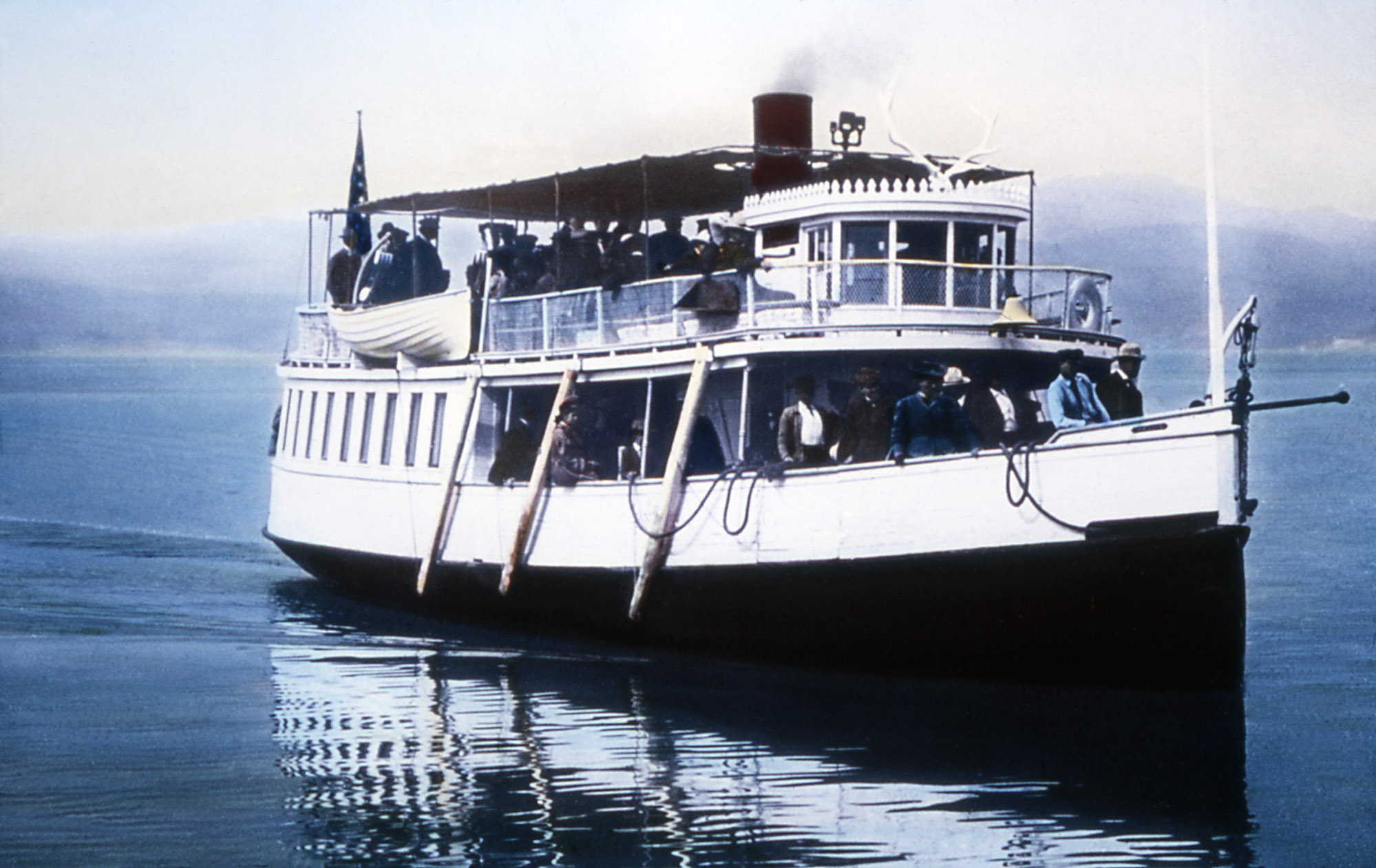
The Henshalls toured Yellowstone “The Wylie Way.” That is, with Wylie Permanent Camping Company, which offered tourists a comprehensive package that included transportation, food and lodging in tents tour that were put up in the Spring and left up for the season. The tour included a steamboat cruise across Yellowstone Lake. Here’s Hester’s description of that.
∞§∞
The shrill whistle of the little steamer called us aboard. She is a steel boat, with her name “Zillah” on a white flag floating at her masthead. We were soon steaming out into the lake. The Captain’s name was Waters, a good name for a steamboat captain. Miss Lillian Ehlert was soon at the wheel steering under the care of the pilot.
Doctor Henshall and Doctor Donaldson and myself sat in the bow of the boat. The scene was beautiful and was all very fascinating to me. Upon the mountains was a vague blue efflorescent haze like the bloom upon a grape, that made the tint deeper, richer, softer, whether it were the deep blue of the farthest reach of vision, or the somber gray of the nearer mountains, or the densely verdant slopes of the foot-hills that dipped down into the dark shadowy waters of the lake.
Along the western shore was the Absaroka Range of mountains; and in one place was seen the profile of a human face, formed by two peaks of the lofty range. The face is upturned toward the sky and is known as the Giant’s Face. It was several minutes before I recognized the resemblance, and then I wondered at my stupidity.
We stopped at Dot Island, a tiny green isle in the middle of the lake, on which are a number of animals, buffalo, elk, deer and antelope. They were fed with hay from the steamboat while we were there. The Captain warned us not to go near, as the big bull buffalo was very fierce. He finally did make a terrific rush and butted the fence until I feared the structure would go down before his fierce onslaughts. He was the last animal fed, and the Doctor said that was the cause of his demonstration; that it was all for effect, and to get us aboard again as the Captain wanted to get the passengers to land at his curio store in season. The man brought another bale of hay and fed the big buffalo, who suddenly became very docile, and we left him quietly munching his hay. I guess the doctor was right.
Soon we were again steaming over the lake. We three again took our places at the bow, and thought it queer that others did not want them. We were told that the “Zillah” was brought from Lake Minnetonka, Minnesota, in sections and put together at the lake, which seemed wonderful to me, as she had a steel hull. Too soon our journey was at an end.
∞§∞
—From Hester Ferguson Henshall’s Journal, A Trip Through Yellowstone National Park [1903]. Montana Historical Society Archives.
— Photo, Yellowstone Digital Slide File.
— Read more about Hester Henshall’s trip in the Summer 2010 Issue of the Pioneer Museum Quarterly.
— For more stories about fishing in Yellowstone Park, click on “fishing” under the “Categories” button on the right.
I can’t say I was mobbed by fans at my book signing at Old Faithful Inn, but I did meet enough of them to confirm that the species exists. My favorite was a young man (about 15, I suppose) who asked, “Did you write this book? Can I get a picture with you?”
Waiting for readers in front of the sign predicting the next time Old Faithful will play.
Second place goes to a guy a little older who said, “I started your book on the way up; it’s great. If I go and get it from my car, will you sign it.”
“Sure, I’ll be here all day,” I replied. The lobby emptied for the next eruption and I made my way up to the observation deck to watch Old Faithful play. When I returned, he was waiting at my table with a beat up copy of Adventures in Yellowstone. I signed it with a flourish. When I handed it back, he smiled and shoved it into his backpack.
“What’s the book about?” was the most common question I got (aside from “When does the geyser go off?”) The best answer seemed to be: “It’s a dozen first-person accounts of travel to Yellowstone Park in the Nineteenth Century.” Then I’d add: “real adventure stories—encounters with Indians, falling in geysers, watching bears fight.” If I held people’s attention for all that, I usually made a sale.
A lot of people asked: “Where did you get the stories?”
“Lot’s of places,” I’d say, “libraries, archives, magazines, books, the Internet; I have more that 300 of them and these are the twelve very best.” Sometimes that cinched a sale; sometimes people said they’d think about it, and, sometimes, they’d just walk away.
A couple of parents asked if they’re were stories they could read to their children. For adventure I suggested Ernest Thompson Seton’s tale about watching a momma black bear fight a grizzly, and for humor, The Earl of Dunraven’s hilarious description of how to pack a mule.
Some people didn’t need any arm twisting. One boy flipped open the table of contents and announced loudly: “It’s got Truman Everts’ story [about being lost alone in the park for 37 days]; I gotta have this book.”
A little later, a girl methodically sampled the book reading sections here and there. Then she put it back on the table and marched away. A few minutes later, she returned with her father in tow. “I never turned my daughter down when she wanted to buy a book,” I said. “Me neither,” he replied with a smile.
This girl was among the several people—mostly youngsters and teachers—that I handed my business card and asked to email me their reactions to my book. I hope I hear from them.
Marsha Karle lavished praise on my book minutes before the next eruption of Old Faithful.
Part of the fun of singing books in the lobby of the Old Faithful Inn was meeting other authors. On Saturday morning, my friends artist/illustrator Marsha Karle and her husband, author Paul Schullery, stopped to chat. They were kind enough to hang around the lobby for a few minutes announcing loudly how much they enjoyed Adventures in Yellowstone and saying everyone should read it. I can’t wait to get my hands on their new book, This High Wild Country: A Celebration of Waterton- Glacier International Peace Park. The combination of Marsha’ s watercolors and Paul’s prose has to make for a wonderful book.
Too bad Paul wasn’t around a few minutes later when another author of books on fishing arrived. I’m sure he would have enjoyed meeting Harry Sloan, the author of Virginia Trout Streams: A Guide to Fishing the Blue Ridge Watershed.
In the afternoon, I got to meet Ralph Himmelsbach, author of Norjak, The Investigation of D.B. Cooper. Ralph was the lead FBI investigator in the case, one of the most fascinating unsolved crimes of the last century. In case you don’t remember, a man calling himself Dan Cooper highjacked a passenger plane, ransomed it for $200,000, and parachuted away.
I’ll post more later on the thrill of hearing people say “I loved your book,” and the fun of convincing others that they’d enjoy it.
On Saturday, I’m going to the Page-Redfield family reunion in Twin Bridges. I was invited to the event by—let’s see—my second cousin once removed. Something like that; I never did get the hang of calculating kinship. I don’t expect to see any relatives much closer than a third cousin. Sometime a couple of generations back branches of the family drifted apart and I’m pretty sure my brothers, cousins, nieces, nephews, etc, won’t be there. But, there could be dozens of shirttail relatives. My family has had nearly a hundred and fifty years of being fruitful and multiplying in Montana.
The first of my relatives to arrive in Montana Territory was an 11-year-old girl named Mary Christianson. In her application for membership in the Montana Historical Society, Mary said she arrived in Montana in 1864 by the Bridger Cutoff. I imagine Mary walking beside a covered wagon in a train led by the famous mountain man Jim Bridger. Bridger’s wagon train emerged from the canyon that bears his name early in July 1864. From the mouth of the canyon, Mary could have looked past the point where three rivers run together to form the Missouri to the Tobacco Root Mountains 70 miles to the west. Mary’s odyssey from her birthplace in Germany, across the Atlantic and then across America was almost over. Mary would spend the rest of her life west of the Tobacco Roots.
While Mary contemplated her new life in gold-rush Montana, her future husband, James Madison Page, languished in the notorious Civil War prison at Andersonville where union soldiers died by the thousands of starvation and disease. (Andersonville Prison has been burned into the American consciousness as a symbol of inhumanity, but Page said he never saw any intentional cruelty there. In fact, in 1908 Page published a book that said the charges against Major Henry Wirtz, who was hanged for murders he allegedly committed at Andersonville, were trumped up.)
Jim Page was released from Andersonville in a prisoner exchange and returned home to Michigan. After recovering from his ordeal and attending business college, Jim decided to move to Montana in 1866. Family lore says he wanted to rejoin the army so he could fight under his hero, General George Armstrong Custer, but his mother talked him out of it.
Jim got a job as a teamster on one of the wagon trains hauling supplies to the gold fields. When he arrived in Montana, he tried his hand at prospecting, but, like many gold rushers, he soon turned to other ventures. He established his Excelsior Ranch near Twin Bridges and began enticing his siblings to join him. His brother, Robert Wallace Page, came to Montana with his family by steamboat up the Missouri in 1879. Low water stopped the boat at Cow Island, but the family had planned to come overland the remaining distance anyway. A sister, Elmira Utley, came with her family a year later on an “immigrant train” operated by the Utah and Northern Railroad. The track ended at Lima, Montana, then, so the Utleys had to continue by horse and wagon from there to Twin Bridges.
My Great Great Grandfather Rodney Page and his widowed sister, Elvira Stephens, were the last to arrive, coming in 1882. By then the track reached as far as Dillon. Actually, Grandpa Rodney went ahead leaving his wife and sister to manage the move while he rushed ahead to join his brother, Jim, on a surveying expedition to Yellowstone Park. That was the beginning of the Page brothers land survey company, which operated for nearly 40 years. Jim Page said the company surveyed in every county in Montana (probably meaning the original territorial counties).
Descendants of the Pages still tell stories about the 1882 Yellowstone trip. Rodney hired two young assistants named Fred Mercer and Harry Redfield. Mercer and Redfield become close friends and loved playing practical jokes on each other. They used to steal each other’s red flannel underwear and toss it into Old Faithful tinting the next eruption pink—so the story goes. With nearly 4,000 gallons in the typical eruption of Old Faithful, it’s doubtful that one pair of flannels would dye it, but perhaps the prank involved a smaller geyser.
Rodney must have liked Mercer and Redfield well enough. When the survey was done, they followed him home and married his daughters. Harry Redfield married Elvira Page and they had eleven children, so their descendants doubtless will dominate the family reunion. Fred Mercer married Eva Page and they had four children. I descend from the Mercer line.
I fulfilled one of my fantasies last Saturday when Tam and I went to the Twin Bridges High School Alumnae Association all-class banquet. These are unusual affairs where you can see three generations of the same family—all TBHS alumnae—telling stories about when they were in school.
You might hear about the Class of ’42 and their hand-made yearbook. When World War II shut down commercial printing, the students went to the typing lab and painstakingly assembled an annual for every one of their classmates.
You might hear a member of the Class of ’56 complain that the last Montana Class C high school state football championship was stolen from them. The team won the game on Thanksgiving Day, 1955, in a blizzard so bad officials discontinued Class C football championships. They also took back the trophy because there was an overage player on the team—not a key player, you understand.
You probably would hear someone from any class of the 60s recall the time a portly fourth-grade teacher got stuck in the chute fire escape during a drill and the extra recess that resulted while a janitor extricated the poor woman.
About 120 people feasted on a simple lettuce salad, baked potato and slabs of prime rib. (Twin Bridges is beef ranching country.) The oldest alumna was from the class of 1934. The honor classes were from years ending in zero.
The honor graduate was Ray White of the class of 1942. Ray came to the state orphans’ home in Twin Bridges as a boy and attended TBHS from there. He says the bookkeeping classes he took in high school launched his successful career as an accountant. Ninety-year-old Ray now shows his gratitude by providing scholarships for college-bound students from his alma mater.
None of my classmates (Class of ’63) showed up, so Tam and I sat at a table with one of my brothers (Class of ’59), his wife, and a friend, Jon (Class of ’60). Because Jon was three years ahead of me, I didn’t know him well in high school, but when I was at the University of Montana, Jon came there for a masters and joined my circle of friends. He dated Tam for a while and I think their relationship was serious.
When the festivities at the school ended, we went downtown with Jon for a comprehensive Twin Bridges pub-crawl (both bars). I had promised Jon’s wife that I would protect him from the widows and divorcees in his class.
While Tam and Jon drank beer and fought mosquitoes in front of the Blue Anchor, I went inside to the restroom. That’s when I saw Lela May (Class of 60). When I was young Lela May was the fuel for my adolescent fantasies—raven black hair, flashy make-up and tight black pants that bulged in all the right places. She was three grades ahead of me—way out of my league—and I knew it.
“Am I blocking your way,” she asked when I stopped in front of her.
“No,” I replied, “I’m getting up the nerve to ask you to dance.”
She smiled and waited for a new song from the over-amped cowboy band. Then she offered her hand and I escorted her to the dance floor.
I still have unfulfilled fantasies, but I can tick one more off my list. I danced with Lela May.




 M. Mark Miller, Author