I’ve used this blog to post stories I’ve found about early travel to Yellowstone Park and occasionally other stories. Also, I like to let people know about my other a ctivities: writing, speaking and occasional personal notes. Of course, I’ll keep doing those things, but with some new twists.
Yellowstone travel stories are getting harder to find. I’ll keep an eye out and post stories when I see them, but I’l going to add what call “Free Reads.” That is, book, articles and reports that are available on the internet at no cost. I’ll provide links so you can read them whenever you want to learn more about Yellowstone Park Adventures
I’ll begin with the Earl of Dunraven’s book, The Great Divide, which chronicles his trip to Yellowstone Park in 1874. The Earl was a wealthy Irish lord who loved adventure, hunting and fishing. He had been a newspaper correspondent and was a skilled writer. He could describe his adventures in bone-chilling detail or with wit and humor. His book is the source of many posts on this blog that you can see by selecting the “Dunraven” button at the left of this page.
You can find complete copies The Great Divide online in several locations. I like seeing page-image versions like the one available at the Internet Archive. Seeing what the book looked like gives a feel of authenticity and the illustrations can be great. They are in this book. Google Books is another internet site where you can get a copy of The Great Divide.
So grab yourself a free copy of The Great Divide or read it on line. If you find anecdotes or stories in it that would make good additions to this blog, please let me know. Remember you can check to see if I’ve already published them by checking for “Dunraven” under the Categories Button to the left of this page.
I’ve added “Free Reads” under the Category Button and plan to add items there regularly. You should watch for them.
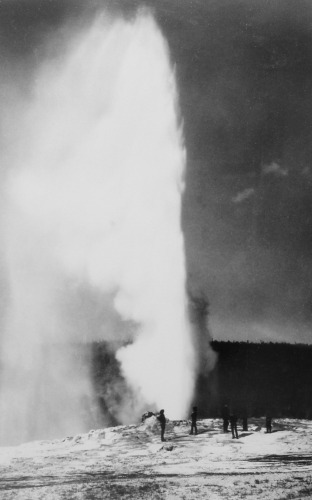
Explorers inspect Old Faithful. — William Henry Jackson Photo, 1871.
Over the last few weeks there have been several stories about injuries and deaths caused by ignoring the rules in Yellowstone National Park. Here a good example from The Billings Gazette. The coverage reminded me that I have posted several stories about tourists’ encounters with hot springs and geysers. I decided to reprise some of them.
Henry “Bird” Calfee, “Saving a Scalded Man — c. 1872.” When a man tries to save a deer in a geyser, he falls in, and his partner has to figure out how to get him home.
Frank Carpenter, “Angering Old Faithful — 1877.” A tourist dumps rubble into the famous geyser just to see what will happen the next time it erupts.
Georgina Synge, “Soaping Beehive Geyser to Make It Play — 1892.” Tourists steal bars soap from their hotel and sneak out on a moonlit night hoping to force a geyser to play. (It doesn’t work.)
A couple of important points about these stories: First, they are survivors’s stories. Dead men tell no tales. Second, they are from different times. Today we know better than to do the things described. When you visit Yellowstone Park, you should obey all the rules. The Park Service has posted a nice summary of them and some good advice.
I hope you enjoyed these stories. If you did, you can look for others on this blog. Even better, buy my books:
Adventures in Yellowstone: Early Travelers Tell Their Tales. — A dozen classic tales in the words of the people lived the adventures including: Mountain Man Osborne Russell’s tales of tangling with Indians and seeing geysers for the first time; N.P. Langford’s diary of the expedition that first brought Yellowstone’s wonders to public attention, and Emma Cowan’s chilling account of being taken captive by Indians.
Macon’s Perfect Shot: A Yellowstone Adventure. — A mid-grades novel about a 14-year-old boy’s adventures in the Park in the 1870s. Macon has to grow up fast when his partner falls into a geyer, and he has to get the scalded man home.
I hope you enjoy reading early traveler’s adventures in the world’s first national park. Learning more about it’s history will enhance your enjoyment when you visit there.
Distinctly Montana published my article “Tales of the Belgrade Bull” in its Spring 2016 issue. It’s the boisterous tale about the son of a Holstein dairy cow that nobody could ride. The bull was “discovered” on a ranch north of Belgrade, Montana, where he learned to buck off children who attempted to ride him after Sunday school. When a threshing crew member mounted him as a full-grown bull in the fall of 1892, it set off a series of wild rides.
An enterprising pair of brothers bought the bull, took him to Belgrade and offered a $25 reward to anyone who could stay on him. Soon cowboys were coming for hundred of miles to try try their luck — only to be sent sprawling.
By 1894 the Belgrade Bull’s fame had spread and he went on tour to Anaconda, Butte and Helena where he took on all challengers. A wild west show bought bought him and took him back east. The show went broke in Indiana and sold the bull to a farmer. Apparently, the bull lived out his days as a herd sire.
I became interested in the story of Belgrade Bull when Ann Butterfield showed me a letter she found in the research collections of the Pioneer Museum in Bozeman. Ann, who was then associate director of the museum, thought maybe I could write an article based on it. I love piecing together stories out of the detritus of the past, so I decided to give it a try.
The bull has been legendary around Belgrade for more than a hundred years and soon I was buried under a treasure trove of newspaper clippings, letters and reminiscences. From them, I assembled an article that was published in the Spring 2009 issue of The Pioneer Museum Quarterly (now The Gallatin History Museum Quarterly). You can read the unabridged version that appeared there on this blog. Begin with Part 1 and follow the links.
You can read the Distinctly Montana version on the link above, but I urge to you buy the magazine. It’s easier to read, and the double-page illustration looks much better. You could get a copy of the longer version by buying a copy of Spring 2009 issue of The Pioneer Museum Quarterly at the Gallatin History Museum, 317 West Main, in Bozeman, MT.
I always enjoy getting ready for my presentations because it gives me a chance to review my collection of more than 300 stories about early travel to Yellowstone Park. That way I can be sure that I’m choosing the very best ones.
I also review and refine the slide show that accompanies my presentation. I’m always looking for dramatic photos to go with the stories I’m going to read like the one above. It does a great job of illustrating a 1911 tale about a near tragedy at the Lower Fall of the Yellowstone.
I’ll begin my presentation, as a usually do, by describing the stories my grandmother used to tell about her trip to the Park in 1909. Grandma made herself a split riding skit for the trip in an era when most women rode horses sidesaddle—or not at all. Her tales about such things as cooking bread in a hot spring and tossing red flannel underwear in geysers to tint their next eruptions pink inspired my interest in Yellowstone Park.
Whenever I can, I read stories written by the women who lived the adventures because people’s personalities and emotions shine through the words they choose. On Thursday I’ll read one of the best: Emma Cowan’s chilling account of watching Indians shoot her husband in the head during her trip to Yellowstone in 1877. The Nez Perce took Emma and her 14-year-old sister captive and held them for two days.
I’ll also read some lighter stuff like Eleanor Corthell’s description of leaving her husband at home and hauling her seven children to Yellowstone Park with a horse and wagon in 1903. Eleanor fretted about her children dashing around boiling geysers and chased a bear away from a pot of beans she was cooking.
The evening will provide a good mix of high adventure and humorous anecdotes.
Of course, after the presentation I’ll answer questions and sign copies of my books.
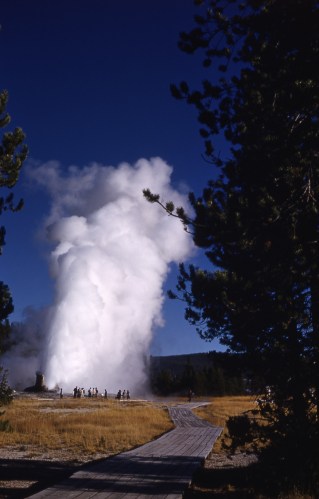
We had dismounted and unloaded our horses and buggy, and were looking for the best sites for our tents, when the cry was heard, “There goes a geyser!” and we dropped everything and ran. The sight was truly a glorious one. At the far end of the basin, Old Faithful was playing his wonderful fountain, and we saw what looked to us a river of water shooting up into the sky. Our guides told us it was only 150 or 200 feet high, but to us it seemed to reach the clouds, and on one side of it was a lovely soft rainbow that came and went with the blowing spray. It spouted for five or ten minutes and then subsided.
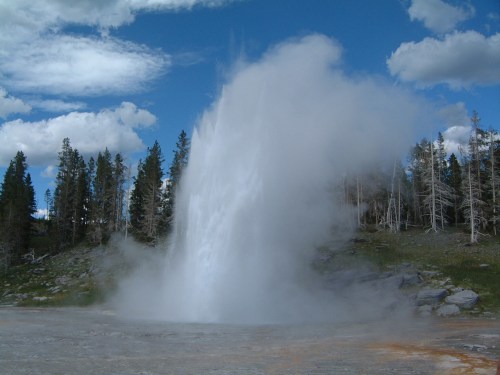
Giant Geyser
Old Faithful is the only geyser whose performances can be depended upon. He spouts regularly every sixty-seven minutes, and has done so ever since the discovery of the Park. The crater looks like a great mound of coral or petrified sponge, surrounded by terraced basins at all shapes and sizes, and of the most lovely colors.
The whole mound is convoluted in the most beautiful fashion, and every one of the little basins around it is rimmed with exquisite scalloping and fluting. The Grand Geyser, the Giant, the Grotto, the Splendid, the Riverside, and the Fan, complete the list of large geysers in this basin, and each one has a marvelous and distinct beauty.
As we were quietly sitting in camp the day after our arrival, I noticed a great steam in the direction of the Grand Geyser, and called out to one of our guides, “George, is old Grand doing anything?” He looked a moment, and then, dropping everything, began to run, shouting out at the top of his voice, “Old Grand is spouting! Old Grand is spouting!” In a second of time our camp was deserted, every thing was left in wild confusion, and we were all running at the top of our speed to see the display.
It was perfectly glorious! As it sent up its grand water rockets 250 feet into the air, shooting out on every side, we all involuntarily shouted and clapped our hands, and Sam took off his hat and swung it over his head in a perfect enthusiasm of delight! It was like a grand oration, and a wonderful poem, and a beautiful picture, and a marvelous statue, and a splendid display of fireworks, and everything else grand and lovely combined in one. Then all would subside, and the pool would be quiet for a moment or two; then again, it would heave and swell, and the glorious fountain would suddenly burst up again into the blue sky! Seven times this took place, and then all the water was sucked down, down, down into the abyss, and we climbed part way into the steaming crater, and picked up specimens from the very spot where just before had been this mighty fountain.
The Giant, too, gave us a grand performance while we were in the Basin. We thought it the grandest and most beautiful of all. It shoots up a column of water at least seven feet thick to the height of 250 feet, the steam rising far higher. It played for nearly an hour, and flooded the whole basin around with boiling water, doubling the volume o water in the river. The internal rumblings and roarings meanwhile were perfectly deafening. I could not help feeling as I gazed on these wonders that there was a lesson in it all. Nothing but heat could bring forth such beauty as we see here at every step, and I thought that thus also did the refining fire of God bring forth in our characters forms and colors as beautiful after their fashion as these.
∞§∞
H.W.S, “A Lady’s Visit To The Geysers Of The Yellowstone Park.” Friends Intelligencer, May 19, 1883. Pages 218-221 and May 27, Pages 234-237.
As Yellowstone Park became a popular tourist destination, a colorful terminology emerged to label the people who worked and visited there. The excerpt below from a newspaper describes that terminology as it existed in 1922. But it misses earlier usage and some categories of people.
The article says “savages” was the term used to label all the people working in the park, but that wasn’t always the case. In fact, savages were a very specific group of employees in the 1880s and 90s. The term applied exclusively to the drivers of the six-horse teams on Tallyhos, the huge stagecoaches that carried thirty or more passengers from the railroad station at the end of the line to the hotel at Mammoth Hot Springs.
It took highly skilled teamsters to drive the giant coaches up the crooked, rocky and steep road. Men who could do the job were hired for their driving ability, not their civility. Apparently such men often had crude manners and profane speech. That’s why they were called “savages.”
In 1915 cars were allowed in the park and buses soon replaced the tallyhos. The buses had transmissions that were difficult to shift, so their drivers became known as “gear jammers,”—and everybody who worked in the park became known as “savages.
The excerpt implies that all park visitors were called “dudes,” but that wasn’t true, even when the article was written. At that time “dude” referred exclusively to the guests of hotels and touring companies. People who provided their own transportation and shelter were called “sagebrushers” because they often had to pitch their tents in sagebrush flats when the park was crowded.
The term “sagebrushes” survived even after the Park Service began providing free campgrounds and people toured in their own cars. Another term missed in the excerpt below is “swaddies,” a label applied to the soldiers who managed the park from 1886 to 1916. Swaddie apparently was a corruption of the British-Indian army’s “swattie.” For decades swaddie bands provided music for dances at Yellowstone hotels where dudes and sagebrushes mingled.
Here’s a description of “Yellowstonese” as it was used in 1922.
∞§∞
“Hello! You Dudes; how do you do? It’s been a long time since we’ve seen you. Oh, how we like to see you smile, And we like to sing to you. Hello, you Dudes; how do you do.”
Have you ever been a dude? If you have you’ll remember the happy times when your gear-jammer rolled you up before a big rustic camp building, and while the pack rats scurried with the baggage you were greeted with this pawn of welcome by a flock of pretty savages from their roost atop a high log.
But if you have never been a dude you’ll probably not understand what all the foregoing is about; for the language is pure Yellowstonese, and in it “dude’ means a traveler through the great playground, which this year is celebrating its golden anniversary.
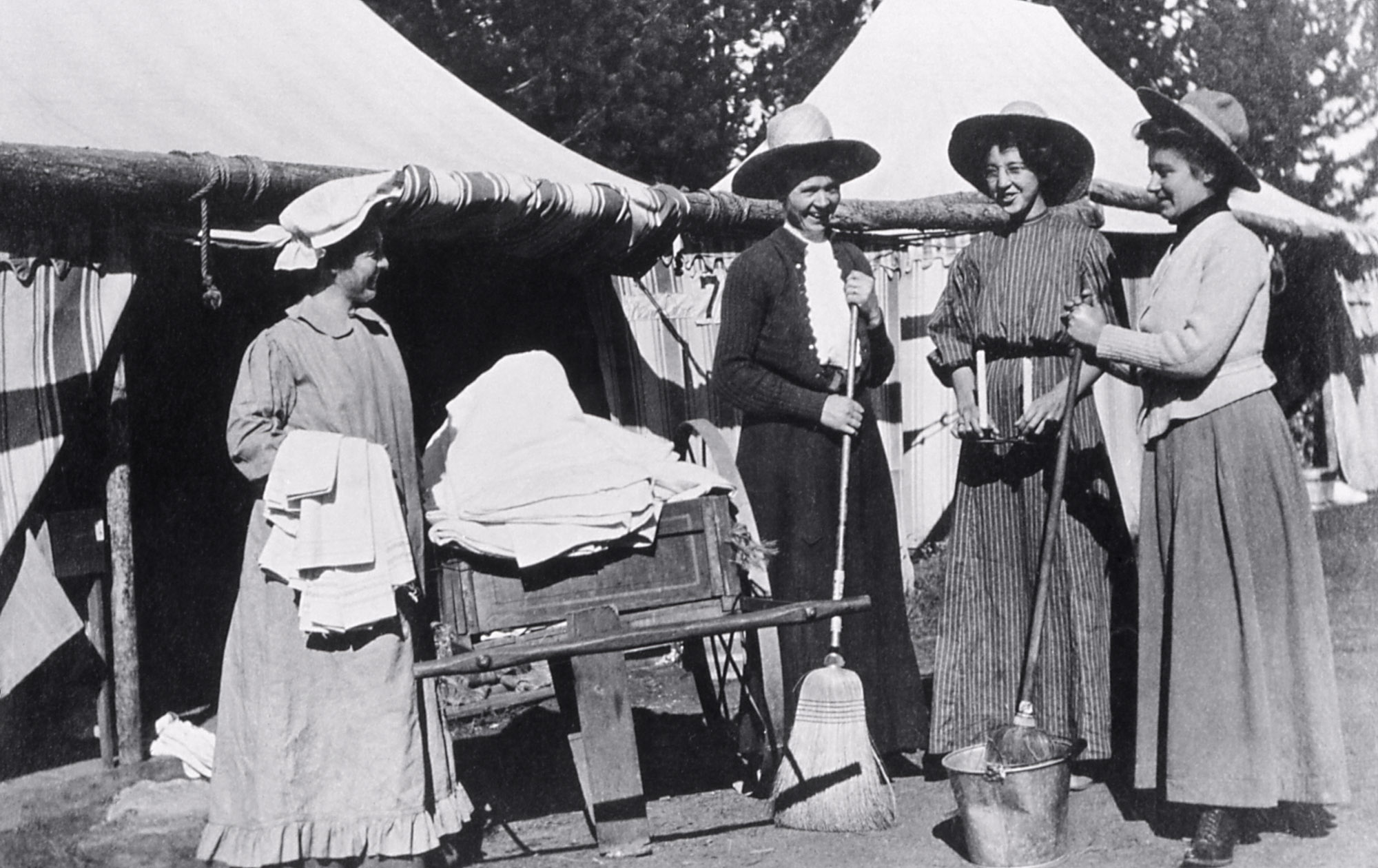
A “savage,” generically speaking, is anyone who works there, but in actual use of Yellowstonese more minute classifications are made. The “gear jammer” is the driver of your big yellow bus, the “pack rat” is one of the college boys who work as porters, and when you speak of a “savage” you usually are referring to one of that merry band which has become as celebrated in the Yellowstone as Old Faithful itself—the college girls who earn books and tuition during the summer as guides, waitresses and tent girls in the Yellowstone camps and who keep the great wonderland lively with their songs, plays and adventures.
She is a happy and self-reliant creature, the savage, and the best hype of American girl. Should you change to go up to old Yellowstone celebrate its fiftieth year as a national park you’ll meet her on every hand. She’ll sing you in, she’ll feed you. Your tent in camp will be spotless and neat under her capable hands, and when you hike she’ll tell you what makes the geyser gyse and introduce you to the bears. She’ll sing to you the quoin Yellowstone songs around the campfire at night, and if you look credulous, relate or two of the weird and wonderful Yellowstone stories invented particularly for dude consumption.
And in her leisure hours you’ll find her everywhere. She’ll be climbing or hiking or fishing, holding a fish-fry by the river or a marshmallow roast on the mountain side, adventuring everywhere, and then turning up fresh as a daisy to take up her camp duties or help stage a dance or an entertainment for the park’s guests.
Real girls! And when you are told that out of all the applications that pour in only the first six thousand are considered, and out of that number four hundred-odd girls are finally selected, then you commence to realize what a picked, genuinely representative group of the best young American womanhood the savages really are. And when you find a Chi Omega from Vassar serving your hot cakes and a Kappa Epsilon from California showing you the geysers or falls you begin to grasp the fact that here are representatives of colleges and national sororities from every portion of the country.
The savages’ summer commences at Salt Lake City when the “Savage Special,” a real limited pulls out of the station and heads north for west Yellowstone in June. It is an unusual train. Old Acquaintances belong renewed and all the old park yard being tried out on new girls keep things in a gale of fun. Ukuleles and unlimbered and every station is serenaded right up to the park entrance itself, where, piling into waiting busses, the savages scatter to the various camps.
Some of them will become waitresses, and here you learn some more Yellowstonese, for then the savages are known as “heavers.” The girls who draw the dishwashing jobs become “divers” and to the tent girls immediately accrues the euphemistic title of “bedbugs” among their fellows. Then, every week they all change around, the “bedbugs” become “divers”,” these change to “heavers” and the erstwhile “heavers” draw the coveted detail of making up beds. The latter is the soft job. Its holders are off for the day in their particular row is made up, and their fun begins.
∞§∞
Excerpt from Eyre Powell, “The Sophisticated Savage of Yellowstone.” New York Tribune, July 16, 1922. (Pages 5-6)
National Park Service Photo, Yellowstone Digital Slide File.
While checking to see how my blog was doing yesterday, I noticed that one of my hits came from Billings author Craig Lancaster’s Wikipedia page. “That’s strange,” I thought. So I checked it out.
We all know that Wikipedia guards its credibility zealously and insists that citations come only from reliable sources. That makes official what readers of this blog already knew—everything here is reliable.
And we know the information in the post is solid. After all, Craig wrote it. That struck me as a bit odd. After all, Wikipedia once refused to accommodate renowned author Phillip Roth’s request to change an entry about one of his novels on the grounds that Roth was not a credible source concerning the basis for a character in one of his novels. The incident was described by the BBC, which cited Roth’s long letter to The New Yorker.
When I checked the other citations in Craig’s Wikipedia Entry, I was delighted to find I was in good company including Jenny Shank of PBS, David Crisp of The Billings Outpost, David Moore and Lisa Simon of Reflections West, The Dallas Morning News and the Billings Gazette.
I’ll be even happier when I get my very own copy of Craig’s new book, This is What I Want. You can read all about it on his website, or even better, order your own copy.
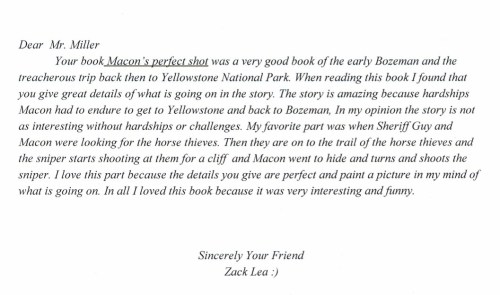
I received this very nice letter today from Zack Lea of Bozeman. I’m thrilled that he loved my book, Macon’s Perfect Shot. I wrote it with guys like Zack in mind. He turned 12 today. Happy Birthday, Zack.
It’s It’s easy to find descriptions of the wonders of Yellowstone Park like waterfalls, geysers and wildlife, but accounts mundane daily activities are rare. This travel diary by Henry Isaac Jacobs of Bozeman, Montana, in 1900 is an exception. Here’s how Henry described preparations for the trip and the first day’s travel.
∞§∞
About the middle of July 1900 we had several relatives arrive here from the far east to spend their vacation among the mountains and breathe this fresh mountain air and drink the cool water and enjoy themselves for a month or so.
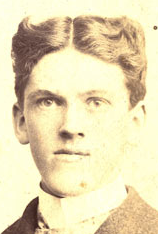
Henry Isaac Jacobs
We had been talking of going through Yellowstone Park before they came. We thought now would be the time to get up a party to go and make our eastern visitors have a good time. So we talked it all over and found out it was favorable with everybody and invited those we wanted in our party and then commenced to prepare for a glorious trip. It was no small task to get everything ready as we had about thirty in our party and wanted to make everything as agreeable as possible for every body.
We boys got together and appointed different ones to see about differing things. And soon got the ball to rolling our way. We had quite a time securing a cook. We had made arrangements with a cook and was relying on him but something went wrong with him and he said he could not go. This being about a day or so before we left and it was pretty hard to get another to fill the place. But we kept a smile on our face and commenced to look for another.
We were about to give up. When we were stopped on the street by a gentleman that said he heard we were looking for a cook. He said he was an old hand at the business and would like the job. We found he was a Frenchman and understood his business all right and just the fellow we were looking for he demanded a good salary. We gladly gave it to him and this stopped our search for a cook. By the time our cook had prepared our provisions we were to use on the trip the rest of the boys had gotten the companies tents and all necessary article for us on our trip.
This being all they had to look after. Mr. Murphy and Mr. Bronx had arranged a party of about ten and was going along with us. This made a party of thirty or more. The time we had set to leave Bozeman on our trip was the first of August and it soon rolled around.
So the morning of the first of August 1900 we commenced to hustle around to get things ready and then gather up our crowd.
This is a fine morning and every body was feeling good. As we had several little things to see about that morning we didn’t get started until about ten o’clock. All the crowd get started but the three seater and we had a wilder horse and it took us quite a while to get him under control but finally we got started and went out of Bozeman singing and having a big time.
Every thing went well until we came near the entrance house and we had some dangerous places to go over on our trip. So two of the boys took our bronco and started with him in search of another and I stayed with the rig to see that nobody run off with the ladies. After a long and weary walk the boys came back with another horse that was more suitable for the occasion. We then hitched up and caught the rest of the party in rocky canyon. They were waiting for us to come to have lunch. Frenchie had everything ready.
We all sat along the side of the road and Frenchie served us our lunch with all his smiles. We had lots of fun eating out of our tin pans and drinking out of our tin cups. We got started rather late in the afternoon. Mr. Morgan told us to head for Mr. Maxeys ranch. So we did and had a nice drive. We reached there about seven o’clock as supper had to be prepared. So all the boys worked hard and soon got things under good headway. And we were soon ready for Frenchie to get supper. It was just about dark when Frenchie gave his first call for supper with his tin pan and knife. Every body was good and ready for supper and eats heartily for the first meal cooked on the trip.
After supper was over we had nothing to do but enjoy our selfs. As there was several target rifles in our party we had a good shooting as sport until is got so dark we could not see the sites and then we had to change to program.
The girls seemed to be enjoying them selves with a big jumping rope so we found them and played school kids for a while. As it was not cool enough for a campfire we all got together and sang songs until Mr. Maxey came out and wanted all the dancers in the house for a little dance. This just struck most of the party and so they accepted the invitation and got ready to go in. As we had a violinist in our party he went and furnished the music and every body present reported a good time. The dance broke up at an early hour and every body turned into camp.
Some of the boys had arranged their beds in Mr. Maxeys barn and some slept out in the open air but the most of us preferred being inside.
This being the first night out it was hard for us to get to sleep. We boys rolled and tumbled and could not go to sleep. Some of the boys suggested we get up and have a war dance. So we got up in our night robes. (This being about two o’clock.) And gave several wild war whoops and around the camp we went. After arousing all those that was trying to sleep we thought we would go back to our tents and try it again. It was already three o’clock this time and we made it out sleeping till six.
∞§∞
Adapted from “A Trip Through Yellowstone Park” by Jacobs. Complete text available on Charlotte Gamel’s website.
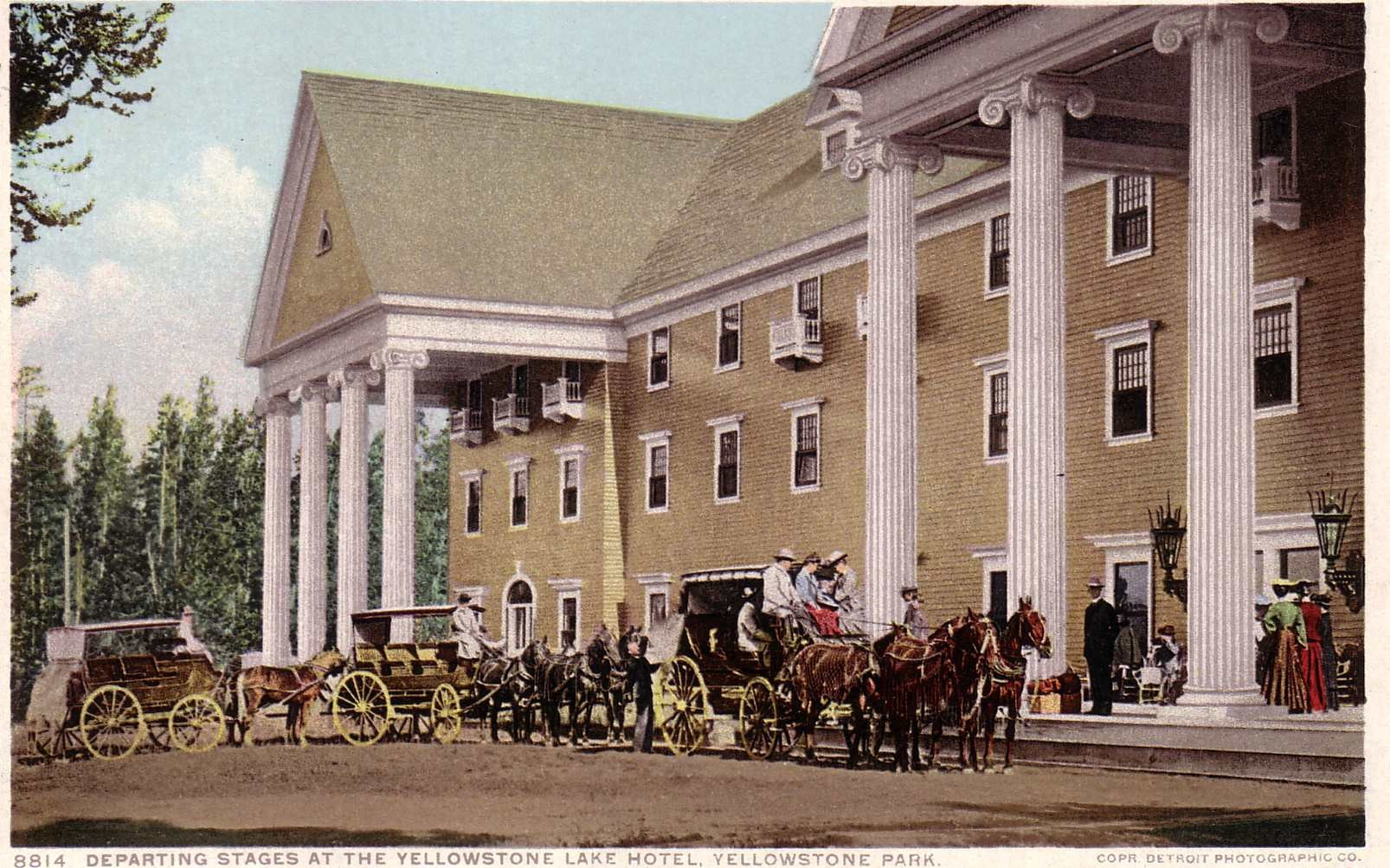
Yellowstone Park’s colonial style Lake Hotel has been added to the National Registry of Historic Places. Originally built by the Northern Pacific Railroad in 1891, Robert Reamer, the architect who conceived the remarkably different Old Faithful Inn, redesigned and expanded it in 1903. The hotel has been renovated several times since then. Here’s how travel writer Thomas Murray’s described it in 1912.
∞§∞
Decidedly more conventional, but quite equal in appointment and comfort to Old Faithful Inn, is the Lake Hotel, some forty miles farther on the road. It was built but a few years ago and is styled the Colonial on account of its massive colonnades fronting on the lake. Standing as it does in the edge of a stately pine forest and commanding a most picturesque view of the lake and mountains, its situation is a superb one.
In the woods near at hand our naturalist friend found wild strawberries and called our attention to the tiny shrubs loaded with huckleberries Here, too, a great colony of bears is often seen and at evening they congregate in a nearby open space in the woods to await the hotel garbage wagon. They are very mild, harmless mendicants, though at times they may show flashes of ill nature towards each other. They are always a great attraction for the hotel guests, some of whom are quite willing to miss a meal to watch the ungainly antics of the brutes.
The Lake Hotel is in the center of the fishing district and the devotee of the -sport will find a veritable paradise at hand. Even the novice is sure of a catch and the skilled fisherman almost deprecates the eagerness of the Yellowstone Lake trout to take the bait. The most favored fishing grounds are near the outlet of the lake, though one is sure of success almost everywhere. The principal catch is lake trout, some of which attain considerable size.
The tourist with several days at his disposal in the Park and who prefers the convenience of the hotel to camping, will no doubt give the greater portion of his time to the Colonial.
∞§∞
Text from Thomas D. Murray, Three Wonderlands of the American West. The Page Company: Boston, 1912. Pp. 14-15.
Frank J. Haynes Postcard, Yellowstone Digital Slide File.
To find stories about bears, click on “Bears” under the Categories button to the left.







 M. Mark Miller, Author