Category: Uncategorized

  • News: Raptors of the West Wins 2011 Montana Book Award

    Last Saturday I spent the day at Chico Hot Springs with other members of the Montana Book Award choosing this year’s winner and honor books. The news release below reports the results of our deliberations.

    ∞§∞

    The 2011 Montana Book Award winner is Raptors of the West by Kate Davis, Rob Palmer and Nick Dunlop, published by Mountain Press. This annual award recognizes literary and/or artistic excellence in a book written or illustrated by someone who lives in Montana, is set in Montana, or deals with Montana themes or issues.

    Presentations and a reception with the winning authors will take place in April, during the Montana Library Association Conference at Big Sky.

    Raptors of the West, the latest collaboration by award-winning photographers Rob Palmer and Nick Dunlop and author/photographer Kate Davis, is a glorious photographic ode to the forty-five birds of prey that roam the skies of the American West. The book is arranged by the habitat type which gives a great way to identify many birds in one area. While the 430 stunning color photographs are enough to set this book apart on their own, Davis’s informative and entertaining captions make this a perfect guide for all age groups.

    Four honor books were also chosen by the 2011 Montana Book Award Committee:

    Beautiful Unbroken: One Nurse’s Life by Mary Jane Nealon, published by Graywolf Press. As a child, Mary Jane Nealon dreams of growing up to become a saint or, failing that, a nurse. Beautiful Unbroken details Nealon’s life of caregiving, from her years as a flying nurse, untethered and free to follow friends and jobs from the Southwest to Savannah, to more somber years in New York City, treating men in a homeless shelter on the Bowery and working in the city’s first AIDS wards. In this compelling and revealing memoir, Nealon brings a poet’s sensitivity to bear on the hard truths of disease and recovery, life and death.

    Conjugations of the Verb To Be by Glen Chamberlain, published by Delphinium Books. In her debut collection of short stories, Glen Chamberlain stakes out her own distinct, well-imagined parcel of Montana land. Set in the fictional town of Buckle–“an informal little dot on the map”–these stories are populated with salt-of-the-earth ranchers, schoolteachers, nurses, lovers and dreamers.

    Hand Raised: The Barns of Montana by Chere Jiusto, and Christine Brown with photographs by Tom Ferris, published by Montana Historical Society Press. Beyond their utilitarian functions, barns are simply beautiful. The historic barns pictured in this book present the best, most unique, most significant, and most beautiful across the state. Photographer Tom Ferris explored barns inside and out across Montana, and authors and
    architectural historians Chere Jiusto and Christine Brown help readers understand the significance of what they are looking at and tell the stories of the individual barns.

    Where Elk Roam: Conservation and Biopolitics of Our National Elk Herd by Bruce L. Smith, published by Lyons Press. This book provides an inside look at the field studies and conservation work of a federal wildlife scientist who for twenty-two years served as the National Elk Refuge’s wildlife biologist, coordinating winter feeding of 8,000 elk and tracking their births, deaths, and annual migrations throughout the Greater Yellowstone Ecosystem.

    The Montana Book Award was founded by the Friends of the Missoula Public Library in 2001 and winners are selected by a committee of individuals representing areas throughout Montana.

    Members of the 2011 Montana Book Award committee included Honore Bray, Missoula; Adam Kish, Twin Bridges; Mark Miller, Bozeman; Carole Ann Clark, Great Falls; Jill Munson, Fort Benton; Gordon Dean, Forsyth; and Sarah Daviau, Libby.

    ∞§∞

    Saturday’s meeting was my last as a member of the MBA selection committee. During my four-year term I read some great books, many good ones, and a few not so good. It’s been great fun, but I’m happy to regain control over my reading list. Tamara Miller will succeed me as the Bozeman representative on the committee.

    — You can read the item I posted last year about Montana Book Award procedures—and the heady experience of serving on the selection committee here.

    — The Montana Book Award Logo is a woodcut by Claire Emory.

    — To find out more about my work with the Montana Book Award look under the “Categories Button” on the right.

  • News: Yellowstone Gate Links to M. Mark Miller Blog

    Today I noticed that I my blog received several hits from Yellowstone Gate, which describes itself as “an independent, online news site covering life in and around Yellowstone and Grand Teton national parks. Our mission is to offer original reporting, insight and commentary on the critical common issues facing the parks and their gateway communities, including Cody, Wyo.; Cooke City, Mont.; Gardiner, Mont.; Jackson, Wyo.; and West Yellowstone, Mont.”

    I decided to reciprocate by posting this notice and adding a link to Yellowstone Gate to my blogroll.  I hope you’ll check there often. I know I will.

    ∞§∞

    — Quotation and logo are from  Yellowstone Gate.

  • A Tale: Tourists Say Goodbye to Budding Romance After Tour — Dale, 1904

    By the time Stephen Dale toured Yellowstone National Park in 1904, it had been transformed from a dangerous wilderness into a genteel resort. Railroads brought tourists from distant locations to the very edge of the park where they boarded carriages for the tour. The Army Corps of Engineers had built some of the best roads in America. And the Yellowstone Park Association had built luxury hotels that rivaled the best in the country. Park company tours sped tourists through Yellowstone in six days—less time than many earlier travelers spent at the Upper Geyser Basin. In this short time travelers became fast friends who found it difficult to say goodbye when the trip ended. Here’s Dale’s story about saying goodbye.

    ∞§∞

    The whole party—in our case seventy-five people—traveled together all the way around, even keeping the same seats on the same stages. No one as far as I can recall was ever introduced, nor was anyone told anybody else’s name. But little things like that did not matter; names could be learned from hotel registers. Sometimes not even this trouble was taken; there was no time, there were too many interesting things to do. So nicknames were applied. There was “That Russian,” “The German,” “The Woman with the Bundle,” “The Baby Elephant,” and “The Heavenly Twins.” There were “Sunny Jim” and “Foxy Grandpa,” “Everyman” and “That Other Man.”

    It was only when we got back to the starting point and there met strangers that we realized what old friends we had all become. On that last day of the tour parties break up with reluctance. In our party at least, friends of only six days’ acquaintance separated sorrowing, and everyone exchanged cards with a neighbor. I have an idea, although it is a secret, that in the case of “The Yale Man,” and “The Lady in the Newport Veil,” “The Professor” and “That Girl with the Pretty Shirtwaist,” “The Doctor” and “That Girl with the Gorgeous Eyes,” other things may possible have been exchanged. Nobody but the postman knows for sure.

    ∞§∞

    — Stephen M. Dale, “Through Yellowstone on a Coach,” Ladies Home Journal, 21:9, 5-6 (August 1904).

    — Photo, Yellowstone Digital Slide File.

  • A Tale: A Mountain Man Has Christmas Dinner — Russell, c. 1838

    ***Happy Holidays***

    Today tourists can see the wonders of Yellowstone Park in Winter by snow coach and snowmobile, but that’s a recent phenomenon. During the period where I focus my research, the 1800s and early 1900s, winter visits to Wonderland were rare and dangerous. I’ve searched diligently for a Christmas story set in Yellowstone Park, but I haven’t found one. I settled for this description of Christmas dinner in Utah from Osborne Russell’s famous Journal of a Trapper, which contains some of the earliest written descriptions of upper Yellowstone. 

    ∞§∞

    December 25th—It was agreed on by the party to prepare a Christmas dinner, but I shall first endeavor to describe the party and then the dinner. I have already said the man who was the proprietor of the lodge in which I staid was a Frenchman with a Flathead wife and one child. The inmates of the next lodge were a halfbreed Iowa, a Nez Perce wife and two children, his wife’s brother and another halfbreed; next lodge was a halfbreed Cree, his wife (a Nez Perce) two children and a Snake Indian. The inmates of the third lodge was a halfbreed Snake, his wife (a Nez Perce) and two children. The remainder were fifteen lodges of Snake Indians. Three of the party spoke English but very broken, therefore that language was made but little use of, as I was familiar with the Canadian French and Indian tongue.

    About ten o’clock we sat down to dinner in the lodge where I staid, which was the most spacious, being about thirty-six feet in circumference at the base, with a fire built in the center. Around this sat on clean epishemores all who claimed kin to the white man (or to use their own expression, all who were gens d’esprit), with their legs crossed in true Turkish style, and now for the dinner.

    The first dish that came on was a large tin pan eighteen inches in diameter, rounding full of stewed elk meat. The next dish was similar to the first, heaped up with boiled deer meat (or as the whites would call it, venison, a term not used in the mountains). The third and fourth dishes were equal in size to the first, containing a boiled flour pudding, prepared with dried, fruit, accompanied by four quarts of sauce made of the juice of sour berries and sugar. Then came the cakes, followed by about six gallons of strong coffee ready sweetened, with tin cups and pans to drink out of, large chips or pieces of bark supplying the places of plates. On being ready, the butcher knives were drawn and the eating commenced at the word given by the landlady.

    As all dinners are accompanied by conversation, this was not deficient in that respect. The principal topic which was discussed was the political affairs of the Rocky Mountains, the state of governments among the different tribes, the personal characters of the most distinguished warrior chiefs, etc. One remarked that the Snake chief, Pahda-hewakunda, was becoming very unpopular and it was the opinion of the Snakes in general that Mohwoom-hah, his brother, would be at the head of affairs before twelve months, as his village already amounted to more than three hundred lodges, and, moreover, he was supported by the bravest men in the nation, among whom were Ink-a-tosh-a-pop, Fibe-bo-un-to-watsee and Who-sha-kik, who were the pillars of the nation and at whose names the Blackfeet quaked with fear.

    In like manner were the characters of the principal chiefs of the Bannock, Nez Perce, Flathead and Crow nations and the policy of their respective nations commented upon by the descendants of Shem and Japhet with as much affected dignity as if they could have read their own names when written, or distinguish the letter B from bull’s foot.

    Dinner being over, the tobacco pipes were filled and lighted, while the squaws and children cleared away the remains of the feast to one side of the lodge, where they held a sociable tete-a-tete over the fragments. After the pipes were extinguished all agreed to have a frolic shooting at a mark, which occupied the remainder of the day.

    ∞§∞

    — Osborne Russell and Lem A York, Journal of a Trapper or Nine Years in the Rocky Mountains, 1834-1843. Syms York Company: Boise Idaho, 1921.  Page 114-116.

    — You might also enjoy;

    — Image, Coppermine Photo Gallery.

  • Happy Thanksgiving!

    Photo from the Brook Collection, Montana State University Library
    Photo from Brook Collection, Montana State University Library
  • Twin Bridges To Play for Montana Football Championship

    Twin Bridges High School Football Team, c. 1930.

    I saw in today’s paper that Twin Bridges made it through the football semifinals and will play for the Montana Class C State Championship next week.

    I’m not a sports fan, but when my high school alma mater plays for a state championship, it grabs my attention. In high schools like mine that’s rare event—something that happens every 50 years or so.

    Twin Bridges plays in Montana’s Class C Athletic Division, which consists of high schools of about a hundred students. There are dozens of such schools in Montana so it’s hard to make it through the welter of playoffs to a state championship.

    In these tiny schools nearly every able bodied male—even a clumsy one like me—is on the football team. Even so, it can be hard to field an eleven-man team. The solution: eight-man football with three backs and five linemen. With a larger fraction of players allowed to handle the ball and a smaller field, eight-man is a dynamic game. Some say it’s more fun to watch than eleven-man.

    On Saturday, Twin Bridges beat Ennis in the semifinal 27 to 6. The highlights of the game must have been touchdown passes from quarterback Tyler Lott to Cole Miotke.  (Here’s the story from The Montana Standard.)

    Lott and Miotke must be the grandchildren of people I went to school with. Lott is probably a descendent of the brothers who built toll bridges across the Big Hole and Beaverhead rivers in the 1860s and founded Twin Bridges. The Miotkes are newcomers having arrived in the area about 50 years ago.

    The continuity of communities like Twin Bridges is part of what makes their sports so intense.  If you’re on the team, people probably will compare you not just to your older brother, but also to your uncle, or maybe even your grandfather. I wonder if this year’s team includes any descendents of Twin Bridges football team that played for the state championship on Thanksgiving Day, about 1952.

    I attended that game, but didn’t watch much of it.  A blizzard blew in the night before and temperatures hovered in the low teens on game day—with a stiff wind and blowing snow. It was so damn cold that I spent most of the game in the cab of my father’s truck.  He left the engine running and the heater on, so I got periodic reports from people who froze out and came to the truck to warm up.

    I wish I could remember those reports.  I suspect the game was mostly just the two teams bashing at each other up and down the frozen field. It was too cold and windy to risk a passing game, but I like to think that my brother, who was an end, snagged a dramatic pass that cinched the game.

    I wish this year’s team better weather and better luck this week.  Go Falcons! Beat Fairfield!

    ∞§∞

    —  Photo from the Brooks Collection, Montana State University Libraries.

  • Teddy Roosevelt Describes Tame Bears in Yellowstone Park — c. 1914

    When I visited Yellowstone Park with my parents as a boy, my mother admonished my brother and me not to feed the bears, and my father said the warning signs used to read, “Bears Will Eat Candy and Fingers Right Off Your Hands.” Despite regulations forbidding  bear feeding, many people did it to entice the animals for close-up views. And the bears obliged by leaning next to car windows to beg for treats and parading their cubs. Although”bear jams” sometimes blocked traffic for miles, most people figured that was just a price that had to be paid to see their antics. It seemed normal to President Theodore Roosevelt too. Here’s how he described Yellowstone bears about 1914.

    ∞§∞

    It was amusing to read the proclamations addressed to the tourists by the Park management, in which they were solemnly warned that the bears were really wild animals, and that they must on no account be either fed or teased. It is curious to think that the descendants of the great grizzlies which were the dread of the early explorers and hunters should now be semi-domesticated creatures, boldly hanging around crowded hotels for the sake of what they can pick up, and quite harmless so long as any reasonable precaution is exercised. They are much safer, for instance, than any or dairy bull or stallion, or even ram, and, in fact, there is no danger from them at all unless they are encouraged to grow too familiar or are in some way molested.

    Of course, among the thousands of tourists, there is a percentage of thoughtless and foolish people; and when such people go out in the afternoon to look at the bears feeding they occasionally bring themselves into jeopardy by some senseless act. The black bears and the cubs of the bigger bears can readily be driven up trees, and some of the tourists occasionally do this. Most of the animals never think of resenting it; but now and then one is run across which has its feelings ruffled by the performance.

    In the summer of 1902, the result proved disastrous to a too inquisitive tourist. He was traveling with his wife, and at one of the hotels, they went out toward the garbage pile to see the bears feeding. The only bear in sight was a large she, which, as it turned out, was in a bad temper because another party of tourists a few minutes before had been chasing her cubs up a tree. The man left his wife and walked toward the bear to see how close he could get. When he was some distance off, she charged him, whereupon he bolted back toward his wife. The bear overtook him, knocked him down and bit him severely. But the man’s wife, without hesitation, attacked the bear with that thoroughly feminine weapon, an umbrella, and frightened her off. The man spent several weeks in the Park hospital before he recovered.

    Perhaps the following telegram sent by the manager of the Lake Hotel to Major Pitcher illustrates with sufficient clearness the mutual relations of the bears, the tourists, and the guardians of the public weal in the Park. The original was sent me by Major Pitcher. It runs:

    “Lake. 7-27-’03. Major Pitcher, Yellowstone: As many as seventeen bears in an evening appear on my garbage dump. To-night eight or ten. Campers and people not of my hotel throw things at them to make them run away. I cannot, unless there personally, control this. Do you think you could detail a trooper to be there every evening from say six o’clock until dark and make people remain behind danger line laid out by Warden Jones? Otherwise, I fear some accident. The arrest of one or two of these campers might help. My own guests do pretty well as they are told. James Barton Key. 9 A. M.”

    Major Pitcher issued the order as requested.

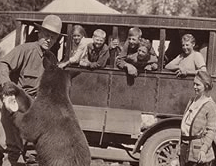
    At times, the bears get so bold that they take to making inroads on the kitchen. One completely terrorized a Chinese cook. It would drive him off and then feast upon whatever was left behind. When a bear begins to act in this way or to show surliness it is sometimes necessary to shoot it. Other bears are tamed until they will feed out of the hand, and will come at once if called. Not only have some of the soldiers and scouts tamed bears in this fashion, but occasionally a chambermaid or waiter girl at one of the hotels has thus developed a bear as a pet.

    The accompanying photographs not only show bears very close up, with men standing by within a few yards of them, but they also show one bear being fed from the piazza by a cook, and another standing beside a particular friend, a chambermaid in one of the hotels. In these photographs, it will be seen that some are grizzlies and some black bears.

    This whole episode of bear life in the Yellowstone is so extraordinary that it will be well worthwhile for any man who has the right powers and enough time, to make a complete study of the life and history of the Yellowstone bears. Indeed, nothing better could be done by some one of our outdoor faunal naturalists than to spend at least a year in the Yellowstone, and to study the life habits of all the wild creatures therein. A man able to do this, and to write down accurately and interestingly what he had seen, would make a contribution of permanent value to our nature literature with their majestic beauty all unmarred.

    ∞§∞

    — Excerpt from Theodore Roosevelt, “Wilderness Reserves,” Pages 23-51 in George Bird Grinnell (ed), American Big Game in Its Haunts. Harper: New York, 1914.

    — Detail from Google Images Photo.

    — You also might enjoy

    — To find more stories about bears, click on “Bears” under the “Categories” button to the left.
  • A Tale: Grub Pile, Preparing a Camp Supper — Ingersoll, 1880

    Most journals by early Yellowstone travelers provide descriptions of the sights: geysers, canyons, falls and wildlife, but only a few tell about ordinary activities like preparing food. Ernest Ingersoll, who explored the West in 1874 and 77 with Yellowstone surveyor F.V. Hayden, wrote about such things. In the late nineteenth century, Ingersoll became a famous naturalist, writer and lecturer. Here’s his account of an evening meal as it might have been prepared in the park in 1880.

    ∞§∞

    The place for the camp having been indicated, the riding animals are hastily unsaddled, and then every one turns to help unpack and place the cargo in orderly array. The very first mule unloaded is the staid veteran distinguished by the honor of bearing the cuisine. The shovel and axe having been released from their lashings, the cook seizes them, and hurriedly digs a trench, in which he starts his fire. While it is kindling, he and anybody else whose hands are free cut or pluck up fuel.

    We are so stiff sometimes from our eight or ten hours in the saddle that we can hardly move our legs; but it is no time to lie down. Hobbling round after wood and water limbers us up a little, and hastens the preparation of dinner, that blessed goal of all our present hopes.

    If a stream that holds out any promise is near, the rod is brought into requisition at once; and, if all goes well, by the time the cook is ready for them, there are enough fish for the crowd. Flies, as a general thing, are rather a delusion to the angler than a snare for the fish. The accepted bait is the grasshopper, except when there are great numbers of this insect, in which case the fish are all so well fed that they will not bite.

    We used to keep our eyes open all day, and pounce upon every grasshopper we could find, saving them for the evenings fishing. The usual catch was salmon trout—great two and three-pounders, gleaming, speckled, and inside golden pink, that sunset color called salmon. They were not gamy, though, and we were glad of it, since the object was not sport, but the despised pot. It really was more exciting to capture the lively bait than it was to hook the trout.

    But all this happens while the cook gets his fire well a-going. That accomplished, and two square bars of three-quarters inch iron laid across the trench, affording a firm resting place for the kettles, the stove is complete. He sets a pail of water on to heat, jams his bake-oven well into the coals on one side, buries the cover of it in the other side of the fire, and gets out his long knife. Going to the cargo, he takes a side of bacon out of its gunny-bag, and cuts as many slices as he needs, saving the rind to grease his oven.

    Then he is ready to make his bread. Flour is more portable than pilot biscuit; therefore warm, light bread, freshly made morning and night, has gratefully succeeded hardtack in all mining and mountain camps. Sometimes a large tin pan is carried, in which to mould the bread; but often a square half-yard of canvas kept for the purpose, and laid in a depression in the ground, forms a sufficiently good bowl, and takes up next to none of the precious room.

    When a bread-pan is taken it is lashed bottom up on top of the kitchen-mules pack. If it breaks loose and slips down on his rump, or dangles against his hocks, there is likely to be some fun; and when a sudden squall sweeps down from the high mountains, and the hailstones beat a devils tattoo on that hollow pan, the mule under it goes utterly crazy. The canvas bread-pan is therefore preferred. Sometimes even this is dispensed with, and the bread is mixed up with water right in the top of the flour-bag, and is molded on the cover of a box or some other smooth surface. Baking powder, not yeast, is used, of course.

    Sometimes the cook used the Dutch oven which every one knows, a shallow iron pot, with a close fitting iron cover upon which you can pile a great thickness of coals, or can build a miniature fire. Having greased the inside of the oven with a bacon rind, bread bakes quickly and safely.

    A better article, however, results from another method. Mold your bread well, lay the round loaf in the skillet and hold it over the fire, turning the loaf occasionally, until it is somewhat stiff; then take it out, prop it upright before the coals with the help of a twig, and turn it frequently. It is soon done through and through, and on both sides alike

    The table furniture, and a large portion of the small groceries, such as salt, pepper, mustard, etc., are carried in two red boxes, each two and a half feet long, one and a half feet broad, and a foot high. Each box is covered by a thin board, which sets in flush with the top of the box, and also by two others hinged together and to the edge of the box.

    Having got his bread a-baking, the cook sets the two boxes a little way apart, unfolds the double covers backward until they rest against each other, letting the ends be supported on a couple of stakes driven into the ground, and over the whole spreads an enameled cloth. He thus has a table two and a half feet high, one and a half feet wide and six feet long.

    Tin and iron ware chiefly constitute the table furniture, so that, as frequently happens, the mule may roll a hundred feet or so down the mountain and not break the dishes. His table set, John returns to his fire, and very soon salutes our happy ears with his stentorian voice in lieu of gong: Grub P-i-i-i-le!

    ∞§∞

    — Excerpt abridged from Ernest Ingersoll, “Rocky Mountain Cookery,” Scribner’s Monthly 29(1)125-132 (May 1880).

    — Illustration from Ingersoll’s book, Knocking Around the Rockies. Harpers: New York, 1882.

  • An Event & A Tale: A Book Signing at Old Faithful Inn and a 1912 Ballgame

    I’ll return to the lobby of Old Faithful Inn on Saturday and Sunday (August 20 and 21) to sign copies of my book Adventures in Yellowstone: Early Travelers Tell Their Tales. It’s a great venue and I always have fun there.
    The Inn probably is the most impressive man-made feature in Yellowtone Park and has been a favorite of visitors since it was finished in 1904, even those who were staying in other accommodations. Below is a description of the Inn by a man who was touring “The Wylie Way,” that is, spending his nights in tents put up for the season. Wylie Way tents weren’t as plush as the park hotels, but they had wooden floors and wood stoves to keep them warm.

    Employees of the park concessioners called both hotel guests and Wylie Way tourists “Dudes.” That distinguished them from “Sagebrushers,” people who had their own transportation and horses. Here the story of a baseball game between hotel and Wylie Way Dudes.

    ∞§∞

    We can’t sit and watch Old Faithful forever, so we step over to Old Faithful Inn and inspect that property. This is indeed a wonderful building, rustic throughout, with a chimney that must be at least fifteen feet square at the base. It runs up through the building and out the roof and has an enormous old-fashioned fireplace on each of the four sides. When we see the log fire sending out its cheerful warmth and glow, and the mammoth pans of hot popcorn passing around, and which we sample generously, it suddenly occurs to us that this is a “pretty happy world” after all.

    Right here I am reminded of the ball game that occurred directly in front of Old Faithful Inn the next afternoon. One team was made up from the “dudes” stopping at the Inn and the other from the “dudes” that were going the “Wylie Way.” Both teams played good ball in spite of the stiff wind that was blowing, but the Inn “dudes” were a little better than their opponents, the score being somewhere in the neighborhood of 8 to 5. The feature of the game proved to be the first-class, all round rooting of the Wylie drivers who, forty strong, were massed back of third base and cheered every good play made by their men, and kicked at every decision that went against them.

    ∞§∞

    — Excerpt from Fred W. Ellsworth, “Though Yellowstone Park with the American Institute of Banking.” Moody’s Magazine: The National Investors Monthly, November 1912, 14(5)369-375.

    — Photo, Coppermine Photo Gallery.

    — You can read other descriptions of Old Faithful Inn and my book signings there here, here, and here.


  • An Event: I Had Fun Signing Books at Old Faithful Inn

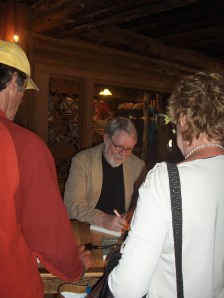
    “He seems to really enjoy being here.” I overheard that comment about myself last weekend from a hotel employee as I signed copies of my book, Adventures In Yellowstone, in the lobby of Old Faithful Inn. That never occurred to me before, but it’s true. I do enjoy meeting people and talking about early travel to Yellowstone Park. When I’m lucky, I also get to add a flamboyant signature to a newly purchased book.

    I sit at a table near the clock that indicates the next time the geyser will play so people see me when they come in to get that information. Most people just look at the predicted time and check their watches to see how long they’ll have to wait. If they have time, some people will stop to chat.

    “Are you the author?” is the most common question.

    At first I explained that the book is a collection of the writings by other people so actually I’m the editor or compiler. But that was too much information, so soon I began to just say, “Yes I am,” and smile. Sometimes I add, “I can prove it,” and hold up the book showing the page with a photo of me. People chuckle at that and agree it’s me.

    “It’s a collection of a dozen stories of early travel to Yellowstone Park in the words of the people who lived the adventures,” I add to guide attention back to the book.

    If people keep listening, I say, “It starts with fur trapper’s story about battling Blackfeet Indians in 1839 and ends in 1904 with a man telling about touring the park in a coach and staying in world-class hotels—like Old Faithful Inn.”

    When they ask about my favorite story, I tell them about Eleanor Corthell taking her seven children to the park from Laramie, Wyoming in 1902. That was a twelve-hundred-mile round trip, I add. The conversation might amble anywhere after that.

    The crowd pulses every 90 minutes in counterpoint to the eruptions of Old Faithful. Right after the geyser plays, the lobby fills with people marveling at the 500-ton stone fireplace and the eight-story tall log room. It’s hard to talk to people when the room is full, but the crowd soon disperses to the souvenir shop, restrooms, and parking lot, so there’s space around the table to talk. That’s prime book selling time.

    The crowd thins and soon the lobby is nearly empty. Then new people start arriving to check the time of the next eruption. While they wait, sometimes I can strike up a conversation. If a book sale results, that’s fine. But if it just gives me a chance to chat with people from all over the world, that’s fine too.

    I really do enjoy it. I’ll be back on August 20 and 21.

    ∞§∞

    — Photo by my author support system, Tamara Miller.

    — You might enjoy reading a description of Old Faithful Inn.