Category: Uncategorized

  • A Tale: Fishing the Once Barren Firehole River — 1897

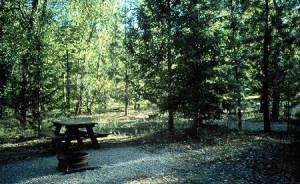
    Fly Fishing on the Firehole River

    Early travelers assumed  the reason that some lakes and streams in Yellowstone Park were barren of fish because of hot water and chemicals from springs and geysers, but systematic studies indicated that the problem was physical barriers like water falls. In 1889 officials initiated a program of stocking fish and proved the studies were right.

     By the late 1890s, when Frank B. King and his friend hauled their fly rods and creels through the park, the once barren rivers and lakes were teeming with fish. King has been traveling through the park for several days before he arrived at the Firehole River and finally got an opportunity to test the famous fishing waters of Yellowstone Park. Here’s his story of what happened then.

    ∞§∞

    When we reached the Park, every one told us we could catch fish anywhere and everywhere, but still those rods remained under the seat, and as the days passed by, we wished we could tell some of those people what we thought of them. When we looked into the hot springs, we saw no signs of fish, and in the geysers the finny tribe was missing.

    Still we went bravely on, now and then casting a longing glance at the rods, and hoping, at least, that we might some day find some place where we could take them out of their cases and look at them, if nothing more.

    As we turned our backs upon Old Faithful and his companions that afternoon, and drove down the Firehole River toward the Fountain House, the shadows were just commencing to lengthen. Through the pines, I could catch here and there tantalizing glimpses of the river as it ran along between its meadowy banks. Now and then, it formed rapids which ran into beautiful pools and then out again into long, open riffles. Here, there would be a log extending out into the water, at the end of which I could see a tempting eddy from which I was almost sure I could coax a “big one.” Next, there would be a long bend with a riffle above and below it. In those riffles, I could imagine I saw several “beauties” waiting for a fly to drop upon the water that they might jump at it.

    Well, I stood all this just as long as I could. I was going to get out my rod and make a try, even if I failed. My companion was a little, in fact, very sleepy, and did not care whether there were fish or no fish; what he had his mind on was that long, quiet nap he was to have when he reached the hotel. By promising him that I would only make a few casts, and that he could sleep in the surrey while I tried my luck, he consented to wait just a minute or two.

    I pulled on some overalls, a fishing-coat, a pair of “gums;” set up my pet rod; tried the reel to see if it still knew its song; ran the line through the guides; tied on a leader; picked a brown hackle, a royal coachman, and a black gnat, out of my book; and sallied down to the river. Before me was a beautiful pool, one of those long, deep ones with just enough current running through it to make the flies work well.

    I crept up as close to the pool as I dared, took the rod in my right hand, and made a long, pretty cast out past the middle of the pool. The flies had no sooner straightened out than there was a break in the water and a streak of gold and black passed over the end hackle and into the water. He had missed it; but he was a beauty. I felt like letting out an Indian whoop—there was a fish in the river anyway, I had seen him. The next thing to do was to catch him.

    I was all of a tremble, for if ever I wanted a fish in my life, I wanted that one, if for nothing more than to give me some cause for yelling to my sleepy companion to bring down the landing-net. Once more I drew back and made a long cast, but the flies struck a little too far up stream and had to travel with the current a little distance.

    No sooner were they over the spot where I had had the first rise than, zip, something struck the end fly and started up stream, making the line hum through the water and the reel spin. I did not think, as some people tell, that I had a whale or an elephant, I knew what it was—it was a good big trout. There is only one thing that acts the way this something on the end of my line did, and that is a gamy trout.

    He ran up stream until the current and strain of the rod was too much, and then he left the water. You can imagine the way he left the water. You know the way a big trout acts. Well, he acted as they all do. When he was back in the water, he started down stream, and when he reached the end of the pool, he broke again and then came toward me and then away from me.

    By this time, the first rush was over and I let out a long, deep yell for my sleepy friend. As soon as he heard that yell, he knew just what was up, and he came down that hill with the landing-net in his hand just as fast as a man who was not a bit sleepy. His first words were:

    “What have you got? How big is he?”

    After a little sulking, a few dashes, and a break or two, came the fight around the landing net, and at last I had him kicking in the grass on the bank. He was a beauty! A Loch Leven that measured nearly twenty inches and weighed over two pounds and a half. As he lay there in the grass, his yellow stripe and red spots upon the black made a very pretty picture. He was a beauty, and he was ours.

    Thoughts of a nap left the mind of my companion, and fishing was declared the order of the day. He soon had his “Leonard” set up, and before many minutes had a mate to mine bending it almost double. I never saw any one wake up so quickly in my life. He never had a thought of sleep the rest of the afternoon. The fact was, he did not have time for such thoughts, the fish kept him too busy.

    From the time I hooked my first fish up to a little while before dark, we had the finest fishing I ever heard of. When I say it was the finest fishing I ever heard of, I mean it, and I have heard some very tall fish stories. We fished side by side all afternoon and one was working with fish all the time, and part of the time both of us had our hands full.

    We lost the biggest one we had hooked, of course; one always does. When we left the stream, we had twenty-two fish that would average over two pounds apiece. Some were Rainbows; some were Loch Levens; some were Cutthroats, and they were all beauties, every one of them a work of art. I never hope to catch such a gamy, beautiful mess of trout again. Such fishing one only has once in a lifetime.

    ∞§∞

    — Frank B. King, “In Nature’s Laboratory: Driving and Fishing in Yellowstone Park.” Overland Monthly, 29(174)594-603  (June 1897).

    — Wikipedia photo.

    — To see more stories about fishing in Yellowstone Park, choose “Fishing” under the categories button on the right side of this page.
  • A Tale: Buffalo Poacher Provokes a Law That Snares Him — 1894

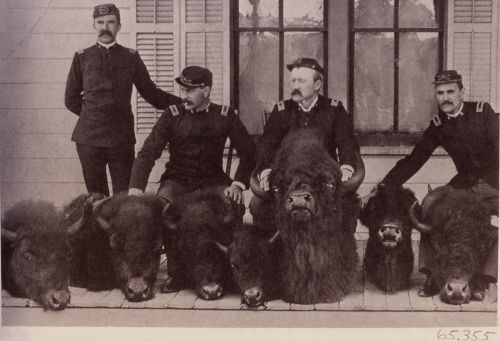
    Buffalo Heads from a Poacher’s Cache

    When the U.S. Army took over administration of Yellowstone Park in 1886, one of it’s primary missions was prevention of the poaching that was decimating the wildlife. The soldiers worked hard to stop illegal hunting, but they lacked authority to anything other than apprehend poachers, escort them out of the Park and order them never to come back. Persistent poachers ignored the orders.

    Finally, in 1894, a poacher was so brazen that he generated public attention and forced Congress to act. Here’s the Park Superintendent’s account of how Ed Howell’s poaching career ended.

    ∞§∞

    Sometime in February I sent a scouting party across the Yellowstone and into the Pelican Valley to look alter the herds of buffalo and elk that usually winter there. On the return of this party they reported to me that they had found an old snowshoe and toboggan trail, but that they were unable to follow it. It apparently headed in the direction of Cooke City.

    While this party was still out, word came to me that Ed Howell, a notorious poacher of Cooke City, had passed the Soda Butte Station one stormy night and had gone on into Cooke for supplies, but that he had not carried any of his trophies with him. A few days after this the sergeant in charge of the Soda Butte Station reported the finding of a trail of this same party with his toboggan and followed it as far as the Park line.

    I then determined on a plan which resulted in the capture of Howell. I waited until I thought it was about time for him to be back in the Pelican country, and then sent out a large search party, with Captain Scott in charge. This party arrived at the Lake Hotel on the evening of March 11. Next day Burgess and Sergeant Troike of the Sixth Cavalry went over into the country previously indicated by me, and made their camp.

    On the morning of the 13th, very soon after starting, they came across some old snowshoe tracks which they could scarcely follow, but by continuing in the direction of them they soon came across a cache of six bison scalps suspended above the ground, in the limbs of a tree.

    Securing these trophies, the party continued on down Astringent Creek to its mouth and then turned down the Pelican. They soon came across a newly-erected lodge, with evidences of occupation, and numerous snowshoe tracks in the vicinity.

    Soon after this they were attracted by the sight of a man pursuing a herd of bison in the valley below them, followed by several shots from a rifle. After completing the killing, the culprit was seen to proceed with the removal of the scalps.

    While thus occupied with the first one my scouting party ran upon him and made the capture. It turned out, as I had anticipated, to be Howell, who coolly remarked that if be had seen the party sooner they could never have captured him, meaning, of course, that he could have shot them before they were near enough to make effective the small pistol, which was the only weapon they carried. They brought him into this place as a prisoner, reaching here on the evening of the 16th of March.

    I at once made full report of the affair and it was widely noted in the newspapers of the country. A suitable recognition, in the way ot a certificate, was made of the coolness and bravery of Burgess and Troike. The scalps, as far as they could be saved, were brought in and properly prepared by a competent taxidermist and placed at the disposal of the Department.

    The feeling aroused in the minds of the public by this act of vandalism stirred Congress to prompt action, so that on May 7 an act for the protection of game in the Park received the President’s signature. In order that it may receive wider distribution, I inclose a copy to be printed with this report.

    Howell denied having killed any bison but those found near him, but I feel sure that he did kill the six found in the cache, and it is quite probable that he killed others which we did not find. In one seuse it was the most fortunate thing that ever happened to the Park, for it was surely the means of securing a law so much needed aud so long striven for.

    On April 25 Howell was released from confinement in the guardhouse by your order aud removed from the Park, and directed never again to return without proper permission. On the evening of July 28 I found him coolly sitting in the barber’s chair in the hotel at this point. I instantly arrested him and reconfined him in the guardhouse, had him reported to the U. S. attorney for this district, and on the evening of August 8 he received the first conviction under the law which he was instrumental in having passed. He was convicted before the ITS. commissioner of returning after expulsion, in violation of the tenth oi the Park regulations, and sentenced to confinement for one month and to a fine of 850.

    With this conviction as a precedent and a strong determination to make other arrests under the new law whenever it is violated, I believe the days of poaching in the Park are nearly at an end.

    ∞§∞

    — Captain George S. Anderson,  Acting Superintendent of Yellowstone Park, Report of the Superintendent of Yellowstone National Park, 1895-1896.

    — Photo, Pioneer Museum of Bozeman.

  • On Writing: Narrative History Requires More Than Getting the Facts Right

    I just finished an article for The Pioneer Museum Quarterly on Fred Bottler, a pioneer rancher in the Yellowstone River’s Paradise Valley north of Yellowstone National Park. Bottler built the first ranch in the valley halfway between Bozeman and Mammoth Hot Springs. That made it an ideal stopping point for early expeditions exploring the park so dozens of park journals and reminiscences mention Bottler’s ranch.

    Gustavus Doane

    Bottler knew the Yellowstone Park area well because he had prospected for gold in there 1860s. That made him an ideal guide, and he accompanied several people who visited the upper Yellowstone in the 1870s.

    My article provides Bottler’s biographical information and recounts stories about him. One of those stories, told by Bottler’s son, Floyd, concerns a pair of needle guns, which were an early type of repeating rifle.

    Floyd said his father won the guns in a card game with soldiers at Fort Ellis, an army post near Bozeman. Although Bottler knew the guns technically were government property, he thought they would be handy if Indians attacked his isolated ranch. He decided to keep them.

    An officer at Fort Ellis, Lieutenant Gustavus Doane (who had a remarkable moustache), heard that Bottler had the guns and decided to retrieve them. Floyd said that when Doane arrived at Bottler’s house, the rancher invited him in and seated him where he could see the guns hanging on a wall.

    Floyd said Doane would look at the guns, then look at Fred, and then back at the guns. Finally, Doane told Bottler that a man living on the edge of Indian country needed such guns and he could keep them—but only if he kept them out of sight when he visited the fort.

    Then, Floyd said, “Their eyes met again and held for a long moment. Then both men rose and the hands met in a strong clasp”

    I couldn’t resist quoting that directly in my article. But when I asked Ann Butterfield, the Pioneer Museum Associate Director, to read a draft of my article, she objected.  She said she liked what I had written, except for that “gazed into each other’s eyes” stuff. “Men just don’t act that way,” she added with a scoff.

    I immediately checked my source and confirmed that I had quoted Floyd accurately. I assured Ann of that, but she was’t really  mollified. That made me think.

    It’s my job to present old stories for today’s readers. I want people to read straight through my stuff and say: “That’s interesting.” I don’t want them stop and say: “This just doesn’t sound right”—even if it is right.

    I also like to quote exactly what people wrote because their word choices make personalities and emotions shine through. It’s always a balancing act to decide when modern sensibilities might collide with old fashioned ways of saying things.

    When I turned in final draft of my article, it didn’t contain the “gazed into each others eyes” quote. Writing narrative history is not just about getting the facts right; it’s also about getting the reader’s experience right. If it distracts, it’s got to go.

    The Pioneer Museum Quarterly will publish my article on Fred Bottler in a few weeks.  I’ll let you know when it’s available.  Then you can decide if I made the right choice.

    ∞§∞

    — Photo detail from the Yellowstone Digital Slide File.

    — You can read an excerpt from my article on Fred Bottler here.

    — To see related posts, click on “Narrative History” under the Categories Button on the right side of this page.
  • An Event: Presenting at Beavertail Hill Park Was Great Fun


    After my wife, Tam, and I arrived at Beavertail Hill State Park on Friday, we chose a campsite and began setting up. Then something clicked inside our RV and all the doors locked tight. We were left outside with only the clothes on our backs and the stuff in our pockets.

    Fortunately, the stuff in my pockets included my cell phone and my Triple A Card. After the panic surge subsided, we called for service. We were only thirty miles south of Missoula so help should have arrived in plenty of time for me to review my notes and prepare for my presentation at 8 p.m., an hour ahead.

    After half an hour dragged by, I asked Tam to bring my notebook of “Sidesaddles and Geysers” stories as soon as she got into the RV. Then I headed to the amphitheater. I explained the situation to the park rangers and assured them that I could ad lib an hour presentation if I had to. I really do think I could do that, but it would be like a high wire act without a net. Probably everything will be fine—but what if you fall?

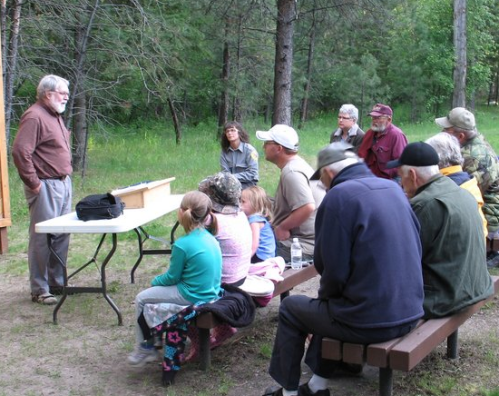
    The park rangers kindly put back the start of the program for ten minutes—to allow for stragglers, they said. I was grateful for the delay. At 8:10, a ranger introduced me. As I stepped forward, a breeze began blowing out of the nearby trees and cold air penetrated my lightweight summer shirt. I stuck my hands in my pockets and began to speak.

    My presentation was part of a series on Women in Montana History so I decided to tell a little more  than I usually do about the women whose stories I read. I thought people might be interested in hearing about how pioneer women came to Montana.

    There were three girls, about seven or eight years old, sitting in the front row and I asked them to help. “Every time I mention a new woman,” I said, “You ask: ‘How did SHE get to Montana?’” The girls agreed to help.

    Then I said I was going to start with stories my grandmother used to tell about her trip to Yellowstone Park in 1909. Then I paused. The girls giggled and yelled: “How did she get to Montana?”

    I explained that Grandma was the only woman I was going to talk about who was born in Montana. Then I launched into her stories about cooking  bread in a hot spring, dyeing geysers by tossing red long johns in them and the handkerchief pool.

    Next I said I was going to tell stories about Emma Stone, who was the first white woman to make a full tour of the park in 1872. Then I paused—and waited. Members of the audience prompted the girls who then yelled, “Oh yeah! How did she get to Montana?”

    So it went for the rest of the evening. I would name another Yellowstone pioneer woman and pause. Other audience members would remind the girls of their job and they would giggle and yell.  Everybody enjoyed the game.

    Emma Stone came to Montana up the Missouri River on a steamboat. Emma’s niece, who chronicled that trip, told about how three large families who shared a small stateroom slept in shifts and about the day they saw Indians driving a herd of buffalo into the river. Young Emma said her uncle shot a buffalo and dragged it aboard so they could have fresh meat.

    About then, Tam arrived with my notebook. Perfect timing. My grandmother and Emma Stone didn’t leave written accounts of their adventures, so I have to ad lib them anyway. But I like to read the stories of people who left journals or reminiscences. Their adventures and personalities shine through the words they wrote.

    The sun was slipping behind the trees and I was starting to shiver, so I asked Tam to bring me a sweater. (She’s always my best audience member and I hated to see her miss my presentation, but I was grateful that I have what she calls “an author support system.”)

    Next I told about Sarah Tracy. Like Emma Stone, Sarah Tracy came to Montana on a steamboat up the Missouri, but she was a new bride so she didn’t have to share a stateroom. In her reminiscence about her trip to Yellowstone Park in 1874, Sarah told about the cavalry that escorted her stagecoach from Bozeman to the Paradise Valley, the terrifying ride over the crude new road through Yankee Jim Canyon, and cooking doughnuts in bear grease.

    I finished with Emma Cowan, who came to Montana as a 10-year-old girl in 1864. Emma said she loved the gypsy life of traveling across the prairie in a covered wagon. I usually read Emma’s gripping description of being taken captive  by Indians in Yellowstone Park in 1877. That’s the year the Army chased the Nez Perce through Yellowstone Park after the bloody Big Hole Battle.

    For a change, I decided to read from my next book, Encounters in Yellowstone that describes what happened when Yellowstone tourists and the Indians collided. The section I read is about the unbelievable ride Emma made to be by her husband’s side. As soon as Emma heard that her husband had survived being shot three times and left for dead, she drove 175 miles in 31 hours by team and wagon to the place where he was waiting.

    The audience greeting the end of my reading with silence—which I’ve decided to take as a good sign.  When announced that I had finished my presentation, they applauded vigorously.

    I hung around for a few minutes to sell and sign copies of my book, Adventures in Yellowstone. Then I went back to the unlocked RV where the author support system fixed a hot supper.

    ∞§∞

    — Photo by Vernon Carroll, Montana Department of Fish, Wildlife and Parks.

  • An Event: Win An Autographed Copy of Adventures in Yellowstone

    I need your help. I’ve been working on my presentation of  “Sidesaddles and Geysers: Women’s Adventures in Early Yellowstone  that will be at Beavertail Hill State Park southeast of Missoula this Friday at 8 p.m.  It’s part of a 12-week series at the park on Women in Montana History.

    Beaver Tail Hill State Park, Montana

    The event, which is sponsored by the Humanities Montana Speakers Bureau, has a standing title, but I always  tailor what I say to the occasion. That gives me a reason to review my files and keeps things fresh in case somebody has a chance to hear me twice.

    Here’s how you can help—and win an autographed copy of my book, Adventures in Yellowstone: Early Travelers Tell Their Tales.

    • Click on the “Categories” button on the right side of this page and choose “Women Stories.”
    • Review stories listed (you’ll have to click the “older posts” button at the bottom of the list to see all 16 of them.)
    • In the comments section below list the four stories that you think will make the best presentation.
    Because time is short, the deadling will be Thursday, June 16, 5 p.m. (MDT)

    I’ll choose a winner from the submissions based on the following criteria:

    • Appropriateness to the audience (families of campers and vactioners) and setting (outdoors in a state park).
    • Appropriateness to the topic, “Montana Women’s History.”
    • Variety (adventure, humor, time period, etc.)
    The winner will receive an autographed copy of my book with any dedication they want.  In case of a tie, the earliest submission will win.  Or if I’m in a good mood, there’ll be more than one winner.

    Enter and many times as you want!

    Tell your friends!  Have fun!

    And if you happen to be in the area on Friday stop by for my free presentation.  I’d love to see you!
    ∞§∞
    — Photo from the Montana Department of Fish, Wildlife and Parks.
  • A Tale: A Woman’s Trout Fishing In Yellowstone Park — 1897

    Early explorers discovered many stretches of water in Yellowstone Park were devoid of fish. At first people thought the problem was caused by hot water and chemicals from geysers and hot springs, but soon they discovered that the problem was obstructions like waterfalls.

    Efforts to stock the barren waters with exotic fish caused ecological problems that officials are still trying to fix, but they also resulted in an anglers’ paradise. Soon people from all over the world were coming Yellowstone Park to fish and reporting phenominal catches. Here’s one woman’s story about fishing a once barren stretch of the Firehole River.
    ∞§∞

    In 1888 the United States Fish Commission stocked the Fire Hole with many varieties of trout. They are still uneducated, eager for the fly; a number six or eight gray professor or brown Montreal proved the most killing. The father of all the Pacific trout, the blackspotted or “cut-throat” (Salmo mykiss), with the scarlet splotch on his lower jaw, was most in evidence. With long, symmetrical body and graduated black spots on his burnished sides, he is a brave, dashing fighter, often leaping salmon-like many times from the water before he can be brought to creel. We found him feeding in the open riffs, or rising on the clear surface of some sunlit pool. “The pleasantest angling is to see the fish cut with her golden oars the silver stream.”

    Our dainty Eastern trout, with brilliant red spots and short, thick-set body, had hardly become accustomed to the change from grass-edged streams and sheltered pools, to the fierce struggle for existence in this fire-bound river. The glint of his white-edged fins betrayed him swaying in the eddies at the foot of some big rock or hidden in the shade of an overhanging bank, thereby offering a direct contrast to his more aggressive Western cousin.

    The California rainbow trout proved true to his reputation, as absolutely eccentric and uncertain, sometimes greedily taking a fly, and again refusing to be tempted by the most brilliant array of a carefully stocked book. During several days’ fishing we landed some small ones, none weighing over two pounds, although they are said to have outstripped the other varieties in rapidity of growth, and tales were told of four-pounders landed by more favored anglers.

    A heavy splash, a ray of silvery light, and with lengthened line the fly was carefully dropped on the surface of a swirling pool, edged with water-plants and tangled grasses, where the current had gullied out deep holes around the big boulders; a rise, a strike—now for a fight.

    Long dashes down stream taxed my unsteady footing; the sharp click and whirr of the reel resounded in desperate efforts to hold him somewhat in check; another headlong dash, then a vicious bulldog shake of the head as he sawed back and forth across the rocks. Every wile inherited from generations of wily ancestors was tried until, in a moment of exhaustion, the net was slipped under him. Wading ashore with my prize, I had barely time to notice his size—a good four-pounder, and unusual markings, large yellow spots encircled by black, with great brilliancy of iridescent color—when back he flopped into the water and was gone. However, I took afterward several of the same variety, known in the Park as the Von Baer trout, and which I have since found to be the Salmo fario, the veritable trout of Izaak Walton.

    So, on down the stream, careful placing of the fly and changing of the feathers brought different varieties to the surface. One other fish proved a complete surprise. He was of silvery gray color, covered with small black crescents. Some of the Park fishermen called him a Norwegian trout; others, the Loch Leven. Any country might be proud to claim him, with his harmonious proportions, game fighting qualities and endurance.

    As the river had worn a pathway around the formation much too deep for wading, I climbed around the edge, past its heated springs and over its mosaic paving, and was seldom disappointed in coaxing a rise where the hot sulphur-tainted streams dripped into the water of the Fire Hole.

    When my creel became uncomfortably heavy, and square spotted tails began to overlap its edge, I waded ashore to look at my catch. Fortunately my boots were heavy, for the bank was honeycombed with miniature geysers and mud-pots, bubbling and sputtering in wicked imitation of their bigger sisters. My last captive being still on my line, I swung it from the river into a geyser cone. Unprepared for the temperature, my return cast brought out only a hook with skull and backbone attached; the flesh had instantlv boiled off.

    Surfeited with success, I unjointed my much tried and highly prized Mitchell rod, a veritable Japanese jinjutsu, ” to conquer by yielding,” among fly-rods. It can never more be duplicated, now that the master who engrafted his love of stream, of woods, of trout, into the rod he fashioned, has passed from sight around the bend of life’s stream, beyond which we cannot follow him.

    ∞§∞

    — Excerpt from Mary T. Townsend, ‘A Woman’s Trout Fishing In Yellowstone Park.’Outing: An Illustrated Magazine of Sport, Travel and Recreation 30:165-177  (1897)

    — Image detail from the same source.

    — For more stories about fishing in Yellowstone Park, click on “fishing” under the “Categories” button on the right.

  • A Tale: Osborne Russell Tangles With Blackfeet — 1839

    Few of the Mountain Men who scoured the Rocky Mountains looking for beaver had the skill or inclination to write about their experiences. A conspicuous exception is Osborne Russell who trapped in Yellowstone Park in the late 1830’s.

    He also described some thrilling adventures. Here’s one of them.

    ∞§∞

    The Trapper’s Last Shot

    We encamped on the Yellowstone in the big plain below the lake. The next day we went to the lake and set our traps on a branch running into it near the outlet on the northeast side. After setting my traps I returned to the Camp.

    The day being very warm, I took a bath in the lake for probably half an hour and returned to camp about 4 o’clock After eating a few minutes, I arose and kindled a fire, filled my tobacco pipe and sat down to smoke. My comrade whose name was White was still sleeping. Presently I cast my eyes towards the horses, which were feeding in the Valley and discovered the heads of some Indians gliding round within 30 steps of me.

    I jumped to my rifle and aroused White while looking towards my powder horn and bullet pouch. They were already in the hands of an Indian and we were completely surrounded. We cocked our rifles and started through their ranks into the woods, which seemed to be completely filled with Blackfeet who rent the air with their horrid yells.

    On presenting our rifles they opened a space about 20 feet wide through which we plunged. About the fourth jump an arrow struck White on the right hip joint. I hastily told him to pull it out. As I spoke another arrow struck me in the same place, but the arrows did not retard our progress. At length another arrow striking through my right leg above the knee benumbed the flesh so that I fell with my breast across a log. The Indian who shot me was within eight feet and made a spring towards me with his uplifted battle-axe. I made a leap and avoided the blow and kept hopping from log to log through a shower of arrows that flew around us like hail.

    After we had passed them about ten paces we wheeled about and took aim at them. They then began to dodge behind the trees and shoot their guns. We then ran and hopped about fifty yards further in the logs and bushes and made a stand.

    I was very faint from the loss of blood and we set down among the logs determined to kill the two foremost when they came up and then die like men. We rested our rifles across a log—White aiming at the foremost and myself at the second. I whispered to him that when they turned their eyes toward us to pull trigger.

    About twenty of them passed by us within fifteen feet without casting a glance towards us another file came round on the opposite side within twenty or thirty paces closing with the first a few rods beyond us and all turning to the right. The next minute they were out of our sight among the bushes. They were all well armed with fusees, bows and battle-axes.

    We sat still until the rustling among the bushes had died away then arose after looking carefully around us. White asked in a whisper how far it was to the lake. I replied by pointing to the southeast about a quarter of a mile. I was nearly fainting from the loss of blood and the want of water.

    We hobbled along forty or fifty rods and I was obliged to sit down for a few minutes, then go a little further, and then rest again. We managed in this way until we reached the bank of the lake. Our next object was to obtain some of the water as the bank was very steep and high. White had been perfectly calm and deliberate, but now his conversation became wild hurried.  Despairing, he observed, “I cannot go down to that water for I am wounded all over—I shall die.” I told him to sit down while I crawled down and brought some in my hat. This I effected with a great deal of difficulty.

    We then hobbled along the border of the Lake for a mile and a half when it grew dark and we stopped. We could still hear the shouting of the savages over their booty. We stopped under a large pine near the lake and I told White I could go no further

    “Oh” said he, “let us go up into the pines and find a spring,” I replied there was no spring within a mile of us, which I knew to be a fact.

    “Well,” said he, “if you stop here I shall make a fire.”

    “ Make as much as you please,” I replied angrily; “this is a poor time now to undertake to frighten me into measures.” I then started to the water crawling on my hands and one knee and returned in about an hour with some in my hat.

    While I was at this he had kindled a small fire and taking a draught of water from the hat he exclaimed, “Oh dear we shall die here, we shall never get out of these mountains.”

    “Well,” said I, “if you persist in thinking so you will die but I can crawl from this place upon my hands and one knee and kill two or three elk and make a shelter of the skins, dry the meat until we get able to travel.” In this manner I persuaded him that we were not in half so bad a situation as we might be although he was not in half so bad a situation as I expected.

    On examining I found only a slight wound from an arrow on his hip bone, but he was not so much to blame as he was a young man who had been brought up in Missouri, the pet of the family and had never done or learned much of anything but horseracing and gambling whilst under the care of his parents (if care it can be called).

    I pulled off an old piece of a coat made of blanket (as he was entirely without clothing except his hat and shirt)—set myself in a leaning position against a tree ever and anon gathering such leaves and rubbish as I could reach without altering the position of my body to keep up a little fire in this manner miserably spent the night.

    It was now ninety miles to Fort Hall and we expected to see little or no game on the route, but we determined to travel it in three days. We lay down and shivered with the cold till daylight then arose and again pursued our journey towards the fork of Snake river where we arrived sun about an hour high forded the river which was nearly swimming and encamped. The weather being very cold and fording the river so late at night caused me much suffering during the night. September 4th we were on our way at daybreak and traveled all day through the high Sage and sand down Snake River. We stopped at dark nearly worn out with fatigue hunger and want of sleep as we had now traveled sixty-five in two days without eating. We sat and hovered over a small fire until another day appeared then set out as usual and traveled to within about 10 of the Fort when I was seized with a cramp in my wounded leg which compelled me to stop and sit down every thirty or forty rods. At length we discovered a half breed encamped in the valley who furnished us with horses and went with us to the fort where we arrived about sun an hour high being naked hungry wounded sleepy and fatigued. Here again I entered a trading post after being defeated by the Indians but the treatment was quite different from that which I had received at Laramie’s fork in 1837 when I had been defeated by the Crows.

    The Fort was in charge of Mr. Courtney M. Walker who had been lately employed by the Hudsons Bay Company for that purpose He invited us into a room and ordered supper to be prepared immediately. Likewise such articles of clothing and Blankets as we called for.

    After dressing ourselves and giving a brief history of our defeat and sufferings supper was brought in consisting of tea, cakes, buttermilk, dried meat, etc. I ate very sparingly as I had been three days fasting but drank so much strong tea that it kept me awake till after midnight. I continued to bathe my leg in warm salt water and applied a salve, which healed it in a very short time so that in ten days I was again setting traps for Beaver.

     ∞§∞

    — Adapted from Journal of a Trapper [1834-1843] by Osborne Russell.

    — Detail from a Library of Congress Image.

    — You can read more by Osborn Russell in my book, Adventures in Yellowstone.

    — You might also enjoy these tales by Mountain Men:

  • Adventures in Yellowstone Crackes Top One Percent on Amazon

    I admit it. I regularly check the sales rank of my book, Adventures in Yellowstone: Early Travelers Tell Their Tales, on Amazon.Com. It’s like buying a lottery ticket. I know the odds against making the bestseller list are colossal, but it feeds my dreams.

    During the winter months when Yellowstone Park was buried under 20-foot snowdrifts, my sales rank bounced around between a hundred thousand and a million. I know that doesn’t sound impressive, but you should recall that there are about six million titles available on Amazon so that’s well within the top twenty percent.
    Over the past few weeks, snow began melting, the Park officially opened for the 2011 season, and the sales rank for Adventures regularly topped one hundred thousand, or, as I like to think of it, the top five percent. Then, for at least a few minutes this afternoon—TA DAH—my book ranked in at thirty-five thousand, well inside the top one percent.

    There are two kinds of people who should read Adventures in Yellowstone this summer.  First are those who plan a Yellowstone Park vacation. Nothing enhances the Yellowstone experience like a little knowledge. You’ll feel smart when you cross Dunraven Pass knowing that it was named for an Irish nobleman who visited Yellowstone twice in the 1870s.

    When somebody asks, “Who was that guy who was lost for a month in the park,” you’ll be able to answer, “That was Truman Everts; he survived for thirty-seven days by eating thistle roots.”

    When you pass by Nez Perce Creek and people say, “I thought Indians were afraid to come here because of the geysers,” you can tell them, “Oh no, early travelers did indeed tangle with Indians here; in fact,the Nez Perce held a women named Emma Cowan captive for two days in 1877.”

    The other kind of people you should read Adventures are those who aren’t planning a Yellowstone vacation. That’s because everybody likes an exciting adventure story like Henry “Bird” Calfee’s tale about saving his friend who fell into a geyser, or Carrie Strahorn’s rush to safety after being caught in a snowstorm. And everybody likes a funny story like the one Eleanor Corthell told about when she left her husband at home, bought a horse and wagon, and took their seven children to the park.

    So if you’re planning a vacation in Yellowstone Park this summer (or know someone who is), then you should buy a copy of Adventures in Yellowstone. And if you’re just looking for summer reading filled with adventure and fun, then you too should buy a copy.

    And remember, it’s also available for Kindle.

    Ask for it from your favorite bookseller.  Or order it on-line.

    And tell your friends.

    ∞§∞

  • On Writing: Cubism, Narrative History and the Nez Perce

    While organizing research notes for my next book, Encounters in Yellowstone 1877, it occurred to me that my task is akin that of the Cubist painters.  A hundred years ago artists including Pablo Picasso, George Braque and Juan Gris invented Cubism. They looked at objects from multiple viewpoints, analyzed each viewpoint, and then reassembled them into a single composition. That’s like what I’m doing.

    "Three Musicians," Pablo Picasso

    I’ve collected numerous pieces about the events of the summer of 1877 when the Nez Perce Indians encountered several groups of tourists while fleeing from the Army through Yellowstone Park.  Those pieces contain distinct—even disparate—viewpoints. Here are some of them:

    • Yellow Wolf, a young Nez Perce brave who felt justified in seeking revenge on all whites following the Army’s pre-dawn attack on the sleeping Indian camp that left dozens of women and children dead.
    • Emma Cowan, a young wife fulfilling her dream of visiting “geyserland” who spoke sympathetically of the plight of the Nez Perce in her reminiscence even after Indians left her husband for dead after shooting him in the head and then took her captive.
    • Jack Bean, an old Indian fighter who had been with the troops that buried the mutilated bodies of Custer and his men after the Battle of the Little Big Horn and had no qualms about scalping Indians.
    • General Oliver Otis Howard, an evangelical Christian and Civil War hero, who led his exhausted troops across Yellowstone Park after several humiliating skirmishes with the Nez Perce.

    My job is to analyze the accounts of these people—and of dozens of others—and sift out the truth. Then I’ll try to put the whole thing together in a coherent whole. To do that, I’ll need to look for places where the various viewpoints converge and diverge, overlap and separate, compliment and contradict.

    Like a Cubist painting, the final narrative won’t always arrange things in the way that people are used to seeing them, but I hope it will be compelling and enlightening.  I’m enjoying the challenge.

    ∞§∞

     — Image, Metropolitan Museum of Modern Art.

    — To see related posts, click on “Narrative History” under the Categories Button on  this page.

  • A Tale: Skiing with Theodore Roosevelt in Yellowstone Park — 1903

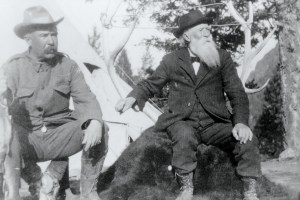
    In 1903 President Theodore Roosevelt invited John Burroughs to join him on a two-week trip to Yellowstone National Park. At the time, Burroughs was a very popular writer whose nature essays were compared to those of Henry David Thoreau.

    Theodore Roosevelt and John Burroughs

    Roosevelt and Burroughs had built a long-term friendship on their mutual respect and love of the nature. They corresponded regularly, mostly about natural history. For some reason the president called Burroughs “Oom John.”

    The pair crossed the country in Roosevelt’s private Pullman car stopping at cities and towns where the president met local dignitaries and gave speeches. Between cities the president reminisced about his life as a rancher and sportsman.

    When they reached the entrance of the park at Gardiner, the Roosevelt left reporters and his secret service guards behind and went through the park accompanied only by Burroughs, Park Superintendent John Pitcher and a small entourage. 

    The 65-year-old Burroughs was afraid he wouldn’t be able the keep up with the 44-year-old president who had a larger-than-life reputation for physical stamina. Here’s Burroughs’ description of what happened when the pair went skiing.

    ∞§∞

    At the Canyon Hotel the snow was very deep, and had become so soft from the warmth of the earth beneath, as well as from the sun above, that we could only reach the brink of the Canyon on skis. The President and Major Pitcher had used skis before, but I had not, and, starting out without the customary pole, I soon came to grief. The snow gave way beneath me, and I was soon in an awkward predicament. The more I struggled, the lower my head and shoulders went, till only my heels, strapped to those long timbers, protruded above the snow. To reverse my position was impossible till some one came, and reached me the end of a pole, and pulled me upright. But I very soon got the hang of the things, and the President and I quickly left the superintendent behind. I think I could have passed the President, but my manners forbade. He was heavier than I was, and broke in more. When one of his feet would go down half a yard or more, I noted with admiration the skilled diplomacy he displayed in extricating it. The tendency of my skis was all the time to diverge, and each to go off at an acute angle to my main course, and I had constantly to be on the alert to check this tendency.

    Paths had been shoveled for us along the brink of the Canyon, so that we got the usual views from the different points. The Canyon was nearly free from snow, and was a grand spectacle, by far the grandest to be seen in the Park. The President told us that once, when pressed for meat, while returning through here from one of his hunting trips, he had made his way down to the river that we saw rushing along beneath us, and had caught some trout for dinner. Necessity alone could induce him to fish.

    Across the head of the Falls there was a bridge of snow and ice, upon which we were told that the coyotes passed. As the season progressed, there would come a day when the bridge would not be safe. It would be interesting to know if the coyotes knew when this time arrived.

    The only live thing we saw in the Canyon was an osprey perched upon a rock opposite us.

    Near the falls of the Yellowstone, as at other places we had visited, a squad of soldiers had their winter quarters. The President always called on them, looked over the books they had to read, examined their housekeeping arrangements, and conversed freely with them.

    In front of the hotel were some low hills separated by gentle valleys. At the President’s suggestion, he and I raced on our skis down those inclines. We had only to stand up straight, and let gravity do the rest. As we were going swiftly down the side of one of the hills, I saw out of the corner of my eye the President taking a header into the snow. The snow had given way beneath him, and nothing could save him from taking the plunge. I don’t know whether I called out, or only thought, something about the downfall of the administration. At any rate, the administration was down, and pretty well buried, but it was quickly on its feet again, shaking off the snow with a boy’s laughter. I kept straight on, and very soon the laugh was on me, for the treacherous snow sank beneath me, and I took a header, too.

    “Who is laughing now, Oom John?” called out the President.

    The spirit of the boy was in the air that day about the Canyon of the Yellowstone, and the biggest boy of us all was President Roosevelt.

    ∞§∞

    — You also might enjoy “The Army Protects Theodore Roosevelt from Snooping Reporter in Yellowstone Park.”

    — Excerpt from “Camping with the President” by John Burroughs,” Saturday Evening Post, May, 1906.

    — Yellowstone Digital Slide File Photo.