Category: Uncategorized

  • Narrative History or Historical Fiction 3: A Moonlit Night In Yellowstone Park, August 23, 1877.

    “Should I approach it as narrative history or as historical fiction?” That question haunted me this week as I continued research for my next book, Encounters in Yellowstone 1877. I’ve written about it before, here and here.

    Great Fountain Geyser

    To write the kind of story readers want, I need to include details that bring the story to life and give it credibility. That’s true no matter how I approach the book, but there’s more flexibility in fiction.

    A crucial scene in the book occurs on August 23, 1877, the night before Nez Perce Indians take Mrs. Emma Cowan captive along with her brother, Frank, and their 13-year-old sister, Ida. Earlier that afternoon, the tourists learned that the Nez Perce had fought a bloody battle with the Army two weeks before and were headed toward the park. In her reminiscence about the trip, Emma admited the news worried her.

    In his book about the trip, Frank said, “Mrs. Cowan was uneasy, and upon being asked what was wrong, replied ‘nothing.’” Frank said that later he saw Emma come to the door of the tent she shared with her husband and Ida and look out several times. Emma’s repeatedly peering out of the tent is a good example of the adage, “actions speak louder than words.”

    I was reminded of Jerrie Hurd’s admonition to write slow scenes fast and fast scenes slow. Jerrie says “when you get to the action, slow down, take your time, fill-in as much detail as possible allowing the reader to savor every moment of what’s happening.”

    There’s no doubt that Emma was worried, but what did she see? If I knew that, I could heighten the drama, but neither Emma nor Frank described the scene and there are no other accounts by members of their party.

    What to do? I saw three options: (1) write historical fiction and invent a plausible scene, (2) write up what I already knew as narrative history and hope that my readers will forgive the lack of detail, or (3) do more research to flesh things out. I chose option 3.

    I knew that the tourists were camped in the trees near the Fountain Geyser, which is at the edge of the Lower Geyser Basin in Yellowstone Park, so the first thing I did was a web search for images of the area. I found several photos like the one above that show several geysers spewing columns of water and steam in the middle of a chalky plain surrounded by pine forest. (I plan to visit the site this summer to get more detail.)

    Then I reviewed Emma and Frank’s accounts of the evening. After deciding to head home the next day, the group put on a sort of minstrel show to celebrate. They built a bonfire and spent the evening singing and dancing. Then the bachelors in the group curled up in their blankets under the trees while Emma, her husband and Ida retired to their tent.

    Next, I looked for journals of travelers who were nearby that night. One of them was Jack Bean of Bozeman, a scout the Army hired to find the Nez Perce. Bean was on a hillside about 30 miles from Emma’s camp watching the Nez Perce arrive at Henry’s Lake. Bean didn’t comment on the weather, but apparently had no difficulty seeing the Indians’ campfires four miles away across the lake.

    Another Scout, S.G. Fisher, who had been hired in Idaho, was 10 miles closer than Bean in Targhee Pass. Fisher had heard about a Nez Perce camp ahead of him and was planning to attack it with his force of 80 Bannack Indians. Fisher said he approached the camp cautiously because “the moon was shining brightly.” Fisher found the Nez Perce had moved on—and I found an important snippet of information—it was a moonlit night.

    With the new information from my research, I feel confident that I can write compelling description of Emma’s behavior—one that sticks close enough to the facts to qualify as narrative history. It probably will go something like this:

    Emma didn’t fall asleep quickly that night. Instead, she repeatedly came to the door of the tent she shared with her husband and sister and peered out. Perhaps she was just checking to make sure the bonfire her friends had built to celebrate their impending departure from Yellowstone hadn’t spread.

    Perhaps she was hoping to see Fountain Geyser play one more time. The bright moonlight reflected off the surrounding chalky ground would have made that a beautiful sight.

    Most likely, she was worried about encountering Nez Perce on the trip home. Emma couldn’t have known that Yellow Wolf and his band of Nez Perce scouts had seen the bonfire and were planning to attack the camp the next morning.

    I’m glad I kept researching. I’m sticking with narrative history.

    ∞§∞

    You also might enjoy:

    — To see related posts, click on “Narrative History” under the Categories Button on the right side of this page.

    — Image detail from Coppermine Gallery Photo.
  • An Event: Sidesaddles and Geysers Set for June 17 at Beavertail Hill

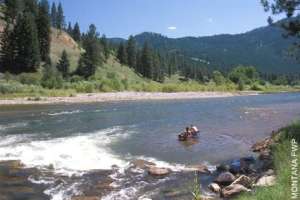
    I’ll be presenting my Humanities Montana Program, “Sidesaddles and Geysers: Women’s Adventures in Early Yellowstone” on June 17 at 8 p.m. at Beavertail Hill State Park. which is 26 miles southeast of Missoula off Interstate 90.

    Beavertail Hill State Park

    The presentation will be part of a 12-week series on Women in Montana History. I always tailor my talks to my audience, so I’ll focus on Big Sky Country pioneers who began visiting Yellowstone Park when it was still a roadless wilderness.

    Fortunately, my collection of first-person accounts of early travel to the park includes lots of good material on the topic.  That includes several items posted on this blog:

    So if you’re in the Missoula area on June 17, come out an see me.
    ∞§∞
    — Montana Fish Wildlife and Parks Photo.
  • News & Views: Visitors “Outrageously” Close to Old Faithful

    Visitors Near Old Faithful, April 2011

    A front-page article in the Bozeman Daily Chronicle reported this morning that a group of tourists had been caught on video standing within a few feet of the famous Old Faithful Geyser. Chronicle Staff Writer Daniel Person reported: “The outrageous incident was captured by a webcam that broadcast live footage of Old Faithful and is unlike anything park officials have seen in recent times.”

    Explorers Near Old Faithful, August 1871

    I was struck by the similarity between the new picture and famed Yellowstone Photographer William Henry Jackson’s 1871 photo of Old Faithful. Jackson’s photo shows members of the government sponsored Hayden Expedition standing closer to the geyser than did the 2011 visitors.  Certainly, Jackson’s photo, which is thought to be the first taken of the famous geyser,  doesn’t document “outrageous” behavior. It shows that over the last 140 years people have learned how to protect themselves and the wonders of Yellowstone.

    My collections of first-person accounts of early travel to Yellowstone Park includes reports of all kinds of things that would be considered outrageous today like gathering mineral specimens by the wagon load, hunting bald eagles for sport, and dumping rubble in Old Faithful just to see what would happen.

    We can be glad that such activities are now considered to be outrageous.

    ∞§∞

    — Color photo, frame capture from NPS live website camera at Old Faithful.

    — William Henry Jackson photo, Yellowstone Digital Slide File.

    — You might also enjoy these stories:

  • A Tale: Saving a Scalded Man — c. 1872

    After the Washburn Expedition got home in 1870, the news stimulated enormous excitement in Montana. Bozeman artist and photographer Henry “Bird” Calfee and his friend, Macon Josey, decided to see the wonders. 

    Henry "Bird" Calfee

    Calfee’s account of their trip was found at the Pioneer Museum of Bozeman in a clipping from an unidentified newspaper, which apparently was published about than twenty years after the trip. Calfee said the trip took place in 1871, but that must be in error because he recounts things that didn’t occur until 1872—like an encounter with the notorious Harlow gang of horse thieves. 

    Calfee was so impressed with the park that he returned often, and eventually started a business selling Yellowstone photographs. Here’s an excerpt from his reminiscence that tells about Josey falling in a geyser, an incident I fictionalized in my middle-grade novel, Macon’s Perfect Shot.

    ∞§∞

    While out exploring and gathering specimens on a tributary of the Firehole River we scared a dear out of a small bunch of timber. In its frightened condition, it attempted to bound over a large open geyser that was in its line of retreat. Failing to land with its hind feet on the farther edge of the formation, it fell backwards into the boiling caldron. We hastened to its rescue and attempted to raise it out by thrusting a long pole under its belly. The formation gave way with us, my companion going down with it into the horrible seething pool. I narrowly escaped by falling backward into the solid formation.

    I assisted my companion it quickly as possible, but in one half minute he was scalded from his waist down. He was so a badly scalded that when I pulled his boots and socks off the flesh rolled off with them. I managed to get him back to camp and put what little remaining flour we had on his raw and bleeding burns.

    I began immediately making preparations for an early start the next morning for the settlement on the Madison River below. I expected to reach them in two days, but so slow was our progress that we were scarcely out of sight of the lower geyser basin at the end of that time. I hastily constructed a travois after the Indian style, in which Josey could ride.

    I then went up to the old Faithful geyser to whom we had delivered our washing the morning before. I found it all nicely washed and lying on his pearly pavement ready for delivery. Our linen and cotton garments, which had been stiff and black with dirt, lay there as white as the driven snow, and our woolen clothes were as clean as could be. But oh my, imagine them in that mammoth unpatented washing machine boiling for one solid hour and then imagine my one hundred and sixty-five pound carcass inside of a suit of underwear scarcely large enough for a ten-year-old boy. I said to Old Faithful, you are a mighty good laundryman but you will not do up my flannels any more. I went back to camp regretting that we couldn’t stay in this vicinity long enough to patronize him again.

    Early next morning I got up and got breakfast, which was not a very laborious job as it consisted of elk, straight. I saddled and packed up got Josey into his travois and started down the river reluctantly leaving behind us the world’s most marvelous wonders, many of which were yet to be won by human eye. I here resolved to return as soon as circumstances would permit.

    We were all day getting into the lower geyser basin, all of ten miles. We camped near the Fountain geyser and as we were leaving next morning it began spouting. Josey asked me to lead his horse around where he could have a good view of the eruption that continued at least a half hour. Josey declared he could have lain there all day, suffering as he was, and watch such displays of natural magnificence and grandeur. I doubt whether distress and pain could relieve him of all desire for such displays of natural beauty. We bade goodbye to the fountain, started on our journey.

    The next day we traveled along at a better speed. That afternoon we passed through the portals of that picturesque valley of the Madison and shook hands with a hardy pioneer, George Lyon, whose latch string hung outside of his dirt covered mansion. As we rode up he stood in his yard with his ax in his had silently gazing, full of wonder and amazement at the appearance of such a looking caravan.

    Josey perched on his eminence with his head bundled up for protection from mosquitoes with his legs crossed resembling an Arab more than a geyser crippled shoemaker. And I, with my geyser done up clothes, presented a spectacle, which Lyon had never seen before.

    We were welcomed, thrice welcomed, to the hospitalities of our host and we were soon off our horses and at home. About the first thing I did was to introduce Josey to a cake of soap and a trough of water, after which there was little resemblance to the man that started out with me in the spring to explore the wonders of Yellowstone.

    Our landlord soon spread out a bountiful supper—the best that a bachelor’s culinary affords. After supper we sat around his open fireplace and narrated for the first time our perilous adventures. He listened attentively to all we said and pronounced us lucky to be alive.

    ∞§∞

    — Abridged from “Calfee’s Adventures” by Henry “Bird” Calfee. Clipping of unknown origin, Pioneer Museum, Bozeman.

    — Photo, Yellowstone Digital Slide File.

    — You might enjoy Frank Carpenter’s story of doing laundry in a geyser in “Angering Old Faithful.”

    — You can read more about Calfee’s adventures in my book, Adventures in Yellowstone.

  • A Tale: Rumors of Wonders on the Upper Yellowstone — New York Times 1867

    Thumb Paint Pots

    After the Montana gold rush of 1863, groups of prospectors began scouring the area that became Yellowstone Park for gold. Occasionally their reports appeared in territorial newspapers. According to conventional wisdom, however, newspapers in the states (as opposed the the territories) were always skepical about reports of wonders on the upper Yellowstone until the famous of Washburn Expedition of 1870. This report from the September 14, 1867, issue of The New York Times proves that wasn’t always the case, although the reports of “blue flame” and “molten brimstone” don’t match any known features of the area today and show that some skepticism was in order.

    ∞§∞

    The Montana Post says that an exploring party, which has been to the headwaters of the Yellowstone River, has just returned and reports seeing one of the greatest wonders of the world. For eight days, the party traveled through a country emitting blue flame and a living stream of molten brimstone. The country was smooth and rolling, a long level plain intervening between roiling mounds. On the summits of the roiling mounds were craters for 4 to 6 inches in diameter, from which streamed a blaze and constant whistling sound. The hollow ground resounded beneath our feet as they traveled and every moment seemed to break through. Not a living thing was seen in the vicinity. The explorers gave it the significant appellation of hell.

    ∞§∞

    — New York Times, September 14, 1867, page 1.

    — Ashahel Curtis Postcard, Copperplate Photo Gallery

  • News: I Had a Great Time at Country Bookshelf

    It was a gorgeous spring evening when I parked my car in a city lot last night and headed to Country Bookshelf on Main Street. Although my inner cynic reminded me that we will probably get more snow in Bozeman, I couldn’t help being buoyed by the warm evening.

    When I arrived at the store, I was pleased to see a window display promoting my talk. A large poster announced that a discussion of the 2010 Montana Book Award by Bozeman author and member of the selection committee—me. The latest winner and the four honor books were displayed conspicuously. That—along with the nice advertisement in this morning’s newspaper—will surely draw an audience, I thought.

    When I stepped inside, the clerk greeted me with a smile. (They always greet you with a smile at Country Bookshelf.) There was another poster beside the cash register.

    We chatted amiably. Then I explained that I was planning to do brief readings from each of the books, so I needed a few minutes to mark the spots I had chosen with post-it notes. Then I made my way to the mezzanine where there was another display of the MBA winners.

    I was finding the selected spots in the books, when an acquaintance came in and began asking questions. I answered as well as I could while searching the books.

    When the appointed hour arrived, only three people were there and that included the storeowner and a clerk. As I was deciding what to do, a woman arrived and hope flickered for a moment.

    With such a small group, we re-arranged the chairs. I abandoned the lectern, sat by the book display, and we began. It was magic. I had everything I needed: a topic I love (good books) and an attentive (albeit small) audience.

    I outlined the history of the Montana Book Award and described how it works. (I’ve blogged about that here.) Then I launched into a discussion of each of the books. I said that reviewers usually neglect books’ connections to Montana history and culture and tried to correct that. I described their literary merits in terms of research, writing, and ability to engage readers. And I read short excerpts.

    Here’s a list of titles with links to reviews I posted earlier:

    I paused now and then to answer questions and let the presentation amble wherever the audience wanted to take it. All too soon, it was done. I read a short excerpt from my book, Adventures in Yellowstone, and signed copies to leave at the store.

    I am grateful to the owner of Country Bookshelf, Ariana Paliobagis, and her staff. They did everything they could to make the evening a success—and it was, at least for me.

    I only wish I had drawn a larger audience of book lovers—and book buyers. I hope you’ll do yourself a favor by rushing to Country Bookshelf and buying Montana Book Award winners. The store and the books deserve your support.

    ∞§∞

  • News: Montana Book Awards Presentations Were Fun

    Ruth McLaughlin, Don Flores, Barbara Theroux (MBA organizer), Susan Resnick

    It’s good to be home after an intense few days of Montana Book Awards events in Billings at the combined Montana Library Association/Mountain Plains Library Association meeting. I had a great time.

    On Wednesday evening I “opened out of town” with my talk on the MBA Book Awards at Hastings Book Store in Billings. I’m sure the warm up will help me do a better job when reprise the talk at the Bozeman’s Country Bookshelf on Tuesday at 7 p.m. Here’s the announcement of the Bozeman event.

    More important, I got to meet three of the winning authors at the MBA presentation ceremony on Thursday. It’s always fun to compare notes with fellow writers.

    I had a long chat with Ruth McLaughlin, who won the 2010 award for her marvelous book, Bound Like Grass. We compared notes on growing up on Montana ranches, she on the east side of our vast state, I on the west side. Our biographies have some interesting parallels in addition to growing up rural in the 50s and 60s. We both used the University of Montana as our escape route to the larger world; we knew some of the same professors, and—most important—we met our spouses there.  My wife, Tam, and her husband, Mike, were classmates at Great Falls High School and they seemed to enjoy reminiscing.

    I also discovered a small connection with Dan Flores, who wrote the MBA Honor Book, Visions of the Big Sky. It’s a beautiful book with 140 plates representing art portraying the Northern Rockies.  All the MBA judges reported the same reaction when they first saw it: “Oh no! Now I’ve got to read a coffee table book.”  But they hastened to add that when they began to read it they got hooked on Dan’s erudite and expansive essays.

    I asked Dan how he happened to write it. He told me that he used to write a column for The Big Sky Journal called “Images of the West” and the book is largely a compilation of those pieces.  Dan stopped being a regular columnist for the magazine, but the editor decided to retain the column title.  I wrote an article under the label entitled “Entrepreneurs on the Edges of Yellowstone.”

    Susan Kushner Resnick came to Billings all the way from Boston to accept an Honor Book designation for Goodbye Wifes and Daughters, a marvelous account of the mine disaster that killed nearly 80 men at Bear Creek, Montana, in 1943.  I wish I had found more time to talk to her about weaving together disparate strands of research into a compelling narrative. I’m sure she could have offered me some good tips on how to approach my next book, Encounters in Yellowstone.

    I’m sorry I didn’t get a chance to meet Kevin Canty, who won an Honor Book designation for Everything: A Novel.  Kevin’s car broke down in Bozeman and he didn’t make it to the ceremony.  I would have loved to talk to him about how he makes writing about running water and jumping fish come to life.

    We also didn’t hear from Nathaniel Philbrick, who won an Honor Book designation for his book The Last Stand: Custer, Sitting Bull and the Battle of the Little Big Horn.  I’m sure he’s hunkered down somewhere working through piles of books and papers doing research for his next book.

    ∞§∞

    — Photo by Mike McLaughlin

  • Listening to some of Montana’s Best Writers with Librarians

    I just got back from Author Series: A Literary Potpourri, a set of presentations by Montana authors at the joint meeting of the Montana Library Association and the Mountain Plains Library Associations in Billings.

    If anyone needed a reminder that the Montana literary scene has deep roots in every corner of the state, this was it. The quality and scope of the presentations was tremendous.

    My good friend, Billings author Craig Lancaster led off with a reading from his 2009 Montana Book Award honor book, 600 Hours of Edward. Craig read a hilarious section from the book where Edward, who has Aspersers Syndrome, obsessively contemplates the possibility of having sex on a first date he has finally arranged. (It’s okay to call it hilarious; Craig said the audience laughed in all the right places). Craig also read a scene from his new book, Summer Son, where the main character, Mitch Quillen, tries to figure out why his father keeps telephoning but refuses to talk.

    Ruth McLaughlin, who now lives in Great Falls, read from the 2010 Montana Book Award winner, Bound Like Grass, a memoir about her growing up on a ranch in Eastern Montana. She read a section called “Hunger” that sweeps across three generations of hardscrabble existence including tales of her father fainting from hunger in school, her parents feeding their family bologna while saving grass fed beef for sale, and her own gorging on ice cream when she escaped to Missoula for college. I can’t overstate the admiration I have for Ruth’s ability to blend such disparate tales into a seamless whole.

    Montana Poet Laureate Henry Real Bird read new work from typescript he held in hands, selections from his book, Horse Tracks, and recited other poems from memory. Henry’s mesmerizing recitations would have been hard to tell from his afterwords if he didn’t end with the phrase “and that’s how that one goes.” He was born and raised on the Crow Reservation and still speaks Crow as his primary language and his poetry springs from deep roots.

    Outdoor and western writer Dan Aadland, like Real Bird, is a rancher who raises horses and writes, but his writing has the crisp precision you’d expect from person who holds a doctoral degree. That’s not to say Aadland’s writing isn’t personal and compelling—it is. He read from his book, Montana Hunter’s Journey, which chronicles his quest to learn about Theodore Roosevelt by riding through and hunting in the same land the great President visited.

    In a few minutes, I’ll make my way over to the library at Montana State University—Billings, to take part in the Montana Book Award presentation ceremony. I get to present an original piece by Montana artist Dana Boussard to the 2010 MBA Winner, Ruth McLaughlin. I’m thrilled!

    ∞§∞

  • We Are All Heros in the Stories We Tell About Ourselves

    A few days ago, I posted Andrew Weikert’s story about his first encounter with the Nez Perce in Yellowstone Park. It drew a lot of attention and this comment from Danny O’Keefe:

    Methinks Mr. Weikert may have been a bit prone to exaggeration judging by the litheness expressed about being able to bound into the saddle. I also doubt the Nez Perce were such poor shots. Other, more sober and historical, reports indicate they were highly accurate. Imagine the state of mind of a people on the run and fearing oblivion. The decency they exhibited in most instances stands in contrast to the treatment they received.

    I began to respond to Danny, but soon discovered I had so much to say that I flooded the reply box. I decided to gather my thoughts and use them for a blog post.

    The most important thing to say is that I agree with Danny’s statement about the Nez Perce: “The decency they exhibited in most cases stands in contrast to the treatment they received.” That’s the consensus now and everything I see in the historical record supports it. But the phrase “in most cases” is important.

    Overall, the Nez Perce behaved in an honorable fashion, but the historic record is mixed. Emma Cowan, who was taken captive by the Nez Perce, said this: “they were kind to us, a handful of the hated oppressors. Think of it, you who assume to be civilized people! Less than ten days had elapsed since the Big Hole fight in Montana, in which women and children, as well as warriors, were killed by the score. A number, badly wounded, were in camp while we were there. Yet were we treated kindly, given food and horses, and sent to our homes.”

    On the other hand, a party of Nez Perce scouts did indeed attack the camp where Weikert and Wilkie’s friends were hiding, and later Indians shot an unarmed music teacher dead when he stepped into view at a cabin door.

    We’re all heroes in the stories we tell about ourselves, so I don’t doubt that Weikert embellished his recollections. But it’s certain that the Nez Perce attacked him and his friends. He had the dead bodies to prove it.

    I don’t know where Danny gets the ideas about Weikert’s “litheness expressed about being able to bound into the saddle.” Weikert clearly said, “I was riding ahead when I saw them [the Indians].” He was already mounted and quickly hunched over to make a smaller target. Doubtless, the Nez Perce were fine shots, but it’s very difficult to shoot a man on a moving horse. The best evidence that Nez Perce weren’t the sharpshooters Danny says they were is that Weikert and Wilkie both lived.

    I’m still working my way through the mountains of material that have been written about the flight of the Nez Perce and I could already write thousands of words about such things as the failure of whites to understand their culture, writer’s motivations to portray them either as “Red Devils” or “Noble Savages,” and why the events of the summer of 1877 led to alternating periods of peace and violence. But I’ll save those explanations for my book.

    The items I put on my blog are stories, not historical documents. I collect, edit and post them in hopes that readers will find them interesting and fun.

    I am a storyteller, not a historian. I choose well told accounts that describe interesting experiences. I don’t fret over their literal truth. No doubt, many stories contain exaggerations and embellishments. When I think stories contain outright fabrications, I provide caveats. But I trust my readers to take things with the proverbial “grain of salt.”

    My sincere thanks to Danny for his comment. It forced me to think through a lot of important issues—far more than I could discuss here. That will make this blog—and all my work—better.

    ∞§∞

  • A Tale: The Facts Are Tangled, But The Stagecoach Robbery Stories Are Fun

    When I got to the Pioneer Museum on Friday for my afternoon of volunteer work, Associate Director Ann Butterfield told me, “I found something that might interest you.” After a few minutes of her muttering “now where did I see that thing,” she pulled out a file folder entitled “QK Club.” QK stands for “quest for knowledge.” The club began in Bozeman in the 1920s and still meets monthly.

    At its meetings, members present learned papers and other members offer critiques on topics ranging from the death of Montana pioneer John Bozeman to the future of nuclear power. The paper Ann handed me contained a marvelous descriptions of stagecoach robberies in Yellowstone National Park.

    It was written by Jefferson Jones, long time publisher of The Bozeman Daily Chronicle, who was critiquing a paper entitled “Road Agents of Early Yellowstone National Park” by the famous Yellowstone photographer, Jack E. Haynes. In it, Jones quoted an interview with Lester Piersdorff, a Bozeman pioneer who claimed to be a witness to “the holdup of the park stages on October 14, 1897.” Piersdorff, who was in his 80s at the time of the interview, also said he knew about a stagecoach robbery in the 1880s, a that Haynes apparently hadn’t heard of.

    The first thing I did was dig through the collection of QK Club papers held at the Pioneer Museum to look for the Haynes paper. Supposedly, it was presented on October 21, 1952, and the Museum’s collection begins with 1956, so I decided to look for it later in the more extensive collection at Montana State University.

    The Museum has an index of QK Club papers that runs back to 1923, so I decided to look there. Not only did the index fail to list a paper by Jack E. Haynes, it didn’t even show a meeting on October 21, 1952.

    Next, I decided to check the Museum’s vertical files to see if there was a folder on Piersdorff, who sounded like a very colorful character. I went through the file drawers asking myself “was that ‘I’ before ‘E’ or ‘E’ before ‘I.’”I checked both spellings and was getting ready to give up when I saw a file labeled “Pierstorff,” with a “T.”  I pulled it out and there was a photo of “Lester Pierstorf” peering out from under a hat with a pipe protruding from his walrus mustache. It was a great picture, so I checked the Museum’s photo archive for it—no luck!

    Another clipping in the folder had a headline “Masked Bandits Loot 19 Stages; Lester Piersdorff Driver of One.” This time the spelling went back to “Piersdorff” with a “d,” but said he was a driver in robberies in 1897, but didn’t mention the robbery in the 1880s that he described to  Jones. Also, the clipping (from an unnamed source) had a different date for the robbery. Jones said it happened on August 14, but the clipping said August 7.

    Tired of the contradictory evidence, I decided to look up stagecoach robberies in Aubrey Haines definitive history of Yellowstone Park, The Yellowstone Story. (That’s Haines, the historian, not to be confused with Haynes, the photographer.) Sure enough, historian Haines reports the story that Jones attributes to Piersdorff, but he introduces it this way, “The holdup incident spawned a legend. Jefferson Jones told it this way.” Then Haines offers the story in the identical words that Jones attributed to Piersdorff.

    After repeating the story, Haines says: “It is a beautiful little story, but there is no truth in it.” In a footnote he says, “Told to J.E. Haynes during a discussion of his article “Yellowstone’s Stage Holdups,” [probably by Jones].

    So for what it’s worth, here’s Piersdorff’s account of stagecoach holdup in the 1880s.

    ∞§∞

    The circumstances of the holdup, as I recall them, were somewhat as follows:

    Major McDougle, paymaster of the army in the park, traveling in an ambulance with a bodyguard of six soldiers rounded a turn in the road at Eagles Nest on the Gardner River to find himself confronted by nine mounted road agents, dressed in military uniform, carrying army carbines and their horses bore regulation army saddles and saddle bags.

    Until the command “Hands Up” was issued, Major McDougle though he was looking at a cavalry patrol out on a morning maneuver. With the McDougle party covered by rifles, one road agent dismounted and searched the group for rifles and revolvers, which he took from the men and heaved into the nearby Gardner River.

    He then went to work breaking open the army chest containing $40,000 in gold, all sacked. As the road agent lifted out a sack, he would place it in the saddlebag of one of his confederates. When the robbery was completed, the men saluted the Major and rode down the road toward Gardiner.

    The robbery created much talk at the time, but the men were never apprehended nor the money recovered.

    [Piersdorff then continue with corrections to things Jack Haynes had reported about the 1897 robberies.]

    Jack is in error in stating that only six stagecoaches of the Yellowstone Park Transportation Company were involved in the August 14, 1897, holdup. There were 15 stages in all. [Various accounts put the number of coaches robbed at 6, 15 and 19.] Jack mentions loot taken in that robbery was $400. Not counting the jewelry taken there was approximately $8,000 cash split by the two road agents from that holdup, as I shall tell you about.

    Passengers in the last stagecoach were never robbed and only half of the passengers in Steele’s stage were robbed because at that moment the two road agents spied a Corporal and soldier riding on the old freight road near Spring Creek not far distant and the road agents evidently decided to pull out.

    As Jack states in his paper, I happened to eat opposite Gus Smitzer and George Heeb at the employees’ mess at Canyon the night before the holdup. It was then that I first noted Heeb had a bad scar on his right hand between the thumb and first finger. I little realized at the time how important that scar was to loom in just 14 hours.

    When the following morning the holdup occurred on the Canyon-Norris road, I turned to my passenger in my stage and said: “There’s a holdup going on here and if you have any valuables you better pass them to me.” Purses, billfolds, watches and the like, were all handed to me and I shoved them under the driver’s seat in a water bucket.

    Shortly afterwards when a road agent, who proved to be Heeb, stood opposite us on a bank and shouted, “This is a holdup. Give me your valuables,” only some $15 in loose cash from the pockets of my passengers was handed down. The valuables in the water bucket were never touched.

    The bandit, who had sewed together flour sacks over his head, that extended down to his waist, though which his arms protruded and which had holes for the eyes, pointed his revolver at me with his announcement, “This is a holdup.”

    Being in a higher position on the driver’s seat of the stage than he was, I looked down at the gun. As Jack in his account states, the men had covered their hands with charcoal. I noticed that the right hand of the road agent, which held the revolver, had a scar between the thumb and first finger to which the charcoal had not adhered. I noticed, too, as the road agent held his gun up toward me that the trigger guard had a peculiar “S” mark inscribed on it. When Heeb was captured later, he was carrying a gun with an “S” on the trigger guard. Testimony regarding the scar on Heeb’s right hand and his revolver with the “S” marking I gave in court at the Cheyenne trial was part of the evidence that convicted him.

    ∞§∞

    — Story from the Pioneer Museum of Bozeman.

    — Image, Coppermine Photo Gallery.

    — You might also enjoy