Category: Washburn

  • “Treed by a Lion” by Truman Everts, 1870

    Reprise from 07/22/2010

    Probably the best known story of early travel to Yellowstone Park is Truman Everts’ account of being lost and alone there for 37 days. During the famous Washburn Expedition of 1870, Everts became separated from his companions as they made their way through heavy timber east of Lake Yellowstone. Everts was extremely nearsighted so he got off his horse to look for tracks. While he was scrutinizing a path, the horse ran away leaving him with little but the clothing on his back.

    Everts was a clever and tenacious man. He built a nest between two hot springs to survive a snow storm, made fire with the lens from an opera glass, and lived mostly on a diet of thistle roots.

    He told about his adventures in a magazine article that helped win support for creation of Yellowstone Park. Here’s one of them.

    ∞§∞

    I stretched myself under a tree, and fell asleep. How long I slept I know not but suddenly I was roused by a loud, shrill scream, like that of a human being in distress. There was no mistaking that fearful voice. It was the screech of a mountain lion, so alarmingly near as to cause every nerve to thrill with terror.

    The work of the moment was to yell in return—seize with convulsive grasp the limbs of the friendly tree—and swing myself into it. Scrambling hurriedly from limb to limb, I was soon as near the top as safety would permit.

    The savage beast was snuffing and growling below—on the very spot I had just abandoned. I answered every growl with a responsive scream. Terrified at the delay and pawing of the beast, I increased my voice to its utmost volume. I then broke branches from the limbs and madly hurled them at the spot from whence the howlings preceded.

    I failed to alarm the animal that now began to make the circuit of the tree—as if to select a spot for springing into it. With my strength increased by terror, I shook the slender trunk until every limb rustled. All in vain. The terrible creature pursued his walk around the tree—lashing the ground with his tail, and prolonging his howling almost to a roar.

    It was too dark to see, but the movements of the lion kept me apprised of its position. Whenever I heard it on one side of the tree, I speedily changed to the opposite—an exercise that I could only have performed under the impulse of terror. I would alternately sweat and thrill with horror at the thought of being torn to pieces—and devoured by this formidable monster. All my attempts to frighten it seemed unavailing.

    Disheartened at its persistency, and expecting at every moment that it would take the deadly leap. I tried to collect my thoughts, and prepare for the fatal encounter. Just at this moment it occurred to me that I would try silence.  Clasping the trunk of the tree with both arms, I sat perfectly still.

    The lion ranged around, occasionally snuffing and pausing—all the while filling the forest with the echo of his howling. Suddenly it imitated my example and fell silent. This was more terrible than the clatter and crash of his movements through the brushwood. Now I did not know from what direction to expect this attack. Moments passed with me like hours. After a lapse of time, which I cannot estimate, the beast gave a spring into the thicket and ran screaming into the forest. My deliverance was effected.

    Had strength permitted, I should have retained my perch till daylight. But with the consciousness of escape from the jaws of the ferocious brute came a sense of overpowering weakness. That made my descent from the tree both difficult and dangerous. Incredible as it may seem, I lay down in my old bed, and was soon lost in a slumber so profound that I did not awake until after daylight.

    ∞§∞

    • Excerpt and illustration from Truman Everts’ “Thirty-Seven Days of Peril,”  Scribner’s Monthly, 3(1):1-17  (November 1871).
    • For more stories about the Washburn Expedition, click on “Washburn” under the “Categories” button to the left.
    • This tale is available in my anthology, The Stories of Yellowstone, along with 71 other exciting and humorous stories.
    • You can read a compete version Evert’s story in my book, Adventures in Yellowstone.
  • “Shooting Jake Smith’s Hat” by N.P. Langford, 1877

    Reprise from 07/28/2010

    books
    N.P. Langford

    One of the members of the famous Washburn Expedition that explored  the uppper Yellowstone in 1870, a jocular man named Jake Smith, was always ready to gamble. Unfortunately, he lost all his money in a card game the night before the trip started. But Jake came up with a way to replenish his stake. N.P. Langford tells the story.

    ∞§∞

    Jake Smith

    Descending the range to the east, we reached Trail creek, a tributary of the Yellowstone about 3 o’clock in the afternoon, where we are now camped for the night. We are now fairly launched upon our expedition without the possibility of obtaining outside assistance in case we need it. Our safety will depend upon our vigilance. We are all well armed with long range repeating rifles and needle guns, though there are but few of our party who are experts at off-hand shooting with a revolver.

    In the course of our discussion Jake Smith expressed his doubt whether any member of our party is sufficiently skilled in the use of the revolver to hit an Indian at even a close range. He offered to put the matter to a test by setting up his hat at a distance of twenty yards for the boys to shoot at with their revolvers, without a rest, at twenty-five cents a shot.

    Several members of our party blazed away with indifferent success—with the result that Jake was adding to his exchequer without damage to his hat. I could not resist the inclination to quietly drop out of sight behind a clump of bushes. From my place of concealment I sent from my breech-loading Ballard repeating rifle four bullets in rapid succession, through the hat—badly riddling it.

    Jake inquired, “Whose revolver is it that makes that loud report?” He did not discover the true state of the case, but removed the target with the ready acknowledgment that there were members of our party whose aim with a revolver was more accurate than he had thought.

    ∞§∞

    • Excerpt from N.P. Langford, Diary of the Washburn Expedition to the Yellowstone and Firehole Rivers in the Year 1879. You can read a condensed version in my book, Adventures in Yellowstone.
    • N.P. Langford Photo from the book.  Jake Smith Photo,Yellowstone Digital Slide File.
    • You can read a condensed version of Langford’s The Discovery of Yellowstone Park in my book, Adventures in Yellowstone.
    • To see more stories by this author, click on “Langford” under the “Categories” button to the left.
    • For more stories about the Washburn Expedition, click on “Washburn” under the “Categories” button to the left.
  • When All the Fish Were Natives

    Yellowstone Lake, Thomas Moran.

    Just in case you missed it, I decided to post a link to my article, When All the Fish Were Natives, that was published in the 2012 Fly Fishing issue of The Big Sky Journal.

    Early travelers to the area that became Yellowstone National Park depended on the abundant fish in the Yellowstone River watershed to supplement their larders, but they often they went hungry after discovering other streams and lakes were barren. At first, people thought the strange distribution of fish was caused by chemical laden hot springs, but that proved to be wrong. The article describes how scientists unraveled the mystery.

    The article also tells about Cornelius Hedges discovery that anglers could catch fish in cold waters and cook them in hot springs without touching them, Lord Blackmore’s fabulous afternoon catching 254 fish, and General W.E. Strong’s thrill at landing his first fish in the park light tackle—a four-pound trout.

    The article is accompanied by a slide show of historic images.

    ∞§∞

    — You might also enjoy “The Two-Ocean Pass and the Mystery of the Fishless Waters.”

    — To find more of my stories in The Big Sky Journal, click on My Media.

  • A Tale: Lieutenant Doane Descends to the Bottom of Yellowstone Canyon — 1870

    The Army assigned Lieutenant Gustavus Doane to led an army escort for the famous Washburn expedition that explored the upper Yellowstone in 1870. Doane’s official report was one of several well-written accounts of the expedition, which thrust the wonders of the area into public awareness and helped get it declared a national park. Here’s Doane’s description of going to the bottom of Yellowstone Canyon.

    ∞§∞

    Yellowstone Canyon

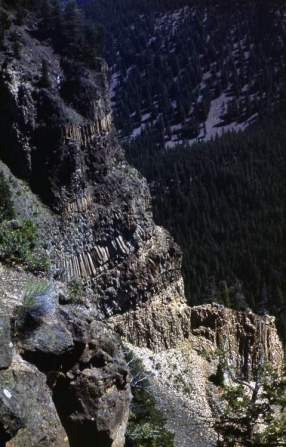
    Selecting the channel of a small creek, and leaving the horses, I followed it down on foot, wading in the bed of the stream, which fell off at an angle about 30°, between walls of the gypsum. Private McConnell accompanied me. On entering the ravine, we came at once to hot springs of sulphur, sulphate of copper, alum, steam jets, &c., in endless variety, some of them of very peculiar form. One of them in particular, of sulphur, had built up a tall spire from the slope of the wall, standing out like an enormous horn, with hot water trickling down its sides. The creek ran on a bed of solid rock, in many places smooth and slippery, in other obstructed by masses of debris formed from the overhanging cliffs of the sulphereted limestone above.

    After descending for three miles in the channel, we came to a sort of bench or terrace, the same one seen previously in following down the creek from our first camp in the basin. Here we found a large flock of mountain sheep, very tame, and greatly astonished, no doubt, at our sudden appearance. McConnell killed one and wounded another, whereupon the rest disappeared, clambering up the steep walls with a celerity truly astonishing. We were now 1,500 feet below the brink. From here the creek channel was more precipitous, and for a mile we climbed downward over masses of rock and fallen trees, splashing in warm water, ducking under cascades, and skirting close against sideling places to keep from falling into boiling caldrons in the channel.

    After four hours of hard labor since leaving the horses, we finally reached the bottom of the gulf and the margin of the Yellowstone, famished with thirst, wet and exhausted. The river water here is quite warm and of a villainously alum and sulphurous taste. Its margin is lined with all kinds of chemical springs, some depositing craters of calcareous rock, others muddy, black, blue, slaty, or reddish water. The internal heat renders the atmosphere oppressive, though a strong breeze draws through the canyon. A frying sound comes constantly to the ear, mingled with the rush of the current. The place abounds with sickening and purgatorial smells.

    We had come down the ravine at least four miles, and looking upward the fearful wall appeared to reach the sky. It was about 3 o’clock p.m., and stars could be distinctly seen, so much of the sunlight was cut off from entering the chasm. Tall pines on the extreme verge appeared the height of two or three feet. The canyon, as before said, was in two benches, with a plateau on either side, about half way down. This plateau, about a hundred yards in width, looked from below like a mere shelf against the wall; the total depth was not less than 2,500 feet, and more probably 3,000. There are perhaps other canons longer and deeper than this one, but surely none combining grandeur and immensity with peculiarity of formation and profusion of volcanic or chemical phenomena.

    Returning to the summit, we were five hours reaching our horses, by which time darkness had set in, and we were without a trail, in the dense forest, having fallen timber to evade and treacherous marshes to cross on our way to camp. I knew the general direction, however, and took a straight course, using great caution in threading the marshes, wherein our horses sank in up to their bodies nevertheless. Fortune favored us, and we arrived in camp at 11 o’clock at night, wet and chilled to the bone.

    ∞§∞

    — Excerpt adapted from the Report of Lieutenant Gustavus C. Doan upon the So-called Yellowstone Expedition of 1870.  Washington D.C.: U.S. Government Printing Office, 1871.

    — Image from the Coppermine Photo Gallery.

    — For other tales from the Washburn Expedition, click on “Washburn” under the “Categories” button to the left.

    — You might also enjoy:

  • A Tale: First Report of Cooking Live Fish in a Hot Spring — Hedges, 1870.

    Many early Yellowstone travelers describe places like the Fishing Cone where anglers could catch a fish in cool water and then cook it in a nearby hot spring without taking it off the hook. In fact, Philetus Norris, the park’s second superintendent, used to demonstrate the feat for the amusement of tourists.

    The earliest written description of cooking live fish in a hot spring was written by Cornelius Hedges, a member of the famous Washburn expedition of 1870. Here’s Hedges’ description of how he accidentally discovered the trick.

    ∞§∞

    My individual taste led me to fishing, and I venture that none of the party dared to complain they did not have all the fine trout that there several appetites and capacities could provide storage for. Indeed, I felt in gratitude bound to hear testimony that for fine fish, and solid, satisfying fun, there is no body of water under the sun more attractive to the ambitious fisherman than Yellowstone Lake.

    While upon the subject of fishing, allow me to relate one or two instances of personal experience. One day, after the loss of one of our comrade, when rations were getting short, I was deputed to lay in a stock of fish to eke our scanty larder on our homeward journey.

    Proud of this tribute to my piscatory skill, I endeavored under some difficulties, to justify the expectations of my companions, and in about two hours, while the waves were comparatively quiet, I strewed the beach with about 50 beauties, not one of which would weight less than 2 pounds, while the average weight was about 3 pounds.

    Another incident, illustrative of the proximity of hot springs rather than of trouting: Near the southwest corner of the lake is a large basin of exceedingly hot springs. Some are in the very margin of the lake, while others rise under the lake and indicate their locations by steam and ebullition upon the lake’s surface when the waves are not too uneasy. One spring of large size, unfathomable depth, sending out a continuous stream of at least 50 inches of scalding water, is still separated from the cool water of the lake by a rocky partition not more than a foot thick in places.

    I returned to the narrow rim of this partitian and catching sight of some expectant trout lying in easy reach, I solicited their attention to a transfixed grasshopper, and meeting an early and energetic response, I attempted to land my prize beyond the spring, but unfortunately for the fish, he escaped the hook to plunge into this boiling spring.

    As soon as possible, I relieved the agonized creature by throwing him out with my pole, and although his contortions were not fully ended, his skin came off and he had all the appearance of being boiled through. The incident, though excusable as an incident, was too shocking to repeat.

    ∞§∞

    — Cornelius Hedges, “Yellowstone Lake,” Helena Daily Herald, November 9, 1970.

    — Illustration from William Cullen Bryant (ed.), Picturesque America. New York: Appleton, 1872. 1:302.

    — You also might enjoy Henry J. Winser’s story about “Cooking Fish on the Hook in a Hot Spring.”

    — For more stories about fishing, click “Fishing” under the Categories button to the left.

  • A Scene: The Geysers of Yellowstone — Washburn, 1870

    There had been rumors of wonders in the upper Yellowstone for more than 50 years, but the Washburn Expedition of 1870 made it official. The place really did contain towering waterfalls, a huge inland sea and—most stupendous—boilding fountains that threw water hundreds of feet into the air. 

    There were several reasons Washburn and his companions captured the public imagination. First, the expedition was composed of prominent government officials and businessmen whose word could not be doubted. Second, the expedition included several skilled writers who published reports immediately after they returned from the wilderness. Third, there was a well developed communication system that included several Montana territorial newspapers and the telegraph to spread the news across the nation. Finally, the Northern Pacific Railroad, which was making its way westward, promoted the area in hopes of  making it a tourist destination.

    General Washburn himself was one of the skilled writers whose work was caught up in this fortuitous combination. Here’s his description of the geysers of the Upper Yellowstone.

    ∞§∞

    Grand Geyser

    On the south end of the lake is a very beautiful collection of hot springs and wells. In many the water is so clear that you can see down fifty or a hundred feet.

    The lake is 8,000 feet above the level of the sea, a beautiful sheet of water, with numerous islands and bays, and will in time be a great summer resort; for its various inlets, surrounded by the finest mountain scenery, cannot fail to be very popular to the seeker of pleasure, while its high elevation and numerous medicinal springs will attract the invalid. Its size is about twenty-two by fifteen miles.

    Leaving the lake, we moved nearly west, over several high ranges, and camped in the snow amid the mountains. Next day, about noon we struck the Fire Hole River. and camped in Burnt Hole Valley.

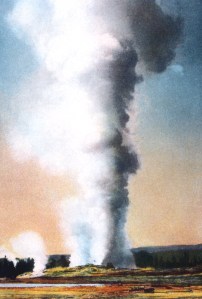
    This is the most remarkable valley we found. Hot springs are almost innumerable. Geysers were spouting in such size and number as to startle all, and are beyond description. Enormous columns of hot water and steam were thrown into the air with a velocity and noise truly amazing. We classified and named some of them according to size:

    No. 1. The Giant, 7 by 10 feet, throwing a solid column of water from £0 to 120 feet high.

    No. 2. The Giantess, 20 by 30. throwing a solid column and jets from 150 to 200 feet high.

    No. 3. Old Faithful, 7 by 8, irregular in shape, a solid column each hour, 75 feet high.

    No. 4. Bee Hive, 24 by 15 inches, stream measured 219 feet.

    No. 5. Fan Tail, irregular shape, throwing a double stream 60 feet high.

    No. 6 is a beautiful arched spray, called by us the Grotto, with several apertures through which, when quiet, one can easily pass, but when in action each making so many vents for the water and steam.

    Upon going into camp we observed a small hot spring that had apparently built itself up about three feet. The water was warm but resting very quietly, and we camped within 200 yards of it. While we were eating breakfast this spring, without any warning threw, as if it were the nozzle of an enormous steam-engine, a stream of water into the air 210 feet, and continued doing so for some time, thereby enabling us to measure it, and then as suddenly subsided.

    Surrounded by these hot springs is a beautiful cold spring of tolerably fair water. Here we found a beautiful spring or well, raised around it was a border of pure white, carved as if by the hand of a master-workman, the water pure. Looking down into it, one can see the sides white and clear as alabaster, and carved in every conceivable, shape, down, down, until the eye tires in penetrating.

    Standing and looking down into the steam and vapor of the crater of the Giantess. With the sun upon our back, the shadow is surrounded by a beautiful rainbow; and, by getting the proper angle, the rainbow, surrounding only the head, gives that halo so many painters have vainly tried to give in paintings of the Savior.

    Standing near the fountain when in motion, and the sun shining, the scene is grandly magnificent; each of the broken atoms of water shining like so many brilliants, while myriads of rainbows are dancing attendance. No wonder, then, that our usually staid and sober companions threw up their hats and shouted with ecstasy at the sight.

    We bid farewell to the geysers, little dreaming there were more beyond. Five miles below Burnt Hole we found the “Lake of Fire and Brimstone.” In the valley we found a lake measuring 450 yards in diameter, gently overflowing, that had built itself up by a deposit of white sub-strata at least 50 feet above the plain. This body of water was steaming hot.

    Below this was a similar spring, but of smaller dimensions while between the two, and apparently having no connection with either, was a spring of enormous volume flowing into the Madison, and is undoubtedly the spring about which Bridger was laughed at so much when he reported that it heated the Madison for two miles below. For some distance down the river we found hot springs and evidences of volcanic action.

    ∞§∞

    — From Henry Washburn, “The Yellowstone Expedition,” Helena Daily Herald, September 27 and 28, 1870.

    — Frank J. Haynes postcard, Yellowstone Digital Slide File.

    — You might also enjoy General Washburn’s description of Yellowstone Falls.

    — For more stories from the Washburn Expedition, click “Washburn” under the “Categories” button to the left.

  • A Tale: Two Pictures and 1300 Words — Walter Trumbull, 1870

    The Washburn Expedition of 1870 convinced the public that there really were wonders on the upper Yellowstone. Stories of towering waterfalls, mountains of glass, a crystal-clear inland sea, and fountains of boiling water could no longer dismissed as “tall tales.” Prominent government officials and businessmen whose word couldn’t be doubted said they were there.

    Just as important the as credibility of members of the Washburn Expedition was their writing skill. Several expedition members  wrote articles about the trip for the Helena Herald that were reprinted around the world.

    N.P. Langford and Truman Everts published articles in Scribner’s Monthly that also brought national attention. The illustrations that accompanied those articles where artists’ fanciful imaginings based on verbal descriptions. The images with Langford’s article were by Thomas Moran, whose later paintings of Yellowstone gave him world fame. Moran and photographer William Henry Jackson, whose work influenced the decision to make the area a national park, went to the upper Yellowstone with the Hayden expedition in 1871.

    Two members of the Washburn Expedition left pencil sketches of what they saw, Charles Moore, a private in the military escort, and Walter Trumbull, the son of U.S. Senator Lyman Trumbull of Illinois. Trumbull also published an account of his Yellowstone experience in the Overland Monthly. His written description and sketches of the Yellowstone Falls provide an interesting opportunity to test the adage, “A picture in worth a thousand words.”

    ∞§∞

    We reached the falls of the Yellowstone on the morning of August 30th. These falls, two in number, are less than half a mile apart. From the lake to the upper falls, a distance of about twenty miles, the river flows, with the exception of a short series of rapids having a moderate current, through an open, undulating country, gently sloping toward the stream..

    Here and there are small groves, and the timber is quite thick a mile away from the river. A quarter of a mile above the upper falls the river breaks into rapids, and foams in eddies about huge, granite boulders, some of which have trees and shrubs growing upon them.

    Above the rapids, the river is about 150 yards wide, but, as it approaches the falls, high, rocky bluffs crowd in on both sides, forcing the water into a narrow gorge, which, at the brink of the falls, is about thirty yards wide.

    The most convenient and desirable place from which to view the falls is from a ledge, easily reached, which juts into the river a considerable distance, just below the falls, and a few feet lower than their brink. It is so close that occasional drops dampen one’s face.  The height of the upper falls is 115 feet. The ledge is irregular, the water being much deeper on the west side than on the east. Great rocks project in the face of the fall, tearing and churning the waters into foam, with here and there a little strip of green, which contrasts beautifully with the surrounding silvery whiteness of the water.

    Between the two falls, the river flows quietly in a wide channel, between steep, timbered bluffs, four hundred feet high. Just above the lower falls the bluffs again converge; the one from the west stretching out as if to dam up the river, which has, however, forced its way through a break, forty yards wide. The rocky cliffs rise perpendicularly from the brink of the falls, to a height of several hundred feet. The rocky formation is of a shelly character, and slightly colored with flowers of sulphur. The plunge of the water is in the direct course of the stream, and at the brink of the falls, it appears to be of uniform depth. It clears its bed at a bound, and takes a fearful leap of 350 feet.

    The volume of water is about half as great as that which passes over the American Fall, at Niagara, and it falls more than twice the distance. The adjacent scenery is infinitely grander. Having passed over the precipice, the clear, unbroken, greenish mass is in an instant transformed by the jagged edges of the precipice into many streams, apparently separated, yet still united, and having the appearance of molten silver.

    These streams, or jets, are shaped like a comet, with nucleus and trailing coma, following in quick succession; or they look like foaming, crested tongues, constantly overlapping each other. The outer jets decrease in size as they descend, curl outward, and break into mist. In the sunlight, a rainbow constantly spans the chasm. The foot of the falls is enveloped in mist, which conceals the river for more than a hundred yards below.

    These falls are exactly the same in height as the Vernal Falls in the Yosemite Valley, but the volume of water is at least five times as great. I think I never saw a waterfall more beautiful than the Vernal, and its surroundings are sublime. Its Indian name is said to mean “Crown of Diamonds;” and it certainly deserves the name. I remember sitting on the rocky ledge just at the edge of the falls, and with an opera-glass watching the water as they plunged downward, breaking into myriads of drops; each drop, like a lens, gathering prismatic tints from the shining sun, and flashing like diamonds of the purest brilliancy.

    The lower fall of the Yellowstone reminds me of the Vernal Fall, on the Merced.  Though nothing, perhaps, can equal the sublime scenery of the Yosemite, yet that only excels the lower falls of the Yellowstone, and the grand canyon which extends for many miles below them.

    Below the falls, the hills gradually increase in height, while the river descends in a succession of rapids through the canyon. At the falls, the canyon is not more than twelve hundred feet deep, but a few miles lower down it is nearly eighteen hundred feet deep. Its average thick a mile away from the river. A quarter of a mile above the upper falls the river breaks into rapids, and foams in eddies about huge, granite boulders, some of which have trees and shrubs growing upon them.

    Above the rapids, the river is about 150 yards wide, but, as it approaches the falls, high, rocky bluffs crowd in on both sides, forcing the water into a narrow gorge, which, at the brink of the falls, is about thirty yards wide.

    The most convenient and desirable place from which to view the falls is from a ledge, easily reached, which juts into the river a considerable distance, just below the falls, and a few feet lower than their brink. It is so close that occasional drops dampen one’s face. The height of the upper falls is 115 feet. The ledge is irregular, the water being much deeper on the west side than on the east. Great rocks project in the face of the fall, tearing and churning the waters into foam, with here and there a little strip of green, which contrasts beautifully with the surrounding silvery whiteness of the water.

    Between the two falls, the river flows quietly, in a wide channel, between steep, timbered bluffs, four hundred feet high. Just above the lower falls the bluffs again converge; the one from the west stretching out as if to dam up the river, which has, however, forced its way through a break, forty yards wide. The rocky cliffs rise perpendicularly from the brink of the falls, to a height of several hundred feet. The rocky formation is of a shelly character, and slightly colored with flowers of sulphur.

    The plunge of the water is in the direct course of the stream, and at the brink of the falls, it appears to be of uniform depth. It clears its bed at a bound, and takes a fearful leap of 350 feet. The volume of water is about half as great as that which passes over the American Fall, at Niagara, and it falls more than twice the distance.

    The adjacent scenery is infinitely grander. Having passed over the precipice, the clear, unbroken, greenish mass is in an instant transformed by the jagged edges of the precipice into many streams, apparently separated, yet still united, and having the appearance of molten silver. These streams, or jets, are shaped like a comet, with nucleus and trailing coma, following in quick succession; or they look like foaming, crested tongues, constantly overlapping each other. The outer jets decrease in size as they descend, curl outward, and break into mist. In the sunlight, a rainbow constantly spans the chasm. The foot of the falls is enveloped in mist, which conceals the river for more than a hundred yards below.

    These falls are exactly the same in height as the Vernal Falls in the Yosemite Valley, but the volume of water is at least five times as great. I think I never saw a waterfall more beautiful than the Vernal, and its surroundings are sublime. Its Indian name is said to mean “Crown of Diamonds;” and it certainly deserves the name.

    I remember sitting on the rocky ledge just at the edge of the falls, and with an opera-glass watching the waters as they plunged downward, breaking into myriads of drops; each drop, like a lens, gathering prismatic tints from the shining sun, and flashing like diamonds of the purest brilliancy. The lower fall of the Yellowstone reminds me of the Vernal Fall, on the Merced. Though nothing, perhaps, can equal the sublime scenery of the Yosemite, yet that only excels the lower falls of the Yellowstone, and the grand canyon which extends for many miles below them.

    ∞§∞

    — Excerpt from “The Washburn Expedition”  by Walter Trumbull, Overland Monthly, May-June 1871.

    — Images from the Coppermine Photo Gallery.

    — For more stories about the Washburn Expedition, click on “Washburn” under the “Categories” button to the left.

  • Treed by a Lion — Truman Everts, 1870

    Probably the best known story of early travel to Yellowstone Park is Truman Everts’ account of  being lost and alone there for 37 days. During the famous Washburn Expedition of 1870, Everts became separated from his companions as they made their way through heavy timber east of Lake Yellowstone. Everts was extremely nearsighted so he got off his horse to look for tracks. While he was scrutinizing a path, the horse ran away leaving him with little but the clothing on his back.

    Everts was a clever and tenacious man. He built a nest between two hot springs to survive a snow storm, made fire with the lens from an opera glass, and lived mostly on a diet of thistle roots.

    He told about his adventures in a magazine article that helped win support for creation of Yellowstone Park. Here’s one of them.

    ∞§∞

    I stretched myself under a tree, and fell asleep. How long I slept I know not; but suddenly I was roused by a loud, shrill scream, like that of a human being in distress. There was no mistaking that fearful voice. It was the screech of a mountain lion; so alarmingly near as to cause every nerve to thrill with terror.

    The work of the moment was to yell in return—seize with convulsive grasp the limbs of the friendly tree—and swing myself into it. Scrambling hurriedly from limb to limb, I was soon as near the top as safety would permit.

    The savage beast was snuffing and growling below—on the very spot I had just abandoned. I answered every growl with a responsive scream. Terrified at the delay and pawing of the beast, I increased my voice to its utmost volume. I then broke branches from the limbs and madly hurled them at the spot from whence the howlings preceded.

    I failed to alarm the animal that now began to make the circuit of the tree—as if to select a spot for springing into it. With my strength increased by terror, I shook the slender trunk until every limb rustled. All in vain. The terrible creature pursued his walk around the tree—lashing the ground with his tail, and prolonging his howling almost to a roar.

    It was too dark to see, but the movements of the lion kept me apprised of its position. Whenever I heard it on one side of the tree, I speedily changed to the opposite—an exercise that I could only have performed under the impulse of terror. I would alternately sweat and thrill with horror at the thought of being torn to pieces—and devoured by this formidable monster. All my attempts to frighten it seemed unavailing.

    Disheartened at its persistency, and expecting at every moment that it would take the deadly leap. I tried to collect my thoughts, and prepare for the fatal encounter. Just at this moment it occurred to me that I would try silence.  Clasping the trunk of the tree with both arms, I sat perfectly still.

    The lion ranged around, occasionally snuffing and pausing—all the while filling the forest with the echo of his howling. Suddenly it imitated my example and fell silent. This was more terrible than the clatter and crash of his movements through the brushwood. Now I did not know from what direction to expect this attack. Moments passed with me like hours. After a lapse of time, which I cannot estimate, the beast gave a spring into the thicket and ran screaming into the forest. My deliverance was effected.

    Had strength permitted, I should have retained my perch till daylight. But with the consciousness of escape from the jaws of the ferocious brute came a sense of overpowering weakness. That made my descent from the tree both difficult and dangerous. Incredible as it may seem, I lay down in my old bed, and was soon lost in a slumber so profound that I did not awake until after daylight.

    ∞§∞

    — Excerpt and illustration from Truman Everts’ “Thirty-Seven Days of Peril,”  Scribner’s Monthly, 3(1):1-17  (November 1871).

    — For more stories about the Washburn Expedition, click on “Washburn” under the “Categories” button to the left.

    — For more stories about the Washburn Expedition, click on “Washburn” under the “Categories” button to the left.