Category: Yellowstone Stories

  • A Tale: A Narrow Escape from the Nez Perce — Ben Stone, 1877

    McCartney’s “Hotel” at Mammoth Hot Springs

    Ben Stone was an African American hired to cook for a group of men from Helena who toured Yellowstone in August 1877, the year the Nez Perce passed through there. The Helena Party fought a couple of gun battles with Nez Perce scouts. Leaving the body of one of their companions behind, several members party made their way to Mammoth Hot Springs where there was an incipient resort.

    When two young men failed to show up at Mammoth, two others went to search for them, leaving Stone, a music teacher named Dietrich, and a wounded man named Stewart to wait for a ride. Here’s how Stone described what happened then.

    ∞§∞

    No more of our party, having shown up in the three days after arriving at the Springs, we were alarmed about them, and Andy Weikert concluded to go and see if he could find anything of them. James McCartney, proprietor of the Mammoth Hot Springs, kindly volunteered to go with him.

    The next day after they left an ambulance arrived to take Stewart, Dietrich, and myself to Bozeman. The boys with the ambulance begged Dietrich to go with them, but he said, with tears in his eyes, “My God! What will Mrs. Roberts say if I go and leave Joe?” Through my inducement he came. “What shall I say when I meet his mother, when she asks me where Joe is?”

    Dietrich and I concluded to remain until we heard from Weikert and McCartney. If Joe or any of the rest of the party were brought in, we wished to be there to care for them, in case they were wounded. One of the party, with the ambulance (Jake Stoner), remained with us.

    Dietrich and Stoner went down to Gardiner’s River fishing, not returning until three in the afternoon, leaving me to keep house alone at the Springs. After they returned, I cooked dinner and, after eating, Dietrich and I concluded to go up and take a bath. Stoner said he would go along to look at the Springs, and took his gun with him, as he said, “To knock over a grouse, as grub was getting scarce.”

    After taking our bath and drinking some of the water out of the Hot Springs, we went back to the house.

    Dietrich said: “I’ll go down and water and stake the mare for the night.

    “All right,” I answered, “and while you’re gone, I’ll keep house.

    Taking a seat in the doorway, I felt uneasy. On glancing towards the Springs, I saw Jake Stoner running to the house. I smilingly asked him if he had caught any grouse.

    He said: “No, but I’ve caught something else.”

    I inquired of him what he had caught, when he said that, while up on top of the Springs, he had caught sight of a large party coming this way.

    I replied: “You did! That must be white men. How many did you see?”

    “I saw two parties, with about ten persons in each nearly forty yards apart, and traveling very slowly.”

    I said: “They must be white men. Andy and McCartney have found the boys, and are bringing them in. Of course, they are wounded, and have to travel slowly. I’ll go in the house, make a fire, and have grub ready for the boys by the time they get here.

    “No,” said Jake: “don’t do that. We had better cache ourselves in the timber until we know whether they are white men or not.”

    I replied: “That’s a good idea—we’ll do that.”

    He then asked for Dietrich, saying, “I’ll warn him, so he can take to timber too.”

    I told him where Dietrich was, and he went down the flat towards him. I started up the gulch to cache myself. After advancing twenty-five or thirty yards, I took to the timber on my right, and went up in it to a point of rocks overlooking the house, and where I could see both trails approaching the house. After waiting there fifteen or twenty minutes, and the parties not coming, I began to think the boys were a long time coming. Looked out, but could not see anything.

    Sat down and waited ten minutes—nothing in sight. I exposed myself in trying to find out if the parties were coming. When I got to where I could see, I descried an object in the distance, in what appeared to be a long white blanket. He dodged around out of sight, as if intending to go behind the Springs. Another appeared closer to me, in what also appeared to be a blanket. He dodged around in the same manner as the former one.

    Another soon appeared. I had no doubt that he was an Indian, and I said to myself: “Mr. Stone, it’s about time you were traveling!” I “lit out” for timber about one hundred yards up the gulch. While I was waiting to see who were coming, the Indians had worked around and got into the gulch I had to go up, and get to the timber. I had to go within five or six yards of them through the brush. Moving as fast and cautiously as I could, I accidentally stepped on a piece of dead brush, which broke with a loud crash. Some of the Indians heard and one made for me. I then moved very fast, for I knew I had to work for my life, if I did not get to timber soon, I was a dead man.

    In a few moments, I found that the Indian would cut me off, as from the crash of breaking twigs I knew he was close to me. I thought I was a dead man, sure, and said: “My God! What shall I do!” Just then, I chanced to run under a tree, with low branches. I took hold of the branches and hoisted myself in, without any expectation of saving my life. I had no more than got into the tree, before an Indian on horseback dashed under it, gazing in every direction for me, and seeming surprised at not seeing the object that made the noise.

    After going about ten yards, he stopped his horse, raised his gun up on his arm, and listened for an instant. He then went through an opening out of sight.

    I now considered myself perfectly safe, but remained in the tree about two hours.

    While in the tree I heard several shots at the house, and saw they had made fires there. Suppose they had burned the buildings.

    ∞§∞

    After the Indians left, Stone decided to make for a ranch north of the Park.  On the way, he met a group of soldiers who were pursuing the Indians. Later he learned that the Indians had killed Dietrich and other members of the party were safe.

    ∞§∞

    —  Abridged from “Two Narrow Escapes from the Clutches of the Red Devils in 1877: His Own Story Told by Benjamin Stone.” The Avant Courier, Bozeman, September 6, 1877.

    — Photo from the Yellowstone Digital Slide File.

  • A Tale: Early Hotels Offered Crude Accommodations — 1883

    In August of 1883 Yellowstone Park was overrun with parties of dignitaries including President Chester A. Arthur. Still, that’s when a 58-year-old school teacher, Margaret Cruikshank took new Northern Pacific train to Yellowstone. Miss Cruikshank said her guidebooks were far too lavish in praising the natural wonders of the Park, and she was quick to condemn the accommodations. Here’s her description of Marshall’s Hotel at the Lower Geyser Basin.

     ∞§∞

    Marshall’s Hotel

    We went on a rather monotonous day’s journey till the early afternoon brought us to the Forks of Firehole—Marshall’s.

    Marshall is a man who, having no park permit, has chosen to assume that he could keep such a house of entertainment, that the Yellowstone Park Company would be glad to let him stay.

    When only rough teamsters and hunters visited the Park I suppose he gave satisfaction. But now that crowds throng there and are of a more fastidious sort, Marshall won’t do. Marshall must go.

    The effective force here is only three—Marshall, his wife, and a Chinaman—and they are all overworked and all cross. Not being forethoughted and forehanded as to providing and not having very high standards. I cannot praise their results.

    We had a tolerably good supper, which I enjoyed. Part of the reason was that our party got in early and the over‑worked cook was not so rushed. We had fish nicely fried and quite tolerable coffee. I often found it difficult when things were at their worst at Marshall’s to force down enough food to sustain nature, such abominable messes were served up to us.

    Above the square part of the building was a great loft, and this was elegantly subdivided into cells by burlap partitions reaching rather more than half‑way up. Judging by their size I thought that there must have been more than a dozen of these little cubbyholes, dark and stifling! Into these most of us were stowed. Beyond beds, the less said about our accommodations the better. Many slept on the floor.

    Our room was in the southeast comer upstairs and had two beds in it, one at each end. Mrs. Gobeen was our roommate.

    It fell to my lot to sleep where the eaves came down over me like the crust over the blackbird in the pie. Mrs. Gobeen objected to having the window open. The bed was stuffed with sagebrush and had a horrid medicinal, quininey smell. And though the bedclothes may have been clean, I fancied that they had covered every teamster in the valley, beside being washed in that hot spring till the blankets were perfect felt. Moreover, with the sagacity usually exhibited by the lower classes in bed making, every double blanket had its fold up towards the head, so that if you were too warm you had to throw off both thicknesses—or neither.

    ∞§∞

    — Margaret Cruikshank’s journal is at the Yellowstone Research Center in Gardiner, Montana.

    — Photo from a  stereopticon view, Yellowstone Digital Slide File.

  • A Tale: Hunting a Yellowstone Lion

    The story below was included as an example of student writing in a 1914 composition textbook for college freshmen. The textbook authors didn’t give the student’s name or the year the piece was written, but apparently it was after the army took over administration of Yellowstone in 1886.

     The Secretary of Interior promulgated a regulation in 1883 that prohibited hunting in Yellowstone Park, but that was generally interpreted as not applying to predators. In fact the general policy toward predators—cayotes, wolves, bears, wolverines, and mountain lions—was “shoot on sight.” Predators weren’t protected in the park until the 1930s.

    The textbook authors praise this account as an “ambitious and  effective narrative theme.”  I agree.

    ∞§∞

    “Whoa there! Back into the road, you black brute! What are you shyin’ at?” yelled the driver of a sightseeing coach in the Yellowstone.

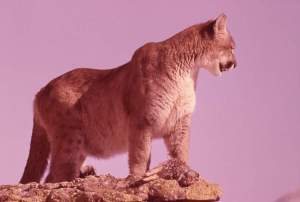
    He glanced across the bridge and immediately learned the reason for the strange behavior of one of his leaders. There, in a leather-wood thicket, crouched the long, lithe form of a mountain lion. Its wicked yellow eyes challenged his right to the passage, and its long slender tail writhed among the bushes. The driver pulled up his horses, uncertain of the lion’s intentions; but the great cat, finding himself unmolested, slipped through the bushes and disappeared among the jagged rocks on the mountain slope.

    As the coach was discharging its passengers at the next stopping place, the driver yelled to a camp boy, “Go over and tell the guards I saw that big lion they’ve been looking for, down by the last bridge. Tell ’em they’d better hurry before he leaves the country.”

    The boy lost no time; and soon two of the soldiers were at the bridge, carefully examining the tracks of the great beast from the impressions in the loose dirt. They quickly learned that this lion was the very one with which they had been having a great deal of trouble, the one which had invaded camps during the night, and had terrified tourists with his long-drawn, almost human wail from the forests.

    Clambering over the great grey rocks, and sliding in the loose gravel of the slope, the two soldiers made their way slowly up the mountain side. When they reached the first promontory they stopped to rest and look about them. Far to the left and a mile below them, still shrouded by the evening mists yet tinted now by the morning sun, lay the magnificent and awe-inspiring Yellowstone Gorge. They gazed at the green thread winding along the floor of the great chasm and tried to hear what they knew to be the roar of its rushing waters.

    “It’s a great sight, Judd! We don’t realize it, bein’ here all the time. But come on. Let’s hit the trail again.”

    “Wait a second.” replied the other. “Help me tighten this bandage on my hand. It’s come loose.”

    The men, intent upon the loosened bandage, failed to see that, from the edge of an overhanging rock above them, two pale green eyes were watching their every move. Behind the eyes, the sinewy form of a great cat was stealthily adjusting itself for a leap.

    Having tightened the bandage, the men straightened up and at the same time stepped back a pace. Their feet, imbedded in the loose gravel, began to slide, and together the two soldiers rolled back under the overhanging rock. At the same instant a great tawny streak flashed over their heads, and the huge form of the mountain lion crashed into the rocks at the very place upon which they had been standing.

    They jumped to their feet and, with startled eyes, watched the great ball of yellow fur as it bumped and rolled down the steep incline. The lion tore madly at the rocks and bushes as he fell, but tried in vain to secure a footing in the sliding gravel. A hundred feet below, he stopped with a thud against a fallen tree trunk; but before he could move, two bullets crunched their way through his body, and, with a gasp, he straightened out, dead.

    ∞§∞

    Anonymous, “A Yellowstone Lion,” pages 561-562 in Frances Berkeley Young and Karl Young, Freshman English: A Manual. New York: Henry Holt and Company, 1914. Pages 561-562.

    — Coppermine Gallery Photo.

  • A Tale: Teddy Roosevelt Bags an Elk on Two Ocean Pass — 1891

    There was no greater supporter of Yellowstone National Park than Theodore Roosevelt. TR was an avid hunter, but he favored prohibition of hunting inside Yellowstone National Park. The idea was that keeping hunters out would make the Park an endless well of trophy animals that could be hunted when they strayed outside its boundaries.
    And Roosevelt knew that areas near the park provided marvelous hunting. Here’s his description of one of his kills while on a hunting expedition in 1891 to the Two Ocean Pass, an area just outside Yellowstone’s southern border.

    ∞§∞

    The weather became clear and very cold, so that the snow made the frosty mountains gleam like silver. The moon was full, and in the flood of light the wild scenery round our camp was very beautiful. As always where we camped for several days, we had fixed long tables and settles, and were most comfortable; and when we came in at nightfall, or sometimes long afterward, cold, tired, and hungry, it was sheer physical delight to get warm before the roaring fire of pitchy stumps, and then to feast ravenously on bread and beans, on stewed or roasted elk venison, on grouse and sometimes trout, and flapjacks with maple syrup.

    Next morning dawned clear and cold, the sky a glorious blue. Woody and I started to hunt over the great tableland, and led our stout horses up the mountainside, by elk trails so bad that they had to climb like goats. All these elk-trails have one striking peculiarity. They lead through thick timber, but every now and then send off short, well-worn branches to some cliff-edge or jutting crag, commanding a view far and wide over the country beneath. Elk love to stand on these lookout points, and scan the valleys and mountains round about.

    Blue grouse rose from beside our path; Clarke’s crows flew past us, with a hollow, flapping sound, or lit in the pine-tops, calling and flirting their tails; the gray-clad whiskyjacks, with multitudinous cries, hopped and fluttered near us. Snow-shoe rabbits scuttled away, the big furry feet which give them their name already turning white. At last we came out on the great plateau, seamed with deep, narrow ravines. Reaches of pasture alternated with groves and open forests of varying size.

    Almost immediately we heard the bugle of a bull elk, and saw a big band of cows and calves on the other side of a valley. There were three bulls with them, one very large, and we tried to creep up on them; but the wind was baffling and spoiled our stalk. So we returned to our horses, mounted them, and rode a mile farther, toward a large open wood on a hill-side. When within two hundred yards we heard directly ahead the bugle of a bull, and pulled up short.

    In a moment I saw him walking through an open glade; he had not seen us. The slight breeze brought us down his scent. Elk have a strong characteristic smell; it is usually sweet, like that of a herd of Alderney cows; but in old bulls, while rutting, it is rank, pungent, and lasting. We stood motionless till the bull was out of sight, then stole to the wood, tied our horses, and trotted after him. He was travelling fast, occasionally calling; whereupon others in the neighborhood would answer. Evidently he had been driven out of some herd by the master bull.

    He went faster than we did, and while we were vainly trying to overtake him we heard another very loud and sonorous challenge to our left. It came from a ridge-crest at the edge of the woods, among some scattered clumps of the northern nut-pine or pinyon—a queer conifer, growing very high on the mountains, its multi-forked trunk and wide-spreading branches giving it the rounded top, and, at a distance, the general look of an oak rather than a pine.

    We at once walked toward the ridge, up-wind. In a minute or two, to our chagrin, we stumbled on an outlying spike bull, evidently kept on the outskirts of the herd by the master bull. I thought he would alarm all the rest; but, as we stood motionless, he could not see clearly what we were. He stood, ran, stood again, gazed at us, and trotted slowly off.

    We hurried forward as fast as we dared, and with too little care; for we suddenly came in view of two cows. As they raised their heads to look, Woody squatted down where he was, to keep their attention fixed, while I cautiously tried to slip off to one side unobserved. Favored by the neutral tint of my buckskin hunting-shirt, with which my shoes, leggins, and soft hat matched, I succeeded. As soon as I was out of sight I ran hard and came up to a hillock crested with pinyons, behind which I judged I should find the herd.

    As I approached the crest, their strong, sweet smell smote my nostrils. In another moment I saw the tips of a pair of mighty antlers, and I peered over the crest with my rifle at the ready. Thirty yards off, behind a clump of pinyons, stood a huge bull, his head thrown back as he rubbed his shoulders with his horns. There were several cows around him, and one saw me immediately, and took alarm. I fired into the bull’s shoulder, inflicting a mortal wound; but he went off, and I raced after him at top speed, firing twice into his flank; then he stopped, very sick, and I broke his neck with a fourth bullet.

    The elk I thus slew was a giant. His body was the size of a steer’s, and his antlers, though not unusually long, were very massive and heavy. He lay in a glade, on the edge of a great cliff. Standing on its brink we overlooked a most beautiful country, the home of all homes for the elk: a wilderness of mountains, the immense evergreen forest broken by park and glade, by meadow and pasture, by bare hill-side and barren tableland.

    ∞§∞

    — Excerpt from Theodore Roosevelt “An Elk Hunt at Two Ocean Pass.”  Pages  177-202 in The Wilderness Hunter: An Account of Big Game in the United States.  Putnam’s Sons: New York, 1902.

    — Photo from The Wilderness Hunter.

    — For other stories about tracking game, click on “Hunting” under the Categories button to the left.

  • A Tale: A Fur Trader Travels to Geyserland — Ferris, 1834

    Only a few of the rugged mountain men who penetrated the area that became Yellowstone National Park could read and write. One who could was Warren Angus Ferris,  a clerk for the American Fur Company. Ferris kept a journal that was published in serialized form in 1843-44 in the Western Literary Messenger and later as a book entitled Life in the Rocky Mountains. In these writings he offered one of the earliest written descriptions of the grand geysers in the Upper Geyser Basin.

    ∞§∞

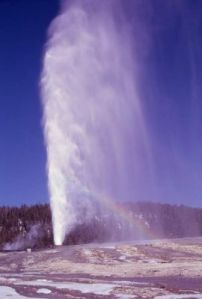
    Beehive Geyser

    I had heard in the summer of 1833, while at rendezvous, that remarkable boiling springs had been discovered, on the sources of the Madison, by a party of trappers in their spring hunt; of which the accounts they gave, were so very astonishing, that I determined to examine them myself, before recording their descriptions, though I had the united testimony of more than twenty men on the subject, who all declared they saw them, and that they really were, as extensive and remarkable as they had been described.

    Having now an opportunity of paying them a visit, and as another or a better might not soon occur, I parted with the company after supper, and, taking with me two Pen-d’orielles, set out at a round pace, the night being clear and comfortable. We proceeded over the plain about twenty miles, and halted until daylight on a fine spring, flowing into Cammas Creek.

    Refreshed by a few hours sleep, we started again after a hasty breakfast, and entered a very extensive forest called the Piny Woods, which we passed through, and reached the vicinity of the springs about dark, having seen several small lakes or ponds, on the sources of the Madison; and rode about forty miles; which was a hard day’s ride, taking into consideration the rough irregularity of the country through which we had travelled.

    We regaled ourselves with a cup of coffee, and immediately after supper lay down to rest, sleepy, and much fatigued. The continual roaring of the springs, however, for some time prevented my going to sleep, and excited an impatient curiosity to examine them; which I was obliged to defer the gratification of, until morning; and filled my slumbers with visions of water spouts, cataracts, fountains, jets d’eau of immense dimensions, etc. etc.

    When I arose in the morning, clouds of vapor seemed like a dense fog to overhang the springs, from which frequent reports or explosions of different loudness, constantly assailed our ears. I immediately proceeded to inspect them, and might have exclaimed with the Queen of Sheba, when their full reality of dimensions and novelty burst upon my view, “The half was not told me.”

    From the surface of a rocky plain or table, burst forth columns of water, of various dimensions, projected high in the air, accompanied by loud explosions, and sulphurous vapors, which were highly disagreeable to the smell. The rock from which these springs burst forth, was calcareous, and probably extends some distance from them, beneath the soil. The largest of these wonderful fountains, projects a column of boiling water several feet in diameter, to the height of more than one hundred and fifty feet—in my opinion; but the party of Alvarez, who discovered it, persist in declaring that it could not be less than four times that distance in height accompanied with a tremendous noise.

    These explosions and discharges occur at intervals of about two hours. After having witnessed three of them, I ventured near enough to put my hand into the water of its basin, but withdrew it instantly, for the heat of the water in this immense cauldron, was altogether too great for comfort, and the agitation of the water, the disagreeable effluvium continually exuding, and the hollow unearthly rumbling under the rock on which I stood, so ill accorded with my notions of personal safety, that I reheated back precipitately to a respectful distance.

    The Indians who were with me, were quite appalled, and could not by any means be induced to approach them. They seemed astonished at my presumption in advancing up to the large one, and when I safely returned, congratulated me on my “narrow escape.”  They believed them to be supernatural, and supposed them to be the production of the Evil Spirit. One of them remarked that hell, of which he had heard from the whites, must be in that vicinity.

    The diameter of the basin into which the water of the largest jet principally falls, and from the centre of which, through a hole in the rock of about nine or ten feet in diameter, the water spouts up as above related, may be about thirty feet. There are many other smaller fountains, that did not throw their waters up so high, but occurred at shorter intervals. In some instances, the volumes were projected obliquely upwards, and fell into the neighboring fountains or on the rock or prairie. But their ascent was generally perpendicular, falling in and about their own basins or apertures.

    These wonderful productions of nature, are situated near the centre of a small valley, surrounded by pine covered hills, through which a small fork of the Madison flows. Highly gratified with my visit to these formidable and magnificent fountains, jets, or springs, whichever the reader may please to call them, I set out after dinner to rejoin my companions.

    ∞§∞

    — From Warren Angus Ferris, A Diary of Wanderings on the sources of the Rivers Missouri, Columbia, and Colorado from February, 1830, to November, 1835.

    — Image from the Coppermine Photo Gallery.

    — You might also enjoy these early descriptions of geysers:

  • A Tale: One Good, Square Drink — General W.E. Strong, 1875

    Before the Northern Pacific completed its transcontinental link in 1883, the best way from the east coast to Yellowstone Park was to take the Union Pacific to Corinne, Utah, and then travel north 400 miles by stagecoach. The stagecoach ride itself could be a great adventure. Here’s General W.E. Strong’s description of his ride in 1875.

    ∞§∞

    At 6 o’clock we were ready to start. The coach had pulled up at the village of Franklin, near Corinne, Utah, and stopped near a whiskey shop for the regular driver to take the reins. This dignitary, who soon appeared, was a slim-built man of five-and-thirty—and so very drunk that I could hardly believe we were to be conducted over our first run by a person in his condition. He had most remarkable control over his legs and hands, however, he managed to reach the coach and climb to his seat without aid from anyone.

    “Are you ready,” says the driver. “All ready” was the response. Then gathering the reins carefully in his left hand and swinging his whip with the right, the lash cutting sharply across the flanks of the leaders, “Lee Goddard,” (that was his name) exclaimed “Git out of here, you pirates.”  The next instant we were off, lead, swing, and wheel horses on the keen jump. Again and again the whip was applied and thus we departed from Franklin at the rate of sixteen miles an hour.

    The intense pleasure to me of this first morning’s ride in the great, swaying Concord wagon is indescribable. We were fairly afloat on the great plains of Idaho.

    At Bear River we jumped out and ‘stretched our legs’  while a fresh relay of six handsome bays were hitched to the coach, and in five minutes were bowling along again, at a killing pace. Goddard’s run is to Port Neuf Canyon, sixty miles, and he changes five times—an average of 12 miles for each relay.

    From Bear River to Port Neuf Canyon the road was fearfully dusty, so we were enveloped in great clouds hour after hour, and it seemed sometimes as though we would surely suffocate. For miles and miles the lead horses were entirely hidden and very frequently all of the horses were lost of view.

    The stage driver looked longingly at the demijohn of whiskey—about a gallon—that was under our feet, and finally mustered the courage to say that if he had one good, square drink he was sure he could get through to Port Neuf in time; but as the small flask we carried—strictly for medical purposes—would not probably have come up to his estimate of a good, square drink, I declined the proposition.

    Later, and while we were making some sharp curves, where the narrow road was cut out from the mountain’s side, with frightful precipices below us, I turned, and, to my astonishment, saw the driver nodding, with the reins hanging loosely in his hands. The situation was by no means pleasant. The horses were going rapidly, with a drunken driver fast asleep, and only a foot between the outer wheels and the brink of the precipice two hundred feet high—where, if a horse slipped and went down, or a wheel came off, there was no hope for us.

    In view of this, I grasped the reins, and at the same time shook the fellow gently until he awoke, when he very cooly asked, “Wha-ze matter?” and I told him he was sleeping, he laughed saying, “Don’t be skeert, ole fellar; them hosses, they knows the road, sure’s yer borned. Never upset a stage in my life.” At the same time he applied the whip to the swing horses sending us along faster than ever.

    ∞§∞

    — From General W. E. Strong, A Trip to the Yellowstone National Park in July, August, and September, 1875. (Pages 15-18).

    — Northern Pacific Railroad postcard.

    — You might also enjoy General Strong’s account of catching his first fish in Yellowstone Park, or Sidford Hamp’s story of a stagecoach robbery.


  • Two Ocean Pass and the Mystery of the Fishless Waters

    Parting of the Waters, Two Ocean Pass

    Early travelers to the area that became Yellowstone National Park found fish were abundant in the Yellowstone River and Lake and their tributaries, but many other lakes and streams were devoid of fish. At first, people thought heat and chemicals from geothermal features killed fish in some places. Then geologists offered another explanation.

    The Yellowstone plateau, geologists said, was a huge sheet of volcanic rock left by a super volcano. Across eons, a giant glacier formed over the volcanic rock. When the ice age ended, the glacier melted washing away soft material but leaving hard volcanic rock. This formed a circle of waterfalls and cascades that fish couldn’t get over to populate the plateau.

    The geologists’ theory explained the fishless waters, but it left a deeper mystery: How did fish get into upper Yellowstone and its tributaries?  Certainly, they didn’t do it by climbing the 300-foot lower fall of the Yellowstone.

    Then, people remembered Mountain Man Jim Bridger’s tale of the “Two Ocean Pass,” a place on the headwaters of the Yellowstone where creeks crossed the continental divide. Explorers had documented the existence of the pass, but it wasn’t until 1891 that the U.S. Fish Commission sent an ichthyologist to the area.

    Here’s how Dr. Barton Warren Evermann described what he found at the Two-Ocean Pass.

    ∞§∞

    We stood upon the bank of either fork of Atlantic Creek, just above the place of the ”parting of the waters,” and watched the stream pursue its rapid but dangerous and uncertain course along the very crest of the “Great Continental Divide.” A creek flowing along the ridgepole of a continent is unusual and strange, and well worth watching and experimenting with.

    We waded to the middle of the North Fork, and, lying down upon the rocks in its bed. We drank the pure icy water that was hurrying to the Pacific, and, without rising, but by simply bending a little to the left, we took a draught from that portion of the stream which was just deciding to go east, via the Missouri-Mississippi route, to the Gulf of Mexico.

    And then we tossed chips, two at a time, into the stream. Though they would strike the water within an inch or so of each other, not infrequently one would be carried by the current to the left, keeping in Atlantic Creek, while the other might be carried a little to the right and enter the branch running across the meadow to Pacific Creek; the one beginning a journey which will finally bring it to the Great Gulf, the other entering upon a long voyage in the opposite direction to Balboa’s ocean.

    Pacific Creek is a stream of good size long before it enters the Pass, and its course through the meadow is in a definite channel; but not so with Atlantic Creek. The west bank of each fork is low, and the water is liable to break through anywhere, and thus send a part of its water across to Pacific Creek. It is probably true that one or two branches always connect the two creeks under ordinary conditions, and that, following heavy rains, or when the snows are melting, a much greater portion of the water of Atlantic Creek finds its way across the meadow to the other.

    It is certain that there is, under ordinary circumstances, a continuous waterway through Two-Ocean Pass of such a character as to permit fishes to pass easily and readily from Snake River over to the Yellowstone, or in the opposite direction. Indeed, it is possible, barring certain falls in Snake River, for a fish so inclined to start at the mouth of the Columbia, travel up that great river to its principal tributary, the Snake, thence on through the long, tortuous course of that stream, and, under the shadows of the Grand Tetons, enter the cold waters of Pacific Creek, by which it could journey on up to the very crest of the Great Continental Divide to Two Ocean Pass; through this Pass it may have a choice of two routes to Atlantic Creek, in which the down-stream journey is begun. Soon it reaches the Yellowstone, down which it continues to Yellowstone Lake, then through the lower Yellowstone out into the turbid waters of the Missouri. For many hundred miles, it may continue down this mighty river before reaching the Father of Waters, which will finally carry it to the Gulf of Mexico—a wonderful journey of nearly six thousand miles, by far the longest possible fresh-water journey in the world.

    We found trout in Pacific Creek at every point where we examined it. In Two-Ocean Pass, we obtained specimens from each of the streams, and in such positions as would have permitted them to pass easily from one side of the divide to the other. We also caught trout in Atlantic Creek below the Pass, and in the upper Yellowstone, where they were abundant.

    Thus it is certain that there is no obstruction even in dry weather to prevent the passage of trout from the Snake River to Yellowstone Lake; it is quite evident that trout do pass over in this way; and it is almost absolutely certain that Yellowstone Lake was stocked with trout from the west, via Two-Ocean Pass.

    ∞§∞

    — Excerpt adapted from Barton Warren Evermann, “Two Ocean Pass,” Inland Educator 2(6): 299-306 (July 1896).

    — U.S. Forest Service Photo.

    — To learn more about Two Ocean Pass and fishing in Yellowstone in the 1870’s, check out my Big Sky Journal Article, “When All the Fish Were Natives.”

  • A Tale: Part 6: A Lady’s Visit To The Geysers Of The Yellowstone Park — HWS 1880.

    The final installment of HWS’s chronicle of her Yellowstone adventure begins at the edge of the Grand Canyon of the Yellowstone. Then a photographer takes her picture on Foxey and she visits Yellowstone Lake and the Upper Geyser Basin. Then she starts home.

    Begin with Part 1

    ∞§∞

    The lads of our party found great delight in starting enormous fallen trees down the awful incline, and watching them crash their way with a fearful swiftness to the river’s brink. Any mother will know how that made me feel, especially when I add that no doctor could be procured in that region under seven days at the very least, and that we had neither houses nor beds, nor anything considered necessary in sickness. I confess I was thankful every minute that our family did not possess a country seat on the banks of the Yellowstone Canyon!

    Near us was camped a photographer, and of course we were taken, guides, pack train, colts, dogs and all. They put me, mounted on Foxey, in the very forefront of the picture, and beside me an old blind pack-horse with our store on his back, choosing this position for us, no doubt, because we were the two queerest looking objects in the whole train. We have since heard that this picture is to be put in a panorama amongst other objects of interest in the Park, and that we shall be magnified to the size of fifteen feet and perfectly recognizable!

    One of our chief difficulties arose from the impurity of the water and its impregnation with mineral substances, yet the whole of our party went through the trip without suffering any bad effects, and even grew stronger and better, though not a drop of any stimulant was touched by any of us.

    The Yellowstone Lake lies 7,780 feet above the sea, almost on the top of the Rocky Mountains, and covers 300 square miles, being the fourth in size, which lies entirely within the limits of the United States. Its pure, cold waters, in some places 300 feet deep, are the rich blue color of the open sea, and swarm with trout, while it is the summer home of white swan, pelicans, geese, snipe, ducks, cranes, etc., and its shores furnish feeding grounds for elk, antelope, black and white tailed deer, bears, and mountain sheep.

    Scattered along its shores are many clusters of hot springs and small geysers. It is surrounded on every side but one with snowy mountains, and was long considered to be entirely mountain-locked and inaccessible. The guides told us that it was literally true that a man could stand at one point on the shore of the lake and catch fish on one side of him, which he could swing over and cook in a boiling spring on the other side!

    Leaving these high elevations, we went to see the Upper and Lower Geyser Basins. We had dismounted and unloaded our horses and buggy, and were looking for the best sites for our tents, when the cry was heard, “There goes a geyser!” and we dropped everything and ran. The sight was truly a glorious one. At the far end of the basin, Old Faithful was playing his wonderful fountain, and we saw what looked to us a river of water shooting up into the sky.

    Our guides told us it was only 150 or 200 feet high, but to us it seemed to reach the clouds, and on one side of it was a lovely soft rainbow that came and went with the blowing spray. It spouted for five or ten minutes and then subsided. Old Faithful is the only geyser whose performances can be depended upon. He spouts regularly every sixty-seven minutes, and has done so ever since the discovery of the Park.

    The crater looks like a great mound of coral or petrified sponge, surrounded by terraced basins at all shapes and sizes, and of the most lovely colors. The whole mound is convoluted in the most beautiful fashion, and every one of the little basins around it is rimmed with exquisite scalloping and fluting. The Grand Geyser, the Giant, the Grotto, the Splendid, the Riverside, and the Fan, complete the list of large geysers in this basin, and each one has a marvelous and distinct beauty.

    As we were quietly sitting in camp the day after our arrival, I noticed a great steam in the direction of the Grand Geyser, and called out to one of our guides, “George, is old Grand doing anything?” He looked a moment, and then, dropping everything, began to run, shouting out at the top of his voice, “Old Grand is spouting! Old Grand is spouting!”

    In a second of time our camp was deserted, every thing was left in wild confusion, and we were all running at the top of our speed to see the display. It was perfectly glorious! As it sent up its grand water rockets 250 feet into the air, shooting out on every side, we all involuntarily shouted and clapped our hands, and Sam took off his hat and swung it over his head in a perfect enthusiasm of delight!

    It was like a grand oration, and a wonderful poem, and a beautiful picture, and a marvelous statue, and a splendid display of fireworks, and everything else grand and lovely combined in one. Then all would subside, and the pool would be quiet for a moment or two; then again, it would heave and swell, and the glorious fountain would suddenly burst up again into the blue sky! Seven times this took place, and then all the water was sucked down, down, down into the abyss, and we climbed part way into the steaming crater, and picked up specimens from the very spot where just before had been this mighty fountain.

    The Giant, too, gave us a grand performance while we were in the Basin. We thought it the grandest and most beautiful of all. It shoots up a column of water at least seven feet thick to the height of 250 feet, the steam rising far higher. It played for nearly an hour, and flooded the whole basin around with boiling water, doubling the volume o water in the river.

    The internal rumblings and roarings meanwhile were perfectly deafening. I could not help feeling as I gazed on these wonders that there was a lesson in it all. Nothing but heat could bring forth such beauty as we see here at every step, and I thought that thus also did the refining fire of God bring forth in our characters forms and colors as beautiful after their fashion as these.

    On the 19th, we broke camp and started for our homeward journey. And so, in due time, our trip was over, and the “Mystic Wonderland” lay behind us; but we all felt that we had stored up while there a treasure of fascinating memories of which no time nor distance could rob us. Some of us felt also that we had learned to know our God and His greatness as we had not known Him before, while living amid such displays of His creating and sustaining power, and realized that never again could we doubt His love and care.

    ∞§∞

    — From H. W. S., “A Lady’s Visit To The Geysers Of The Yellowstone Park.” Friends Intelligencer May 19, 1883. Pages 218-221, and May 27, Pages 234-237.

    — Detail from a photo in the collection of the Pioneer Museum of Bozeman.

  • A Tale: A Lady’s Visit To The Geysers Of The Yellowstone Park (Part 4) — HWS 1880.

    HWS describes the wonder of a glass mountain, the “grapples” of traveling in a wagon over crude roads and managing rambunctious young travelers.

    Begin with Part 1

    ∞§∞

    Our route lay for two days through the Parks of the Rocky Mountains. These are so wonderfully beautiful that I feel as if I wanted to make everybody see them.

    Obsidian Cliff

    Imagine an English nobleman’s country seat set right down in the midst of these mountains, with great stretches of greenest grass, groups of beautiful trees, beds of brightest flowers, a winding, dashing mountain river, tiny lakes, slopes of turf, fantastic rocks scattered in the most romantic confusion, and around it all a girdle of grandest mountains, often flecked with snow, and changing continually from sunshine to storm, one hour covered with clouds, and the next standing out in clear cut beauty” and sublimity against the deep blue sky.

    I confess that it stands out in my memory as the emblem of all that this world can give of peace and beauty and perfect rest; and to remember that these rugged mountains are full of such quiet nooks gives one a blessed sense of the sweetness of God’s almighty power, which has delighted itself in such lovely bits of creation.

    We traveled over a road made of obsidian, which is a sort of volcanic glass, of a reddish black color, and glistened beautifully in the sun. We picked up some specimens, and found it was very much like the lumps that are thrown out of the melting pot in a glass factory when a pot breaks. It is very evident that the whole mountain was at one time a molten mass. It is one of the boasts of the Yellowstone Park that it possesses the only glass mountain and glass road in the world.

    The road was made by building great fires on the glass mountain, upon which, after a thorough heating, cold water was dashed, thus cracking off large masses of glass, which were afterwards broken into small fragments with small picks and sledges. But I confess that I walked along that wonderful road, and looked up at that cliff in a very commonplace frame of mind. For the fact was I had been so unmercifully jolted over the stumps of trees and small rocks of which our “excellent carriage road” was composed that every bit of sentiment except fatigue had been shaken out of me, and I could not help thinking as much of the jolts that had been and the jolts that were to be as of the obsidian mountain.

    At one of the hot springs along the bed of which we passed, some of our young people barely escaped a serious accident. They had dismounted, and gone down to get a drink at the river, when they saw a hot spring bubbling up in the edge of it, and crowded round it to see the curious phenomenon of a hot spring in a cold river. A crust of geyserite had been formed on the bank, and they rashly ventured upon it, when, to their dismay, it crashed through, and let them all down into the water! Fortunately, it was neither very deep nor very hot, as it was tempered by the cool water of the river, and no harm came of it but a temporary wetting.

    When we reached the celebrated Mammoth Hot Springs, we felt that we were fully repaid for all our journey. The first impression on beholding it is that of a snow mountain, beautifully terraced into exquisitely shaped and colored basins, and with frozen cascades projecting on each side. At the top of this snowy hill, there is a large lake of boiling springs, which is exquisite in coloring, and full of most beautiful formations. It shades off from a deep crimson rim to a snowy white, and then to a deep emerald centre, and seems to be filled with bunches of the finest spun glass, and with thousands of sinter ferns and mushrooms, and stalactites and flowers of all shapes and colors.

    From this lake the water falls gently and quietly down the hill, dropping as it goes into a series of terraced basins, from a few inches to six or eight feet in diameter, and from one inch to several feet in depth. The margins of these basins were exquisitely fluted and scalloped, with a finish resembling the finest beadwork. Some were a delicate pink, some a lovely lemon, then an ultramarine blue, dark red emerald green, bright yellow, or a rich salmon; each basin perfectly distinct in form and color. The whole formed a scene that baffles description. When we reached the summit it was just sunset and the evening glow was over it all. The quiet water of the hot lake was rendered lovelier still by the sunset clouds that were reflected in its depths, and far off in the horizon lofty snowy mountain ranges bounded the view, with green valleys and dark canyons making rifts in their rugged sides—it was a dream of beauty! But there is no escaping the stern realities of life, and a camping-out tour has its drawbacks to the unmitigated enjoyment of the female head of the company, who feels the responsibility of having things moderately respectable.

    As it may interest any other old lady who thinks of making such a trip, with a party of young people, to know what lies before her, I will describe my various grapples each day, beginning with the morning. We slept mostly, as I have said, right flat out in the middle of the plain, with generally not even a shrub to creep behind, and as we all kept near together for protection, it became a matter requiring no small skill to manage our times for getting up and going to bed satisfactorily, so as to create privacy where there was no material for it. Then came breakfast.

    Tin Lee made delicious “flappee jacks,” as he called them, and all the young folks were “devoted” to them. And to keep account of whose turn it was to have one, and of the amount of honey, jam, or molasses that could be allowed to each, was a wonderful grapple. Next came the packing up for our start. First, the bedding of each one had to be rolled up into as complete a bundle as possible, and securely strapped, for the horses’ backs; and to collect all the multitudinous wrappings, and superintend the rolling them up, required more vigilance and energy than any one could think who has not tried it.

    Then the young people had to be marshaled, and their shawls and overcoats and waterproofs tied on to the backs of their saddles, and all the contingencies of weather—hot and cold, wet and dry— to be provided for; for after our pack train, with our baggage, once started in the morning, we never saw it again till we went into camp at night. Then the lunch for our whole party had to be provided and packed; and afterwards followed the grapples of the day’s journey, the finding the trail, and the grappling with the rocks and roots and stumps and swamps over which it generally pursued its course; the fording of streams, the climbing of mountains, the crossing of gullies, the going down the steepest of hill sides, all in a continuous succession, one after another.

    And to make matters worse for those of us who occupied the wagon, the trails often led along the sides of hills, and being simply ” natural roads,” t. e., not graded in the least, they, of course, slanted sideways, and kept us continually jumping from one side of the wagon to the other to make it balance, and keep it from toppling over. Then, as noon drew near, and cries for lunch began to come from our hungry equestrians, there was the necessity of finding out a pleasant lunching place, where shade and water could be secured.

    After this would come the grapples of the afternoon journey and as evening drew on there would be the search for a good camping place, combining grass for our horses, wood for our fires, and water to drink for both man and beast. And lastly came the grapple for our night arrangements. A soft spot would have to be found for our sleeping, sheltered from the wind if possible, and then I would dig the small holes I spoke of, which so largely added to our comfort. All this had to be done, regardless of the holes and humps of all sorts and sizes, evidently the homes of wild creatures of various kinds, on the top of which our beds had to be spread. It was often a matter of speculation with me, when we lay down at ten o’clock, as to how we should grapple with any of these wild creatures, if they should take a notion to try and get out of their holes during the night. But I am thankful to say that, discouraged no doubt by our superincumbent weight, none of them ever did so.

    Finally, all the merry singing party had to be coaxed, or scolded, or inveigled into bed, which was no small grapple, as any mother will know. Besides all this, there was our ” wash” to be attended to, for, be as economical as we would, still handkerchiefs and towels would get soiled, and even camping out did not render us entirely indifferent to cleanliness. I, as the oldest member of the party, had to keep up a continual grapple with wet feet, cuts, bruises, sunburn, etc., until sometimes I felt as if life was all one long grapple. Reading or meditating is pretty much out of the question in a trip like this, and for this reason it is an invaluable remedy for over-tasked brains and nerves. I felt as if we were all a party of cabbage-heads struggling for existence under most unfavorable circumstances.

    ∞§∞

    — From H. W. S., “A Lady’s Visit To The Geysers Of The Yellowstone Park.” Friends Intelligencer May 19, 1883. Pages 218-221, and May 27, Pages 234-237.

    — Coppermine Gallery Photo.

  • A Tale: A Lady’s Visit To The Geysers Of The Yellowstone Park (Part 2) — HWS 1880

    After reaching the end of the railroad line, HWS travels with a pack train through scorching days and freezing nights across Idaho to the edge of Yellowstone National Park.

    Begin with Part 1

    ∞§∞

    We were met on the little railroad platform at Camas by our guides, three fine looking mountaineers, who informed us that they had a train of twenty-six horses and mules ready for our trip. We had also engaged a Chinese cook at Ogden, named Tin Lee, a very obliging fellow, and excellent in his profession.

    So far things looked promising, but it was perfectly hot, and the wind blew almost a hurricane all the time, and the sand was whirled in through every crack in such quantities as absolutely to necessitate closed doors and windows, and all day long it was simply unmitigated discomfort. They told us it had only rained twice there in four years, and we could almost believe it, though we could not but suspect that this was one of the stories told to “tenderfeet,” as all new comers in the West are called.

    We wore through the day, somehow, however, and at night were repaid for all our troubles. The storekeeper allowed us to spread our bedding in his hay-yard the air cooled off rapidly with the going down of the sun, and with the sweet, soft hay beneath us, and the glorious clear sky above us, we felt we had beds that a monarch might envy. No physical sensation in the world appears to me to be more delightful than that of sleeping in the open air on a clear, cool night, with plenty of blankets and buffalo robes around and underneath one.

    To have all the wide universe to breathe into, and the infinite sky to gaze upon, seems to lift one out of this ordinary everyday world into a region of glorious possibilities and undreamed of triumphs. Next morning the guides brought the riding horses up to the store, and we all went out and tried them, in order to find out those, which would best suit our individual likings.

    This was fun to the young people, but I am free to confess it was misery to me, for I had not been on the back of a horse for years, and had long ago decided that, being in my fiftieth year, and rather stout, my time for horseback riding was over. I tried several, but found them all so slippery that I experienced a great tendency to fall off their backs the moment they undertook to go out of a walk, especially as we had to use Spanish saddles, with only a high peak in front. The prospect began to look very dreary to me, as the guides said we should have five or six hundred miles to travel in this way.

    I began to ask myself if even the “Mystic Wonderland” would pay for such a journey. But of course, the party could not be stopped by any whim of mine, so I made up my mind to say nothing, and just “grin and bear it.” However, at last we found a light two-seated wagon in the town, which we bought with the hope of selling it again on our return, and two of our pack-mules were found to pull it, so that this difficulty was surmounted for the time, though our guides seemed to think it very doubtful whether a wagon would be able to travel over the rough trails into the Park.

    We made an imposing appearance as we started off with our long train of three guides, ten packhorses, nine horseback riders, the wagon with its occupants, two dogs, and three little colts, who were accompanying their mothers on the trip. The next morning, however, we were greeted with the intelligence that our horses and mules had strayed away during the night and were lost! The search for them occupied several hours, and after we had resumed our journey, the wagon made our route much more perplexing on account of the difficulty of fording the streams.

    The sun seemed to scorch like a fire, and the wind, which might have been a comfort had it been moderate, seemed to take away our breath by its fierceness. We wondered if there was any comfort possible in a country that is both hot and windy at once. No one can have an idea of these winds who has not felt them. They seem to blow you back in your life somehow, and you have to use all your energies to catch up again. Our night experiences were peculiar. We had to go to bed and get up in the midst of a vast airy space, with no shelter for anything. Of course no one thought of undressing much, but the little we did need to do for comfort’s sake was an affair of highest art, as may readily be imagined.

    Though the days were so sultry, the nights were bitterly cold, and it was quite a common thing for us to find ice half an inch or an inch thick in our basins or buckets when we woke in the morning; and this in August! This extreme change of temperature is caused by the excessively dry air, which does not retain heat like a moist atmosphere; in consequence of which it cools off the moment the sun’s rays leave it. The lower layers of atmosphere, rarefied with the day’s heat, all rise, and the cold winds from the mountains rush in to fill their place. For two days, we had not seen a single human being, and not even a dog, or horse or cow. On the third day, however, to our delight, we met a man and his wife, traveling with all their household goods from Montana to Ogden, and they gave us some information about the route.

    We camped that night in a beautiful green meadow, and though we tried to toast our poor cold feet at our fire before going to bed, we arose in the morning shivering with cold,

    Mr. S having dreamed that he was asleep in an icehouse, and all the rest of us having had equally delightful sensations. Our slumbers were also disturbed by a stampede of our horses, which were frightened by a flock of wild swans, and came tearing and racing almost over our very beds, but were fortunately turned off in another direction by two of our young men jumping out at them, and they were finally quieted by our guides.

    ∞§∞

    — From H. W. S., “A Lady’s Visit To The Geysers Of The Yellowstone Park.” Friends Intelligencer May 19, 1883. Pages 218-221, and May 27, Pages 234-237.

    — Library of Congress Photo.

    In Part 3,  HWS describes the wonders of geyserland and the joys of evenings around the campfire.