Category: yellowstone

  • A Tale: Snow Stymies An Attempt To Explore Yellowstone — 1870

    When my Summer 2011 issue of Pioneer Museum Quarterly arrived, I immediately went through it to find my article, “Fred Bottler: Yellowstone Pioneer in Paradise.” It’s always thrill to see my stuff printed on slick paper in justified columns.

    Philetus W. Norris

    Fred Bottler started the first permanent ranch in the Paradise Valley in 1867 in a spot halfway between Bozeman and Mammoth Hot Springs, a day’s ride from each of them. That made Bottler’s a perfect overnight stop for early travelers on their way to Yellowstone Park. Also, Bottler hunted elk and prospected for gold in the park before he started ranching so he was the perfect guide.

    Many early travelers mention Bottler in their journals and reminiscences and I began collecting information about him several years ago. When Pioneer Museum Director John Russell asked me to write an article for the Quarterly, I organized my Bottler file and went to work. The result is an account of Bottler’s life and a collection of stories about him.  Here’s a sample.

    ∞§∞

    In 1870, Philetus Norris, who became the second Yellowstone Park Superintendent, hired Bottler to guide him to the wonders of the region. Perhaps driven by the knowledge that others were planning a similar expedition later that summer, Norris and Bottler headed into the park in early June. Deep snow prevented them from getting to the grand geysers, so they decided to try to cross the mountains to Mammoth Hot Springs.

    Norris described their trek this way: “Although the snow-capped cliffs and yawning chasms in the basaltic or ancient lava beds, fringed with snow-crushed, tangled timber and impetuous torrents of mingled hot-spring and snow-melt water made our progress—mainly on foot, leading our horses—slow, tedious and dangerous, we persevered until we came to a large river.”

    It was the snowmelt-swollen Gardner River, a knee-deep stream 20 feet wide. When Bottler stepped into the rushing water, the torrent knocked him off his feet, swept him away and carried him downstream. Bottler grabbed an overhanging cottonwood branch and hung on. Norris rushed up barely in time to save him. Bottler had lost his rifle and ammunition belt in the icy water.

    Norris summarized the situation like this: “With my only companion sadly bruised by the rocks, benumbed, the remnants of his dressed elk-skin garments saturated by snow water, without gun or pistol, in a snow-bound mountain defile in an Indian country, even a June night was far from pleasant for us.”

    The next morning, Norris surveyed the area with his powerful field glasses and spotted steam rising from Mammoth Hot Springs eight miles away. The men decided they couldn’t make it to the springs over the mountain torrents swollen by melting snow. Besides, they had only one gun to provide meat and protection from wild animals and Indians. The river accident had banged Bottler up too much for him to climb back over the mountains, so they headed down the second canyon of the Yellowstone River, which later became known as Yankee Jim Canyon.

    Bottler returned to his ranch to recuperate, and Norris went to Missoula to attend to business. From Missoula, Norris proceeded to the Pacific coast where he heard in August that a party headed by Montana Surveyor General Henry Washburn had returned from exploring the upper Yellowstone. Apparently, the news that others had beat him to documenting the wonders of the Yellowstone upset Norris greatly. “I was intensely mortified,” he said, “to learn that Messrs. Langford, Hauser and others had gone up the Yellowstone.”

    ∞§∞

    — Excerpt from M. Mark Miller, “Fred Bottler: Yellowstone Pioneer in Paradise,” Pioneer Museum Quarterly, Summer 2011, pp. 13-18.

    — You can read the rest of my stories about Fred Bottle by buying a copy of the Quarterly at the Pioneer Museum of Bozeman.  Better still, join the Gallatin Historical Society and get a free subscription.

    — Photo, Yellowstone Digital Slide File.

  • A Tale: Fishing the Once Barren Firehole River — 1897

    Fly Fishing on the Firehole River

    Early travelers assumed  the reason that some lakes and streams in Yellowstone Park were barren of fish because of hot water and chemicals from springs and geysers, but systematic studies indicated that the problem was physical barriers like water falls. In 1889 officials initiated a program of stocking fish and proved the studies were right.

     By the late 1890s, when Frank B. King and his friend hauled their fly rods and creels through the park, the once barren rivers and lakes were teeming with fish. King has been traveling through the park for several days before he arrived at the Firehole River and finally got an opportunity to test the famous fishing waters of Yellowstone Park. Here’s his story of what happened then.

    ∞§∞

    When we reached the Park, every one told us we could catch fish anywhere and everywhere, but still those rods remained under the seat, and as the days passed by, we wished we could tell some of those people what we thought of them. When we looked into the hot springs, we saw no signs of fish, and in the geysers the finny tribe was missing.

    Still we went bravely on, now and then casting a longing glance at the rods, and hoping, at least, that we might some day find some place where we could take them out of their cases and look at them, if nothing more.

    As we turned our backs upon Old Faithful and his companions that afternoon, and drove down the Firehole River toward the Fountain House, the shadows were just commencing to lengthen. Through the pines, I could catch here and there tantalizing glimpses of the river as it ran along between its meadowy banks. Now and then, it formed rapids which ran into beautiful pools and then out again into long, open riffles. Here, there would be a log extending out into the water, at the end of which I could see a tempting eddy from which I was almost sure I could coax a “big one.” Next, there would be a long bend with a riffle above and below it. In those riffles, I could imagine I saw several “beauties” waiting for a fly to drop upon the water that they might jump at it.

    Well, I stood all this just as long as I could. I was going to get out my rod and make a try, even if I failed. My companion was a little, in fact, very sleepy, and did not care whether there were fish or no fish; what he had his mind on was that long, quiet nap he was to have when he reached the hotel. By promising him that I would only make a few casts, and that he could sleep in the surrey while I tried my luck, he consented to wait just a minute or two.

    I pulled on some overalls, a fishing-coat, a pair of “gums;” set up my pet rod; tried the reel to see if it still knew its song; ran the line through the guides; tied on a leader; picked a brown hackle, a royal coachman, and a black gnat, out of my book; and sallied down to the river. Before me was a beautiful pool, one of those long, deep ones with just enough current running through it to make the flies work well.

    I crept up as close to the pool as I dared, took the rod in my right hand, and made a long, pretty cast out past the middle of the pool. The flies had no sooner straightened out than there was a break in the water and a streak of gold and black passed over the end hackle and into the water. He had missed it; but he was a beauty. I felt like letting out an Indian whoop—there was a fish in the river anyway, I had seen him. The next thing to do was to catch him.

    I was all of a tremble, for if ever I wanted a fish in my life, I wanted that one, if for nothing more than to give me some cause for yelling to my sleepy companion to bring down the landing-net. Once more I drew back and made a long cast, but the flies struck a little too far up stream and had to travel with the current a little distance.

    No sooner were they over the spot where I had had the first rise than, zip, something struck the end fly and started up stream, making the line hum through the water and the reel spin. I did not think, as some people tell, that I had a whale or an elephant, I knew what it was—it was a good big trout. There is only one thing that acts the way this something on the end of my line did, and that is a gamy trout.

    He ran up stream until the current and strain of the rod was too much, and then he left the water. You can imagine the way he left the water. You know the way a big trout acts. Well, he acted as they all do. When he was back in the water, he started down stream, and when he reached the end of the pool, he broke again and then came toward me and then away from me.

    By this time, the first rush was over and I let out a long, deep yell for my sleepy friend. As soon as he heard that yell, he knew just what was up, and he came down that hill with the landing-net in his hand just as fast as a man who was not a bit sleepy. His first words were:

    “What have you got? How big is he?”

    After a little sulking, a few dashes, and a break or two, came the fight around the landing net, and at last I had him kicking in the grass on the bank. He was a beauty! A Loch Leven that measured nearly twenty inches and weighed over two pounds and a half. As he lay there in the grass, his yellow stripe and red spots upon the black made a very pretty picture. He was a beauty, and he was ours.

    Thoughts of a nap left the mind of my companion, and fishing was declared the order of the day. He soon had his “Leonard” set up, and before many minutes had a mate to mine bending it almost double. I never saw any one wake up so quickly in my life. He never had a thought of sleep the rest of the afternoon. The fact was, he did not have time for such thoughts, the fish kept him too busy.

    From the time I hooked my first fish up to a little while before dark, we had the finest fishing I ever heard of. When I say it was the finest fishing I ever heard of, I mean it, and I have heard some very tall fish stories. We fished side by side all afternoon and one was working with fish all the time, and part of the time both of us had our hands full.

    We lost the biggest one we had hooked, of course; one always does. When we left the stream, we had twenty-two fish that would average over two pounds apiece. Some were Rainbows; some were Loch Levens; some were Cutthroats, and they were all beauties, every one of them a work of art. I never hope to catch such a gamy, beautiful mess of trout again. Such fishing one only has once in a lifetime.

    ∞§∞

    — Frank B. King, “In Nature’s Laboratory: Driving and Fishing in Yellowstone Park.” Overland Monthly, 29(174)594-603  (June 1897).

    — Wikipedia photo.

    — To see more stories about fishing in Yellowstone Park, choose “Fishing” under the categories button on the right side of this page.

  • A Tale: The Last Outpost of Civilization — 1874

    Late in the summer of 1870, men rushed into the area that was to become Yellowstone Park looking to find Truman Everts and claim the reward that was offered for his rescue.

    McCartney's "Hotel"

    Everts, who had become separated from the famous Washburn Expedition, had been alone in the wilderness for thirty-seven days when Jack Baronett found him. Everts refused to pay the reward on the grounds that he would have made it to safety on his own. Baronett said  he found Everts nearly starved to death and raving mad.

    The searchers also discovered Mammoth Hot Springs and immediately saw an opportunity to convert the area into a bath resort. The next summer, two entrepreneurs named James McCarntey and Harry Horr took out homestead claims near the springs and build the first hotel in Yellowstone Park—a 25-by 35-foot log cabin with a sod-covered slab roof. “Guests” at the cabin had to provide their own blankets and sleep on the floor.

    Although the hotel had hot and cold running water (a 40-degree stream on one side and a 150-degree stream on the other), the Earl of Dunraven  wasn’t impressed with the accommodations when he visited in 1874. Here’s his description.

    ∞§∞

    The accommodation at the Mammoth Hot Springs Hotel was in an inverse ratio to the gorgeous description contained in the advertisements of the Helena and Virginia newspapers. No doubt the neighborhood of these springs will some day become a fashionable place. At present, being the last outpost of civilization—that is, the last place where whisky is sold—it is merely resorted to by a few invalids from Helena and Virginia City, and is principally known to fame as a rendezvous of hunters, trappers, and idlers, who take the opportunity to loiter about on the chance of getting a party to conduct to the geysers, hunting a little, and selling meat to a few visitors who frequent the place in summer; sending the good specimens of heads and skeletons of rare beasts to the natural history men in New York and the East; and occupying their spare time by making little basket-work ornaments and nicknacks, which, after placing them for some days in the water so that they become coated with white silicates, they sell to the travelers and invalids as memorials of their trip. They are a curious race, these mountain men, hunters, trappers, and guides—very good fellows as a rule, honest and open-handed, obliging and civil to strangers if treated with civility by them. They make what I should think must be rather a poor living out of travelers and pleasure parties, doing a little hunting, a little mining, and more prospecting during the summer. In the winter they hibernate like bears, for there is absolutely nothing for them to do. They seek out a sheltered canyon or warm valley with a southern aspect, and, building a little shanty, purchase some pork and flour, and lay up till spring opens the rivers and allows of gulch mining operations being recommenced. If you ask a man in the autumn where he is going and what he is going to do, ten to one he will tell you that it is getting pretty late in the season now, and that it won’t be long before we have some heavy snow, and he is going “down the river or up the canyon.”

    ∞§∞

    — The Earl of Dunraven, Hunting in the Yellowstone, Outing Publishing Company, New York, 1917.

    — Photo detail from the Yellowstone Digital Slide File.

    — To see more stories by this author, click on “Dunraven” under the “Categories” button to the left.

    — You might also enjoy Truman Everts’ chilling tale of being “Treed by a Lion.”

  • A Tale: Buffalo Poacher Provokes a Law That Snares Him — 1894

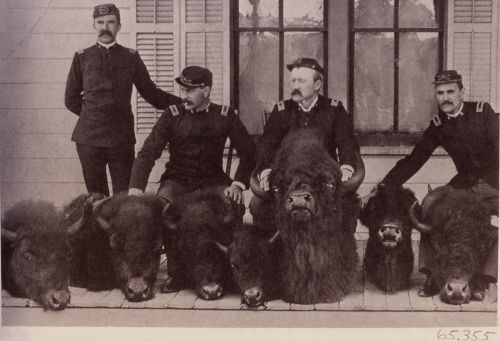
    Buffalo Heads from a Poacher’s Cache

    When the U.S. Army took over administration of Yellowstone Park in 1886, one of it’s primary missions was prevention of the poaching that was decimating the wildlife. The soldiers worked hard to stop illegal hunting, but they lacked authority to anything other than apprehend poachers, escort them out of the Park and order them never to come back. Persistent poachers ignored the orders.

    Finally, in 1894, a poacher was so brazen that he generated public attention and forced Congress to act. Here’s the Park Superintendent’s account of how Ed Howell’s poaching career ended.

    ∞§∞

    Sometime in February I sent a scouting party across the Yellowstone and into the Pelican Valley to look alter the herds of buffalo and elk that usually winter there. On the return of this party they reported to me that they had found an old snowshoe and toboggan trail, but that they were unable to follow it. It apparently headed in the direction of Cooke City.

    While this party was still out, word came to me that Ed Howell, a notorious poacher of Cooke City, had passed the Soda Butte Station one stormy night and had gone on into Cooke for supplies, but that he had not carried any of his trophies with him. A few days after this the sergeant in charge of the Soda Butte Station reported the finding of a trail of this same party with his toboggan and followed it as far as the Park line.

    I then determined on a plan which resulted in the capture of Howell. I waited until I thought it was about time for him to be back in the Pelican country, and then sent out a large search party, with Captain Scott in charge. This party arrived at the Lake Hotel on the evening of March 11. Next day Burgess and Sergeant Troike of the Sixth Cavalry went over into the country previously indicated by me, and made their camp.

    On the morning of the 13th, very soon after starting, they came across some old snowshoe tracks which they could scarcely follow, but by continuing in the direction of them they soon came across a cache of six bison scalps suspended above the ground, in the limbs of a tree.

    Securing these trophies, the party continued on down Astringent Creek to its mouth and then turned down the Pelican. They soon came across a newly-erected lodge, with evidences of occupation, and numerous snowshoe tracks in the vicinity.

    Soon after this they were attracted by the sight of a man pursuing a herd of bison in the valley below them, followed by several shots from a rifle. After completing the killing, the culprit was seen to proceed with the removal of the scalps.

    While thus occupied with the first one my scouting party ran upon him and made the capture. It turned out, as I had anticipated, to be Howell, who coolly remarked that if be had seen the party sooner they could never have captured him, meaning, of course, that he could have shot them before they were near enough to make effective the small pistol, which was the only weapon they carried. They brought him into this place as a prisoner, reaching here on the evening of the 16th of March.

    I at once made full report of the affair and it was widely noted in the newspapers of the country. A suitable recognition, in the way ot a certificate, was made of the coolness and bravery of Burgess and Troike. The scalps, as far as they could be saved, were brought in and properly prepared by a competent taxidermist and placed at the disposal of the Department.

    The feeling aroused in the minds of the public by this act of vandalism stirred Congress to prompt action, so that on May 7 an act for the protection of game in the Park received the President’s signature. In order that it may receive wider distribution, I inclose a copy to be printed with this report.

    Howell denied having killed any bison but those found near him, but I feel sure that he did kill the six found in the cache, and it is quite probable that he killed others which we did not find. In one seuse it was the most fortunate thing that ever happened to the Park, for it was surely the means of securing a law so much needed aud so long striven for.

    On April 25 Howell was released from confinement in the guardhouse by your order aud removed from the Park, and directed never again to return without proper permission. On the evening of July 28 I found him coolly sitting in the barber’s chair in the hotel at this point. I instantly arrested him and reconfined him in the guardhouse, had him reported to the U. S. attorney for this district, and on the evening of August 8 he received the first conviction under the law which he was instrumental in having passed. He was convicted before the ITS. commissioner of returning after expulsion, in violation of the tenth oi the Park regulations, and sentenced to confinement for one month and to a fine of 850.

    With this conviction as a precedent and a strong determination to make other arrests under the new law whenever it is violated, I believe the days of poaching in the Park are nearly at an end.

    ∞§∞

    — Captain George S. Anderson,  Acting Superintendent of Yellowstone Park, Report of the Superintendent of Yellowstone National Park, 1895-1896.

    — Photo, Pioneer Museum of Bozeman.

  • A Tale: Skiing with Theodore Roosevelt in Yellowstone Park — 1903

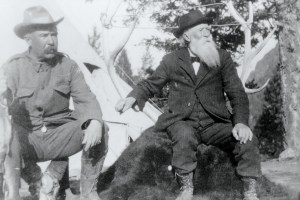
    In 1903 President Theodore Roosevelt invited John Burroughs to join him on a two-week trip to Yellowstone National Park. At the time, Burroughs was a very popular writer whose nature essays were compared to those of Henry David Thoreau.

    Theodore Roosevelt and John Burroughs

    Roosevelt and Burroughs had built a long-term friendship on their mutual respect and love of the nature. They corresponded regularly, mostly about natural history. For some reason the president called Burroughs “Oom John.”

    The pair crossed the country in Roosevelt’s private Pullman car stopping at cities and towns where the president met local dignitaries and gave speeches. Between cities the president reminisced about his life as a rancher and sportsman.

    When they reached the entrance of the park at Gardiner, the Roosevelt left reporters and his secret service guards behind and went through the park accompanied only by Burroughs, Park Superintendent John Pitcher and a small entourage. 

    The 65-year-old Burroughs was afraid he wouldn’t be able the keep up with the 44-year-old president who had a larger-than-life reputation for physical stamina. Here’s Burroughs’ description of what happened when the pair went skiing.

    ∞§∞

    At the Canyon Hotel the snow was very deep, and had become so soft from the warmth of the earth beneath, as well as from the sun above, that we could only reach the brink of the Canyon on skis. The President and Major Pitcher had used skis before, but I had not, and, starting out without the customary pole, I soon came to grief. The snow gave way beneath me, and I was soon in an awkward predicament. The more I struggled, the lower my head and shoulders went, till only my heels, strapped to those long timbers, protruded above the snow. To reverse my position was impossible till some one came, and reached me the end of a pole, and pulled me upright. But I very soon got the hang of the things, and the President and I quickly left the superintendent behind. I think I could have passed the President, but my manners forbade. He was heavier than I was, and broke in more. When one of his feet would go down half a yard or more, I noted with admiration the skilled diplomacy he displayed in extricating it. The tendency of my skis was all the time to diverge, and each to go off at an acute angle to my main course, and I had constantly to be on the alert to check this tendency.

    Paths had been shoveled for us along the brink of the Canyon, so that we got the usual views from the different points. The Canyon was nearly free from snow, and was a grand spectacle, by far the grandest to be seen in the Park. The President told us that once, when pressed for meat, while returning through here from one of his hunting trips, he had made his way down to the river that we saw rushing along beneath us, and had caught some trout for dinner. Necessity alone could induce him to fish.

    Across the head of the Falls there was a bridge of snow and ice, upon which we were told that the coyotes passed. As the season progressed, there would come a day when the bridge would not be safe. It would be interesting to know if the coyotes knew when this time arrived.

    The only live thing we saw in the Canyon was an osprey perched upon a rock opposite us.

    Near the falls of the Yellowstone, as at other places we had visited, a squad of soldiers had their winter quarters. The President always called on them, looked over the books they had to read, examined their housekeeping arrangements, and conversed freely with them.

    In front of the hotel were some low hills separated by gentle valleys. At the President’s suggestion, he and I raced on our skis down those inclines. We had only to stand up straight, and let gravity do the rest. As we were going swiftly down the side of one of the hills, I saw out of the corner of my eye the President taking a header into the snow. The snow had given way beneath him, and nothing could save him from taking the plunge. I don’t know whether I called out, or only thought, something about the downfall of the administration. At any rate, the administration was down, and pretty well buried, but it was quickly on its feet again, shaking off the snow with a boy’s laughter. I kept straight on, and very soon the laugh was on me, for the treacherous snow sank beneath me, and I took a header, too.

    “Who is laughing now, Oom John?” called out the President.

    The spirit of the boy was in the air that day about the Canyon of the Yellowstone, and the biggest boy of us all was President Roosevelt.

    ∞§∞

    — You also might enjoy “The Army Protects Theodore Roosevelt from Snooping Reporter in Yellowstone Park.”

    — Excerpt from “Camping with the President” by John Burroughs,” Saturday Evening Post, May, 1906.

    — Yellowstone Digital Slide File Photo.

  • A Tale: Touring Yellowstone Legally by Car — 1916

    In 1902 when Henry G. Merry raced his 1897 Winton past the cavalry at the North Entrance to Yellowstone Park, the soldiers mounted their horses and chased him down. They took Merry to the Park Superintendent who chastised him and had him escorted out, but not until the Superintendent got a ride in the new fangled contraption. Cars were forbidden because people thought they would frighten wildlife and the horses used by other travelers.

    In 1915 when cars were officially allowed in the park, the action transformed the Yellowstone experience.  As the story below shows, fears of auto-induced mayhem proved to be unfounded.
    ∞§∞

    At the Park boundary is the soldier station. Fortunately the regulations are easily complied with, and in a few minutes the speedometer is again registering the speed limit. One season’s operation of the automobile regulations demonstrated to the powers that be that the average motorist is a saner and more reasonable being than was at first supposed; as a consequence, there has been a considerable downward revision of the rules governing his actions.

    Shortly after the entrance is passed the grade becomes noticeably steeper, and leaving the stream that has been so closely followed, a sharp rise carries the road over the divide through Sylvan Pass at an altitude of eight thousand four hundred feet. Gliding down the western slope through the cool, silent forests affords an indescribably keen enjoyment, and the motorist must have travelled far who has experienced roads as well built and maintained as this, more than a mile and a half above sea-level in the midst of rugged mountain summits.

    Eleanor and Sylvan Lakes are skirted in turn; the latter a dainty body of water set in the depth of an alpine forest and guarded by a grim peak at its head. The waving pines on the islets that dot its surface and the dense growth along its shores dispel any thought of the short distance to timber-line and eternal snow. As the road continues down a gently winding course all expectations are centred on Yellowstone Lake, till at last it flashes afar off through the pines—a great body of water scintillating under the turquoise brilliance of a Wyoming sky. In another instant it is gone and the road turns to hurry down to it in a flowing ribbon that stretches ahead as far as the eye can reach through the forest and across many a meadow of luxuriant grass.

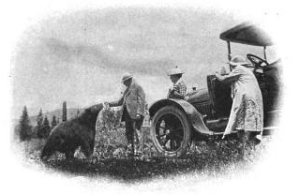
    Half hidden in the long grass of these mountain parks scattered herds of elk and deer may be seen grazing within a few hundred feet of the road, and not even the rasping shriek of the electric horn seems to disturb the peaceful and contented existence of nature’s animals. Prior to the admittance of horseless vehicles to the Park, it was argued that the smell and the unnatural noise of the motors would drive the animal life away from the roads and would bring to an end one of the most fascinating features of this wonderland.

    When, however, the whir of the motor as it toils up the rugged heights of Mt. Washburn, and passes almost unnoticed within two hundred yards of a band of the most wary of wild animals, the Rocky Mountain sheep, and when at night the bears, having feasted on ”beefsteaks that have proved too tough for the tourists,” make bold actually to clamber into the motor-cars and despoil seat cushions in search of sweets unwittingly left in side pockets, it will be appreciated that the contention that the motor-car would frighten these animals was quite without foundation. The whole atmosphere of Yellowstone seems to exert a soothing effect on both man and beast, and it is said that “Even broncs won’t buck in the Park.”

     ∞§∞

    —   Excerpt and photo from Charles J. Beldon “The Motor in Yellowstone,” Scribners Magazine, 63:673-683 (1918).

    — You also might enjoy Henry G. Merry’s story about the first car in Yellowstone.

  • View: Thomas Moran Painted His Impression of the Grand Canyon of the Yellowstone

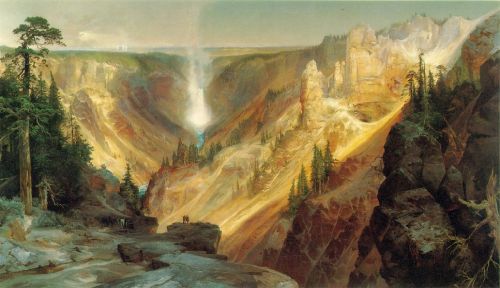
    “The Grand Canyon of the Yellowstone,” Thomas Moran

    In their journals, many tourists compared the experience of actually seeing the Yellowstone Falls and Canyon to viewing Thomas Moran’s famous painting, “The Grand Canyon of the Yellowstone.” They often disagreed on the question, ”did he get the colors right,” perhaps because the canyon looks different depending on cloud cover and sun angle. But few of them commented on other differences between viewing the painting and what they saw at the canyon.

    Moran said “I place no value upon literal transcripts from Nature . …  I did not wish to realize the scene literally, but to preserve and to convey its true impression.” To convey this “true impression,” he included several elements in the painting that could never have been seen at a single time and place.

    The painting is 12 feet wide and 7 feet tall making it impossible to see its details here, but one writer described Moran’s painting like this in 1872 when it was new:

    ∞§∞

    One of the last acts of Congress was the purchase of Mr. Thomas Moran’s “Grand Canyon of the Yellowstone,” for ten thousand dollars. It is to be placed above one of the great marble stairways in the Senate wing of the Capitol. It is the most magnificent painting we ever beheld, and we have seen Bierstadt’s “Yo Semite” and “Rocky Mountains.”

    Geyser Plumes Detail

    The Rocky Mountain range is just visible in the far distance, with the ” Tetons,” three snow covered peaks, rising above. Three of the largest geysers may also be seen in the distance and to the left of the Fall.

    The track of the river may be known by a long depression in the distant landscape. On a level plateau of purplish rock, or calcareous substance in the foreground, a few men and horses are standing.

    A dead deer or antelope lies near, and behind a cluster of huge pines, on a beetling rock, stands a large bear calmly surveying the scene. To the right in the foreground, the rocks are piled up rugged and high, and in the shadow are of a purplish-brown color.

    Just beyond this is a long smooth slope of gold color shaded to a pale primrose on one side, and to a very deep orange on the other, while still beyond rise the wonderful cliffs, which give to the scene a character distinct from any in the world.

    The coloring is pale gold in ground work, with lines and figures in violet, crimson, scarlet, deep amber and vermilion—just as if tinted by rainbows and sunbeams! This most strange and beautiful coloring is produced by the water oozing through the veins of the calcareous towers and domes, which are filled with iron and sulphur.

    One can readily imagine the tallest cliff to be a vast cathedral, with its outer walls painted in the fadeless colors of Pompeii, and with windows of deeply stained glass. The gorge or Canyon—worn to a great distance by the Fall—is, in the first broad light, of a yellowish gold; then in the deepening shadow is lavender, and lilac, and at the farthest point, deep purple.

    Here, two miles from the beholder, the Yellowstone River, blue as a summer sky, falls a distance of three hundred and fifty feet, over the gorgeous cliff, with the white mist rising, ever and always upward, like the prayer of a troubled soul, to the blue heavens above. It is too grand and wonderful for words to describe it, and none can ever judge of its wonders from any engraving or photograph in mere black and white.

    ∞§∞

    Among the “impressionistic” elements of the painting are:

    • There is no vantage where a person can see the Falls, The Grand Tetons, and geyser plumes simultaneously.

    Two Men Detail

    • It’s unclear who the small figures in the foreground are. Conjectures include Ferdinand Hayden, the head of the government expedition that Moran traveled with, and his executive officer, James Stevenson, or Moran himself and photographer William Henry Jackson, who was also on the expedition.

    • And, not visible here, a slaughtered deer and native American with his back turned to the canyon.

    Moran never offered any explanation of these things and was content to let the painting stand on its own. He probably would have agreed that seeing the painting was no substitute for the real thing. But then, seeing the real thing is no substitute for the painting.

    ∞§∞

    —  The description of Moran’s painting is from The Ladies’ Repository: Universalist Monthly Magazine,1872.

    — For more about Moran’s legacy, click “Thomas Moran” under the Catergories  Button.

    — See this link for a discussion of Moran’s view of art and his obligation to reproduce nature. 

  • A Tale: A Mother Takes Her Seven Children to Yellowstone Park — 1903

    In 1903, Eleanor Corthell bought a team of horses and a spring wagon to take her seven children to Yellowstone Park. She told the seller to send his bill to her husband, Nellis Corthell, a prominent Laramie lawyer. Nellis tried to talk Eleanor out of the trip, but in the end, she said, all he could do was “fizz and fume and furnish the wherewithal.”

    Here are some excerpts from Mrs. Corthell’s account of her family’s adventures.

    ∞§∞

    Nearly half a lifetime I have lived in Laramie, with all the while a great longing to see the wonders of the Yellowstone, in season, out of season, when the house was full of babies—even when it was full of measles. As the older children outgrew marbles and dolls, I conceived the bold idea of stowing them all in a prairie schooner and sailing away over the Rocky Mountains, deserts, forests and fords to the enchanted land five hundred miles away.

    My husband offered strenuous objection, of course, to the crazy project, but could only fizz and fume and furnish the wherewithal—for the reasons advanced he found irresistible, such an ideal vacation for the children. A chance for their botany, geography, zoology, to be naturalized. To be drivers and cooks would throw them on their own resources somewhat, a valuable education in itself. So economical, too! Such a fine opportunity for stretching of legs and lungs, with the Park at the end! Reasons to turn a man’s head, you see, so when the boys wrote along the wagon top ” Park or Bust,” that settled it, and we started July 4th, 1903.

    After traveling several days, Mrs. Corthell wrote:

    Everybody is growing handy, even expert, in camp work. The boys can skin a cottontail or dress a sage hen equal to Kit Carson himself, while daughter can prepare a savory dinner or pack a mess box good enough for an army general. The children are eagerly interested in everything they see, hear or can catch. Tad announces that we have seen nine horned toads, caught six, mailed three and have two packed in little tablet boxes with which to surprise the chum at home. Query: Where is the medicine that was in the boxes?

    At the Paint Pots near West Thumb on Lake Yellowstone, Eleanor was vigilant.

    I was kept busy counting the children. Every time one of them moved I was certain he would stumble into one of the boiling, walloping vats of mud. That the mud was delicate rose, emerald green, or heavenly blue did not reassure me in the least. But the children simply laughed. Even the youngest pertly informed me he had not come all the way to Yellowstone Park to fall into a mud hole. Still the horrid smells and the horrible groans and growls, and the gaping mouths clear to Hades aroused such emotions of terror in me that in sheer desperation I hurried over to the lake.

    Eleanor summarized the trip this way:

    Like everybody else, we loved Old Faithful and the Morning Glory, we feared Excelsior, we admired the Giant, Bee Hive, Punch Bowl and a hundred other yawning chasms and smiling springs and spouting geysers. But the horrible rumbling—as if an earthquake were imminent—and the smell of brimstone made me eager to get my brood into the valley of safety beyond the Yellowstone.

    Altogether we traveled twelve hundred miles, stood the journey well, and never, never had such a wonderful, delightful summer. The children will have lifelong memories of the grandest scenes the world can produce.

    ∞§∞

    — Excerpts from “A Family Trip to the Yellowstone” by Mrs. N. E. Corthell, The Independent, June 29, 1905.

    — Photo from the Pioneer Museum of Bozeman.

    — You can read Eleanor Corthell’s complete story about her family trip in my book, Adventures in Yellowstone.

    — You also might enjoy Mrs. Corthell’s story about chasing a bear away from her bean pot.

  • A Tale: Stampeded by an Umbrella — Wingate, 1885

    General George W. Wingate, a wealthy New Yorker, took his wife and 17-year-old daughter to Yellowstone Park in 1885. Although there were roads by then, the Wingates decided to travel on horseback and the women rode sidesaddle. Here’s General Wingate’s description of an incident that occurred while the ladies were riding through the Paradise Valley north of Yellowstone Park.

     ∞§∞

    Hemmed in on every side by high mountains every breath of air was excluded, while the sun beat into it like a furnace; consequently the ride was very hot and tiresome. The heat was so great that the ladies got out their umbrellas from the wagon and raised them, but slowly with great care, for fear of stampeding the ponies who were not familiar with those refinements. The horses, however, were tired and languid from the heat and paid no attention to them so the rode forward in comfort.

    As we reached the end of the valley, where the Park branch of the Northern Pacific terminates, a dashing young ranchman rode out from behind some buildings. He had a spirited horse and rode well—and he knew it. Ladies were scarce in the valley, and the opportunity to display his horsemanship and personal graces to two at once was not to be thrown away. So he swung his horse around and rode towards us, making his steed curvet and prance, while he swayed to the motion as easily and gracefully as if in an armchair.

    While we were admiring him, a sudden gust of wind came whirling out of a canyon. It caught my daughter’s umbrella and instantly turned it inside out, with a loud “crack.” At the unwonted sight and sound, our horses roused from their lethargy, simultaneously reared, snorted and bolted in different directions, and at their top speed.

    The steed of our gallant ranchman was even more frightened that ours. It ran half a mile with him, and as we last saw him he had all he could do to keep it from dashing into a barbed wire fence. The change from his jaunty air to that of anxiety to keep the horse out of the fence was sudden and ludicrous. I fear his pride had a sad fall.

    We could do nothing with the horses until May threw away her unbrella, and even then none of our steeds would approach it.  As [our guide] Fisher said, “umbrellas and cayuses don’t agree.”

    ∞§∞

    — Text adapted from Through Yellowstone on Horsback by George W. Wingate, 1886

    — Detail from illustration in Wingate’s book.

    — You also might enjoy “Little Invulnerable,” N.P. Langford’s description of the antics of an undersized horse.

  • A Tale: Rumors of Wonders on the Upper Yellowstone — New York Times 1867

    Thumb Paint Pots

    After the Montana gold rush of 1863, groups of prospectors began scouring the area that became Yellowstone Park for gold. Occasionally their reports appeared in territorial newspapers. According to conventional wisdom, however, newspapers in the states (as opposed the the territories) were always skepical about reports of wonders on the upper Yellowstone until the famous of Washburn Expedition of 1870. This report from the September 14, 1867, issue of The New York Times proves that wasn’t always the case, although the reports of “blue flame” and “molten brimstone” don’t match any known features of the area today and show that some skepticism was in order.

    ∞§∞

    The Montana Post says that an exploring party, which has been to the headwaters of the Yellowstone River, has just returned and reports seeing one of the greatest wonders of the world. For eight days, the party traveled through a country emitting blue flame and a living stream of molten brimstone. The country was smooth and rolling, a long level plain intervening between roiling mounds. On the summits of the roiling mounds were craters for 4 to 6 inches in diameter, from which streamed a blaze and constant whistling sound. The hollow ground resounded beneath our feet as they traveled and every moment seemed to break through. Not a living thing was seen in the vicinity. The explorers gave it the significant appellation of hell.

    ∞§∞

    — New York Times, September 14, 1867, page 1.

    — Ashahel Curtis Postcard, Copperplate Photo Gallery