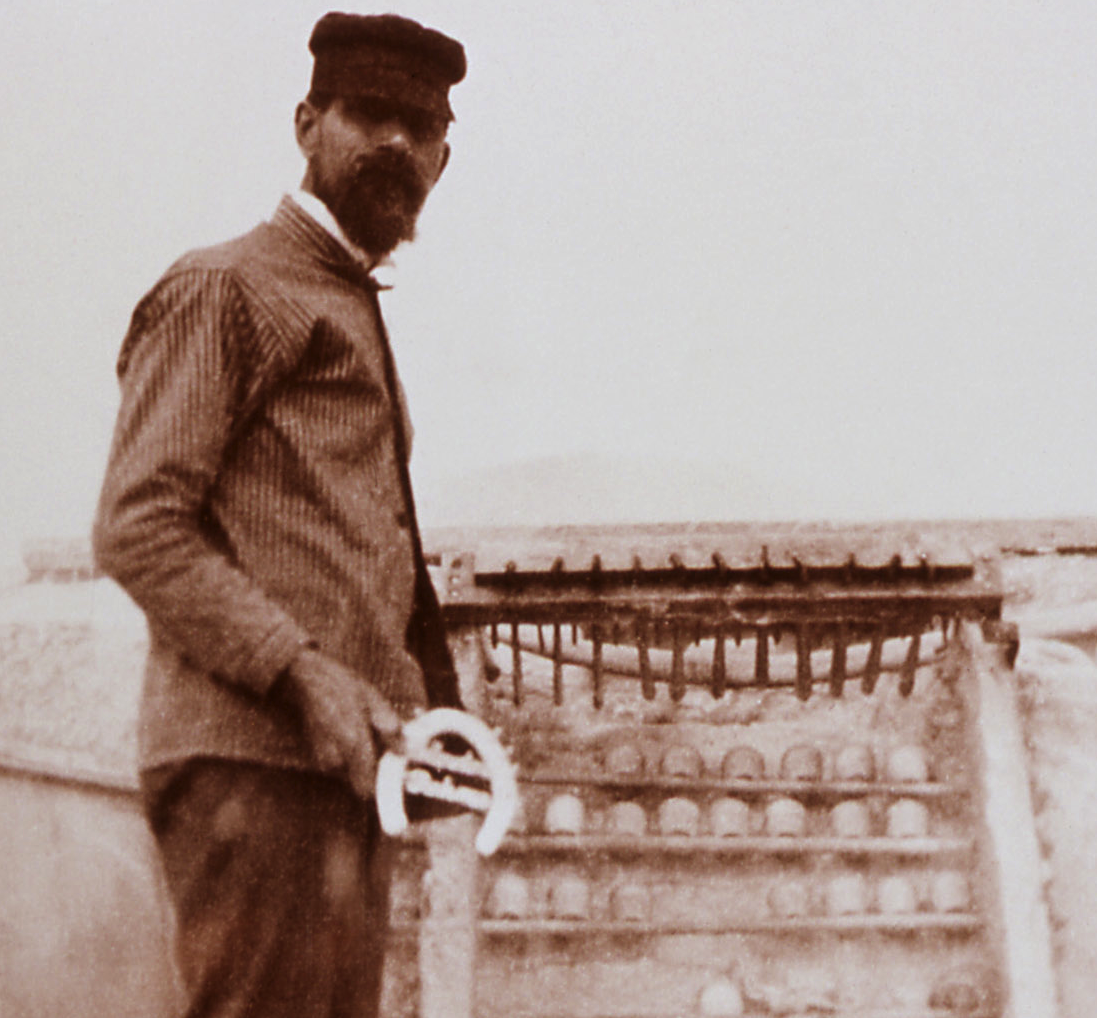
Tag: Fred Bottler

  • A Tale: Gilman Sawtell, Yellowstone’s First Commericial Guide

    On Friday afternoon, while I was doing my usual shift as a volunteer at the Pioneer Museum of Bozeman, I saw that the new edition of the Pioneer Museum Quarterly was out.  Of course, I immediately went through it to look at my article on Gillman Sawtell.  It’s a companion piece to the one I published last summer on Fred Bottler.

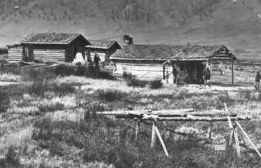
    Sawtell's buildings at Henry's Lake.

    Sawtell and Bottler were pioneer ranchmen who in the 1860s staked out claims on the edges of what was to become Yellowstone Park—Bottler in the Paradise Valley north of the park, Sawtell at Henry’s Lake to the west.  Their ranches became stopping points for early Yellowstone explorers and tourists and both were park guides.  Here’s a excerpt from the Quarterly article on Sawtell.

    ∞§∞

    Sawtell staked his claim on the northwest edge of Henrys Lake and launched a group of enterprises that included ranching, commercial hunting and guiding tourists.

    Sawtell’s main business was harvesting and selling fish, as many as 40,000 of them a year. He reportedly caught as many as 160 trout an hour, averaging two and a half pounds each, with a hook and line. In winter when the lake froze over, springs kept open a small area near Sawtell’s compound. Fish swarmed the open water and Sawtell harvested them with a spear.

    Sawtell sawed blocks of ice from the lake in winter and stored them packed in sawdust in a sturdy thick-walled icehouse he built of logs. He stored his catch in the icehouse until he had enough to fill his wagon. As late as 1896, Sawtell was hauling fish to Monida where they were loaded into railroad cars for sale in Butte and Ogden, Utah.

    While launching his enterprises, Sawtell built a veritable village. He had six sturdy log buildings: a residence, a blacksmith shop, a stable, a storage shed for hides and game, and his icehouse. He apparently had guests in mind when he built the compound. His whitewashed house was big enough to accommodate 20 people and had numerous bedsteads, stools, and tables. He kept enough stoneware to serve that many.

    Sawtell kept tamed antelope and elk at his ranch. In 1871, he used a rowboat to run down several baby swans. He raised the signets until they were big enough to travel (about the size of domestic geese) and shipped them to New York City for Central Park.

    In 1871, Sawtell guided a group of men from Virginia City and Deer Lodge on a tour that covered the geyser basins, Yellowstone Lake, and the Grand Canyon of the Yellowstone. Because of this trip, Sawtell is credited with being the first commercial Yellowstone guide.

    ∞§∞

    —Excerpt from M. Mark Miller, “Gilman Sawtell: Yellowstone Pioneer at Henry’s Lake,” Pioneer Museum Quarterly, Winter 2012, pp. 13-15.

    —  You can read the rest of my article about Gilman Sawtell by buying a copy of the Quarterly at the Pioneer Museum of Bozeman.  Better stil, join the Gallatin Historical Society and get a free subscription.

    — You might also enjoy my story about Fred Bottler, who settled in the Paradise Valley north of Yellowstone Park in 1867.

    — Detail from an 1872 William Henry Jackson photo.

  • A Tale: A Dark and Stormy Night in Yellowstone Park — Dunraven, 1874

    Late October is a time for scary stories so I decided to check my collection of tales from Yellowstone Park for one to share here. I didn’t find anything about geyser ghosts and goblins, but I did locate a chilling tale by the Earl of Dunraven.

    Dunraven was hunting in Yellowstone in 1874. (It was legal then.) When a storm came up, the Earl and his guides, Fred Bottler and Texas Jack Omohondro, decided to return to camp, but their companion, Dr. George Kingsley, decided to keep hunting a little longer. The storm grew worse as darkness fell. Here’s the Earl’s story about what happened next.

    ∞§∞

    When Jack and I got in we found camp in a sorry plight, everything soaked through—tents, bedding, and all, and our prospects for the night looked anything but cheerful; but by extending the hide of the wapiti stag between four trees, and hauling it out taut with ropes, we managed to make a tolerable shelter; and, taking from out of our cache some dry birch bark and splinters of fat pine, we lit a huge fire, and sat down to make some tea for supper.

    About dusk, we heard a shot, and visions of fresh venison steaks floated before our eyes. About half an hour passed, but no venison and no Kingsley appeared, and then we heard another shot, and two or three minutes afterwards yet another.

    By this time, it was getting quite dark, and we were puzzled to know what Kingsley could be firing at—unless, indeed, he was treed by a bear. After a short interval we heard the sound of his rifle again, evidently further off, and then it suddenly occurred to us that he was lost and making signals. We fired our rifles, and whooped, and yelled, and shouted, but all to no purpose. The sound of his rifle became fainter and fainter; —he was going in the wrong direction.

    To be left out on such a night might cost a man his life, for it would have been hard for even an old experienced mountain man to have found material dry enough to make a fire; so Jack and Bottler started out into the blackness of the night and the thick fog to look for him, leaving me behind to heap logs on the fire, and occasionally emit a dismal yell to keep them acquainted with the whereabouts of camp.

    For some time I could hear the responsive shouts of the searchers, but after awhile they ceased, and nothing broke the horrid silence except the noises of the night and of the storm.

    The heavy raindrops pattered incessantly on the elk hide; the water trickled and splashed, and gurgled down the hillside in a thousand muddy rills and miniature cascades. The night was very dark, but not so black but that I could dimly see white ghost-like shreds of vapor and great indistinct rolling masses of fog driving up the valley in the gale. The wind rumbled in the caverns of the cliffs, shrieked and whistled shrilly among the dead pine trees, and fiercely shook the frail shelter overhead, dashing the raindrops in my face.

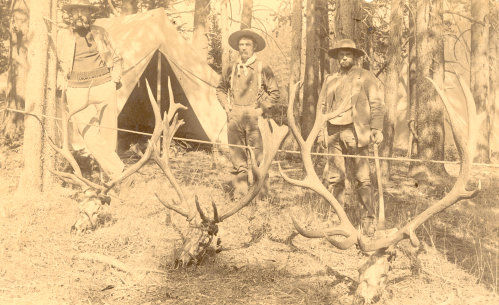
    Every now and then the fire would burn up bright, casting a fitful gleam out into the damp darkness, and lighting up the bare jaws and white skulls of the two elk-heads, which seemed to grin derisively at me out of the gloom; and then, quenched by the hissing rain, it would sink down into a dull red glow.

    My dog moved uneasily about, now pressing close up against me, shivering with cold and fear, nestling up to me for protection, and looking into my face for that comfort, which I had not in me to give him—now starting to his feet, whimpering, and scared when some great gust smote the pine tree overhead, angrily seized and rattled the elk-hide, and scooping up the firebrands tossed them in the air.

    The tall firs bowed like bulrushes before the storm, swaying to and fro, bending their lofty heads like bows and flinging them up again erect, smiting their great boughs together in agony, groaning and complaining, yet fiercely fighting with the tempest.

    At intervals, when the gale paused for a moment as it were to gather strength, its shrill shrieking subdued to a dismal groan, there was occasionally heard with startling distinctness, through the continuous distant din and clamor of the night, a long, painfully-rending cr-r-r-rash, followed by a dull heavy thud, notifying the fall of some monarch of the woods, and making my heart quake within me as I uneasily glanced at the two tall hemlocks overhead that wrathfully ground their trunks together, and whose creaking limbs were wrestling manfully with the storm.

    Strange and indistinct noises would come up from the vale: rocks became detached, and thundered down the far-off crags. A sudden burst of wind would bear upon me the roar of the torrent below with such clearness that it sounded as though it were close at hand. It was an awful night, in the strictest sense of the word. The Demon of the Tempest was abroad in his anger, yelling down the valley, dashing out the water-floods with his hands, laying waste the forest, and filling with dread the hearts of man and beast and every living thing.

    There was not a star or a gleam of moonlight. It was very gruesome sitting there all alone, and I began to feel, like David, “horribly afraid.” I do not know how long I was alone; probably it was only for a short time—a couple of hours or so, at most— but the minutes were as hours to me.

    Most dismal was my condition; and I could not even resort to the Dutch expedient for importing courage, to supply my natural allowance of that quality which had quickly oozed out of my cold fingertips. I had poured into a tin pannikin the last drain of whisky from the keg, and had placed it carefully to settle.

    I knew that Kingsley would really want it, so I could not seek consolation in that way. I could not find even a piece of dry tobacco wherewith to comfort myself; I began to feel very wretched indeed; and it was truly a great relief when I heard the shouts of the returning party.

    They brought in the lost man pretty well exhausted, for he had been out a long time exposed to the weather, had walked a great distance, and had fallen about terribly in the darkness. He had tried in vain to make a fire, and was wandering about without an idea of the direction in which camp lay.

    He was indeed in real need of a stimulant, and when, in answer to his inquiring glance at the keg, I said that there was half a pannikin full, his face beamed with a cheerful smile. But alas! A catastrophe had occurred. A gust of wind or a falling branch had over-thrown all my arrangements, and when I arose to give him the pannikin, behold, it was bottom upwards and dry!

    ∞§∞

    —   From the Earl of Dunraven, Hunting in the Yellowstone, New York: Outing Publishing Company, 1917. (Pages 174-177.)

    —   C.D. Loughrey Photo, c. 1888, Pioneer Museum of Bozeman.

    — To see more stories by by the Earl, click on “Dunraven” under the Categories button on the left side of this page.
  • A Tale: Snow Stymies An Attempt To Explore Yellowstone — 1870

    When my Summer 2011 issue of Pioneer Museum Quarterly arrived, I immediately went through it to find my article, “Fred Bottler: Yellowstone Pioneer in Paradise.” It’s always thrill to see my stuff printed on slick paper in justified columns.

    Philetus W. Norris

    Fred Bottler started the first permanent ranch in the Paradise Valley in 1867 in a spot halfway between Bozeman and Mammoth Hot Springs, a day’s ride from each of them. That made Bottler’s a perfect overnight stop for early travelers on their way to Yellowstone Park. Also, Bottler hunted elk and prospected for gold in the park before he started ranching so he was the perfect guide.

    Many early travelers mention Bottler in their journals and reminiscences and I began collecting information about him several years ago. When Pioneer Museum Director John Russell asked me to write an article for the Quarterly, I organized my Bottler file and went to work. The result is an account of Bottler’s life and a collection of stories about him.  Here’s a sample.

    ∞§∞

    In 1870, Philetus Norris, who became the second Yellowstone Park Superintendent, hired Bottler to guide him to the wonders of the region. Perhaps driven by the knowledge that others were planning a similar expedition later that summer, Norris and Bottler headed into the park in early June. Deep snow prevented them from getting to the grand geysers, so they decided to try to cross the mountains to Mammoth Hot Springs.

    Norris described their trek this way: “Although the snow-capped cliffs and yawning chasms in the basaltic or ancient lava beds, fringed with snow-crushed, tangled timber and impetuous torrents of mingled hot-spring and snow-melt water made our progress—mainly on foot, leading our horses—slow, tedious and dangerous, we persevered until we came to a large river.”

    It was the snowmelt-swollen Gardner River, a knee-deep stream 20 feet wide. When Bottler stepped into the rushing water, the torrent knocked him off his feet, swept him away and carried him downstream. Bottler grabbed an overhanging cottonwood branch and hung on. Norris rushed up barely in time to save him. Bottler had lost his rifle and ammunition belt in the icy water.

    Norris summarized the situation like this: “With my only companion sadly bruised by the rocks, benumbed, the remnants of his dressed elk-skin garments saturated by snow water, without gun or pistol, in a snow-bound mountain defile in an Indian country, even a June night was far from pleasant for us.”

    The next morning, Norris surveyed the area with his powerful field glasses and spotted steam rising from Mammoth Hot Springs eight miles away. The men decided they couldn’t make it to the springs over the mountain torrents swollen by melting snow. Besides, they had only one gun to provide meat and protection from wild animals and Indians. The river accident had banged Bottler up too much for him to climb back over the mountains, so they headed down the second canyon of the Yellowstone River, which later became known as Yankee Jim Canyon.

    Bottler returned to his ranch to recuperate, and Norris went to Missoula to attend to business. From Missoula, Norris proceeded to the Pacific coast where he heard in August that a party headed by Montana Surveyor General Henry Washburn had returned from exploring the upper Yellowstone. Apparently, the news that others had beat him to documenting the wonders of the Yellowstone upset Norris greatly. “I was intensely mortified,” he said, “to learn that Messrs. Langford, Hauser and others had gone up the Yellowstone.”

    ∞§∞

    — Excerpt from M. Mark Miller, “Fred Bottler: Yellowstone Pioneer in Paradise,” Pioneer Museum Quarterly, Summer 2011, pp. 13-18.

    — You can read the rest of my stories about Fred Bottle by buying a copy of the Quarterly at the Pioneer Museum of Bozeman.  Better still, join the Gallatin Historical Society and get a free subscription.

    — Photo, Yellowstone Digital Slide File.

  • A Tale: Mabel Cross Osmond: Dolly Saved My Life — 1874

    Coating souvenirs at Mammoth Hot Springs

    Mabel Cross Osmond was just six and half years old when she first went to Yellowstone Park with her parents in 1874. Mabel’s father Captain Robert Cross was a Civil War veteran who came to Montana to be the post trader at Crow Agency, which was then located nine miles east of the present Livingston, Montana.

    Mabel wrote her memoir more that fifty years after her trip, but she still had vivid memories of it including such details as the saddle she rode. “The blacksmith,” she said, “taking a man’s saddle, fastened a covered iron rod from the pommel around on the right side to the back. This rod and the seat were well padded with blankets.  A covered stirrup, wide enough for my two feet was hung on the left side and across this open side from the pommel to the rod in back was attached a buckled leather strap so that, when mounted, I sat as a child in a high chair.”

    Mabel of rode an Indian pony she called “Dolly” that she said saved her life “by instantly stopping when, while descending a steep trail my saddle turned, leaving me hanging head downward, helplessly strapped in until the others could reach me.”

    The Crosses had an army escort to see them though Indian country until they reached the Bottler ranch.  Mabel recalled the stop clearly.

    “We enjoyed one of Grandma Bottler’s good dinners. I remember the cute little roast Pig with an ear of corn in its mouth, and also being awakened during the night by hearing her shrilly shouting — “Fredereek, Fredereek, the skunk is after the chickuns.” Though eighty years old, she kept her ‘store teeth’ put away —‘fearing to wear them out’ — she told us.”

    At Mammoth Hot Springs, Mabel’s father made a basket out of her mother’s corset stays and laid it in one of the pools.   The running waters encrusted the item with white mineral deposits making a souvenir that Mabel still had when she wrote her memoir.

    The Crosses traveled along Indian trails and through timber so thick that it hid the sky and pack mules had difficulty carrying their wide loads between the trees.  They camped at the geyser basins for several days, plenty of time to see most of the geysers play.

    When the Crosses got the Yellowstone Lake, Mabel took a ride on the boat that Sarah Tracy had named  “The Sally” just weeks earlier.  Mabel sailed to a small island where she feasted on gooseberries and ripe red raspberries, but she attributed the seasickness she got on the return trip to rough waters.  She said her hosts named an Island for her, but it didn’t stick.

    ∞§∞

    — Adapted from Mabel Cross Osmond, Memories of a Trip Through Yellowstone National Park in 1874. Typescript, Pioneer Museum of Bozeman.

    — Photo, Yellowstone Digital Slide.

  • A Tale: Doughnuts in Bear Grease, Sarah Tracy — 1873

    Doing Laundry in a Hot Spring

    Indians stole a band of horses the day before Sarah Tracy left Bozeman for Yellowstone Park in June of 1873. But Mrs. Tracy was used to Indians. When she arrived in Bozeman in 1869 with her new husband, Bozeman Pioneer W.H. Tracy, Indians were encamped on the south side of town. She said, “They would peer in the windows if the doors were locked, or come flocking around the door begging for biscuits, soap, clothes, everything.”

    Such encounters left Mrs. Tracy with little fear of Indians, but the commander at Fort Ellis still didn’t want to let her party go to Yellowstone in the midst of “Indian troubles.” Finally, after some haggling, he agreed to provide an armed escort.

    “We were soon on our way with twelve mounted soldiers following us,” Mrs. Tracy said in a reminiscence she wrote about the trip. “With their guns and knapsacks on their shoulders, and their belts filled with cartridges, they looked very war like.” The soldiers escorted the stage across Trail Creek Pass to the Yellowstone River and then turned back after seeing no signs of Indians. The party then headed south to the Bottler brothers’ ranch. Diaries of early trips to Yellowstone often mention a stop at Bottlers.

    In 1868 Frederick and Phillip Bottler started the first permanent ranch in the Paradise Valley. The Bottlers’ ranch was a one-day ride from Bozeman and located halfway to Mammoth Hot Springs. That made it an ideal stopping point for travelers heading for the park. The Bottlers always made visitors welcome and eventually started a guesthouse.

    After a night at Bottlers, the stage headed to Mammoth Hot Springs over a new road through Yankee Jim Canyon. This road was so bad Mrs. Tracy said that it “fairly made one shudder to ride over it in a four-wheeled stage coach.” As the coach approached Mammoth passengers got a marvelous view from the top of a hill, but the descent down the mountain required chaining the stage’s rear wheels. This “rough locking” slowed the stage by making it skid and keeping it from crowding the horses.

    “We drove up to the hotel with a grand flourish of the four-horse whip, bringing the landlord and the guests to the door to meet us.” This description conjures pictures of an elegant building, but the “hotel” at Mammoth then was just an 25-by-35 foot log cabin with a sod roof. Crude as it was, the hotel had hot and cold running water; a stream of 40 degrees ran on one side and of 150 degrees on the other.

    Mrs. Tracy and her companion, Sarah Graham, waited for their husbands to join them for two days. They enjoyed fishing, climbing the terraces, two baths a day and three hearty meals. When the men arrived they all started on horseback for a tour of the Park.

    “We rode side saddles,” Mrs. Tracy said, “and it was quite difficult for an amateur rider to keep seated.” Their train of a saddle horse for each traveler and eight packhorses made an impressive appearance strung out on the trail.  Their route frequently crossed the rushing, boulder-strewn Gardiner River, and Sarah said,

    I was in great fear of crossing, but as there was no alternative, I had to hold on as best I could. At first, I dismounted to walk over the bad places, but they were so frequent, I concluded to remain in my saddle. One old mountaineer remarked, “Wait until the mountains are so steep you must hold onto the horse’s ears going up, and tail going down.” And we certainly found some mountains where the saddle would slip over the back going up, and nearly over the head coming down. We made only one ride each day, as it was too much work to repack the horses.

    At Yellowstone Lake they found the man who had guided Emma Stone’s party, E.S. Topping, and his partner, Frank Williams. The men had recently built a sailboat. They said they would let the first woman to visit name the boat.  Since Mrs. Tracy and Mrs. Graham were both named Sarah, they decided to christen the boat “The Sallie.” Mrs. Tracy said after the name was painted on the boat, “We had a fine sail across the lake and our pictures taken on board,”

    At their camp, Topping and Williams rewarded the women by letting them make doughnuts fried in bear grease. In her reminiscence, Mrs. Tracy said of her twelve-day trip:

    “The balmy breezes and mountain sunshine had done our complexions to a turn. While our clothing was little worse for wear, yet we had seen the Yellowstone National Park in its primitive beauty. And bear’s grease doughnuts had certainly agreed with us.”

    ∞§∞

    — Sarah Tracy’s reminiscence is at the Museum of the Rockies in Bozeman.

    — You also might enjoy reading about Emma Stone, the first woman to make a complete tour of Yellowstone Park.

    — Photo, Yellowstone Digital Slide File

  • Early Yellowstone Entrepreneurs

    Just in case you missed it, I decided to post a link to my article, Entrepreneurs on the Edges of Yellowstone, that was published in the summer 2008 issue of The Big Sky Journal.

    It describes the first intrepid entrepreneurs who tried to turn a dollar in Yellowstone Park. There’s Gilman Sawtell, a rancher and commercial fisherman who harvested thousands of fish from Henry’s Lake near the west entrance to the park. And Fred Bottler, who started ranching north of the park and hunted elk for their hides shipping them back east by thousands.  Sawtell and Bottler were also the first park guides.

    There are hotel and road builders and their first customers including women who rode sidesaddle through the roadless wilderness. Just click this link to read all about them.

    ∞§∞