Tag: Geyser

  • News & Views: Visitors “Outrageously” Close to Old Faithful

    Visitors Near Old Faithful, April 2011

    A front-page article in the Bozeman Daily Chronicle reported this morning that a group of tourists had been caught on video standing within a few feet of the famous Old Faithful Geyser. Chronicle Staff Writer Daniel Person reported: “The outrageous incident was captured by a webcam that broadcast live footage of Old Faithful and is unlike anything park officials have seen in recent times.”

    Explorers Near Old Faithful, August 1871

    I was struck by the similarity between the new picture and famed Yellowstone Photographer William Henry Jackson’s 1871 photo of Old Faithful. Jackson’s photo shows members of the government sponsored Hayden Expedition standing closer to the geyser than did the 2011 visitors.  Certainly, Jackson’s photo, which is thought to be the first taken of the famous geyser,  doesn’t document “outrageous” behavior. It shows that over the last 140 years people have learned how to protect themselves and the wonders of Yellowstone.

    My collections of first-person accounts of early travel to Yellowstone Park includes reports of all kinds of things that would be considered outrageous today like gathering mineral specimens by the wagon load, hunting bald eagles for sport, and dumping rubble in Old Faithful just to see what would happen.

    We can be glad that such activities are now considered to be outrageous.

    ∞§∞

    — Color photo, frame capture from NPS live website camera at Old Faithful.

    — William Henry Jackson photo, Yellowstone Digital Slide File.

    — You might also enjoy these stories:

  • A Tale: Saving a Scalded Man — c. 1872

    After the Washburn Expedition got home in 1870, the news stimulated enormous excitement in Montana. Bozeman artist and photographer Henry “Bird” Calfee and his friend, Macon Josey, decided to see the wonders. 

    Henry "Bird" Calfee

    Calfee’s account of their trip was found at the Pioneer Museum of Bozeman in a clipping from an unidentified newspaper, which apparently was published about than twenty years after the trip. Calfee said the trip took place in 1871, but that must be in error because he recounts things that didn’t occur until 1872—like an encounter with the notorious Harlow gang of horse thieves. 

    Calfee was so impressed with the park that he returned often, and eventually started a business selling Yellowstone photographs. Here’s an excerpt from his reminiscence that tells about Josey falling in a geyser, an incident I fictionalized in my middle-grade novel, Macon’s Perfect Shot.

    ∞§∞

    While out exploring and gathering specimens on a tributary of the Firehole River we scared a dear out of a small bunch of timber. In its frightened condition, it attempted to bound over a large open geyser that was in its line of retreat. Failing to land with its hind feet on the farther edge of the formation, it fell backwards into the boiling caldron. We hastened to its rescue and attempted to raise it out by thrusting a long pole under its belly. The formation gave way with us, my companion going down with it into the horrible seething pool. I narrowly escaped by falling backward into the solid formation.

    I assisted my companion it quickly as possible, but in one half minute he was scalded from his waist down. He was so a badly scalded that when I pulled his boots and socks off the flesh rolled off with them. I managed to get him back to camp and put what little remaining flour we had on his raw and bleeding burns.

    I began immediately making preparations for an early start the next morning for the settlement on the Madison River below. I expected to reach them in two days, but so slow was our progress that we were scarcely out of sight of the lower geyser basin at the end of that time. I hastily constructed a travois after the Indian style, in which Josey could ride.

    I then went up to the old Faithful geyser to whom we had delivered our washing the morning before. I found it all nicely washed and lying on his pearly pavement ready for delivery. Our linen and cotton garments, which had been stiff and black with dirt, lay there as white as the driven snow, and our woolen clothes were as clean as could be. But oh my, imagine them in that mammoth unpatented washing machine boiling for one solid hour and then imagine my one hundred and sixty-five pound carcass inside of a suit of underwear scarcely large enough for a ten-year-old boy. I said to Old Faithful, you are a mighty good laundryman but you will not do up my flannels any more. I went back to camp regretting that we couldn’t stay in this vicinity long enough to patronize him again.

    Early next morning I got up and got breakfast, which was not a very laborious job as it consisted of elk, straight. I saddled and packed up got Josey into his travois and started down the river reluctantly leaving behind us the world’s most marvelous wonders, many of which were yet to be won by human eye. I here resolved to return as soon as circumstances would permit.

    We were all day getting into the lower geyser basin, all of ten miles. We camped near the Fountain geyser and as we were leaving next morning it began spouting. Josey asked me to lead his horse around where he could have a good view of the eruption that continued at least a half hour. Josey declared he could have lain there all day, suffering as he was, and watch such displays of natural magnificence and grandeur. I doubt whether distress and pain could relieve him of all desire for such displays of natural beauty. We bade goodbye to the fountain, started on our journey.

    The next day we traveled along at a better speed. That afternoon we passed through the portals of that picturesque valley of the Madison and shook hands with a hardy pioneer, George Lyon, whose latch string hung outside of his dirt covered mansion. As we rode up he stood in his yard with his ax in his had silently gazing, full of wonder and amazement at the appearance of such a looking caravan.

    Josey perched on his eminence with his head bundled up for protection from mosquitoes with his legs crossed resembling an Arab more than a geyser crippled shoemaker. And I, with my geyser done up clothes, presented a spectacle, which Lyon had never seen before.

    We were welcomed, thrice welcomed, to the hospitalities of our host and we were soon off our horses and at home. About the first thing I did was to introduce Josey to a cake of soap and a trough of water, after which there was little resemblance to the man that started out with me in the spring to explore the wonders of Yellowstone.

    Our landlord soon spread out a bountiful supper—the best that a bachelor’s culinary affords. After supper we sat around his open fireplace and narrated for the first time our perilous adventures. He listened attentively to all we said and pronounced us lucky to be alive.

    ∞§∞

    — Abridged from “Calfee’s Adventures” by Henry “Bird” Calfee. Clipping of unknown origin, Pioneer Museum, Bozeman.

    — Photo, Yellowstone Digital Slide File.

    — You might enjoy Frank Carpenter’s story of doing laundry in a geyser in “Angering Old Faithful.”

    — You can read more about Calfee’s adventures in my book, Adventures in Yellowstone.

  • A Tale: Hour Spring, A Geyser by Another Name — c. 1834

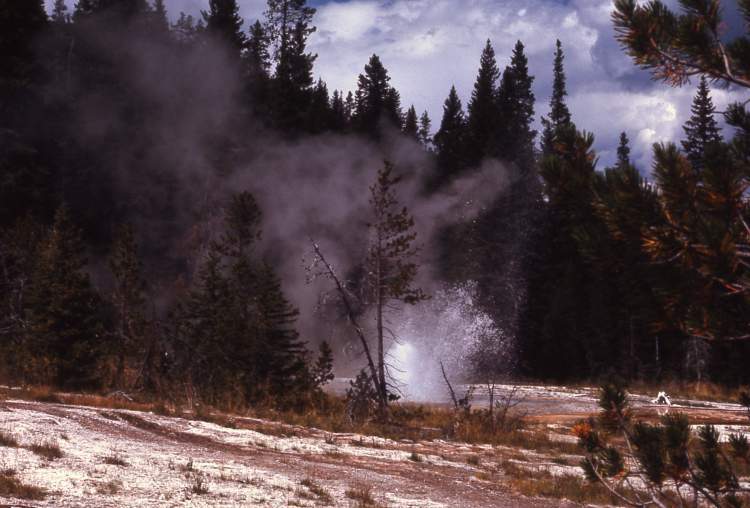
    Rustic Geyser, Heart Lake Geyser Basin

    In the decade between 1834 and 1843, a trapper named Osborne Russell kept a journal describing his adventures in the frontier northwest. Russell’s journal provides one of the earliest written accounts of travel to the upper Yellowstone. Here’s his description of hot springs and geysers in a now extinct geothermal area.

    ∞§∞

    The next day we traveled along the border of the lake till we came to the northwest extremity, where we found about 50 springs of boiling hot water. We stopped here some hours as one of my comrades had visited this spot the year previous he wished to show us some curiosities.

    The first spring we visited was about ten feet in diameter, which threw up mud with a noise similar to boiling soap. Close about this were numerous similar to it throwing up the hot mud and water five or six feet high. About thirty or forty paces from these along the side of a small ridge the hot steam rushed forth from holes in the ground with a hissing noise which could be heard a mile distant.

    On a near approach we could hear the water bubbling under ground some distance from the surface. The sound of our footsteps over this place was like thumping over a hollow vessel of immense size. In many places were peaks from two to six feet high formed of limestone, deposited by the boiling water, which appeared of snowy whiteness. The water when cold is perfectly sweet except having a fresh limestone taste.

    After surveying these natural wonders for sometime, my comrade conducted me to what he called the “Hour Spring.” At this spring the first thing that attracts the attention is a hole about 15 inches in diameter in which the water is boiling slowly about 4 inches below the surface. At length it begins to boil and bubble violently and the water commences raising and shooting upwards until the column arises to the height of sixty feet. It falls to the ground in drops on a circle of about 30 feet in diameter being perfectly cold when it strikes the ground.

    It continues shooting up in this manner five or six minutes and then sinks back to its former state of slowly boiling for an hour — and then shoots forth as before. My comrade said he had watched the motions of this spring for one whole day and part of the night the year previous and found no irregularity whatever in its movements.

    ∞§∞

    — Photo, Coppermine Photo Galley

    — From Osborn Russell, Journal of a Trapper, Syms-York Company, Boise, Idaho, 1921. Pages 99-100.

    — You might also enjoy:

  • A Tale: The First Written Description of Yellowstone Geysers — Daniel T. Potts, 1827


    By the early 1800’s trappers were scouring the Rocky Mountains  for beaver. Evidence of  their travel is sketchy, but we know that trapper brigades reached the Yellowstone Plateau by 1826.

    In 1947, two elderly ladies offered to sell the National Park Service three letters that were then 120 years old. A fur trapper named Daniel T. Potts had sent one of them to his brother in 1827. It is thought to be the first written description of the thermal features of the Upper Yellowstone by someone who actually saw them. Here’s the famous “Letter from Sweet Lake.”

    ∞§∞

    Sweet Lake
    July 8th 1827

    Respected Brother,

    Shortly after writing to you last year I took my departure for the Blackfoot Country. We took a northerly direction about fifty miles where we cross Snake River or the South fork of Columbia—which heads on the top of the great chain of Rocky Mountains that separate the water of the Atlantic from that of the Pacific. Near this place Yellowstone South fork of Missouri and the Henrys fork head at an angular point. The head of the Yellowstone has a large fresh water lake on the very top of the mountain—which is about one hundred by forty miles in diameter and as clear as crystal.

    On the south borders of this lake is a number of hot and boiling springs—some of water and others of most beautiful fine clay. The springs throw particles to the immense height of from twenty to thirty feet in height. The clay is white and of a pink. The water appears fathomless; it appears to be entirely hollow underneath.

    There is also a number of places where the pure sulphur is sent forth in abundance. One of our men visited one of those whilst taking his recreation. There at an instant the earth began a tremendous trembling. With difficulty he made his escape when an explosion took place resembling that of thunder. During our stay in that quarter, I heard it every day.

    From this place by a circuitous rout to the northwest, we returned. Two others and myself pushed on in the advance for the purpose of accumulating a few more Beaver. In the act of passing through a narrow confine in the Mountain, we where met plumb in face by a large party of Blackfeet Indians. Not knowing our number, they fled into the mountain in confusion—and we to a small grove of willows. Here we made every preparation for battle. After finding our enemy as much alarmed as ourselves we mounted our Horses which where heavily loaded we took the back retreat.

    The Indian raised a tremendous yell and showered down from the mountaintop. They had almost cut off our retreat when put whip to our horses. They pursued us in close quarters until we reached the plains where we left them behind.

    Tomorrow I depart for the west. We are all in good health and hope that this letter will find you in the same situation. I wish you to remember my best respects to all enquiring friends particularly your wife.

    Remain yours most affectionately.

    Daniel T. Potts

    ∞§∞

    — Original manuscript, Yellowstone National Park Research Library.

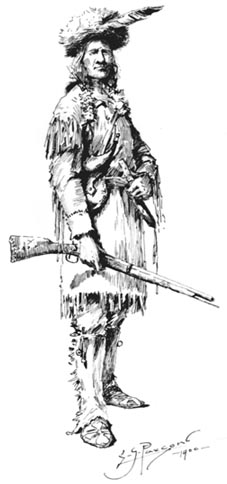
    — Sketch by E.S. Paxson, Montana Historical Society

    — You might also enjoy:

  • A Tale: A Cloud-Burst of the Rarest Jewels


    Most Yellowstone tourist who kept journals struggled to describe geysers. Some relied on quantitative descriptions of such things as how high water was hurled snd how much time separated eruptions. Other’s chose adjectives—”stupendous,” “astounding”—and left their readers to imagine what they meant.  And many simply used phrases like “words cannot describe ….”

    John L. Stoddard was a professional writer who revealed his emotions and used figures of speech to describe what he saw. Stoddard was a world traveler who turned his experiences into popular lectures that he delivered across American. He published them is a series of books entitled Stoddard’s Lectures. Here’s his description of Fountain Geyser.

    ∞§∞

    “Show me a geyser!” I at last exclaimed impatiently, “I want to see a genuine geyser.” Accordingly our guide conducted us to what he announced as “The Fountain.” I look around me with surprise. I saw no fountain, but merely a pool of boiling water, from which the light breeze bore away a thin transparent cloud of steam. It is true, around this was a pavement as delicately fashioned as any piece of coral ever taken from the sea. Nevertheless, while I admired that, I could not understand why this comparatively tranquil pool was called a geyser, and frankly said I was disappointed. But even as I spoke, I saw to my astonishment the boiling water in this reservoir sink and disappear from view.

    “Where has it gone?” I eagerly inquired.

    “Stand back!” Shouted the guide, “she’s coming.”

    I ran back a few steps, then turned a caught my breath; for at that very instant, up from the pool which I had just beheld so beautiful and tranquil, there rose on great outburst of sublimity, such a stupendous mass of water as I had never imagined possible in vertical form. I knew that it was boiling and that a deluge of those scalding drops would probably mean death, but I was powerless to move. Amazement and delight enchained me spellbound. Talk of a fountain! This was a cloud-burst of the rarest jewels which, till that moment had been held in solution in a subterranean cavern, but which had suddenly crystallized into a million radiant forms on thus emerging into light and air. The sun was shining though the glittering mass; and myriads of diamonds, moonstones, pearls, and opals mingled in splendid rivalry two hundred feet about our head.

    ∞§∞

    — From Stoddard’s Lectures, Volume 10, 1905.

    — F. J. Haynes Postcard, Yellowstone Digital Slide File.

  • A Tale: Yellowstone’s First Tourists Seek “First Blood”

    When the Washburn expedition returned from exploring the upper Yellowstone in 1870, they confirmed the rumors of the wonders there. Interest in the area surged when people learned it really did contain a grand canyon, a giant lake, geysers and petrified forests.

    Washburn and his companions returned to civilization in late summer—too late to mount another expedition to the Yellowstone plateau where blizzards could trap traveler in September. But in 1871—a year before the national park was created—a small group of men set off “to see Wonderland.”

    The group, considered by many to be Yellowstone’s first tourists, was led by Professor Rossiter Raymond. Their principal chronicler was Calvin C. Clawson who wrote about the trip in a series of 17 articles for The New Northwest, a Deer Lodge newspaper.

    Clawson not only describes the sights the party encountered, he speculates on such things as using of the finely ground minerals found in the geyser basins for lady’s cosmetics, and embalming bodies in the calcium-laden waters. Clawson also describes the antics men out for an enjoyable adventure. Like groups everywhere, they sometimes entertained themselves with strange contests—like seeing who could get “First Blood.”

    ∞§∞

    The morning of the eleventh was very pleasant, and a calm air was highly appreciated after a boisterous night. While we made preparations to start, a large eagle sailed over and alighted in a tree half a mile down the creek. Prof. Raymond and Eiler immediately mounted their horses and gave chase.

    As yet we had taken no game—not even a chicken killed or a fish caught—and there was a strife among us to see who would get the first blood.

    I knew that when we got to Bear Creek, among the berries, with my dog Nig’s assistance, I could get a bear—for he was celebrated for hunting that kind of game.

    Bear Creek is well named. Its underbrush furnishes bears with ample and secure hiding places. Here berries grow in abundance, and the industrious ant rears her ingenious palace. Bruin is fond of both.

    After the horses were unsaddled and secured, in company with the dog and my gun, I took a stroll up the creek to see if we couldn’t bag a Bruin before the eagle hunters came up. As we advanced, the “signs” became more and more numerous—until I was satisfied we would soon be rewarded with a bear fight.

    All of a sudden I was brought to my senses by a terrible noise in the bushes ahead of me, as of the rushing and snorting of wild animals. Of course it was a bear out berrying, and he was coming directly towards me. Nearer and nearer he came. I could see the tops of the high berry bushes bending before him.

    Now it occurred to me there might be two—two bears are a good many. I would have whistled for Nig, but to attract attention would prove ruinous, for the bear was coming plenty fast already. If the gun should fail, there would be no alternative but to trust to my knife, and that would bring me face to face with the enemy.

    Old hunters say a bear can be successfully handled (in an emergency) by waiting till he rises on his hind feet, and then smiting him under the fifth rib till he dies. They never tell how the bear amuses himself in the meantime—whether he “throws up his hand” or goes for his foe “tooth and toe nail.”

    These things have to be considered—and I considered them. I recollected that I had never seen but one man who stabbed a bear. We had to take two horses to get him (not the bear) to camp—he was too much scattered to carry on one. The best surgical assistance never could make anything else out of him but a torn up man—although he lived.

    Closer and closer come the bears—I thought I got a glimpse of them through the bushes.   There was a drove of them—two abreast, rushing on me—another minute and the fight would begin. There was no tree in reach. I held a council of war—a change of base was considered in order. I immediately stepped behind a point of rocks half a mile down the creek. After waiting a reasonable time for the enemy to appear, I walked into camp—demoralized, but not damaged. The dog soon followed, panting as though he too had a race for life.

    In a short time the eagle hunters made their appearance—with their hats bedecked with trophies in the shape of eagle feathers, and an eagle hanging to the horn of each saddle—while the wings dragged the ground.

    The old one had showed fight when she saw the hunters approaching, and settled down by the nest to protect her young. After several shots from a rifle, she was disabled—and Mr. Raymond climbed the tree as far as possible, threw a rope over the limb, and shook the two young out—then brought them to camp. They were monsters for their age, and after admiring them a while, we turned them loose to shift for themselves.

    The first blood was unanimously accorded to the Professor by the balance of the party, but if the other parent bird had been at home they might have “got away” with the invaders.

    ∞§∞

    — You can read Clawson’s complete account of the 1871 trip to the upper Yellowstone in A Ride to the Infernal Regions edited by Eugene Lee Silliman.

    —Photo from the Yellowstone Digital Slide File.

  • A Tale: A Million Billion Barrels of Hot Water — 1871

    A group of professionals and businessmen visited the geysers in 1871—long before the era of hot water heaters. The trip was chronicled by Harry Norton, who published the first Yellowstone travel guide in Virginia City in 1873. Norton called one of his companions, who owned telegraph lines between Deer Lodge and Bozeman, “Prince Telegraph.” Here’s Norton’s description of the Prince’s experiments in geyserland.

    ∞§∞

    Just for the oddity of the idea, some of the party proposed that we should try a cup of geyser tea. Happy thought! A million billion barrels of hot water within easy reach, and nothing to do but put the tea a-drawing! Notwithstanding all that has been said by former tourists, the tea was excellent—and produced no disagreeable effects.

    We afterwards utilized several of the geysers by boiling meat, dirty clothes, beans, coffee, etc., each experiment being attended with satisfaction. For boiled beans, two quarts of “navies” were put in a flour sack, and with a rope, lowered into the steaming crater. In thirty minutes they were perfectly soft and palatable. This is not a first-rate method to make allopathic bean soup, but for a homeopathic dose. it can’t be beat. In this connection, a little incident:

    Prince Telegraph’s wardrobe, like our saddle-seat, was constantly getting out of repair—and as he had failed in trying to sew on a patch with a needle-gun he was obliged to procure assistance. He finally compromised affairs by a change of duties: Woodall, an expert, was to sew on the patch while Prince Telegraph washed the dishes—his first attempt probably in a lifetime. Hesitating a moment, a brilliant idea struck him. Fifty or sixty feet distant was a very noisy little geyser. Its aperture was in the centre of a noisy shallow, well-rimmed basin of about two and a half by four feet. The water scarcely ever covered the flat bottom at a greater depth than two inches.

    Pitching the soiled tin ware, knives, forks, towels, etc., into a champagne basket, and with an “0h, ho! I guess I can’t wash dishes!” the Prince approaching his improvised dishpan, unceremoniously dumped them in to soak while he placidly enjoyed his meerschaum. Suddenly, and as if resenting the insult to its dignity, the little spouter spit the basin full to overflowing in a second. Setting the contents in a perfect whirl, and the next instant, drawing in its breath, the geyser commenced sucking everything toward the aperture.

    We at the camp heard an agonizing cry for help, and looking out, beheld the Prince—with hat off and eyes peeled—dancing around his dishpan in a frantic attempt to save the last culinary outfit. It was comical in the extreme. There would be a plunge of the hand in the boiling water, a yell of pain, and out would come a spoon—another plunge and yell, and a tin plate—an” Oh! ah! o-o-o, e-e-e” and a fork. As we arrived, the towel and one tin plate were just going out of sight; while the Prince, gazing at his parboiled hands, was profanely discussing the idea of being “sucked in” by a geyser!

    ∞§∞

    — From  Harry J. Norton, Wonderland Illustrated or, Horseback Rides Through the Yellowstone National Park, 1873.

    — Postcard from the Yellowstone Digital Slide File.

    — You may also enjoy Colonel William J. Barlow’s tale of bathing in Mammoth Hot Spring.

    — For more funny stories click on “Humor” under the “Categories” button on the left side of this page.

  • A Tale: Angering Old Faithful — 1877

    Today most Yellowstone tourists believe that nature is fragile. They wouldn’t collect a leaf or pick a flower for fear of causing irreparable damage. But early tourists shattered geological features to gather specimens, slaughtered animals for fun, and experimented with geysers.

    Explorers Near Old Faithful, August 1871

    They reported these things without the slightest embarrassment.

    On a Sunday in the summer of 1877, Frank Carpenter was lolling around Old Faithful with his companions: Dingee, Arnold and Mr. Huston—and Frank’s sisters, Ida and Emma. They soon tired of quietly observing the Sabbath and decided to experiment with Old Faithful. Here’s Frank’s story.

    ∞§∞

    We conclude that we will do our washing, since such an opportunity for “boiling clothes” will not be presented again soon.

    Emma and Ida put their clothes in a pillowcase. Dingee took off his blouse and tied a large stone in it and I finished tying it with my handkerchief. Arnold also removed his jacket—and we repaired to the laundry—Old Faithful.

    We hear the preparatory rumbling and the waters rise a few feet above the surface. Mr. Houston now gives the command to throw our garments into the water. The water goes down and remains low so long that we begin to feel uneasy. Dingee begins to lament his loss and to curse the man who “put us up to the job up.”

    Mr. Huston remarks that it will be all right, and the next instant, with a rush and a roar she “goes off.” The clothes, mixed in every conceivable shape, shoot up to a distance of a hundred feet and fall with a splash in the basins below.

    The water subsides, and we fish out the clothing, which, we find as nice and clean as a Chinaman could wash it with a week’s scrubbing. Dingee rejoices.

    Wishing to experiment further, we collect an immense quantity of rubbish and drop it into the crater. We fill it to the top with at least a thousand pounds of stones, trees, and stumps. Now we sit down to await further developments.

    At the exact time advertised, sixty-five minutes from the time of the last eruption, the earth begins to tremble. We hear the rush again. “Off she goes,” and away go rocks, trees and rubbish—to a height of seventy-five or eighty feet.

    Old Faithful seems to have been angered by the unwarrantable procedure on our parts—or he wishes to show us that our attempts to check his power are futile. And he furnishes entertainment of unusual magnitude and duration.

    ∞§∞

    — From The Wonders in Geyserland by Frank D. Carpenter.

    — Photo byWilliam Henry Jackson 1872. Yellowstone Digital Slide.

    — You may also enjoy Colonel John W. Barlow’s tale of bathing in Mammoth Hot Spring.

  • Why I’m Interested in Yellowstone Stories

    Hot Springs Cone

    When I was a little boy, my grandmother used to tell me stories about her trip to Yellowstone National Park in 1909. Grandma went to the park with her aunt, seven cousins, and two brothers. Great Aunt Elvina was recently widowed and her youngest daughter was born after her husband died. Family lore says that the baby is the reason they took a milk cow with them. Grandma said she would hang a bucket of cream under the wagon axle in the morning where the rocking motion would turn it to butter by evening.

    At 20, Grandma was the eldest of the young people and she was responsible cooking and taking care of the camps. Aunt Elvina had her hands full with the baby and keeping track of the other small children.

    Grandma’s 15- and 17-year-old male cousins probably drove the teams, took care of the horses, and milked the cow. The party had a surrey for Elvina and the small children, a covered wagon for supplies and equipment, and four saddle horses.

    Grandma used to brag about making herself a split riding skirt and riding astride through the park. At that time proper young ladies rode side-saddle.

    She told about making bread in a hot spring. She put dough in a lard can, tied it to a rope, and dropped it into the boiling water. After an appropriate length of time, she pulled it and found a palatable loaf, although it lacked a pretty brown crust.

    Grandma also recounted stories her father told about working in the park in 1882. Grandma’s grandfather, Rodney Page, was a surveyor by profession and he got a contract to survey the northern border of Yellowstone. In fact, he apparently moved to Montana to take the job. He left his wife behind in Michigan to manage moving the family.

    On Rodney’s survey crew were two young men, Fred Mercer and Harry Redfield, who enjoyed playing practical jokes. Grandma said they stole each other’s red flannel underwear and pitched it into a geyser. The next time the geyser played, it was colored pink from the dye.

    Despite their pranks, Grandpa Rodney apparently approved of the two young men. After their work in the park, they returned home with him. Harry Redfiled married his daughter Elvina, and Fred Mercer, her sister, Evelyn. I descend from the Mercer line.

    In addition to stories about her family, Grandma told about experiences every early Yellowstone traveler knew about like catching a fish and turning to drop it in a hot spring to cook where and angler without removing it from the hook. Grandma commented that she preferred to clean her fish before cooking them. Actually, there are several places in the park where you could do this: along the Firehole and Gardiner Rivers and the shore of  Yellowstone Lakc. The Fishing Pot is probably the most well known.

    I also remember Grandma’s telling about the Handkerchief Pool, a now defunct geothermal feature in the Upper Geyser Basin. The Handkerchief Pool looked like a large pot of boiling water and gave off clouds of steam and a sulphur smell. When someone dropped a hankie in the pool, it would swirls around for awhile. Then the pool would suck it out of sight. About the time spectators had given the hankie up for lost, it would pop to the surface. Then the owner could fish the freshly laundered item out with a stick.

    As a small boy, I was fascinated by Grandma’s Yellowstone stories. As an adult, I wanted to know more, so I began researching early travel to Yellowstone. I now have a growing collection of about 300 first-person accounts of trips to the park.

    I’m sad to say that Grandma never wrote about her trip.

    ∞§∞

    — Postcard from the Pioneer Museum of Bozeman.

    — You also might enjoy these stories:

  • An Event: Off to a Family Reunion

    On Saturday, I’m going to the Page-Redfield family reunion in Twin Bridges. I was invited to the event by—let’s see—my second cousin once removed. Something like that; I never did get the hang of calculating kinship. I don’t expect to see any relatives much closer than a third cousin. Sometime a couple of generations back branches of the family drifted apart and I’m pretty sure my brothers, cousins, nieces, nephews, etc, won’t be there. But, there could be dozens of shirttail relatives. My family has had nearly a hundred and fifty years of being fruitful and multiplying in Montana.

    The first of my relatives to arrive in Montana Territory was an 11-year-old girl named Mary Christianson. In her application for membership in the Montana Historical Society, Mary said she arrived in Montana in 1864 by the Bridger Cutoff. I imagine Mary walking beside a covered wagon in a train led by the famous mountain man Jim Bridger. Bridger’s wagon train emerged from the canyon that bears his name early in July 1864. From the mouth of the canyon, Mary could have looked past the point where three rivers run together to form the Missouri to the Tobacco Root Mountains 70 miles to the west. Mary’s odyssey from her birthplace in Germany, across the Atlantic and then across America was almost over. Mary would spend the rest of her life west of the Tobacco Roots.

    While Mary contemplated her new life in gold-rush Montana, her future husband, James Madison Page, languished in the notorious Civil War prison at Andersonville where union soldiers died by the thousands of starvation and disease. (Andersonville Prison has been burned into the American consciousness as a symbol of inhumanity, but Page said he never saw  any intentional cruelty there. In fact, in 1908 Page published a book that said the charges against Major Henry Wirtz, who was hanged for murders he allegedly committed at Andersonville, were trumped up.)

    Jim Page was released from Andersonville in a prisoner exchange and returned home to Michigan. After recovering from his ordeal and attending business college, Jim decided to move to Montana in 1866. Family lore says he wanted to rejoin the army so he could fight under his hero, General George Armstrong Custer, but his mother talked him out of it.

    Jim got a job as a teamster on one of the wagon trains hauling supplies to the gold fields. When he arrived in Montana, he tried his hand at prospecting, but, like many gold rushers, he soon turned to other ventures. He established his Excelsior Ranch near Twin Bridges and began enticing his siblings to join him. His brother, Robert Wallace Page, came to Montana with his family by steamboat up the Missouri in 1879. Low water stopped the boat at Cow Island, but the family had planned to come overland the remaining distance anyway. A sister, Elmira Utley, came with her family a year later on an “immigrant train” operated by the Utah and Northern Railroad. The track ended at Lima, Montana, then, so the Utleys had to continue by horse and wagon from there to Twin Bridges.

    My Great Great Grandfather Rodney Page and his widowed sister, Elvira Stephens, were the last to arrive, coming in 1882. By then the track reached as far as Dillon. Actually, Grandpa Rodney went ahead leaving  his wife and sister to manage the move while he rushed ahead to join his brother, Jim, on a surveying expedition to Yellowstone Park. That was the beginning of the Page brothers land survey company, which operated for nearly 40 years. Jim Page said the company surveyed in every county in Montana (probably meaning the original territorial counties).

    Descendants of the Pages still tell stories about the 1882 Yellowstone trip. Rodney hired two young assistants named Fred Mercer and Harry Redfield. Mercer and Redfield become close friends and loved playing practical jokes on each other. They used to steal each other’s red flannel underwear and toss it into Old Faithful tinting the next eruption pink—so the story goes. With nearly 4,000 gallons in the typical eruption of Old Faithful, it’s doubtful that one pair of flannels would dye it, but perhaps the prank involved a smaller geyser.

    Rodney must have liked Mercer and Redfield well enough. When the survey was done, they followed him home and married his daughters. Harry Redfield married Elvira Page and they had eleven children, so their descendants doubtless will dominate the family reunion. Fred Mercer married Eva Page and they had four children. I descend from the Mercer line.

    ∞§∞