Tag: Gilman Sawtell

  • A Tale: Gilman Sawtell, Yellowstone’s First Commericial Guide

    On Friday afternoon, while I was doing my usual shift as a volunteer at the Pioneer Museum of Bozeman, I saw that the new edition of the Pioneer Museum Quarterly was out.  Of course, I immediately went through it to look at my article on Gillman Sawtell.  It’s a companion piece to the one I published last summer on Fred Bottler.
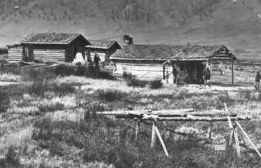
    Sawtell's buildings at Henry's Lake.

    Sawtell and Bottler were pioneer ranchmen who in the 1860s staked out claims on the edges of what was to become Yellowstone Park—Bottler in the Paradise Valley north of the park, Sawtell at Henry’s Lake to the west.  Their ranches became stopping points for early Yellowstone explorers and tourists and both were park guides.  Here’s a excerpt from the Quarterly article on Sawtell.

    ∞§∞

    Sawtell staked his claim on the northwest edge of Henrys Lake and launched a group of enterprises that included ranching, commercial hunting and guiding tourists.

    Sawtell’s main business was harvesting and selling fish, as many as 40,000 of them a year. He reportedly caught as many as 160 trout an hour, averaging two and a half pounds each, with a hook and line. In winter when the lake froze over, springs kept open a small area near Sawtell’s compound. Fish swarmed the open water and Sawtell harvested them with a spear.

    Sawtell sawed blocks of ice from the lake in winter and stored them packed in sawdust in a sturdy thick-walled icehouse he built of logs. He stored his catch in the icehouse until he had enough to fill his wagon. As late as 1896, Sawtell was hauling fish to Monida where they were loaded into railroad cars for sale in Butte and Ogden, Utah.

    While launching his enterprises, Sawtell built a veritable village. He had six sturdy log buildings: a residence, a blacksmith shop, a stable, a storage shed for hides and game, and his icehouse. He apparently had guests in mind when he built the compound. His whitewashed house was big enough to accommodate 20 people and had numerous bedsteads, stools, and tables. He kept enough stoneware to serve that many.

    Sawtell kept tamed antelope and elk at his ranch. In 1871, he used a rowboat to run down several baby swans. He raised the signets until they were big enough to travel (about the size of domestic geese) and shipped them to New York City for Central Park.

    In 1871, Sawtell guided a group of men from Virginia City and Deer Lodge on a tour that covered the geyser basins, Yellowstone Lake, and the Grand Canyon of the Yellowstone. Because of this trip, Sawtell is credited with being the first commercial Yellowstone guide.

    ∞§∞

    —Excerpt from M. Mark Miller, “Gilman Sawtell: Yellowstone Pioneer at Henry’s Lake,” Pioneer Museum Quarterly, Winter 2012, pp. 13-15.

    —  You can read the rest of my article about Gilman Sawtell by buying a copy of the Quarterly at the Pioneer Museum of Bozeman.  Better stil, join the Gallatin Historical Society and get a free subscription.

    — You might also enjoy my story about Fred Bottler, who settled in the Paradise Valley north of Yellowstone Park in 1867.

    — Detail from an 1872 William Henry Jackson photo.

  • A Tale: Big Boots to Fill — Carrie Strahorn, 1880

    In October 1880, Carrie Strahorn and her husband, Robert (she called him “Pard”) were the only passengers on the first run of George Marshall’s stage between Virginia City, Montana, and the Lower Geyser Basin. The Strahorns spent their first night in a cabin in the Madison River valley that belonged to Gilman Sawtell, Yellowstone Park’s first commercial guide and builder of the first road to the Lower Geyser Basin.

    Carrie Strahorn

    On their second day of travel, the Strahorns crossed the Continental Divide over Raynolds Pass and went to Henrys Lake where Sawtell had built a two-story building he planed to use as a hotel for Yellowstone tourists. Sawtell wasn’t there because, as Carrie put it, “during the late Indian troubles, he had abandoned this house and cached the doors and windows for fear the house would be burned.” The Strahorns made themselves at home anyway and Marshall fixed them a dinner of canned beans. Carrie told this story about what happened next.

    ∞§∞

    Pard and I gathered our blankets to go back to the stage to fix a place to sleep, but Mr. Marshall insisted there was a nice lot of hay upstairs where we could be more comfortable, and handing us a candle, directed us to the stairway. It was a rickety passage, with the wind howling through every aperture and holding high carnival with every loose board in the house.

    Once upstairs, the room to which we were sent seemed about forty feet square. The glimmering candle would light only a corner of the great black space, and a gust of wind would blow out the glim at intervals until the place seemed full of spooks and goblins. Pard and I gazed at each other when we could, and when we couldn’t, well, maybe I cried—I don’t quite remember.

    He had persuaded me to buy a very heavy pair of shoes in Virginia City, because he had been told the ground was so hot in some sections of the park that thin soles were not at all safe to wear, and would soon be burned through. Then he had proceeded to hold them up to ridicule all day, and I had finally wagered five dollars with him that in spite of their looks I could get both of my feet into one of his shoes. So there in the dim candle light, with any number of sashless and paneless windows, with the pallet of hay down in a dark corner, partly covered with canvas, with the wind shrieking requiems for the dead and threats for the living,  and with the rafters full of bats, I called to him to bring me his shoe, and let me win my wager.

    I put on his number seven and declared my foot was lost and lonesome in it, and he cried out, “Well, then, now put in the other one! Put in the other one!” I began at once taking it off to put it on the other foot, when he cried out, “Oh, no, not that way, but both at once.” But I revolted and said, “No, that was not in the bargain; I had not agreed to put both in at the same time.” In deep chagrin, he threw a five-dollar gold piece at me, which was lost for half an hour in the hay before I could find it, while he gave a grunt or two that will be better not translated. And so we went on with our merrymaking, trying to forget our surroundings, and dispel thoughts of our discomfort, but it was a glad hour that saw us started again on our way with a new sun.

    ∞§∞

    —   Excerpt from “Early Days In Yellowstone,” pages 254-286 in Carrie Adell Strahorn, Fifteen Thousand Miles by Stage, New York: Putnam’s Sons, 1911.

    —   Photo detail from Strahorn’s book.

    You also might enjoy:

    — You can read Carrie Strahorn’s account of her 1880 trip to Yellowstone Park in my book, Adventures in Yellowstone.  

  • A Tale: Gilmann Sawtell, First Yellowstone Park Guide

    Inside Sawtell's Cabin, Sawtell far left.

    Most of the tales I post here come from my collection on early travel to Yellowstone Park that I assembled for my Humanities Montana presentations.  I focus on first-person accounts and let people tell about their adventures in their own words.  But often there very interesting people who never wrote their own story, so I write one for them.  Gilman Sawtell is such a person.

    ∞§∞

    Most of the earliest Park tourists came from Montana because that’s where the access rivers ran. The north entrance via the Yellowstone River was 60 miles from the farm town of Bozeman, and the west entrance via the Madison was 90 miles from the gold rush town of Virginia City. Both rivers flow through rugged canyons that made travel difficult. In fact, the Madison Canyon was so bad that early travelers chose to cross the continental divide twice to avoid it. But that was a small sacrifice. Passage over the Raynolds and Targhee Passes was relatively easy. Besides, traveling this route provided the reward of a stop at Henry’s Lake.

    Many travelers left glowing descriptions of Henry’s Lake. The four-mile long lake is surrounded by stately mountains and fed by snowmelt streams and cold springs. Travelers praised the spot as a paradise for game, waterfowl. It was a haven for birds, and filled with magnificent trout. Travelers usually spent several days there hunting and fishing and lolling in the sturdy log structures built by Gilman Sawtell.

    Sawtell was a blue-eyed blond who came west with his wife and son after serving as a Union soldier in the Civil War. He prospected for gold near for a while and in 1867 he began homesteading at Henry’s lake. Sawtell left his mark in many ways. His main business was harvesting and selling fish—as many as 40,000 pounds a year. To make his commercial fish business work, Sawtell had to keep his product fresh and haul it to distant markets.

    Sawtell sawed blocks of ice from the lake in winter and stored them packed in sawdust in an sturdy thick-walled icehouse he built of logs. He speared fish and stored them in the icehouse until he had enough to fill his wagon. In the 1860s Sawtell sold his fish for top prices in the gold rush town of Virginia City 90 miles away. He had to build his own road to get there. As late as 1896, Sawtell was still hauling fish to Monida where they were loaded into railroad cars for sale in Butte and Ogden.

    While launching his fish business, Sawtell built a veritable village. By 1871 he had six well-built log buildings: a residence, a blacksmith shop, a stable, a storage shed for skins and game, and his icehouse. In addition he farmed crops of hay, grain, and vegetables.

    It’s not known when Sawtell began visiting Yellowstone, but he was telling stories about geysers by the mid 1860s. In 1873 he contracted with Virginia businessmen to build a road from his ranch over Targhee Pass to the lower geyser basin. This was called “The Yellowstone Free Road” to distinguish it from the toll road Bozeman businessmen were building along the Yellowstone River to Mammoth Hot Springs. The race for tourist dollars was on.

    In 1871 Sawtell guided a group of businessmen from Deer Lodge and Virginia City on a tour that covered the geyser basins, Yellowstone Lake, and the Grand Canyon of the Yellowstone. This trip made Sawtell the first commercial guide to Yellowstone. Several of these travelers described the trip in newspapers articles. These articles appeared in Virginia City, Helena and Deer Lodge. They fueled Montanan’s interest in visiting the upper Yellowstone and encouraged the U.S. congress to establish the national park. The most extensive account of this trip was written by Calvin C. Clawson, a reporter for The New Northwest, a Deer Lodge newspaper.

    ∞§∞

    — For more information about my Humanities Montana Presentation, click the button at the top of the page.

    — Read a story by Calvin Clawson about the 1871 trip. “First Blood.”

    — William Henry Jackson photo from the Yellowstone Digital Archive.

    — For more stories about fishing in Yellowstone Park, click on “fishing” under the “Categories” button on the right.

  • Early Yellowstone Entrepreneurs

    Just in case you missed it, I decided to post a link to my article, Entrepreneurs on the Edges of Yellowstone, that was published in the summer 2008 issue of The Big Sky Journal.

    It describes the first intrepid entrepreneurs who tried to turn a dollar in Yellowstone Park. There’s Gilman Sawtell, a rancher and commercial fisherman who harvested thousands of fish from Henry’s Lake near the west entrance to the park. And Fred Bottler, who started ranching north of the park and hunted elk for their hides shipping them back east by thousands.  Sawtell and Bottler were also the first park guides.

    There are hotel and road builders and their first customers including women who rode sidesaddle through the roadless wilderness. Just click this link to read all about them.

    ∞§∞