Tag: Nez Perce

  • A Tale: A General Visits the Park During Indian Troubles — William Tecumseh. Sherman, 1877

    During the summer of 1877, William Tecumseh Sherman, who was then commanding general of the U.S. Army, decided to tour the forts along the proposed route of the Northern Pacific Railroad. That was just one year after a coalition of Sioux and Cheyenne decimated the Seventh Cavalary under George Armstrong Custer at the Battle of the Little Big Horn. In fact, the army was still patrolling the northern plains after the Sioux Chief Sitting Bull fled toi Canada. In addition, several bands of Nez Perce refused to move to a reservation in Washington and were headed to Montana.
    WAR AND CONFLICT BOOK ERA:  CIVIL WAR/LEADERS
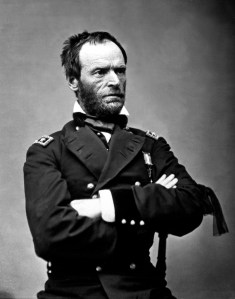
    General William Tecumseh Sherman

    Like many military officers, Sherman was fascinated with Yellowstone Park and had read several army and civilian reports about it. He knew about the Nez Perce troubles, but he decided to take a side trip to see the wonders of Yellowstone Park anyway. He was convinced that the Indians would not enter the park because they feared the geothermal features so he traveled with a small party of about a dozen men. After a 15-day tour, Sherman and his companions returned to Fort Ellis, near Bozeman, Montana, just a few days before the Nez Perce entered the park.

    Here’s an abridged version of Sherman’s report of his trip to Yellowstone Park.

    ∞§∞

    I suppose you want to hear something of the National Park, or “Wonderland,” as it is called here. As you know, I came from the Big Horn here with two light spring-wagons and one light wagon, with six saddle horses. Here we organized the party: Colonels Poe, Bacon, my son and self, three drivers, one packer, four soldiers, and five pack mules; making four officers, four soldiers, one citizen, and twenty-three animals. The packer was also guide.

    Our rate of travel was about 20 miles a day or less. Our first day’s travel took us southeast over the mountain range to the valley of the Yellowstone; the next two days up the valley of the Yellowstone to the mouth of Gardner’s River. Thus far we took our carriages, and along the valley found scattered ranchos, at a few of which were fields of potatoes, wheat, and oats, with cattle and horses.

    At the mouth of Gardner’s River begins the park, and up to that point the road is comparatively easy and good, but here begins the real labor; nothing but a narrow trail, with mountains and ravines so sharp and steep that every prudent horseman will lead instead of ride his horse, and the actual labor is hard.

    The next day is consumed in slowly toiling up Mount Washburn, the last thousand feet of ascent on foot. This is the summit so graphically described by Lord Dunraven in his most excellent book recently published under the title of the “Great Divide.” The view is simply sublime, worth the labor of reaching it once, but not twice. I do not propose to try it again.

    Descending Mount Washburn, by a trail through woods, one emerges into the meadows or springs out of which Cascade Creek takes its water; and following it to near its mouth you camp, and walk to the Great Falls and the head of the Yellowstone Canyon. In grandeur, majesty, coloring, &c., these probably equal any on earth. The painting by Moran in the Capitol is good, but painting and words are unequal to the subject. They must be seen to be appreciated and felt.

    The next day, eight miles up from the falls, we came to Sulphur Mountain, a bare, naked, repulsive hill, but of large extent, at the base of which were hot bubbling springs, with all the ground crisp with sulphur; and six miles farther up, or south, close to the Yellowstone, we reached and camped at Mud Springs.

    From the Mud Springs the trail leads due west, crosses the mountain range to the Lower Geyser Basin. It would require a volume to describe these geysers in detail. It must suffice now for me to say that the Lower Geyser Basin presents a series of hot springs or basins of water coming up from below, hot enough to scald your hand, boil a ham, egg, or anything else; clear as crystal, with basins of every conceivable shape, from the size of a quill to actual lakes a hundred. Yards across. In walking among and around them, one feels that in a moment he may break through and be lost in a species of hell.

    Six miles higher up the West Madison is the Upper Geyser Basin—the “spouting geysers,” the real object and aim of our visit. To describe these in detail would surpass my ability, or the compass of a letter. They have been described by Lieutenant Doane, Hayden, Strong, Lord Dunraven, and many others. The map by Major Ludlow, of the Engineers, locates the several geysers accurately. We reached the Upper Geyser Basin at twelve noon, one day, and remained there till 4 p.m. of the next. During that time we saw the ” Old Faithful” perform at intervals varying from 62 minutes to 80 minutes.

    Each eruption was similar, preceded by about live minutes of sputtering, and then would arise a column of hot water, steaming and smoking, to the height of 125 or 130 feet, the steam going a hundred or more feet higher, according to the state of the wind. It was difficult to say where the water ended and steam began; and this must be the reason why different observers have reported different results. The whole performance lasts about five minutes, when the column of water gradually sinks, and the spring resumes its normal state of rest.

    This is but one of some twenty of the active geysers of this basin. For the time we remained we were lucky, for we saw the Beehive twice in eruption, the Riverside and Fan each once. The Castle and Grotto were repeatedly in agitation, though their jets did not rise more than 20 feet. We did not see the “Giant” or the ” Grand ” in eruption, but they seemed busy enough in bubbling and boiling.

    In our return trip we again visited points of most interest and some new ones. The trip is a hard one and cannot be softened. The United States has reserved this park, but has spent not a dollar in its care or development. The paths are mere Indian trails, in some places as bad as bad can be. There is little game in the park now; we saw two bear, two elk, and about a dozen deer and antelope, but killed none. A few sage-chickens and abundance of fish completed all we got to supplement our bacon.

    We saw no signs of Indians, and felt at no moment more sense of danger than we do here. Some four or five years ago parties swarmed to the park from curiosity, but now the travel is very slack. Two small parties of citizens were in the park with us, and on our return we met several others going in, but all were small.

    ∞§∞

    — Abridged from Reports of the Inspection Made in the Summer of 1877 by Generals P.H. Sheridan and W.T. Sherman. Washington: U.S. Government Printing Office, 1878. (Pages 34-37)

    — Photo from Wikipedia Commons.

    — For related stories click “Nez Perce” under the Categories button.

  • A Tale: Colonel Pickett’s Version of Bagging His First Bear — 1877

    When two people  describe the same event, interesting differences often occur. That certainly happened when Colonel William D. Pickett’s and his guide, Jack Bean, described the Colonel’s first bear hunt.

    Col. Pickett

    The hunt happened shortly after the Nez Perce Indians fled through Yellowstone Park following the bloody Big Hole Battle on August 9, 1877. Although there was still a possibility of danger from Indians remaining in the Park, Pickett was eager to hunt for grizzly bears there so he hired Jack Bean, an old Indian fighter and frontiersman, as his guide.

    Bean’s version of their trip presented the Colonel as a bit of a buffoon. Here’s how Colonel Pickett, who lated became a famous bear hunter, described his first kill.

    ∞§∞

    It was learned the hostile Indians had passed through the National Park, followed by Howard’s forces. As there was still time to make a hasty trip through the Park before the severe winter set in, I determined to do so. I was urged not to make the attempt on account of the hostiles’ sick or wounded that might have been left behind, and of other Indians. I recognized the risk, but since as a youngster I had served during the Mexican war as a mounted volunteer on the northwest frontier of Texas against the Comanches, and all the bad Indians of the Indian Territory and of the Kansas Territory who infested that frontier, I had some knowledge of Indian ways. Added to this, was the experience of four years’ service in the War Between the States. These experiences qualified me to judge of the credence to be placed in war rumors. I was anxious to make the trip.

    Only one man of suitable qualities could be found willing to make the trip—Jack Bean. He knew the routes through the Park; he was a good packer and mountain man, cautious, but resolute. We went light. I rode my hunting mare Kate; Jack his horse, and we packed my little red mule Dollie. I was armed with a .45-90-450 Sharpe long-range rifle, and Jack with a .44-40-200 repeater. In addition to a belt of cartridges, Bean carried around his neck a shot bag pretty full of cartridges, so that in case of being set afoot, they would be handy. When Dollie was packed there was not much visible except her ears and feet.

    We left Bozeman September 11, and nooned in the second canyon of the Yellowstone on the 13th. While there, a portion of the cavalry that accompanied Colonel Gilbert on his trip around from the head of the Madison, passed down toward Fort Ellis, having with them Cowan and Albert Oldham, who had survived the hostile Indians near the Lower Geysers.

    In the afternoon, we passed up the river, by the cabin of Henderson, burned by hostiles, turned up Gardiner’s River and camped within three miles of Mammoth Hot Springs. As this squad of cavalry passed down, we were conscious that we had to depend entirely on our own resources for the remainder of the trip, for there was probably not another white man in the Park. A note in my diary says: “International rifle match commences today.”

    Early on the 14th, we went on to the Hot Springs, and spent two or three hours viewing their beauties and wonders. We passed by the cabin, in the door of which the Helena man had been killed a few days before, after having escaped the attack on the camp above the Grand Falls. During the day’s travel, there were splendid mountain views from the trail.

    In the afternoon of September 15, the trail descended to the valley of the Yellowstone and passed within one mile of Baronett’s Bridge, across which Howard’s command passed on the 5th of September in pursuit of the Nez Perces. We soon dropped into the trail taken by that command and followed it back to Tower Falls.

    September 16, we packed up and began the ascent of the Mt. Washburn range. For a few miles, the trail followed an open ridge, exposing us to a northeast blizzard, accompanied by snow. After descending into the gulch, up which the trail leads to the pass in the range, the snow became deeper, and toward the summit of the range, it was eighteen or twenty inches, knee-deep, which compelled us to dismount and lead the horses, as the ascent was very hard on them. In view of future possibilities, we made every effort to save their strength. It was one of the most laborious day’s work of my experience.

    When near the summit, going through open pine timber, we discovered a large bear approaching us. He was moving along the side of the steep mountain to the left, about on a level, and would have passed out of safe range. I immediately dismounted and cut across as rapidly as the snow and the ascent admitted, to intercept him. He had not discovered us. When within about one hundred yards, watching my opportunity through the timber, I fired at his side. He was hit, but not mortally. As my later experience told me, those bears when hit always either roll down hill or go “on the jump.” On the jump this bear came, passing about twenty yards in our front. A cartridge was ready, and against Jack’s injunction “Don’t shoot,” I fired; yet, it failed to stop him, and Jack turned loose with his repeater, I shooting rapidly with my rifle. By the time the bear had reached the gulch he stopped, to go no further.

    The excitement caused by this incident and my enthusiasm on killing my first grizzly—for I claimed the bear—dispelled at once all feelings of hardship and fatigue. The bear was a grizzly of about four hundred pounds weight, fat and with a fine pelt. We had not time to skin him, nor could the hide have been packed. After getting a few steaks, a piece of skin from over the shoulder and one of his forepaws, we continued our laborious ascent of the mountain. Still excited by this incident, the work was now in the nature of a labor of love.

    ∞§∞

    — Abridged from William D. Pickett, Hunting at High Altitudes, (George Bird Grinnell, ed.) Harper & Brothers: New York, 1913. Pages 62-68.

    —Photo from the book.

    — Read more about Jack Bean in my book Adventures in Yellowstone.

    You might also enjoy these stories:

  • On Writing: Cubism, Narrative History and the Nez Perce

    While organizing research notes for my next book, Encounters in Yellowstone 1877, it occurred to me that my task is akin that of the Cubist painters.  A hundred years ago artists including Pablo Picasso, George Braque and Juan Gris invented Cubism. They looked at objects from multiple viewpoints, analyzed each viewpoint, and then reassembled them into a single composition. That’s like what I’m doing.

    "Three Musicians," Pablo Picasso

    I’ve collected numerous pieces about the events of the summer of 1877 when the Nez Perce Indians encountered several groups of tourists while fleeing from the Army through Yellowstone Park.  Those pieces contain distinct—even disparate—viewpoints. Here are some of them:

    • Yellow Wolf, a young Nez Perce brave who felt justified in seeking revenge on all whites following the Army’s pre-dawn attack on the sleeping Indian camp that left dozens of women and children dead.
    • Emma Cowan, a young wife fulfilling her dream of visiting “geyserland” who spoke sympathetically of the plight of the Nez Perce in her reminiscence even after Indians left her husband for dead after shooting him in the head and then took her captive.
    • Jack Bean, an old Indian fighter who had been with the troops that buried the mutilated bodies of Custer and his men after the Battle of the Little Big Horn and had no qualms about scalping Indians.
    • General Oliver Otis Howard, an evangelical Christian and Civil War hero, who led his exhausted troops across Yellowstone Park after several humiliating skirmishes with the Nez Perce.

    My job is to analyze the accounts of these people—and of dozens of others—and sift out the truth. Then I’ll try to put the whole thing together in a coherent whole. To do that, I’ll need to look for places where the various viewpoints converge and diverge, overlap and separate, compliment and contradict.

    Like a Cubist painting, the final narrative won’t always arrange things in the way that people are used to seeing them, but I hope it will be compelling and enlightening.  I’m enjoying the challenge.

    ∞§∞

     — Image, Metropolitan Museum of Modern Art.

    — To see related posts, click on “Narrative History” under the Categories Button on  this page.

  • We Are All Heros in the Stories We Tell About Ourselves

    A few days ago, I posted Andrew Weikert’s story about his first encounter with the Nez Perce in Yellowstone Park. It drew a lot of attention and this comment from Danny O’Keefe:

    Methinks Mr. Weikert may have been a bit prone to exaggeration judging by the litheness expressed about being able to bound into the saddle. I also doubt the Nez Perce were such poor shots. Other, more sober and historical, reports indicate they were highly accurate. Imagine the state of mind of a people on the run and fearing oblivion. The decency they exhibited in most instances stands in contrast to the treatment they received.

    I began to respond to Danny, but soon discovered I had so much to say that I flooded the reply box. I decided to gather my thoughts and use them for a blog post.

    The most important thing to say is that I agree with Danny’s statement about the Nez Perce: “The decency they exhibited in most cases stands in contrast to the treatment they received.” That’s the consensus now and everything I see in the historical record supports it. But the phrase “in most cases” is important.

    Overall, the Nez Perce behaved in an honorable fashion, but the historic record is mixed. Emma Cowan, who was taken captive by the Nez Perce, said this: “they were kind to us, a handful of the hated oppressors. Think of it, you who assume to be civilized people! Less than ten days had elapsed since the Big Hole fight in Montana, in which women and children, as well as warriors, were killed by the score. A number, badly wounded, were in camp while we were there. Yet were we treated kindly, given food and horses, and sent to our homes.”

    On the other hand, a party of Nez Perce scouts did indeed attack the camp where Weikert and Wilkie’s friends were hiding, and later Indians shot an unarmed music teacher dead when he stepped into view at a cabin door.

    We’re all heroes in the stories we tell about ourselves, so I don’t doubt that Weikert embellished his recollections. But it’s certain that the Nez Perce attacked him and his friends. He had the dead bodies to prove it.

    I don’t know where Danny gets the ideas about Weikert’s “litheness expressed about being able to bound into the saddle.” Weikert clearly said, “I was riding ahead when I saw them [the Indians].” He was already mounted and quickly hunched over to make a smaller target. Doubtless, the Nez Perce were fine shots, but it’s very difficult to shoot a man on a moving horse. The best evidence that Nez Perce weren’t the sharpshooters Danny says they were is that Weikert and Wilkie both lived.

    I’m still working my way through the mountains of material that have been written about the flight of the Nez Perce and I could already write thousands of words about such things as the failure of whites to understand their culture, writer’s motivations to portray them either as “Red Devils” or “Noble Savages,” and why the events of the summer of 1877 led to alternating periods of peace and violence. But I’ll save those explanations for my book.

    The items I put on my blog are stories, not historical documents. I collect, edit and post them in hopes that readers will find them interesting and fun.

    I am a storyteller, not a historian. I choose well told accounts that describe interesting experiences. I don’t fret over their literal truth. No doubt, many stories contain exaggerations and embellishments. When I think stories contain outright fabrications, I provide caveats. But I trust my readers to take things with the proverbial “grain of salt.”

    My sincere thanks to Danny for his comment. It forced me to think through a lot of important issues—far more than I could discuss here. That will make this blog—and all my work—better.

    ∞§∞

  • A Tale: A Battle With Fleeing Nez Perce — 1877

    My next book, Encounters in Yellowstone 1877, will tell the stories of the several groups of tourists who tangled with the Nez Perce while they fled through Yellowstone Park after the Big Hole Battle.

    Mammoth Hot Springs

    The Army’s pre-dawn attack on the sleeping Indian camp left dozens of women and children dead, which enraged many young Indians. Despite chiefs’ efforts to avoid whites, several groups were attacked in or near Yellowstone Park.

    The most famous encounter is Emma’s Cowan’s ordeal of being captured, but there are other chilling events. Andrew Weikert was touring with a group of young men when they spotted the Indians a few miles south of Mammoth Hot Springs. The group beat a hasty retreat to thick grove of trees and spent the night hiding. The next morning, Weikert and a companion named Wilkie decided to leave the others in camp and go see if the Nez Perce had moved on. Here’s how Weikert described what happened.

    ∞§∞

    We could see where the Indians and their horses had made a trail, so we thought the coast was clear. We started back for camp, but, we ran against an obstacle that made our hair raise and the blood rush to our faces.

    We had gotten into the timber not more than a quarter of a mile when we ran onto a lot of the redskins lying in wait for us. They were under the hill, behind a log, so we did not see them until we got within about seventy-five feet.

    I was riding ahead when I saw them raise up their heads from behind the log. I told Wilkie there were Indians ahead and wheeled my horse. At the same time I was getting my gun up ready to fire. Looking back I saw half a dozen guns leveled at me so I made myself small as I could, with my gun across my knees.

    Bang! bang! bang! then zip! zip! zip! went the balls, but none struck me that time. I was perfectly cool and self-possessed, but will own up that my hair was standing on end when I first saw them. My horse had made a few more jumps, when bang! they went again.

    This time they were a little more successful, for they cut a crease in my shoulder blade about four inches long; did not break a bone, but splintered my shoulder bone a little. And another ball took a piece out of my gunstock. I then began hugging my horse still closer, if such a thing was possible, when they gave us another volley.

    By this time, we were out of range, but the balls flew past thick and fast and we could hear them strike the trees. Now for a race!

    I supposed that they had their horses close at hand, but they did not mount them just then. Just at this time, my horse tripped his foot and fell and came near turning a somersault. I went sprawling on the ground directly in front of him.

    My shoulder was paining considerably, but I did not have long to remain there, for the ‘reds’ were running up again to get another shot at me. I up and let them have one from my repeater. You ought to have seen them dodge. I did this all in a few seconds, and my horse was on his feet again ready to start. I just put my hand on the horn of the saddle, made a bound into it, and was off.

    Wilkie had gotten considerably ahead of me by this time, but I soon made up for lost time. We got back on the prairie again on Alum Creek in the valley, then back in the timber again. The Indians did not follow us. We rode as far as we could, then took it afoot, for the under-brush was so thick that we could hardly get our horses through.

    After we got into the timber quite a ways, we halted to take breath and to see what damage was done. Wilkie asked me if I was hurt; I told him judging from the hole in my shirt on the right shoulder, and the way the blood was running in my boot, I thought that there must be a scratch at least.

    We examined it and bound it up the best we could. Wilkie, being a safe distance from the Indians, did not get hurt. We looked our horses over, and found them all sound, thank fortune. So we mounted and took our direction for camp, rode as lively as we could in hopes that the reds had not been there so we could warn the boys.

    ∞§∞

    —Adapted from Weikert’s Journal published in Contributions to the Montana Historical Society, 1900.

    — Frank J. Haynes postcard, Coppermine Photo Gallery.

    — You might also enjoy:

  • Researching Attitudes Toward Indians

    What would it feel like to wake up in a wilderness with a lead slug embedded in your skull and remember watching your wife being dragged away by hostile Indians? That happened to George Cowan when the Nez Perce fled through Yellowstone Park  a hundred and thirty-three years ago.

    I’m writing about George’s ordeal for my next book, Encounters in Yellowstone 1877, so I need to know how he felt. Actually, it’s not hard to empathize with George. We all know that his head hurt from the bullet lodged there. And of course, George felt anger  — maybe even rage — at his attackers, and fear — maybe even terror — at what they might do to his wife.

    George’s story is compelling because it’s easy to identify with him, but can we assume he reacted in the same way we would? Wouldn’t events like the Battle of the Little Big Horn that happen just a year before George’s ordeal have colored his reactions?

    Last week, I did some research to answer questions like those. I started by searching the index of Montana the Magazine of Western History. I scanned subject headings until I saw “Indians, attitudes toward.” Under that heading I found an article published in 1957 by Robert W. Mardock entitled “Strange Concepts of the American Indian Since the Civil War.” Mardock says in the 1870s Americans called Indians everything from “noble savages” to “red devils.”

    New England writers like Cooper and Longfellow promoted the “noble savage” view, but Mardock says things were different on the frontier. He quoted a Virginia City, Montana, newspaper: “It is high time that sickly sentimentalism about humane treatment and conciliatory measures should be consigned to novel writers, and if the Indians continue their barbarity, wipe them out.’”

    According to Mardock, “The apprehensions and viewpoints of our frontier areas were strongly reflected in the Eastern newspapers. Exaggerated dispatches from the West, incredibly wild and inaccurate when reporting Indian ‘massacres’ and depredations, were commonly printed without ever questioning their accuracy. The frontier ‘red devil’ concept dominated the national press with few exceptions.”

    George Cowan was an attorney so he probably read both territorial and national newspapers. Visions of “red devils” must have danced through his mind when he came to that morning.

    And what was George’s wife, Emma, thinking when the Indians hauled her away? I found a 1984 article by Glenda Riley entitled “Frontierswomen’s Changing View of Indians in the Trans-Mississippi West,” that provides some insight.

    Riley says, “Journalists and novelists fed the anti-Indian prejudices of their reading publics with fictionalized accounts of brutal and primitive savages who preyed especially on women. When women’s accounts were published they were usually ‘penny dreadfuls’ or narratives of captivity that further inflamed hatred of Indians.”

    In their accounts, George and Emma Cowan don’t dwell on their feelings toward Indians, but they were creatures of their times so the insights Mardock and Riley provide must apply to them. I’ll use those insights as I scrutinize the Cowans’ accounts and write about their adventures. Encounters in Yellowstone will be a better book because I took the time to dig into these things.  Of course, I will do more research.

  • Outline Complete for Encounters in Yellowstone 1877

    I have completed a major milestone for my next book, Encounters in Yellowstone 1877. I finished an outline. That was a complicated task because I’m writing about a myriad of overlapping events and disparate (often desperate) people.

    First, there are the Nez Perce, who decide to flee their homeland in Idaho and Washington State and make a new life in the buffalo country of Montana. After the army’s predawn attack on their sleeping camp on the banks of the Big Hole River, the Indians fragment. The Chiefs try to avoid whites while leading the main group, but they lose control over small bands of young men who spread out to seek revenge. These young warriors attack settlers along the Montana-Idaho border and tourists in Yellowstone National Park.

    Like a nuclear chain reaction, each attack breaks up a group of people yielding several dramatic stories. For example, when a young warrior named Yellow Wolf and his companions attack a tourist party near the lower geyser basin, they capture a young woman, shoot her husband in the head and leave him for dead, and send several other tourists fleeing into the forrest. This one event yields Emma Cowan’s chilling tales of her captivity and quest for help after being released in the wilderness; George Cowan’s story of regaining consciousness to find himself wounded and alone, and the Cowan’s companions’ efforts to hide, flee and find help. Meanwhile, army units converge on Yellowstone Park from several directions, trying to find and subdue the elusive Nez Perce.

    I’ve organized these events into 20 chapters that chronicle events beginning in 1805 when the Nez Perce befriend several starving men from the Lewis and Clark Expedition, and ending 130 years later with publication of a book entitled Adventures in Geyserland. Doubtless I’ll make changes as my research proceeds. I’ll need to merge some chapters, split others and rearrange things. But I have an outline that organizes a complicated human drama into a coherent narrative. For now, I’m happy with that.

    ∞§∞

  • A Tale: Captured by Indians by Emma Cowan—1877

    Cowan Party
    The Cowans visiting the site of their capture in 1901.

    Emma Cowan and her family visited Yellowstone National Park in 1877—the year the U.S. Army pursued the Nez Perce Indians there. The Nez Perce generally had amicable relations with whites, but in what has become a familiar story, the peace was shattered when gold was discovered on their land. Some Nez Perce acquiesced to government demands that they move to a tiny reservation, but others decided to flee their homeland instead.

    The Army sent soldiers to subdue the defiant Nez Perce, but the Indians defeated them several times. In the most dramatic battle, the Army made a pre-dawn attack on a sleeping Nez Perce camp on the banks the Big Hole River in southwest Montana. The Indians rallied, drove back their attackers, then retreated leaving their equipment, teepees, and at least 89 dead—most of them women and children.

    After the battle, they fled though Yellowstone Park where they captured Emma’s party.  Here’s her account of what happened later.

    ∞§∞

    Every Indian carried a splendid gun, with belts full of cartridges. As the morning sunshine glinted on the polished surface of the gun barrels, a regiment of soldiers could have not looked more formidable. The Indians pretended all the while to be our very good friends, saying that if they should let us go, bad Indians, as they termed them, would kill us.

    Suddenly, without warning, shots rang out. Two Indians came dashing down the trail in front of us. My husband was getting off his horse. I wondered what the reason. I soon knew, for he fell as soon as he reached the ground—fell heading downhill. Shots followed and Indian yells, and all was confusion. In less time than it takes to tell it, I was off my horse and by my husband’s side….

    I heard my sister’s screams and called to her. She came and crouched by me, as I knelt by his side. I saw he was wounded in the leg above the knee, and by the way the blood spurted out I feared an artery had been severed. He asked for water. I dared not leave him to get it.

    I think we both glanced up the hill at the same moment, for he said, “Keep quiet. It won’t last long.” That thought had flashed through my mind also. Every gun in the whole party of Indians was leveled at us three. I shall never forget the picture, which left an impression that years cannot efface. The holes in those gun barrels looked as big as saucers.

    I gave it only a glance, for my attention was drawn to something near at hand. A pressure on my shoulder was drawing me away from my husband. Looking back over my shoulder, I saw an Indian with an immense navy pistol trying to get a shot at my husband’s head. Wrenching my arm from his grasp, I leaned over my husband, only to be roughly drawn aside. Another Indian stepped up, a pistol shot rang out, my husband’s head fell back, and a red stream trickled down his face from beneath his hat. The warm sunshine, the smell of blood, the horror of it all, a faint remembrance of seeing rocks thrown at his head, my sister’s screams, a faint sick feeling, and all was blank.

    ∞§∞

    Two days later the Indians released Emma, her sister, Ida, and her brother, Frank. They made their way to Mammoth Hot Springs where they found help. Emma’s husband, George, survived the shooting. He carried the slug that an Army surgeon dug out of his head as a watch fob for the rest of his life.

    While making their way through the Yellowstone wilderness, the Nez Perce discovered they were not welcome with their old friends, the Crow, who had made accommodations with the whites. The Nez Perce decided to head north to join Sitting Bull and his Sioux in Canada. In October the starving and exhausted remnants of the band surrendered to the Army just 40 miles from the Canadian border.

    ∞§∞

    You can read Emma’s complete story in my book, Adventures In Yellowstone.

    — You might also be interested in:

    — Photo, Pioneer Museum of Bozeman.