Tag: stage coach

  • A Tale: Hunting a Yellowstone Lion

    The story below was included as an example of student writing in a 1914 composition textbook for college freshmen. The textbook authors didn’t give the student’s name or the year the piece was written, but apparently it was after the army took over administration of Yellowstone in 1886.
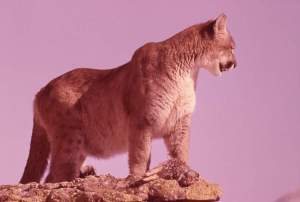
     The Secretary of Interior promulgated a regulation in 1883 that prohibited hunting in Yellowstone Park, but that was generally interpreted as not applying to predators. In fact the general policy toward predators—cayotes, wolves, bears, wolverines, and mountain lions—was “shoot on sight.” Predators weren’t protected in the park until the 1930s.

    The textbook authors praise this account as an “ambitious and  effective narrative theme.”  I agree.

    ∞§∞

    “Whoa there! Back into the road, you black brute! What are you shyin’ at?” yelled the driver of a sightseeing coach in the Yellowstone.

    He glanced across the bridge and immediately learned the reason for the strange behavior of one of his leaders. There, in a leather-wood thicket, crouched the long, lithe form of a mountain lion. Its wicked yellow eyes challenged his right to the passage, and its long slender tail writhed among the bushes. The driver pulled up his horses, uncertain of the lion’s intentions; but the great cat, finding himself unmolested, slipped through the bushes and disappeared among the jagged rocks on the mountain slope.

    As the coach was discharging its passengers at the next stopping place, the driver yelled to a camp boy, “Go over and tell the guards I saw that big lion they’ve been looking for, down by the last bridge. Tell ’em they’d better hurry before he leaves the country.”

    The boy lost no time; and soon two of the soldiers were at the bridge, carefully examining the tracks of the great beast from the impressions in the loose dirt. They quickly learned that this lion was the very one with which they had been having a great deal of trouble, the one which had invaded camps during the night, and had terrified tourists with his long-drawn, almost human wail from the forests.

    Clambering over the great grey rocks, and sliding in the loose gravel of the slope, the two soldiers made their way slowly up the mountain side. When they reached the first promontory they stopped to rest and look about them. Far to the left and a mile below them, still shrouded by the evening mists yet tinted now by the morning sun, lay the magnificent and awe-inspiring Yellowstone Gorge. They gazed at the green thread winding along the floor of the great chasm and tried to hear what they knew to be the roar of its rushing waters.

    “It’s a great sight, Judd! We don’t realize it, bein’ here all the time. But come on. Let’s hit the trail again.”

    “Wait a second.” replied the other. “Help me tighten this bandage on my hand. It’s come loose.”

    The men, intent upon the loosened bandage, failed to see that, from the edge of an overhanging rock above them, two pale green eyes were watching their every move. Behind the eyes, the sinewy form of a great cat was stealthily adjusting itself for a leap.

    Having tightened the bandage, the men straightened up and at the same time stepped back a pace. Their feet, imbedded in the loose gravel, began to slide, and together the two soldiers rolled back under the overhanging rock. At the same instant a great tawny streak flashed over their heads, and the huge form of the mountain lion crashed into the rocks at the very place upon which they had been standing.

    They jumped to their feet and, with startled eyes, watched the great ball of yellow fur as it bumped and rolled down the steep incline. The lion tore madly at the rocks and bushes as he fell, but tried in vain to secure a footing in the sliding gravel. A hundred feet below, he stopped with a thud against a fallen tree trunk; but before he could move, two bullets crunched their way through his body, and, with a gasp, he straightened out, dead.

    ∞§∞

    Anonymous, “A Yellowstone Lion,” pages 561-562 in Frances Berkeley Young and Karl Young, Freshman English: A Manual. New York: Henry Holt and Company, 1914. Pages 561-562.

    — Coppermine Gallery Photo.

  • A Tale: Doughnuts in Bear Grease, Sarah Tracy — 1873

    Doing Laundry in a Hot Spring

    Indians stole a band of horses the day before Sarah Tracy left Bozeman for Yellowstone Park in June of 1873. But Mrs. Tracy was used to Indians. When she arrived in Bozeman in 1869 with her new husband, Bozeman Pioneer W.H. Tracy, Indians were encamped on the south side of town. She said, “They would peer in the windows if the doors were locked, or come flocking around the door begging for biscuits, soap, clothes, everything.”

    Such encounters left Mrs. Tracy with little fear of Indians, but the commander at Fort Ellis still didn’t want to let her party go to Yellowstone in the midst of “Indian troubles.” Finally, after some haggling, he agreed to provide an armed escort.

    “We were soon on our way with twelve mounted soldiers following us,” Mrs. Tracy said in a reminiscence she wrote about the trip. “With their guns and knapsacks on their shoulders, and their belts filled with cartridges, they looked very war like.” The soldiers escorted the stage across Trail Creek Pass to the Yellowstone River and then turned back after seeing no signs of Indians. The party then headed south to the Bottler brothers’ ranch. Diaries of early trips to Yellowstone often mention a stop at Bottlers.

    In 1868 Frederick and Phillip Bottler started the first permanent ranch in the Paradise Valley. The Bottlers’ ranch was a one-day ride from Bozeman and located halfway to Mammoth Hot Springs. That made it an ideal stopping point for travelers heading for the park. The Bottlers always made visitors welcome and eventually started a guesthouse.

    After a night at Bottlers, the stage headed to Mammoth Hot Springs over a new road through Yankee Jim Canyon. This road was so bad Mrs. Tracy said that it “fairly made one shudder to ride over it in a four-wheeled stage coach.” As the coach approached Mammoth passengers got a marvelous view from the top of a hill, but the descent down the mountain required chaining the stage’s rear wheels. This “rough locking” slowed the stage by making it skid and keeping it from crowding the horses.

    “We drove up to the hotel with a grand flourish of the four-horse whip, bringing the landlord and the guests to the door to meet us.” This description conjures pictures of an elegant building, but the “hotel” at Mammoth then was just an 25-by-35 foot log cabin with a sod roof. Crude as it was, the hotel had hot and cold running water; a stream of 40 degrees ran on one side and of 150 degrees on the other.

    Mrs. Tracy and her companion, Sarah Graham, waited for their husbands to join them for two days. They enjoyed fishing, climbing the terraces, two baths a day and three hearty meals. When the men arrived they all started on horseback for a tour of the Park.

    “We rode side saddles,” Mrs. Tracy said, “and it was quite difficult for an amateur rider to keep seated.” Their train of a saddle horse for each traveler and eight packhorses made an impressive appearance strung out on the trail.  Their route frequently crossed the rushing, boulder-strewn Gardiner River, and Sarah said,

    I was in great fear of crossing, but as there was no alternative, I had to hold on as best I could. At first, I dismounted to walk over the bad places, but they were so frequent, I concluded to remain in my saddle. One old mountaineer remarked, “Wait until the mountains are so steep you must hold onto the horse’s ears going up, and tail going down.” And we certainly found some mountains where the saddle would slip over the back going up, and nearly over the head coming down. We made only one ride each day, as it was too much work to repack the horses.

    At Yellowstone Lake they found the man who had guided Emma Stone’s party, E.S. Topping, and his partner, Frank Williams. The men had recently built a sailboat. They said they would let the first woman to visit name the boat.  Since Mrs. Tracy and Mrs. Graham were both named Sarah, they decided to christen the boat “The Sallie.” Mrs. Tracy said after the name was painted on the boat, “We had a fine sail across the lake and our pictures taken on board,”

    At their camp, Topping and Williams rewarded the women by letting them make doughnuts fried in bear grease. In her reminiscence, Mrs. Tracy said of her twelve-day trip:

    “The balmy breezes and mountain sunshine had done our complexions to a turn. While our clothing was little worse for wear, yet we had seen the Yellowstone National Park in its primitive beauty. And bear’s grease doughnuts had certainly agreed with us.”

    ∞§∞

    — Sarah Tracy’s reminiscence is at the Museum of the Rockies in Bozeman.

    — You also might enjoy reading about Emma Stone, the first woman to make a complete tour of Yellowstone Park.

    — Photo, Yellowstone Digital Slide File