Tag: Thomas Moran

  • Moran’s Legacy: Tower Fall — Text by N.P. Langford

    Tower Falls, Thomas Moran, 1875

    Thomas Moran began conjuring images of the upper Yellowstone before he even saw the place. Moran was an illustrator for Scribner’s Monthly and provided drawings for N.P. Langford’s article about the famous Washburn expedition of 1870.

    While learning to paint, Moran sought inspiration from literary works such as Longfellow’s “Hiawatha,” so it wasn’t hard for him to base his illustrations entirely on Langford’s words. The results were interesting (if sometimes inaccurate). Below is what Langford said about Tower Fall and how Moran pictured it.

    ∞§∞
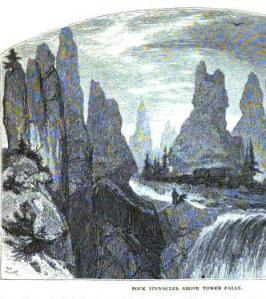
    Tower Falls Illustration from Scribner’s

    Tower Creek is a mountain torrent flowing through a gorge about forty yards wide. Just below our camp, it falls perpendicularly over an even ledge 112 feet, forming one of the most beautiful cataracts in the world. For some distance above the fall, the stream is broken into a great number of channels each of which has worked a torturous course through a compact body of shale to the verge of the precipice where they re-united and form the fall.

    The countless shapes into which the shale has been wrought by the action of the angry waters, add a feature of great interest to the scene. Spires of solid shale, capped with slate, beautifully rounded and polished, faultless in symmetry, raise their tapering forms to the height of from 80 to 150 feet, all over the plateau above the cataract. Some resemble towers, others spires of churches, and others still shoot up as lithe and slender as the minarets of a mosque.

    Some of the loftiest of these formations, standing like sentinels upon the very brink of the fall, are accessible to an expert and adventurous climber. The position attain on one of their narrow summits, amid the uproar at a height of 250 feet above the boiling chasm, as the writer can affirm, requires a steady hand and strong nerves; yet the view which rewards the temerity of the exploit is full of compensations.

    Below the fall the stream descends in numerous rapids, with frightful velocity, through a gloomy gorge, to its unions with the Yellowstone. Its bed is filled with enormous boulders, against which the rushing waters break with great fury. Many of the capricious formations wrought from the shale excite merriment as well as wonder. Of this kind especially was a huge mass sixty feet in height, which, from its supposed resemblance to the proverbial foot of his Satanic Majesty, we called the ‘Devil’s Hoof.’

    The scenery of mountain, rock, and forest surrounding the falls is very beautiful. Here too, the hunter and fisherman can indulge their tastes with the certainty of ample reward. As a halfway resort to the greater wonders still farther up the marvelous river, the visitor of future years will find no more delightful resting place. No account of this beautiful fall has ever been given by any of the former visitors to this region. The name of “Tower Falls,” which we  gave it, was suggested by some of the most conspicuous features of the scenery.”

    ∞§∞

    Moran’s 1871 field sketch of Tower Falls.

    Moran actually got to see Tower Fall in 1871 when he accompanied the government explorer, F.V. Hayden there. During the two days Moran spent at Tower Fall, he must have worked diligently making sketches from various vantage points in ink and watercolor. He used these en plain air studies later to produce several paintings in his studio.
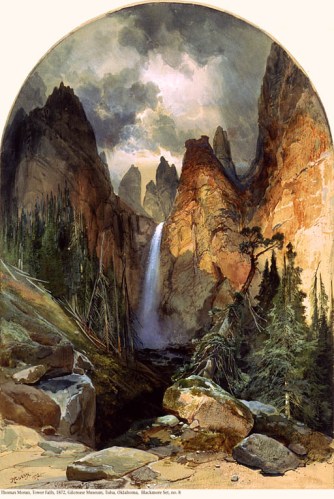
    Tower Fall, Thomas Moran, 1872.

    A year after the Washburn Expedition, Moran produced the full color rendition seen below. This piece reflects the Romantic Hudson River School that dominated American art at the time. It is characterized by aerial perspective, concealed brushstrokes and luminist techniques that made the landscapes seem to glow.

    In 1875, Moran offered the version of Tower Fall shown at the top of this post that is more impressionistic in that it juxtaposes elements in ways that can’t be seen from any actual viewpoint. Moran, who famously said, “I place no value upon literal transcripts from Nature,” was a Romantic who sought to reproduce the emotional rapture that some landscapes evoke.

    ∞§∞

    — The magazine illustration and N. P. Langford’s description are from his article “The Wonders of the Yellowstone.” Scribner’s Monthly, 2(1) 1-16 (May, 1871)

    — Other images are from the Coppermine Gallery.

    — For more on Moran’s Legacy, click on “Thamas Moran” under the Categories button to the left.

    — You might also enjoy N.P. Langford’s humorous tale about the naming of Tower Fall.
  • View: Thomas Moran Painted His Impression of the Grand Canyon of the Yellowstone

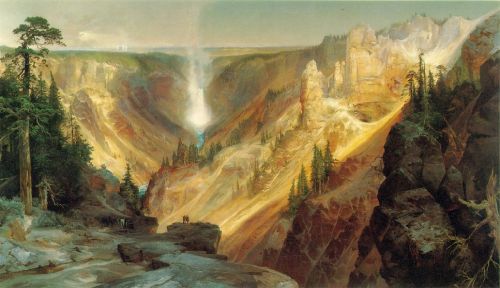
    “The Grand Canyon of the Yellowstone,” Thomas Moran

    In their journals, many tourists compared the experience of actually seeing the Yellowstone Falls and Canyon to viewing Thomas Moran’s famous painting, “The Grand Canyon of the Yellowstone.” They often disagreed on the question, ”did he get the colors right,” perhaps because the canyon looks different depending on cloud cover and sun angle. But few of them commented on other differences between viewing the painting and what they saw at the canyon.

    Moran said “I place no value upon literal transcripts from Nature . …  I did not wish to realize the scene literally, but to preserve and to convey its true impression.” To convey this “true impression,” he included several elements in the painting that could never have been seen at a single time and place.

    The painting is 12 feet wide and 7 feet tall making it impossible to see its details here, but one writer described Moran’s painting like this in 1872 when it was new:

    ∞§∞

    One of the last acts of Congress was the purchase of Mr. Thomas Moran’s “Grand Canyon of the Yellowstone,” for ten thousand dollars. It is to be placed above one of the great marble stairways in the Senate wing of the Capitol. It is the most magnificent painting we ever beheld, and we have seen Bierstadt’s “Yo Semite” and “Rocky Mountains.”

    Geyser Plumes Detail

    The Rocky Mountain range is just visible in the far distance, with the ” Tetons,” three snow covered peaks, rising above. Three of the largest geysers may also be seen in the distance and to the left of the Fall.

    The track of the river may be known by a long depression in the distant landscape. On a level plateau of purplish rock, or calcareous substance in the foreground, a few men and horses are standing.

    A dead deer or antelope lies near, and behind a cluster of huge pines, on a beetling rock, stands a large bear calmly surveying the scene. To the right in the foreground, the rocks are piled up rugged and high, and in the shadow are of a purplish-brown color.

    Just beyond this is a long smooth slope of gold color shaded to a pale primrose on one side, and to a very deep orange on the other, while still beyond rise the wonderful cliffs, which give to the scene a character distinct from any in the world.

    The coloring is pale gold in ground work, with lines and figures in violet, crimson, scarlet, deep amber and vermilion—just as if tinted by rainbows and sunbeams! This most strange and beautiful coloring is produced by the water oozing through the veins of the calcareous towers and domes, which are filled with iron and sulphur.

    One can readily imagine the tallest cliff to be a vast cathedral, with its outer walls painted in the fadeless colors of Pompeii, and with windows of deeply stained glass. The gorge or Canyon—worn to a great distance by the Fall—is, in the first broad light, of a yellowish gold; then in the deepening shadow is lavender, and lilac, and at the farthest point, deep purple.

    Here, two miles from the beholder, the Yellowstone River, blue as a summer sky, falls a distance of three hundred and fifty feet, over the gorgeous cliff, with the white mist rising, ever and always upward, like the prayer of a troubled soul, to the blue heavens above. It is too grand and wonderful for words to describe it, and none can ever judge of its wonders from any engraving or photograph in mere black and white.

    ∞§∞

    Among the “impressionistic” elements of the painting are:

    • There is no vantage where a person can see the Falls, The Grand Tetons, and geyser plumes simultaneously.

    Two Men Detail

    • It’s unclear who the small figures in the foreground are. Conjectures include Ferdinand Hayden, the head of the government expedition that Moran traveled with, and his executive officer, James Stevenson, or Moran himself and photographer William Henry Jackson, who was also on the expedition.

    • And, not visible here, a slaughtered deer and native American with his back turned to the canyon.

    Moran never offered any explanation of these things and was content to let the painting stand on its own. He probably would have agreed that seeing the painting was no substitute for the real thing. But then, seeing the real thing is no substitute for the painting.

    ∞§∞

    —  The description of Moran’s painting is from The Ladies’ Repository: Universalist Monthly Magazine,1872.

    — For more about Moran’s legacy, click “Thomas Moran” under the Catergories  Button.

    — See this link for a discussion of Moran’s view of art and his obligation to reproduce nature.