Tag: Yellowstone Park

  • A Tale: Watching Bears Fight at a Dump — 1896

    Tourists watching bears.Bears are remarkably adaptive animals that adjust their behavior to the activities of people they encounter. When people began visiting the Park in the 1870s, bears were fearless and easy to find. But they soon figured out that rifle shots are deadly. By the 1880s bear sightings were rare.

    In 1883 the Army forbade firearms in the Park and soon developers built grand hotels. The hotels began dumping their kitchen scraps in the woods and bears took that as an invitation to dinner. Watching bears at the dump soon became a popular pastime and it continued until the Park Service began locking garbage away in the 1960s.

    When cars were admitted to the Park in 1915, bears discovered they could approach them because there were no horses to scare. Bear jams blocked traffic and became a nuisance until the Park clamped down on feeding bears in the 1960s.

    While visiting Yellowstone Park in 1896, author and naturalist Ernest Thompson Seton decided to study bears. So he spent a day in the garbage dump hiding among the carrot tops, rotting potato peels and tomato cans with his notebook and sketchpad. The bears obliged him by trooping into the dump to eat scraps and lick jam jars. A large female and her three-legged, pot-bellied son caught Seton’s attention. The sickly little bear became the inspiration of Seton’s famous story, “Johnny Bear.”

    Despite his infirmities, Johnny Bear’s mother, Grumpy, loved him dearly. Like all momma bears, Grumpy was fearless when it came to protecting her son. She drove the other bears away from Johnny and left him alone to lick syrup cans.

    When Johnny got his head stuck in a can, he yowled, and complained, and struggled until he was able to pull it off. Then he punished the offending container by smashing it flat with his little paws.

    Suddenly, a huge grizzly ambled into the dump between Johnny and Grumpy. To protect her son, Grumpy charged the much larger animal and thumped him on the head. The grizzly responded with a terrible blow that sent her sprawling. The two bears clinched and rolled around in a battle that left Seaton nothing to watch but clouds of dirt and flailing legs. Johnny climbed to the top on a tree and whined as the battle raged. The grizzly easily defeated Grumpy so she dashed up the tree to join her son.

    While the grizzly ambled though the dump grazing, Seton decided he need photographs the combatants. So he began snapping pictures of Grumpy and Johnny. He then pointed his camera at the grizzly and it began moving toward him. When the giant got within five yards, Seton thought he had met his end. But the bear turned away and began licking tomato cans.

    Seton returned to the hotel after his day of bear watching, but the hotel staff refused to let the stinking naturalist in. They made him take off his clothes in the woods behind the hotel. Then they brought a fresh change from his hotel room. But Seton wasn’t humiliated. He considered the day a great success. After all, he had the material for his most famous story.

    ∞§∞

    —Read a condensed version Ernest Thompson Seton’s “Johnny Bear” in my book, Adventures in Yellowstone.

    — F.J. Haynes Postcard, Copperplate Photo Gallery.

    — To find more stories about bears, click on “Bears” under the “Categories” button to the left.

  • Researching Attitudes Toward Indians

    What would it feel like to wake up in a wilderness with a lead slug embedded in your skull and remember watching your wife being dragged away by hostile Indians? That happened to George Cowan when the Nez Perce fled through Yellowstone Park  a hundred and thirty-three years ago.

    I’m writing about George’s ordeal for my next book, Encounters in Yellowstone 1877, so I need to know how he felt. Actually, it’s not hard to empathize with George. We all know that his head hurt from the bullet lodged there. And of course, George felt anger  — maybe even rage — at his attackers, and fear — maybe even terror — at what they might do to his wife.

    George’s story is compelling because it’s easy to identify with him, but can we assume he reacted in the same way we would? Wouldn’t events like the Battle of the Little Big Horn that happen just a year before George’s ordeal have colored his reactions?

    Last week, I did some research to answer questions like those. I started by searching the index of Montana the Magazine of Western History. I scanned subject headings until I saw “Indians, attitudes toward.” Under that heading I found an article published in 1957 by Robert W. Mardock entitled “Strange Concepts of the American Indian Since the Civil War.” Mardock says in the 1870s Americans called Indians everything from “noble savages” to “red devils.”

    New England writers like Cooper and Longfellow promoted the “noble savage” view, but Mardock says things were different on the frontier. He quoted a Virginia City, Montana, newspaper: “It is high time that sickly sentimentalism about humane treatment and conciliatory measures should be consigned to novel writers, and if the Indians continue their barbarity, wipe them out.’”

    According to Mardock, “The apprehensions and viewpoints of our frontier areas were strongly reflected in the Eastern newspapers. Exaggerated dispatches from the West, incredibly wild and inaccurate when reporting Indian ‘massacres’ and depredations, were commonly printed without ever questioning their accuracy. The frontier ‘red devil’ concept dominated the national press with few exceptions.”

    George Cowan was an attorney so he probably read both territorial and national newspapers. Visions of “red devils” must have danced through his mind when he came to that morning.

    And what was George’s wife, Emma, thinking when the Indians hauled her away? I found a 1984 article by Glenda Riley entitled “Frontierswomen’s Changing View of Indians in the Trans-Mississippi West,” that provides some insight.

    Riley says, “Journalists and novelists fed the anti-Indian prejudices of their reading publics with fictionalized accounts of brutal and primitive savages who preyed especially on women. When women’s accounts were published they were usually ‘penny dreadfuls’ or narratives of captivity that further inflamed hatred of Indians.”

    In their accounts, George and Emma Cowan don’t dwell on their feelings toward Indians, but they were creatures of their times so the insights Mardock and Riley provide must apply to them. I’ll use those insights as I scrutinize the Cowans’ accounts and write about their adventures. Encounters in Yellowstone will be a better book because I took the time to dig into these things.  Of course, I will do more research.

  • A Tale: Little Invulnerable —Langford, 1870

    Private Moore's drawing.

    The remote area that became Yellowstone National Park was a roadless wilderness when the famous Washburn Expedition explored there in 1870. That meant they had to carry supplies on packhorses. Vital as these animals were to survival, the explorers rarely mentioned them. But, one horse’s antics earned him a place in several journals and a nickname. Here’s Nathaniel P. Langford’s description of “Little Invulnerable.”

    ∞§∞

    One of our packhorses is at once a source of anxiety and amusement to us all. He is a remarkable animal owned by Judge Hedges, who makes no pretentious to being a good judge of horses.

    Mr. Hedges says that the man from whom he purchased the animal, in descanting upon his many excellent qualities, said: “He is that kind of an animal that drives the whole herd before him.” The man spoke truly, but Mr. Hedges did not realize that the seller meant to declare that the animal, from sheer exhaustion, would always be lagging behind the others of the herd.

    From the start, and especially during our journey through the forest, this pony, by his acrobatic performances and mishaps, has furnished much amusement for us all.

    Progress today could only be accomplished by leaping our animals over the fallen trunks of trees. Our little bronco, with all the spirit necessary, lacks oftentimes the power to scale the tree trunks.

    As a consequence, he is frequently found resting upon his midriff with his fore and hind feet suspended over the opposite sides of some huge log. “The spirit indeed is willing, but the flesh is weak.” He has an ambitious spirit, which is exceeded only by his patience. He has had many mishaps, any one of which would have permanently disabled a larger animal, and we have dubbed him “Little Invulnerable.” One of the soldiers of our escort, Private Moore, has made a sketch of him as he appeared today lying across a log, of which I am to have a copy.

    ∞§∞

    —You can read a condensed version Langford’s book, The Discovery of Yellowstone Park, in my book, Adventures in Yellowstone: Early Travelers Tell Their Tales.

    —Illustration from Langford’s book.

    — You can read a condensed version of Langford’s The Discovery of Yellowstone Park in my book, Adventures in Yellowstone.

    — To see more stories by this author, click on “Langford” under the “Categories” button to the left.

    — For more stories about the Washburn Expedition, click on “Washburn” under the “Categories” button to the left.

  • News: My Upcoming Events

    November 17, Helena: I’ll be hosting a table for “Great Conversations,” a fundraiser sponsored by the Helena Education Foundation.  My job will be to lead a dinner conversation (scintillating, I hope) with seven people who want to talk about early travel to Yellowstone Park.  I’ll get a free dinner, an opportunity to talk about a topic I love, and the satisfaction of contributing to Helena schools.

    February 17, Bozeman: I’ll be making a presentation for the Fine Arts Series of the Montana State University College of Art and Architecture. My title will be “Bozeman to Wonderland: Early Trips to Yellowstone Park.”  In addition to talking about the explorers who first documented Yellowstone’s wonders, I’ll tell about Bozeman women who arranged for cavalry to escort them to the park through Indian country and rode sidesaddle through the wilderness.

    Meanwhile,  Ivan Doig says on his website, writer at work.

  • A Tale: Colonel Pickett Gets His Bear — 1877


    Jack Bean with trophy bear.

    After word spread about the magnificent big game in Yellowstone Park, hunters from the eastern United States and Europe began coming to bag a trophy. Even if they were skilled hunters where they came from, they needed someone to guide them in the rugged West. Jack Bean had the perfect credentials for the job. Before hiring out as a guide, Bean had been a trapper, hunter, and Indian fighter.

    In the summer of 1877, the army hired Bean to look for Chief Joseph and his band of Nez Perce Indians along the Madison River and in Yellowstone Park. He returned to Bozeman after locating the Indians and telling the Army they were headed into Yellowstone Park, to discover that a Colonel Pickett wanted to hire him as a hunting guide. In his memoir, Bean tells this tale about the intrepid Colonel.

    ∞§∞

    The Colonel was very anxious to kill a bear and had only seen a bear entering the brush on his previous hunting trips.

    The next morning our trail led us over Mount Washburn where it commenced to snow. By the time we had reached our highest point in the trail the snow was about a foot deep. As the Colonel had only summer shoes, he had to walk to keep warm. So the Colonel stopped to dig the snow off his shoes and tie them a little tighter. I looked back behind me and saw a big bear crossing the trail. I spoke to the Colonel, “There goes a bear. ” But he kept tying his shoe. When he had finished he raised his head and with a southern accent answered me, “Whar?”

    I advised him that a bear didn’t wait for a man to tie his shoe. Our trail now left the ridge and descended down to the head of Tower Creek where we saw another big bear in the trail coming toward us. So I told the Colonel, “There comes a bear.”

    “Whar?” he answered so I showed him. He got off his horse and walked quietly up the trail. I watched Mr. Bear and saw him leave the trail and start up the grassy hillside.

    I was afraid that the Colonel would shoot him when the bear was right above him and it would come down and use him rather roughly. The Colonel saw him when he was on the hill side about 30 yards away, so I dismounted and slipped up behind the Colonel. When the Colonel shot the bear it made a big growl and came down the hill on the run and passed him within 30 feet. The Colonel didn’t know I was so close behind him until I spoke.

    I told him to hold his fire until the bear jumped the creek, but he wouldn’t do it. As the bear passed the Colonel shot and missed him. When the bear crossed the creek I opened fire with my Winchester. By the time the Colonel could load and was ready to shoot again I had put five Winchester balls into him. But the Colonel gave him his last shot through the breast while the bear was falling. It rolled into the creek dead.

    We found when we had examined the bear that the Colonel’s first shot just went under the skin in the bear’s neck, which caused him to come down the hill so rapidly.

    I knew that the Colonel would want to take this hide along. But we only had one packhorse between the two of us and it was too loaded to carry the wet and green hide. So I decided that I had better spoil it. So I gave my knife a lick on the steel and as we got to the bear stuck my knife between the ears and split the skin down the backbone clean to the tail.

    The Colonel gave me a slap on the back and says, “Bean, that’s my bear.”

    I told him, “All right.” It was no credit to me to kill a bear.

    “Well,” he says, “We’ll take this skin.”

    I said, “Why didn’t you say so before I split the skin—why I’ve spoiled it.”

    The Colonel was very much put out to lose the skin. He tramped the snow down for ten feet around and finally concluded he would take the front paw and hind foot and a good chunk of meat to eat. I only took meat enough for him, as I didn’t care for bear meat. And after dissecting the bear we journeyed on our way to the Yellowstone Falls and made camp.

    That night he wanted me to cook him plenty of bear meat, but I cooked bacon for myself. I noticed that after chewing the bear meat a little, he would throw it out of his mouth when he thought I wasn’t looking. I gave him bear meat for about two days and throwed the balance away, which was never inquired for.

    ∞§∞

    — Adapted from Jack Bean, Real Hunting Tales, typed manuscript, Pioneer Museum of Bozeman.  Pages 31-33.

    — You might enjoy Colonel Picket’s version of bagging his first grizzly.

    — Pioneer Museum Photo.

    — Read more about Jack Bean in my book Adventures in Yellowstone.

  • Outline Complete for Encounters in Yellowstone 1877

    I have completed a major milestone for my next book, Encounters in Yellowstone 1877. I finished an outline. That was a complicated task because I’m writing about a myriad of overlapping events and disparate (often desperate) people.

    First, there are the Nez Perce, who decide to flee their homeland in Idaho and Washington State and make a new life in the buffalo country of Montana. After the army’s predawn attack on their sleeping camp on the banks of the Big Hole River, the Indians fragment. The Chiefs try to avoid whites while leading the main group, but they lose control over small bands of young men who spread out to seek revenge. These young warriors attack settlers along the Montana-Idaho border and tourists in Yellowstone National Park.

    Like a nuclear chain reaction, each attack breaks up a group of people yielding several dramatic stories. For example, when a young warrior named Yellow Wolf and his companions attack a tourist party near the lower geyser basin, they capture a young woman, shoot her husband in the head and leave him for dead, and send several other tourists fleeing into the forrest. This one event yields Emma Cowan’s chilling tales of her captivity and quest for help after being released in the wilderness; George Cowan’s story of regaining consciousness to find himself wounded and alone, and the Cowan’s companions’ efforts to hide, flee and find help. Meanwhile, army units converge on Yellowstone Park from several directions, trying to find and subdue the elusive Nez Perce.

    I’ve organized these events into 20 chapters that chronicle events beginning in 1805 when the Nez Perce befriend several starving men from the Lewis and Clark Expedition, and ending 130 years later with publication of a book entitled Adventures in Geyserland. Doubtless I’ll make changes as my research proceeds. I’ll need to merge some chapters, split others and rearrange things. But I have an outline that organizes a complicated human drama into a coherent narrative. For now, I’m happy with that.

    ∞§∞

  • A Tale: How to Pack a Mule — 1874

    Early tourists had to brave a roadless wilderness to see the sights of the new Yellowstone National Park. That meant supplies had to be carried by pack animals—often cantankerous mules.  One such tourist was the Earl of Dunraven, an Irish noble who first visited the park in 1874. Dunraven was an astute observer and a droll wit.  Here’s his description of how to pack a mule.

    ∞§∞

    A man stands on each side of the mule to be operated upon; the saddle, a light wooden frame, is placed on his back and securely girthed. A long rope is looped into proper form and arranged on the saddle. The side packs are then lifted into position on each side of the saddle and tightly fastened. The middle bundle is placed between them—a few spare articles are flung on the top—a tent thrown over all—and the load ready to be secured.

    The rope is fixed so the fall is one side and the slack is on the other. Each man places one foot against the animal’s ribs. Throwing the whole weight of his body into the effort, each man hauls with all his strength upon the line.

    At each jerk, the wretched mule expel an agonized grunt—snaps at the men’s shoulders— and probably gives them a sharp pinch, which necessitates immediate retaliation.

    The men haul a while, squeezing the poor creature’s diaphragm most terrible. Smaller and more wasp like grows his waist—and last not another inch of line can be got in, and the rope is made fast.

    “Bueno,” cries the muleteer, giving the beast a spank on the behind which starts it off—teetering about on the tips of its toes like a ballet dancer. Having done with one animal, the packers proceed to the next, and so on through the lot.

    While you are busy with the others, Numbers One and Two have occupied themselves in tracing mystic circles in and out—among and round and round several short, stumpy, thickly branching firs—and, having diabolical ingenuity they have twisted, tied, and tangled their trail-ropes into inextricable confusion. They are standing there patiently in their knots.

    Number Three has been entrusted with the brittle and perishable articles because she is regarded as a steady and reliable animal of a serious turn of mind. She has acquired a stomach ache from the unusual constriction of that organ—and is rolling over and over—flourishing all four legs in the air at once.

    You may use language strong enough to split a rock—hot enough to fuse a diamond, without effect.  You may curse and swear your “level best”—but it does not do a bit of good. Go on they will, till they kick their packs off. And then they must be caught —the scattered articles gathered together—and the whole operation commenced afresh.

    ∞§∞

     You can read more about the Earl’s adventures in my book, Adventures In Yellowstone.

    —Text and ilustration from the Earl of Dunraven, The Great Divide: Travels in the Upper Yellowstone in the Summer of 1874, London: Chatto and Windus, Picadilly, 1876.  pages 139-141.

     You can read more about the Earl’s adventures in my book, Adventures In Yellowstone.

    — For more stories by this author, click on “Dunraven” under the “Categories” button to the left.
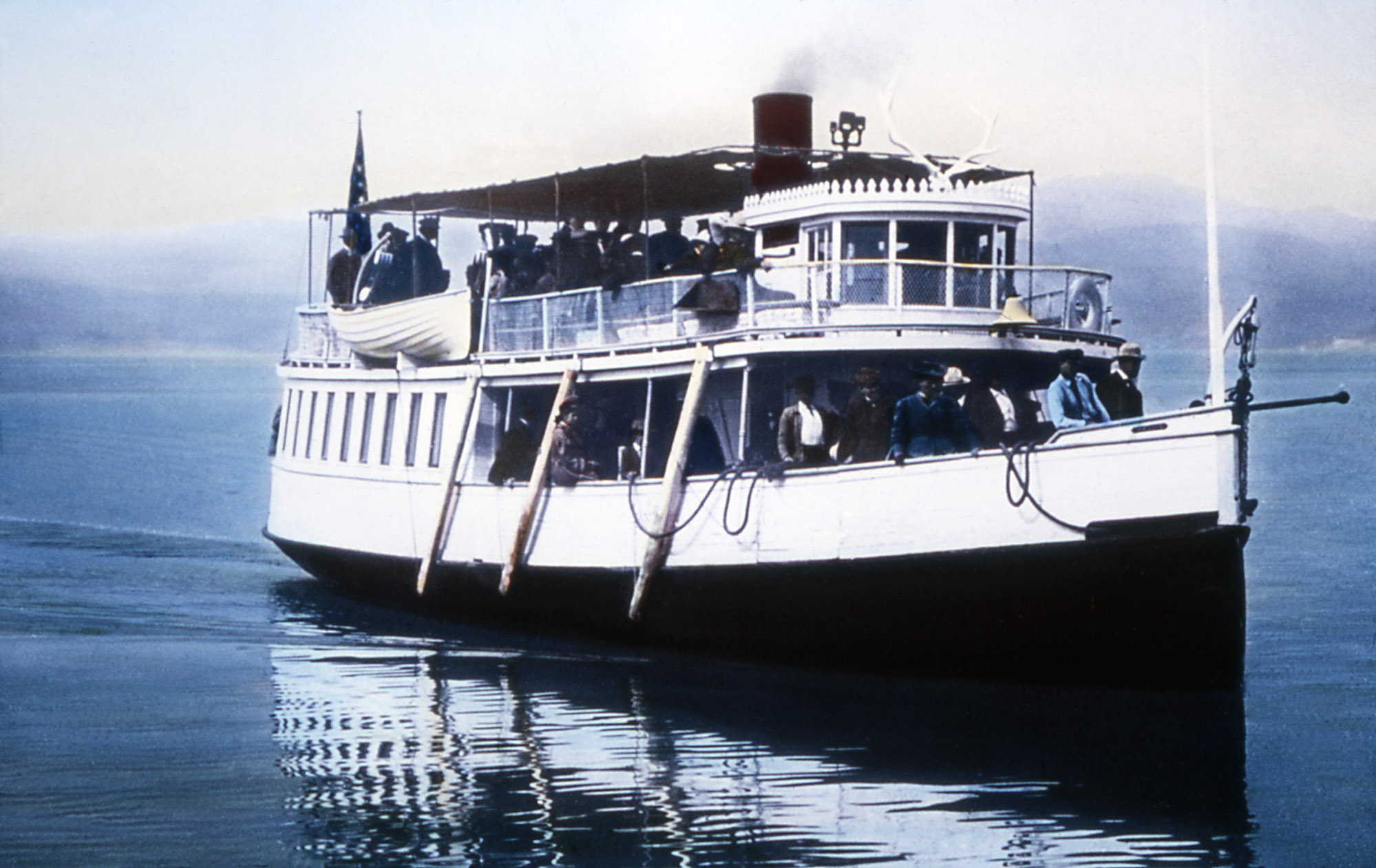
  • A Tale: Cruising Lake Yellowstone — 1903

    As soon as the Summer issue of the Pioneer Museum Quarterly arrived, I checked for my article on Hester Henshall’s 1903 trip to Yellowstone Park. I contribute regularly to the Quarterly, a publication of the Gallatin Historical Society. It’s always fun to see my stuff in print.

    Hester traveled by train from Bozeman to Yellowstone Park, with her husband, Dr. James Henshall, who was director of the Federal Fish Hatchery in Bozeman. Dr. Henshall was a physician, but he made his name as an angler and fish biologist. His Book of the Black Bass, published in 1881, is still in print

    The Henshalls toured Yellowstone “The Wylie Way.” That is, with Wylie Permanent Camping Company, which offered tourists a comprehensive package that included transportation, food and lodging in tents tour that were put up in the Spring and left up for the season. The tour included a steamboat cruise across Yellowstone Lake. Here’s Hester’s description of that.

    ∞§∞

    The shrill whistle of the little steamer called us aboard. She is a steel boat, with her name “Zillah” on a white flag floating at her masthead. We were soon steaming out into the lake. The Captain’s name was Waters, a good name for a steamboat captain. Miss Lillian Ehlert was soon at the wheel steering under the care of the pilot.

    Doctor Henshall and Doctor Donaldson and myself sat in the bow of the boat. The scene was beautiful and was all very fascinating to me. Upon the mountains was a vague blue efflorescent haze like the bloom upon a grape, that made the tint deeper, richer, softer, whether it were the deep blue of the farthest reach of vision, or the somber gray of the nearer mountains, or the densely verdant slopes of the foot-hills that dipped down into the dark shadowy waters of the lake.

    Along the western shore was the Absaroka Range of mountains; and in one place was seen the profile of a human face, formed by two peaks of the lofty range. The face is upturned toward the sky and is known as the Giant’s Face. It was several minutes before I recognized the resemblance, and then I wondered at my stupidity.

    We stopped at Dot Island, a tiny green isle in the middle of the lake, on which are a number of animals, buffalo, elk, deer and antelope. They were fed with hay from the steamboat while we were there. The Captain warned us not to go near, as the big bull buffalo was very fierce. He finally did make a terrific rush and butted the fence until I feared the structure would go down before his fierce onslaughts. He was the last animal fed, and the Doctor said that was the cause of his demonstration; that it was all for effect, and to get us aboard again as the Captain wanted to get the passengers to land at his curio store in season. The man brought another bale of hay and fed the big buffalo, who suddenly became very docile, and we left him quietly munching his hay. I guess the doctor was right.

    Soon we were again steaming over the lake. We three again took our places at the bow, and thought it queer that others did not want them. We were told that the “Zillah” was brought from Lake Minnetonka, Minnesota, in sections and put together at the lake, which seemed wonderful to me, as she had a steel hull. Too soon our journey was at an end.

    ∞§∞

    —From Hester Ferguson Henshall’s Journal, A Trip Through Yellowstone National Park [1903]. Montana Historical Society Archives.

    — Photo, Yellowstone Digital Slide File.

    — Read more about Hester Henshall’s trip in the Summer 2010 Issue of the Pioneer Museum Quarterly.

    — For more stories about fishing in Yellowstone Park, click on “fishing” under the “Categories” button on the right.

  • A Tale: Maud Gets Her Revenge — 1913

    In 1913 Louise Elliott publish a book about a young schoolteacher from Lander, Wyoming, who took a job as a camp assistant for a mobile camp tour. In her preface, Elliott confesses that she used several techniques that critics now might label “new journalism.” She created composite characters by combining traits of her camp companions, and made up a “little romance” for her protagonist.

    We can forgive Elliott because she provided an explicit disclaimer—and an entertaining portrait of  travel to Yellowstone Park in the early twentieth century. While her tales must be taken with the proverbial grain of salt, we probably can take her word that “the camp episodes and jokes, the weather and scenery, and the statistics” were all accurate descriptions copied from her diary.

    Elliott gives interesting details of her trip—a cook who makes biscuits “charred on the outside and doughy in the middle,”—a guide who carries “the scratchiest flannels” to be worn by anyone who didn’t heed his warning to bring warm clothing—and, snobbish hotel guests who refuse to return the greetings of lowly campers.

    At one point during the story, Elliott says her protagonist, Violet, and her friend, Maud, became irritated with one of their guests—a Boston lady that they called “The Spinster.” Here’s Louise’s story about that.

    ∞§∞

    Maud and I baked enough biscuits for supper and some cup cakes while the Spinster complained of all the discomforts of camp life as compared with her home conveniences. Neither did she forget to mention her lovely twenty-eight dollar and fifty-cent air mattress.

    “That settles it once for all,” whispered Maud. “Never again!”

    Well Maud had her revenge—and not once today has the Spinster boasted of her comfortable pneumatic mattress. I wondered last night why Maud was anxious to retire early as she is usually the last one to bed.

    The great pine fire was lighting our tent, and the Spinster was peacefully enjoying her first snore when I saw our Irish lassie get stealthily out of bed—and crawl over to the hated mattress. She certainly must have made a thorough study of the mechanism—she knew just where to find the valve screw. She gave a few turns—crept back into bed again—and began breathing hard and steady.

    Maud had not let me into her proposed vengeance because she feared I would not countenance it. But I suspected that the air was slowly leaking out of the mattress under the sleeping Bostonian. Soon that lady stopped her regular breathing and sat up in bed. She began fumbling under her and muttered, “Well, I never.” Finally she got up, punching the mattress, muttering something and reached into her bag.

    Pump, pump, pump—I tried so hard to keep from giggling that a snort escaped from my throat. Maud began to talk incoherently and to toss and throw her arms about to cover my tell-tale noises. “No sir, I told you before that I will not dance—no—no—.” Then her voice died away and she snored vociferously while the—pump, pump, pump—continued. At last the wonderful pneumatic was restored to its proper stage of plumpness and the weary Spinster was soon resuming her snores where she left off.

    She was more silent than usual this morning and did not allude in any way to her mattress. But while Maud and I were doing up the dishes, she went into the tent and gave her bed a thorough examination. She became more talkative after she had read the little pamphlet of directions, which had been attached to the mattress. After that she told the party how Maud had discussed her secrets and love affairs in her sleep.

    Maud asked innocently, “What did I talk about?”

    ∞§∞

    — From L. Louise Elliott, Six Weeks on Horseback Through Yellowstone Park, 1913.

    — Pioneer Museum of Bozeman Photo.

  • An Event: Meeting Other Authors at Old Faithful Inn


    Marsha Karle lavished praise on my book minutes before the next eruption of Old Faithful.

    Part of the fun of singing books in the lobby of the Old Faithful Inn was meeting other authors.  On Saturday morning, my friends artist/illustrator Marsha Karle and her husband, author Paul Schullery, stopped to chat. They were kind enough to hang around the lobby for a few minutes announcing loudly how much they enjoyed Adventures in Yellowstone and saying everyone should read it.  I can’t wait to get my hands on their new book, This High Wild Country: A Celebration of Waterton- Glacier International Peace Park. The combination of Marsha’ s watercolors and Paul’s prose has to make for a wonderful book.


    Too bad Paul wasn’t around a few minutes later when another author of books on fishing arrived. I’m sure he would have enjoyed meeting Harry Sloan, the author of Virginia Trout Streams: A Guide to Fishing the Blue Ridge Watershed.

    In the afternoon, I got to meet Ralph Himmelsbach, author of  Norjak, The Investigation of D.B. Cooper.  Ralph was the lead FBI investigator in the case, one of the most fascinating unsolved crimes of the last century. In case you don’t remember, a man calling himself Dan Cooper highjacked a passenger plane, ransomed it for $200,000, and parachuted away.

    I’ll post more later on the thrill of hearing people say “I loved your book,” and the fun of convincing others that  they’d enjoy it.

    ∞§∞