Author: mmarkmiller

  • A Tale: A Lady’s Visit To The Geysers Of The Yellowstone Park — HWS 1880 (Part 1)

    When I find long pieces on early travel to Yellowstone Park, I usually look for a excerpt or two to post on my blog. But when I examined “A Lady’s Visits To The Geysers of Yellowstone Park,” I couldn’t find short piece that stood out.
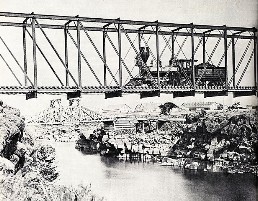
    Utah and Northern Bridge, Idaho Falls, 1880.

    In fact, the whole thing struck me as a charming account that deserved wide circulation. Also, since it’s getting harder to find items, I decided to post it in sections.

    The magazine that published the article identifies its author only as HWS, and she reveals few details about herself, just that she was a stout lady in her 50s who had two daughters.

    We know that HWS was adventurous because she took her trip at a time when getting to Yellowstone Park required a long horseback or stagecoach ride. Also, road building was just beginning in Yellowstone Park so HWS knew she would have to ride a horse when she was there.

    In part 1 or her story, HWS describes preparations for her Yellowstone adventure and the trip from Ogden, Utah, to Camas, Idaho, on the Utah and Northern Railroad. By 1883, thousands would take the train to Yellowstone Park and cross it in comfortable coaches. But in 1881, when HWS went there, it was still a remote wilderness with only a few primitive roads.

    ∞§∞

    In the summer of 1880, while traveling in California, we conceived the idea of taking a trip the following year to the National Yellowstone Park. Our party consisted of myself and three children, two young collegians, two gentlemen from Philadelphia, and a young cousin. As we had learned that our journey would have to be largely made on horseback, we condensed our baggage as much as possible, and packed it in some admirable canvas saddlebags we found in an outlying store at Salt Lake. Our “proud clothes” we left in Ogden to be picked up on our return.

    During our previous camping-out trip in Colorado, we had discovered that an oval hole dug for the hips relieved the strain on the body, and made even the hard earth quite bearable. And if to this was added a small pillow to place under the back or side, it became luxurious! We therefore purchased pillows at Salt Lake, and I supplied myself with a private trowel to carry in my own knapsack for these digging purposes. The three ladies of the party (myself and my two daughters) wore short flannel suits, with Turkish trousers. The gentlemen wore flannel shirts, and winter coats and pants, with brown duck overalls for protection from rents and holes. These latter garments were bought at my especial request, as I strongly objected to the risk of spending all my spare time in mending.

    On July 27th we started for Camas on the little narrow gauge railroad, our road lying through the dreariest of all dreary alkali plains. As far as the eye could reach, there was nothing to be seen but the burning sand and the sad gray sagebrush, which is the only thing that will grow upon it. Prairie the people called it, but desert it is, and desert it used to be called, I am sure, in the geographies of my childhood. I remember well how I used to be interested and excited in those far off days with the vague | descriptions given us of this mysterious I “Great American Desert,” and how I used to long to penetrate its dreary wastes, but never hoped to have such good fortune bestowed upon me.

    And now here I found myself, feeling as natural and almost as much at home as on a New Jersey sand-flat, and could hardly wonder how it came about. I believe it is the tin cans that have done it—tin cans and Yankee push and grit, but chiefly tin cans, for without them I do not see how these deserts could have been traversed or settled. The altitudes are so high, and the nights so cold, and the water so scarce, that nothing fit to eat grows naturally, and very little can be raised artificially, and therefore if it had not been for the ease of carrying food in these cans, civilization would, it seems to me, have met with an impassible barrier in these desert plains.

    ∞§∞

    — From H. W. S., “A Lady’s Visit To The Geysers Of The Yellowstone Park.” Friends Intelligencer May 19, 1883. Pages 218-221, and May 27, Pages 234-237.

    — Image from Widipedia Commons.

    In Part 2HWS describes the trials and tribulations of traveling across Idaho to the edge of Yellowstone National Park with a pack train.

  • A Tale: First Report of Cooking Live Fish in a Hot Spring — Hedges, 1870.

    Many early Yellowstone travelers describe places like the Fishing Cone where anglers could catch a fish in cool water and then cook it in a nearby hot spring without taking it off the hook. In fact, Philetus Norris, the park’s second superintendent, used to demonstrate the feat for the amusement of tourists.

    The earliest written description of cooking live fish in a hot spring was written by Cornelius Hedges, a member of the famous Washburn expedition of 1870. Here’s Hedges’ description of how he accidentally discovered the trick.

    ∞§∞

    My individual taste led me to fishing, and I venture that none of the party dared to complain they did not have all the fine trout that there several appetites and capacities could provide storage for. Indeed, I felt in gratitude bound to hear testimony that for fine fish, and solid, satisfying fun, there is no body of water under the sun more attractive to the ambitious fisherman than Yellowstone Lake.

    While upon the subject of fishing, allow me to relate one or two instances of personal experience. One day, after the loss of one of our comrade, when rations were getting short, I was deputed to lay in a stock of fish to eke our scanty larder on our homeward journey.

    Proud of this tribute to my piscatory skill, I endeavored under some difficulties, to justify the expectations of my companions, and in about two hours, while the waves were comparatively quiet, I strewed the beach with about 50 beauties, not one of which would weight less than 2 pounds, while the average weight was about 3 pounds.

    Another incident, illustrative of the proximity of hot springs rather than of trouting: Near the southwest corner of the lake is a large basin of exceedingly hot springs. Some are in the very margin of the lake, while others rise under the lake and indicate their locations by steam and ebullition upon the lake’s surface when the waves are not too uneasy. One spring of large size, unfathomable depth, sending out a continuous stream of at least 50 inches of scalding water, is still separated from the cool water of the lake by a rocky partition not more than a foot thick in places.

    I returned to the narrow rim of this partitian and catching sight of some expectant trout lying in easy reach, I solicited their attention to a transfixed grasshopper, and meeting an early and energetic response, I attempted to land my prize beyond the spring, but unfortunately for the fish, he escaped the hook to plunge into this boiling spring.

    As soon as possible, I relieved the agonized creature by throwing him out with my pole, and although his contortions were not fully ended, his skin came off and he had all the appearance of being boiled through. The incident, though excusable as an incident, was too shocking to repeat.

    ∞§∞

    — Cornelius Hedges, “Yellowstone Lake,” Helena Daily Herald, November 9, 1970.

    — Illustration from William Cullen Bryant (ed.), Picturesque America. New York: Appleton, 1872. 1:302.

    — You also might enjoy Henry J. Winser’s story about “Cooking Fish on the Hook in a Hot Spring.”

    — For more stories about fishing, click “Fishing” under the Categories button to the left.

  • A Tale: A Bedtime Story — Osborne Russell, 1835

    The trappers who visited the Yellowstone Plateau in the early 1800’s told about the wonders they had seen, but their reports often were  dismissed as tall tales. Perhaps that’s because they had a well developed tradition of entertaining themselves by spinning yarns around their campfires. Osborne Russell, who visited the upper Yellowstone with the Jim Bridger brigade in the 1830’s, described a story telling session in his famous Journal of a Trapper.

    ∞§∞

    We killed a fat elk and camped at sunset in a smooth, grassy spot between two high, shaggy ridges, watered by a small stream which came tumbling down the gorge behind us. As we had passed the infernal regions we thought, as a matter of course, this must be a commencement of the Elysian Fields, and accordingly commenced preparing a feast. A large fire was soon blazing, encircled with sides of elk ribs and meat cut in slices, supported on sticks, down which the grease ran in torrents.

    The repast being over, the jovial tale goes round the circle, the peals of loud laughter break upon the stillness of the night which, after being mimicked in the echo from rock to rock dies away in the solitary gloom. Every tale reminds an auditor of something similar to it but under different circumstances, which, being told, the “laughing part” gives rise to increasing merriment and furnishes more subjects for good jokes and witty sayings such as a Swift never dreamed of.

    Thus the evening passed, with eating, drinking and stories, enlivened with witty humor until near midnight, all being wrapped in their blankets lying round the fire, gradually falling to sleep one by one, until the last tale is encored by the snoring of the drowsy audience. The speaker takes the hint, breaks off the subject and wrapping his blanket more closely about him, soon joins the snoring party.

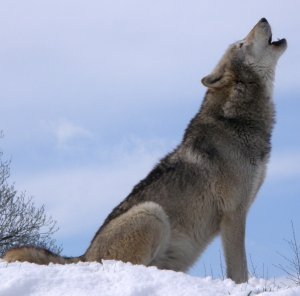
    The light of the fire being superseded by that of the moon just rising from behind the eastern mountain, a sullen gloom is cast over the remaining fragments of the feast and all is silent except the occasional howling of the solitary wolf on the neighboring mountain, whose senses are attracted by the flavor of roasted meat, but fearing to approach nearer, he sits upon a rock and bewails his calamities in piteous moans which are reechoed among the mountains.

    ∞§∞

    — From Osborn Russell, Journal of a Trapper. Syms-York: Boise, Idaho, 1921.  Pages 49-50.

    — You might enjoy these stories by Osborne Russell:

    — You can read more excerpts from Osborne Russell’s Journal of a Trapper in my book, Adventures in Yellowstone.

    — Wikipedia photo.

  • An Event: Meet Me Next Summer at Old Faithful Inn

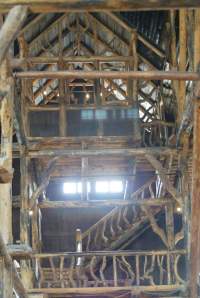
    Old Faithful Inn Crows Nest

    I’ll be returning to Yellowstone Park this summer to greet tourists and sign copies of my book, Adventures in Yellowstone: Early Travelers Tell Their Tales, in the lobby of the world famous Old Faithful Inn. Why don’t you join me there on the weekends August 11-12 and August 25-26? [The dates of July 21-22 posted here earlier have been changed.]

    You can read about my book signing at the Inn in July last year here, and in August here.  For a complete list of my activities, click on “My Events” above.  Check back often because things are poppin’.

    ∞§∞

    — Image from The Coppermine  Photo Gallery.

  • News: Yellowstone Gate Links to M. Mark Miller Blog

    Today I noticed that I my blog received several hits from Yellowstone Gate, which describes itself as “an independent, online news site covering life in and around Yellowstone and Grand Teton national parks. Our mission is to offer original reporting, insight and commentary on the critical common issues facing the parks and their gateway communities, including Cody, Wyo.; Cooke City, Mont.; Gardiner, Mont.; Jackson, Wyo.; and West Yellowstone, Mont.”

    I decided to reciprocate by posting this notice and adding a link to Yellowstone Gate to my blogroll.  I hope you’ll check there often. I know I will.

    ∞§∞

    — Quotation and logo are from  Yellowstone Gate.

  • A Tale: The Army Protects Theodore Roosevelt From Snooping Reporter — 1903

    Guard Mount at Fort Yellowstone

    When the U.S. congress established Yellowstone National Park in 1872, they put a civilian staff  in charge, but failed to appropriate enough money for the job of protecting it. Poachers decimated wildlife; collectors vandalized natural features and monopolists gouged travelers. Things became so bad by 1886 that the U.S. Army was asked to step in. It ran the park until 1918 when the National Park Service took over.

    By all accounts, the Army was diligent and left its mark in ways ranging from the shape of rangers’ hats to Grand Loop pattern of roadways. Here’s a story that describes how effective they were when they were asked to protect President Theodore Roosevelt when he visited Yellowstone in 1903.

    ∞§∞

    An incident that occurred during President Roosevelt’s recent visit proves the exceedingly careful manner in which the Park is guarded. When Mr. Roosevelt made it known that his object in entering the Yellowstone Park was to secure several days of complete privacy, and that he did not want any one aside from Major Pitcher and the picked escort to accompany him, a certain correspondent representing a New York daily, who had been ordered to be on hand in case of any accident to the President or other emergency of National importance, resolved to ignore the President’s request and to follow him at all hazards.

    With this object in view, he attempted to bribe some of the native population, but without success. Not disheartened by his failure to secure a friendly companion and guide, the correspondent hired a horse and persuaded a stray dog to accompany him. This was on the afternoon of the President’s arrival at Fort Yellowstone. The Fort is ten miles from Gardiner, where the rest of the correspondents and the President’s party had stopped.

    The recreant correspondent set forth in high glee at the possibility of working a “beat” on his fellow-craftsmen. As he rode along through the leafy lanes and past the towering cliffs, which in part line the road to the Springs, he felt very well satisfied with himself, and chuckled at the ease with which he had evaded the guards stationed near Gardiner. Suddenly, as he was entering a particularly dark part of a forest, he heard a voice from the brush on the right.

    “Theodore Jones,” it said slowly and in unmistakable authoritative tones. “Theodore Jones!”

    The correspondent reined up his horse in amazement. Who was it calling his name? Had he been followed from Gardiner? If so, why did the voice come from the bushes and evidently some distance from the road?

    “Hello !” he shouted, in reply.

    There was no answer. He called again and again, but without result. Then he put spurs to his horse and rode on. Half a mile further down the road, just as he was passing through another bit of woodland, a deep voice called out seemingly at his very elbow:

    “Theodore Jones ! Theodore Jones-s-s ! Better go back.”

    For one moment, the newspaperman hesitated, then he rode resolutely forward. He felt that he was being tricked, but he intended to see the game out. He was a bit nervous because he realized that his course of action was not entirely honorable, and it was with something very like relief that he espied at a turn in the road a United States trooper sitting with horse blocking the path and a rifle slung carelessly across the pommel of his saddle.

    “Haiti” called out the soldier. “Mr. Jones, you are wanted at Headquarters.”

    “How do you know my name is Jones?” demanded the correspondent.

    The trooper smiled as if the question was a joke. Placing one hand upon the correspondent’s bridle, he led him without further words to Fort Yellowstone. A technical charge of unlawfully bringing a dog into the reservation was entered against Mr. Jones, but he was released on his promise not to enter the Park again until the President’s return. The incident had its value in showing the extreme care taken by the Park’s guardians in keeping out unwelcome visitors. The correspondent’s errand was known at Headquarters before he had crossed the line.

    ∞§∞

    — From Henry Harrison Lewis, “Managing a National Park.” The Outlook 74(18)1036-40. (Aug. 29, 1903).

    — You also might enjoy

    — Detail from Coppermine Gallery Photo.

  • A Tale: Tourists Say Goodbye to Budding Romance After Tour — Dale, 1904

    By the time Stephen Dale toured Yellowstone National Park in 1904, it had been transformed from a dangerous wilderness into a genteel resort. Railroads brought tourists from distant locations to the very edge of the park where they boarded carriages for the tour. The Army Corps of Engineers had built some of the best roads in America. And the Yellowstone Park Association had built luxury hotels that rivaled the best in the country. Park company tours sped tourists through Yellowstone in six days—less time than many earlier travelers spent at the Upper Geyser Basin. In this short time travelers became fast friends who found it difficult to say goodbye when the trip ended. Here’s Dale’s story about saying goodbye.

    ∞§∞

    The whole party—in our case seventy-five people—traveled together all the way around, even keeping the same seats on the same stages. No one as far as I can recall was ever introduced, nor was anyone told anybody else’s name. But little things like that did not matter; names could be learned from hotel registers. Sometimes not even this trouble was taken; there was no time, there were too many interesting things to do. So nicknames were applied. There was “That Russian,” “The German,” “The Woman with the Bundle,” “The Baby Elephant,” and “The Heavenly Twins.” There were “Sunny Jim” and “Foxy Grandpa,” “Everyman” and “That Other Man.”

    It was only when we got back to the starting point and there met strangers that we realized what old friends we had all become. On that last day of the tour parties break up with reluctance. In our party at least, friends of only six days’ acquaintance separated sorrowing, and everyone exchanged cards with a neighbor. I have an idea, although it is a secret, that in the case of “The Yale Man,” and “The Lady in the Newport Veil,” “The Professor” and “That Girl with the Pretty Shirtwaist,” “The Doctor” and “That Girl with the Gorgeous Eyes,” other things may possible have been exchanged. Nobody but the postman knows for sure.

    ∞§∞

    — Stephen M. Dale, “Through Yellowstone on a Coach,” Ladies Home Journal, 21:9, 5-6 (August 1904).

    — Photo, Yellowstone Digital Slide File.

  • An Event: Getting Ready to Launch 2012 at Old Faithful Snow Lodge

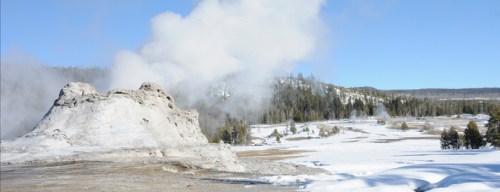
    Castle Geyser in Winter

    I spent the day preparing for my presentations on January 1 and 2 at the Old Faithful Inn Snow Lodge. I’ll be at the visitor center gift shop on both days from 7 to 9 p.m. to do readings and sign copies of my book, Adventures in Yellowstone: Early Travelers Tell Their Tales.

    I could have just marked a few selections in Adventures and been done with it, but I prefer to do a unique presentation every time I speak. That motivates me to re-examine my collection of stories about early travel to Yellowstone Park and lets people see my presentations more than once without a lot of repetition. That’s really important this time because I’m on for two nights in a row.

    I’ll begin both nights by introducing myself and explaining how I became interested in early travel to Yellowstone Park. That gives me an excuse to recount the stories my grandmother told me when I was a little boy. Grandma went to the park in 1909 with her aunt, seven cousins and two brothers. Family lore says they took a milk cow with them to provide for the younger children.

    Then I’ll tell stories that explore snow and cold weather in the Park. On Jan. 1, Sunday, I’ll read a story about pioneer photographer F. J. Haynes who was a member of the first winter expedition to the park in 1887. Haynes marveled at the fantastic forms created when ice formed on trees near hot springs and geyser and managed to take pictures in temperatures that reached 50 degrees below zero. On Jan. 2, Monday, I’ll tell how soldiers, who guarded Yellowstone at the dawn of the Twentieth Century, tracked down a notorious buffalo poacher in February.

    Of course, I’ll read from Adventures in Yellowstone. On Sunday, I’ll read an excerpt from Truman Everts’ story of being treed by a mountain lion. The incident occurred when Everts became separated from the famous Washburn Expedition of 1870. Everts’ tale of being lost and alone in the Yellowstone wilderness for 37 days is one of the park’s most famous.

    Another very famous Yellowstone story is Emma Cowan’s account of being captured by the Nez Perce in 1877. On Monday, I’ll read her chilling description of watching Indians shoot her husband in the head.

    Emma’s adventures will also appear in my Sunday presentation when I read a section from the book I’m working on now, Encounters in Yellowstone, which will tell what happened when several groups of tourists ran afoul of the Nez Perce. I’ll read a section from the new book that describes Emma driving her team and wagon 125 miles in 15 hours to be by her wounded husband’s side.

    On Monday, I’ll read a selection from Macon’s Perfect Shot, a mid-grades novel that I’m sending to a publisher next week. Perfect Shot tells about a 14-year-old boy who learns to shoot while visiting the Park in the 1870s. I’ll read an excerpt where he makes an impossible shot—and regrets it.

    If time allows, I’ll read a couple of my favorite stories. On Sunday, I’ll have Henry Merry’s tale of driving the first automobile into the park in 1904.  Merry tried to race his Winton past the guards, but they lassoed the car and dragged it to the superintendent’s office.  On Monday, I’ll be ready to read “Maud’s Revenge,” the story of how a camp cook gets even with a supercilious travel guest.

    I’ll like to end my presentation with a farewell story. On Sunday, I’ll read story from Osborne Russell’s famous Journal of a Trapper about a group of Mountain Men telling tall tales around a campfire in the 1830s. On Monday, I’ll end up with Stephan Dale’s 1904 story about people finishing a six-day tour by saying goodbye to new friendships and budding romances.

    ∞§∞

    — Photo courtesy of Xantera.

  • A Tale: A Mountain Man Has Christmas Dinner — Russell, c. 1838

    ***Happy Holidays***

    Today tourists can see the wonders of Yellowstone Park in Winter by snow coach and snowmobile, but that’s a recent phenomenon. During the period where I focus my research, the 1800s and early 1900s, winter visits to Wonderland were rare and dangerous. I’ve searched diligently for a Christmas story set in Yellowstone Park, but I haven’t found one. I settled for this description of Christmas dinner in Utah from Osborne Russell’s famous Journal of a Trapper, which contains some of the earliest written descriptions of upper Yellowstone. 

    ∞§∞

    December 25th—It was agreed on by the party to prepare a Christmas dinner, but I shall first endeavor to describe the party and then the dinner. I have already said the man who was the proprietor of the lodge in which I staid was a Frenchman with a Flathead wife and one child. The inmates of the next lodge were a halfbreed Iowa, a Nez Perce wife and two children, his wife’s brother and another halfbreed; next lodge was a halfbreed Cree, his wife (a Nez Perce) two children and a Snake Indian. The inmates of the third lodge was a halfbreed Snake, his wife (a Nez Perce) and two children. The remainder were fifteen lodges of Snake Indians. Three of the party spoke English but very broken, therefore that language was made but little use of, as I was familiar with the Canadian French and Indian tongue.
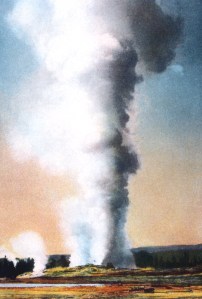
    About ten o’clock we sat down to dinner in the lodge where I staid, which was the most spacious, being about thirty-six feet in circumference at the base, with a fire built in the center. Around this sat on clean epishemores all who claimed kin to the white man (or to use their own expression, all who were gens d’esprit), with their legs crossed in true Turkish style, and now for the dinner.

    The first dish that came on was a large tin pan eighteen inches in diameter, rounding full of stewed elk meat. The next dish was similar to the first, heaped up with boiled deer meat (or as the whites would call it, venison, a term not used in the mountains). The third and fourth dishes were equal in size to the first, containing a boiled flour pudding, prepared with dried, fruit, accompanied by four quarts of sauce made of the juice of sour berries and sugar. Then came the cakes, followed by about six gallons of strong coffee ready sweetened, with tin cups and pans to drink out of, large chips or pieces of bark supplying the places of plates. On being ready, the butcher knives were drawn and the eating commenced at the word given by the landlady.

    As all dinners are accompanied by conversation, this was not deficient in that respect. The principal topic which was discussed was the political affairs of the Rocky Mountains, the state of governments among the different tribes, the personal characters of the most distinguished warrior chiefs, etc. One remarked that the Snake chief, Pahda-hewakunda, was becoming very unpopular and it was the opinion of the Snakes in general that Mohwoom-hah, his brother, would be at the head of affairs before twelve months, as his village already amounted to more than three hundred lodges, and, moreover, he was supported by the bravest men in the nation, among whom were Ink-a-tosh-a-pop, Fibe-bo-un-to-watsee and Who-sha-kik, who were the pillars of the nation and at whose names the Blackfeet quaked with fear.

    In like manner were the characters of the principal chiefs of the Bannock, Nez Perce, Flathead and Crow nations and the policy of their respective nations commented upon by the descendants of Shem and Japhet with as much affected dignity as if they could have read their own names when written, or distinguish the letter B from bull’s foot.

    Dinner being over, the tobacco pipes were filled and lighted, while the squaws and children cleared away the remains of the feast to one side of the lodge, where they held a sociable tete-a-tete over the fragments. After the pipes were extinguished all agreed to have a frolic shooting at a mark, which occupied the remainder of the day.

    ∞§∞

    — Osborne Russell and Lem A York, Journal of a Trapper or Nine Years in the Rocky Mountains, 1834-1843. Syms York Company: Boise Idaho, 1921.  Page 114-116.

    — You might also enjoy;

    — Image, Coppermine Photo Gallery.

  • A Scene: The Geysers of Yellowstone — Washburn, 1870

    There had been rumors of wonders in the upper Yellowstone for more than 50 years, but the Washburn Expedition of 1870 made it official. The place really did contain towering waterfalls, a huge inland sea and—most stupendous—boilding fountains that threw water hundreds of feet into the air. 

    There were several reasons Washburn and his companions captured the public imagination. First, the expedition was composed of prominent government officials and businessmen whose word could not be doubted. Second, the expedition included several skilled writers who published reports immediately after they returned from the wilderness. Third, there was a well developed communication system that included several Montana territorial newspapers and the telegraph to spread the news across the nation. Finally, the Northern Pacific Railroad, which was making its way westward, promoted the area in hopes of  making it a tourist destination.

    General Washburn himself was one of the skilled writers whose work was caught up in this fortuitous combination. Here’s his description of the geysers of the Upper Yellowstone.

    ∞§∞

    Grand Geyser

    On the south end of the lake is a very beautiful collection of hot springs and wells. In many the water is so clear that you can see down fifty or a hundred feet.

    The lake is 8,000 feet above the level of the sea, a beautiful sheet of water, with numerous islands and bays, and will in time be a great summer resort; for its various inlets, surrounded by the finest mountain scenery, cannot fail to be very popular to the seeker of pleasure, while its high elevation and numerous medicinal springs will attract the invalid. Its size is about twenty-two by fifteen miles.

    Leaving the lake, we moved nearly west, over several high ranges, and camped in the snow amid the mountains. Next day, about noon we struck the Fire Hole River. and camped in Burnt Hole Valley.

    This is the most remarkable valley we found. Hot springs are almost innumerable. Geysers were spouting in such size and number as to startle all, and are beyond description. Enormous columns of hot water and steam were thrown into the air with a velocity and noise truly amazing. We classified and named some of them according to size:

    No. 1. The Giant, 7 by 10 feet, throwing a solid column of water from £0 to 120 feet high.

    No. 2. The Giantess, 20 by 30. throwing a solid column and jets from 150 to 200 feet high.

    No. 3. Old Faithful, 7 by 8, irregular in shape, a solid column each hour, 75 feet high.

    No. 4. Bee Hive, 24 by 15 inches, stream measured 219 feet.

    No. 5. Fan Tail, irregular shape, throwing a double stream 60 feet high.

    No. 6 is a beautiful arched spray, called by us the Grotto, with several apertures through which, when quiet, one can easily pass, but when in action each making so many vents for the water and steam.

    Upon going into camp we observed a small hot spring that had apparently built itself up about three feet. The water was warm but resting very quietly, and we camped within 200 yards of it. While we were eating breakfast this spring, without any warning threw, as if it were the nozzle of an enormous steam-engine, a stream of water into the air 210 feet, and continued doing so for some time, thereby enabling us to measure it, and then as suddenly subsided.

    Surrounded by these hot springs is a beautiful cold spring of tolerably fair water. Here we found a beautiful spring or well, raised around it was a border of pure white, carved as if by the hand of a master-workman, the water pure. Looking down into it, one can see the sides white and clear as alabaster, and carved in every conceivable, shape, down, down, until the eye tires in penetrating.

    Standing and looking down into the steam and vapor of the crater of the Giantess. With the sun upon our back, the shadow is surrounded by a beautiful rainbow; and, by getting the proper angle, the rainbow, surrounding only the head, gives that halo so many painters have vainly tried to give in paintings of the Savior.

    Standing near the fountain when in motion, and the sun shining, the scene is grandly magnificent; each of the broken atoms of water shining like so many brilliants, while myriads of rainbows are dancing attendance. No wonder, then, that our usually staid and sober companions threw up their hats and shouted with ecstasy at the sight.

    We bid farewell to the geysers, little dreaming there were more beyond. Five miles below Burnt Hole we found the “Lake of Fire and Brimstone.” In the valley we found a lake measuring 450 yards in diameter, gently overflowing, that had built itself up by a deposit of white sub-strata at least 50 feet above the plain. This body of water was steaming hot.

    Below this was a similar spring, but of smaller dimensions while between the two, and apparently having no connection with either, was a spring of enormous volume flowing into the Madison, and is undoubtedly the spring about which Bridger was laughed at so much when he reported that it heated the Madison for two miles below. For some distance down the river we found hot springs and evidences of volcanic action.

    ∞§∞

    — From Henry Washburn, “The Yellowstone Expedition,” Helena Daily Herald, September 27 and 28, 1870.

    — Frank J. Haynes postcard, Yellowstone Digital Slide File.

    — You might also enjoy General Washburn’s description of Yellowstone Falls.

    — For more stories from the Washburn Expedition, click “Washburn” under the “Categories” button to the left.