Author: mmarkmiller

  • A Tale: Osborne Russell Tangles With Blackfeet — 1839

    Few of the Mountain Men who scoured the Rocky Mountains looking for beaver had the skill or inclination to write about their experiences. A conspicuous exception is Osborne Russell who trapped in Yellowstone Park in the late 1830’s.

    He also described some thrilling adventures. Here’s one of them.

    ∞§∞

    The Trapper’s Last Shot

    We encamped on the Yellowstone in the big plain below the lake. The next day we went to the lake and set our traps on a branch running into it near the outlet on the northeast side. After setting my traps I returned to the Camp.

    The day being very warm, I took a bath in the lake for probably half an hour and returned to camp about 4 o’clock After eating a few minutes, I arose and kindled a fire, filled my tobacco pipe and sat down to smoke. My comrade whose name was White was still sleeping. Presently I cast my eyes towards the horses, which were feeding in the Valley and discovered the heads of some Indians gliding round within 30 steps of me.

    I jumped to my rifle and aroused White while looking towards my powder horn and bullet pouch. They were already in the hands of an Indian and we were completely surrounded. We cocked our rifles and started through their ranks into the woods, which seemed to be completely filled with Blackfeet who rent the air with their horrid yells.

    On presenting our rifles they opened a space about 20 feet wide through which we plunged. About the fourth jump an arrow struck White on the right hip joint. I hastily told him to pull it out. As I spoke another arrow struck me in the same place, but the arrows did not retard our progress. At length another arrow striking through my right leg above the knee benumbed the flesh so that I fell with my breast across a log. The Indian who shot me was within eight feet and made a spring towards me with his uplifted battle-axe. I made a leap and avoided the blow and kept hopping from log to log through a shower of arrows that flew around us like hail.

    After we had passed them about ten paces we wheeled about and took aim at them. They then began to dodge behind the trees and shoot their guns. We then ran and hopped about fifty yards further in the logs and bushes and made a stand.

    I was very faint from the loss of blood and we set down among the logs determined to kill the two foremost when they came up and then die like men. We rested our rifles across a log—White aiming at the foremost and myself at the second. I whispered to him that when they turned their eyes toward us to pull trigger.

    About twenty of them passed by us within fifteen feet without casting a glance towards us another file came round on the opposite side within twenty or thirty paces closing with the first a few rods beyond us and all turning to the right. The next minute they were out of our sight among the bushes. They were all well armed with fusees, bows and battle-axes.

    We sat still until the rustling among the bushes had died away then arose after looking carefully around us. White asked in a whisper how far it was to the lake. I replied by pointing to the southeast about a quarter of a mile. I was nearly fainting from the loss of blood and the want of water.

    We hobbled along forty or fifty rods and I was obliged to sit down for a few minutes, then go a little further, and then rest again. We managed in this way until we reached the bank of the lake. Our next object was to obtain some of the water as the bank was very steep and high. White had been perfectly calm and deliberate, but now his conversation became wild hurried.  Despairing, he observed, “I cannot go down to that water for I am wounded all over—I shall die.” I told him to sit down while I crawled down and brought some in my hat. This I effected with a great deal of difficulty.

    We then hobbled along the border of the Lake for a mile and a half when it grew dark and we stopped. We could still hear the shouting of the savages over their booty. We stopped under a large pine near the lake and I told White I could go no further

    “Oh” said he, “let us go up into the pines and find a spring,” I replied there was no spring within a mile of us, which I knew to be a fact.

    “Well,” said he, “if you stop here I shall make a fire.”

    “ Make as much as you please,” I replied angrily; “this is a poor time now to undertake to frighten me into measures.” I then started to the water crawling on my hands and one knee and returned in about an hour with some in my hat.

    While I was at this he had kindled a small fire and taking a draught of water from the hat he exclaimed, “Oh dear we shall die here, we shall never get out of these mountains.”

    “Well,” said I, “if you persist in thinking so you will die but I can crawl from this place upon my hands and one knee and kill two or three elk and make a shelter of the skins, dry the meat until we get able to travel.” In this manner I persuaded him that we were not in half so bad a situation as we might be although he was not in half so bad a situation as I expected.

    On examining I found only a slight wound from an arrow on his hip bone, but he was not so much to blame as he was a young man who had been brought up in Missouri, the pet of the family and had never done or learned much of anything but horseracing and gambling whilst under the care of his parents (if care it can be called).

    I pulled off an old piece of a coat made of blanket (as he was entirely without clothing except his hat and shirt)—set myself in a leaning position against a tree ever and anon gathering such leaves and rubbish as I could reach without altering the position of my body to keep up a little fire in this manner miserably spent the night.

    It was now ninety miles to Fort Hall and we expected to see little or no game on the route, but we determined to travel it in three days. We lay down and shivered with the cold till daylight then arose and again pursued our journey towards the fork of Snake river where we arrived sun about an hour high forded the river which was nearly swimming and encamped. The weather being very cold and fording the river so late at night caused me much suffering during the night. September 4th we were on our way at daybreak and traveled all day through the high Sage and sand down Snake River. We stopped at dark nearly worn out with fatigue hunger and want of sleep as we had now traveled sixty-five in two days without eating. We sat and hovered over a small fire until another day appeared then set out as usual and traveled to within about 10 of the Fort when I was seized with a cramp in my wounded leg which compelled me to stop and sit down every thirty or forty rods. At length we discovered a half breed encamped in the valley who furnished us with horses and went with us to the fort where we arrived about sun an hour high being naked hungry wounded sleepy and fatigued. Here again I entered a trading post after being defeated by the Indians but the treatment was quite different from that which I had received at Laramie’s fork in 1837 when I had been defeated by the Crows.

    The Fort was in charge of Mr. Courtney M. Walker who had been lately employed by the Hudsons Bay Company for that purpose He invited us into a room and ordered supper to be prepared immediately. Likewise such articles of clothing and Blankets as we called for.

    After dressing ourselves and giving a brief history of our defeat and sufferings supper was brought in consisting of tea, cakes, buttermilk, dried meat, etc. I ate very sparingly as I had been three days fasting but drank so much strong tea that it kept me awake till after midnight. I continued to bathe my leg in warm salt water and applied a salve, which healed it in a very short time so that in ten days I was again setting traps for Beaver.

     ∞§∞

    — Adapted from Journal of a Trapper [1834-1843] by Osborne Russell.

    — Detail from a Library of Congress Image.

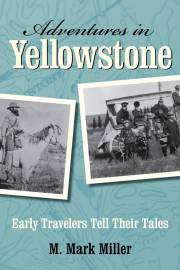
    — You can read more by Osborn Russell in my book, Adventures in Yellowstone.

    — You might also enjoy these tales by Mountain Men:

  • Adventures in Yellowstone Crackes Top One Percent on Amazon

    I admit it. I regularly check the sales rank of my book, Adventures in Yellowstone: Early Travelers Tell Their Tales, on Amazon.Com. It’s like buying a lottery ticket. I know the odds against making the bestseller list are colossal, but it feeds my dreams.

    During the winter months when Yellowstone Park was buried under 20-foot snowdrifts, my sales rank bounced around between a hundred thousand and a million. I know that doesn’t sound impressive, but you should recall that there are about six million titles available on Amazon so that’s well within the top twenty percent.
    Over the past few weeks, snow began melting, the Park officially opened for the 2011 season, and the sales rank for Adventures regularly topped one hundred thousand, or, as I like to think of it, the top five percent. Then, for at least a few minutes this afternoon—TA DAH—my book ranked in at thirty-five thousand, well inside the top one percent.

    There are two kinds of people who should read Adventures in Yellowstone this summer.  First are those who plan a Yellowstone Park vacation. Nothing enhances the Yellowstone experience like a little knowledge. You’ll feel smart when you cross Dunraven Pass knowing that it was named for an Irish nobleman who visited Yellowstone twice in the 1870s.

    When somebody asks, “Who was that guy who was lost for a month in the park,” you’ll be able to answer, “That was Truman Everts; he survived for thirty-seven days by eating thistle roots.”

    When you pass by Nez Perce Creek and people say, “I thought Indians were afraid to come here because of the geysers,” you can tell them, “Oh no, early travelers did indeed tangle with Indians here; in fact,the Nez Perce held a women named Emma Cowan captive for two days in 1877.”

    The other kind of people you should read Adventures are those who aren’t planning a Yellowstone vacation. That’s because everybody likes an exciting adventure story like Henry “Bird” Calfee’s tale about saving his friend who fell into a geyser, or Carrie Strahorn’s rush to safety after being caught in a snowstorm. And everybody likes a funny story like the one Eleanor Corthell told about when she left her husband at home, bought a horse and wagon, and took their seven children to the park.

    So if you’re planning a vacation in Yellowstone Park this summer (or know someone who is), then you should buy a copy of Adventures in Yellowstone. And if you’re just looking for summer reading filled with adventure and fun, then you too should buy a copy.

    And remember, it’s also available for Kindle.

    Ask for it from your favorite bookseller.  Or order it on-line.

    And tell your friends.

    ∞§∞

  • A Tale: Nights of Romance in Yellowstone Park — 1919

    Not all stories about Yellowstone Park are high adventures like battling Indians, or tumbling down canyons, or falling in geysers. Some are just sweet little tales about young people falling in love. Here’s an example.

    ∞§∞

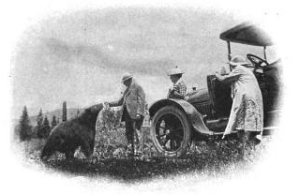
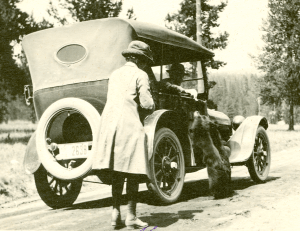
    Yellowstone Bear on the Running Board.

    The giant Speedex hummed out of Bozeman with its load of khaki-clad, riding-trousered women and men in old army uniforms. The running-board was piled high with the dunnage which accompanies an automobile tour, and in back, two burly, grey, spare tires rode majestic. The giant Speedex was bound for the Yellowstone Park.

    Not two minutes behind roared Winsted Tripp’s fiery roadster. The girl was in the big machine ahead. In the hotel the night before, Win had noted the entrance of the party; had heard the clerk describing the route they must take to get to the Park and had observed the girl. So it was that he had arisen early, and was now sailing along with the top down and windshield up, the breeze blowing over his thick hair and over the iron-grey ambrosial locks of old Pop Slocum, who was accompanying him on his trip through the Park.

    All morning long the roadster sped down the Yellowstone Trail on its way to the Gardiner gateway. Win kept a lookout for the Speedex, and twice sighted the big spare tires down the dustless road ahead. He aimed to travel a short distance behind the other party, and if necessary assist Fate in decreeing that they should stop at the same hotel that night.

    They made Mammoth Hot Springs about half-past four and secured a room. Then the young man with his old comrade went for a tour of the great hot springs formation. It was the cool of the afternoon, and the white limestone dust on the formation looked like snow. Old maids, college professors, geologists, guides, bored tourists, were everywhere, giving the multitudinous colored pools, spiderweb limestone deposits, and other wonders the great American “once-over.”

    Win thought once that he glimpsed the girl, but he couldn’t be sure.

    Those nights at Mammoth Hotel! The stars sparkling in the dry air of that high altitude; the arc lights flaring like giant diamonds around the grounds; the dance-floor in the hotel swimming in color as the couples sway to the orchestra’s jangling tunes; the scent of balsam firs that pervades everything in the Park . . . Nights of romance!

    “Go in and dance,” urged Pop Slocum. “You may not know yon gay damsels, but tell ’em you’re a gentleman and are taking as much risk as they are anyhow, and I’ll bet no one will object.”

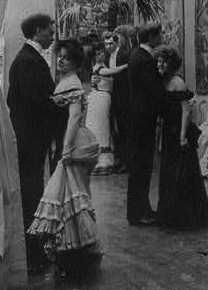
    Ballroom Scene.

    But Win preferred to sit on the sidelines and watch the dancers. He had been a male wallflower since the first dance he had ever attended. He couldn’t talk to girls, that was the trouble; he always felt called on to say something humorous or brilliant, and always managed to stammer out some peculiarly stupid remark.

    And so, melancholy came upon Win, and he began to be afraid of his interest in the girl. She was too far above him, he concluded; she’d never understand. Finally, he went upstairs to bed.

    The travellers went on early the next morning. They were getting into the heart of the great reserve, and the roads were becoming ever more tortuous and steep, though their ribbon-smooth surfacing continued.

    Pop Slocum was surprised by Win’s gloomy silence in the seat beside him. The old man had turned and stared for perhaps thirty seconds, while Win tried to look unconscious of it but felt the hot blood climbing to his ears.

    “My God!” finally boomed the old man. “I might have known as much!”

    “Known what?” asked Win.

    “You’re in love, my boy, in love! That’s my diagnosis!”

    Win grinned like a twelve-year-old boy.

    “Correct you are, Pop,” he admitted.

    ###

    The Norris Geyser Basin rushed upon them around a curve, and Win drove his car off to the side of the road and stopped with a squall of brake linings. Below them was spread the basin, like the roof of hell’s kitchen, smoking and steaming and hissing in a thousand vents.

    The two men set out for the basin They had walked hardly a dozen steps when the old man grasped Win’s arm.

    “There she is, lad!” he whispered, pointing towards the party out on the walk.

    And there indeed she was, clad in an abbreviated yellow coat, khaki breeches, puttees, and battered old army hat. Win quickened his pace, and the old man giggled excitedly.

    “Now, leave it to me, Bud,” he instructed. “Just follow my lead, and keep wide awake.”

    They approached the party with all decent speed; the others had paused to examine a steam vent, and in no time, Win was able to get a satisfactory glance at the group. Pop Slocum was not idle. He had a way with him which never gave offense, yet admitted him to any company on terms of friendly and jovial intimacy. He had introduced himself and Win all around within three minutes.

    And the girl? She smiled at Win frankly, as if she were meeting a friend again. She was about to say something, when Pop suddenly slipped and nearly tumbled into the hot water that lay on the thin crust of the basin. He grasped frantically and in so doing kicked the girl’s foot so as to shove her towards Win.

    She lost her balance, and fell into Win’s arms. Perhaps he held her longer than was really necessary; at any rate he saw that she was thoroughly steady and in no danger of falling before letting her go. Pop had recovered, and the incident passed off. But Dorothy Brown’s cheeks were bright with color; and Winsted Tripp was reduced to embarrassed silence.

    ###

    It was evening at the Grand Canyon Hotel. In the lobby the jazz band was putting “pep” into the couples weaving in and out on the polished floor. On the porch the older men smoked and talked of war and bolshevism and stockmarkets and automobiles, while the women gathered in those familiar gossip-circles which they can never forego, although they have the vote, and sit in Congress.

    A steep winding trail leads down from the Canyon hotel to a platform overlooking the lower falls of the Yellowstone.  Here Win had come, to sit in the moonlight and bid farewell to the romance he had possessed

    The night was bright with a full moon, and the canyon of the Yellowstone stretched away before him into infinity, a grey giant, dreaming under the stars. The roar of the river had become nearly soundless to Win’s ears, its steady noise turning his nerves to its own pitch.

    He was aroused from his reflections by the presence of someone else on the platform. He looked again, and rubbed his eyes.

    “Oh, so it’s you back again,” he said confusedly.

    “Yes,” said Dorothy Brown, “It’s I, back again.”

    Her tone had a little gladness that Win could not mistake. In that moment he knew his heart had found its objective

    ∞§∞

    — Condensed from R. Maury, “A Yellowstone Rencontrem,” The University of Virginia Magazine, October 1919, pp. 221-232.

    — “Bear on the Running Board,”  Pioneer Museum of Bozeman Photo.

    — “Ballroom Scene,” detail from Library of Congress Photo.

  • On Writing: Cubism, Narrative History and the Nez Perce

    While organizing research notes for my next book, Encounters in Yellowstone 1877, it occurred to me that my task is akin that of the Cubist painters.  A hundred years ago artists including Pablo Picasso, George Braque and Juan Gris invented Cubism. They looked at objects from multiple viewpoints, analyzed each viewpoint, and then reassembled them into a single composition. That’s like what I’m doing.

    "Three Musicians," Pablo Picasso

    I’ve collected numerous pieces about the events of the summer of 1877 when the Nez Perce Indians encountered several groups of tourists while fleeing from the Army through Yellowstone Park.  Those pieces contain distinct—even disparate—viewpoints. Here are some of them:

    • Yellow Wolf, a young Nez Perce brave who felt justified in seeking revenge on all whites following the Army’s pre-dawn attack on the sleeping Indian camp that left dozens of women and children dead.
    • Emma Cowan, a young wife fulfilling her dream of visiting “geyserland” who spoke sympathetically of the plight of the Nez Perce in her reminiscence even after Indians left her husband for dead after shooting him in the head and then took her captive.
    • Jack Bean, an old Indian fighter who had been with the troops that buried the mutilated bodies of Custer and his men after the Battle of the Little Big Horn and had no qualms about scalping Indians.
    • General Oliver Otis Howard, an evangelical Christian and Civil War hero, who led his exhausted troops across Yellowstone Park after several humiliating skirmishes with the Nez Perce.

    My job is to analyze the accounts of these people—and of dozens of others—and sift out the truth. Then I’ll try to put the whole thing together in a coherent whole. To do that, I’ll need to look for places where the various viewpoints converge and diverge, overlap and separate, compliment and contradict.

    Like a Cubist painting, the final narrative won’t always arrange things in the way that people are used to seeing them, but I hope it will be compelling and enlightening.  I’m enjoying the challenge.

    ∞§∞

     — Image, Metropolitan Museum of Modern Art.

    — To see related posts, click on “Narrative History” under the Categories Button on  this page.

  • A Tale: Skiing with Theodore Roosevelt in Yellowstone Park — 1903

    In 1903 President Theodore Roosevelt invited John Burroughs to join him on a two-week trip to Yellowstone National Park. At the time, Burroughs was a very popular writer whose nature essays were compared to those of Henry David Thoreau.

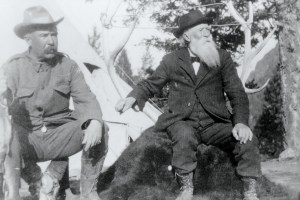
    Theodore Roosevelt and John Burroughs

    Roosevelt and Burroughs had built a long-term friendship on their mutual respect and love of the nature. They corresponded regularly, mostly about natural history. For some reason the president called Burroughs “Oom John.”

    The pair crossed the country in Roosevelt’s private Pullman car stopping at cities and towns where the president met local dignitaries and gave speeches. Between cities the president reminisced about his life as a rancher and sportsman.

    When they reached the entrance of the park at Gardiner, the Roosevelt left reporters and his secret service guards behind and went through the park accompanied only by Burroughs, Park Superintendent John Pitcher and a small entourage. 

    The 65-year-old Burroughs was afraid he wouldn’t be able the keep up with the 44-year-old president who had a larger-than-life reputation for physical stamina. Here’s Burroughs’ description of what happened when the pair went skiing.

    ∞§∞

    At the Canyon Hotel the snow was very deep, and had become so soft from the warmth of the earth beneath, as well as from the sun above, that we could only reach the brink of the Canyon on skis. The President and Major Pitcher had used skis before, but I had not, and, starting out without the customary pole, I soon came to grief. The snow gave way beneath me, and I was soon in an awkward predicament. The more I struggled, the lower my head and shoulders went, till only my heels, strapped to those long timbers, protruded above the snow. To reverse my position was impossible till some one came, and reached me the end of a pole, and pulled me upright. But I very soon got the hang of the things, and the President and I quickly left the superintendent behind. I think I could have passed the President, but my manners forbade. He was heavier than I was, and broke in more. When one of his feet would go down half a yard or more, I noted with admiration the skilled diplomacy he displayed in extricating it. The tendency of my skis was all the time to diverge, and each to go off at an acute angle to my main course, and I had constantly to be on the alert to check this tendency.

    Paths had been shoveled for us along the brink of the Canyon, so that we got the usual views from the different points. The Canyon was nearly free from snow, and was a grand spectacle, by far the grandest to be seen in the Park. The President told us that once, when pressed for meat, while returning through here from one of his hunting trips, he had made his way down to the river that we saw rushing along beneath us, and had caught some trout for dinner. Necessity alone could induce him to fish.

    Across the head of the Falls there was a bridge of snow and ice, upon which we were told that the coyotes passed. As the season progressed, there would come a day when the bridge would not be safe. It would be interesting to know if the coyotes knew when this time arrived.

    The only live thing we saw in the Canyon was an osprey perched upon a rock opposite us.

    Near the falls of the Yellowstone, as at other places we had visited, a squad of soldiers had their winter quarters. The President always called on them, looked over the books they had to read, examined their housekeeping arrangements, and conversed freely with them.

    In front of the hotel were some low hills separated by gentle valleys. At the President’s suggestion, he and I raced on our skis down those inclines. We had only to stand up straight, and let gravity do the rest. As we were going swiftly down the side of one of the hills, I saw out of the corner of my eye the President taking a header into the snow. The snow had given way beneath him, and nothing could save him from taking the plunge. I don’t know whether I called out, or only thought, something about the downfall of the administration. At any rate, the administration was down, and pretty well buried, but it was quickly on its feet again, shaking off the snow with a boy’s laughter. I kept straight on, and very soon the laugh was on me, for the treacherous snow sank beneath me, and I took a header, too.

    “Who is laughing now, Oom John?” called out the President.

    The spirit of the boy was in the air that day about the Canyon of the Yellowstone, and the biggest boy of us all was President Roosevelt.

    ∞§∞

    — You also might enjoy “The Army Protects Theodore Roosevelt from Snooping Reporter in Yellowstone Park.”

    — Excerpt from “Camping with the President” by John Burroughs,” Saturday Evening Post, May, 1906.

    — Yellowstone Digital Slide File Photo.

  • Narrative History or Historical Fiction 3: A Moonlit Night In Yellowstone Park, August 23, 1877.

    “Should I approach it as narrative history or as historical fiction?” That question haunted me this week as I continued research for my next book, Encounters in Yellowstone 1877. I’ve written about it before, here and here.

    Great Fountain Geyser

    To write the kind of story readers want, I need to include details that bring the story to life and give it credibility. That’s true no matter how I approach the book, but there’s more flexibility in fiction.

    A crucial scene in the book occurs on August 23, 1877, the night before Nez Perce Indians take Mrs. Emma Cowan captive along with her brother, Frank, and their 13-year-old sister, Ida. Earlier that afternoon, the tourists learned that the Nez Perce had fought a bloody battle with the Army two weeks before and were headed toward the park. In her reminiscence about the trip, Emma admited the news worried her.

    In his book about the trip, Frank said, “Mrs. Cowan was uneasy, and upon being asked what was wrong, replied ‘nothing.’” Frank said that later he saw Emma come to the door of the tent she shared with her husband and Ida and look out several times. Emma’s repeatedly peering out of the tent is a good example of the adage, “actions speak louder than words.”

    I was reminded of Jerrie Hurd’s admonition to write slow scenes fast and fast scenes slow. Jerrie says “when you get to the action, slow down, take your time, fill-in as much detail as possible allowing the reader to savor every moment of what’s happening.”

    There’s no doubt that Emma was worried, but what did she see? If I knew that, I could heighten the drama, but neither Emma nor Frank described the scene and there are no other accounts by members of their party.

    What to do? I saw three options: (1) write historical fiction and invent a plausible scene, (2) write up what I already knew as narrative history and hope that my readers will forgive the lack of detail, or (3) do more research to flesh things out. I chose option 3.

    I knew that the tourists were camped in the trees near the Fountain Geyser, which is at the edge of the Lower Geyser Basin in Yellowstone Park, so the first thing I did was a web search for images of the area. I found several photos like the one above that show several geysers spewing columns of water and steam in the middle of a chalky plain surrounded by pine forest. (I plan to visit the site this summer to get more detail.)

    Then I reviewed Emma and Frank’s accounts of the evening. After deciding to head home the next day, the group put on a sort of minstrel show to celebrate. They built a bonfire and spent the evening singing and dancing. Then the bachelors in the group curled up in their blankets under the trees while Emma, her husband and Ida retired to their tent.

    Next, I looked for journals of travelers who were nearby that night. One of them was Jack Bean of Bozeman, a scout the Army hired to find the Nez Perce. Bean was on a hillside about 30 miles from Emma’s camp watching the Nez Perce arrive at Henry’s Lake. Bean didn’t comment on the weather, but apparently had no difficulty seeing the Indians’ campfires four miles away across the lake.

    Another Scout, S.G. Fisher, who had been hired in Idaho, was 10 miles closer than Bean in Targhee Pass. Fisher had heard about a Nez Perce camp ahead of him and was planning to attack it with his force of 80 Bannack Indians. Fisher said he approached the camp cautiously because “the moon was shining brightly.” Fisher found the Nez Perce had moved on—and I found an important snippet of information—it was a moonlit night.

    With the new information from my research, I feel confident that I can write compelling description of Emma’s behavior—one that sticks close enough to the facts to qualify as narrative history. It probably will go something like this:

    Emma didn’t fall asleep quickly that night. Instead, she repeatedly came to the door of the tent she shared with her husband and sister and peered out. Perhaps she was just checking to make sure the bonfire her friends had built to celebrate their impending departure from Yellowstone hadn’t spread.

    Perhaps she was hoping to see Fountain Geyser play one more time. The bright moonlight reflected off the surrounding chalky ground would have made that a beautiful sight.

    Most likely, she was worried about encountering Nez Perce on the trip home. Emma couldn’t have known that Yellow Wolf and his band of Nez Perce scouts had seen the bonfire and were planning to attack the camp the next morning.

    I’m glad I kept researching. I’m sticking with narrative history.

    ∞§∞

    You also might enjoy:

    — To see related posts, click on “Narrative History” under the Categories Button on the right side of this page.

    — Image detail from Coppermine Gallery Photo.

  • A Tale: Touring Yellowstone Legally by Car — 1916

    In 1902 when Henry G. Merry raced his 1897 Winton past the cavalry at the North Entrance to Yellowstone Park, the soldiers mounted their horses and chased him down. They took Merry to the Park Superintendent who chastised him and had him escorted out, but not until the Superintendent got a ride in the new fangled contraption. Cars were forbidden because people thought they would frighten wildlife and the horses used by other travelers.

    In 1915 when cars were officially allowed in the park, the action transformed the Yellowstone experience.  As the story below shows, fears of auto-induced mayhem proved to be unfounded.
    ∞§∞

    At the Park boundary is the soldier station. Fortunately the regulations are easily complied with, and in a few minutes the speedometer is again registering the speed limit. One season’s operation of the automobile regulations demonstrated to the powers that be that the average motorist is a saner and more reasonable being than was at first supposed; as a consequence, there has been a considerable downward revision of the rules governing his actions.

    Shortly after the entrance is passed the grade becomes noticeably steeper, and leaving the stream that has been so closely followed, a sharp rise carries the road over the divide through Sylvan Pass at an altitude of eight thousand four hundred feet. Gliding down the western slope through the cool, silent forests affords an indescribably keen enjoyment, and the motorist must have travelled far who has experienced roads as well built and maintained as this, more than a mile and a half above sea-level in the midst of rugged mountain summits.

    Eleanor and Sylvan Lakes are skirted in turn; the latter a dainty body of water set in the depth of an alpine forest and guarded by a grim peak at its head. The waving pines on the islets that dot its surface and the dense growth along its shores dispel any thought of the short distance to timber-line and eternal snow. As the road continues down a gently winding course all expectations are centred on Yellowstone Lake, till at last it flashes afar off through the pines—a great body of water scintillating under the turquoise brilliance of a Wyoming sky. In another instant it is gone and the road turns to hurry down to it in a flowing ribbon that stretches ahead as far as the eye can reach through the forest and across many a meadow of luxuriant grass.

    Half hidden in the long grass of these mountain parks scattered herds of elk and deer may be seen grazing within a few hundred feet of the road, and not even the rasping shriek of the electric horn seems to disturb the peaceful and contented existence of nature’s animals. Prior to the admittance of horseless vehicles to the Park, it was argued that the smell and the unnatural noise of the motors would drive the animal life away from the roads and would bring to an end one of the most fascinating features of this wonderland.

    When, however, the whir of the motor as it toils up the rugged heights of Mt. Washburn, and passes almost unnoticed within two hundred yards of a band of the most wary of wild animals, the Rocky Mountain sheep, and when at night the bears, having feasted on ”beefsteaks that have proved too tough for the tourists,” make bold actually to clamber into the motor-cars and despoil seat cushions in search of sweets unwittingly left in side pockets, it will be appreciated that the contention that the motor-car would frighten these animals was quite without foundation. The whole atmosphere of Yellowstone seems to exert a soothing effect on both man and beast, and it is said that “Even broncs won’t buck in the Park.”

     ∞§∞

    —   Excerpt and photo from Charles J. Beldon “The Motor in Yellowstone,” Scribners Magazine, 63:673-683 (1918).

    — You also might enjoy Henry G. Merry’s story about the first car in Yellowstone.

  • An Event: Sidesaddles and Geysers Set for June 17 at Beavertail Hill

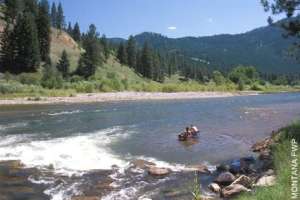
    I’ll be presenting my Humanities Montana Program, “Sidesaddles and Geysers: Women’s Adventures in Early Yellowstone” on June 17 at 8 p.m. at Beavertail Hill State Park. which is 26 miles southeast of Missoula off Interstate 90.

    Beavertail Hill State Park

    The presentation will be part of a 12-week series on Women in Montana History. I always tailor my talks to my audience, so I’ll focus on Big Sky Country pioneers who began visiting Yellowstone Park when it was still a roadless wilderness.

    Fortunately, my collection of first-person accounts of early travel to the park includes lots of good material on the topic.  That includes several items posted on this blog:

    So if you’re in the Missoula area on June 17, come out an see me.
    ∞§∞
    — Montana Fish Wildlife and Parks Photo.
  • View: Thomas Moran Painted His Impression of the Grand Canyon of the Yellowstone

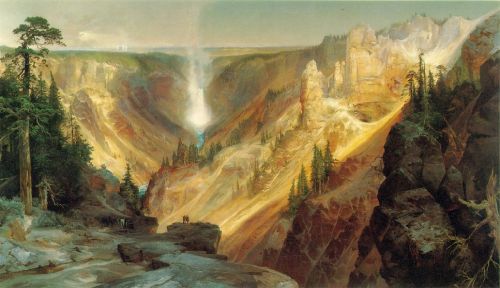
    “The Grand Canyon of the Yellowstone,” Thomas Moran

    In their journals, many tourists compared the experience of actually seeing the Yellowstone Falls and Canyon to viewing Thomas Moran’s famous painting, “The Grand Canyon of the Yellowstone.” They often disagreed on the question, ”did he get the colors right,” perhaps because the canyon looks different depending on cloud cover and sun angle. But few of them commented on other differences between viewing the painting and what they saw at the canyon.

    Moran said “I place no value upon literal transcripts from Nature . …  I did not wish to realize the scene literally, but to preserve and to convey its true impression.” To convey this “true impression,” he included several elements in the painting that could never have been seen at a single time and place.

    The painting is 12 feet wide and 7 feet tall making it impossible to see its details here, but one writer described Moran’s painting like this in 1872 when it was new:

    ∞§∞

    One of the last acts of Congress was the purchase of Mr. Thomas Moran’s “Grand Canyon of the Yellowstone,” for ten thousand dollars. It is to be placed above one of the great marble stairways in the Senate wing of the Capitol. It is the most magnificent painting we ever beheld, and we have seen Bierstadt’s “Yo Semite” and “Rocky Mountains.”

    Geyser Plumes Detail

    The Rocky Mountain range is just visible in the far distance, with the ” Tetons,” three snow covered peaks, rising above. Three of the largest geysers may also be seen in the distance and to the left of the Fall.

    The track of the river may be known by a long depression in the distant landscape. On a level plateau of purplish rock, or calcareous substance in the foreground, a few men and horses are standing.

    A dead deer or antelope lies near, and behind a cluster of huge pines, on a beetling rock, stands a large bear calmly surveying the scene. To the right in the foreground, the rocks are piled up rugged and high, and in the shadow are of a purplish-brown color.

    Just beyond this is a long smooth slope of gold color shaded to a pale primrose on one side, and to a very deep orange on the other, while still beyond rise the wonderful cliffs, which give to the scene a character distinct from any in the world.

    The coloring is pale gold in ground work, with lines and figures in violet, crimson, scarlet, deep amber and vermilion—just as if tinted by rainbows and sunbeams! This most strange and beautiful coloring is produced by the water oozing through the veins of the calcareous towers and domes, which are filled with iron and sulphur.

    One can readily imagine the tallest cliff to be a vast cathedral, with its outer walls painted in the fadeless colors of Pompeii, and with windows of deeply stained glass. The gorge or Canyon—worn to a great distance by the Fall—is, in the first broad light, of a yellowish gold; then in the deepening shadow is lavender, and lilac, and at the farthest point, deep purple.

    Here, two miles from the beholder, the Yellowstone River, blue as a summer sky, falls a distance of three hundred and fifty feet, over the gorgeous cliff, with the white mist rising, ever and always upward, like the prayer of a troubled soul, to the blue heavens above. It is too grand and wonderful for words to describe it, and none can ever judge of its wonders from any engraving or photograph in mere black and white.

    ∞§∞

    Among the “impressionistic” elements of the painting are:

    • There is no vantage where a person can see the Falls, The Grand Tetons, and geyser plumes simultaneously.

    Two Men Detail

    • It’s unclear who the small figures in the foreground are. Conjectures include Ferdinand Hayden, the head of the government expedition that Moran traveled with, and his executive officer, James Stevenson, or Moran himself and photographer William Henry Jackson, who was also on the expedition.

    • And, not visible here, a slaughtered deer and native American with his back turned to the canyon.

    Moran never offered any explanation of these things and was content to let the painting stand on its own. He probably would have agreed that seeing the painting was no substitute for the real thing. But then, seeing the real thing is no substitute for the painting.

    ∞§∞

    —  The description of Moran’s painting is from The Ladies’ Repository: Universalist Monthly Magazine,1872.

    — For more about Moran’s legacy, click “Thomas Moran” under the Catergories  Button.

    — See this link for a discussion of Moran’s view of art and his obligation to reproduce nature. 

  • A Tale: A Mother Takes Her Seven Children to Yellowstone Park — 1903

    In 1903, Eleanor Corthell bought a team of horses and a spring wagon to take her seven children to Yellowstone Park. She told the seller to send his bill to her husband, Nellis Corthell, a prominent Laramie lawyer. Nellis tried to talk Eleanor out of the trip, but in the end, she said, all he could do was “fizz and fume and furnish the wherewithal.”

    Here are some excerpts from Mrs. Corthell’s account of her family’s adventures.

    ∞§∞

    Nearly half a lifetime I have lived in Laramie, with all the while a great longing to see the wonders of the Yellowstone, in season, out of season, when the house was full of babies—even when it was full of measles. As the older children outgrew marbles and dolls, I conceived the bold idea of stowing them all in a prairie schooner and sailing away over the Rocky Mountains, deserts, forests and fords to the enchanted land five hundred miles away.

    My husband offered strenuous objection, of course, to the crazy project, but could only fizz and fume and furnish the wherewithal—for the reasons advanced he found irresistible, such an ideal vacation for the children. A chance for their botany, geography, zoology, to be naturalized. To be drivers and cooks would throw them on their own resources somewhat, a valuable education in itself. So economical, too! Such a fine opportunity for stretching of legs and lungs, with the Park at the end! Reasons to turn a man’s head, you see, so when the boys wrote along the wagon top ” Park or Bust,” that settled it, and we started July 4th, 1903.

    After traveling several days, Mrs. Corthell wrote:

    Everybody is growing handy, even expert, in camp work. The boys can skin a cottontail or dress a sage hen equal to Kit Carson himself, while daughter can prepare a savory dinner or pack a mess box good enough for an army general. The children are eagerly interested in everything they see, hear or can catch. Tad announces that we have seen nine horned toads, caught six, mailed three and have two packed in little tablet boxes with which to surprise the chum at home. Query: Where is the medicine that was in the boxes?

    At the Paint Pots near West Thumb on Lake Yellowstone, Eleanor was vigilant.

    I was kept busy counting the children. Every time one of them moved I was certain he would stumble into one of the boiling, walloping vats of mud. That the mud was delicate rose, emerald green, or heavenly blue did not reassure me in the least. But the children simply laughed. Even the youngest pertly informed me he had not come all the way to Yellowstone Park to fall into a mud hole. Still the horrid smells and the horrible groans and growls, and the gaping mouths clear to Hades aroused such emotions of terror in me that in sheer desperation I hurried over to the lake.

    Eleanor summarized the trip this way:

    Like everybody else, we loved Old Faithful and the Morning Glory, we feared Excelsior, we admired the Giant, Bee Hive, Punch Bowl and a hundred other yawning chasms and smiling springs and spouting geysers. But the horrible rumbling—as if an earthquake were imminent—and the smell of brimstone made me eager to get my brood into the valley of safety beyond the Yellowstone.

    Altogether we traveled twelve hundred miles, stood the journey well, and never, never had such a wonderful, delightful summer. The children will have lifelong memories of the grandest scenes the world can produce.

    ∞§∞

    — Excerpts from “A Family Trip to the Yellowstone” by Mrs. N. E. Corthell, The Independent, June 29, 1905.

    — Photo from the Pioneer Museum of Bozeman.

    — You can read Eleanor Corthell’s complete story about her family trip in my book, Adventures in Yellowstone.

    — You also might enjoy Mrs. Corthell’s story about chasing a bear away from her bean pot.