This morning Scott McMillion posted a link to a story in the Wyoming Tribune Eagle, “The Life and Times of Grizzly Bear 179.” Here’s how Scott described the story: “The story of bear 179, who has lived a long and productive life. As a yearling, she watched her mother tear into Joe Heimer and Sonja Crowley, who were hunting elk near Gardiner. I wrote about that attack in Mark of the Grizzly. But 179 never repeated that kind of behavior and raised 11 cubs to maturity.”
The Tribune Eagle story chronicles the life of 179 from the time wildlife biologists first tagged her in 1990 until the last time she was captured in 2012. Although 24 is old for a grizzly sow, she is still roaming free in Yellowstone Park as far as anybody knows.
Grizzly Bear 179 has been captured eight times helping wildlife managers understand how her species survives. The Tribune Eagle story recounts several of her captures and encounters with human beings.
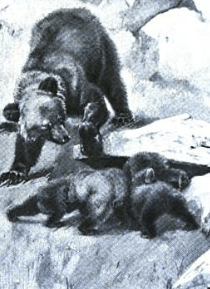
Just as the story reminded Scott McMillian of his book, Mark of the Grizzly, which is a collection of terrifying tales of people who got too close to the big bears, I was reminded of Ernest Thompson Seton’s Biography of a Grizzly. Seton’s book recounts the life of Wahb, a bear that roamed between the Meeteesee region of Wyoming and Yellowstone Park.
Seton was a universally know author a hundred years ago. Naturalists roundly criticize Seton for his habit of attributing human characteristics to animals, but people still remember their grade school teachers and parents reading his animal stories to them. Seton made Wahb so famous that in 1915 the New York Times published the news that he had been shot to death.
I thought I should celebrate International Women’s Day by providing a list of stories about some intrepid travelers who visited Yellowstone Park more than a hundred years ago. Here are some of my favorites. You can find even more by clicking on “Women’s Stories” under the Categories button.
In the summer of 1877, several bands of Nez Perce abandoned their homeland in Idaho and eastern Oregon in hopes of making a new life in the buffalo country of Montana. Pursued by the Army, they fled through Yellowstone Park.
Although the Nez Perce chiefs wanted to avoid contact with whites, a group of young men separated from the main Indian body and attacked several groups of tourists. On August 26, the Indians attacked a group from Helena, Montana, killing one of them and forcing others flee. Most of the survivors made their way to the incipient resort at Mammoth Hot Springs.
After waiting for two days for stragglers to come in, the leader of the Helena tourists, Andrew Weikert, got the owner of the resort, James McCartney, to return with him to the scene of the attack. They planned to look for two men who hadn’t returned and bury one they knew had been killed. Here’s Weikert’s story of their adventure.
∞§∞
While McCartney and I were on our way from the Springs to the old camp, this same band of Indians passed us somewhere, but we did not see them at that time. We went within two miles of the old camp and unpacked and stayed all night, for it was too late to go farther.
We started early the next morning and got into the old camp, then began our search. We soon found Kenck’s body and buried it the best we could. We found his watch in his pocket and ring on his finger, which the Indians had missed. We spent the remainder of the day searching for the other two missing boys, but not finding them, concluded that they had made their escape.
We packed up what little was left in the camp and started back, camping at night where we did the night before; had our supper then made down our bed, then went to picket our horses so they could not go too far away.
Mack said, “Andy, something tells me we had better go on.” I told him all right, so we saddled up and started. I looked back through an opening in the timber and saw an Indian ride across, so we “lit out” pretty lively for a little ways. I presume he wanted to find out how we were fixed, but we slipped them that time and traveled on until 3 o’clock in the morning, then crossed the Yellowstone and camped until morning.
It was about 9 o’clock when we found our horses, for we had to turn them loose so that they could get something to eat. Had almost come to the conclusion that the Indians had stolen them. We, at this time, were about eighteen miles from the Springs. We saddled and packed our horses then started to the Springs.
We met a party of Indians on the trail; got within two hundred yards of them before we saw them. There were eighteen of them, so we thought there was not much chance for us. So we struck out for the nearest brush.
We had a lively race for a mile, for the Indians were firing at us all the time and trying to head us off from the brush. Eighteen guns kept up quite a racket and they got some of the balls in pretty close. We could hear the balls whistle through the air and see them pick up the dust.
We returned fire as best we could and think we made some good Indians. We rode together for some time, then Mack started right straight up the hill for the brush. I kept out on the hillside more so as to give my horse a better chance.
The Indians got off their horses and kept right behind a reef of rocks, so we had rather a poor chance to return fire, but they kept pouring the lead into the hill close around me all the time, for they were not over two hundred yards from me. But they soon put a ball into my horse and he stopped as quick as a person could snap his finger. I knew that something was wrong, so I got off quick and in an instant saw the blood running out of his side.
So I said, “Goodbye Toby, I have not time to stay, but must make the rest of the way afoot.” I made all speed possible for the brush, for I could not see enough of the Indians behind the rocks to shoot at and had no cartridges to waste. We had fired several shots apiece.
About this time, Mack’s horse commenced bucking (the saddle had got back on his rump,) and bucked him off, then ran out to where I was, and followed up after me with the saddle under him. I took my knife after me, from my belt and was going to try and catch him, if he would come close enough, then cut the saddle loose and jump on him, but he tramped on the saddle and away he went.
The Indians never let up shooting, but kept picking up the dust all around me. I think they must have fired fifty shots at me, but only cut a piece out of my boot leg and killed my horse. He had keeled over before Mack and I got together.
Mack wanted to get down behind a big log that was lying close by, but I looked up and saw the reds almost over our heads, I then told him that I was going for the brush. He asked me to wait until he would take off his spurs, then he would go with me. He put his hand on my shoulder and yanked off his spurs, throwing them down towards the log saying they might lie there until some time later he might call for them.
While he was taking off his spurs the reds fired three shots at us. I don’t think either of them was over ten feet from us. I made the remark that they were coming pretty thick; Mack says “Just so.”
We soon got to the brush, but there was no reds to be seen anywhere. They were terrible brave so long is they had the advantage, but just as soon as the tables were turned, they made themselves scarce behind the hills, as they will not follow a man into the brush.
We camped there for about an hour, then ventured out to see if the walking was good, or probably they had missed one of our horses. We did not find any except the dead, and from even this they had taken my saddle and bridle. We saw the Indians about four miles off so concluded to make it on foot to the Springs.
∞§∞
Weikert later returned to retrieve the dead man’s body and take it to Helena for a proper burial. Soldiers pursuing the Nez Perce rescued the two missing men.
I’m working on a book titled Encounters in Yellowstone 1877 that will chronicle more stories of Yellowstone tourists who ran afoul of the Indians.
∞§∞
Adapted from Weikert’s Journal published in Contributions to the Montana Historical Society, 1900.
— NPS photo from the Yellowstone Digital Slide File.
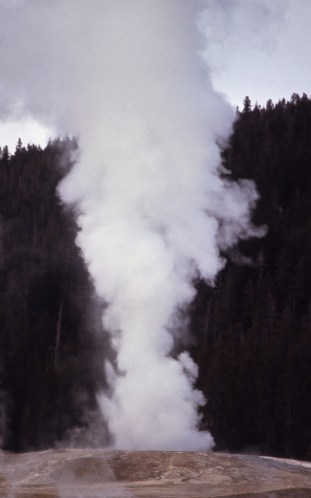
Live Science reported yesterday that Yellowstone’s Giantess Geyser was erupting for the first time in two and a half years. When I heard the news, I immediately searched my files to see if I had a first-hand account by an early tourist who actually watched the geyser play. No luck.
Lots of people mention the Giantess in their description of the Upper Geyser Basin, but it seems they are usually borrowing from guidebook descriptions. Here’s an example from W. W. Wylie’s 1882 Yellowstone guidebook. It would be interesting to know if this year’s eruption follows the pattern Wylie described.
∞§∞
Giantess Geyser
The Giantess is upon the summit of the formation, about 100 yards to the northeast of the Bee-hive. It is a large oval aperture, with scalloped edges, the diameters of which are twenty-five and eighteen feet. This Geyser is very irregular, acting once in about fourteen days. The crater is usually full and boiling gently; gives no warning of an approaching eruption. The beautiful walls may be seen to a great depth through the wonderfully transparent water.
When this Geyser does act, the eruption at intervals of about forty minutes lasts for twelve to sixteen hours; so that, although it may begin in the night, it may be seen in daylight. When it begins an eruption, for some minutes it throws 250 feet high, but after this not eighty feet high. Its action is very much like that of the Splendid, in viewing which one finds a very good substitutejbr the Giantess.
∞§∞
— Page 36 in The Yellowstone National Park or the Great American Wonderland by William Wallace Wylie,Ramsey, Kansas City, MO.:Millett and Hudson, 1882.
Conventional Yellowstone Park history holds that people didn’t start visiting the area just for fun until the area was explored in the 1870s. But this tale proves the sights attracted people long before that.
James Gemmell toured the area that became Yellowstone Park in 1846 with the best guide of all, Jim Bridger. Gemmell and his companion left Fort Bridger on the Green River in Utah, followed the Snake River to “Wonderland,” and spent several weeks seeing the sights on their way to trade with Indians in Montana. Here’s his story.
∞§∞
In 1846 I started from Fort Bridger in company with old Jim Bridger on a trading expedition to the Crows and Sioux. We left in August with a large and complete outfit, went up Green River and camped for a time near the Three Tetons, and then followed the trail over the divide between Snake River and the streams which flow north into Yellowstone Lake.
We camped for a time near the west arm of the lake and here Bridger proposed to show me the wonderful spouting springs at the head of the Madison. Leaving our main camp, with a small and select party we took the trail by Snake Lake (now called Shoshonne Lake) and visited what have of late years become so famous as the Upper and Lower Geyser Basins. There we spent a week and then returned to our camp, whence we resumed our journey, skirted the Yellowstone Lake along its west side, visited the Upper and Lower Falls, and the Mammoth Hot Springs, which appeared as wonderful to us as had the geysers.
Here we camped several days to enjoy the baths and to recuperate our animals, for we had had hard work in getting around the lake and down the river, because of so much fallen timber which had to be removed. We then worked our way down the Yellowstone and camped again for a few days’ rest on what is now the reservation, opposite to where Benson’s Landing now is.
From here we crossed the present Crow Reservation and made our winter camp at the mouth of the Big Horn, where we had a big trade with the Crow and Sioux Indians, who at that time were friendly towards each other. The next spring we returned with our furs and robes, passing up the Big Horn River and over the mountains to Independence Kock and thence home.
∞§∞
— Gemmell’s story is quoted in William F. Wheeler, “The Late James Gemmell,” Contributions to the Historical Society of Montana 2 (Helena, Mont.: State Publishing Co., 1896), pages 331-332.
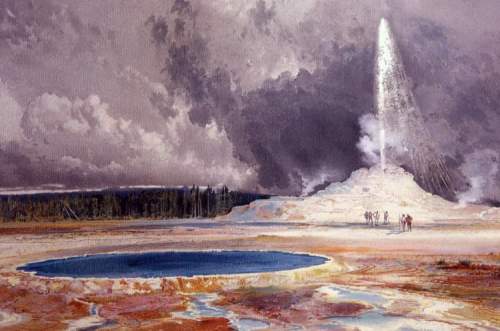
— The Thomas Moran painting of Castle Geyser is from the Copper Mine Photo Gallery.
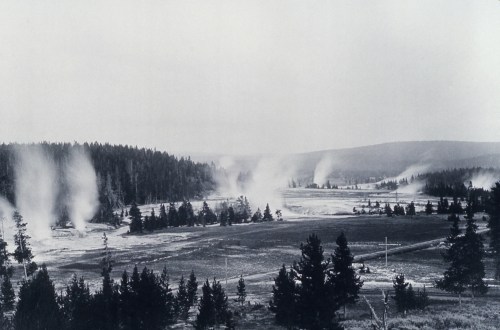
Today tourists often stop at the Upper Geyser Basin just long enough to see Old Faithful, —just an hour or two—and then move on. But early travelers often camped near the basins for a week or more hoping to see ALL the geysers play and in all conditions: daylight, moonlight and firelight. Here’s how one man described what he saw in 1883.
∞§∞
There are hundreds of springs in the basin, all differing more or less in some particular. On a calm, clear morning, at or just before sunrise, when all the springs are sending up their columns of steam of every magnitude, and all boiling and fussing and splashing away, as if trying each to attract the greatest share of attention, and while one or two of the larger geysers are piercing the heavens with their stupendous columns, the basin presents a lively and interesting spectacle.
The eruptions as witnessed by moonlight are truly sublime, though deprived of much of their glory, as it is difficult to distinguish between water and steam. Some of the party built bonfires and watched the eruptions by firelight, which were very fine, giving the rising volumes the appearance of fiery liquid hurled forth from the crater of a volcano.
It is not the most quiet and agreeable place for sleeping. One is frequently disturbed during the night by the alarming detonations and subterranean thunder, making an almost constantly rumbling noise as of heavy machinery in motion, the come and go of ponderous freight-trains, the hiss and rush of escaping steam, and the loud plash of falling torrents, as the geysers, the ever-vigilant sentinels on the outposts of old Pluto’s infernal regions, sound the alarm and spout forth in the darkness. This is more sensibly realized by sleeping on the ground, and, rest assured, the sensations are not always of the most desirable character.
∞§∞
— Pages 118-123 in Edwin J. Stanley, Rambles in Wonderland or Up the Yellowstone. New York: Appleton and Company, 1883.
— National Park Service Photo, Yellowstone Digital Slide File.
I emailed a complete book manuscriptto my publisher yesterday, a full day ahead of the deadline specified in my contract with Globe Pequot Press. The book, Smaller Stories of Greater Yellowstone, is an anthology of seventy-two tales of early adventures in Yellowstone Park by the people who lived them.
The stories in the book span the period from 1807, when John Colter first discovered the wonders of the upper Yellowstone, to the 1910s, when tourists started speeding between luxury hotels in their automobiles. The earliest stories recount mountain men’s awe at geysers hurling boiling water hundreds of feet into the air, and their gun battles with hostile Indians. The latest stories are set in a time when matrons felt comfortable taking their children to the park without an adult male accompanying them.
I conjured the idea for Smaller Stories of Greater Yellowstone while signing copies of my first book, Adventures in Yellowstone, at Old Faithful Inn. People there told me they were looking forward to reading the 6,000-word tales in Adventures, but they really wanted shorter stories they could complete while driving between sights or sitting around their evening campfires.
I figured it would be easy to oblige them. After all, I’ve been collecting accounts of early Yellowstone travel for more than a decade. And I’ve been excerpting tales 400 to 1,500 words long for my Humanities Montana presentations and for my blog. All I needed to do, I thought, is assemble blog posts, sort them into chapters and write introductions.
The task was a lot easier because I use Scrivener, which is described as “a powerful content-generation tool for writers that allows them to concentrate on composing and structuring long and difficult documents.” Since the tales I wanted to use were already written, the structuring part of Scrivener was the most useful.
First I harvested more than 200 blog posts and dumped them into separate files in Scrivener in the order they had been posted. Fortunately, it’s easy to reorganize files with Scrivener. They’re listed in a column at the left side of the display called the “Binder.” Files in the binder can be rearranged simply by dragging them to where you want them.
The program also provides several ways to sort files including placing them in folders. I created a folder called “Non-Stories” and put all posts that I knew weren’t appropriate for the book there, things like reviews of my first book and announcements of book signings. That left about 150 blog posts—far more than enough.
I moved the Non-Stories file from the Draft area where Scrivener keeps material headed for the final manuscript, and put it In the Research area where Scrivener keeps supporting materials. Then I looked at the number of words in the Draft area and came up with about 150,000, twice as many as I needed. So I created a filed labeled “Outtakes” and began putting weaker stories there.
While I was reading items to decide if they went into “Outtakes,” I began creating new folders in the draft area to organize the “Keepers.” For example, items about fur trappers went into a folder called “Mountain Men,” and items about fishing in a “Fishing” folder.
My goal was a book of a dozen parts, each contain five to seven stories totaling five or six thousand words, so there was a lot of rearranging and inventing of new categories. For example, when I found I had too many items in “hunting,” I pulled out the stories about bears and created a new folder including bear stories about other things.
When a folder contained too many items, I searched them for weak stories or stories that were similar looking for candidates for the Outtakes folder. On the other hand, when a folder contained too few items, I searched the outtakes folder looking for candidates to add. Some stories I really liked didn’t fit into any category, so I created a folder called “Travelers’ Antics” and put them together there.
I finally got a dozen chapters the right length and began the tasks of writing introductions and editing. With the help of a couple of friends, I finished a few weeks ago. Since then I’ve been polishing and I emailed the manuscript yesterday.
Doubtless, my editor at Globe Pequot will be getting back to me with suggestions. When that happens, I’ll be able to locate the offending sections and fix them quickly using Scrivener.
Shorter Stories of Greater Yellowstone should be out in the spring of 2015.
When I came downstairs for my morning coffee on Tuesday, my wife pointed to a headline reading “Wonderland Report” on the front page of the Bozeman Daily Chronicle. It was over a story about a manuscript describing the 1869 Folsom-Cook-Peterson expedition to the area that became Yellowstone National Park. The manuscript was recently obtained by the Montana State University Library. I skimmed through the story and commented that the newly discovered manuscript should help historians answer some long standing questions.
Charles CookDavid E. Folsom
Historians generally credit the Folsom-Cook-Peterson expedition as the first serious effort to explore and document the wonders of the upper Yellowstone. Trappers and prospectors had been telling stories for decades about fountains of boiling water, canyons a thousand feet deep, and mountains of glass. At first people discounted such reports as tall tales, but by the late 1860s it became obvious that there really were wonders in the area.
Montanans made several attempts to mount expeditions large enough to repel Indian attacks in the 1860s, but they all fizzled. Then David E. Folsom and Charles Cook figured that the Indians wouldn’t notice a small group traveling through the area. William Peterson, who worked for Cook, volunteered to go with them. The trio traveled through the area that became Yellowstone Park for about a month in September and October of 1869. When they returned home, the checkered history of the report of their adventures began.*
At first the men were reluctant to write about what they had seen. As Folsom said later, “I doubted if any magazine editor would look upon a truthful description in any other light than the production of the too-vivid imagination of a typical Rocky Mountain liar.”
At the behest of a friend who had connections to New York publishing, Folsom and Cook prepared a manuscript that merged separate diaries they kept during the trip. When they submitted the manuscript for publication, Folsom’s fears proved to be well founded. The New York Tribune, Scribner’s andHarper’s magazines all turned it down. The reason they gave was that they had reputations “they could not risk with such unreliable material.”
Finally, the men succeeded in getting the manuscript published in the less prestigious Chicago-based Western Monthly Magazine inJune of 1870. Cook later complained that “the editor cut out portions of the diary which destroyed its continuity” and kept it from “giving a reliable description of our trip.” The magazine also attributed the article solely to Cook.
The Western Monthly offices were destroyed in the Great Chicago Fire of October 1871, which limited access to copies of the report. Also, the Montana State Historical Society had a copy of the magazine containing the story that burned in the Helena fire of 1874. The unfortunate history of the manuscript continued after Folsom lent a copy of it to a professor at Montana State College (now University) and it was destroyed in a fire that gutted the chemistry building in 1916.
N.P. Langford overstated the rarity of the Western Monthly article in an introduction he wrote for Contributions to the Historical Society of Montana, which republished it in 1904. Langford, who helped organize the 1870 Washburn Expedition and became famous for his descriptions of it in Scibner’s Monthly, also mis-attributed the article to Folsom alone rather than crediting it as a joint effort. The error seems odd because Folsom, Cook and Peterson all were still alive then.
Apparently, the Folsom-Cook article never circulated widely in Montana, so it probably had little impact. But Folsom, who took a job in the Montana Surveyor Generals’ office, worked with another Yellowstone explorer, Walter DeLacy, to produce a famous map of Montana that included the upper Yellowstone. The map showed the “Route of Messrs Cook & Folsom 1869” and provided far more detail about Yellowstone features than had been revealed before.
Also, Folsom’s descriptions helped inspire the Washburn Expedition of 1870, which brought the wonders of the Upper Yellowstone to national attention. The expedition led by Montana Surveyor General Henry D. Washburn included several prominent officials and businessmen whose word could not be doubted. Perhaps more important, several members of the Washburn Expedition were skilled writers with good connections to territorial newspapers and national publications. Their reports eclipsed the Folsom-Cook article and helped create Yellowstone National Park in 1872.
Nearly a hundred years after Folsom, Cook and Peterson visited the Upper Yellowstone, Aubrey L. Haines conducted exhaustive research on their trip. Haines, who is considered the dean of Yellowstone Park historians, scrutinized everything he could find about the trio and the University of Oklahoma Press published his findings in 1965 under the title The Valley of the Upper Yellowstone: An Exploration of the headwaters of the Yellowstone River in the Year 1869, as Recorded by Charles W. Cook, David E. Folsom, and William Peterson. It would be interesting to compare Haines’ version with the manuscript MSU recently obtained.
∞§∞
* Details surrounding publication of the Folsom-Cook-Peterson report are described in Aubrey L. Hains’ book, Yellowstone National Park: Its Exploration and Establishment, National Park Service in 1974.
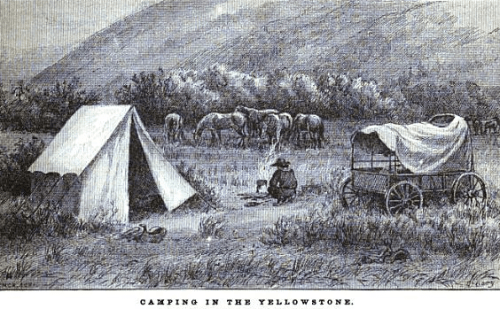
In 1885, General George W. Wingate decided to take his wife and 17-year-old daughter to Yellowstone Park. Although coach tours and luxury hotels were available by then, the Wingates decided to travel on horseback and camp out. That way they could travel at their own pace and see sights skipped by the rushed five-day tours.
In his accounts of the trip, General Wingate not only described the sights, he also told about the adventures of his companions and their travel routines. Here’s his description of setting up camp.
∞§∞
The routine of camping was always the same, and with experience soon became rapid. During the day we would decide where we would camp for the night, the selection depending first on getting good water, and next upon finding suitable grazing for the stock. As we approached the place selected, Fisher (the guide) would gallop on and reconnoiter, while we followed more slowly. We would find him waiting for us on what he considered the best spot.
“Well, what do you think of this?” he would ask, as we rode up. “This is all right,” I would answer. “Pitch our tent there, fronting the east; halt the wagon there, and place the table there.” These brief directions given, we would dismount, throwing the reins over our ponies’ heads. This is almost equivalent to tying them, as they step on tbe reins and hurt themselves with the curb, if they attempt to walk.
The ladies seek the nearest shade and lay themselves flat on their backs, the true way to rest (an idea which they had extracted from Mrs. Custer’s Boots and Saddles), without much regard to the character of the ground, while Fisher and I would unsaddle the ponies, piling the saddles in a heap, and throwing the saddle blankets over them to air and dry.
The wagon by this time would be up, and would swing into the designated position and unharness. Horace (the driver) would lead the horses to the best grass. Those most inclined to stray would be picketed, the others hobbled. In picketing, a horse is fastened to each end of a rope sixty feet long, by a bowline knot around the throat. To the middle of this rope another is fastened, and attached to a stout stake, tree or rock. This is decidedly preferable to picketing each animal separately.
The horses are more quiet in each others company, and if they do break away from the picket pin and stray off, are apt to bring up by the cross rope catching in a tree or rock. Besides, the rope makes a trail which is easily followed. In hobbling, a leather strap about eighteen inches long is fastened to each foreleg. I prefer picketing to hobbling, as the latter affects a horse’s gait.
While the horses were being put out, Sam (our cook) would start his fire and put on his Dutch oven. This was a cast-iron kettle, with a cover of similar material turned up at the edges so as to hold embers, and proved to be a most indispensable article. While it was heating, he would wash his hands with great ostentation (for the benefit of the ladies), retire into the wagon, and mix his biscuit. By the time this was done,
Horace would be back from the horses. He would put on more wood, fish out and grease the oven. The dough would then be put in, the cover put on, and the whole affair placed in a bed of hot embers, which were also heaped over it. A large gridiron, two feet square, would then be set over the fire, on which the other kettles and pans would soon be simmering.
Sam flying around from one side of the fire to another, with an intense air of preoccupation, and occasionally uttering a droll remark regarding his experiences in cooking under the various circumstances of his checkered life. As soon as the bread was on the fire, our tent would be put up. We first pegged the corners and put up the pins for the corner guy ropes.
Then the tent was spread, one of the men crawling into it and adjusting the poles (presenting a most ludicrous appearance as he did so), raised it, tightened the corner guys and drove the other pins, and put a few stones on the flaps if the weather was cold, so as to keep the wind from blowing under it.
The bedding was then unrolled, a large waterproof spread upon the ground, with two buffalo robes, and then our three mattresses placed over it. The blankets were next spread, one over each mattress, and four for a cover. If the mosquitoes threatened to be troublesome, some sticks were put at the head of the beds, and our mosquito nets tied to them; but this precaution was but seldom necessary.
The hand-bags were now carried into the tent, and the camp was completed, the whole operation not occupying fifteen minutes. The men had an A. tent, which they only pitched when it was cold or threatened to rain. Usually they slept on the saddle blankets, and used the tent as an extra covering.
Sam would have his bread baked in twenty minutes. He would then take it out, clean out his Dutch oven, put in whatever he had to roast, and put it back into the tire. By this time the tent was up, the ladies had become sufficiently rested and would begin to either sketch or read, until the melodious banging of a tin pail, and Sam’s eloquent cry of ” din-nur-r,” would rouse all to their feet. No one was ever late to dinner on that trip.
∞§∞
— Text and illustration from George W. Wingate, “My Trip to Yellowstone,” American Agriculturalist. 45(5): 204-205 (May 1886).
 “The story of bear 179, who has lived a long and productive life. As a yearling, she watched her mother tear into Joe Heimer and Sonja Crowley, who were hunting elk near Gardiner. I wrote about that attack in Mark of the Grizzly. But 179 never repeated that kind of behavior and raised 11 cubs to maturity.”



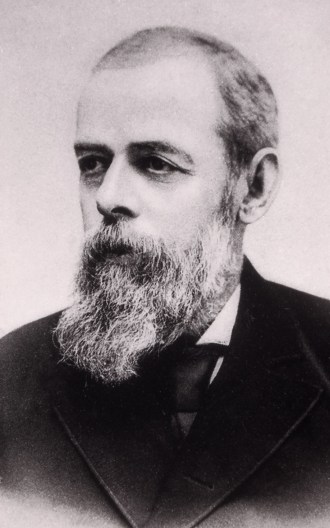
 M. Mark Miller, Author