Category: Bears

  • An Event: “An Ursine History of Yellowstone Park” in Cooke City


    Bears at Dump 2 MHS Photo
    Yellowstone tourists watching bears at a hotel dump.

    I’ve been preparing a talk titled “An Ursine History of Yellowstone Park: Stories of People and Bears” to present at the Cooke City Museum on Thursday, July 21, at 6 p.m.. It’s part of the Museum’s “Joe’s Campfire Talks,” an outdoor summer series. I’ve presented there twice before and really enjoy the venue.

    “Ursine History” is a topic I’ve been thinking about for several years and I’m glad for the opportunity to dig through my files and organize my thoughts on it. I always discover new things when I take a fresh look at my collection of more than 300 first-person accounts by Yellowstone travelers.

    Bears are resilient animals that adapt quickly to changes in their surroundings so their behavior provides an interesting way of looking at Yellowstone Park history. Examine how tourists interacted with bears across time reveals a lot about how attitudes toward wildlife and nature have changed.

    The first Euro-Americans to visit Yellowstone park were mountain men who scoured the area to trap beaver and other fur bearing animals. For them bears were a source of food —and bear grease that they used for everything from lubricants for their guns to laxatives. I like to enliven my presentations by reading first-person accounts by Yellowstone travelers, so I’ll read an excerpt from Osborne Russell’s Journal of a Trapper for this section of my talk. In the excerpt, Russell learns just how dangerous a grizzly can be when he decides to track a wounded animal.

    The congressional act that established Yellowstone Park in 1872 explicitly allowed hunting so visitors to the remote roadless wilderness could hunt for sustenance. That led to an era that some writers have called a holocaust when the population of large animals in Yellowstone was decimated. Bear hunters were among those who came to the park to bag trophies. I’ll read Jack Bean’s hilarious account of a neophyte hunter’s adventure bagging his first bear.

    When they were hunted, bears learned that humans meant danger and sightings of them became rare. But after the Army took over administration of the Park in 1886 and outlawed guns, they began to reappear. In fact, they became pests patrolling campground for garbage and unattended picnic baskets. Then hotels created dumps for kitchen garbage in nearby woods and watching bears in them became a signature experience for Yellowstone travelers.

    Bears didn’t approach horse-drawn conveyances, but with the coming of the automobile, they rapidly became accomplished roadside beggars, and bear jams backed up traffic for miles. In the 1960s park rangers began locking up garbage containers and enforcing “do not feed the bears” rules. Soon, bear sightings became rare again.

    That’s an outline of my presentation. I’m looking forward to giving it. If you’re looking for something to do on Thursday, come to the Cooke City Museum and hear “An Ursine History of Yellowstone Park.”

    ∞§∞

    • Photo from the Montana Historical Society.


  • Tales of Two Grizzlys

    This morning Scott McMillion posted a link to a story in the Wyoming Tribune Eagle, “The Life and Times of Grizzly Bear 179.”  Here’s how Scott described the story: Screen Shot 2014-03-12 at 9.19.17 AM “The story of bear 179, who has lived a long and productive life. As a yearling, she watched her mother tear into Joe Heimer and Sonja Crowley, who were hunting elk near Gardiner. I wrote about that attack in Mark of the Grizzly. But 179 never repeated that kind of behavior and raised 11 cubs to maturity.”

    The Tribune Eagle story chronicles the life of 179 from the time wildlife biologists first tagged her in 1990 until the last time she was captured in 2012.  Although 24 is old for a grizzly sow, she is still roaming free in Yellowstone Park as far as anybody knows.

    Grizzly Bear 179 has been captured eight times helping wildlife managers understand how her species survives. The Tribune Eagle story recounts several of her captures and encounters with human beings.

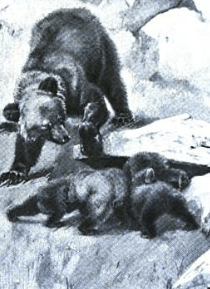
    Just as the story reminded Scott McMillian of his book, Mark of the Grizzly, which is a collection of terrifying tales of people who got too close to the big bears, I was reminded of Ernest Thompson Seton’s Biography of a Grizzly. Seton’s book recounts the life of Wahb, a bear that roamed between the Meeteesee region of Wyoming and Yellowstone Park.

    Seton was a universally know author a hundred years ago. Naturalists roundly criticize Seton for his habit of attributing human characteristics to animals, but people still remember their grade school teachers and parents reading his animal stories to them. Seton made Wahb so famous that in 1915 the New York Times published the news that he had been shot to death.

    I’ve blogged several stories about Wahb:

    Watching Bears Fight at a Dump — Ernest Thompson Seton, 1896

    An excerpt for Seton’s famous story, “Johnny Bear,” in which a crippled black bear cub watches his mother battle Wahb to protect her son.


    Ernest Thomson Seton Retells the Story of a Bear Fight — Ernest Thompson Seton, 1896

    An excerpt from Biography of a Grizzly that tells the story of the battle at a garbage dump from Wahb’s perspective.


    Watching a Giant Grizzley — Grace Gallatin Seton, 1896.

    Seton’s wife describes finding her husband watching bears frolic and fight at the dump.

    ∞§∞

    — You can find similar stories by clicking on “Bears” under the Categories button.

    — The illustration is a detail from a drawing by Seton in Biography of a Grizzly.

    — You can read a condensed version of Seton’s “Johnny Bear” in my book, Adventures in Yellowstone.

  • A Tale: An Unfair Fight Between a Bear and a Pussy Cat — Ernest Thompson Seton, 1896


    In 1896, naturalist and writer Ernest Thompson Seton went to Yellowstone Park to inventory animals there for a magazine assignment. He spent a day watching bears at the Fountain Hotel dump near the Lower Geyser Basin. Such bear watching was common then.

    Seton saw a momma black bear called “Grumpy” pick a fight with a huge grizzly called “Wahb” to protect her sickly cub. After the battle, Seton interviewed hotel employees to find out as much as he could about the bears. Based on his research, Seton wrote his famous story, “Johnny Bear,” and a book, Biography of a Grizzly

    The most memorable incident in “Johnny Bear,” is the battle between Grumpy and Wahb, but in it Seton described other adventures like Grumpy’s encounter with an even more formidable foe. 

    ∞§∞

    Grumpy herself was fond of plum jam. The odor was now, of course, very strong and proportionately alluring; so Grumpy followed it somewhat cautiously up to the kitchen door. There was nothing surprising about this. The rule of “live and let live” is Bear & Kitten Setonso strictly enforced in the park that the bears often come to the kitchen door for pickings, and on getting something, they go quietly back to the woods. Doubtless Johnny and Grumpy would each have gotten their tart but that a new factor appeared in the case.
    That week the Hotel people had brought a new cat from the East. She was not much more than a kitten, but still had a litter of her own, and at the moment that Grumpy reached the door, the cat and her family were sunning themselves on the top step. Pussy opened her eyes to see this huge, shaggy monster towering above her.

    The cat had never before seen a bear—she had not been there long enough; she did not know even what a bear was. She knew what a dog was, and here was a bigger, more awful bobtailed black dog than ever she had dreamed of coming right at her. Her first thought was to fly for her life. But her next was for the kittens. She must take care of them. She must at least cover their retreat. So, like a brave little mother, she braced herself on that doorstep, and spreading her back, her claws, her tail, and everything she had to spread, she screamed out at the bear an unmistakable order to, “STOP!”

    The language must have been “cat,” but the meaning was clear to the bear; for those who saw it maintain stoutly that Grumpy not only stopped, but she also conformed to the custom of the country and in token of surrender held up her hands.

    However, the position she thus took made her so high that the cat seemed tiny in the distance below. Old Grumpy had faced a Grizzly once, and was she now to be held up by a miserable little spike-tailed skunk no bigger than a mouthful? She was ashamed of herself, especially when a wail from Johnny smote on her ear and reminded her of her plain duty, as well as supplied his usual moral support.

    So she dropped down on her front feet to proceed.

    Again the cat shrieked, “STOP!”

    But Grumpy ignored the command. A scared mew from a kitten nerved the cat, and she launched her ultimatum, which ultimatum was herself. Eighteen sharp claws, a mouthful of keen teeth, had Pussy, and she worked them all with a desperate will when she landed on Grumpy’s bare, bald, sensitive nose, just the spot of all where the bear could not stand it, and then worked backward to a point outside the sweep of Grumpy’s claws. After one or two vain attempts to shake the spotted fury off, old Grumpy did just as most creatures would have done under the circumstances; she turned tail and bolted out of the enemy’s country into her own woods.

    But Puss’s fighting blood was up. She was not content with repelling the enemy; she wanted to inflict a crushing defeat, to achieve an absolute and final rout. And however fast old Grumpy might go, it did not count, for the cat was still on top, working her teeth and claws like a little demon. Grumpy, always erratic, now became panic stricken. The trail of the pair was flecked with tufts of long black hair, and there was even blood shed. Honor surely was satisfied, but Pussy was not. Round and round they had gone in the mad race. Grumpy was frantic, absolutely humiliated, and ready to make any terms; but Pussy seemed deaf to her cough-like yelps, and no one knows how far the cat might have ridden that day had not Johnny unwittingly put a new idea into his mother’s head by bawling in his best style from the top of his last tree, which tree Grumpy made for and scrambled up.

    This was so clearly the enemy’s country and in view of his reinforcements that the cat wisely decided to follow no farther. She jumped from the climbing bear to the ground, and then mounted sentry guard below, marching around with tail in the air, daring that bear to come down. Then the kittens came out and sat around, and enjoyed it all hugely. And the mountaineers assured me that the bears would have been kept up the tree till they were starved, had not the cook of the Hotel come out and called off his cat—although his statement was not among those vouched for by the officers of the Park.

    ∞§∞

    • — Excerpt condensed from “Johnny Bear” by Ernest Thompson Seton, Scriberner’s Magazine 28(6):658-671 (December 1900).  Illustration by Seton from the magazine.

    — You might also enjoy:

    — You can read a condensed version Ernest Thompson Seton’s “Johnny Bear” in my book, Adventures in Yellowstone.

  • A Tale: “The worst nuisance in the way of wild varmints is the bears.” Clifton Johnson, 1919.

    Model T tourists and bears YDSF

    Sometime in the nineteen teens, Clifton Johnson took a walking tour of Yellowstone Park. He visited the area in May before the tourist season, so about the only people he encountered were winter keepers, men who cleared the roofs of park buildings to keep mountains of snow from crushing them. Johnson had long conversations with the winter keepers and collected their stories.

    One of the people Johnson interviewed was the winter keeper at Norris Geyser Basin, a man who had lived in the park since 1883 before the Army took over administration there. The Army forbid hunting and ended the decimation of park wildlife that had made seeing large animals like elk and bison rare. The soldiers lacked today’s notion of ecological balance so they continued killing large predators like wolves and mountain lions in hopes of protecting other animals.

    By the time Johnson visited Yellowstone Park, most animals had made a comeback so he saw many of them and their tracks in fresh snow as he trudged along. Here’s what the winter keeper at Norris said about Yellowstone animals.

    ∞§∞

     I spoke to the keeper about some of the animals I had seen, and of the numerous foot prints of wild creatures I had observed in the snow and mud. “Yes,” he said, “we have here about every animal that’ll live in a cold climate—bears and buffaloes, moose, wildcats, lynx, badgers, big-horns, red, black, blue, and silver foxes, mountain lions, eagles, and lots of other creatures. They claim there ain’t any wolves; but I think I saw one once. He snapped his jaw at me and run off, but it was in a snowstorm, and I didn’t see him real plain.

    The government tries to kill off any such animals that are very destructive to the other creatures. Mountain lions are bad that way. They ketch a good many of our deer and elk. I suppose there’s quite a lot of ’em in the park; but you might stay here a hundred years and never see one—they’re just that sly. However, they see you and will follow you, stopping when you stop and going on when you go on.

    “Nearly all the animals are much more plenty than they were when I began living in the Park in 1883. I didn’t see any deer for a long time. They were so wild they kept back in the woods. Now they’re so tame I often feed ’em out of my hand.

    One of the most interesting things I know of is to see a deer kill a snake. It will leap into the air, put all four feet within a few inches of each other and light on the snake so quick that the snake don’t know what’s happened. The deer is off at once, and then makes the same kind of a jump again and again, till its sharp hoofs cut the snake right in two. A deer will kill every snake it comes across.

    “One queer creature we have in the Park is a wood rat—a tremendous big fellow with a flat tail as large around as your finger. It likes to beat on the floor with that tail, and makes as much noise as you could with a stick. For a nesting place it prefers some dark loft where it uses all sorts of rubbish in building a nest that would fill a barrel. Whatever it can get hold of that is not too heavy or bulky it carries off. We might leave our shoes and socks here by the stove, and perhaps one of those rats would carry ’em off. But the chances are, if it wasn’t disturbed, it would bring ’em back the next night.

    “The worst nuisance we have though in the way of wild varmints is the bears. They’re raising Cain all the time, and there’s getting to be lots of ’em. The grizzlies are the bosses. When a bunch of the cinnamons and blacks are together at a hotel garbage heap they all get up and run fit to kill themselves if a grizzly comes around. Some of the bears are big fellows that have a footprint the size of a pan. About this time of year they’re beginning to fish in the small streams. They’ll lie down at the edge of the water and watch perfectly still, and then give a slap that’ll throw a trout way out on the land.

    “They make lots of trouble for tourists with tents and wagons. I was camping in the Park one time, and a bear smelt my provisions and come right after ’em. It was night and dark, and every time I heard the bear prowling around I’d throw something at it, and I had to spend all the next day picking up the articles I’d used for bombarding the creature.

    “I used to have a mule that liked nothing better than to chase a bear up a tree. Then he’d back up to the into a path made by two bears which had followed the road, one behind the other, almost the entire distance to the Canyon. The imprint of their broad feet was clearly marked and had a savagely human aspect. I decided to give the creatures the road if I chanced to meet them, and that I would climb a tree if they were inclined to cultivate my acquaintance. But probably they would have made as hasty a detour as any I contemplated. At least, two grizzlies which I attempted to approach one evening in the neighborhood of the hotel where I was stopping, promptly scampered off into the brush with just such snorts of alarm as a hog makes when suddenly frightened into flight.

    ∞§∞

    — “May in the Yellowstone, Pages 215-231 in Clifton Johnson, Highways and Byways of the Rocky Mountains.  New York: MacMillan, 1919.

    — Photo, Yellowstone Digital Slide File.

    — You might also enjoy  this tale about “Hunting a Mountain Lion.”

    — To see more stories like this click “Bears” under the Categories Button.

  • A Tale: “Mr. Dooley, Her Story.” The Tragic Tale of a Captive Grizzly — Dan Beard, 1907

    Today most people know it’s not wise to capture young animals and try to tame them. Such “adoptions” may seem like acts of kindness, but they usually end in tragedy. Sometimes when people discover that baby animals are hard to care for, they return them to place where they found them, but the youngsters fail to re-connect with the mothers and die. 

    Mr. Dooley
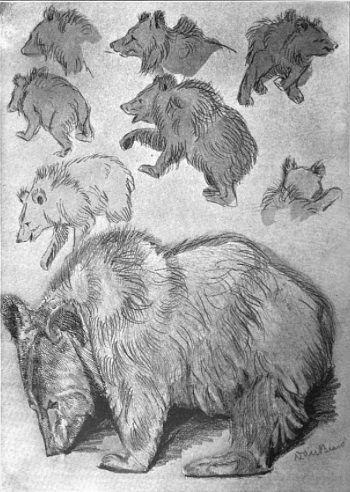
    Sketches of “Mr. Dooley” by Dan Beard.

    Even if the animals seem tame when they are young, when they grow up they can become dangerous. Often they run away, but because they’ve lost their fear of humans, they’re vulnerable to hunters.

    A century ago, people were far less sensitive to these problems as is demonstrated by this story published by Dan Beard in 1907. Beard was a famous author and illustrator, who founded the Sons of Daniel Boone in 1905 and merged the group with the Boy Scouts of America in 1910.

    Beard loved the animals he wrote about and illustrated. Here’s his story about the tragic life of Mr. Dooley, a grizzly captured in Yellowstone Park

    ∞§∞

    A few years ago, Mr. Walker, of the Yellowstone Park, while on horseback, ran down a silvertip cub, and when I sketched it the cub was fastened to a tree.

    The cub was named Mr. Dooley, but there was some mistake in this, as the young monster was not a mister, as it appears “he” was a she.

    I placed my sketching stool just out of reach of the cub, and, while I worked with my pencil, Mr. Dooley spent her time scraping the dirt with her paws, making long canals in the loose earth as she backed away, but all the time keeping her wicked little pig eyes fastened on me.

    Every once in a while she would make a sudden savage rush at me and end it with a half-strangled, gurgling growl.

    When the season was over, the commander of the post stated that he intended to send Mr. Dooley to the Washington Zoo. This grieved Mr. Walker, until the late Major Bach innocently asked if Dooley never escaped, and the next morning it was discovered that Dooley had escaped.

    In the following spring, when Mrs. Walker arrived with her husband at the canyon, to open the hotel, Dooley was waiting to greet them on the broad veranda.

    Time rolled on, and Dooley became a favorite visitor at the camps, and it was not an unusual sight to see a great, hulking, silver-tip bear wrestling with the guides and enjoying the fun as much as the astonished spectators.

    Dooley, although a very, very bad little cub, broadened both in mind and body as she grew older, and adopted the Golden Rule as her moral code; but this was a sad mistake on the bear’s part. There perhaps never was a more gentle, better-hearted bear than Mr. Dooley, the great grizzly of Yellowstone Park. Far better would it have been for the lady bear with a gentleman’s name if she had adhered closely to the traditions of her race and developed into a surly, gruff, dangerous old girl, in place of the gentle, sweet-tempered creature she really made of herself. True, she would not have been petted and fed with prunes and sweetmeats, but she would have been much happier than she now is, poor thing!

    The trouble with Mr. Dooley is that she made the mistake of applying the Golden Rule to human beings, and the human beings did not appreciate the generous nature of the bear.

    Human beings are all right when they preach and when they write, but their brothers in fur will do well not to trust to the sincerity of the two-legged creatures’ sentiments.

    Because the gentle grizzly of Yellowstone Park was guileless and unsuspicious, she (Mr. Dooley) was led into captivity, and is now imprisoned in a narrow iron-barred cell in the Washington Zoo.

    And when the readers visit Washington, and see a big grizzly with its tongue lolling out of its mouth, and a far-away look in its eyes, they may know that it is the lady bear, known as Mr. Dooley, of Yellowstone Park, and that the poor girl is dreaming of her free life in the mountains, or her real friends, the guides and cooks of the camps, and Mr. and Mrs. Walker of the Canyon Hotel.

    It is hoped that the visitors will take with them some little green thing—turnips, apples, or any vegetable, which will gladden the heart of the lady bear who trusted man to her sorrow.

    ∞§∞

    — Text and illustration from “Mr. Dooley: Her Story” Pages 269-273 in Daniel Carter Beard, Dan Beard’s Animal Book and Campfire Stories. New York, Moffat, Yard and Company, 1907.

    — For more stories like this, click on “bears” under the Categories button to the left.

  • A Tale: “Bear That Killed Man Blown to Pieces” — 1917

    Values change. While searching for stories to post here, I frequently find reports of behavior that would outrage today’s sensibilities. Here’s an example published in Popular Mechanics in 1917.

    ∞§∞

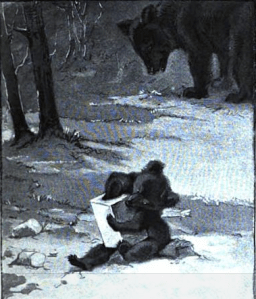
    A bear that had severely mauled a government teamster in Yellowstone National Park was blown to pieces by dynamite recently, while the teamster died of his injuries in the hospital at Mammoth Hot Springs.Screen Shot 2013-04-07 at 8.02.58 AM The man was asleep under a supply wagon in the park when he was attacked by the bear. Two companions drove the animal away, after serious injuries had been inflicted on their mate, and when the latter had been removed to the hospital they prepared a warm reception for the bear, knowing it would return. Dynamite, connected with a small electric battery, was placed under a bait of army bacon a short distance from the camp. When the bear came back under cover of darkness and nosed the bait, the mine was sprung and the dynamite did its work most effectively. Bruin disappeared in sections, and the unlucky teamster was avenged.
    ∞§∞

    —  Text and illustration from “Bear That Killed Man Blown to Pieces,” Popular Mechanics, 27(4):561 (1917).

  • A Tale: Bears Entertain Yellowstone Campers — Dearling, 1900

    Table for Bears Yellowstone Slidefile Asahel Curtis postcard
    Setting the Table for Bears.

    By the 1890s, grand hotels had been built throughout Yellowstone Park and kitchen managers dumped their refuse in nearby woods. Bears soon began treating the arrival of garbage carts as invitations to dinner and watching them at the dump became a “must-do ” experience on par with viewing geysers, canyons and falls.

    In 1900, John Samuel Dearling visited Yellowstone Park “The Wylie Way,” that is, on a carriage tour operated by the Wylie Permanent Camping Company. Both black bears and grizzlies or “silvertips” frequented the Wylie camps just like they did the grand hotels. Here’s how Dearling described the bear antics he encountered in his book published in 1913

    ∞§∞

    Near a hotel, where the refuse was dumped from the kitchen, I saw thirteen bears at one sight. They came there every evening about six o’clock to get their dinner. They must have had watches or clocks of their own, for they did not wait for the hotel bell to ring; they were surely beauties, nearly all silvertips, and of good size—too big for me to play with.

    They watched us pretty closely while they ate their meals and once in a while one would get suspicious and walk off, but he would come back in a few minutes; he could not stand to see the other boys getting all the hash. They did not use very good manners at the festal-board, as they snarled and growled at each other a good deal. It reminded me of the scenes at some of our American breakfast tables.

    There was one poor fellow in the lot that I was sorry for. I would like to have been a Good Samaritan, but my nerve failed me. His lordship had by some means gotten a tin can mashed on his right fore foot; he must have been supping out of a can and some other bear stepped on the can and pressed it into the flesh; at any rate I was told that it had been on there for several weeks. This trouble all came about by his being a right-handed bear; if it had been mashed on his left hand, he could have pulled it off with his right hand.

    There was a family of bears near the Yellowstone Lake that gave the Wylie Company outfit considerable trouble, and some fun; the family consisted of old Betsey and her two boys. While the boys were under her control they behaved fairly well, but had no respect for their neighbors, and old Betsey like all other mothers, could not see the faults of her own children.

    The Wylie people had tents for their kitchens as well as for their sleeping apartments; now old Betsy’s boys thought it great fun to creep under the tents of the kitchen, like an American boy goes under the tent at a circus.

    One night about eight o’clock, Joe, the youngest one (the youngest is always the worst of the lot, that is what my brothers used to say) stole under the tent and proceeded to help himself to a pot of pork and beans; he did not look for a spoon, but in his haste rammed his hand to the bottom of the kettle.

    The beans were pretty hot at the bottom and Joe howled with pain. This attracted the white folks and they rushed into the kitchen and captured the free lunch find; he hallooed for his mamma, and Betsy was not slow in responding, but before she could arrive with reinforcements, the victors had their captive in jail, under a box.

    This so smothered his voice that Betsy could not say for sure that it was her boy that was in the toils of the law. So, after making some big bluffs and parading around the tent with her artillery cocked and pinned, she at last decided not to storm the fortress. Joe was kept for a week or two, then released under parole pending good behavior.

    ∞§∞

    —   From John Samuel Dearling, “Yellowstone National Park,” Pages 319-433 in A Drummer’s Experience, Colorado Spring, Colorado: Pikes Peak Publishing Company, 1913.

    —   Asahel Curtis Postcard from the Yellowstone Digital Slide File.

    —   For more stories about hunting, watching and photographing bears, click “Bears” under the categories button to the left.

  • A Tale: Ernest Thompson Seton Describes a Bear Fight — 1896

    In 1886 the army took over administration of Yellowstone National Park and began enforcing a no guns policy. Soon animals that had fled from public view to avoid slaughter reappeared where tourists could see them. When luxury hotels began dumping garbage in nearby forests, bear watching became as popular with tourists as viewing geysers. One tourist who went to the park to watch bears was the famous wildlife artist, naturalist, and writer Ernest Thompson Seton.

    Seton, who helped found the Boy Scouts of America, not only wrote the first Boy Scout Handbook, he also wrote and illustrated popular stories about wild animals for magazines and books. Nearly every boy and girl in America knew about Seton and his stories.

    In 1897 he came to Yellowstone Park to do an inventory of large animals for a magazine that focused on wildlife conservation. On that trip Seton saw a fight between a grizzly and a momma black bear protecting her invalid cub that everybody called “Johnny.” Seton’s story about the fight became the basis for his most famous story, “Johnny Bear.” Seton was so fond of the story that he told it a second time from the perspective of Wahb, the subject of his book Biography of a Grizzly.

    “Johnny Bear” originally appeared in Scribner’s Magazine and was republished in Seton’s book Wild Animals I Have Known. The following is a condensed version.

    ∞§∞

    All the jam pots were at Johnny’s end; he stayed by them, and Grumpy stayed by him. At length he noticed that his mother had a better tin than any he could find, and, as he ran whining to take it from her, he chanced to glance away up the slope. There he saw something that made him sit up and utter a curious little Koff Koff Koff Koff Koff.

    His mother turned quickly, and sat up to see “what the child was looking at” I followed their gaze, and there, oh horrors! was an enormous grizzly bear. He was a monster; he looked like a fur-clad omnibus coming through the trees.

    Johnny set up a whine at once and got behind his mother. She uttered a deep growl, and all her back hair stood on end. Mine did too, but I kept as still as possible.

    With stately tread the grizzly came on. His vast shoulders sliding along his sides, and his silvery robe swaying at each tread, like the trappings on an elephant, gave an impression of power that was appalling.

    Johnny began to whine more loudly, and I fully sympathized with him now, though I did not join in. After a moment’s hesitation Grumpy turned to her noisy cub and said something that sounded to me like two or three short coughs—Koff Koff Koff. But I imagine that she really said, “My child, I think you had better get up that tree, while I go and drive the brute away.”

    At any rate, that was what Johnny did.

    Grumpy stalked out to meet the grizzly. She stood as high as she could and set all her bristles on end; then, growling and chopping her teeth, she faced him.

    The grizzly, so far as I could see, took no notice of her. He came striding tward the feast as though alone. But when Grumpy got within twelve feet of him she uttered a succession of short, coughy roars, and, charging, gave him a tremendous blow on the ear. The grizzly was surprised; but he replied with a left-hander that knocked her over like a sack of hay.

    Nothing daunted, but doubly furious, she jumped up and rushed at him.  Then they clinched and rolled over and over, whacking and pounding, snorting and growling, and making no end of dust and rumpus. But above all their noise I could clearly hear Little Johnny, yelling at the top of his voice, and evidently encouraging his mother to go right in and finish the grizzly at once. . . .

    She scrambled over and tried to escape. But the grizzly was mad now. He meant to punish her, and dashed around the root. For a minute they kept up a dodging chase about it; but Grumpy was quicker of foot, and somehow always managed to keep the root between herself and her foe, while Johnny, safe in the tree, continued to take an intense and uproarious interest.

    At length, seeing he could not catch her that way, the grizzly sat up on his haunches; and while he doubtless was planning a new move, old Grumpy saw her chance, and making a dash, got away from the root and up to the top of the tree where Johnny was perched.

    ∞§∞

    — Excerpt condensed from “Johnny Bear” by Ernest Thompson Seton, Scriberner’s Magazine 28(6):658-671 (December 1900).

    — Illustration by the Seton from the magazine.

    — You might also enjoy:

  • A Tale: A Bear Fight in the Yellowstone Park — 1903

    By the dawn of the Twentieth Century, watching the antics of bears at hotel garbage dumps became one of the most popular activities in Yellowstone Park.  Here’s a colorful description.

    ∞§∞

    The transportation company’s stages had emptied their loads of dust covered sightseers at the open doors of the Fountain House, and the ink on the register was not yet dry wherewith the newcomers had written their names, when the Fountain geyser began to grumble, hiss and send up clouds of steam, promising an early eruption. Following suit, all the finger holes and cracks in the formation, the hot springs and the baby geysers shot out jets of steam. The Mammoth Paint Pot began to plop, plop, plop! And throw up gobs of pink, white and yellow mud into the air from its bowl full of scalding clay. All this hubbub was a vain attempt to attract the tourist attention.
    The Dante’s Inferno in front of the hotel might have saved its steam and sulpher for another occasion, as it was unnoticed by the guests. The new arrivals were following the layovers in a stampede for the garbage heap on the white geyserite formation back of the house. Suddenly the crowd came to a halt.

    “Gee!” exclaimed a small boy, as he pushed the button on his Kodak.

    “Waught! Waugh! Shouted the pilgrims from Medicine Hat and Rat Portage.

    “Hey! May be rubberneck, what?” laughed the man from Moose Jaw.

    ‘Say! She’s a tough proposition, an’ she wears the straps all right,” cried the guide; while the doctor from Chicago, the broker from New York, the office holder from Ohio, the colonel from Kentucky and the dude from Honolulu all clapped their hands with delight.

    Having dumped its load of table leavings and tin cans the hotel garbage wagon was rumbling back over the formation to the stables, but it was not the wagon, team, driver or load of food scraps which called forth the applause and exclamations of pleasure from the guests of the Fountain House; it was nine great black bears that interested us.

    To the delight of the spectators, the bears had given a short exhibition of their skills as boxers. It was a hot fight; but it did not last long. In fact, it was a mistake in the first place; an impromptu affair not down on the menu. This is the way it happened.

    A long legged cinnamon bear snatched the remains of some ribs of beef from under the nose of a big mother black bear at the moment she was calling her two little cubs to partake of the roast. A benevolent looking bruin, with a glossy black coat covering rotund body, was busily engaged in pawing over the garbage near by, when the indignant mother lifted her paw for a swinging blow, missed the culprit and landed with a resounding swat on the jowl of her benevolent appearing neighbor.

    “Ough-oo-oo-ee-ee-eah!” cried Fatty, in a rage, as he rose on his hind legs and let go at the solar plexus of Old Spot. He had gained his name by breaking through the crust near the Paint Pot and covered on black wide with white mud. Spot’s temper had be none of the best since that day, and in less time than it takes to tell it, he let fly with his left and right at his nearest neighbor, and it became a free-for-all fight accompanied by a continued ought-oo-eahing in various keys.

    During the melee the cinnamon bear who caused the riot was quietly eating the remains of the roast beef, gnawing the bones within 10 feet of the gallant Kentucky colonel, to the latter’s great amusement.

    Although nearly all the men present had cameras, only women and children took advantage of the sunlight and clear sky to photograph the scrapping bears. The sport-loving men stood around in a semicircle, with pleased grins on their faces, too much engaged in applauding the hairy gladiators to waste a thought on the black boxes under their arms.

    Scarcely had the women and children time to wind up their films when the brown bear, elated over his former success, made another attempt to slip up unobserved to the garbage pile. To the casual onlooker it would appear that the black bears were all too busy seeking their own dinner to heed the brown’s approach; but a close observer could not fail to notice that the beadlike eyes of the blacks were keenly alert. No sooner did Brownie come within reach than biff! biff! biff! came the great black paws on his unprotected head.

    An elderly spinster, who seemed deeply interested in the zoological show, stood within 15 feet of the feeding brutes and directly in front of the cinnamon bear, when, with open mouth, it made a dash for safety. With a quick movement the frightened spinster gathered up her skirts, there was a flash of white petticoats, a twinkling of feet, and she was gone, never once looking back until she slammed the hotel door behind her.

    The astonishingly rapid gait at which the terror stricken lady made her 100-yard dash called forth the wildest enthusiasm from the spectators, and the colonel pushed the button of his pocket camera three times without once winding up the film.

    Of course, the brown bear turned aside into the woods the moment he was out of reach of the powerful blows of his relatives, but it was of no use telling that to the spinster. She will always believe that the brute followed her to the hotel door.

    ∞§∞

    — Text and image from Dan Beard, “A Bear Fight in the Yellowstone Park,” Recreation 18(2):85-87 (February 1903).

    — You might also enjoy:

    — You can read Ernest Thompson Seton’s “Johnny Bear” in my book, Adventures in Yellowstone…Early Travelers Tell Their Tales.

    — To find more stories about bears, click on “Bears” under the “Categories” button to the left.

  • Teddy Roosevelt Describes Tame Bears in Yellowstone Park — c. 1914

    When I visited Yellowstone Park with my parents as a boy, my mother admonished my brother and me not to feed the bears, and my father said the warning signs used to read, “Bears Will Eat Candy and Fingers Right Off Your Hands.” Despite regulations forbidding  bear feeding, many people did it to entice the animals for close-up views. And the bears obliged by leaning next to car windows to beg for treats and parading their cubs. Although”bear jams” sometimes blocked traffic for miles, most people figured that was just a price that had to be paid to see their antics. It seemed normal to President Theodore Roosevelt too. Here’s how he described Yellowstone bears about 1914.

    ∞§∞

    It was amusing to read the proclamations addressed to the tourists by the Park management, in which they were solemnly warned that the bears were really wild animals, and that they must on no account be either fed or teased. It is curious to think that the descendants of the great grizzlies which were the dread of the early explorers and hunters should now be semi-domesticated creatures, boldly hanging around crowded hotels for the sake of what they can pick up, and quite harmless so long as any reasonable precaution is exercised. They are much safer, for instance, than any or dairy bull or stallion, or even ram, and, in fact, there is no danger from them at all unless they are encouraged to grow too familiar or are in some way molested.

    Of course, among the thousands of tourists, there is a percentage of thoughtless and foolish people; and when such people go out in the afternoon to look at the bears feeding they occasionally bring themselves into jeopardy by some senseless act. The black bears and the cubs of the bigger bears can readily be driven up trees, and some of the tourists occasionally do this. Most of the animals never think of resenting it; but now and then one is run across which has its feelings ruffled by the performance.

    In the summer of 1902, the result proved disastrous to a too inquisitive tourist. He was traveling with his wife, and at one of the hotels, they went out toward the garbage pile to see the bears feeding. The only bear in sight was a large she, which, as it turned out, was in a bad temper because another party of tourists a few minutes before had been chasing her cubs up a tree. The man left his wife and walked toward the bear to see how close he could get. When he was some distance off, she charged him, whereupon he bolted back toward his wife. The bear overtook him, knocked him down and bit him severely. But the man’s wife, without hesitation, attacked the bear with that thoroughly feminine weapon, an umbrella, and frightened her off. The man spent several weeks in the Park hospital before he recovered.

    Perhaps the following telegram sent by the manager of the Lake Hotel to Major Pitcher illustrates with sufficient clearness the mutual relations of the bears, the tourists, and the guardians of the public weal in the Park. The original was sent me by Major Pitcher. It runs:

    “Lake. 7-27-’03. Major Pitcher, Yellowstone: As many as seventeen bears in an evening appear on my garbage dump. To-night eight or ten. Campers and people not of my hotel throw things at them to make them run away. I cannot, unless there personally, control this. Do you think you could detail a trooper to be there every evening from say six o’clock until dark and make people remain behind danger line laid out by Warden Jones? Otherwise, I fear some accident. The arrest of one or two of these campers might help. My own guests do pretty well as they are told. James Barton Key. 9 A. M.”

    Major Pitcher issued the order as requested.

    At times, the bears get so bold that they take to making inroads on the kitchen. One completely terrorized a Chinese cook. It would drive him off and then feast upon whatever was left behind. When a bear begins to act in this way or to show surliness it is sometimes necessary to shoot it. Other bears are tamed until they will feed out of the hand, and will come at once if called. Not only have some of the soldiers and scouts tamed bears in this fashion, but occasionally a chambermaid or waiter girl at one of the hotels has thus developed a bear as a pet.

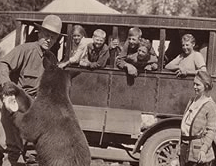
    The accompanying photographs not only show bears very close up, with men standing by within a few yards of them, but they also show one bear being fed from the piazza by a cook, and another standing beside a particular friend, a chambermaid in one of the hotels. In these photographs, it will be seen that some are grizzlies and some black bears.

    This whole episode of bear life in the Yellowstone is so extraordinary that it will be well worthwhile for any man who has the right powers and enough time, to make a complete study of the life and history of the Yellowstone bears. Indeed, nothing better could be done by some one of our outdoor faunal naturalists than to spend at least a year in the Yellowstone, and to study the life habits of all the wild creatures therein. A man able to do this, and to write down accurately and interestingly what he had seen, would make a contribution of permanent value to our nature literature with their majestic beauty all unmarred.

    ∞§∞

    — Excerpt from Theodore Roosevelt, “Wilderness Reserves,” Pages 23-51 in George Bird Grinnell (ed), American Big Game in Its Haunts. Harper: New York, 1914.

    — Detail from Google Images Photo.

    — You also might enjoy

    — To find more stories about bears, click on “Bears” under the “Categories” button to the left.