Category: Women’s Stories

  • Western Girls Don’t Need Chaperones — Alice Richards, 1898.

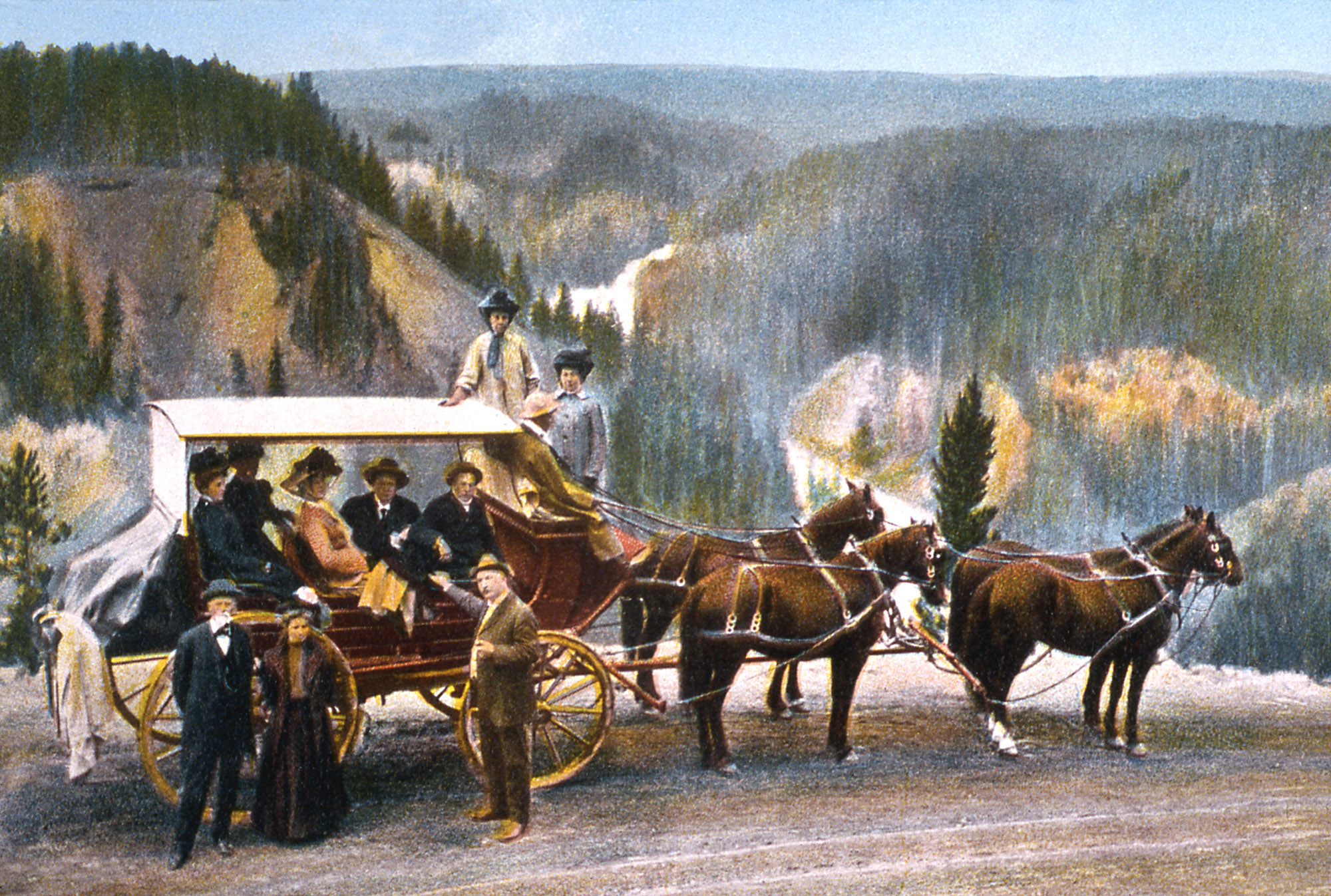
    Postcard of a stagecoach near the Upper Falls of the Yellowstone River; Frank J Haynes; No date
    Postcard of a stagecoach near the Upper Falls of the Yellowstone River.

    Alice Richards was the daughter of Wyoming’s first state governor, William A. Richards. In 1898, S.S. Huntley, General Manager of the Yellowstone National Park Transportation Company, invited her to tour the Park as his guest. Alice eagerly organized a party of three other young women, but she couldn’t find an older person to serve as chaperone. Undaunted, the party resolved to be on their best behavior and take the trip without an escort. Here’s Alice’s story.

    ∞§∞

    Mr. Huntley said that not enough people from Wyoming were visiting the park and if I would get up a party, he would provide transportation through the Park. I was greatly interested and began to talk about such a trip as soon as I reached home. I had expected to find it easy to get older friends to join me, but no one was interested though the expense at hotels we knew was not very high.

    When I was about to give up on the idea, my father said he wanted my sister Ruth and myself to go. He spoke to Jesse Knight, the Judge of the State Supreme Court, who said his daughter, Harriet, could go. She found that a university friend of hers, Harriet Fox, would like to make the trip—so the plans were made and we four left Cheyenne on July 30th, via the Cheyenne and Northern Railroad.

    We had a gay time on the trip because we were allowed the freedom of the train and rode on the engine, on the rear platform, and in the baggage car. I think Hattie Fox knew the engineer. We met several people whom we knew and had a generally good time — but we always remembered we were “ladies.” I was 21 and a half years old; the Hatties were a little younger and Ruth was 15.

    From Livingston, which is on the main line of the Northern Pacific Railroad, we took a branch, which runs 51 miles south to the town of Cinnabar, Montana. Here we were met by Park employees who took charge of us. “Tourists are conveyed in six-horse tally-ho coaches to the Mammoth Hot Springs Hotel, seven miles from Cinnabar

    The other tourists were “conveyed” by stagecoach, but the four of us were taken in charge by, put in the Park wagon with two seats behind the driver. Four schoolteachers from Brooklyn wanted a wagon also. They said: “We do not see why those giddy girls have a wagon when we can’t have one.” So, right there, easterners began to be critical of “those western girls.”

    Maybe here is the place to say that they finally changed their minds. Even the teachers said they wished eastern girls had the high spirits and courtesy of us giddy western girls. We were full of fun, but we were always polite and courteous to others and didn’t do anything out of the way. However, after we had been on the way a day or two, Mrs. Meyer from Red Lodge, Montana, suggested to me that some of us ride in their somewhat larger wagon while she or her husband rode with us.

    She said, “You do not need chaperones as you behave well, but those easterners do not understand our ways and will take away a better report if you seem to be of our party.” Being loyal westerners we agreed—I remember I was very glad for I did feel the responsibility of my party.

    At Cinnabar, we were approached by an emissary from Mr. Huntley who ushered us over to the Park wagon mentioned above. The baggage was out in with us and we started out with Mr. Murphy as driver to get our first view of Wonderland ahead. In a note to me, Mr. Huntley had said that he would try to find an honest driver for us, but quite soon Mr. Murphy began telling quite tall tales of the rather rough country through which we were passing.

    We didn’t “ah” and “oh” quite enough to suit him and pretty soon he turned to us and said, “ Just were are you girls from?” We tried to say we were tenderfeet—but it didn’t suit him. When he found that the Hatties were from the University of Wyoming, and Ruth and I from Cheyenne, he was quite abashed. “Why didn’t Mr. Huntley tell me I was driving western girls? I thought I was going to have some nice innocent girls from the east.”

    Later he said, “I was taking someone else’s place today but I am going to ask Mr. Huntley to let me take you all the way through the Park—even though I can’t tell my tall tales.” We assured him we would gladly listen and would be glad to have for all the trip—which we did and found him a very good driver and a kind friend.

    The first stop on the trip after leaving the railroad is the Mammoth Hot Springs—which fully lived up to their name. However, this is not a tale of the Park, but of four girls who managed their own trip—with the help of Park employees. The people were the greatest item of interest. There were many easterners, and others from many parts of the country.

    Everything went smoothly, we all behaved as well as if we had been chaperoned—perhaps better. The first few days the other tourists were inclined to be critical, but when they could find nothing to really criticize, they one and all decided that western girls were pretty nice people after all.

    ∞§∞

    • Compiled from the correspondence, notes and diary of Alice Richards McCreery. Originals are in the Wyoming Historical Society’s Richards locker in Cheyenne.
    • F.J. Haynes Postcard, Yellowstone Digital Slide File.
  • Yellowstone Stores for International Women’s Day

    I thought I should celebrate International Women’s Day by providing a list of stories about some intrepid travelers who visited Yellowstone Park more than a hundred years ago. Here are some of my favorites. You can find even more by clicking on “Women’s Stories” under the Categories button.

    Emma Stone tours Yellowstone — 1872.

    Emma is the first white woman to make a compete circuit of the park.

    Doughnuts fried in bear grease — Sarah Tracy, 1873.

    Because of Indian troubles, armed soldiers escort Sarah on her way to Yellowstone Park

    Dolly saved my life — Mabel Cross Osmond, 1874.

    When 6-year-old Mabel tours Yellowstone Park with her parents, an alert Indian pony keeps her from serious injury.

    Captured by Indians — Emma Cowan, 1877.

    Emma watches in horror when Indians shoot her husband in the head.

    An October snow storm — Carrie Strahorn, 1880.

    When Carrie braves fresh snow to see the Yellowstone Fall, she is caught in a blizzard.

    A mother takes her seven children to the park — Eleanor Corthell, 1903.

    An intrepid woman buys a horse and wagon and takes her family on the adventure of their lifetime.

    Maud gets her revenge — L. Louis Elliot, 1913.

    A camp assistant evens the score with a supercilious guest.

    ∞§∞

    — Read more about women travelers in my book, Adventures In Yellowstone.

  • A Tale: Montana Women Held Elective Office Before They Could Vote

    March is Women’s History Month so I decided to post something in observance of that here. Of course, this blog contains dozens of stories by and about women who visited Yellowstone Park long ago, but I wanted to post something visitors hadn’t seen before. Checking my files, I came across my article about Adda Hamilton, who was elected School Superintendent of Gallatin County, Montana, in 1884. I published it in The Pioneer Museum Quarterly in Spring 2007.

    I came across Adda’s story General George W. Wingate’s book about his trip to Yellowstone Park in 1885. Like General Wingate, I was intrigued to find out that women were winning elections in Montana before they could vote, so I researched Adda’s story and submitted it for publication. Here it is.

    ∞§∞

    When General George W. Wingate visited Bozeman in 1885, he was amazed that a woman held political office.[1] Wingate was talking about Adda Hamilton who was elected Gallatin County School Superintendent in 1884.

    Wingate said he was glad that she won her election by a large majority. “For this” Wingate said, “she seems to have been greatly indebted to her opponent.” As Wingate told the story:

    “Miss Hamilton’s opponent had occupied the position for which she was a candidate for several years, and was enraged at the thought that a woman should have the audacity to oppose his re-election. In a speech made shortly before the election to a crowded meeting, composed largely of his own adherents, . . . he forgot himself so much as to sneer at Miss Hamilton as a ‘school marm who had come to the territory a few years ago without a dollar in her pocket.’”

    “He was continuing in this strain when an Irishman in the audience stood up and interrupted him with a stentorian shout — ‘Boys lets give three cheers for Miss Hamilton;’ whereupon every man in the audience stood up in his place, waved his hat and cheered for Miss Hamilton at the top of his lungs.”

    Most likely the man who abused Miss Hamilton was the Republican William Wallace Wylie. In 1878, Wylie was recruited to be Bozeman’s first superintendent of schools, a position he held for three years. Then he was principal of the Bozeman Academy for four years. After he lost his election to Miss Hamilton, he was named Superintendent of Schools for Montana Territory.

    Wylie was described in Progressive Men of Montana as “being inflexibly opposed to the liquor traffic and standing true to his convictions in 1888 transferred his allegiance to the Prohibition Party.” He was also an elder in the Presbyterian Church. Wylie was an author and lecturer about Yellowstone National Park and founded a large company that provide guided carriage tours and lodging in permanent tent camps.[2]

    When Adda Hamilton announced that she was running for school superintendent as an independent, The Bozeman Avant Courier described her as “a young lady of pleasant address, excellent educational attainments and experience as a teacher and is doubtless qualified for the position to which she aspires.”[3]

    The Avant Courier said her name had been submitted for nomination at the Democratic Party Convention, which chose another candidate. “Some persons may question the propriety or wisdom of her present course in running as an independent,” the article continued, “but this is a matter that must be left to the young lady’s own judgment, and she doubtless is actuated by the best of reasons and or purest motives.” In Miss Hamilton’s formal announcement, she said she decided to seek office “at the earnest solicitation of many citizens.”

    Hamilton wasn’t the only woman to run in Montana in 1884. The Avant Courier republished an article from the Dillon Tribune that reported “The girl candidates for Superintendent of Public Instruction in many of the counties of Montana are going to win.”[4]

    In Meagher County, the article said, “two girls are pitted against each other, and the fight for the position is quite lively. Miss Darcy is the candidate for the unwashed Democrats and Miss Nichols musters with the Republican boys.” Miss Clark of Lewis and Clark County was described as “a talented young woman” and “an accomplished politician. The Tribune expected Miss Clark to win.

    The Tribune said that as an independent, Miss Hamilton “enters the field against the odds of regular party nominees.” Describing her as a candidate “with sand,” the paper added, “Hamilton should be elected.” Among her virtues, the paper said, “she says she isn’t afraid of road agents,” which “would afford the pleasure to hop around from one county school house to another. The men of Gallatin Country would be confounded mean if they don’t run Hamilton in.”

    On Election Day, Miss Hamilton won the election with 1485 men’s votes. The Republican candidate got 1051 and the Democrat, 487.[5] That, as General Wingate said, “shows what comes of abusing a woman in Montana.” Montana didn’t grant the vote to women for another twenty-five years.

    ∞§∞

    —   This article first appeared in The Pioneer Museum Quarterly, Summer 2007, page 4.

    —   To find stories about women’s adventures in Yellowstone Park, click on “Women’s Stories” under the “Categories” button to the left.

    Footnotes

    1. George W. Wingate, Through Yellowstone Park on Horseback, Moscow, Idaho: University of Idaho Press, 1999.
    2. Progressive Men of the State of Montana. A.W. Bowen, Chicago, 1901.
    3. Avant Courier, Bozeman, MT., October 9 1884.
    4. Avant Courier, Bozeman, MT., October 30, 1884.
    5. Avant Courier, Bozeman, MT., December 6, 1884.
  • A Tale: A Nighttime Visitor — Synge c. 1890

    By the time Georgina M. Synge visited Yellowstone Park in the 1890s, most tourists sped through the park on rigorously scheduled five-day coach tours.

    A Wolverine

    But Georgina and her companion, whom she simply called “A.” (probably A. was her husband), preferred the flexibility of traveling on horseback. Having their own horses and tents not only provided them with the flexibility to stay as long as they wanted at any given sight, it also allowed them to choose their  route. After visiting the Grand Geysers, they decided to detour into the back country in hopes of seeing some big game. Here’s how Georgina described what happened when a surprise visitor came to her tent.

    ∞§∞

    We pitched our tent on the Yellowstone banks, by a lovely bend that carried it through great rocks further down. Behind us were thick forests, and in front long blue lines of hills. It looked a splendid place for trout, with its deep pools and gravelly shallows, so, though it was getting dark, A. brought out his rods, and in a very few minutes had secured some fine big fellows, which were delicious, grilled for supper.

    The men had stupidly left the axe behind at our lunching place, and so it happened our tent was not very well pegged down that night. However, as it was clear still weather, we thought it did not matter, not dreaming of other alarms. I was rather tired and slept soundly, and it must have been about one o’clock when I was awakened by funny little squeaks near the tent, and I heard the men from the wagon, about ten yards off, calling out and trying to frighten something away. This ceased for a little. Then presently I heard something creeping round the tent, and some more squeals. The lamp was dimly burning, and I turned it on the entrance, which was the unpegged part. Something was squeezing itself under the canvas, something about the size of a badger, black and smooth, and with a sharp little nose.

    I turned the lamp full upon it, and we stared at each other, both much surprised. My stick was close at hand, so I whacked on the ground, upon which the little beast turned tail in a hurry, and scuttled out as fast as it could. A. by this time was awake, and professed to be much surprised that I, who was so fond of live creatures, should object to the poor little thing.

    “As if it would have hurt us,” he remarked, as he turned over and went to sleep again. However, dearly as I love the animal world, I prefer not to have unknown species thereof rambling about my sleeping apartment, and so I lay awake on the chance of having another visit. Before long I heard something walking about with heavy lumbering gait, some few yards off. Then it came nearer, walked slowly round the tent, sniffing along the bottom, and brushing up against the canvas as it passed. With some difficulty I awoke A.

    “There’s a wild beast outside!” I cried,” and it’s trying to get in—what shall we do!” A. replied that he would rather be eaten than wake up, and that it was most likely a poor little mink or inoffensive creature of that kind, and I had better go to sleep again. But at that moment it began to move once more, there was a shuffling at the entrance—a great big something bulging it out as it tried to poke its way through. Then, as we watched, horrified (having no guns in the tent), we saw a large brown head thrust through the insecurely fastened opening.

    “It’s a wolf!” I shrieked, “and it wants to eat us!” And we seized our sticks and made a terrific noise to frighten the monster. He certainly was surprised, for he quickly withdrew his nose, and we heard him sloping off. I was dying with curiosity to see what he was like, and at last summoned up courage to peep out. It was early morning, and a faint cold light made everything distinctly visible.

    There, squatting a few yards off, was our visitor, watching us, and trying to make up his mind whether to investigate further. I had no desire for a closer acquaintance with him, however, and beat on the sides of the tent with my stick, and yelled at him in a way that evidently struck terror into his savage breast, for he turned tail and trotted off, and I lost sight of him below the hill. After this we barricaded the entrance and made it as secure as we could, and A. promised to keep watch for the rest of the night. However, I had not the smallest inclination, to close an eye even, and as soon as it was light enough we got up and roused the men to prepare breakfast.

    We found they had had a lively night also, as they had had mink after the fish, and our big brown visitor also, which latter had been attracted by the elk steak. They declared it was a wolverine, which is a very cowardly sort of brute, and rarely shows fight or attacks mankind. But they confided in A. afterwards that it was really a cinnamon bear, but that they did not like to tell me for fear I should be too much alarmed to sleep in the tent again, whereas nobody minded wolverines. However, as I told them, one was quite as alarming to me as the other, though, now it was all over, I was not ill-pleased at having seen one of these interesting beasts so near; for many people go through the Yellowstone without seeing a vestige of a bear, especially if they keep on the trail.

    ∞§∞

    —From “Big Game” pp. 71-84 in Georgina M. Synge, A Ride Through Wonderland.  Sampson, Marston & Company. London, 1892.

    —Image from the Coppermine Photo Gallery.

  • An Event: Getting Ready To Present “The Nez Perce in Yellowstone” at The Pioneer Museum

    The big event on my schedule this week is my presentation, “The Nez Perce in Yellowstone,” at The Pioneer Museum of Bozeman on Saturday at 9:30 a.m. The talk, which is part of the Gallatin Historical Society’s Fall Lecture Series, will focus the dramatic stories told by tourists who survived run-ins with the Indians in the Summer of 1877.

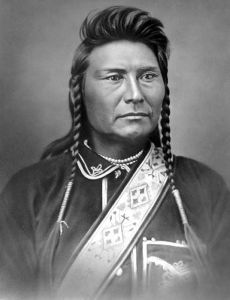
    Chief Joseph

    I’ll begin with an overview of the flight of the Nez Perce who generally had lived peacefully with whites for most of the 1800’s. After gold was discovered on Nez Perce land in 1853, settlers began moving onto their land. In 1877 the Indians were ordered onto a tiny reservation, but they decided instead to flee to the buffalo country on the plains. Most accounts of the flight of the Nez Perce emphasize things that happened outside of Yellowstone Park like broken treaties and battles, but I’ll reverse that pattern and focus in the human drama of the Indians’ encounters with tourists.

    I’ll read from my collection of first-person accounts of travel through Yellowstone Park in the 1800s. I like to present stories in the words of people who lived the adventures because that lets emotions and personalities shine through.

    The first tourist the Nez Perce found in the park was John Shively, a prospector who was familiar with the area. The Indians forced Shively to guide them all the way through the park. He was with them for thirteen days, so his story provides a good overview.

    The next tourists the Nez Perce found were the “Radersburg Party,” which included Emma Cowan and her thirteen-year-old sister, Ida. Emma and Ida were the only women to tangle with the Nez Perce inside the park. I’ll read Emma’s chilling description of the Indians shooting her husband in the head and taking her and her sister captive.

    To slow things down, I’ll talk about “Skedaddlers,” tourists who visited the park in the summer of 1877, but left before the Indians arrived. These include: the famous Civil War General William Tecumseh Sherman; Bozeman Businessman Nelson Story; English nobleman and park popularizer, The Earl of Dunraven and his companions, Buffalo Bill’s sometime partner, Texas Jack Omohundro, and Dunraven’s friend, George Henry Kingsley, a physician who patched up the Nez Perce’ victims at Mammoth Hot Springs.

    Next, I’ll talk about the Helena Party’s trip and contrast that all-male group that entered the park from the north with the co-ed Radersburg Party that entered from the west. Then I’ll read Andrew Weikert’s description of his blazing gun battle with the Nez Perce.

    I’ll describe how survivors of encounters with the Nez Perce were either rescued by soldiers looking for the Indians or made their way to Mammoth Hot Springs. I’ll explain that after Emma Cowan, her sister, and several wounded men left Mammoth for civilization, three men stayed there to see if their missing companions would appear. Then I’ll read Ben Stone’s description of the Indian attack at Mammoth that left another man dead.

    I’ll end with my synthesis of accounts of Emma Cowan’s overnight ride from Helena to Bottler’s Ranch in the Paradise Valley to join her husband who had survived three gunshot wounds and was rescued by the army. That will give me an opportunity to talk about Encounters in Yellowstone, a book I’m writing now.

    ∞§∞

    — The presentation will be at Pioneer Museum of Bozeman,  315 E. Main. It is free and open to the public.  Please tell your friends.

    — The photo of Chief Joseph is in the public domain.

  • A Tale: The New Camp Spirit Gets Arrested— Eleanor Corthell 1903

    Eleanor Corthell’s husband “could only fizz and fume” when she announced in 1903 that she was taking their seven children to Yellowstone National Park by team and wagon. But he could think of no good reason to stop her.

    By then the park had been transformed from a forbidding wilderness into a genteel resort where an unaccompanied woman could travel without fear of being attacked by Indians or bears. The Army Corps of Engineers had completed a network of roads in the park that were among the best in the United States, certainly good enough to be navigated by Mrs. Corthell’s sixteen-year-old son. There were stores where the Corthells could buy supplies and post offices where they could keep in contact with family and friends.

    Although the park had several grand hotels, the Corthells camped out for their entire two-month adventure. This meant that Mrs. Corthell had to manage not only the logistics of the trip but also cooking and laundry—all out of doors. That might sound like an enormous challenge, but as Eleanor would have pointed out, she would have been in charge of all those duties had she stayed at home.

    Despite the relative tranquility of Yellowstone Park at the time, the Corthells had plenty of adventures. Their travels across the ranch country of central Wyoming reminded them of Owen Wister’s novel The Virginian, which many consider to be the first Western. In the park they kept their eyes out for black bear cubs like Johnny Bear and  grizzlies like Wahb, who were the subjects of famous stories by the hugely popular naturalist and writer Ernest Thompson Seton.

    Eleanor’s husband, Nellis, joined his family in the park and promptly ran afoul of regulations that were enforced by the Army, which ran the park then. But Nellis (Eleanor called him “The New Camp Spirit”) was a prominent Wyoming attorney, and he managed to talk himself down to a two-dollar fine.

    Eleanor’s story of her family trek was published in June 1905 in the magazine, Independent.  Here’s an excerpt.

    ∞§∞

    We camped across the road from Old Faithful and saw it play five times; but we shouldn’t have stopped there, we were taking chances. The park rules are very strict in regard to trespass on the formations, and thereby hangs a tale: But then, you would not expect such a large family to pass among a whole valley full of yawning gulfs and smiling springs and shooting geysers, absorbed until they forgot time and place and circumstance and not have something happen, would you? Since none of them fell into a hot spring, what could matter?

    Well, “The New Camp Spirit” got arrested! And that mattered a good deal.

    The horses found feed scarce in the very heavy timber so came into the open where the road lay. Just across, on forbidden territory, was a bunch of grass that poor Star wanted. Now he didn’t intend to swallow Old Faithful, or tramp on its flinty surroundings. We were busy spreading a good, hot dinner on the tablecloth, so failed to notice Star quite quick enough. Presently we saw, and sent a boy to drive him back, but a soldier on horseback got ahead of him, and swearing like a trooper at boy and horse, he came thundering up saying, “Consider yourself under arrest, sir, and come with me!”

    In his very, very sweetest manner and most persuasive tone, Mr. Corthell asked, “May I finish my dinner first?” “Well, yes sir,” the soldier said, somewhat mollified. And he sullenly stood in the background.

    But dinner had lost its savor. This is an experience we had nowhere reckoned on. What if it meant jail—forgotten pocketbooks, broken wagons, floods, nothing ever created such consternation as this. But we didn’t fall into a panic. The chief victim was so placid, so serene, even sweetly content, that the example set composed the rest of us. Before the walk to headquarters was over, sweetness won the day, so the fine was only two dollars when it might have been a hundred. From this point on the “New Camp Spirit” took no more chances and always put out his fires.

    ∞§∞

    — Excerpts from “A Family Trip to the Yellowstone” by Mrs. N. E. Corthell, The Independent, 58:2952, 1460-67 (June 29, 1905).

    — Photo, Pioneer Museum of Bozeman.

    — Read more about Eleanor Corthell’s adventures:


  • A Tale: “Near Roughing It” With TR — Corinne Roosevelt Robinson, 1890

    Corinne Roosevelt Robinson published a book in 1921 about her memories of her late brother, President Theodore Roosevelt. She described the summer of 1890 when TR acquiesced to requests that he take his family to Yellowstone Park, a place he visited often. Although she praised his geniality and good cheer, Corinne made it clear that TR didn’t like the comforts required by the ladies on the trip and would rather be “roughing it.”

    In her book, Corinne included a letter that she sent to her aunt about the trip. She said she decided not to “terrify” her aunt by reporting the seriousness of the injuries TR’s wife, Edith, suffered when she fell off a horse. Here’s an excerpt.

    ∞§∞

    — Theodore Roosevelt, C. 1895

    “We have had a most delightful two weeks’ camping and have enjoyed every moment. The weather has been cloudless, and though the nights were cold, we were only uncomfortable one night. We were all in the best of health and the best of spirits, and ate without a murmur the strange meals of ham, tomatoes, greasy cakes and coffee prepared by our irresistible Chinese cook. Breakfast and dinner were always the same, and lunch was generally bread and cheese carried in our pockets and eaten by the wayside. We have really had great comfort, however, and have enjoyed the pretense of roughing it and the delicious, free, open-air life hugely—and such scenery!

    Nothing in my estimation can equal in unique beauty the Yellowstone canyon, the wonderful shapes of the rocks, some like peaks and turrets, others broken in strange fantastic jags, and then the marvelous colors of them all. Pale greens and yellows, vivid reds and orange, salmon pinks and every shade of brown are strewn with a lavish hand over the whole Canyon—and the beautiful Falls are so foamy and white, and leap with such exultation from their rocky ledge 360 feet down.

    We had one really exciting ride. We had undertaken too long an expedition, namely, the ascent of Mt. Washburn, and then to Towers’ Falls in one day, during which, to add to the complications, Edith had been thrown and quite badly bruised. We found ourselves at Tower Falls at six o’clock in the evening instead of at lunchtime, and realized we were still sixteen miles from Camp, and a narrow trail only to lead us back, a trail of which our guide was not perfectly sure.

    We galloped as long as there was light, but the sun soon set over the wonderful mountains, and although there was a little crescent moon, still, it soon grew very dark and we had to keep close behind each other, single file, and go very carefully as the trail lay along the mountainside. Often we had to traverse dark woods and trust entirely to the horses, who behaved beautifully and stepped carefully over the fallen logs. Twice, Dodge, our guide, lost the trail, and it gave one a very eerie feeling, but he found it again and on we went.

    Once at about 11 p.m., Theodore suggested stopping and making a great fire, and waiting until daylight to go on, for he was afraid that we would be tired out, but we all preferred to continue, and about 11:30, to our great joy, we heard the roar of the Falls and suddenly came out on the deep Canyon, looking very wonderful and mysterious in the dim star-light. We reached our Camp after twelve o’clock, having been fifteen hours away from it, thirteen and a half of which we had been in the saddle. It was really an experience.”

    It was a hazardous ride and I did not terrify my aunt by some of the incidents such as the severe discomfort suffered by Mrs. Theodore Roosevelt when she was thrown and narrowly escaped a broken back, and when a few hours later my own horse sank in a quicksand and barely recovered himself in time to struggle to terra firma again, not to mention the dangers of the utter darkness when the small, dim crescent moon faded from the horizon.

    My brother was the real leader of the cavalcade, for the guide, Ira Dodge, proved singularly incompetent. Theodore kept up our flagging spirits, exhausted as we were by the long rough day in the saddle, and although furious with Dodge because of his ignorance of the trail through which he was supposed to guide us, he still gave us the sense of confidence, which is one’s only hope on such an adventure. Looking back over that camping trip in the Yellowstone, the prominent figure of the whole holiday was, of course, my brother. He was a boy in his tricks and teasing, crawling under the tent flaps at night, pretending to be the unexpected bear, which we always dreaded. He was a real inspiration in his knowledge of the fauna and birds of the vicinity and his willingness to give us the benefit of that knowledge.

    ∞§∞

    —Corinne Roosevelt Robinson, “The Elkhorn Ranch and Near-Roughing it in Yellowstone Park,” Pages 135-155 in My Brother Theodore Roosevelt, Charles Scribner’s Sons, 1921.

    — Photo, Wikipedia Commons.

  • A Tale: Part 6: A Lady’s Visit To The Geysers Of The Yellowstone Park — HWS 1880.

    The final installment of HWS’s chronicle of her Yellowstone adventure begins at the edge of the Grand Canyon of the Yellowstone. Then a photographer takes her picture on Foxey and she visits Yellowstone Lake and the Upper Geyser Basin. Then she starts home.

    Begin with Part 1

    ∞§∞

    The lads of our party found great delight in starting enormous fallen trees down the awful incline, and watching them crash their way with a fearful swiftness to the river’s brink. Any mother will know how that made me feel, especially when I add that no doctor could be procured in that region under seven days at the very least, and that we had neither houses nor beds, nor anything considered necessary in sickness. I confess I was thankful every minute that our family did not possess a country seat on the banks of the Yellowstone Canyon!

    Near us was camped a photographer, and of course we were taken, guides, pack train, colts, dogs and all. They put me, mounted on Foxey, in the very forefront of the picture, and beside me an old blind pack-horse with our store on his back, choosing this position for us, no doubt, because we were the two queerest looking objects in the whole train. We have since heard that this picture is to be put in a panorama amongst other objects of interest in the Park, and that we shall be magnified to the size of fifteen feet and perfectly recognizable!

    One of our chief difficulties arose from the impurity of the water and its impregnation with mineral substances, yet the whole of our party went through the trip without suffering any bad effects, and even grew stronger and better, though not a drop of any stimulant was touched by any of us.

    The Yellowstone Lake lies 7,780 feet above the sea, almost on the top of the Rocky Mountains, and covers 300 square miles, being the fourth in size, which lies entirely within the limits of the United States. Its pure, cold waters, in some places 300 feet deep, are the rich blue color of the open sea, and swarm with trout, while it is the summer home of white swan, pelicans, geese, snipe, ducks, cranes, etc., and its shores furnish feeding grounds for elk, antelope, black and white tailed deer, bears, and mountain sheep.

    Scattered along its shores are many clusters of hot springs and small geysers. It is surrounded on every side but one with snowy mountains, and was long considered to be entirely mountain-locked and inaccessible. The guides told us that it was literally true that a man could stand at one point on the shore of the lake and catch fish on one side of him, which he could swing over and cook in a boiling spring on the other side!

    Leaving these high elevations, we went to see the Upper and Lower Geyser Basins. We had dismounted and unloaded our horses and buggy, and were looking for the best sites for our tents, when the cry was heard, “There goes a geyser!” and we dropped everything and ran. The sight was truly a glorious one. At the far end of the basin, Old Faithful was playing his wonderful fountain, and we saw what looked to us a river of water shooting up into the sky.

    Our guides told us it was only 150 or 200 feet high, but to us it seemed to reach the clouds, and on one side of it was a lovely soft rainbow that came and went with the blowing spray. It spouted for five or ten minutes and then subsided. Old Faithful is the only geyser whose performances can be depended upon. He spouts regularly every sixty-seven minutes, and has done so ever since the discovery of the Park.

    The crater looks like a great mound of coral or petrified sponge, surrounded by terraced basins at all shapes and sizes, and of the most lovely colors. The whole mound is convoluted in the most beautiful fashion, and every one of the little basins around it is rimmed with exquisite scalloping and fluting. The Grand Geyser, the Giant, the Grotto, the Splendid, the Riverside, and the Fan, complete the list of large geysers in this basin, and each one has a marvelous and distinct beauty.

    As we were quietly sitting in camp the day after our arrival, I noticed a great steam in the direction of the Grand Geyser, and called out to one of our guides, “George, is old Grand doing anything?” He looked a moment, and then, dropping everything, began to run, shouting out at the top of his voice, “Old Grand is spouting! Old Grand is spouting!”

    In a second of time our camp was deserted, every thing was left in wild confusion, and we were all running at the top of our speed to see the display. It was perfectly glorious! As it sent up its grand water rockets 250 feet into the air, shooting out on every side, we all involuntarily shouted and clapped our hands, and Sam took off his hat and swung it over his head in a perfect enthusiasm of delight!

    It was like a grand oration, and a wonderful poem, and a beautiful picture, and a marvelous statue, and a splendid display of fireworks, and everything else grand and lovely combined in one. Then all would subside, and the pool would be quiet for a moment or two; then again, it would heave and swell, and the glorious fountain would suddenly burst up again into the blue sky! Seven times this took place, and then all the water was sucked down, down, down into the abyss, and we climbed part way into the steaming crater, and picked up specimens from the very spot where just before had been this mighty fountain.

    The Giant, too, gave us a grand performance while we were in the Basin. We thought it the grandest and most beautiful of all. It shoots up a column of water at least seven feet thick to the height of 250 feet, the steam rising far higher. It played for nearly an hour, and flooded the whole basin around with boiling water, doubling the volume o water in the river.

    The internal rumblings and roarings meanwhile were perfectly deafening. I could not help feeling as I gazed on these wonders that there was a lesson in it all. Nothing but heat could bring forth such beauty as we see here at every step, and I thought that thus also did the refining fire of God bring forth in our characters forms and colors as beautiful after their fashion as these.

    On the 19th, we broke camp and started for our homeward journey. And so, in due time, our trip was over, and the “Mystic Wonderland” lay behind us; but we all felt that we had stored up while there a treasure of fascinating memories of which no time nor distance could rob us. Some of us felt also that we had learned to know our God and His greatness as we had not known Him before, while living amid such displays of His creating and sustaining power, and realized that never again could we doubt His love and care.

    ∞§∞

    — From H. W. S., “A Lady’s Visit To The Geysers Of The Yellowstone Park.” Friends Intelligencer May 19, 1883. Pages 218-221, and May 27, Pages 234-237.

    — Detail from a photo in the collection of the Pioneer Museum of Bozeman.

  • A Tale: Part 5: A Lady’s Visit To The Geysers Of The Yellowstone Park — HWS 1880

    Tower Creek, Thomas Moran, 1871

    HWS abandons her wagon and mounts “a sober old creature named Foxey” to cross the roadless wilderness to the Grand Canyon of the Yellowstone.

    Begin with Part 1

    ∞§∞

     The day we left the Mammoth Hot Springs, we had an accumulation of all the miseries of camping-out life. Fierce heat succeeded by torrents of wind and rain, and, to add to everything else, perfect swarms of mosquitoes. But we were repaid by the sight of Tower Creek, which rises in the high divide between the valleys of the Missouri and Yellowstone, and flows for ten miles through a cavern so deep and gloomy that it is called the Devil’s Gorge.

    About two hundred yards before entering the Yellowstone River, it dashes over an abrupt descent of 156 feet, forming a very beautiful waterfall. All around are columns of volcanic breccia, some resembling towers, some the spires of churches, and some are almost as slender and graceful as the minarets of a mosque. But, alas, one sad fatality spoiled the scene for me.

    It was impossible to take the wagon any further, and there was no alternative but to mount one of those wild beasts named by Adam a horse. The guides picked me out a sober old creature named Foxey, used to carry a pack, and likely therefore to be equal to my weight, and unlikely to be frisky or foolish. On the morning of the 9th of August, we started a long train of twenty-six horses, two dogs, and three colts, for the Yellowstone Falls and Canyon.

    As I was quite determined never to go out of a walk, on account of the tendency to slip off, I took the tail end of the pack train, and plodded on very contentedly for a while. But, alas, my comfort was of short duration, for, when we stopped to lunch, Foxey lost sight of the pack, to which he felt he rightfully belonged, and getting either bewildered or angry, he began to behave in the most unaccountable manner. He backed and forwarded and sidled and turned round and round and neighed, and completely mastered me, till our of the guides came up and fastened a rope to his bridle and led him the rest of the way.

    It is beyond my power to depict the grandeur and beauty of the mystic river, and its falls and canyon. There are two falls, half a mile apart; the upper is 140 feet high, and the lower 397. The water is compressed into a mass about 100 feet wide, and from four to six feet deep, and falls over the precipices in one apparently solid mass of glorious emerald, into its marvelous canyon below. This canyon is one of the Park’s greatest wonders.

    It is a stupendous chasm about twenty-five miles long and from 1,000 to 3,000 feet high. It can only be seen from the top, as its sides are inaccessible except in one place six miles below the falls. The river has cut its way through a material largely composed of soft clays, sand, tufa, volcanic ash and breccia, with occasional layers of basalt, and has wrought out for itself a wonderful channel.

    Towers and turrets and dykes and castle walls of all shapes and sizes are crowded together throughout its whole length in wild confusion. Here and there a single tower stands out in solitary grandeur, isolated from all its fellows, with perhaps a lonely fish hawk’s nest on its top, and little birds stretching out their open mouths towards the mother, who was circling in the grand and awful chasm over the river. But wonderful as these walls are for their height, and the grotesque and beautiful forms into which they are eroded, they are vastly more so for their color.

    From their lofty tops to the very edge of the water, they are dyed with an endless variety of the most vivid and delicate coloring. They are a mass of yellows and red and coal black and snow-white and cream and buff and brown and gray and olive, mingled together in richest confusion, while at the bottom runs the river, a glorious roaring torrent of purest emerald green, embroidered with silvery foam, between slopes decorated with velvet grass. The effect is indescribable.

    ∞§∞

    — From H. W. S., “A Lady’s Visit To The Geysers Of The Yellowstone Park.” Friends Intelligencer May 19, 1883. Pages 218-221, and May 27, Pages 234-237.

    — Coppermine Gallery Image.

  • A Tale: A Lady’s Visit To The Geysers Of The Yellowstone Park (Part 4) — HWS 1880.

    HWS describes the wonder of a glass mountain, the “grapples” of traveling in a wagon over crude roads and managing rambunctious young travelers.

    Begin with Part 1

    ∞§∞

    Our route lay for two days through the Parks of the Rocky Mountains. These are so wonderfully beautiful that I feel as if I wanted to make everybody see them.

    Obsidian Cliff

    Imagine an English nobleman’s country seat set right down in the midst of these mountains, with great stretches of greenest grass, groups of beautiful trees, beds of brightest flowers, a winding, dashing mountain river, tiny lakes, slopes of turf, fantastic rocks scattered in the most romantic confusion, and around it all a girdle of grandest mountains, often flecked with snow, and changing continually from sunshine to storm, one hour covered with clouds, and the next standing out in clear cut beauty” and sublimity against the deep blue sky.

    I confess that it stands out in my memory as the emblem of all that this world can give of peace and beauty and perfect rest; and to remember that these rugged mountains are full of such quiet nooks gives one a blessed sense of the sweetness of God’s almighty power, which has delighted itself in such lovely bits of creation.

    We traveled over a road made of obsidian, which is a sort of volcanic glass, of a reddish black color, and glistened beautifully in the sun. We picked up some specimens, and found it was very much like the lumps that are thrown out of the melting pot in a glass factory when a pot breaks. It is very evident that the whole mountain was at one time a molten mass. It is one of the boasts of the Yellowstone Park that it possesses the only glass mountain and glass road in the world.

    The road was made by building great fires on the glass mountain, upon which, after a thorough heating, cold water was dashed, thus cracking off large masses of glass, which were afterwards broken into small fragments with small picks and sledges. But I confess that I walked along that wonderful road, and looked up at that cliff in a very commonplace frame of mind. For the fact was I had been so unmercifully jolted over the stumps of trees and small rocks of which our “excellent carriage road” was composed that every bit of sentiment except fatigue had been shaken out of me, and I could not help thinking as much of the jolts that had been and the jolts that were to be as of the obsidian mountain.

    At one of the hot springs along the bed of which we passed, some of our young people barely escaped a serious accident. They had dismounted, and gone down to get a drink at the river, when they saw a hot spring bubbling up in the edge of it, and crowded round it to see the curious phenomenon of a hot spring in a cold river. A crust of geyserite had been formed on the bank, and they rashly ventured upon it, when, to their dismay, it crashed through, and let them all down into the water! Fortunately, it was neither very deep nor very hot, as it was tempered by the cool water of the river, and no harm came of it but a temporary wetting.

    When we reached the celebrated Mammoth Hot Springs, we felt that we were fully repaid for all our journey. The first impression on beholding it is that of a snow mountain, beautifully terraced into exquisitely shaped and colored basins, and with frozen cascades projecting on each side. At the top of this snowy hill, there is a large lake of boiling springs, which is exquisite in coloring, and full of most beautiful formations. It shades off from a deep crimson rim to a snowy white, and then to a deep emerald centre, and seems to be filled with bunches of the finest spun glass, and with thousands of sinter ferns and mushrooms, and stalactites and flowers of all shapes and colors.

    From this lake the water falls gently and quietly down the hill, dropping as it goes into a series of terraced basins, from a few inches to six or eight feet in diameter, and from one inch to several feet in depth. The margins of these basins were exquisitely fluted and scalloped, with a finish resembling the finest beadwork. Some were a delicate pink, some a lovely lemon, then an ultramarine blue, dark red emerald green, bright yellow, or a rich salmon; each basin perfectly distinct in form and color. The whole formed a scene that baffles description. When we reached the summit it was just sunset and the evening glow was over it all. The quiet water of the hot lake was rendered lovelier still by the sunset clouds that were reflected in its depths, and far off in the horizon lofty snowy mountain ranges bounded the view, with green valleys and dark canyons making rifts in their rugged sides—it was a dream of beauty! But there is no escaping the stern realities of life, and a camping-out tour has its drawbacks to the unmitigated enjoyment of the female head of the company, who feels the responsibility of having things moderately respectable.

    As it may interest any other old lady who thinks of making such a trip, with a party of young people, to know what lies before her, I will describe my various grapples each day, beginning with the morning. We slept mostly, as I have said, right flat out in the middle of the plain, with generally not even a shrub to creep behind, and as we all kept near together for protection, it became a matter requiring no small skill to manage our times for getting up and going to bed satisfactorily, so as to create privacy where there was no material for it. Then came breakfast.

    Tin Lee made delicious “flappee jacks,” as he called them, and all the young folks were “devoted” to them. And to keep account of whose turn it was to have one, and of the amount of honey, jam, or molasses that could be allowed to each, was a wonderful grapple. Next came the packing up for our start. First, the bedding of each one had to be rolled up into as complete a bundle as possible, and securely strapped, for the horses’ backs; and to collect all the multitudinous wrappings, and superintend the rolling them up, required more vigilance and energy than any one could think who has not tried it.

    Then the young people had to be marshaled, and their shawls and overcoats and waterproofs tied on to the backs of their saddles, and all the contingencies of weather—hot and cold, wet and dry— to be provided for; for after our pack train, with our baggage, once started in the morning, we never saw it again till we went into camp at night. Then the lunch for our whole party had to be provided and packed; and afterwards followed the grapples of the day’s journey, the finding the trail, and the grappling with the rocks and roots and stumps and swamps over which it generally pursued its course; the fording of streams, the climbing of mountains, the crossing of gullies, the going down the steepest of hill sides, all in a continuous succession, one after another.

    And to make matters worse for those of us who occupied the wagon, the trails often led along the sides of hills, and being simply ” natural roads,” t. e., not graded in the least, they, of course, slanted sideways, and kept us continually jumping from one side of the wagon to the other to make it balance, and keep it from toppling over. Then, as noon drew near, and cries for lunch began to come from our hungry equestrians, there was the necessity of finding out a pleasant lunching place, where shade and water could be secured.

    After this would come the grapples of the afternoon journey and as evening drew on there would be the search for a good camping place, combining grass for our horses, wood for our fires, and water to drink for both man and beast. And lastly came the grapple for our night arrangements. A soft spot would have to be found for our sleeping, sheltered from the wind if possible, and then I would dig the small holes I spoke of, which so largely added to our comfort. All this had to be done, regardless of the holes and humps of all sorts and sizes, evidently the homes of wild creatures of various kinds, on the top of which our beds had to be spread. It was often a matter of speculation with me, when we lay down at ten o’clock, as to how we should grapple with any of these wild creatures, if they should take a notion to try and get out of their holes during the night. But I am thankful to say that, discouraged no doubt by our superincumbent weight, none of them ever did so.

    Finally, all the merry singing party had to be coaxed, or scolded, or inveigled into bed, which was no small grapple, as any mother will know. Besides all this, there was our ” wash” to be attended to, for, be as economical as we would, still handkerchiefs and towels would get soiled, and even camping out did not render us entirely indifferent to cleanliness. I, as the oldest member of the party, had to keep up a continual grapple with wet feet, cuts, bruises, sunburn, etc., until sometimes I felt as if life was all one long grapple. Reading or meditating is pretty much out of the question in a trip like this, and for this reason it is an invaluable remedy for over-tasked brains and nerves. I felt as if we were all a party of cabbage-heads struggling for existence under most unfavorable circumstances.

    ∞§∞

    — From H. W. S., “A Lady’s Visit To The Geysers Of The Yellowstone Park.” Friends Intelligencer May 19, 1883. Pages 218-221, and May 27, Pages 234-237.

    — Coppermine Gallery Photo.