This morning Scott McMillion posted a link to a story in the Wyoming Tribune Eagle, “The Life and Times of Grizzly Bear 179.” Here’s how Scott described the story: “The story of bear 179, who has lived a long and productive life. As a yearling, she watched her mother tear into Joe Heimer and Sonja Crowley, who were hunting elk near Gardiner. I wrote about that attack in Mark of the Grizzly. But 179 never repeated that kind of behavior and raised 11 cubs to maturity.”
The Tribune Eagle story chronicles the life of 179 from the time wildlife biologists first tagged her in 1990 until the last time she was captured in 2012. Although 24 is old for a grizzly sow, she is still roaming free in Yellowstone Park as far as anybody knows.
Grizzly Bear 179 has been captured eight times helping wildlife managers understand how her species survives. The Tribune Eagle story recounts several of her captures and encounters with human beings.
Just as the story reminded Scott McMillian of his book, Mark of the Grizzly, which is a collection of terrifying tales of people who got too close to the big bears, I was reminded of Ernest Thompson Seton’s Biography of a Grizzly. Seton’s book recounts the life of Wahb, a bear that roamed between the Meeteesee region of Wyoming and Yellowstone Park.
Seton was a universally know author a hundred years ago. Naturalists roundly criticize Seton for his habit of attributing human characteristics to animals, but people still remember their grade school teachers and parents reading his animal stories to them. Seton made Wahb so famous that in 1915 the New York Times published the news that he had been shot to death.
In 1896, naturalist and writer Ernest Thompson Seton went to Yellowstone Park to inventory animals there for a magazine assignment. He spent a day watching bears at the Fountain Hotel dump near the Lower Geyser Basin. Such bear watching was common then.
Seton saw a momma black bear called “Grumpy” pick a fight with a huge grizzly called “Wahb” to protect her sickly cub. After the battle, Seton interviewed hotel employees to find out as much as he could about the bears. Based on his research, Seton wrote his famous story, “Johnny Bear,” and a book, Biography of a Grizzly.
The most memorable incident in “Johnny Bear,” is the battle between Grumpy and Wahb, but in it Seton described other adventures like Grumpy’s encounter with an even more formidable foe.
∞§∞
Grumpy herself was fond of plum jam. The odor was now, of course, very strong and proportionately alluring; so Grumpy followed it somewhat cautiously up to the kitchen door. There was nothing surprising about this. The rule of “live and let live” is so strictly enforced in the park that the bears often come to the kitchen door for pickings, and on getting something, they go quietly back to the woods. Doubtless Johnny and Grumpy would each have gotten their tart but that a new factor appeared in the case.
That week the Hotel people had brought a new cat from the East. She was not much more than a kitten, but still had a litter of her own, and at the moment that Grumpy reached the door, the cat and her family were sunning themselves on the top step. Pussy opened her eyes to see this huge, shaggy monster towering above her.
The cat had never before seen a bear—she had not been there long enough; she did not know even what a bear was. She knew what a dog was, and here was a bigger, more awful bobtailed black dog than ever she had dreamed of coming right at her. Her first thought was to fly for her life. But her next was for the kittens. She must take care of them. She must at least cover their retreat. So, like a brave little mother, she braced herself on that doorstep, and spreading her back, her claws, her tail, and everything she had to spread, she screamed out at the bear an unmistakable order to, “STOP!”
The language must have been “cat,” but the meaning was clear to the bear; for those who saw it maintain stoutly that Grumpy not only stopped, but she also conformed to the custom of the country and in token of surrender held up her hands.
However, the position she thus took made her so high that the cat seemed tiny in the distance below. Old Grumpy had faced a Grizzly once, and was she now to be held up by a miserable little spike-tailed skunk no bigger than a mouthful? She was ashamed of herself, especially when a wail from Johnny smote on her ear and reminded her of her plain duty, as well as supplied his usual moral support.
So she dropped down on her front feet to proceed.
Again the cat shrieked, “STOP!”
But Grumpy ignored the command. A scared mew from a kitten nerved the cat, and she launched her ultimatum, which ultimatum was herself. Eighteen sharp claws, a mouthful of keen teeth, had Pussy, and she worked them all with a desperate will when she landed on Grumpy’s bare, bald, sensitive nose, just the spot of all where the bear could not stand it, and then worked backward to a point outside the sweep of Grumpy’s claws. After one or two vain attempts to shake the spotted fury off, old Grumpy did just as most creatures would have done under the circumstances; she turned tail and bolted out of the enemy’s country into her own woods.
But Puss’s fighting blood was up. She was not content with repelling the enemy; she wanted to inflict a crushing defeat, to achieve an absolute and final rout. And however fast old Grumpy might go, it did not count, for the cat was still on top, working her teeth and claws like a little demon. Grumpy, always erratic, now became panic stricken. The trail of the pair was flecked with tufts of long black hair, and there was even blood shed. Honor surely was satisfied, but Pussy was not. Round and round they had gone in the mad race. Grumpy was frantic, absolutely humiliated, and ready to make any terms; but Pussy seemed deaf to her cough-like yelps, and no one knows how far the cat might have ridden that day had not Johnny unwittingly put a new idea into his mother’s head by bawling in his best style from the top of his last tree, which tree Grumpy made for and scrambled up.
This was so clearly the enemy’s country and in view of his reinforcements that the cat wisely decided to follow no farther. She jumped from the climbing bear to the ground, and then mounted sentry guard below, marching around with tail in the air, daring that bear to come down. Then the kittens came out and sat around, and enjoyed it all hugely. And the mountaineers assured me that the bears would have been kept up the tree till they were starved, had not the cook of the Hotel come out and called off his cat—although his statement was not among those vouched for by the officers of the Park.
∞§∞
— Excerpt condensed from “Johnny Bear” by Ernest Thompson Seton, Scriberner’s Magazine 28(6):658-671 (December 1900). Illustration by Seton from the magazine.
Some stories are just so good they deserve to be told twice. Ernest Thompson Seton, who was an enomously popular writer, artist and naturalist at the dawn of the Twentieth Century, found one when he visited Yellowstone Park in 1898.
At the time, watching bears at the garbage dumps near the park’s grand hotels was a spectacle not to be missed. One day Seton took his notebook, sketchpad and camera to the dump near the Fountain Hotel and hid out in the garbage to watch bears parade in and hold a banquet. That’s when he saw a mother black bear attack a huge grizzly to protect her sickly little cub.
The incident not only provided material for Seton’s most famous short story, “Johnny Bear,” it also appeared in his book, The Biography of a Grizzly. The biography chronicles the life of Wahb, a grizzly who lived most of the year east of Yellowstone Park in an area called Meteetsee and was the scourge of ranchers there. But as Seton discovered, Wahb spent his summers dining in the dumps in Yellowstone Park. Here’s an excerpt from The Biography of a Grizzly.
∞§∞
The Bears are especially numerous about the Fountain Hotel. In the woods, a quarter of a mile away, is a smooth open place where the steward of the hotel has all the broken and waste food put out daily for the Bears, and the man whose work it is has become the Steward of the Bears’ Banquet. Each day it is spread, and each year there are more Bears to partake of it. It is a common thing now to see a dozen Bears feasting there at one time. They are of all kinds—Black, Brown, Cinnamon, Grizzly, Silvertip, Roachbacks, big and small, families and rangers, from all parts of the vast surrounding country. All seem to realize that in the Park no violence is allowed, and the most ferocious of them have here put on a new behavior. Although scores of Bears roam about this choice resort, and sometimes quarrel among themselves, not one of them has ever yet harmed a man.
Year after year they have come and gone. The passing travelers see them. The men of the hotel know many of them well. They know that they show up each summer during the short season when the hotel is in use, and that they disappear again, no man knowing whence they come or whither they go.
One day the owner of the Palette Ranch came through the Park. During his stay at the Fountain Hotel, he went to the Bear banquet-hall at high meal-tide. There were several Blackbears feasting, but they made way for a huge Silvertip Grizzly that came about sundown.
“That,” said the man who was acting as guide, “is the biggest Grizzly in the Park; but he is a peaceable sort, or Lud knows what ‘d happen.”
“That!” said the ranchman, in astonishment, as the Grizzly came hulking nearer, and loomed up like a load of hay among the piney pillars of the Banquet Hall.” That! If that is not Meteetsee Wahb, I never saw a Bear in my life! Why, that is the worst Grizzly that ever rolled a log in the Big Horn Basin.”
” It ain’t possible,” said the other, “for he ‘s here every summer, July and August, an’ I reckon he don’t live so far away.”
“Well, that settles it,” said the ranchman; “July and August is just the time we miss him on the range; and you can see for yourself that he is a little lame behind and has lost a claw of his left front foot. Now I know where he puts in his summers; but I did not suppose that the old reprobate would know enough to behave himself away from home.”
The big Grizzly became very well known during the successive hotel seasons. Once only did he really behave ill, and that was the first season he appeared, before he fully knew the ways of thePark.
He wandered over to the hotel, one day, and in at the front door. In the hall he reared up his eight feet of stature as the guests fled in terror; then he went into the clerk’s office. The man said: “All right; if you need this office more than I do, you can have it,” and leaping over the counter, locked himself in the telegraph-office, to wire the superintendent of the Park: “Old Grizzly in the office now, seems to want to run hotel; may we shoot?”
The reply came: “No shooting allowed in Park; use the hose.” Which they did, and, wholly taken by surprise, the Bear leaped over the counter too, and ambled out the back way, with a heavy thud thudding of his feet, and a rattling of his claws on the floor. He passed through the kitchen as he went, and, picking up a quarter of beef, took it along.
This was the only time he was known to do ill, though on one occasion he was led into a breach of the peace by another Bear. This was a large she-Blackbear and a noted mischief-maker. She had a wretched, sickly cub that she was very proud of—so proud that she went out of her way to seek trouble on his behalf. And he, like all spoiled children, was the cause of much bad feeling. She was so big and fierce that she could bully all the other Blackbears, but when she tried to drive off old Wahb she received a pat from his paw that sent her tumbling like a football. He followed her up, and would have killed her, for she had broken the peace of the Park, but she escaped by climbing a tree, from the top of which her miserable little cub was apprehensively squealing at the pitch of his voice. So the affair was ended; in future the Blackbear kept out of Wahb’s way, and he won the reputation of being a peaceable, well-behaved Bear.
∞§∞
— Excerpt from The Biography of a Grizzly, Ernest Thompson Seton, 1900.
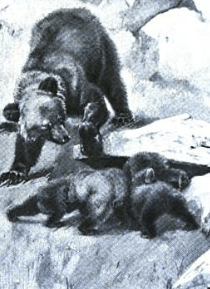
— The illustration is a detail from a drawing by Seton in the same source.
 “The story of bear 179, who has lived a long and productive life. As a yearling, she watched her mother tear into Joe Heimer and Sonja Crowley, who were hunting elk near Gardiner. I wrote about that attack in Mark of the Grizzly. But 179 never repeated that kind of behavior and raised 11 cubs to maturity.”
 so strictly enforced in the park that the bears often come to the kitchen door for pickings, and on getting something, they go quietly back to the woods. Doubtless Johnny and Grumpy would each have gotten their tart but that a new factor appeared in the case.
 M. Mark Miller, Author