Tag: Theodore Roosevelt

  • A Tale: “Near Roughing It” With TR — Corinne Roosevelt Robinson, 1890

    Corinne Roosevelt Robinson published a book in 1921 about her memories of her late brother, President Theodore Roosevelt. She described the summer of 1890 when TR acquiesced to requests that he take his family to Yellowstone Park, a place he visited often. Although she praised his geniality and good cheer, Corinne made it clear that TR didn’t like the comforts required by the ladies on the trip and would rather be “roughing it.”

    In her book, Corinne included a letter that she sent to her aunt about the trip. She said she decided not to “terrify” her aunt by reporting the seriousness of the injuries TR’s wife, Edith, suffered when she fell off a horse. Here’s an excerpt.

    ∞§∞

    — Theodore Roosevelt, C. 1895

    “We have had a most delightful two weeks’ camping and have enjoyed every moment. The weather has been cloudless, and though the nights were cold, we were only uncomfortable one night. We were all in the best of health and the best of spirits, and ate without a murmur the strange meals of ham, tomatoes, greasy cakes and coffee prepared by our irresistible Chinese cook. Breakfast and dinner were always the same, and lunch was generally bread and cheese carried in our pockets and eaten by the wayside. We have really had great comfort, however, and have enjoyed the pretense of roughing it and the delicious, free, open-air life hugely—and such scenery!

    Nothing in my estimation can equal in unique beauty the Yellowstone canyon, the wonderful shapes of the rocks, some like peaks and turrets, others broken in strange fantastic jags, and then the marvelous colors of them all. Pale greens and yellows, vivid reds and orange, salmon pinks and every shade of brown are strewn with a lavish hand over the whole Canyon—and the beautiful Falls are so foamy and white, and leap with such exultation from their rocky ledge 360 feet down.

    We had one really exciting ride. We had undertaken too long an expedition, namely, the ascent of Mt. Washburn, and then to Towers’ Falls in one day, during which, to add to the complications, Edith had been thrown and quite badly bruised. We found ourselves at Tower Falls at six o’clock in the evening instead of at lunchtime, and realized we were still sixteen miles from Camp, and a narrow trail only to lead us back, a trail of which our guide was not perfectly sure.

    We galloped as long as there was light, but the sun soon set over the wonderful mountains, and although there was a little crescent moon, still, it soon grew very dark and we had to keep close behind each other, single file, and go very carefully as the trail lay along the mountainside. Often we had to traverse dark woods and trust entirely to the horses, who behaved beautifully and stepped carefully over the fallen logs. Twice, Dodge, our guide, lost the trail, and it gave one a very eerie feeling, but he found it again and on we went.

    Once at about 11 p.m., Theodore suggested stopping and making a great fire, and waiting until daylight to go on, for he was afraid that we would be tired out, but we all preferred to continue, and about 11:30, to our great joy, we heard the roar of the Falls and suddenly came out on the deep Canyon, looking very wonderful and mysterious in the dim star-light. We reached our Camp after twelve o’clock, having been fifteen hours away from it, thirteen and a half of which we had been in the saddle. It was really an experience.”

    It was a hazardous ride and I did not terrify my aunt by some of the incidents such as the severe discomfort suffered by Mrs. Theodore Roosevelt when she was thrown and narrowly escaped a broken back, and when a few hours later my own horse sank in a quicksand and barely recovered himself in time to struggle to terra firma again, not to mention the dangers of the utter darkness when the small, dim crescent moon faded from the horizon.

    My brother was the real leader of the cavalcade, for the guide, Ira Dodge, proved singularly incompetent. Theodore kept up our flagging spirits, exhausted as we were by the long rough day in the saddle, and although furious with Dodge because of his ignorance of the trail through which he was supposed to guide us, he still gave us the sense of confidence, which is one’s only hope on such an adventure. Looking back over that camping trip in the Yellowstone, the prominent figure of the whole holiday was, of course, my brother. He was a boy in his tricks and teasing, crawling under the tent flaps at night, pretending to be the unexpected bear, which we always dreaded. He was a real inspiration in his knowledge of the fauna and birds of the vicinity and his willingness to give us the benefit of that knowledge.

    ∞§∞

    —Corinne Roosevelt Robinson, “The Elkhorn Ranch and Near-Roughing it in Yellowstone Park,” Pages 135-155 in My Brother Theodore Roosevelt, Charles Scribner’s Sons, 1921.

    — Photo, Wikipedia Commons.

  • A Tale: TR Seeks the Thrill of Killing Endangered Bison — 1889

    American bison once numbered 30 million or more, but by the middle of the 1880’s commercial hunters had decimated the herds that once darkened the prairies. But the fact that bison were nearing extinction didn’t deter sportsmen from pursuing the thrill of killing one of the magnificent animals.

    Even Theodore Roosevelt, who is renowned for his role in the American conservation movement and environment preservation, could not resist the temptation of bison hunting. Here’s how he described the experience.

    ∞§∞

    In the fall of 1889 I heard that a very few bison were still left around the head of Wisdom River. Thither I went and hunted faithfully; there was plenty of game of other kind, but of bison not a trace did we see. Nevertheless a few days later that same year I came across these great wild cattle at a time when I had no idea of seeing them.

    We had gone out to find moose, but had seen no sign of them, and had then begun to climb over the higher peaks with an idea of getting sheep. The old hunter who was with me was, very fortunately, suffering from rheumatism, and he therefore carried a long staff instead of his rifle; I say fortunately, for if he had carried his rifle it would have been impossible to stop his firing at such game as bison, nor would he have spared the cows and calves.

    About the middle of the afternoon we crossed a low, rocky ridge, above timber line, and saw at our feet a basin or round valley of singular beauty. The ground rose in a pass evidently much frequented by game in bygone days, their trails lying along it in thick zigzags, each gradually fading out after a few hundred yards, and then starting again in a little different place, as game trails so often seem to do.

    We bent our steps toward these trails, and no sooner had we reached the first than the old hunter bent over it with a sharp exclamation of wonder. There in the dust were the unmistakable hoof-marks of a small band of bison, apparently but a few hours old. There had been half a dozen animals in the party; one a big bull, and two calves.

    We immediately turned and followed the trail. It led down to the little lake, where the beasts had spread and grazed on the tender, green blades, and had drunk their fill. The footprints then came together again, showing where the animals had gathered and walked off in single file to the forest

    It was a very still day, and there were nearly three hours of daylight left. Without a word my silent companion, who had been scanning the whole country with hawk-eyed eagerness, besides scrutinizing the sign on his hands and knees, took the trail, motioning me to follow. In a moment we entered the woods, breathing a sigh of relief as we did so; for while in the meadow we could never tell that the buffalo might not see us, if they happened to be lying in some place with a commanding lookout.

    The old hunter was thoroughly roused, and he showed himself a very skilful tracker. We were much favored by the character of the forest, which was rather open, and in most places free from undergrowth and down timber. The ground was covered with pine needles and soft moss, so that it was not difficult to walk noiselessly. Once or twice when I trod on a small dry twig, or let the nails in my shoes clink slightly against a stone, the hunter turned to me with a frown of angry impatience; but as he walked slowly, continually halting to look ahead, as well as stooping over to examine the trail, I did not find it very difficult to move silently.

    At last,  we saw a movement among the young trees not fifty yards away. Peering through the safe shelter yielded by some thick evergreen bushes, we speedily made out three bison, a cow, a calf, and a yearling. Soon another cow and calf stepped out after them. I did not wish to shoot, waiting for the appearance of the big bull which I knew was accompanying them.

    So for several minutes I watched the great, clumsy, shaggy beasts, as all unconscious they grazed in the open glade. Mixed with the eager excitement of the hunter was a certain half melancholy feeling as I gazed on these bison, themselves part of the last remnant of a doomed and nearly vanished race. Few, indeed, are the men who now have, or ever more shall have, the chance of seeing the mightiest of American beasts, in all his wild vigor, surrounded by the tremendous desolation of his far-off mountain home.

    At last, when I had begun to grow very anxious lest the others should take alarm, the bull likewise appeared on the edge of the glade, and stood with outstretched head, scratching his throat against a young tree, which shook violently. I aimed low, behind his shoulder, and pulled trigger. At the crack of the rifle all the bison, without the momentary halt of terror-struck surprise so common among game, turned and raced off at headlong speed.

    The fringe of young pines beyond and below the glade cracked and swayed as if a whirlwind were passing, and in another moment they reached the top of a very steep incline, thickly strewn with boulders and dead timber. Down this they plunged with reckless speed; their surefootedness was a marvel in such seemingly unwieldy beasts. A column of dust obscured their passage, and under its cover they disappeared in the forest; but the trail of the bull was marked by splashes of frothy blood, and we followed it at a trot.

    Fifty yards beyond the border of the forest we found the stark black body stretched motionless. He was a splendid old bull, still in his full vigor, with large, sharp horns, and heavy mane and glossy coat; and I felt the most exulting pride as I handled and examined him; for I had procured a trophy such as can fall henceforth to few hunters indeed.

    ∞§∞

    — Abridged from Theodore Roosevelt. “The Bison or American Buffalo,” pages 3-36 in Hunting the Grisly and Other Sketchs. New York: The Review of Reviews Company, 1915.

    — Photo from Wikipedia Commons.

    — For more stories about hunting in or near Yellowstone Park, click on “hunting” under “Categories” to the left.

  • A Tale: Teddy Roosevelt Bags an Elk on Two Ocean Pass — 1891

    There was no greater supporter of Yellowstone National Park than Theodore Roosevelt. TR was an avid hunter, but he favored prohibition of hunting inside Yellowstone National Park. The idea was that keeping hunters out would make the Park an endless well of trophy animals that could be hunted when they strayed outside its boundaries.
    And Roosevelt knew that areas near the park provided marvelous hunting. Here’s his description of one of his kills while on a hunting expedition in 1891 to the Two Ocean Pass, an area just outside Yellowstone’s southern border.

    ∞§∞

    The weather became clear and very cold, so that the snow made the frosty mountains gleam like silver. The moon was full, and in the flood of light the wild scenery round our camp was very beautiful. As always where we camped for several days, we had fixed long tables and settles, and were most comfortable; and when we came in at nightfall, or sometimes long afterward, cold, tired, and hungry, it was sheer physical delight to get warm before the roaring fire of pitchy stumps, and then to feast ravenously on bread and beans, on stewed or roasted elk venison, on grouse and sometimes trout, and flapjacks with maple syrup.

    Next morning dawned clear and cold, the sky a glorious blue. Woody and I started to hunt over the great tableland, and led our stout horses up the mountainside, by elk trails so bad that they had to climb like goats. All these elk-trails have one striking peculiarity. They lead through thick timber, but every now and then send off short, well-worn branches to some cliff-edge or jutting crag, commanding a view far and wide over the country beneath. Elk love to stand on these lookout points, and scan the valleys and mountains round about.

    Blue grouse rose from beside our path; Clarke’s crows flew past us, with a hollow, flapping sound, or lit in the pine-tops, calling and flirting their tails; the gray-clad whiskyjacks, with multitudinous cries, hopped and fluttered near us. Snow-shoe rabbits scuttled away, the big furry feet which give them their name already turning white. At last we came out on the great plateau, seamed with deep, narrow ravines. Reaches of pasture alternated with groves and open forests of varying size.

    Almost immediately we heard the bugle of a bull elk, and saw a big band of cows and calves on the other side of a valley. There were three bulls with them, one very large, and we tried to creep up on them; but the wind was baffling and spoiled our stalk. So we returned to our horses, mounted them, and rode a mile farther, toward a large open wood on a hill-side. When within two hundred yards we heard directly ahead the bugle of a bull, and pulled up short.

    In a moment I saw him walking through an open glade; he had not seen us. The slight breeze brought us down his scent. Elk have a strong characteristic smell; it is usually sweet, like that of a herd of Alderney cows; but in old bulls, while rutting, it is rank, pungent, and lasting. We stood motionless till the bull was out of sight, then stole to the wood, tied our horses, and trotted after him. He was travelling fast, occasionally calling; whereupon others in the neighborhood would answer. Evidently he had been driven out of some herd by the master bull.

    He went faster than we did, and while we were vainly trying to overtake him we heard another very loud and sonorous challenge to our left. It came from a ridge-crest at the edge of the woods, among some scattered clumps of the northern nut-pine or pinyon—a queer conifer, growing very high on the mountains, its multi-forked trunk and wide-spreading branches giving it the rounded top, and, at a distance, the general look of an oak rather than a pine.

    We at once walked toward the ridge, up-wind. In a minute or two, to our chagrin, we stumbled on an outlying spike bull, evidently kept on the outskirts of the herd by the master bull. I thought he would alarm all the rest; but, as we stood motionless, he could not see clearly what we were. He stood, ran, stood again, gazed at us, and trotted slowly off.

    We hurried forward as fast as we dared, and with too little care; for we suddenly came in view of two cows. As they raised their heads to look, Woody squatted down where he was, to keep their attention fixed, while I cautiously tried to slip off to one side unobserved. Favored by the neutral tint of my buckskin hunting-shirt, with which my shoes, leggins, and soft hat matched, I succeeded. As soon as I was out of sight I ran hard and came up to a hillock crested with pinyons, behind which I judged I should find the herd.

    As I approached the crest, their strong, sweet smell smote my nostrils. In another moment I saw the tips of a pair of mighty antlers, and I peered over the crest with my rifle at the ready. Thirty yards off, behind a clump of pinyons, stood a huge bull, his head thrown back as he rubbed his shoulders with his horns. There were several cows around him, and one saw me immediately, and took alarm. I fired into the bull’s shoulder, inflicting a mortal wound; but he went off, and I raced after him at top speed, firing twice into his flank; then he stopped, very sick, and I broke his neck with a fourth bullet.

    The elk I thus slew was a giant. His body was the size of a steer’s, and his antlers, though not unusually long, were very massive and heavy. He lay in a glade, on the edge of a great cliff. Standing on its brink we overlooked a most beautiful country, the home of all homes for the elk: a wilderness of mountains, the immense evergreen forest broken by park and glade, by meadow and pasture, by bare hill-side and barren tableland.

    ∞§∞

    — Excerpt from Theodore Roosevelt “An Elk Hunt at Two Ocean Pass.”  Pages  177-202 in The Wilderness Hunter: An Account of Big Game in the United States.  Putnam’s Sons: New York, 1902.

    — Photo from The Wilderness Hunter.

    — For other stories about tracking game, click on “Hunting” under the Categories button to the left.

  • A Tale: The Army Protects Theodore Roosevelt From Snooping Reporter — 1903

    Guard Mount at Fort Yellowstone

    When the U.S. congress established Yellowstone National Park in 1872, they put a civilian staff  in charge, but failed to appropriate enough money for the job of protecting it. Poachers decimated wildlife; collectors vandalized natural features and monopolists gouged travelers. Things became so bad by 1886 that the U.S. Army was asked to step in. It ran the park until 1918 when the National Park Service took over.

    By all accounts, the Army was diligent and left its mark in ways ranging from the shape of rangers’ hats to Grand Loop pattern of roadways. Here’s a story that describes how effective they were when they were asked to protect President Theodore Roosevelt when he visited Yellowstone in 1903.

    ∞§∞

    An incident that occurred during President Roosevelt’s recent visit proves the exceedingly careful manner in which the Park is guarded. When Mr. Roosevelt made it known that his object in entering the Yellowstone Park was to secure several days of complete privacy, and that he did not want any one aside from Major Pitcher and the picked escort to accompany him, a certain correspondent representing a New York daily, who had been ordered to be on hand in case of any accident to the President or other emergency of National importance, resolved to ignore the President’s request and to follow him at all hazards.

    With this object in view, he attempted to bribe some of the native population, but without success. Not disheartened by his failure to secure a friendly companion and guide, the correspondent hired a horse and persuaded a stray dog to accompany him. This was on the afternoon of the President’s arrival at Fort Yellowstone. The Fort is ten miles from Gardiner, where the rest of the correspondents and the President’s party had stopped.

    The recreant correspondent set forth in high glee at the possibility of working a “beat” on his fellow-craftsmen. As he rode along through the leafy lanes and past the towering cliffs, which in part line the road to the Springs, he felt very well satisfied with himself, and chuckled at the ease with which he had evaded the guards stationed near Gardiner. Suddenly, as he was entering a particularly dark part of a forest, he heard a voice from the brush on the right.

    “Theodore Jones,” it said slowly and in unmistakable authoritative tones. “Theodore Jones!”

    The correspondent reined up his horse in amazement. Who was it calling his name? Had he been followed from Gardiner? If so, why did the voice come from the bushes and evidently some distance from the road?

    “Hello !” he shouted, in reply.

    There was no answer. He called again and again, but without result. Then he put spurs to his horse and rode on. Half a mile further down the road, just as he was passing through another bit of woodland, a deep voice called out seemingly at his very elbow:

    “Theodore Jones ! Theodore Jones-s-s ! Better go back.”

    For one moment, the newspaperman hesitated, then he rode resolutely forward. He felt that he was being tricked, but he intended to see the game out. He was a bit nervous because he realized that his course of action was not entirely honorable, and it was with something very like relief that he espied at a turn in the road a United States trooper sitting with horse blocking the path and a rifle slung carelessly across the pommel of his saddle.

    “Haiti” called out the soldier. “Mr. Jones, you are wanted at Headquarters.”

    “How do you know my name is Jones?” demanded the correspondent.

    The trooper smiled as if the question was a joke. Placing one hand upon the correspondent’s bridle, he led him without further words to Fort Yellowstone. A technical charge of unlawfully bringing a dog into the reservation was entered against Mr. Jones, but he was released on his promise not to enter the Park again until the President’s return. The incident had its value in showing the extreme care taken by the Park’s guardians in keeping out unwelcome visitors. The correspondent’s errand was known at Headquarters before he had crossed the line.

    ∞§∞

    — From Henry Harrison Lewis, “Managing a National Park.” The Outlook 74(18)1036-40. (Aug. 29, 1903).

    — You also might enjoy

    — Detail from Coppermine Gallery Photo.

  • A Tale: Skiing with Theodore Roosevelt in Yellowstone Park — 1903

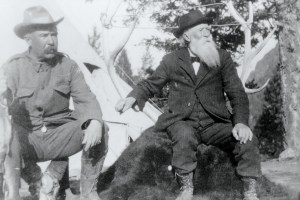
    In 1903 President Theodore Roosevelt invited John Burroughs to join him on a two-week trip to Yellowstone National Park. At the time, Burroughs was a very popular writer whose nature essays were compared to those of Henry David Thoreau.

    Theodore Roosevelt and John Burroughs

    Roosevelt and Burroughs had built a long-term friendship on their mutual respect and love of the nature. They corresponded regularly, mostly about natural history. For some reason the president called Burroughs “Oom John.”

    The pair crossed the country in Roosevelt’s private Pullman car stopping at cities and towns where the president met local dignitaries and gave speeches. Between cities the president reminisced about his life as a rancher and sportsman.

    When they reached the entrance of the park at Gardiner, the Roosevelt left reporters and his secret service guards behind and went through the park accompanied only by Burroughs, Park Superintendent John Pitcher and a small entourage. 

    The 65-year-old Burroughs was afraid he wouldn’t be able the keep up with the 44-year-old president who had a larger-than-life reputation for physical stamina. Here’s Burroughs’ description of what happened when the pair went skiing.

    ∞§∞

    At the Canyon Hotel the snow was very deep, and had become so soft from the warmth of the earth beneath, as well as from the sun above, that we could only reach the brink of the Canyon on skis. The President and Major Pitcher had used skis before, but I had not, and, starting out without the customary pole, I soon came to grief. The snow gave way beneath me, and I was soon in an awkward predicament. The more I struggled, the lower my head and shoulders went, till only my heels, strapped to those long timbers, protruded above the snow. To reverse my position was impossible till some one came, and reached me the end of a pole, and pulled me upright. But I very soon got the hang of the things, and the President and I quickly left the superintendent behind. I think I could have passed the President, but my manners forbade. He was heavier than I was, and broke in more. When one of his feet would go down half a yard or more, I noted with admiration the skilled diplomacy he displayed in extricating it. The tendency of my skis was all the time to diverge, and each to go off at an acute angle to my main course, and I had constantly to be on the alert to check this tendency.

    Paths had been shoveled for us along the brink of the Canyon, so that we got the usual views from the different points. The Canyon was nearly free from snow, and was a grand spectacle, by far the grandest to be seen in the Park. The President told us that once, when pressed for meat, while returning through here from one of his hunting trips, he had made his way down to the river that we saw rushing along beneath us, and had caught some trout for dinner. Necessity alone could induce him to fish.

    Across the head of the Falls there was a bridge of snow and ice, upon which we were told that the coyotes passed. As the season progressed, there would come a day when the bridge would not be safe. It would be interesting to know if the coyotes knew when this time arrived.

    The only live thing we saw in the Canyon was an osprey perched upon a rock opposite us.

    Near the falls of the Yellowstone, as at other places we had visited, a squad of soldiers had their winter quarters. The President always called on them, looked over the books they had to read, examined their housekeeping arrangements, and conversed freely with them.

    In front of the hotel were some low hills separated by gentle valleys. At the President’s suggestion, he and I raced on our skis down those inclines. We had only to stand up straight, and let gravity do the rest. As we were going swiftly down the side of one of the hills, I saw out of the corner of my eye the President taking a header into the snow. The snow had given way beneath him, and nothing could save him from taking the plunge. I don’t know whether I called out, or only thought, something about the downfall of the administration. At any rate, the administration was down, and pretty well buried, but it was quickly on its feet again, shaking off the snow with a boy’s laughter. I kept straight on, and very soon the laugh was on me, for the treacherous snow sank beneath me, and I took a header, too.

    “Who is laughing now, Oom John?” called out the President.

    The spirit of the boy was in the air that day about the Canyon of the Yellowstone, and the biggest boy of us all was President Roosevelt.

    ∞§∞

    — You also might enjoy “The Army Protects Theodore Roosevelt from Snooping Reporter in Yellowstone Park.”

    — Excerpt from “Camping with the President” by John Burroughs,” Saturday Evening Post, May, 1906.

    — Yellowstone Digital Slide File Photo.

  • News and Views: Three Recent Books Describe Early Yellowstone Travel

    I was delighted this morning to find a brand new, autographed copy of Paul Schullery’s book, Old Yellowstone Days, on my breakfast table. Now I can retire the 1977 edition that I refer to often. It’s falling apart.

    The re-issue of Paul’s book means that three collections of first-person accounts of early travel to Yellowstone National Park have been published in the last two years. Old Yellowstone Days joins Ho! For Wonderland: Travelers Accounts of Yellowstone, 1872-1914 by Lee H. Whittlesey and Elizabeth A. Watry and my book, Adventures In Yellowstone: Early Travelers Tell Their Tales.

    At a superficial level, a single blurb could describe all three books: “A collection of interesting stories about nineteenth century travel to the world’s first national park by the people who lived the adventures.” But, the books really are quite different. In fact, only two of the forty stories contained in the three books appear more than once.

    Schullery focuses on celebrities. His book includes Rudyard Kipling’s description of Yellowstone as “a howling wilderness . . . full of the freaks of nature,” and his condescending description of a Fourth of July Celebration as “wild advertisement, gas, bunkum, blow, anything you please beyond the bounds of common sense,” and Theodore Roosevelt’s lament that hunters were wiping out all of America’s big game—bison, elk and moose, as well as Frederick Remington’s description of his adventures helping soldiers capture poachers.

    Whittlesey and Watry provide a wide sample of “ordinary” Yellowstone experiences. They begin with Montana Pioneer Granville Stuart’s detailed descriptions of everything he saw when the park was just a year old in 1873. They end with Elbert and Alice Hubbard’s precious accounts of what they saw in 1914. Whittlesey and Watry approach their task in a scholarly manner liberally sprinkling their book with footnotes to explain unclear references.

    I take the opposite approach focusing on extraordinary tales filled with adventure, like Emma Cowan’s story of watching Indians shoot her husband in the head, or with humor, like the Earl of Dunraven’s hilarious explanation of how to pack a mule. I don’t use a single footnote and edit extensively for easy reading by today’s readers.

    The books are testament to the enormous diversity of the Yellowstone experience. Fans of Yellowstone Park would enjoy all of them. So would fans of history. And fans of well told stories.

    ∞§∞