Tag: Yellowstone Park

  • A Tale: Jim Bridger’s Descriptions of Yellowstone Wonders — Gunnison, 1852

    Conventional wisdom is that people just didn’t believe trappers’ tales of fountains of boiling water, mountains of glass and the other wonders of the upper Yellowstone. But that’s not entirely true, at least in the case of the famous Mountain Man, Jim Bridger. The U.S. Army apparently found Bridger reliable; they frequently hired him as a scout, included his descriptions in their reports and called him “Major.”

    Jim Bridger

    One of the officers who believed Bridger was John W. Gunnison, a lieutenant in the Army Corps of Topographers. When a severe winter kept Gunnison from doing surveys of the Great Salt Lake Valley in 1849-50, he used the time to do research on the people who lived there. He published a book in 1852 that included this description of Bridger.

    ∞§∞

    The builder of Fort Bridger is one of-the hardy race of mountain trappers who are now disappearing from the continent, being enclosed in the wave of civilisation. These trappers have made a thousand fortunes for eastern men, and by their improvidence have nothing for themselves.

    Major Bridger, or “old Jim,” has been more wise of late, and laid aside a competence; but the mountain tastes fostered by twenty-eight years of exciting scenes, will probably keep him there for life. He has been very active, and traversed the region from the head-waters of the Missouri to the Del Norte—and along the Gila to the Gulf, and thence throughout Oregon and the interior of California.

    His graphic sketches are delightful romances. With a buffalo skin and piece of charcoal, he will map out any portion of this immense region, and delineate mountains, streams, and-the circular valleys called “holes,” with wonderful accuracy; at least we may so speak of that portion we traversed after his descriptions were given.

    He gives a picture, most romantic and enticing, of the head-waters of the Yellowstone. A lake sixty miles long, cold and pellucid, lies embosomed amid high precipitous mountains. On the west side is a sloping plain several miles wide, with clumps of trees and groves of pine.

    The ground resounds to the tread of horses. Geysers spout up seventy feet high, with a terrific hissing noise, at regular intervals. Waterfalls are sparkling, leaping, and thundering down the precipices, and collect in the pool below. The river issues from this lake, and for fifteen miles roars through the perpendicular canyon at the outlet. In this section are the Great-Springs, so hot that meat is readily cooked in them, and as they descend on the successive terraces, afford at length delightful baths. On the other side is an acid spring, which gushes out in a river torrent; and below is a cave which supplies “vermilion” for the savages in abundance.

    Bear, elk, deer, wolf, and fox, are among the sporting game, and the feathered tribe yields its share for variety, on the sportsman’s table of rock or turf.

    ∞§∞

    — From Gunnison, J.W.,  A History of the Mormons. Philadelphia: Lippincott, Grambo  & Co., 1852.   p. 151

    — Photo, Wikipedia Commons.

    — You might also enjoy:

  • A Tale: Watching a Giant Grizzly — Grace Gallatin Seton, 1896

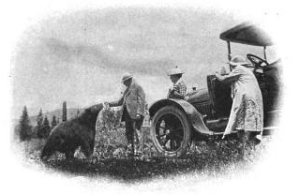
    In 1915 a giant grizzly that roamed between the Meeteesee region of Wyoming and Yellowstone Park was so well known that The New York Times published the news that he had been shot to death. He was Wahb, a bear made famous by the naturalist and writer Ernest Thompson Seton. Seton, who was instrumental in founding the Boy Scouts of America, described Wahb in his popular book, Biography of a Grizzly, and in his story “Johnny Bear.”

    Seton’s wife, Grace Gallatin Seton, also wrote about Wahb. In her version, Grace called her husband “Nimrod,” after the mighty hunter of the Bible. She called A. A. Anderson, the owner of the ranch where she first saw Wahb’s tracks, “The Host.” Here’s Grace’s story.

    ∞§∞

    A fourteen-inch track is big, even for a grizzly. That was the size of Wahb’s. The first time I saw it, the hole looked big enough for a baby’s bathtub. The Host said there was only one bear in that region that could make a track like that; in spite of the fact that this was beyond his range, it must be Meeteetsee Wahb. He got off his horse and measured the track Yes, the hind foot tracked fourteen inches. What a hole in the ground it looked!

    The Host said the maker of it was probably far away, as he judged the track to be several weeks old. I had heard so many tales of this monster that when I gazed upon his track I felt as though I were looking at the autograph of a hero.

    It was not till the next year that I really saw Wahb. It was at his summer haunt, the Fountain Hotel in the Yellowstone National Park. If you were to ask Nimrod to describe the Fountain Geyser or Hell Hole, or any of the other tourist sights thereabouts, I am sure he would shake his head and tell you there was nothing but bears around the hotel. For this was the occasion when Nimrod spent the entire day in the garbage heap watching the bears, while I did the conventional thing and saw the sights.

    About sunset, I got back to the hotel. Much to my surprise, I could not find Nimrod; and neither had he been seen since morning, when he had started in the direction of the garbage heap in the woods some quarter of a mile back from the hotel. Anxiously I hurried there, but could see no Nimrod. Instead, I saw the outline of a Grizzly feeding quietly on the hillside. It was very lonely and gruesome.

    Under other circumstances, I certainly would have departed quickly the way I came, but now I must find Nimrod. It was growing dark, and the bear looked a shocking size, as big as a whale. Dear me, perhaps Nimrod was inside—Jonah style. Just then, I heard a sepulchral whisper from the earth.

    “Keep quiet, don’t move, it’s the Big Grizzly.”

    I looked about for the owner of the whisper and discovered Nimrod not far away in a nest he had made for himself in a pile of rubbish. I edged nearer.

    “See, over there in the woods are two black bears. You scared them away. Isn’t he a monster?indicating Wahb.

    I responded with appropriate enthusiasm. Then after a respectful silence, I ventured to say:

    “How long have you been here?”

    “All day—and such a day—thirteen bears at one time. It is worth all your geysers rolled into one.

    “H’m—Have you had anything to eat?”

    “No.” Another silence, then I began again.

    “Aren’t you hungry? Don’t you want to come to dinner?”

    He nodded yes. Then I sneaked away and came back as soon as possible with a change of clothes. The scene was as I had left it, but duskier. I stood waiting for the next move. The Grizzly made it. He evidently had finished his meal for the night, and now moved majestically off up the hill towards the pine woods. At the edge of these he stood for a moment, Wahb’s last appearance, so far as I am concerned, for, as he posed, the fading light dropped its curtain of darkness between us, and I was able to get Nimrod away.

    ∞§∞

    — Condensed from Grace Gallatin Seton, “What I Know About Wahb of the Big Horn Basin,” A Woman Tenderfoot. Doubleday, Page and Co.: New York, 1900.

    — Illustration from Grace Gallatin Seton, “A Woman Tenderfoot and a Grizzly.” The Puritan: A Journal for Gentlewomen. October 1900. Pp. 109-117.

    You also might enjoy:

  • A Tale: The Last Outpost of Civilization — 1874

    Late in the summer of 1870, men rushed into the area that was to become Yellowstone Park looking to find Truman Everts and claim the reward that was offered for his rescue.

    McCartney's "Hotel"

    Everts, who had become separated from the famous Washburn Expedition, had been alone in the wilderness for thirty-seven days when Jack Baronett found him. Everts refused to pay the reward on the grounds that he would have made it to safety on his own. Baronett said  he found Everts nearly starved to death and raving mad.

    The searchers also discovered Mammoth Hot Springs and immediately saw an opportunity to convert the area into a bath resort. The next summer, two entrepreneurs named James McCarntey and Harry Horr took out homestead claims near the springs and build the first hotel in Yellowstone Park—a 25-by 35-foot log cabin with a sod-covered slab roof. “Guests” at the cabin had to provide their own blankets and sleep on the floor.

    Although the hotel had hot and cold running water (a 40-degree stream on one side and a 150-degree stream on the other), the Earl of Dunraven  wasn’t impressed with the accommodations when he visited in 1874. Here’s his description.

    ∞§∞

    The accommodation at the Mammoth Hot Springs Hotel was in an inverse ratio to the gorgeous description contained in the advertisements of the Helena and Virginia newspapers. No doubt the neighborhood of these springs will some day become a fashionable place. At present, being the last outpost of civilization—that is, the last place where whisky is sold—it is merely resorted to by a few invalids from Helena and Virginia City, and is principally known to fame as a rendezvous of hunters, trappers, and idlers, who take the opportunity to loiter about on the chance of getting a party to conduct to the geysers, hunting a little, and selling meat to a few visitors who frequent the place in summer; sending the good specimens of heads and skeletons of rare beasts to the natural history men in New York and the East; and occupying their spare time by making little basket-work ornaments and nicknacks, which, after placing them for some days in the water so that they become coated with white silicates, they sell to the travelers and invalids as memorials of their trip. They are a curious race, these mountain men, hunters, trappers, and guides—very good fellows as a rule, honest and open-handed, obliging and civil to strangers if treated with civility by them. They make what I should think must be rather a poor living out of travelers and pleasure parties, doing a little hunting, a little mining, and more prospecting during the summer. In the winter they hibernate like bears, for there is absolutely nothing for them to do. They seek out a sheltered canyon or warm valley with a southern aspect, and, building a little shanty, purchase some pork and flour, and lay up till spring opens the rivers and allows of gulch mining operations being recommenced. If you ask a man in the autumn where he is going and what he is going to do, ten to one he will tell you that it is getting pretty late in the season now, and that it won’t be long before we have some heavy snow, and he is going “down the river or up the canyon.”

    ∞§∞

    — The Earl of Dunraven, Hunting in the Yellowstone, Outing Publishing Company, New York, 1917.

    — Photo detail from the Yellowstone Digital Slide File.

    — To see more stories by this author, click on “Dunraven” under the “Categories” button to the left.

    — You might also enjoy Truman Everts’ chilling tale of being “Treed by a Lion.”

  • On Writing: Narrative History Requires More Than Getting the Facts Right

    I just finished an article for The Pioneer Museum Quarterly on Fred Bottler, a pioneer rancher in the Yellowstone River’s Paradise Valley north of Yellowstone National Park. Bottler built the first ranch in the valley halfway between Bozeman and Mammoth Hot Springs. That made it an ideal stopping point for early expeditions exploring the park so dozens of park journals and reminiscences mention Bottler’s ranch.

    Gustavus Doane

    Bottler knew the Yellowstone Park area well because he had prospected for gold in there 1860s. That made him an ideal guide, and he accompanied several people who visited the upper Yellowstone in the 1870s.

    My article provides Bottler’s biographical information and recounts stories about him. One of those stories, told by Bottler’s son, Floyd, concerns a pair of needle guns, which were an early type of repeating rifle.

    Floyd said his father won the guns in a card game with soldiers at Fort Ellis, an army post near Bozeman. Although Bottler knew the guns technically were government property, he thought they would be handy if Indians attacked his isolated ranch. He decided to keep them.

    An officer at Fort Ellis, Lieutenant Gustavus Doane (who had a remarkable moustache), heard that Bottler had the guns and decided to retrieve them. Floyd said that when Doane arrived at Bottler’s house, the rancher invited him in and seated him where he could see the guns hanging on a wall.

    Floyd said Doane would look at the guns, then look at Fred, and then back at the guns. Finally, Doane told Bottler that a man living on the edge of Indian country needed such guns and he could keep them—but only if he kept them out of sight when he visited the fort.

    Then, Floyd said, “Their eyes met again and held for a long moment. Then both men rose and the hands met in a strong clasp”

    I couldn’t resist quoting that directly in my article. But when I asked Ann Butterfield, the Pioneer Museum Associate Director, to read a draft of my article, she objected.  She said she liked what I had written, except for that “gazed into each other’s eyes” stuff. “Men just don’t act that way,” she added with a scoff.

    I immediately checked my source and confirmed that I had quoted Floyd accurately. I assured Ann of that, but she was’t really  mollified. That made me think.

    It’s my job to present old stories for today’s readers. I want people to read straight through my stuff and say: “That’s interesting.” I don’t want them stop and say: “This just doesn’t sound right”—even if it is right.

    I also like to quote exactly what people wrote because their word choices make personalities and emotions shine through. It’s always a balancing act to decide when modern sensibilities might collide with old fashioned ways of saying things.

    When I turned in final draft of my article, it didn’t contain the “gazed into each others eyes” quote. Writing narrative history is not just about getting the facts right; it’s also about getting the reader’s experience right. If it distracts, it’s got to go.

    The Pioneer Museum Quarterly will publish my article on Fred Bottler in a few weeks.  I’ll let you know when it’s available.  Then you can decide if I made the right choice.

    ∞§∞

    — Photo detail from the Yellowstone Digital Slide File.

    — You can read an excerpt from my article on Fred Bottler here.

    — To see related posts, click on “Narrative History” under the Categories Button on the right side of this page.

  • On Writing: Cubism, Narrative History and the Nez Perce

    While organizing research notes for my next book, Encounters in Yellowstone 1877, it occurred to me that my task is akin that of the Cubist painters.  A hundred years ago artists including Pablo Picasso, George Braque and Juan Gris invented Cubism. They looked at objects from multiple viewpoints, analyzed each viewpoint, and then reassembled them into a single composition. That’s like what I’m doing.

    "Three Musicians," Pablo Picasso

    I’ve collected numerous pieces about the events of the summer of 1877 when the Nez Perce Indians encountered several groups of tourists while fleeing from the Army through Yellowstone Park.  Those pieces contain distinct—even disparate—viewpoints. Here are some of them:

    • Yellow Wolf, a young Nez Perce brave who felt justified in seeking revenge on all whites following the Army’s pre-dawn attack on the sleeping Indian camp that left dozens of women and children dead.
    • Emma Cowan, a young wife fulfilling her dream of visiting “geyserland” who spoke sympathetically of the plight of the Nez Perce in her reminiscence even after Indians left her husband for dead after shooting him in the head and then took her captive.
    • Jack Bean, an old Indian fighter who had been with the troops that buried the mutilated bodies of Custer and his men after the Battle of the Little Big Horn and had no qualms about scalping Indians.
    • General Oliver Otis Howard, an evangelical Christian and Civil War hero, who led his exhausted troops across Yellowstone Park after several humiliating skirmishes with the Nez Perce.

    My job is to analyze the accounts of these people—and of dozens of others—and sift out the truth. Then I’ll try to put the whole thing together in a coherent whole. To do that, I’ll need to look for places where the various viewpoints converge and diverge, overlap and separate, compliment and contradict.

    Like a Cubist painting, the final narrative won’t always arrange things in the way that people are used to seeing them, but I hope it will be compelling and enlightening.  I’m enjoying the challenge.

    ∞§∞

     — Image, Metropolitan Museum of Modern Art.

    — To see related posts, click on “Narrative History” under the Categories Button on  this page.

  • Narrative History or Historical Fiction 3: A Moonlit Night In Yellowstone Park, August 23, 1877.

    “Should I approach it as narrative history or as historical fiction?” That question haunted me this week as I continued research for my next book, Encounters in Yellowstone 1877. I’ve written about it before, here and here.

    Great Fountain Geyser

    To write the kind of story readers want, I need to include details that bring the story to life and give it credibility. That’s true no matter how I approach the book, but there’s more flexibility in fiction.

    A crucial scene in the book occurs on August 23, 1877, the night before Nez Perce Indians take Mrs. Emma Cowan captive along with her brother, Frank, and their 13-year-old sister, Ida. Earlier that afternoon, the tourists learned that the Nez Perce had fought a bloody battle with the Army two weeks before and were headed toward the park. In her reminiscence about the trip, Emma admited the news worried her.

    In his book about the trip, Frank said, “Mrs. Cowan was uneasy, and upon being asked what was wrong, replied ‘nothing.’” Frank said that later he saw Emma come to the door of the tent she shared with her husband and Ida and look out several times. Emma’s repeatedly peering out of the tent is a good example of the adage, “actions speak louder than words.”

    I was reminded of Jerrie Hurd’s admonition to write slow scenes fast and fast scenes slow. Jerrie says “when you get to the action, slow down, take your time, fill-in as much detail as possible allowing the reader to savor every moment of what’s happening.”

    There’s no doubt that Emma was worried, but what did she see? If I knew that, I could heighten the drama, but neither Emma nor Frank described the scene and there are no other accounts by members of their party.

    What to do? I saw three options: (1) write historical fiction and invent a plausible scene, (2) write up what I already knew as narrative history and hope that my readers will forgive the lack of detail, or (3) do more research to flesh things out. I chose option 3.

    I knew that the tourists were camped in the trees near the Fountain Geyser, which is at the edge of the Lower Geyser Basin in Yellowstone Park, so the first thing I did was a web search for images of the area. I found several photos like the one above that show several geysers spewing columns of water and steam in the middle of a chalky plain surrounded by pine forest. (I plan to visit the site this summer to get more detail.)

    Then I reviewed Emma and Frank’s accounts of the evening. After deciding to head home the next day, the group put on a sort of minstrel show to celebrate. They built a bonfire and spent the evening singing and dancing. Then the bachelors in the group curled up in their blankets under the trees while Emma, her husband and Ida retired to their tent.

    Next, I looked for journals of travelers who were nearby that night. One of them was Jack Bean of Bozeman, a scout the Army hired to find the Nez Perce. Bean was on a hillside about 30 miles from Emma’s camp watching the Nez Perce arrive at Henry’s Lake. Bean didn’t comment on the weather, but apparently had no difficulty seeing the Indians’ campfires four miles away across the lake.

    Another Scout, S.G. Fisher, who had been hired in Idaho, was 10 miles closer than Bean in Targhee Pass. Fisher had heard about a Nez Perce camp ahead of him and was planning to attack it with his force of 80 Bannack Indians. Fisher said he approached the camp cautiously because “the moon was shining brightly.” Fisher found the Nez Perce had moved on—and I found an important snippet of information—it was a moonlit night.

    With the new information from my research, I feel confident that I can write compelling description of Emma’s behavior—one that sticks close enough to the facts to qualify as narrative history. It probably will go something like this:

    Emma didn’t fall asleep quickly that night. Instead, she repeatedly came to the door of the tent she shared with her husband and sister and peered out. Perhaps she was just checking to make sure the bonfire her friends had built to celebrate their impending departure from Yellowstone hadn’t spread.

    Perhaps she was hoping to see Fountain Geyser play one more time. The bright moonlight reflected off the surrounding chalky ground would have made that a beautiful sight.

    Most likely, she was worried about encountering Nez Perce on the trip home. Emma couldn’t have known that Yellow Wolf and his band of Nez Perce scouts had seen the bonfire and were planning to attack the camp the next morning.

    I’m glad I kept researching. I’m sticking with narrative history.

    ∞§∞

    You also might enjoy:

    — To see related posts, click on “Narrative History” under the Categories Button on the right side of this page.

    — Image detail from Coppermine Gallery Photo.

  • A Tale: Touring Yellowstone Legally by Car — 1916

    In 1902 when Henry G. Merry raced his 1897 Winton past the cavalry at the North Entrance to Yellowstone Park, the soldiers mounted their horses and chased him down. They took Merry to the Park Superintendent who chastised him and had him escorted out, but not until the Superintendent got a ride in the new fangled contraption. Cars were forbidden because people thought they would frighten wildlife and the horses used by other travelers.

    In 1915 when cars were officially allowed in the park, the action transformed the Yellowstone experience.  As the story below shows, fears of auto-induced mayhem proved to be unfounded.

    ∞§∞

    At the Park boundary is the soldier station. Fortunately the regulations are easily complied with, and in a few minutes the speedometer is again registering the speed limit. One season’s operation of the automobile regulations demonstrated to the powers that be that the average motorist is a saner and more reasonable being than was at first supposed; as a consequence, there has been a considerable downward revision of the rules governing his actions.

    Shortly after the entrance is passed the grade becomes noticeably steeper, and leaving the stream that has been so closely followed, a sharp rise carries the road over the divide through Sylvan Pass at an altitude of eight thousand four hundred feet. Gliding down the western slope through the cool, silent forests affords an indescribably keen enjoyment, and the motorist must have travelled far who has experienced roads as well built and maintained as this, more than a mile and a half above sea-level in the midst of rugged mountain summits.

    Eleanor and Sylvan Lakes are skirted in turn; the latter a dainty body of water set in the depth of an alpine forest and guarded by a grim peak at its head. The waving pines on the islets that dot its surface and the dense growth along its shores dispel any thought of the short distance to timber-line and eternal snow. As the road continues down a gently winding course all expectations are centred on Yellowstone Lake, till at last it flashes afar off through the pines—a great body of water scintillating under the turquoise brilliance of a Wyoming sky. In another instant it is gone and the road turns to hurry down to it in a flowing ribbon that stretches ahead as far as the eye can reach through the forest and across many a meadow of luxuriant grass.

    Half hidden in the long grass of these mountain parks scattered herds of elk and deer may be seen grazing within a few hundred feet of the road, and not even the rasping shriek of the electric horn seems to disturb the peaceful and contented existence of nature’s animals. Prior to the admittance of horseless vehicles to the Park, it was argued that the smell and the unnatural noise of the motors would drive the animal life away from the roads and would bring to an end one of the most fascinating features of this wonderland.

    When, however, the whir of the motor as it toils up the rugged heights of Mt. Washburn, and passes almost unnoticed within two hundred yards of a band of the most wary of wild animals, the Rocky Mountain sheep, and when at night the bears, having feasted on ”beefsteaks that have proved too tough for the tourists,” make bold actually to clamber into the motor-cars and despoil seat cushions in search of sweets unwittingly left in side pockets, it will be appreciated that the contention that the motor-car would frighten these animals was quite without foundation. The whole atmosphere of Yellowstone seems to exert a soothing effect on both man and beast, and it is said that “Even broncs won’t buck in the Park.”

     ∞§∞

    —   Excerpt and photo from Charles J. Beldon “The Motor in Yellowstone,” Scribners Magazine, 63:673-683 (1918).

    — You also might enjoy Henry G. Merry’s story about the first car in Yellowstone.

  • A Tale: Stampeded by an Umbrella — Wingate, 1885

    General George W. Wingate, a wealthy New Yorker, took his wife and 17-year-old daughter to Yellowstone Park in 1885. Although there were roads by then, the Wingates decided to travel on horseback and the women rode sidesaddle. Here’s General Wingate’s description of an incident that occurred while the ladies were riding through the Paradise Valley north of Yellowstone Park.

     ∞§∞

    Hemmed in on every side by high mountains every breath of air was excluded, while the sun beat into it like a furnace; consequently the ride was very hot and tiresome. The heat was so great that the ladies got out their umbrellas from the wagon and raised them, but slowly with great care, for fear of stampeding the ponies who were not familiar with those refinements. The horses, however, were tired and languid from the heat and paid no attention to them so the rode forward in comfort.

    As we reached the end of the valley, where the Park branch of the Northern Pacific terminates, a dashing young ranchman rode out from behind some buildings. He had a spirited horse and rode well—and he knew it. Ladies were scarce in the valley, and the opportunity to display his horsemanship and personal graces to two at once was not to be thrown away. So he swung his horse around and rode towards us, making his steed curvet and prance, while he swayed to the motion as easily and gracefully as if in an armchair.

    While we were admiring him, a sudden gust of wind came whirling out of a canyon. It caught my daughter’s umbrella and instantly turned it inside out, with a loud “crack.” At the unwonted sight and sound, our horses roused from their lethargy, simultaneously reared, snorted and bolted in different directions, and at their top speed.

    The steed of our gallant ranchman was even more frightened that ours. It ran half a mile with him, and as we last saw him he had all he could do to keep it from dashing into a barbed wire fence. The change from his jaunty air to that of anxiety to keep the horse out of the fence was sudden and ludicrous. I fear his pride had a sad fall.

    We could do nothing with the horses until May threw away her unbrella, and even then none of our steeds would approach it.  As [our guide] Fisher said, “umbrellas and cayuses don’t agree.”

    ∞§∞

    — Text adapted from Through Yellowstone on Horsback by George W. Wingate, 1886

    — Detail from illustration in Wingate’s book.

    — You also might enjoy “Little Invulnerable,” N.P. Langford’s description of the antics of an undersized horse.

  • News & Views: Visitors “Outrageously” Close to Old Faithful

    Visitors Near Old Faithful, April 2011

    A front-page article in the Bozeman Daily Chronicle reported this morning that a group of tourists had been caught on video standing within a few feet of the famous Old Faithful Geyser. Chronicle Staff Writer Daniel Person reported: “The outrageous incident was captured by a webcam that broadcast live footage of Old Faithful and is unlike anything park officials have seen in recent times.”

    Explorers Near Old Faithful, August 1871

    I was struck by the similarity between the new picture and famed Yellowstone Photographer William Henry Jackson’s 1871 photo of Old Faithful. Jackson’s photo shows members of the government sponsored Hayden Expedition standing closer to the geyser than did the 2011 visitors.  Certainly, Jackson’s photo, which is thought to be the first taken of the famous geyser,  doesn’t document “outrageous” behavior. It shows that over the last 140 years people have learned how to protect themselves and the wonders of Yellowstone.

    My collections of first-person accounts of early travel to Yellowstone Park includes reports of all kinds of things that would be considered outrageous today like gathering mineral specimens by the wagon load, hunting bald eagles for sport, and dumping rubble in Old Faithful just to see what would happen.

    We can be glad that such activities are now considered to be outrageous.

    ∞§∞

    — Color photo, frame capture from NPS live website camera at Old Faithful.

    — William Henry Jackson photo, Yellowstone Digital Slide File.

    — You might also enjoy these stories:

  • A Tale: Army Bicyclists Visit Yellowstone Park — 1896

    One of the best-known photographs of Yellowstone Park shows eight uniformed men standing with their bicycles on Minerva Terrace at Mammoth Hot Springs in 1896. They were members the 25th Infantry, U.S. Army Bicycle Corps, a unit of African-American soldiers with white officers.

    The unit from Fort Missoula was on maneuvers to test the utility of bicycle soldiers. By the time they reached Mammoth, the soldiers had already set up relays to demonstrate they could move messages quickly, and sneaked up on an army camp to show they could spy silently. They had traversed primitive roads, forded streams, climbed fences and traveled up to 90 miles a day—with each man hauling more than 70 pounds of food and equipment.

    The Lieutenant in charge said the maneuvers demonstrated the “practicability of the bicycle for military purposes, even in a mountainous country. The matter was most thoroughly tested under all possible conditions—we made and broke camp in the rain; we traveled through mud, water, sand, dust, over rocks, ruts, etc.; for we crossed and recrossed mountain ranges, and forded streams, carrying our rations, rifles, ammunition, tents, blankets, extra underwear, medicines, tools, repairing material, cooking-utensils and extra bicycle parts.”

    ∞§∞

    — Information from “Recent Experiments in Infantry Bicycling Corps,” by Lieutenant James a Moss, Outing: An Illustrated Monthly Magazine, 1896-97.

    — Colorized photograph by F. Jay Haynes.

    Learn more about Army 25th Infantry Bicycle Corps.