Author: mmarkmiller

  • A Tale: One Side of the Great Indian Question — S. Weir Mitchell, 1880

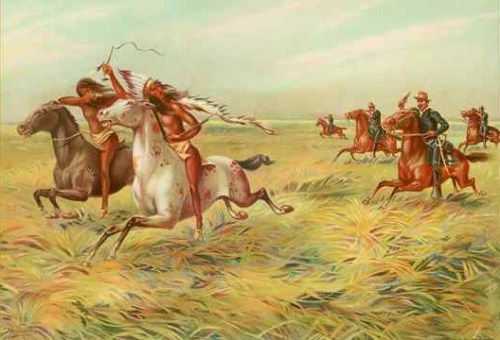
    1899 chromolithograph WikipediaFollowing the U.S. Civil War, “the great Indian question” became central issue of public debate in the United States. Opinions of what to do about America’s indigenous peoples ranged from calling for their extermination to allowing them self-government in secure homelands.

    As the incident below illustrates, relations between Native Americans and whites then often were appalling. The incident was reported in 1880 by the world famous physician and author, S. Weir Mitchel, who was on his way to Yellowstone National Park. Mitchell was camped with a tour group by the bank of the Yellowstone River. Here’s what Mitchell wrote.

    ∞§∞

     Through the inky dark horses were heard, and a broad, guttural German voice called out, “Woa, Daisy! You woa now,” while the owner rode into view on a stout pony, driving a packhorse loaded with camp-traps and guiltless of bridle or halter.

    “Is dis der New York outfit?” said the owner of Daisy.

    The judge was instantly called on to respond and to own that he was the New York outfit.

    “You might know my prudder?” said the German—”geeps a budter wholesale shtore in Read street.”

    Then the major took a hand: “Heard of any Indians?”

    “Yaas: I heerd of one a little vile ago. He was shtealin’ hosses: shtole mine, der whole outfit. I went and found him.”

    “How was that?” said the major.

    “Well, I shneaked up and found him a-sittin’ at his feed: I shot him in der pack. Den I hitched him to close hosses and shnaked him into der prush. Guesh he’s dere yet. I goes for ’em overy dime.”

    This was told tranquilly, without emotion, or with less than that with which a hunter tells you of good luck with the elk. It was a fair illustration of Western life, and one side of the great Indian question.

    The major remarked, “There were two men killed by Indians last week down the river.”

    The owner of Daisy threw a leg over the pommel, struck a match to light a pipe, and said, “Vel, maybe dat’s my prudder-in-law.”

    At last the great whiskey question came up, and after a consoling draught Daisy was summoned to “Get on,” and the German disappeared over a bad trail into utter darkness, leaving the “New York outfit” to settle the difficult question of who stole those horses.

     ∞§∞

    —Excerpt from S. Weir Mitchell, M.D., “Through Yellowstone Park to Fort Custer,” Lippincott’s Magazine of Popular Literature and Science, 25:688-704 (June 1880).

    — 1889 chromolithograph from Wikipedia Commons, artist unknown.

  • Share: Wolves Start an Ecological Cascade That Shapes Yellowstone Rivers (video)

    Screen Shot 2014-10-09 at 10.13.49 AM

    I don’t have any stories that focus on wolves in my collection of more than 300 stories of early travel to Yellowstone Park. In fact, mention of wolves is usually confined to reports of hearing their mournful howls in the distance. But I thought this video was so interesting that I’d share it anyway.

    Before they were re-introduced to Yellowstone in 1995, they had been gone for about 70 years. When the U.S. Army took over administration of the Park in 1886, the ended hunting — except for predators. On the mistaken assumption that it would benefit other mammals like like and deer, government hunters set out to eradicate animals like wolves and mountain lions.

    Removal of the top predators affected the ecology of the park in unexpected ways. Their reintroduction — as this video makes clear — is changing things back.

    ∞§∞

    — Photo taken from the video.


  • An Event: Ready to Launch Macon’s Perfect Shot at Gallatin History Museum

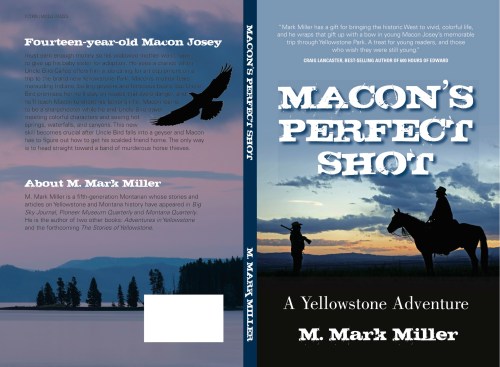
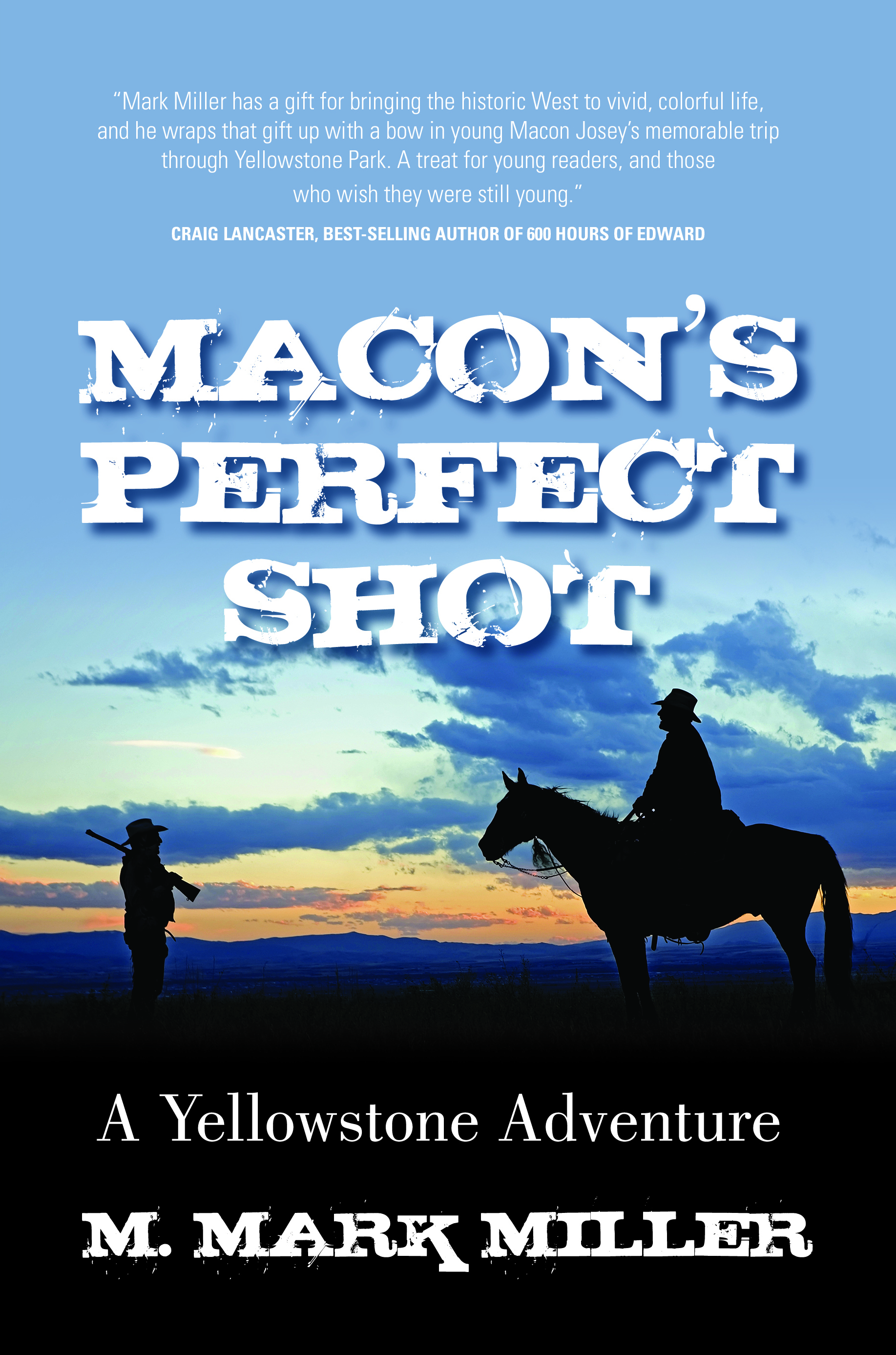
    macons perfect shot cover

    I’ve been getting ready to launch my new middle-grades novel, Macon’s Perfect Shot, with a reading Wednesday, Oct. 8, at 6 p.m. at the Gallatin History Museum, 317 W. Main, in Bozeman. The Museum’s Research Room is the perfect place for the event because it’s where I discovered the stories that inspired the book.

    My first book, Adventures in Yellowstone, is a compilation of a dozen first-person accounts of early travel to Yellowstone Park. I wanted it to be an anthology in the words of the people who live the adventures because that makes their emotions and personalities shine through.

    When I finished Adventures, I discovered I had a lot of stories left that I didn’t think were strong enough to stand on their own, so I invented a 14-year-old boy to live them. Turning to fiction let me attribute several incidents to a single character and to embellish true stories by creating dialog and exploring  motivations that weren’t explicit in the accounts in my collection of more that 300 tales.

    Philetus W. Norris
    Philetus W. Norris

    The first thing I needed was an overarching story that could be used to tie a lot of little incidents together.  I chose Henry “Bird” Calfee’s account of his trip to the brand new Yellowstone National Park in 1872. Calfee told his story in a reminiscence apparently published in a newspaper many years after his trip. It’s contained in an unidentified and undated newspaper clipping in the Gallatin History Museum Reasearch Room.

    Calfee, who later became one of the first commercial photographers in Yellowstone Park, traveled with his friend, Macon Josey. The pair rode on horseback through the roadless wilderness for several weeks and visited all the major sights in the park: Mammoth Hot Spring, Yellowstone Falls. the Grand Canyon of the Yellowstone, and the geyser basins.

    Their adventure climaxed when Josey fell into a geyser and scalded himself up to his waist. Then Calfee had to figure out how to get his injured friend home and the route he chose led directly toward a murderous band of horse thieves.

    I also found a story in an 1872 issue of the Bozeman Avant Courier newspaper that described pioneer sheriff Henry Guy’s pursuit of the notorious Harlow gang that had been stealing horses in the Gallatin Valley. Based on information provided by Calfee and Josey, Sheriff Guy tracked down the gang and engaged them in a fierce gun fight that left three men dead.

    Jack Bean with trophy.
    Jack Bean with trophy.

    The Calfee-Josey story provided a nice adventure narrative, but I wanted to create a coming-of-age story. Although the real Macon Josey was an adult, I made my character by that name a 14-year-old boy. I altered the facts and had Calfee, not Josey, fall into a geyser. That provided a strong pivot point in the plot where Macon had to grow up fast.

    After I had an overarching plot, I began looking through my story collection for other tales I could use as models for Macon’s adventures. Some of those stories have been posted on this blog.

    All the stories I used came from the 1870s, so Macon’s Perfect Shot provides a realistic picture of what travel to Yellowstone Park would have been like when it was a roadless wilderness. The book is aimed toward fifth- and sixth-graders, but I tried to write a novel that would be fun reading for any age. I think I succeeded.

    If you’d like to learn more about Macon’s Perfect Shot or early travel to Yellowstone Park, I’d love to tell you all about it at the book launch.  I hope to see you there.

    It’s free and open to the public and I’ll be available to sign copies of the new book and my first book, Adventures in Yellowstone. And watch for my next book, The Stories of Yellowstone, which is scheduled to be published in November.

    ∞§∞

  • An Event — Finding a Story to Present at the Huntley Irrigation Museum

    An Event — Finding a Story to Present at the Huntley Irrigation Museum

    Bottler's Ranch YDSF
    Bottler’s Ranch

    I’ve been getting ready to present my Humanities Montana program, “Sidesaddles and Geysers” at the Huntley Irrigation Project Museum at 7 p.m. on Friday, September 26. I usually try to localize my presentations, but that’s been difficult this time. After all, irrigation isn’t a big topic in Yellowstone Park history. But I dug though my collection of more that 350 stories of early travel to Yellowstone Park and finally found a candidate—tale of how a Montana rancher armed with only a shovel and a canvass dam stopped a Northern Pacific Railroad construction crew literally in its tracks.

    Fred Bottler came to Montana during the gold rush, but after he failed to strike it rich he decided to take up ranching. In December 1867, Bottler headed east from Bozeman over Trail Creek Pass to the Paradise Valley of the Yellowstone River. He traveled 12 miles down the creek to a spot where he could see the jagged peaks of the Absaroka Mountains carving the skyline. Bottler also could see brown grass that he knew would turn green with the spring rains, and pine forests that grew above the foothills. Land, water and timber. Bottler must have thought, this is the perfect spot for my ranch.

    He started to unload his plow near the mouth of Trail Creek. Then he saw a group of Crow braves maneuvering across the Yellowstone River. He loaded the plow back on his wagon and drove his horses farther south to a spot across the valley from where miners worked their gold claims in Emigrant Gulch. The miners would not only deter Indians, they also would provide a ready market for the things Bottler would raise.

    Bottler staked his claim where springs bubbled out of the mountains and formed streams that provided water for irrigation. Soon he had crops of hay, grain and vegetables. He raised pigs and cured hams and sides of bacon. Bottler milked cows and made butter in a churn turned by a small water wheel. He didn’t confine himself to agriculture. Fred often left management of the ranch to his brother, Phil, and hired out as a guide. He is conspicuously mentioned in several explorers’ journals including those of Philetus Norris, Ferdinand Hayden, and the Earl of Dunraven.

    After the Northern Pacific Railroad finished America’s second transcontinental line in 1883, its next order of business was building a spur to Yellowstone Park. Construction crews began in Livingston and headed up the Paradise Valley. They cut ranchers’ fences and took whatever right-of-way they wanted. After they passed through a rancher’s land, they paid him whatever they pleased.

    On the morning when Fred Bottler figured the railroad crew would reach his land, he told his wife to let him know when they got to his fence and went out to work. Probably, he carried a shovel and a pole with a square of canvas nailed to it. With such equipment, an irrigator can divert a stream and spread water flooding across dry land. A skilled irrigator can work the magic of making water appear to run uphill. Bottler irrigated a hundred acres of land; doubtless, he could direct water wherever he wanted.

    Fred’s wife told him when the crew reached his fence, and he went to negotiate, but the railroad men had already began to cut the wires. Bottler used his canvas dam to divert a nearby stream in front of the railroad route threatening to mire the work in mud. As Yellowstone Park historian, Aubrey Haines put it: “The legal formalities were swiftly attended to.”

    I’ll tell that story to my audience at the Huntley Irrigation Museum, then I’ll turn to my regular presentation.

    I’ll begin with stories my grandmother used to tell about her trip to the park in 1909 and her grandfather’s trip there in 1883. Grandma went to the park with her aunt, two brothers and seven cousin. Family lore has it that they took a cow with them to provide milk for the younger children. Grandma told about baking bread in a hot spring and said her father tossed her uncle’s red flannel underwear into Old Faithful to die it pink.

    Then I’ll tell stories about the first women to visit Yellowstone Park. These brave ladies literally rode sidesaddle through the roadless wilderness in the 1870s. One of the most chilling stories is Emma Cowan’s tale of being captured by Indians in the park. Emma and her family went there in 1877, the year the Nez Perce fled their homeland in hopes of finding freedom in the buffalo country. Emma wrote a gripping account of watching Indians shoot her husband, George, in the head, and leaving him for dead, taking her, her sister and their brother captive.

    After recounting Emma’s story, I’ll slow the pace with a different kind of adventure—Carrie Stahorn’s story of being caught in an October snow storm on the way to the Yellowstone Falls in 1880.

    Then I’ll tell the story of a treacherous climb down Uncle Tom’s Trail that nearly ended with a woman tumbling down the Grand Canyon of the Yellowstone. I’ll end with a bit of humor—the story of budding romance when travelers who met on a six-day coach tour have a tough time saying good-bye.

    That should leave time for questions, and maybe an encore. After the talk, of course, I’ll be available to sign copies of my books,  Adventures in Yellowstone and Macon’s Perfect Shot.

    ∞§∞

    — National Park Service Photo by William Henry Jackson, 1871.

  • News: MACON’S PERFECT SHOT, the Paperback, Arrives

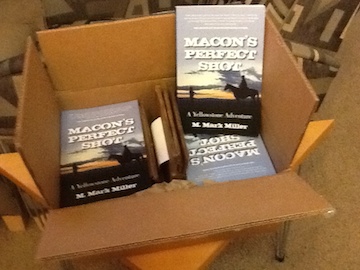
    Macon in a boxIt’s here. And it’s beautiful, thanks to Craig Lancaster”s superlative cover and book design. You can find out about Craig’s marvelous books on his website. I can’t wait for his next novel, The Fallow Season of Hugo Hunter.

    Macon’s Perfect Shot is a ripping adventure story aimed at middle grades, but fun for readers of any age. Inspired by true stories from my collections of more than 400 first-person accounts, the book provides an authentic picture of Yellowstone Park in the 1870s. Great for reluctant readers. Buy it for a kid you love. And tell your teacher friends about it.

    You can order Macon now from Amazon in paperback or Kindle versions.

    I’ll begin working now to get it stocked in bookstores. I’m not usually comfortable working in sales, but it really helps to have a product I believe in. When the box Macon books arrived, I couldn’t resist grabbing a copy and flipping through it. Wherever, my eye landed, I found a section I was proud of. I worked hard to make Macon sing—and I think I succeeded.

    Yesterday I talked with Susan Backer, a life-long elementary school teacher, about the possibility of a teachers guide for Macon’s Perfect Shot. I was delighted when Susan said she saw lots of ways the book could be used in schools and was “excited” about the prospect of writing a teachers guide. More about that later.  Watch this space.

    ∞§∞

    You can read about all my books on my blog.


  • An Event: I’m Ready for My Eastern Montana Tour

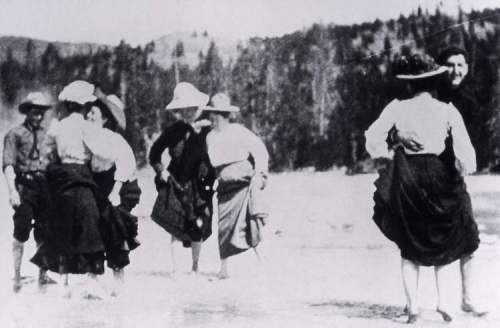
    Wading in Fountain Geyser, c. 1906
    Wading in Fountain Geyser, c. 1906

    I’ve been getting ready — making slide shows and writing scripts — for my Eastern Montana Tour. I’ll be making my Humanities Montana presentation, “Sidesaddles and Geysers: Women’s Adventures in Early Yellowstone,” at three different places in August. I’m really looking forward spending time in a section of Montana that I’ve never seen before and visiting some great museums.

     August 9, 6 p.m., MonDak Heritage Center, Sidney, Montana

    • August 12, 7:30 p.m., Wibaux Museum, Wibaux, Montana

    • August 13, 7 p.m., Wibaux Public Library, Wibaux, Montana

    • August 14, 7 p.m., Range Riders Museum, Miles City, Montana.

    For the tour, I’ve picked some of the very best tales from my collection of more than 300 first-person accounts of early travel to Yellowstone Park. Here’s an outline of what I’ll be presenting at the three museums.

    I’ll begin with stories my grandmother used to tell about her trip to the park in 1909 and her grandfather’s trip there in 1883. Grandma went to the park with her aunt, two brothers and seven cousin. Family lore has it that they took a cow with them to provide milk for the younger children. Grandma told about baking bread in a hot spring and said her father tossed her uncle’s red flannel underwear into Old Faithful to die it pink.

    Then I’ll tell stories about the first women to visit Yellowstone Park. These brave ladies literally rode sidesaddle through the roadless wilderness in the 1870s. One of the most chilling stories is Emma Cowan’s tale of being captured by Indians in the park. Emma and her family went there in 1877, the year the Nez Perce fled their homeland in hopes of finding freedom in the buffalo country. Emma wrote a gripping account of watching Indians shoot her husband, George, in the head, and leaving him for dead, taking her, her sister and their brother captive.

    After recounting Emma’s story, I’ll slow the pace with a different kind of adventure—Carrie Strahorn’s story about when she was caught in an October snowstorm at the Grand Canyon of the Yellowstone.

    Then I’ll tell the store of a treacherous climb down Uncle Tom’s Trail that nearly ended with a woman tumbling down the Grand Canyon of the Yellowstone. I’ll end with a bit of humor—the story of budding romance when travelers who met on a six-day coach tour have a tough time saying good-bye.

    That should leave time for questions, and maybe an encore. After all, I have a collection of more than 300 stories of early travel to Yellowstone Park that I could share. After the talk, of course, I’ll be available to sell and sign copies of my book, Adventures in Yellowstone.

    Because I’ll be making two presentations in Wibaux, I assembled a second slide show and script. Here’s an outline of what I’ll present at the Wibaux Public Library.

    I’ll begin by talking about my books on early travel to Yellowstone Park:

    • Adventures in Yellowstone: Early Travelers Tell Their Talesan anthology of a dozen classic tales including Truman Evert’s tale of being lost alone in the Yellowstone wilderness for 37 days, and Emma Cowan’s story of being captured by Indians.

    • Macon’s Perfect Shota mid-grade novel about a 14-year-old boy who has to use his wits to save the life his traveling companion after the man tumbles into a geyser.

    • The Stories of Yellowstone: Adventure Tales from the World’s First National Park: a collection of 72 short stories covering the period from the early 1800s when mountain men first marvels at Yellowstone’s wonders until the 1920s when genteel matrons sped between luxury hotels in their touring cars.

    Then I’ll read about John Colter, the first white man to visit the area that became Yellowstone Park, and his famous naked run to escape 500 furious Blackfeet Indians.

    After that, I’ll tell about Truman Everts, who was lost alone in the Yellowstone wilderness for 37 days in 1870, and I’ll read his story about being Treed by a Lion.

    If there’s time, I’ll read the Earl of Dunraven’s hilarious description of How to Pack and Mule and Ernest Thompson Seton’s adventure watching bears fight at a hotel dump.

    Of course, I could go on for hours about early travel to Yellowstone, but I’ll want to leave time to answer questions and sign books.

    I’m really looking forward to seeing sights along the way and visiting several of Montana’s great museums.  I hope I’ll see you at one or more of these events.

    ∞§∞


  • Coming Soon: Macon’s Perfect Shot

    Billings author Craig Lancaster is helping me get my mid-grades novel, Macon’s Perfect Shot, ready for publication. Look for it soon at your favorite bookstore or e-bookseller.  Also, look for Craig’s fifth book, The Fallow Season of Hugo Hunter.

    Here’s the dandy cover Craig designed for Macon. Note the great blurb he included.

    macons perfect shot front cover

    Here’s what’s written on the back cover.

    Fourteen-year-old Macon Josey must earn enough money so his widowed mother won’t have to give up his baby sister for adoption. He sees a chance when Uncle Bird Calfee offers him a job caring for art equipment on a trip to the brand new Yellowstone Park. Macon’s mother fears marauding Indians, boiling geysers and ferocious bears, but Uncle Bird promises her he’ll stay on routes that avoid danger, and he’ll teach Macon to shoot his father’s rifle. Macon learns to be a sharpshooter while he and Uncle Bird travel meeting colorful characters and seeing hot springs, waterfalls, and canyons. This new skill becomes crucial after Uncle Bird falls into a geyser and Macon has to figure out how to get his scalded friend home. The only way is to head straight toward a band of murderous horse thieves.

    You can find out more about Macon’s Perfect Shot here.

    While you’re doing your Christmas Shopping look for my next anthology of early Yellowstone travelers’ tales, The Stories of YellowstoneGlobe Pequot will be publishing it in November.

    And don’t forget my first book, Adventures in Yellowstoneis still available. You should read it before your next trip to Yellowstone Park. It will add a new dimension to your Yellowstone experience. You should read it even if you’re not going to the park if you’ve ever wondered what it was like to visit there when it was a remote roadless wilderness.

    ∞§∞


  • An Event — Ready to Present Sidesaddles and Geysers in Cooke City

    An Event — Ready to Present Sidesaddles and Geysers in Cooke City

    Cooke City Visitors Center and Museum
    Cooke City Visitors Center and Museum

    I love Montana’s many small museums and it looks like I’ll get to preview a brand new one next week in Cooke City. I’ll be presenting my Humanities Montana Program, “Sidesaddles and Geysers,”  on Saturday, July 12, at 7:30 p.m. at Joe’s Campfire next to the Cooke City Community Center. Joe’s Campfire is part of the new Cooke City Museum and honors Joe Israel, a forest service employee who used to lecture there on topics of local interest. I’m thrilled to be carrying on Joe’s legacy.

    The Cooke City Museum housed inside the Community Center won’t open officially until July 19, but I may get a preview. I sure hope so because its so much fun to see how colorful communities like Cooke City preserve and display their heritage.  And I know Cooke has an intriguing history.

    Located just outside the northeast border of Yellowstone Nation Park, Cooke City is a mining town where gold was discovered in 1870. The park was created two after that so Cooke City and park history are entangled. The town is nestled in the rugged Bear Tooth Mountains and for decades the only way to get there was through Yellowstone Park. The Bear Tooth Highway that links Cooke City to Red Lodge, Montana, during summer months wasn’t opened until 1936.

    The first bridge across the Yellowstone River was built to provide access to Cooke City. Miners from Cooke City built the first road to the park up Yankee Jim Canyon. In the 1890s, the notorious buffalo poacher, Ed Howell, used Cooke City as his base of operations. I hope I’ll find out lots more about the town next week.

    My presentation, which is part of the Humanities Montana Speakers Bureau, focuses on women traveling to the park in the 1800s and early 1900s. I’ll begin with stories my grandmother used to tell about her trip to the park in 1909 and her grandfather’s trip there in 1883. Grandma went to the park with her aunt, two brothers and seven cousin. Family lore has it that they took a cow with them to provide milk for the younger children. Grandma told about baking bread in a hot spring and said her father tossed her uncle’s red flannel underwear into Old Faithful to die it pink.

    Then I’ll tell stories about the first women to visit Yellowstone Park. These brave ladies literally rode sidesaddle through the roadless wilderness in the 1870s. One of the most chilling stories is Emma Cowan’s tale of being captured by Indians in the park. Emma and her family went there in 1877, the year the Nez Perce fled their homeland in hopes of finding freedom in the buffalo country. Emma wrote a gripping account of watching Indians shoot her husband, George, in the head, and leaving him for dead, taking her, her sister and their brother captive.

    After recounting Emma’s story, I’ll slow the pace with a different kind of adventure—Eleanor Corthell’s account of leaving her husband at home and taking their seven children to the park in 1903. By then park roads were good and their was no danger from Indians. But Eleanor still had plenty to contend with while watching her children frolic near geysers and driving bears away from her cook fire.

    Then I’ll tell the store of a treacherous climb down Uncle Tom’s Trail that nearly ended with a woman tumbling down the Grand Canyon of the Yellowstone. I’ll end with a bit of humor—the story of budding romance when travelers who met on a six-day coach tour have a tough time saying good-bye.

    That should leave time for questions, and maybe an encore. After all, I have a collection of nearly 400 stories of early travel to Yellowstone Park that I could share. After the talk, of course, I’ll be available to sell and sign copies of my book, Adventures in Yellowstone.

    ∞§∞

  • My Writing Process:

    My good friend Craig Lancaster, a Billings-based author who conjures a poignant and hilarious novel every few months, tagged me as part of a blogging exercise that’s been going around. I’ll chat a bit here about my writing process. (That probably should be “writing processes” because I work in several categories: anthology, narrative history and historical fiction.) Then I’ll answer four questions about my work and then tag author friends whose work I admire (and whose methods I’d like to know more about). I’ve learned a lot from reading previous entries and recommend them to you. You can start with Craig’s entry. and then follow it back to David Abrams’ entry. Have fun surfing, then come back to compare my answers when you’re done.

    1. What are you working on?

    Like most writers, I always have several projects at various stages of development. At the moment I’m:

    • Basking the in the glory of my article on the Montana Gin Marriage Law of 1935, which just came out in the summer issue of The Montana Quarterly.
    • Working on page proofs for my next book, The Stories of Yellowstone, that Globe Pequot will publish in November.
    • Planning to publish my mid-grades novel, Macon’s Perfect Shot, about the adventures of a 14-year-old boy who visits Yellowstone Park in the 1870s.
    • Researching my next book, Encounters in Yellowstone, that will tell the stories of tourists who ran afoul of Indians in the park in 1877.

    Of course, dozens more ideas are swirling around and trying to coalesce in the cosmic muck of my mind.

    And, I’m always monitoring my haiku catcher.

    2. How does your work differ from others in its genre?

    Most of my work fits in the category of narrative history, and I dabble a bit in historic fiction. I focus on early travel to Yellowstone National Park. They say you should write about what you know and after a decade of research on early Yellowstone travel I’m getting to know that topic pretty well. I do branch out to aspects Montana history, and now and then I work on a memoir about growing up on a Montana cattle ranch.

    I am not a historian but a collector and teller of stories. I don’t try to document important facts about the past; instead, I try to recreate how things used to feel. I try to explore the ways universal themes manifest themselves at different times. For example, many of the people I write about were fortune hunters, but they tried to make their fortunes in different ways. The stories of mountain men who sought their fortunes trapping beaver and those of prospectors who wanted to strike it rich panning for gold have interesting similarities and differences.

    For me, the story is the thing, but I do care about the facts. Sometimes I work very hard to discover details that explain the motives of the people I write about. After all, it’s the details that bring stories to life. I don’t care if the people and events I write about are important as long as they’re interesting. I don’t care if the people I write about embellish the facts as long as they tell good stories. I don’t fret about verifying every assertion my sources make. Instead, I leave it to my readers to understand that we are all heroes in the stories we tell about ourselves. Of course, I warn my readers when I discover outright fabrications, but I’ll still use a story with caveats. The lies we tell that may say the most about us.

    3. Why do you write what you do?

    When I left my job as a journalism professor at the University of Tennessee and returned home to Montana in 2003, I started looking for something to do. I always wanted to write, so the questions became “write about what?” I remembered my grandmother’s tales about her trip to Yellowstone Park in 1909 and her grandfather’s trip there in 1883. All I had were dim memories of stories I heard when I was a little boy, so I decided to research early travel to Yellowstone. People have always thought the park was special and many of them left accounts of their trips there in journals, letters, diaries, reminiscences, newspaper articles, books, government reports, etc. At first, I thought the Yellowstone experience was universal, but I soon discovered things changed enormously across time. I’m still mining this rich vein of delightful stories.

    4. How does your writing process work?

    Haiku: I always keep myself alert in case a haiku happens. It goes something like this:

    An idea occurs.
    I take it captive with words.
    Then I set it free.

    Collecting: Because my writing is rooted in the past, I spend a lot of time looking for material in libraries, archives and museum. Also, lots of historical material is now available on the web, so I’m spending a lot of time looking there. I have a collection of more than 400 first-person accounts of early travel to Yellowstone Park that I use a lot. I focus my research on looking for stories, that is, situations where a person faces adversity and deals with it (or sometimes fails to deal with it.) The adversity can be something life-threatening like being attacked by hostile Indians, or humorous like an impatient tourist soaping a geyser to make it play. Sometimes, I read through thousands of words before I find a story I can use. I’ve learned to forge ahead because you never know when you’re going to find a gem on the next page.

    Editing: I harvest accounts in their original form and then excerpt the stories I’m going use. How I edit depends on how I’m going to use the stories. If a story is going into an anthology, I work to retain the author’s original voice because that conveys personality and emotion. I edit to correct factual errors and to make the stories accessible to modern readers by doing things like getting rid of archaic vocabulary. Sometimes I condense things as much as 80 percent. For my book, Adventures in Yellowstone, I condensed N.P. Langford’s account of the 1870 Washburn Expedition from 60,000-words to a 10,000-word chapter. For my blog, I cut Lewis Ransom Freeman’s account of running a wooden raft down Yankee Jim Canyon from 7,500 words to 1,500.

    Drafting: After materials have been collected and edited, putting together an anthology is mostly a matter of organizing and writing introductions. I try to arrange things so stories flow smoothly together and complement each other. I treat introductions like a fiction writer would and provide just enough context so readers can understand the story. The point of an anthology is to present authors on their own terms, but when I write narrative history or historical fiction, I assert my own voice. In fact, I’m extra careful to avoid being accused of plagiarizing. I try to follow Kurt Vonnegut’s “Eight Rules for Writing,” particularly number 3: “Every character should want something, even if it is only a glass of water.” This keeps things focused on people, their desires and emotions.

    Polishing: After I’ve finished a draft, I scrutinize it looking for different things. I focus on one thing at a time because there more important things than I can keep track of at one time. I read through once just for mechanics like spelling and grammar. I read another time just to make sure I’ve used vivid verbs. (I used to tell my writing students: “make things do things to things” and I follow that rule myself. It keeps my verbs simple and in active voice. I read another time checking for what I call “desire lines” (Vonnegut’s rule 3) to make sure it’s clear in every scene what the characters want. I read for coherence, flow and rhythm. I check plot points. I read over and over until changes don’t seem to improve things. If I’m lucky, I have time to set he draft aside for a few weeks before I submit it and go through the process again. Sometimes I go back and read things I wrote years ago. That shows me how I’ve grown as a writer and usually I’m pleased with my work.

    That’s it for me. Here are the authors I’ve tagged for next week. Bookmark their blogs so you can see how they do things.

    Max Tomlinson 

    Max is a San Francisco-based author whose trilogy of literary thrillers: Sendaro, Who Sings for the Dead and Lethal Dispatch, gripping tales set in the Amazon rain forests of Peru during the Shining Path uprising of the 1980s.

    Blythe Woolston

    Blythe’s young adult novel, Black Helicopters, is a chilling tale of a girl raised by survivalists in the Montana wilderness. It was a 2013 Montana Book Award Honor book.

    Brad Tyer

    Brad’s 2013 Montana Book Award Honor Book, Opportunity Montana, blends the story of the attempt to restore a river damaged a hundred years ago by industrial pollution with a personal narrative about his relationship with his father.
  • Moran’s Legacy 4: Watching Giantess Geyser — Text by N. P. Langford, 1871

    Giantess Geyser YDSL05101
    Giantess Geyer

    When it was a brand new magazine, Scribner’s Monthly hired Thomas Moran to illustrate N. P. Langford’s two-part report of the Yellowstone wonders he saw on the Washburn Expedition of 1870. Because Moran conjured the illustrations based soley on Langford’s descriptions, it’s particularly interesting to compare what the writer said to what the artist drew.

    Here’s Langford’s description of Giantess Geyser and Moran’s conception of it. As you can see by comparing the illustration to the the photo above, Moran’s pagoda style geyser isn’t very realistic. But it is an interesting interpretations of Langford’s words.

    ∞§∞

    TheGiantessScribners1871MoranOur search for new wonders leading us across the Fire Hole River, we ascended a gentle incrusted slope, and came suddenly upon a large oval aperture with scalloped edges, the diameters of which were eighteen and twenty-five feet, the sides corrugated and covered with a grayish-white silicious deposit, which was distinctly visible at the depth of one hundred feet below the surface.

    No water could be discovered, but we could distinctly hear it gurgling and boiling at a great distance below. Suddenly it began to rise, boiling and spluttering, and sending out huge masses of steam, causing a general stampede of our company, driving us some distance from our point of observation. When within about forty feet of the surface it became stationary, and we returned to look down upon it. It was foaming and surging at a terrible rate, occasionally emitting small jets of hot water nearly to the mouth of the orifice.

    All at once it seemed seized with a fearful spasm, and rose with incredible rapidity, hardly affording us time to flee to a safe distance, when it burst from the orifice with terrific momentum, rising in a column the full size of this immense aperture to the height of sixty feet; and through and out of the apex of this vast aqueous mass, five or six lesser jets or round columns of water, varying in size from six to fifteen inches in diameter, were projected to the marvelous height of two hundred and fifty feet.

    These lesser jets, so much higher than the main column, and shooting through it, doubtless proceed from auxiliary pipes leading into the principal orifice near the bottom, where the explosive force is greater. If the theory that water by constant boiling becomes explosive when freed from air be true, this theory rationally accounts for all irregularities in the eruptions of the geysers.

    This grand eruption continued for twenty minutes, and was the most magnificent sight we ever witnessed. We were standing on the side of the geyser nearest the sun, the gleams of which filled the sparkling column of water and spray with myriads of rainbows, whose arches were constantly changing—dipping and fluttering hither and thither, and disappearing only to be succeeded by others, again and again, amid the aqueous column, while the minute globules into which the spent jets were diffused when falling sparkled like a shower of diamonds, and around every shadow which the denser clouds of vapor, interrupting the  sun’s rays, cast upon the column, could be seen a luminous circle radiant with all the colors of the prism, and resembling the halo of glory represented in paintings as encircling the head of Divinity.

    All that we had previously witnessed seemed tame in comparison with the perfect grandeur and beauty of this display. Two of These wonderful eruptions occurred during the twenty-two hours we remained in the valley. This geyser we named “The Giantess.”

    ∞§∞

     —   Excerpt and illustration from N. P. Langford, “The Wonders of the Yellowstone,”  Scribner’s Monthly 2(2)113-128 (June 1871).

    — NPS Photo, Yellowstone Digital Slide File.

    — For more about Moran’s legacy, click on “Thomas Moran” under the Catergories button.