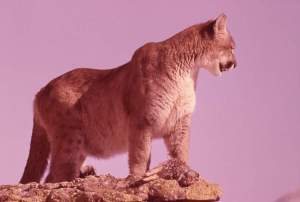
Category: Hunting

  • A Tale: Face to Face With a Hungry Mountain Lion — Turrill, 1898

    Lion 2 YDSF

    By the time Gardner Stillson Turrill toured Yellowstone Park in 1898, the Army had outlawed hunting there and made tourists either leave their guns in storage or have them sealed when they entered the park. Despite the gun regulations, hunters still were drawn to the area. In fact, conservations like Theodore Roosevelt promoted the idea that protecting game animals inside park boundaries would make for to abundant hunting on the periphery.

    Turrill and his companions not only were avid hunters, they also entertained each other buy telling hunting stories. Here’s a tale one of Turrill’s friends told about an adventure he had while staying with an old man in a cabin high in the Wyoming Mountains.

    ∞§∞

    One night I was awakened by a shuffling noise overhead and the heavy footfall of some large animal that was evidently on the cabin roof. I got out of bed to make sure the door and window were securely fastened, and, as additional precaution, I set my rifle at the head of the bunk and piled some dry pine knots on the fire.

    I heard nothing more that night, but the next morning I saw the tracks of an extra large mountain lion on all sides of the house as well as in the snow on the roof. After breakfast I told the old man that I was going out for a little hunt and warned him not to be uneasy if I were gone several hours.

    I followed the tracks of the big cat as he had made his way to the creek. I was fond of adventure and was determined to have a shot at the animal if I could possibly overtake him.

    The snow was soft, but with snowshoes I was able to make good time. In places I noticed where the lion had broken through into deep drifts and the way they were ploughed and scattered by the beast in his efforts to flounder through one could almost imagine that a horse had been forcing his way across. The animal surely must have been hungry to go so far from his lair in the deep snow!

    I soon reached the creek and followed the tracks on over to the other side. The trail now wound here and there among the trees. up the hillside toward a bold bare bluff that towered above the trees several hundred yards ahead of me. I had been advancing with the utmost caution, but now decided that the animal had surely gone to his den somewhere along the base of the cliff

    “Very good.” I thought to myself. ” I will follow the tracks to the den, then climb a tree and shoot Mr. Catamount at my leisure whenever he sees fit to come out. The animal will soon be mine now and I will have a fine skin for my morning’s walk.

    Occupied with these pleasing reflections I shouldered my gun and, as I walked along, looked away through the trees at the precipitous bluff that was my objective point. But suddenly I came to my senses with a start. The panther trail had disappeared.

    I retraced my steps a few rods till I came again to the huge cat-like tracks that I had been following. They seemed to end right there. It was very strange. Did the creature have wings? ‘I pursed my lips to fetch a dismayed whistle, but that whistle was never uttered.

    Quicker than lightning the truth flashed over me. The animal had taken to a tree. and was even then, very likely, making ready for a spring. If I had been experienced I would not have walked into such a trap.

    My heart seemed to stop beating and my blood appeared to be frozen in my veins. A feeling of deadly weakness came over me, but only for a second. Hastily I grasped the gun and looked up. To run would be to court instant death. My only hope was that I might see the beast before he sprang.

    Eagerly I scanned the branches above me but could discern nothing. A moment of breathless suspense, and then I heard a soft patting sound which could be nothing else than the beast’s tail striking against a branch, as he switched it to and fro. The sound seemed to come from a huge spruce just in front of me.

    Looking closely I was able to make out the dark indistinct form lying along one of the main branches in the shadow of the thick foliage. To hesitate was fatal and to miss my mark would be equally so. I hastily threw the gun to my shoulder and pulled the trigger.

    The report of the rifle was followed by a shrill scream as the lion hurled himself at me through the air. But my bullet had taken effect in his shoulder and he fell short.

    I tried to shoot again, but the lever caught for some cause. and the beast came at me snarling and spitting in a terrible fury. The instinct of self-preservation was strong and mustering all my strength. I shoved the muzzle of the gun right into those cruel red jaws.

    The panther gagged, bit at the barrel of the gun and tried to get at me. The next second I gave a jerk on the lever, disengaged it and shoved a cartridge into place. Just as I felt my strength leaving. I pulled the trigger; the old gun roared and the panther fell at my feet with its head literally torn to pieces.

    It was a very weak and humble hunter that pulled himself together. walked back across the creek and up the mountain side to the little cabin. I have never shot a mountain lion since, and I hope that I will never again have occasion to do so.

    ∞§∞

     — Pages 49-52 in Gardner Stillson Turrill, A Tale of the Yellowstone. Jefferson, Iowa: G.S. Turrill Publishing, 1901.

    — You might also enjoy:

    For more hunting tales, click “Hunting” under the Categories button.

  • A Tale: TR Seeks the Thrill of Killing Endangered Bison — 1889

    American bison once numbered 30 million or more, but by the middle of the 1880’s commercial hunters had decimated the herds that once darkened the prairies. But the fact that bison were nearing extinction didn’t deter sportsmen from pursuing the thrill of killing one of the magnificent animals.

    Even Theodore Roosevelt, who is renowned for his role in the American conservation movement and environment preservation, could not resist the temptation of bison hunting. Here’s how he described the experience.

    ∞§∞

    In the fall of 1889 I heard that a very few bison were still left around the head of Wisdom River. Thither I went and hunted faithfully; there was plenty of game of other kind, but of bison not a trace did we see. Nevertheless a few days later that same year I came across these great wild cattle at a time when I had no idea of seeing them.

    We had gone out to find moose, but had seen no sign of them, and had then begun to climb over the higher peaks with an idea of getting sheep. The old hunter who was with me was, very fortunately, suffering from rheumatism, and he therefore carried a long staff instead of his rifle; I say fortunately, for if he had carried his rifle it would have been impossible to stop his firing at such game as bison, nor would he have spared the cows and calves.

    About the middle of the afternoon we crossed a low, rocky ridge, above timber line, and saw at our feet a basin or round valley of singular beauty. The ground rose in a pass evidently much frequented by game in bygone days, their trails lying along it in thick zigzags, each gradually fading out after a few hundred yards, and then starting again in a little different place, as game trails so often seem to do.

    We bent our steps toward these trails, and no sooner had we reached the first than the old hunter bent over it with a sharp exclamation of wonder. There in the dust were the unmistakable hoof-marks of a small band of bison, apparently but a few hours old. There had been half a dozen animals in the party; one a big bull, and two calves.

    We immediately turned and followed the trail. It led down to the little lake, where the beasts had spread and grazed on the tender, green blades, and had drunk their fill. The footprints then came together again, showing where the animals had gathered and walked off in single file to the forest

    It was a very still day, and there were nearly three hours of daylight left. Without a word my silent companion, who had been scanning the whole country with hawk-eyed eagerness, besides scrutinizing the sign on his hands and knees, took the trail, motioning me to follow. In a moment we entered the woods, breathing a sigh of relief as we did so; for while in the meadow we could never tell that the buffalo might not see us, if they happened to be lying in some place with a commanding lookout.

    The old hunter was thoroughly roused, and he showed himself a very skilful tracker. We were much favored by the character of the forest, which was rather open, and in most places free from undergrowth and down timber. The ground was covered with pine needles and soft moss, so that it was not difficult to walk noiselessly. Once or twice when I trod on a small dry twig, or let the nails in my shoes clink slightly against a stone, the hunter turned to me with a frown of angry impatience; but as he walked slowly, continually halting to look ahead, as well as stooping over to examine the trail, I did not find it very difficult to move silently.

    At last,  we saw a movement among the young trees not fifty yards away. Peering through the safe shelter yielded by some thick evergreen bushes, we speedily made out three bison, a cow, a calf, and a yearling. Soon another cow and calf stepped out after them. I did not wish to shoot, waiting for the appearance of the big bull which I knew was accompanying them.

    So for several minutes I watched the great, clumsy, shaggy beasts, as all unconscious they grazed in the open glade. Mixed with the eager excitement of the hunter was a certain half melancholy feeling as I gazed on these bison, themselves part of the last remnant of a doomed and nearly vanished race. Few, indeed, are the men who now have, or ever more shall have, the chance of seeing the mightiest of American beasts, in all his wild vigor, surrounded by the tremendous desolation of his far-off mountain home.

    At last, when I had begun to grow very anxious lest the others should take alarm, the bull likewise appeared on the edge of the glade, and stood with outstretched head, scratching his throat against a young tree, which shook violently. I aimed low, behind his shoulder, and pulled trigger. At the crack of the rifle all the bison, without the momentary halt of terror-struck surprise so common among game, turned and raced off at headlong speed.

    The fringe of young pines beyond and below the glade cracked and swayed as if a whirlwind were passing, and in another moment they reached the top of a very steep incline, thickly strewn with boulders and dead timber. Down this they plunged with reckless speed; their surefootedness was a marvel in such seemingly unwieldy beasts. A column of dust obscured their passage, and under its cover they disappeared in the forest; but the trail of the bull was marked by splashes of frothy blood, and we followed it at a trot.

    Fifty yards beyond the border of the forest we found the stark black body stretched motionless. He was a splendid old bull, still in his full vigor, with large, sharp horns, and heavy mane and glossy coat; and I felt the most exulting pride as I handled and examined him; for I had procured a trophy such as can fall henceforth to few hunters indeed.

    ∞§∞

    — Abridged from Theodore Roosevelt. “The Bison or American Buffalo,” pages 3-36 in Hunting the Grisly and Other Sketchs. New York: The Review of Reviews Company, 1915.

    — Photo from Wikipedia Commons.

    — For more stories about hunting in or near Yellowstone Park, click on “hunting” under “Categories” to the left.

  • A Tale: Hunting a Yellowstone Lion

    The story below was included as an example of student writing in a 1914 composition textbook for college freshmen. The textbook authors didn’t give the student’s name or the year the piece was written, but apparently it was after the army took over administration of Yellowstone in 1886.

     The Secretary of Interior promulgated a regulation in 1883 that prohibited hunting in Yellowstone Park, but that was generally interpreted as not applying to predators. In fact the general policy toward predators—cayotes, wolves, bears, wolverines, and mountain lions—was “shoot on sight.” Predators weren’t protected in the park until the 1930s.

    The textbook authors praise this account as an “ambitious and  effective narrative theme.”  I agree.

    ∞§∞

    “Whoa there! Back into the road, you black brute! What are you shyin’ at?” yelled the driver of a sightseeing coach in the Yellowstone.

    He glanced across the bridge and immediately learned the reason for the strange behavior of one of his leaders. There, in a leather-wood thicket, crouched the long, lithe form of a mountain lion. Its wicked yellow eyes challenged his right to the passage, and its long slender tail writhed among the bushes. The driver pulled up his horses, uncertain of the lion’s intentions; but the great cat, finding himself unmolested, slipped through the bushes and disappeared among the jagged rocks on the mountain slope.

    As the coach was discharging its passengers at the next stopping place, the driver yelled to a camp boy, “Go over and tell the guards I saw that big lion they’ve been looking for, down by the last bridge. Tell ’em they’d better hurry before he leaves the country.”

    The boy lost no time; and soon two of the soldiers were at the bridge, carefully examining the tracks of the great beast from the impressions in the loose dirt. They quickly learned that this lion was the very one with which they had been having a great deal of trouble, the one which had invaded camps during the night, and had terrified tourists with his long-drawn, almost human wail from the forests.

    Clambering over the great grey rocks, and sliding in the loose gravel of the slope, the two soldiers made their way slowly up the mountain side. When they reached the first promontory they stopped to rest and look about them. Far to the left and a mile below them, still shrouded by the evening mists yet tinted now by the morning sun, lay the magnificent and awe-inspiring Yellowstone Gorge. They gazed at the green thread winding along the floor of the great chasm and tried to hear what they knew to be the roar of its rushing waters.

    “It’s a great sight, Judd! We don’t realize it, bein’ here all the time. But come on. Let’s hit the trail again.”

    “Wait a second.” replied the other. “Help me tighten this bandage on my hand. It’s come loose.”

    The men, intent upon the loosened bandage, failed to see that, from the edge of an overhanging rock above them, two pale green eyes were watching their every move. Behind the eyes, the sinewy form of a great cat was stealthily adjusting itself for a leap.

    Having tightened the bandage, the men straightened up and at the same time stepped back a pace. Their feet, imbedded in the loose gravel, began to slide, and together the two soldiers rolled back under the overhanging rock. At the same instant a great tawny streak flashed over their heads, and the huge form of the mountain lion crashed into the rocks at the very place upon which they had been standing.

    They jumped to their feet and, with startled eyes, watched the great ball of yellow fur as it bumped and rolled down the steep incline. The lion tore madly at the rocks and bushes as he fell, but tried in vain to secure a footing in the sliding gravel. A hundred feet below, he stopped with a thud against a fallen tree trunk; but before he could move, two bullets crunched their way through his body, and, with a gasp, he straightened out, dead.

    ∞§∞

    Anonymous, “A Yellowstone Lion,” pages 561-562 in Frances Berkeley Young and Karl Young, Freshman English: A Manual. New York: Henry Holt and Company, 1914. Pages 561-562.

    — Coppermine Gallery Photo.

  • A Tale: Teddy Roosevelt Bags an Elk on Two Ocean Pass — 1891

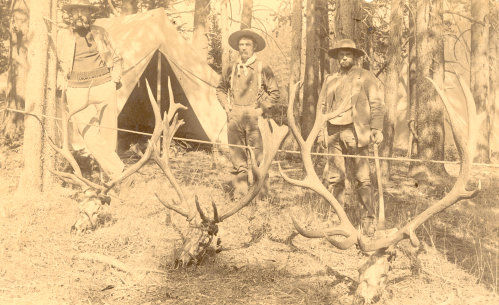
    There was no greater supporter of Yellowstone National Park than Theodore Roosevelt. TR was an avid hunter, but he favored prohibition of hunting inside Yellowstone National Park. The idea was that keeping hunters out would make the Park an endless well of trophy animals that could be hunted when they strayed outside its boundaries.
    And Roosevelt knew that areas near the park provided marvelous hunting. Here’s his description of one of his kills while on a hunting expedition in 1891 to the Two Ocean Pass, an area just outside Yellowstone’s southern border.

    ∞§∞

    The weather became clear and very cold, so that the snow made the frosty mountains gleam like silver. The moon was full, and in the flood of light the wild scenery round our camp was very beautiful. As always where we camped for several days, we had fixed long tables and settles, and were most comfortable; and when we came in at nightfall, or sometimes long afterward, cold, tired, and hungry, it was sheer physical delight to get warm before the roaring fire of pitchy stumps, and then to feast ravenously on bread and beans, on stewed or roasted elk venison, on grouse and sometimes trout, and flapjacks with maple syrup.

    Next morning dawned clear and cold, the sky a glorious blue. Woody and I started to hunt over the great tableland, and led our stout horses up the mountainside, by elk trails so bad that they had to climb like goats. All these elk-trails have one striking peculiarity. They lead through thick timber, but every now and then send off short, well-worn branches to some cliff-edge or jutting crag, commanding a view far and wide over the country beneath. Elk love to stand on these lookout points, and scan the valleys and mountains round about.

    Blue grouse rose from beside our path; Clarke’s crows flew past us, with a hollow, flapping sound, or lit in the pine-tops, calling and flirting their tails; the gray-clad whiskyjacks, with multitudinous cries, hopped and fluttered near us. Snow-shoe rabbits scuttled away, the big furry feet which give them their name already turning white. At last we came out on the great plateau, seamed with deep, narrow ravines. Reaches of pasture alternated with groves and open forests of varying size.

    Almost immediately we heard the bugle of a bull elk, and saw a big band of cows and calves on the other side of a valley. There were three bulls with them, one very large, and we tried to creep up on them; but the wind was baffling and spoiled our stalk. So we returned to our horses, mounted them, and rode a mile farther, toward a large open wood on a hill-side. When within two hundred yards we heard directly ahead the bugle of a bull, and pulled up short.

    In a moment I saw him walking through an open glade; he had not seen us. The slight breeze brought us down his scent. Elk have a strong characteristic smell; it is usually sweet, like that of a herd of Alderney cows; but in old bulls, while rutting, it is rank, pungent, and lasting. We stood motionless till the bull was out of sight, then stole to the wood, tied our horses, and trotted after him. He was travelling fast, occasionally calling; whereupon others in the neighborhood would answer. Evidently he had been driven out of some herd by the master bull.

    He went faster than we did, and while we were vainly trying to overtake him we heard another very loud and sonorous challenge to our left. It came from a ridge-crest at the edge of the woods, among some scattered clumps of the northern nut-pine or pinyon—a queer conifer, growing very high on the mountains, its multi-forked trunk and wide-spreading branches giving it the rounded top, and, at a distance, the general look of an oak rather than a pine.

    We at once walked toward the ridge, up-wind. In a minute or two, to our chagrin, we stumbled on an outlying spike bull, evidently kept on the outskirts of the herd by the master bull. I thought he would alarm all the rest; but, as we stood motionless, he could not see clearly what we were. He stood, ran, stood again, gazed at us, and trotted slowly off.

    We hurried forward as fast as we dared, and with too little care; for we suddenly came in view of two cows. As they raised their heads to look, Woody squatted down where he was, to keep their attention fixed, while I cautiously tried to slip off to one side unobserved. Favored by the neutral tint of my buckskin hunting-shirt, with which my shoes, leggins, and soft hat matched, I succeeded. As soon as I was out of sight I ran hard and came up to a hillock crested with pinyons, behind which I judged I should find the herd.

    As I approached the crest, their strong, sweet smell smote my nostrils. In another moment I saw the tips of a pair of mighty antlers, and I peered over the crest with my rifle at the ready. Thirty yards off, behind a clump of pinyons, stood a huge bull, his head thrown back as he rubbed his shoulders with his horns. There were several cows around him, and one saw me immediately, and took alarm. I fired into the bull’s shoulder, inflicting a mortal wound; but he went off, and I raced after him at top speed, firing twice into his flank; then he stopped, very sick, and I broke his neck with a fourth bullet.

    The elk I thus slew was a giant. His body was the size of a steer’s, and his antlers, though not unusually long, were very massive and heavy. He lay in a glade, on the edge of a great cliff. Standing on its brink we overlooked a most beautiful country, the home of all homes for the elk: a wilderness of mountains, the immense evergreen forest broken by park and glade, by meadow and pasture, by bare hill-side and barren tableland.

    ∞§∞

    — Excerpt from Theodore Roosevelt “An Elk Hunt at Two Ocean Pass.”  Pages  177-202 in The Wilderness Hunter: An Account of Big Game in the United States.  Putnam’s Sons: New York, 1902.

    — Photo from The Wilderness Hunter.

    — For other stories about tracking game, click on “Hunting” under the Categories button to the left.

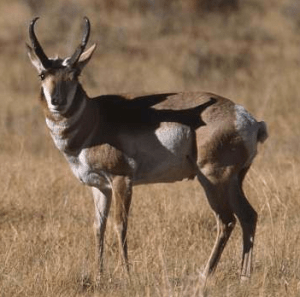
  • A Tale: The Antelope That Got Away — Dunraven, 1874

    While returning from Yellowstone Park in 1874, the Earl of Dunraven discovered he was running out of “grub.” Hunting for food in the Park was legal then, so he decided to replenish the larder by bagging an antelope. He went hunting with pioneer rancher and Yellowstone guide, Fred Bottler, and a helper named Wynn.

    While the trio was pursuing a large buck, a ferocious hail storm forced them to take cover under a pine tree. When the storm abated, Dunraven spotted the buck, tried a long shot and missed. Here’s his story of what happened after that.
    ∞§∞

    It was blowing so hard, and there was such a noise of storm, that there was no danger of the shot having disturbed anything, and so, as the country looked very gamey, we walked on, leading the horses. Presently we came upon a little band containing six antelopes.

    We were by this time near the summit of a long sloping mountain. The ground fell away rapidly on either side, and in a long but narrow glade the antelopes were lying. While we were peering at them, two does—nasty inquisitive females—got up, walked forward a few steps and stared too. We remained still as statues, and after a while they appeared satisfied and began to crop the grass. We then left our ponies, and signing to Wynne, who just then hove in sight, that there was something ahead, and that he was to catch them, hastened up under cover of some brush.

    By the time we reached the tree nearest to them we found the does had all got up and fled to some distance, but a splendid buck with a very large pair of horns was still lying down. At him I fired, and nailed him. He gave one spring straight into the air from his bed, fell back into the same spot, kicked once or twice convulsively, and lay still. I fired the second barrel at a doe and struck her, for she “pecked” almost on to her head, but she recovered and went on.

    Out we rushed: “Never mind the dead one,” shouts Bottler, his face all aglow; “let’s get the other; she’s twice as good, and can’t go far. You take one side of that clump and I will take the other.” So off we set, best pace, bursting up the hill after the wounded doe. We followed her for half an hour, running our level best, and got each a long shot, but missed; and, as she was evidently quite strong, we gave up the chase and walked back.

    We found Wynne driving up the ponies; and as he appeared to have some little trouble with the poor beasts, rendered sulky and ill-tempered by the wet and cold. I said to Bottler, “You go down and help him, and I will butcher the buck.”

    I had scarcely got the words “butcher the buck” out of my mouth, when the darned thing, apparently not appreciating my intentions, came to life, bounded to his feet, sprang into the air, coming down all four feet together, and, with his legs widely extended, gave a phwit—a sort of half whistle, half snort of surprise, I suppose at his own resurrection—stared a second, and made off.

    “Shoot, Bottler,” I cried, “shoot. In Heaven’s name, man, can’t you see the buck?” and I threw up my own rifle and missed him of course. “By George,” says Bottler, wheeling round, “look at the  ___;” and he let go at him with the same result.

    Wynne yelled and dropped the lariats; Bottler ejaculated terrible things; and I also, I fear, made use of very cursory remarks. But neither for swearing, shouting, nor shooting would he stop. He ran about fifty yards, fell on his head and rolled over and over, jumped up again, ran one hundred yards, pitched head over heels the second time, got up, and went down the hill as if he had never felt better in his life.

    We followed of course, and wasted an hour in searching for him in vain. Never again will I pass a beast, however dead he may appear to be, without cutting his throat by way of making sure.

    ∞§∞

    — Excerpt from Hunting on the Yellowstone by the Earl of Dunraven.

    — Image from the Coppermine Photo Gallery.

    — For more stories about The Earl of Dunraven, click on “Dunraven” under the “Categories” button to the right.

    — You can read more of Dunraven’s stories in my book, Adventures in Yellowstone: Early Travelers Tell Their Tales.

  • A Tale: Pioneer Photographer Documents Hunting Expedition Near Yellowstone Park — 1889

    Jack Bean (left) and a client near Jackson Hole, Wyoming, 1889.

    When I received my copy of the fall issue of the Pioneer Museum Quarterly last week, I was delighted to see an article about Charles D. Loughrey, a Bozeman pioneer photographerI had examined the museum’s collection of Loughrey’s photographs but didn’t know much about him.  

    Jacob Rubow of the museum staff dug through Loughrey’s diary and a reminiscence by his brother-in-law, Jack Bean, to glean stories from their lives. One of those stories was about a hunting trip where Bean guided two Englishmen through the park. Hunting inside the park was illegal then, so Bean took his clients to places nearby so they could bag their trophies. And Loughrey was on hand to document the magnificent specimens.

    I asked Jacob if I could post the hunting story on my blog. I’m delighted that he obliged.

    ∞§∞

    In August, 1889, two Englishmen, Messrs. Lennard and Beach, hired Jack Bean, a resident of Bozeman, Montana, to lead them on a hunting trip through Yellowstone National Park and points beyond. Bean, who then earned a living as a guide for hunters and the cavalry out of Fort Ellis, enlisted his friend and brother-in-law, Charles D. Loughrey, as cook and photographer for the expedition. Loughrey had once owned a photography studio in Bozeman, and although the venture was short lived, his photographs, combined with his dutifully-kept journals, have left behind a rarity among historical sources: an illustrated account of the Gallatin Valley and greater Yellowstone region as he saw it in the late nineteenth century. As a frequent companion on Jack Bean’s hunting trips, Loughrey captured striking views of remote corners of the Gallatin Valley, Yellowstone, and the Snake River and Tetons. His diary entries, which chronicle the daily pace of life in the late nineteenth century as well as his and Bean’s adventures in Yellowstone, run from concise to sparse, but, as the saying goes, his pictures are worth a thousand words.

    On August 8, Loughrey and Bean rode into Bozeman through a haze of late-summer smoke blown before a hard east wind. There, they purchased food and had their horses freshly shod. Loughrey spent the next two days busily repairing and fitting his camera with a new lens, packing supplies, and accompanying his wife Ida and family to town “to see a street dog show given by some medicine men.” Then, on the morning of August 11, Loughrey took a bath and set off through the clearing smoke to meet Bean and his assistant guides. The men camped that night amidst heavy thundershowers in the Gallatin Mountains, and spent the following night cussing the building smoke along the Yellowstone River. On the thirteenth, the party camped above the Yankee Jim Tollgate, and on the fourteenth Loughrey wrote a letter to Ida from their camp above Gardiner. While Bean and the other guides spent the next three days waiting in town for the Englishmen, Loughrey explored Mammoth Hot Springs and claimed the hunting party’s first victim, a rattlesnake.

    On Sunday, August 18, with Englishmen in tow, the expedition crossed into the park, camping first at Tower Falls, then spending a “very wet and disagreeable” night in a snowstorm downstream from the Lower Falls of the Yellowstone. A spell of clear, cold weather followed the snowstorm, and the group traveled quickly past the Grand Canyon and Falls, camped at Yellowstone Lake, and then paused at the Upper Geyser Basin on the 23rd. Loughrey lagged behind to take a view of Lewis Falls before exiting the park on the 25th, and rejoined the party later that afternoon at a camp near the Snake River. The enthusiastic hunters spent their first evening beyond the park boundary searching for elk, but returned to camp empty handed. Loughrey stayed in camp on the 27th, washing clothing and photographing the horses grazing beside a stream in a small park. The hunters went out, and Jack Bean “killed a cow elk, which caused great rejoicing in camp.”

    The men spent the next few weeks crisscrossing the area around the Tetons and Snake River, fishing with great success, but hunting with mixed results. They quickly settled into a routine, with the hunters and guides fishing and hunting in pairs most evenings, and Loughrey tending to the camp, cooking, washing clothing, and diligently maintaining his photographic equipment. The hunters pursued elk, deer, and pronghorn “with blood in their eyes,” and when they met with success Loughrey dutifully marched out to capture views of the hunters posing with their trophies, and to collect the antlers. In addition to these portraits of victorious hunters, Loughrey captured candid views of the men in camp, striking images of the Tetons rising above Jackson Lake, and scenic glimpses of the horses and pack animals grazing in mountain parks. On September 20, returning northward, the party passed through Rexburg, Idaho, where Bean purchased sugar and dried fruit. The next day, they reached Market Lake, and in a flurry of activity, Bean packed the Englishmen’s things while Loughrey made portraits of the group and sent a letter to Ida on the five o’clock train. The men ate dinner that night with Captain Head, with whom they “[drank] liquor and [ate] fruit till half past nine.” The Englishmen left on the three o’clock train the next morning. Loughrey, Bean, and company packed up “with the wind howling and all hands cursing,” and started for home, taking care not to “let any grass grow under the horses [sic] feet.”

    Despite a snowstorm and Loughrey’s brief bout with a bug that prevented his eating breakfast on the 24th, the party continued their rapid pace homeward. They camped at Henry’s Lake, then at a creek near the Upper Madison Basin. From there the men crossed over to the Gallatin River, and set off down the Canyon. The group made a final camp at Sheep Rock on September 29, reaching the Bean and Loughrey farms on Rocky Creek, east of Bozeman, at half-past-two the next afternoon. Bean and Loughrey arrived at Bean’s house to find their wives gone to town. The two ate dinner, and then went out to check the garden. Loughrey ran into the ladies on his way home, and returned with them to Bean’s house where they stayed all night. The following evening, the Beans and Loughreys took dinner in town with their in-laws, the Rowlands. On Wednesday, October 22, 1889, a clear day, Loughrey “pitch forked some potatoes before dinner,” “cleaned the chicken house out and pulled the beans.” It was good to be home.

    ∞§∞

    This piece is a portion of a larger work from the Pioneer Museum Quarterly and draws upon: Jack Bean’s Reminiscences: Real Hunting Trails, and Charles D. Loughrey’s journals both of which are in the collections of the Pioneer Museum of Bozeman.

    — Photo from the Bean Collection, Pioneer Museum of Bozeman.

    — You also might enjoy Jack Bean’s story, Colonel Pickett Gets His Bear.

    — You can read more about Jack Bean in my book Adventures in Yellowstone.

  • A Tale: A Dark and Stormy Night in Yellowstone Park — Dunraven, 1874

    Late October is a time for scary stories so I decided to check my collection of tales from Yellowstone Park for one to share here. I didn’t find anything about geyser ghosts and goblins, but I did locate a chilling tale by the Earl of Dunraven.

    Dunraven was hunting in Yellowstone in 1874. (It was legal then.) When a storm came up, the Earl and his guides, Fred Bottler and Texas Jack Omohondro, decided to return to camp, but their companion, Dr. George Kingsley, decided to keep hunting a little longer. The storm grew worse as darkness fell. Here’s the Earl’s story about what happened next.

    ∞§∞

    When Jack and I got in we found camp in a sorry plight, everything soaked through—tents, bedding, and all, and our prospects for the night looked anything but cheerful; but by extending the hide of the wapiti stag between four trees, and hauling it out taut with ropes, we managed to make a tolerable shelter; and, taking from out of our cache some dry birch bark and splinters of fat pine, we lit a huge fire, and sat down to make some tea for supper.

    About dusk, we heard a shot, and visions of fresh venison steaks floated before our eyes. About half an hour passed, but no venison and no Kingsley appeared, and then we heard another shot, and two or three minutes afterwards yet another.

    By this time, it was getting quite dark, and we were puzzled to know what Kingsley could be firing at—unless, indeed, he was treed by a bear. After a short interval we heard the sound of his rifle again, evidently further off, and then it suddenly occurred to us that he was lost and making signals. We fired our rifles, and whooped, and yelled, and shouted, but all to no purpose. The sound of his rifle became fainter and fainter; —he was going in the wrong direction.

    To be left out on such a night might cost a man his life, for it would have been hard for even an old experienced mountain man to have found material dry enough to make a fire; so Jack and Bottler started out into the blackness of the night and the thick fog to look for him, leaving me behind to heap logs on the fire, and occasionally emit a dismal yell to keep them acquainted with the whereabouts of camp.

    For some time I could hear the responsive shouts of the searchers, but after awhile they ceased, and nothing broke the horrid silence except the noises of the night and of the storm.

    The heavy raindrops pattered incessantly on the elk hide; the water trickled and splashed, and gurgled down the hillside in a thousand muddy rills and miniature cascades. The night was very dark, but not so black but that I could dimly see white ghost-like shreds of vapor and great indistinct rolling masses of fog driving up the valley in the gale. The wind rumbled in the caverns of the cliffs, shrieked and whistled shrilly among the dead pine trees, and fiercely shook the frail shelter overhead, dashing the raindrops in my face.

    Every now and then the fire would burn up bright, casting a fitful gleam out into the damp darkness, and lighting up the bare jaws and white skulls of the two elk-heads, which seemed to grin derisively at me out of the gloom; and then, quenched by the hissing rain, it would sink down into a dull red glow.

    My dog moved uneasily about, now pressing close up against me, shivering with cold and fear, nestling up to me for protection, and looking into my face for that comfort, which I had not in me to give him—now starting to his feet, whimpering, and scared when some great gust smote the pine tree overhead, angrily seized and rattled the elk-hide, and scooping up the firebrands tossed them in the air.

    The tall firs bowed like bulrushes before the storm, swaying to and fro, bending their lofty heads like bows and flinging them up again erect, smiting their great boughs together in agony, groaning and complaining, yet fiercely fighting with the tempest.

    At intervals, when the gale paused for a moment as it were to gather strength, its shrill shrieking subdued to a dismal groan, there was occasionally heard with startling distinctness, through the continuous distant din and clamor of the night, a long, painfully-rending cr-r-r-rash, followed by a dull heavy thud, notifying the fall of some monarch of the woods, and making my heart quake within me as I uneasily glanced at the two tall hemlocks overhead that wrathfully ground their trunks together, and whose creaking limbs were wrestling manfully with the storm.

    Strange and indistinct noises would come up from the vale: rocks became detached, and thundered down the far-off crags. A sudden burst of wind would bear upon me the roar of the torrent below with such clearness that it sounded as though it were close at hand. It was an awful night, in the strictest sense of the word. The Demon of the Tempest was abroad in his anger, yelling down the valley, dashing out the water-floods with his hands, laying waste the forest, and filling with dread the hearts of man and beast and every living thing.

    There was not a star or a gleam of moonlight. It was very gruesome sitting there all alone, and I began to feel, like David, “horribly afraid.” I do not know how long I was alone; probably it was only for a short time—a couple of hours or so, at most— but the minutes were as hours to me.

    Most dismal was my condition; and I could not even resort to the Dutch expedient for importing courage, to supply my natural allowance of that quality which had quickly oozed out of my cold fingertips. I had poured into a tin pannikin the last drain of whisky from the keg, and had placed it carefully to settle.

    I knew that Kingsley would really want it, so I could not seek consolation in that way. I could not find even a piece of dry tobacco wherewith to comfort myself; I began to feel very wretched indeed; and it was truly a great relief when I heard the shouts of the returning party.

    They brought in the lost man pretty well exhausted, for he had been out a long time exposed to the weather, had walked a great distance, and had fallen about terribly in the darkness. He had tried in vain to make a fire, and was wandering about without an idea of the direction in which camp lay.

    He was indeed in real need of a stimulant, and when, in answer to his inquiring glance at the keg, I said that there was half a pannikin full, his face beamed with a cheerful smile. But alas! A catastrophe had occurred. A gust of wind or a falling branch had over-thrown all my arrangements, and when I arose to give him the pannikin, behold, it was bottom upwards and dry!

    ∞§∞

    —   From the Earl of Dunraven, Hunting in the Yellowstone, New York: Outing Publishing Company, 1917. (Pages 174-177.)

    —   C.D. Loughrey Photo, c. 1888, Pioneer Museum of Bozeman.

    — To see more stories by by the Earl, click on “Dunraven” under the Categories button on the left side of this page.

  • A Tale: Jim Bridger’s Descriptions of Yellowstone Wonders — Gunnison, 1852

    Conventional wisdom is that people just didn’t believe trappers’ tales of fountains of boiling water, mountains of glass and the other wonders of the upper Yellowstone. But that’s not entirely true, at least in the case of the famous Mountain Man, Jim Bridger. The U.S. Army apparently found Bridger reliable; they frequently hired him as a scout, included his descriptions in their reports and called him “Major.”

    Jim Bridger

    One of the officers who believed Bridger was John W. Gunnison, a lieutenant in the Army Corps of Topographers. When a severe winter kept Gunnison from doing surveys of the Great Salt Lake Valley in 1849-50, he used the time to do research on the people who lived there. He published a book in 1852 that included this description of Bridger.

    ∞§∞

    The builder of Fort Bridger is one of-the hardy race of mountain trappers who are now disappearing from the continent, being enclosed in the wave of civilisation. These trappers have made a thousand fortunes for eastern men, and by their improvidence have nothing for themselves.

    Major Bridger, or “old Jim,” has been more wise of late, and laid aside a competence; but the mountain tastes fostered by twenty-eight years of exciting scenes, will probably keep him there for life. He has been very active, and traversed the region from the head-waters of the Missouri to the Del Norte—and along the Gila to the Gulf, and thence throughout Oregon and the interior of California.

    His graphic sketches are delightful romances. With a buffalo skin and piece of charcoal, he will map out any portion of this immense region, and delineate mountains, streams, and-the circular valleys called “holes,” with wonderful accuracy; at least we may so speak of that portion we traversed after his descriptions were given.

    He gives a picture, most romantic and enticing, of the head-waters of the Yellowstone. A lake sixty miles long, cold and pellucid, lies embosomed amid high precipitous mountains. On the west side is a sloping plain several miles wide, with clumps of trees and groves of pine.

    The ground resounds to the tread of horses. Geysers spout up seventy feet high, with a terrific hissing noise, at regular intervals. Waterfalls are sparkling, leaping, and thundering down the precipices, and collect in the pool below. The river issues from this lake, and for fifteen miles roars through the perpendicular canyon at the outlet. In this section are the Great-Springs, so hot that meat is readily cooked in them, and as they descend on the successive terraces, afford at length delightful baths. On the other side is an acid spring, which gushes out in a river torrent; and below is a cave which supplies “vermilion” for the savages in abundance.

    Bear, elk, deer, wolf, and fox, are among the sporting game, and the feathered tribe yields its share for variety, on the sportsman’s table of rock or turf.

    ∞§∞

    — From Gunnison, J.W.,  A History of the Mormons. Philadelphia: Lippincott, Grambo  & Co., 1852.   p. 151

    — Photo, Wikipedia Commons.

    — You might also enjoy:

  • A Tale: Teaching Greenhorns About Snipe Driving — Langford, 1872

    When I was a little boy my father told me the way to catch a bird was to put salt on its tail. If you do that, he assured me, you can reach right out and pick it up. I looked to my mother for confirmation, and she said something like, “I suppose that’s true.”

    They armed me with a salt shaker and I spent the afternoon trying to get close enough to a bird to salt its tail. Not until my brothers came home from school and started laughing at me did I get the joke.

    The tradition of playing tricks on the naive runs deep in the history of the northern Rockies. The famous Yellowstone explorer, N.P. Langford, told this story in his account of  traveling with the second Hayden Expedition to Yellowstone Park in 1872.

    ∞§∞

    Among our own hunters was a trapper named Shep Medary—a lively, roystering mountaineer, who liked nothing better than to get a joke upon any unfortunate “pilgrim” or ” tender foot ” who was verdant enough to confide in his stories of mountain life.

    “What a night!” said Shep, as the moon rose broad and clear—”what a glorious night for drivin’ snipe!”

    Here was something new. Two of our young men were eager to learn all about the mystery.

    “Driving snipe! what’s that, Shep? Tell us about it.”

    “Did ye never hear?” replied Shep, with a face expressive of wonder at their ignorance. “Why, it’s as old as the mountains, I guess; we always choose such weather as this for drivin’ snipe. The snipe are fat now, and they drive better, and they’re better eatin’ too. I tell you, a breakfast of snipe, broiled on the buffalo chips, is not bad to take, is it, Dick?”

    Beaver Dick, who had just arrived in camp, thus appealed to, growled an assent to the proposition contained in Shep’s question; and the boys, more anxious than ever, pressed Shep for an explanation.

    “Maybe,” said one of them, “maybe we can drive the snipe tonight and get a mess for breakfast: what have we got to do, Shep?”

    “Oh well,” responded Shep, “if you’re so plaguey ignorant, I’m afeard you won’t do. Howsomever, you can try. You boys get a couple of them gunny-sacks and candles, and we’ll go out and start ’em up.”

    Elated with the idea of having a mess of snipe for breakfast, the two young men, under Shep’s direction, each equipped with a gunnysack and candle, followed him out upon the plain, half a mile from camp, accompanied by some half-dozen members of our party. The spot was chosen because of its proximity to a marsh which was supposed to be filled with snipe. In reality it was the swarming place for mosquitoes.

    “Now,” said Shep, stationing the boys about ten feet apart, “open your sacks, be sure and keep the mouths of ’em wide open, and after we leave you, light your candles and hold ’em well into the sack, so that the snipe can see, and the rest of us will drive ’em up. It may take a little spell to get ’em started, but if you wait patiently they’ll come.”

    With this assurance the snipe-drivers left them and returned immediately to camp.

    “I’ve got a couple of green ‘uns out there,” said Shep with a sly wink. “They’ll wait some time for the snipe to come up, I reckon.”

    The boys followed directions—the sacks were held wide open, the candles kept in place. There they stood, the easy prey of the remorseless mosquitoes. An hour passed away, and yet from the ridge above the camp the light of the candles could be seen across the plain. Shep now stole quietly out of camp, and, making a long circuit, came up behind the victims and, raising a war-whoop, fired his pistol in the air.

    The boys dropped their sacks and started on a two-forty pace for camp, coming in amid the laughter and shouts of their companions.

    ∞§∞

    — Excerpt from N. P. Langford, “The Ascent of Mount Hayden,” Scribner’s Monthly (June 1873) 6(3)129-157.

    — Illustration from the article.

    — You can read a condensed version of Langford’s The Discovery of Yellowstone Park in my book, Adventures in Yellowstone.

    — To see more stories by this author, click on “Langford” under the “Categories” button to the left.

  • A Tale: Colonel Pickett’s Version of Bagging His First Bear — 1877

    When two people  describe the same event, interesting differences often occur. That certainly happened when Colonel William D. Pickett’s and his guide, Jack Bean, described the Colonel’s first bear hunt.

    Col. Pickett

    The hunt happened shortly after the Nez Perce Indians fled through Yellowstone Park following the bloody Big Hole Battle on August 9, 1877. Although there was still a possibility of danger from Indians remaining in the Park, Pickett was eager to hunt for grizzly bears there so he hired Jack Bean, an old Indian fighter and frontiersman, as his guide.

    Bean’s version of their trip presented the Colonel as a bit of a buffoon. Here’s how Colonel Pickett, who lated became a famous bear hunter, described his first kill.

    ∞§∞

    It was learned the hostile Indians had passed through the National Park, followed by Howard’s forces. As there was still time to make a hasty trip through the Park before the severe winter set in, I determined to do so. I was urged not to make the attempt on account of the hostiles’ sick or wounded that might have been left behind, and of other Indians. I recognized the risk, but since as a youngster I had served during the Mexican war as a mounted volunteer on the northwest frontier of Texas against the Comanches, and all the bad Indians of the Indian Territory and of the Kansas Territory who infested that frontier, I had some knowledge of Indian ways. Added to this, was the experience of four years’ service in the War Between the States. These experiences qualified me to judge of the credence to be placed in war rumors. I was anxious to make the trip.

    Only one man of suitable qualities could be found willing to make the trip—Jack Bean. He knew the routes through the Park; he was a good packer and mountain man, cautious, but resolute. We went light. I rode my hunting mare Kate; Jack his horse, and we packed my little red mule Dollie. I was armed with a .45-90-450 Sharpe long-range rifle, and Jack with a .44-40-200 repeater. In addition to a belt of cartridges, Bean carried around his neck a shot bag pretty full of cartridges, so that in case of being set afoot, they would be handy. When Dollie was packed there was not much visible except her ears and feet.

    We left Bozeman September 11, and nooned in the second canyon of the Yellowstone on the 13th. While there, a portion of the cavalry that accompanied Colonel Gilbert on his trip around from the head of the Madison, passed down toward Fort Ellis, having with them Cowan and Albert Oldham, who had survived the hostile Indians near the Lower Geysers.

    In the afternoon, we passed up the river, by the cabin of Henderson, burned by hostiles, turned up Gardiner’s River and camped within three miles of Mammoth Hot Springs. As this squad of cavalry passed down, we were conscious that we had to depend entirely on our own resources for the remainder of the trip, for there was probably not another white man in the Park. A note in my diary says: “International rifle match commences today.”

    Early on the 14th, we went on to the Hot Springs, and spent two or three hours viewing their beauties and wonders. We passed by the cabin, in the door of which the Helena man had been killed a few days before, after having escaped the attack on the camp above the Grand Falls. During the day’s travel, there were splendid mountain views from the trail.

    In the afternoon of September 15, the trail descended to the valley of the Yellowstone and passed within one mile of Baronett’s Bridge, across which Howard’s command passed on the 5th of September in pursuit of the Nez Perces. We soon dropped into the trail taken by that command and followed it back to Tower Falls.

    September 16, we packed up and began the ascent of the Mt. Washburn range. For a few miles, the trail followed an open ridge, exposing us to a northeast blizzard, accompanied by snow. After descending into the gulch, up which the trail leads to the pass in the range, the snow became deeper, and toward the summit of the range, it was eighteen or twenty inches, knee-deep, which compelled us to dismount and lead the horses, as the ascent was very hard on them. In view of future possibilities, we made every effort to save their strength. It was one of the most laborious day’s work of my experience.

    When near the summit, going through open pine timber, we discovered a large bear approaching us. He was moving along the side of the steep mountain to the left, about on a level, and would have passed out of safe range. I immediately dismounted and cut across as rapidly as the snow and the ascent admitted, to intercept him. He had not discovered us. When within about one hundred yards, watching my opportunity through the timber, I fired at his side. He was hit, but not mortally. As my later experience told me, those bears when hit always either roll down hill or go “on the jump.” On the jump this bear came, passing about twenty yards in our front. A cartridge was ready, and against Jack’s injunction “Don’t shoot,” I fired; yet, it failed to stop him, and Jack turned loose with his repeater, I shooting rapidly with my rifle. By the time the bear had reached the gulch he stopped, to go no further.

    The excitement caused by this incident and my enthusiasm on killing my first grizzly—for I claimed the bear—dispelled at once all feelings of hardship and fatigue. The bear was a grizzly of about four hundred pounds weight, fat and with a fine pelt. We had not time to skin him, nor could the hide have been packed. After getting a few steaks, a piece of skin from over the shoulder and one of his forepaws, we continued our laborious ascent of the mountain. Still excited by this incident, the work was now in the nature of a labor of love.

    ∞§∞

    — Abridged from William D. Pickett, Hunting at High Altitudes, (George Bird Grinnell, ed.) Harper & Brothers: New York, 1913. Pages 62-68.

    —Photo from the book.

    — Read more about Jack Bean in my book Adventures in Yellowstone.

    You might also enjoy these stories: