Category: Yellowstone Stories

  • “Mule-packin’ is like the first year of gettin‘ married.” — S. Weir Mitchell, 1880

    b1a68165039ba63727f70aab7df33597

    In 1886 the Army took over administration of Yellowstone Park and soon its Corps of Engineers began building “the best roads in America” there. Before that the best way to haul equipment and supplies through the roadless wilderness was by pack mule. But loading the cantankerous animals could be a challenge. Here’s how S. Weir Mitchell described the spectacle of packing mules in 1880.

    ∞§∞

    I reached the camp just in time to see what Mr. Jump, hunter and packer of mules, called “a most awful circus.” As a show it had several drawbacks. What the mule might be if properly brought up is as yet perhaps unknown, but I am quite sure that as at present educated the mule of the West is of an intelligence which, when applied to the development of “cussedness” in all its varieties of illustration, is productive of an amount of profanity in the mule owner which no other subject engenders, and sometimes too of an amount of brutality which makes this form of show unpleasant.

    As a rule, however, the worst of all this comes from the mere drivers. The professional packer is a cool, quiet-tempered man, of great patience, of a certain sense of humor, quaint in his talk, critical as to mules, and now and then capable of amazing man and beast by a wild volume of unheard-of and original oaths. Mule packing is a profession, and certain mulepackers are known from Santa Fe to Bismarck. The essence of mule packing consists in tying on a mule’s back some hundreds of pounds of any shape so as to make it impossible for the bearer to kick, buck, roll or rub it off for ten or twelve hours of mountain ravel.

    The scene before me was an acre of roughly fenced corral, where, under the shadow of a log hut, lay a dozen or two of critics, the sole population of the valley. There were teamsters, cattle-stickers, prospectors. All wore the stout gray duck pantaloons now so common in the West, and all lounged about, shifting uneasily by reason of the cartridge belt around the waist and the inevitable revolver in the back pocket.

    The mule packing interested them curiously, and no connoisseurs at the opera could have been more exacting. The interest was deepened because most of the animals were wagon-mules, never as yet packed, while a few were local celebrities long used to the business. Bad and good, thirty-six wandered grazing in tranquil indifference about the little field, while I joined the critics in the shade, and, lighting a pipe, looked on as Zed Daniels and Mr. Jump, our chief packers, inspected cinch, saddle and aparejo.

    The packing began quietly—a tent or clothes-box on each side, some huge thing as a top pack, secured with a maze of ropes. The cinching of the saddle has been bad, the girth being hauled tight enough to be half buried in the skin and to convert the belly into the form of an hour-glass; but when two stout fellows seize each a rope of the pack, and with one helpful foot on either flank of the unhappy mule pull on the diamond hitch, the hour of revolt arrives. Up go the heels.

    Critic beside me, with delight: “I knowed ‘at he couldn’t pack that mule. That’s Molly, that mule is. Know her? Guess so, rather. She’s a bell-mule to kick. Well, no, she don’t kick so almighty high, but, I tell you, she p’ints ‘em well. That ‘ar mule ‘ud kick a freckle off a girl’s nose, and she never know it.”

    I began to see the fun of mule packing. Neither of the packers said a word. This time a leathern blinder was dropped across Molly’s eyes—a plan which certainly introduces in the mule brain the element of indecision. Then the pack was readjusted with care, and Mr. Daniels, a straw in his lips, drops back a pace, contemplative. Meanwhile, Molly has shaken one wicked, rather comical eye into view over the edge of the blinder. The moment seems well chosen: her heels are everywhere for a few seconds, and that pack is everywhere too. Molly, appeased, nibbles the dry grass. This time the lower jaw and tongue were caught in a running noose, and an effort was made to tie this around the lifted fore leg. As a mule cannot stand on one leg and kick with two legs, the plan seems a good one, though not precisely after the views of Mr. Bergh.

    Critic: “Got her? No, sir: she’s bin thar.”

    At the first effort to lift her near fore leg, Molly, a mule of genius, actually lifted the off fore leg, which made it impossible to raise the other with the whole weight of the shoulders on it. The smiling, impassive Mr. Daniels neatly noosed the lifted leg, and Molly, apparently convinced, abruptly kneeled down and rolled over, kicking as she rolled. Then the packers kicked also, and amidst immense applause from my neighbors Molly was righted, and once more well packed to the point of tying the last knot, when, without the least warning, she began to kick again, and in a second had cleared a space around her. Then, for the first time, our packer took up his testimony, Molly eying him askance with what must have been a sense of fun.

    The things Mr. J. said must be left to the imagination, but as the vocabulary of abuse is unhappily limited, and does not admit of perpetual crescendo when you have begun with an oath as corrosive as nitric acid, he fell away at the close and wound up with, ” You,“ etc. etc. ” I—I— Yes, I’ll fine you, I will.”

    At last Molly was packed, and no one could fail to pity the poor beast with the cruel cinching and the great unwieldy load. To stand up was hard enough, to lie down impossible. The latter she tried twenty-three times in twenty-seven minutes, by my watch. At last she contrived to settle down in a little muddy stream amidst the wildest applause from the critics. Then came a rush of a dozen packers, resounding kicks, oaths thick as snowflakes, a lift of Molly’s tail and a lift of her head, feeble rebellion, and the poor beast on her feet again and tied to a fence.

    After her came John Henry and Craisy and Whitey and Mayflower, and so on, until, with oath and blow and kick, mule and human, the train was packed and thirty-five mules were tied to the snake fence. The critics got up, and were lounging around, the packers wiping their warm brows, when of a sudden, with an impulse unanimous as a party vote, the fence was pulled down and the mules were scattered far and wide.

    At last, however, the white bell-mare, with her foal, was led away, and after her a wayward train of wanderers, kept in order by half a dozen wild horsemen, who urged their little Cayuses along the line, now pushing on a slow animal, now away after a truant, now down to cinch up a loose saddle. It seemed an impossible business, and no one could dream of the order and quiet which a few days’ march would bring about in this obstinate mob.

    As I mounted I saw Mr. J. contemplatively regarding the last of the train. “Well,” said I, “do they get on well?”

    “I was a-thinkin’,” he answered with a certain sadness in his tones, “that the first day’s mule-packin’ is like the first year of gettin‘ married: thar is allus the devil to pay, and after that it most usually settles.”

    ∞§∞

    • Excerpt from S. Weir Mitchell, M.D., “Through Yellowstone Park to Fort Custer,” Lippincott’s Magazine of Popular Literature and Science 25 (June 1880) 688-704.
    • You might also enjoy the Earl of Dunraven’s delightful description of “How to Pack a Mule.”
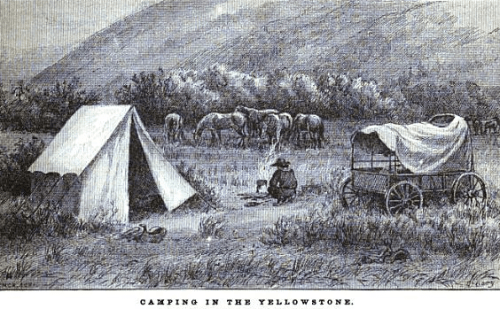
  • A Tale: Making Camp Along the Yellowstone River — George W. Wingate, 1885

    Wingate Camping

    In 1885, General George W. Wingate decided to take his wife and 17-year-old daughter to Yellowstone Park. Although coach tours and luxury hotels were available by then, the Wingates decided to travel on horseback and camp out. That way they could travel at their own pace and see sights skipped by the rushed five-day tours.

    In his accounts of the trip, General Wingate not only described the sights, he also told about the adventures of his companions and their travel routines. Here’s his description of setting up camp.

    ∞§∞

    The routine of camping was always the same, and with experience soon became rapid. During the day we would decide where we would camp for the night, the selection depending first on getting good water, and next upon finding suitable grazing for the stock. As we approached the place selected, Fisher (the guide) would gallop on and reconnoiter, while we followed more slowly. We would find him waiting for us on what he considered the best spot.

    “Well, what do you think of this?” he would ask, as we rode up. “This is all right,” I would answer. “Pitch our tent there, fronting the east; halt the wagon there, and place the table there.” These brief directions given, we would dismount, throwing the reins over our ponies’ heads. This is almost equivalent to tying them, as they step on tbe reins and hurt themselves with the curb, if they attempt to walk.

    The ladies seek the nearest shade and lay themselves flat on their backs, the true way to rest (an idea which they had extracted from Mrs. Custer’s Boots and Saddles), without much regard to the character of the ground, while Fisher and I would unsaddle the ponies, piling the saddles in a heap, and throwing the saddle blankets over them to air and dry.

    The wagon by this time would be up, and would swing into the designated position and unharness. Horace (the driver) would lead the horses to the best grass. Those most inclined to stray would be picketed, the others hobbled. In picketing, a horse is fastened to each end of a rope sixty feet long, by a bowline knot around the throat. To the middle of this rope another is fastened, and attached to a stout stake, tree or rock. This is decidedly preferable to picketing each animal separately.

    The horses are more quiet in each others company, and if they do break away from the picket pin and stray off, are apt to bring up by the cross rope catching in a tree or rock. Besides, the rope makes a trail which is easily followed. In hobbling, a leather strap about eighteen inches long is fastened to each foreleg. I prefer picketing to hobbling, as the latter affects a horse’s gait.

    While the horses were being put out, Sam (our cook) would start his fire and put on his Dutch oven. This was a cast-iron kettle, with a cover of similar material turned up at the edges so as to hold embers, and proved to be a most indispensable article. While it was heating, he would wash his hands with great ostentation (for the benefit of the ladies), retire into the wagon, and mix his biscuit. By the time this was done,

    Horace would be back from the horses. He would put on more wood, fish out and grease the oven. The dough would then be put in, the cover put on, and the whole affair placed in a bed of hot embers, which were also heaped over it. A large gridiron, two feet square, would then be set over the fire, on which the other kettles and pans would soon be simmering.

    Sam flying around from one side of the fire to another, with an intense air of preoccupation, and occasionally uttering a droll remark regarding his experiences in cooking under the various circumstances of his checkered life. As soon as the bread was on the fire, our tent would be put up. We first pegged the corners and put up the pins for the corner guy ropes.

    Then the tent was spread, one of the men crawling into it and adjusting the poles (presenting a most ludicrous appearance as he did so), raised it, tightened the corner guys and drove the other pins, and put a few stones on the flaps if the weather was cold, so as to keep the wind from blowing under it.

    The bedding was then unrolled, a large waterproof spread upon the ground, with two buffalo robes, and then our three mattresses placed over it. The blankets were next spread, one over each mattress, and four for a cover. If the mosquitoes threatened to be troublesome, some sticks were put at the head of the beds, and our mosquito nets tied to them; but this precaution was but seldom necessary.

    The hand-bags were now carried into the tent, and the camp was completed, the whole operation not occupying fifteen minutes. The men had an A. tent, which they only pitched when it was cold or threatened to rain. Usually they slept on the saddle blankets, and used the tent as an extra covering.

    Sam would have his bread baked in twenty minutes. He would then take it out, clean out his Dutch oven, put in whatever he had to roast, and put it back into the tire. By this time the tent was up, the ladies had become sufficiently rested and would begin to either sketch or read, until the melodious banging of a tin pail, and Sam’s eloquent cry of ” din-nur-r,” would rouse all to their feet. No one was ever late to dinner on that trip.

    ∞§∞

    — Text and illustration from George W. Wingate, “My Trip to Yellowstone,” American Agriculturalist.  45(5): 204-205 (May 1886).

    You might also enjoy General Wingate’s stories:


  • A Tale: Breakfast on a Cold Wilderness Morning — Ernest Ingersoll, c. 1880

    Because I write about travel to Yellowstone Park in the Nineteenth Century, I’m always on the lookout for travelers’ accounts of their trips there. I have no problem finding descriptions of unusual sights like geysers and canyons or dramatic events like bear hunting and winter storms. But few writers tell about mundane activities like pitching tents or cooking meals. Ernest Ingersoll is one of the few who does.

    Screen Shot 2013-09-29 at 2.16.42 PMIngersoll was a naturalist and journalist who signed on as a zoologist with expeditions led by the famous Yellowstone explorer Ferdinand Vandeveer Hayden. Apparently Ingersoll was not a member of Hayden’s Yellowstone expeditions in 1871 and 72, but he knew what life must have been like for the people who were. Here’s Ingersoll’s description of camp life and having breakfast on a frigid morning.

    ∞§∞

    Dr. Hayden’s survey was divided into several working divisions of five to seven persons, each of which had a cook, and spent the season in a field of work by itself. Whether or not one thinks these cooks had a hard time of it depends on one’s point of view. It seems to me they had, because they had to rise at such an unearthly hour in the morning; but, on the other hand, they were not obliged to climb snowy and backbreaking peaks, nor to half freeze on their gale-swept summits in” taking observations,” nor to chase a lot of frantic mules and horses that chose to be ugly about being caught up. However, upon having a fairly satisfactory cook depends a large portion of your good time.

    The camp cook presents himself in various characters. There are not many colored men in the West in this capacity, and few Frenchmen; but many Americans have picked up the necessary knowledge by hard experience, not one of whom, perhaps, regards it as a ” profession,” or anything better than a make-shift. It is considered by the ordinary mountaineer as a rather inferior occupation, and, as a rule, it falls to the lot of inferior men, who have tried and failed in more energetic, muscular and profitable pursuits. Of course there are exceptions, but, as a rule, they are men who are not even up to the level of picturesque interest, and are worthy of small regard from the observer, unless he is hungry. We are hungry, therefore we pursue the subject.

    Roads being non-existent in the days whereof I am speaking—to a great extent it is still so—and it often being necessary to go boldly across the country without any regard for even Indian trails, the cuisine, like everything else, had to accommodate itself to the backs of the sturdy mules, on whose steady endurance depends nearly all hopes of success. The conditions to be met by kitchen and larder are, ability to be stowed together in packages of small size, convenient shape, and sufficient strength to withstand, without injury, the severest strain of the lash-ropes, and the forty or more accidents liable to happen in the course of a thousand miles of rough mountain travel.

    The only sort of package that will meet these requirements is the bag. When it is full it is of that elongated and rounded shape which will lie well in the burden. As fast as it is emptied space is utilized and the weight remains manageable. In bags, then, are packed all the raw material except the few condiments, in bottles and flasks, for which, with other fragile things, a pair of paniers is provided. Even the few articles of iron-ware permitted to the camp cook are tied up in a gunny-sack.

    Concerning the preparation of breakfast, I must confess almost entire ignorance. My first intimation of the meal was usually a rough shake, with a loud “Breakfast is just ready, sir. Sorry, sir, but you must get up.”

    Oh, those mornings! If Ben Franklin and all the rest who so fluently advise early rising could have spent a few nights under the frosty stars of the high Rockies, they would have modified their views as to the loveliness of dawn. (Sunset glories for me!) The snow, or the hoarfrost, is thick on the grass beside your couch, and possibly your clothes, carefully tucked under the flap of your canvas coverlid last night, have been elbowed outside and are covered with as much rime as the beard of St Nicholas, while your boots are as stiff as iron, and twice as cold.

    Having groaned your way into them, you hobble to the neighboring stream, duck your head in icy water, and wipe your face on a frozen towel. Usually, you must next seize a rope that has been trailing all night through the frosty grass and painfully tie up your horse, which has just been brought in, so that by the time you do kick a boulder loose and lug it up to the table for your breakfast-chair, your teeth chatter until you can hardly take a voluntary bite, and your fingers are too numb to pass the bacon to the next invalid.

    This frigid condition of things was not invariable, but it was in this way that most of our breakfasts were eaten among the peaks. The matutinal meal over, we felt more limber. Overcoats were thrown aside, and every one hastened to roll up his bedding, strike the tents—if any had been erected—and help saddle and pack the mules. By the time this was accomplished the cook had washed his dishes, strapped up his “munitions of peace,” and announced that he was ready for the kitchen mule, which was the last one to be packed. This completed, he mounted the bell-mare and started off, the train of pack animals filed along behind, and we began another morning’s work before the day was well aired.

    This is the little I can remember concerning breakfast.

    ∞§∞

     — Excerpt abridged from Ernest Ingersoll, “Rocky Mountain Cookery,” Scribner’s Monthly 29(1) 125-132 (May 1880).

    — Illustration from Ingersoll’s book, Knocking Around the Rockies. Harpers: New York, 1882.

    — You might also enjoy Ingersoll’s description of preparing a camp supper.

  • A Tale: Gathering a Specimen From a Boiling Spring— N.P. Langford, 1870

    When the famous Washburn Expedition of 1870 explored the area that later became Yellowstone National Park, they wanted to bring back specimens to prove that the geological wonders they reported weren’t just tall tales. Locating remarkable features like geysers, hot springs and paint pots wasn’t hard, but collecting tangible evidence could be dangerous.  Here’s Nathaniel P. Langford’s description of gathering a specimen.

    ∞§∞

    gathering a specimen

    Entering the basin cautiously, we found the entire surface of the earth covered with the incrusted sinter thrown from the springs. Jets of hot vapor were expelled through a hundred natural orifices with which it was pierced, and through every fracture made by passing over it. The springs themselves were as diabolical in appearance as the witches’ caldron in Macbeth, and needed but the presence of Hecate and her weird band to realize that horrible creation of poetic fancy.

    They were all in a state of violent ebullition, throwing their liquid contents to the height of three or four feet. The largest had a basin twenty by forty feet in diameter. Its greenish-yellow water was covered with bubbles, which were constantly rising, bursting, and emitting sulphurous gas from various parts of its surface. The central spring seethed and bubbled like a boiling caldron. Fearful volumes of vapor were constantly escaping it.

    Near it was another, not so large, but more infernal in appearance. Its contents, of the consistency of paint, were in constant, noisy ebullition. A stick thrust into it, on being withdrawn, was coated with lead-colored slime a quarter of an inch in thickness. Nothing flows from this spring. Seemingly, it is boiling down.

    A fourth spring, which exhibited the same physical features, was partly covered by an overhanging ledge of rock. We tried to fathom it, but the bottom was beyond the reach of the longest pole we could find. Rocks cast into it increased the agitation of its waters. There were several other springs in the group, smaller in size, but presenting the same characteristics.

    The approach to them was unsafe, the incrustation surrounding them bending in many places beneath our weight—and from the fractures thus created would ooze a sulphury slime of the consistency of mucilage.

    It was with great difficulty that we obtained specimens from the natural apertures with which the crust is filled—a feat which was accomplished by one only of our party, who extended himself at full length upon that portion of the incrustation which yielded the least, but which was not sufficiently strong to bear his weight while in an upright position, and at imminent risk of sinking into the infernal mixture, rolled over and over to the edge of the opening, and with the crust slowly bending and sinking beneath him, hurriedly secured the coveted prize.

    ∞§∞

    — Excerpt and illustration from Nathaniel P. Langford, “The Wonders of the Yellowstone,” Scribner’s Monthly 2(1):1-27 (May 1871).

    — To see other stories by this author, click “Langford” under the Categories button.

    — An abridged version of Langford’s 1905 book, The Discovery of Yellowstone Park—Diary of the Washburn Expedition to the Yellowstone and Firehole Rivers in the Year 1870, is available in my book, Adventures in Yellowstone.

  • A Tale: An Unfair Fight Between a Bear and a Pussy Cat — Ernest Thompson Seton, 1896


    In 1896, naturalist and writer Ernest Thompson Seton went to Yellowstone Park to inventory animals there for a magazine assignment. He spent a day watching bears at the Fountain Hotel dump near the Lower Geyser Basin. Such bear watching was common then.

    Seton saw a momma black bear called “Grumpy” pick a fight with a huge grizzly called “Wahb” to protect her sickly cub. After the battle, Seton interviewed hotel employees to find out as much as he could about the bears. Based on his research, Seton wrote his famous story, “Johnny Bear,” and a book, Biography of a Grizzly

    The most memorable incident in “Johnny Bear,” is the battle between Grumpy and Wahb, but in it Seton described other adventures like Grumpy’s encounter with an even more formidable foe. 

    ∞§∞

    Grumpy herself was fond of plum jam. The odor was now, of course, very strong and proportionately alluring; so Grumpy followed it somewhat cautiously up to the kitchen door. There was nothing surprising about this. The rule of “live and let live” is Bear & Kitten Setonso strictly enforced in the park that the bears often come to the kitchen door for pickings, and on getting something, they go quietly back to the woods. Doubtless Johnny and Grumpy would each have gotten their tart but that a new factor appeared in the case.
    That week the Hotel people had brought a new cat from the East. She was not much more than a kitten, but still had a litter of her own, and at the moment that Grumpy reached the door, the cat and her family were sunning themselves on the top step. Pussy opened her eyes to see this huge, shaggy monster towering above her.

    The cat had never before seen a bear—she had not been there long enough; she did not know even what a bear was. She knew what a dog was, and here was a bigger, more awful bobtailed black dog than ever she had dreamed of coming right at her. Her first thought was to fly for her life. But her next was for the kittens. She must take care of them. She must at least cover their retreat. So, like a brave little mother, she braced herself on that doorstep, and spreading her back, her claws, her tail, and everything she had to spread, she screamed out at the bear an unmistakable order to, “STOP!”

    The language must have been “cat,” but the meaning was clear to the bear; for those who saw it maintain stoutly that Grumpy not only stopped, but she also conformed to the custom of the country and in token of surrender held up her hands.

    However, the position she thus took made her so high that the cat seemed tiny in the distance below. Old Grumpy had faced a Grizzly once, and was she now to be held up by a miserable little spike-tailed skunk no bigger than a mouthful? She was ashamed of herself, especially when a wail from Johnny smote on her ear and reminded her of her plain duty, as well as supplied his usual moral support.

    So she dropped down on her front feet to proceed.

    Again the cat shrieked, “STOP!”

    But Grumpy ignored the command. A scared mew from a kitten nerved the cat, and she launched her ultimatum, which ultimatum was herself. Eighteen sharp claws, a mouthful of keen teeth, had Pussy, and she worked them all with a desperate will when she landed on Grumpy’s bare, bald, sensitive nose, just the spot of all where the bear could not stand it, and then worked backward to a point outside the sweep of Grumpy’s claws. After one or two vain attempts to shake the spotted fury off, old Grumpy did just as most creatures would have done under the circumstances; she turned tail and bolted out of the enemy’s country into her own woods.

    But Puss’s fighting blood was up. She was not content with repelling the enemy; she wanted to inflict a crushing defeat, to achieve an absolute and final rout. And however fast old Grumpy might go, it did not count, for the cat was still on top, working her teeth and claws like a little demon. Grumpy, always erratic, now became panic stricken. The trail of the pair was flecked with tufts of long black hair, and there was even blood shed. Honor surely was satisfied, but Pussy was not. Round and round they had gone in the mad race. Grumpy was frantic, absolutely humiliated, and ready to make any terms; but Pussy seemed deaf to her cough-like yelps, and no one knows how far the cat might have ridden that day had not Johnny unwittingly put a new idea into his mother’s head by bawling in his best style from the top of his last tree, which tree Grumpy made for and scrambled up.

    This was so clearly the enemy’s country and in view of his reinforcements that the cat wisely decided to follow no farther. She jumped from the climbing bear to the ground, and then mounted sentry guard below, marching around with tail in the air, daring that bear to come down. Then the kittens came out and sat around, and enjoyed it all hugely. And the mountaineers assured me that the bears would have been kept up the tree till they were starved, had not the cook of the Hotel come out and called off his cat—although his statement was not among those vouched for by the officers of the Park.

    ∞§∞

    • — Excerpt condensed from “Johnny Bear” by Ernest Thompson Seton, Scriberner’s Magazine 28(6):658-671 (December 1900).  Illustration by Seton from the magazine.

    — You might also enjoy:

    — You can read a condensed version Ernest Thompson Seton’s “Johnny Bear” in my book, Adventures in Yellowstone.

  • A Tale: Confusion Surrounds the First Car Officially in Yellowstone — 1915

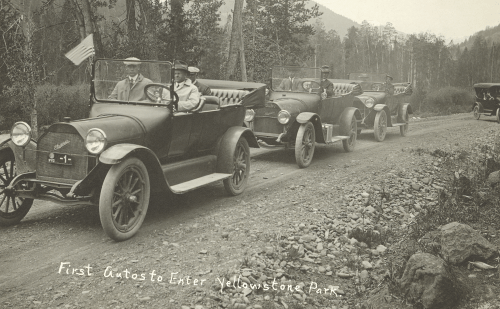
    YNP First Cars 1915 PMB
    Dignitaries in a White Motor Company car lead the official automobile entourage in Yellowstone Park on August 1, 1915.

    The story below claims to describe the trip by the first automobiles admitted to Yellowstone National Park. I’ve learned to be skeptical of such claims so I checked it out in Aubrey Haines’ definitive history, The Yellowstone Story

    According to Haines, Henry G. Merry sneaked in his 1897 Winton in 1902 making it the first car to enter the park. As Merry’s son told the story, his father raced his car past the mounted guards at the Gardiner Entrance. The cavalrymen gave chase on horseback and caught the machine when slowed on steep hill. They tied ropes to the the Winton and dragged it to park headquarters at Mammoth where the park superintendent ordered it out of the park—after demanding a ride.

    People feared that automobiles would frighten horses and wildlife, so the park superintendent issue a general order forbidding cars. Hains says several vehicles entered the park by accident or contrivance before the order was lifted in 1915.

    Political pressure from motorists increased until the Secretary of Interior decided in April 1915 to admit cars on August 1 of that year. However, the park superintendent wasn’t sure that cars could make the trip so he allowed two cars, a Buick and a Franklin, to drive a two-day circuit in June. Then a group of congressmen and government officials motored from the East Entrance to the Lake Hotel on July 4. The new regulation allowing cars was to go into effect on August 1, but the superintendent feared congestion so he issued seven permits on July 31.

    Haines says that officials of the White Motor Company thought one of their cars was the first officially allowed in the park and issued a news release to that effect. The news release apparently was the basis for the story below. A magazine editor asked for clarification from the park superintendent who told him that a Ford had been issued permit number one the day before the White led the official entourage.

    For the first year, private cars shared park roads with touring coaches pulled by four-horse teams, but in 1916 commercial tour busses were admitted. Those buses were made by the White Motor Company.

    ∞§∞

    The first car entered the park at 6 o’clock on the afternoon of July 31, when a party of government officials, riding in a White car, passed through the lava arch at Gardiner, Montana, followed by a large cavalcade of motorists who were waiting for the honor of entering the park on the first day.

    In the official car were Colonel Lloyd M. Brett, U. S. A., acting superintendent of the park, Major Amos A. Fries, U. S. A., chief of the park engineers, H. W. Child, president of the Yellowstone Park Hotel and Transportation Companies, and Robert S. Yard, of the Department of the Interior. The car, followed by the procession of motorists, led the way to the Mammoth Hot Springs Hotel, where the night was spent. The following day it led to a tour of the entire park.

    From the seat of a comfortable motorcar it is possible to see Yellowstone in a way that no other mode of transportation affords. Entering the park at Gardiner, the official car covered a five-mile stretch of road, winding around beautiful hills and high cliffs and skirted by the rugged, foaming Gardiner river. This road brought the party to the Mammoth Hot Springs Hotel.

    Promptly at 7 the next morning, the official White left Mammoth Hotel for a complete circuit of the park. The road requires a sharp ascent and soon overlooks the gleaming white formation of the Mammoth Hot Springs, 6,264 feet, which had appeared as a small mountain when viewed from the porch of the hotel. Three miles farther, Silver Gate and the Hoodoos, massive blocks of travertine, are passed at an altitude of 7,000 feet. One-half mile farther, one of the prettiest spots on the trip is reached. This is Golden Gate, 7,245 feet,  a curving road on the side of a deep canyon. A fine concrete viaduct here shows great engineering skill.

    Golden Gate canyon then emerges into picturesque Swan Lake basin. From this mountain valley can be seen Electric peak, Quadrant mountain, Bannock peak, Antler peak, The Dome, Trilobite point and Mount Holmes. Ten miles from Mammoth Hot Springs, Appollinaris Spring is reached. Two miles farther Obsidian cliff is reached.

    Roaring mountain, fifteen and one-half miles from Mammoth Hot Springs, is the next interesting place. Passing from here Twin Lakes is almost immediately reached. Here are two small lakes of entirely different color, but joined together by a small strip of water. Then comes the Frying Pan, eighteen miles from Mammoth Hot Springs, with an altitude of 7,500 feet. This is a hot spring, which stews and sizzles year in and year out, reminding one of a hot griddle all ready for business.

    At the crossing of the Gibbon River, the tourist comes to the first soldier station, and from there it is only a half mile to Norris Geyser basin, where Norris hotel is located. As the official car pulled up to the steps of the hotel a great crowd collected to see the first motorcar that had ever visited the hotel.

    A great deal of time can be well spent at this point viewing the many geysers— Constant geyser, Whirligig geyser, Valentine geyser, Black Growler, Bathtub, Emerald pool and some small paint pots.as the vari-colored thermal pools are called.

    The official car left Norris at 9:15 a. m., after a brief stop. The next hotel stop is Fountain Hotel, twenty miles farther into the park. Approaching Fountain Hotel another geyser basin is seen. This is the largest in area of the park geyser basins, but the geysers here are scattered and are not of as much importance as others along the route. Fountain Hotel was passed at 11:00 a. m., and after a short ride Mammoth Paint Pots were reached.

    The official party reached Upper geyser basin at 12:00 o’clock, and stopped two and one-half hours for lunch at the beautiful Old Faithful Inn. The stop gave time for a leisurely visit to the area of geysers here, which contains the largest and finest geysers in the world. Of course the center of attraction is Old Faithful geyser, which nearly every one has heard of, and the Giant geyser, the greatest of them all.

    Leaving Old Faithful Inn at 2:30, the official car sped on and began the long climb to the Continental Divide, first along the Fire Hole river and then up Spring Creek canyon. Two miles from the hotel a stop was made to view the beautiful Keppler cascades. The first crossing of the Continental divide is made at an altitude of 8.240 feet, eight and one-half miles from Old Faithful Inn. The road leads down Corkscrew hill, where good brakes and a substantial steering gear come in handy.

    Lake hotel was reached at 6:15 p. m., and it seemed a pity that the schedule required the party to push on to Canyon Hotel without much time to spend enjoying the wonderful view across the Yellowstone lake from the veranda of the Lake Hotel. However, there was a slight delay here, while the White ran back seven miles to rescue the press car, which had stalled and refused to start on one of the long, tortuous hills.

    Starting after dinner from the Lake Hotel at 7:30 p. m., the seventeen miles of road to Canyon Hotel were covered in one and one-half hours, over soft, slippery roads which, added to the frequent turnings, scarcely warranted the speed that “was made. It had rained all of Saturday night and the car was covered with mud. The night was spent at Grand Canyon Hotel.

    Beautiful sights were seen on the morning run from the Canyon Hotel to Tower falls by way of Dunraven pass, 8,800 feet. There is a road that leads to the top of Mt. Washburn, but since the roads in this vicinity were found particularly wet, narrow and slippery, this route was avoided.

    About half way around Mt. Washburn, a brand new auto station built of logs has just been erected, on the outside of the road. Soldiers are stationed here, as elsewhere through the park, to check passing autos and make sure that motor tourists are observing the regulations.

    Leaving Mt. Washburn, the road steadily descends to Tower creek, whose altitude is 6,400 feet. The road along here provides wonderful scenery, as is runs along high above the rock-strewn Yellowstone river.  After the long, descending road from Mt. Washburn another soldier station is passed and, by turning off the main road a half mile, the Petrified Trees may be reached. The sight is well worth the slight detour.

    Approaching the end of the trip a fine view is obtained of the valley in which Fort Yellowstone and Mammoth Hotel are located. The sight of this great group of buildings, flanked by hills and mountains and the white terraces of the Mammoth Hot Springs, is a fitting end to a most remarkable journey. The official car unloaded its passengers in front of the residence of Colonel Brett at 11:15 on August 2, and the first tour of Yellowstone Park ever made by Automobile had been completed in less than one and one-half days.

    However, no one wishing to really enjoy the scenery of Yellowstone Park should make the trip in less than four days. Overnight stops should be made at Mammoth Hot Springs Hotel, Old Faithful Inn, the Lake Hotel and at the Grand Canyon Hotel. While all motor tourists would be required to make the regular schedule between the checking stations, the regulations permit them to lay over at hotels and other points of interest until they are ready to proceed, which may be done when the next schedule of motor cars passes their location.

    At present the privileges of the park are only extended to privately owned motor cars. The present tourist service through the park will be maintained by horse-drawn vehicles operated by the regular transportation companies as heretofore. All regular traffic will move in one general direction in going through the park. Motor cars will leave one-half hour before the stages, from the entrances or from the controls where they are checked in during the journey through the park. The speed at which cars may travel is stated in the regulations and varies according to the requirements of safety in various localities. Fines will be imposed on motorists who arrive or leave the controls not according to schedule.

    A special telephone service has been installed to enable motor tourists to keep in touch with headquarters if breakdowns occur. In such emergencies, if motor cars are unable to reach the next control on time, they must be parked off the road or on the outer edge of it, and wait for the next schedule of motor cars passing that point or, until special permission to proceed is obtained from the park guards.

    Motorists who intend to tour Yellowstone Park should thoroughly familiarize themselves with the rules and know the penalties imposed for any infractions. It is also important to plan the trip before entering the park, so as not to miss any points of interest which one might wish to return to. This cannot be done except by encircling the park and entering again, since travel moves only in one direction.

    ∞§∞

    — Condensed from “Motorists Touring Yellowstone Park,” Automobile Topics. 39(3):189-190 (August 28, 1915.)

    — Photo, Pioneer Museum of Bozeman.

    You might also enjoy

  • A Tale: Guarding the Horses — Rossiter Raymond, 1871


    Early travelers to Yellowstone Park often woke up in the morning to discover that their horses and wandered away in the night. That’s because the tourists faced a dilemma. Their horses needed to graze to keep up their strength, so the travelers had to give them some freedom. But with too much freedom, the animals would wander away leaving the travelers afoot in the remote wilderness.

     Rossiter Raymond, who led the first group of tourists to visit Yellowstone Park in 1871, solved the problem by picketing his men’s horses and posting a guard to keep their roped untangled. His Raymond’s description of what it was like to be on guard duty.

    ∞§∞

    grazing horsesOur practice, at night was to pour water on the fire after supper, and picket the animals close around us where we lay on the ground. After reaching the Upper Madison we took turns in standing guard, to watch again possible stealing or stampeding of the stock and also, from time to time, to see to it that the picket-ropes were clear.
    When you want to pasture one horse for one night on an ample lawn, the business is easy enough. You drive your picket pin deep enough to hold, and leave enough of it above ground to permit the firm fastening of the rope, but not to permit the winding up of the rope oil the pin by possible circular promenades on the horse’s part; after which, you bid the horse, and all care on his behalf, goodnight.

    Unless he is a very raw recruit at picket-duty, he will move about with perfect freedom over the whole circle of which the rope is the radius; and you will hear him nibble and crunch the squeaking grass at all hours of the night. But, when you apprehend Indians you can’t afford to hunt up a smooth lawn for each horse. As the higher mountains are entered, the grass grows scanty, and it is necessary to make the best of such patches as occur.

    So the animals get picketed where bushes interfere with the free circulation of the ropes, or so near together that they can (and accordingly do) get up mutual entanglements. Every such performance shortens the radius, and the realm of food. An experienced picketer generally makes one or two attempts to disentangle himself, by traveling around in the direction that first occurs to him. If this happens to be the right one, he may work out again to the, full arc of his destined supper: otherwise he winds himself up, and then (unlike a clock) stops going.

    It is the duty of the guard to go out, unwind him, and start him again, lest, standing in patient disgust all night, he be found in the morning empty of grass and of spirit for the day’s work. It is solemnly amusing to march in a moony midnight hither and thither, followed by a silent steed, through all the intricacies of the knot he has tied, with the aid of stumps, bushes, his own legs, and his neighbor’s rope. Fancy yourself unraveling a bad case of shoestring, and obliged to pull a horse through every loop at the end of the string. The Lancers ” is nothing to it. For a real mazy dance, to puzzle the floor-committee, give me the nine-horse pick picket cotillion.

    At daylight the animals are let loose, and stray about, trailing their long ropes, in search of untrampled grass for breakfast. It is easy to catch them by means of the ropes, though now and then an experienced old fellow has learned the exact length of his lariat, and will not let you get near enough to clutch the end of it.

    This keeping guard at night without the companionship of the campfire is a chilly and dispiriting affair. The first watch is not very lonely. There is generally some wakeful comrade who sits up in his bed to talk; or perhaps the whole party linger around the flameless embers, exchanging stories of adventure. But he who “goes on” from midnight till dawn, surrounded only by mummies rolled in blankets on the ground, is thrown upon his thoughts for company.

    The night-noises are mysterious and amazingly various, particularly if the camp is surrounded by woods. There are deer and elk going down to the water to drink; there are unnatural birds that whistle and answer, for the world, like ambuscading savages; there are crackling twigs; the picket-ropes crawl through the grass with a dreadful sound; the grass itself squeaks in an unearthly way when it is pulled by the horses’ mouths.

    The steady crunching of their grinders is a re-assuring, because familiar sound; but ever and anon it stops suddenly, all the horses seeming to stand motionless, and to listen. Their ears are quicker than yours: they hear something moving in the forest, -doubtless the wily Sioux. You glide from tree to tree, revolver in hand, until you get near enough to see that they are all asleep. Old Bony is dreaming unpleasantly besides: it is an uncanny thing—a horse with the nightmare. You make the rounds. They all wake and go to eating again: so you know they were not scared except the blooded bay, who mistakes you for an Indian, and snorts and cavorts furiously.

    I remember well such a night, near the banks of the Yellowstone Lake, when we were doubly suspicious, because we had heard a rifle-shot close by our camp, not fired by any member of our party. I was on guard at about 1 a.m., and keenly alive to all the blood-curdling sensations I have mentioned, when suddenly the trees above and the ground beneath were shaken by a brief but unmistakable earthquake. The shock was in the nature of a horizontal vibration; and the emotion produced by the experience at such an hour, in the solemn woods, was a unique combination of awe and nausea. I was not sorry that one or two of the party were waked by it: under the circumstances, I was grateful for a little conversation.

    ∞§∞

     — Pages 173-176 in  Rossiter W. Raymond, Camp and Cabin. New York: Ford Howard and Hulbert, 1880.

    — B.H. Alexander Postcard, Pioneer Museum of Bozeman.

    — You might also enjoy these tales about Raymond’s expedition.

  • A Tale: Traveling to Yellowstone with a Mule Train — John Mortimer Murphy, c. 1879

    Charles D. Loughrey Mule Train PMB

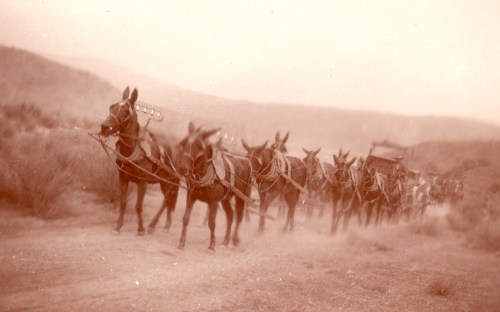
    When John Mortimer Murphy went to Yellowstone Park in the 1870s, he decided to take part of the trip from Utah to Montana by mule train. Such trains, which supplied Montana gold rush towns in the 1860s and 70s, had teams of as many as 20 mules. Here’s Murphy’s tale about traveling with the hardy teamsters who drove the huge teams.

    ∞§∞

    After a tediously slow journey the train reached Corinne, the only gentile settlement in Utah, and therefore a perfect Babylon of wickedness in the eyes of Mormons. This place was formerly unusually prosperous and enterprising, as it was the head-quarters for the numerous prairie schooners that transported goods into Montana; but since the construction of the Utah Northern Railroad it has lost its commerce and prestige, and is now only a sleepy village of 700 inhabitants.

    I left there for a small town called Franklin, in Idaho, 100 miles distant, via railroad, which is now the head-quarters for the hundreds of large wagons or prairie schooners that take manufactured articles into Montana, and return laden with the products of that extensive region. From Franklin all travel northward is by stage or horseback, and he who chooses the latter may rely upon jolting enough to dispel all symptoms of indigestion, as the country to be traversed is very hilly, and the roads are mere trails.

    I secured a seat in one of the “schooners,” as I wished to see the sort of life led by those captains of the plains who drive the mules, and I thoroughly enjoyed the novelty of the trip. The genial fellow with whom I booked as a free passenger led a line of perhaps thirty wagons, and by this leading advantage escaped the clouds of dust, which enveloped those in the rear. His team consisted of eight pairs of mules and two “bell mares,” whose jingling cadence soothed the feelings of the obstinate long-eared quadrupeds so much that they toiled and struggled all day without an effort at a display of stubbornness.

    Our route led back through Idaho, and carried us through the fertile valley of the Beaver River, where Mormons were quite thickly settled. Their substantial houses, well-kept farms, and crowds of tow-headed children were seen in every direction, and gave the country a cultivated appearance most pleasing to behold.

    The long line of wagons rumbled onward all day, and in the evening encamped together in an open plain. Fires were then lighted, and a supper, consisting of fat bacon, bread made out of self-raising flour and baked in a pan, and hot strong coffee was partaken of by the drivers with a relish which can be enjoyed only by those who toil hard and have their appetites sharpened by the bracing air of the plains.

    After this was over the teamsters paid each other, friendly visits, but I noticed that the inquiries made were usually about the draught animals, and their good conduct during the day. If the answers were not satisfactory on the latter point, a dozen recipes would be given for bettering it, and some would go so far as to advise the death of that “Yaller Jim,” “Black Bill,” or “Wall-eyed Virginia,” as nothing else could cure them of their ill temper.

    The last spree in Franklin, Bozeman, or Helena was related with the most minute exactness, and the fight that Piegan Jack had with Hiel Southard discussed in all its bearings—and the cause of the death of the latter analyzed in the most tediously detailed manner.

    When the time for retiring came each muleteer spread a roll of blankets under his wagon, rolled himself up in it, and was soon fast asleep. At daybreak the next morning the animals were fed, a repast of the same character as the previous dinner eaten, and the long line resumed its march.

    These teamsters are a hardy, rough-and-ready class, who seem impervious alike to fear and the vicissitudes of the weather; and it would be difficult to find any persons more hospitable than they are. Their mode of life prevents them from enjoying many of the advantages of education, yet few are met who cannot read and write; and all can discuss local and national politics with a terseness and emphasis that would do credit to a professional politician.

    The individual among them who is not brave, or, as they term it, “has no sand in him,” is rare indeed, as the majority of them have had to fight Indians many a day, and being adepts with the rifle and revolver, the body of men that could defeat them is difficult to find. Every one carries arms in his wagon, and not a few wear revolvers in their belts, so that they are prepared for emergencies at all times.

    Many drive their own teams, but several are employed by transport companies at sums varying from 100 to 200 dollars per mouth, according to the dangerous character of the route they traverse, or the heavy work they have to do. Whenever a body of Indians takes to the war path the caravanseries are the first objects of assault, if plunder is desired, but the occasion is very rare when the attack is successful, if the teamsters are in any numbers, or have received an intimation of their danger.

    I stayed with the caravan until it reached Fort Hall, in Idaho, and there bidding my kind host a farewell, I booked as a passenger in the stage that ran through Montana, then distant some 200 miles. The route over which it travelled was but sparsely settled, and wandering Indians even were seldom seen.

     ∞§∞

    — John Mortimer Murphy, Rambles in Northwestern America, London: Chapman and Hall, 1879. (pages 195-197)

    — Charles D.Loughrey Photo, Pioneer Museum of Bozeman.

    — You might also enjoy General W.E. Strong’s story about traveling to Montana by stagecoach, “One Good Square Drink.”

  • A Tale: Face to Face With a Hungry Mountain Lion — Turrill, 1898

    Lion 2 YDSF

    By the time Gardner Stillson Turrill toured Yellowstone Park in 1898, the Army had outlawed hunting there and made tourists either leave their guns in storage or have them sealed when they entered the park. Despite the gun regulations, hunters still were drawn to the area. In fact, conservations like Theodore Roosevelt promoted the idea that protecting game animals inside park boundaries would make for to abundant hunting on the periphery.

    Turrill and his companions not only were avid hunters, they also entertained each other buy telling hunting stories. Here’s a tale one of Turrill’s friends told about an adventure he had while staying with an old man in a cabin high in the Wyoming Mountains.

    ∞§∞

    One night I was awakened by a shuffling noise overhead and the heavy footfall of some large animal that was evidently on the cabin roof. I got out of bed to make sure the door and window were securely fastened, and, as additional precaution, I set my rifle at the head of the bunk and piled some dry pine knots on the fire.

    I heard nothing more that night, but the next morning I saw the tracks of an extra large mountain lion on all sides of the house as well as in the snow on the roof. After breakfast I told the old man that I was going out for a little hunt and warned him not to be uneasy if I were gone several hours.

    I followed the tracks of the big cat as he had made his way to the creek. I was fond of adventure and was determined to have a shot at the animal if I could possibly overtake him.

    The snow was soft, but with snowshoes I was able to make good time. In places I noticed where the lion had broken through into deep drifts and the way they were ploughed and scattered by the beast in his efforts to flounder through one could almost imagine that a horse had been forcing his way across. The animal surely must have been hungry to go so far from his lair in the deep snow!

    I soon reached the creek and followed the tracks on over to the other side. The trail now wound here and there among the trees. up the hillside toward a bold bare bluff that towered above the trees several hundred yards ahead of me. I had been advancing with the utmost caution, but now decided that the animal had surely gone to his den somewhere along the base of the cliff

    “Very good.” I thought to myself. ” I will follow the tracks to the den, then climb a tree and shoot Mr. Catamount at my leisure whenever he sees fit to come out. The animal will soon be mine now and I will have a fine skin for my morning’s walk.

    Occupied with these pleasing reflections I shouldered my gun and, as I walked along, looked away through the trees at the precipitous bluff that was my objective point. But suddenly I came to my senses with a start. The panther trail had disappeared.

    I retraced my steps a few rods till I came again to the huge cat-like tracks that I had been following. They seemed to end right there. It was very strange. Did the creature have wings? ‘I pursed my lips to fetch a dismayed whistle, but that whistle was never uttered.

    Quicker than lightning the truth flashed over me. The animal had taken to a tree. and was even then, very likely, making ready for a spring. If I had been experienced I would not have walked into such a trap.

    My heart seemed to stop beating and my blood appeared to be frozen in my veins. A feeling of deadly weakness came over me, but only for a second. Hastily I grasped the gun and looked up. To run would be to court instant death. My only hope was that I might see the beast before he sprang.

    Eagerly I scanned the branches above me but could discern nothing. A moment of breathless suspense, and then I heard a soft patting sound which could be nothing else than the beast’s tail striking against a branch, as he switched it to and fro. The sound seemed to come from a huge spruce just in front of me.

    Looking closely I was able to make out the dark indistinct form lying along one of the main branches in the shadow of the thick foliage. To hesitate was fatal and to miss my mark would be equally so. I hastily threw the gun to my shoulder and pulled the trigger.

    The report of the rifle was followed by a shrill scream as the lion hurled himself at me through the air. But my bullet had taken effect in his shoulder and he fell short.

    I tried to shoot again, but the lever caught for some cause. and the beast came at me snarling and spitting in a terrible fury. The instinct of self-preservation was strong and mustering all my strength. I shoved the muzzle of the gun right into those cruel red jaws.

    The panther gagged, bit at the barrel of the gun and tried to get at me. The next second I gave a jerk on the lever, disengaged it and shoved a cartridge into place. Just as I felt my strength leaving. I pulled the trigger; the old gun roared and the panther fell at my feet with its head literally torn to pieces.

    It was a very weak and humble hunter that pulled himself together. walked back across the creek and up the mountain side to the little cabin. I have never shot a mountain lion since, and I hope that I will never again have occasion to do so.

    ∞§∞

     — Pages 49-52 in Gardner Stillson Turrill, A Tale of the Yellowstone. Jefferson, Iowa: G.S. Turrill Publishing, 1901.

    — You might also enjoy:

    For more hunting tales, click “Hunting” under the Categories button.

  • A Tale: “The worst nuisance in the way of wild varmints is the bears.” Clifton Johnson, 1919.

    Model T tourists and bears YDSF

    Sometime in the nineteen teens, Clifton Johnson took a walking tour of Yellowstone Park. He visited the area in May before the tourist season, so about the only people he encountered were winter keepers, men who cleared the roofs of park buildings to keep mountains of snow from crushing them. Johnson had long conversations with the winter keepers and collected their stories.

    One of the people Johnson interviewed was the winter keeper at Norris Geyser Basin, a man who had lived in the park since 1883 before the Army took over administration there. The Army forbid hunting and ended the decimation of park wildlife that had made seeing large animals like elk and bison rare. The soldiers lacked today’s notion of ecological balance so they continued killing large predators like wolves and mountain lions in hopes of protecting other animals.

    By the time Johnson visited Yellowstone Park, most animals had made a comeback so he saw many of them and their tracks in fresh snow as he trudged along. Here’s what the winter keeper at Norris said about Yellowstone animals.

    ∞§∞

     I spoke to the keeper about some of the animals I had seen, and of the numerous foot prints of wild creatures I had observed in the snow and mud. “Yes,” he said, “we have here about every animal that’ll live in a cold climate—bears and buffaloes, moose, wildcats, lynx, badgers, big-horns, red, black, blue, and silver foxes, mountain lions, eagles, and lots of other creatures. They claim there ain’t any wolves; but I think I saw one once. He snapped his jaw at me and run off, but it was in a snowstorm, and I didn’t see him real plain.

    The government tries to kill off any such animals that are very destructive to the other creatures. Mountain lions are bad that way. They ketch a good many of our deer and elk. I suppose there’s quite a lot of ’em in the park; but you might stay here a hundred years and never see one—they’re just that sly. However, they see you and will follow you, stopping when you stop and going on when you go on.

    “Nearly all the animals are much more plenty than they were when I began living in the Park in 1883. I didn’t see any deer for a long time. They were so wild they kept back in the woods. Now they’re so tame I often feed ’em out of my hand.

    One of the most interesting things I know of is to see a deer kill a snake. It will leap into the air, put all four feet within a few inches of each other and light on the snake so quick that the snake don’t know what’s happened. The deer is off at once, and then makes the same kind of a jump again and again, till its sharp hoofs cut the snake right in two. A deer will kill every snake it comes across.

    “One queer creature we have in the Park is a wood rat—a tremendous big fellow with a flat tail as large around as your finger. It likes to beat on the floor with that tail, and makes as much noise as you could with a stick. For a nesting place it prefers some dark loft where it uses all sorts of rubbish in building a nest that would fill a barrel. Whatever it can get hold of that is not too heavy or bulky it carries off. We might leave our shoes and socks here by the stove, and perhaps one of those rats would carry ’em off. But the chances are, if it wasn’t disturbed, it would bring ’em back the next night.

    “The worst nuisance we have though in the way of wild varmints is the bears. They’re raising Cain all the time, and there’s getting to be lots of ’em. The grizzlies are the bosses. When a bunch of the cinnamons and blacks are together at a hotel garbage heap they all get up and run fit to kill themselves if a grizzly comes around. Some of the bears are big fellows that have a footprint the size of a pan. About this time of year they’re beginning to fish in the small streams. They’ll lie down at the edge of the water and watch perfectly still, and then give a slap that’ll throw a trout way out on the land.

    “They make lots of trouble for tourists with tents and wagons. I was camping in the Park one time, and a bear smelt my provisions and come right after ’em. It was night and dark, and every time I heard the bear prowling around I’d throw something at it, and I had to spend all the next day picking up the articles I’d used for bombarding the creature.

    “I used to have a mule that liked nothing better than to chase a bear up a tree. Then he’d back up to the into a path made by two bears which had followed the road, one behind the other, almost the entire distance to the Canyon. The imprint of their broad feet was clearly marked and had a savagely human aspect. I decided to give the creatures the road if I chanced to meet them, and that I would climb a tree if they were inclined to cultivate my acquaintance. But probably they would have made as hasty a detour as any I contemplated. At least, two grizzlies which I attempted to approach one evening in the neighborhood of the hotel where I was stopping, promptly scampered off into the brush with just such snorts of alarm as a hog makes when suddenly frightened into flight.

    ∞§∞

    — “May in the Yellowstone, Pages 215-231 in Clifton Johnson, Highways and Byways of the Rocky Mountains.  New York: MacMillan, 1919.

    — Photo, Yellowstone Digital Slide File.

    — You might also enjoy  this tale about “Hunting a Mountain Lion.”

    — To see more stories like this click “Bears” under the Categories Button.