Thomas Moran began conjuring images of the upper Yellowstone before he even saw the place. Moran was an illustrator for Scribner’s Monthly and provided drawings for N.P. Langford’s article about the famous Washburn expedition of 1870.
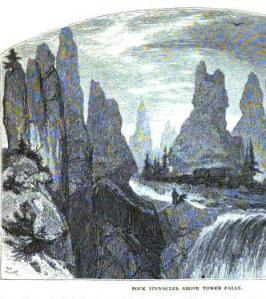
While learning to paint, Moran sought inspiration from literary works such as Longfellow’s “Hiawatha,” so it wasn’t hard for him to base his illustrations entirely on Langford’s words. The results were interesting (if sometimes inaccurate). Below is what Langford said about Tower Fall and how Moran pictured it.
∞§∞
Tower Falls Illustration from Scribner’s
Tower Creek is a mountain torrent flowing through a gorge about forty yards wide. Just below our camp, it falls perpendicularly over an even ledge 112 feet, forming one of the most beautiful cataracts in the world. For some distance above the fall, the stream is broken into a great number of channels each of which has worked a torturous course through a compact body of shale to the verge of the precipice where they re-united and form the fall.
The countless shapes into which the shale has been wrought by the action of the angry waters, add a feature of great interest to the scene. Spires of solid shale, capped with slate, beautifully rounded and polished, faultless in symmetry, raise their tapering forms to the height of from 80 to 150 feet, all over the plateau above the cataract. Some resemble towers, others spires of churches, and others still shoot up as lithe and slender as the minarets of a mosque.
Some of the loftiest of these formations, standing like sentinels upon the very brink of the fall, are accessible to an expert and adventurous climber. The position attain on one of their narrow summits, amid the uproar at a height of 250 feet above the boiling chasm, as the writer can affirm, requires a steady hand and strong nerves; yet the view which rewards the temerity of the exploit is full of compensations.
Below the fall the stream descends in numerous rapids, with frightful velocity, through a gloomy gorge, to its unions with the Yellowstone. Its bed is filled with enormous boulders, against which the rushing waters break with great fury. Many of the capricious formations wrought from the shale excite merriment as well as wonder. Of this kind especially was a huge mass sixty feet in height, which, from its supposed resemblance to the proverbial foot of his Satanic Majesty, we called the ‘Devil’s Hoof.’
The scenery of mountain, rock, and forest surrounding the falls is very beautiful. Here too, the hunter and fisherman can indulge their tastes with the certainty of ample reward. As a halfway resort to the greater wonders still farther up the marvelous river, the visitor of future years will find no more delightful resting place. No account of this beautiful fall has ever been given by any of the former visitors to this region. The name of “Tower Falls,” which we gave it, was suggested by some of the most conspicuous features of the scenery.”
∞§∞
Moran’s 1871 field sketch of Tower Falls.
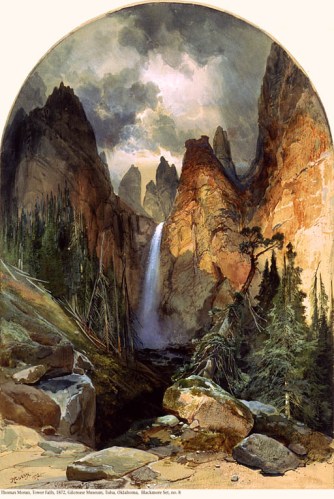
Moran actually got to see Tower Fall in 1871 when he accompanied the government explorer, F.V. Hayden there. During the two days Moran spent at Tower Fall, he must have worked diligently making sketches from various vantage points in ink and watercolor. He used these en plain air studies later to produce several paintings in his studio.
Tower Fall, Thomas Moran, 1872.
A year after the Washburn Expedition, Moran produced the full color rendition seen below. This piece reflects the Romantic Hudson River School that dominated American art at the time. It is characterized by aerial perspective, concealed brushstrokes and luminist techniques that made the landscapes seem to glow.
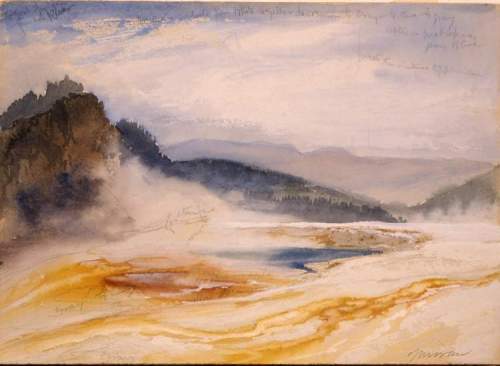
In 1875, Moran offered the version of Tower Fall shown at the top of this post that is more impressionistic in that it juxtaposes elements in ways that can’t be seen from any actual viewpoint. Moran, who famously said, “I place no value upon literal transcripts from Nature,” was a Romantic who sought to reproduce the emotional rapture that some landscapes evoke.
∞§∞
— The magazine illustration and N. P. Langford’s description are from his article “The Wonders of the Yellowstone.” Scribner’s Monthly, 2(1) 1-16 (May, 1871)
— Other images are from the Coppermine Gallery.
— For more on Moran’s Legacy, click on “Thamas Moran” under the Categories button to the left.
In 1886 the army took over administration of Yellowstone National Park and began enforcing a no guns policy. Soon animals that had fled from public view to avoid slaughter reappeared where tourists could see them. When luxury hotels began dumping garbage in nearby forests, bear watching became as popular with tourists as viewing geysers. One tourist who went to the park to watch bears was the famous wildlife artist, naturalist, and writer Ernest Thompson Seton.
Seton, who helped found the Boy Scouts of America, not only wrote the first Boy Scout Handbook, he also wrote and illustrated popular stories about wild animals for magazines and books. Nearly every boy and girl in America knew about Seton and his stories.
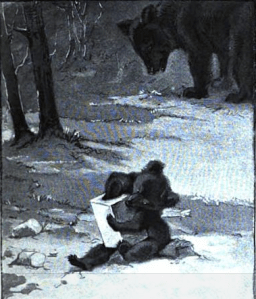
In 1897 he came to Yellowstone Park to do an inventory of large animals for a magazine that focused on wildlife conservation. On that trip Seton saw a fight between a grizzly and a momma black bear protecting her invalid cub that everybody called “Johnny.” Seton’s story about the fight became the basis for his most famous story, “Johnny Bear.” Seton was so fond of the story that he told it a second time from the perspective of Wahb, the subject of his book Biography of a Grizzly.
“Johnny Bear” originally appeared in Scribner’s Magazine and was republished in Seton’s book Wild Animals I Have Known. The following is a condensed version.
∞§∞
All the jam pots were at Johnny’s end; he stayed by them, and Grumpy stayed by him. At length he noticed that his mother had a better tin than any he could find, and, as he ran whining to take it from her, he chanced to glance away up the slope. There he saw something that made him sit up and utter a curious little Koff Koff Koff Koff Koff.
His mother turned quickly, and sat up to see “what the child was looking at” I followed their gaze, and there, oh horrors! was an enormous grizzly bear. He was a monster; he looked like a fur-clad omnibus coming through the trees.
Johnny set up a whine at once and got behind his mother. She uttered a deep growl, and all her back hair stood on end. Mine did too, but I kept as still as possible.
With stately tread the grizzly came on. His vast shoulders sliding along his sides, and his silvery robe swaying at each tread, like the trappings on an elephant, gave an impression of power that was appalling.
Johnny began to whine more loudly, and I fully sympathized with him now, though I did not join in. After a moment’s hesitation Grumpy turned to her noisy cub and said something that sounded to me like two or three short coughs—Koff Koff Koff. But I imagine that she really said, “My child, I think you had better get up that tree, while I go and drive the brute away.”
At any rate, that was what Johnny did.
Grumpy stalked out to meet the grizzly. She stood as high as she could and set all her bristles on end; then, growling and chopping her teeth, she faced him.
The grizzly, so far as I could see, took no notice of her. He came striding tward the feast as though alone. But when Grumpy got within twelve feet of him she uttered a succession of short, coughy roars, and, charging, gave him a tremendous blow on the ear. The grizzly was surprised; but he replied with a left-hander that knocked her over like a sack of hay.
Nothing daunted, but doubly furious, she jumped up and rushed at him. Then they clinched and rolled over and over, whacking and pounding, snorting and growling, and making no end of dust and rumpus. But above all their noise I could clearly hear Little Johnny, yelling at the top of his voice, and evidently encouraging his mother to go right in and finish the grizzly at once. . . .
She scrambled over and tried to escape. But the grizzly was mad now. He meant to punish her, and dashed around the root. For a minute they kept up a dodging chase about it; but Grumpy was quicker of foot, and somehow always managed to keep the root between herself and her foe, while Johnny, safe in the tree, continued to take an intense and uproarious interest.
At length, seeing he could not catch her that way, the grizzly sat up on his haunches; and while he doubtless was planning a new move, old Grumpy saw her chance, and making a dash, got away from the root and up to the top of the tree where Johnny was perched.
∞§∞
— Excerpt condensed from “Johnny Bear” by Ernest Thompson Seton, Scriberner’s Magazine 28(6):658-671 (December 1900).
The big event on my schedule this week is my presentation, “The Nez Perce in Yellowstone,” at The Pioneer Museum of Bozeman on Saturday at 9:30 a.m. The talk, which is part of the Gallatin Historical Society’s Fall Lecture Series, will focus the dramatic stories told by tourists who survived run-ins with the Indians in the Summer of 1877.
Chief Joseph
I’ll begin with an overview of the flight of the Nez Perce who generally had lived peacefully with whites for most of the 1800’s. After gold was discovered on Nez Perce land in 1853, settlers began moving onto their land. In 1877 the Indians were ordered onto a tiny reservation, but they decided instead to flee to the buffalo country on the plains. Most accounts of the flight of the Nez Perce emphasize things that happened outside of Yellowstone Park like broken treaties and battles, but I’ll reverse that pattern and focus in the human drama of the Indians’ encounters with tourists.
I’ll read from my collection of first-person accounts of travel through Yellowstone Park in the 1800s. I like to present stories in the words of people who lived the adventures because that lets emotions and personalities shine through.
The first tourist the Nez Perce found in the park was John Shively, a prospector who was familiar with the area. The Indians forced Shively to guide them all the way through the park. He was with them for thirteen days, so his story provides a good overview.
The next tourists the Nez Perce found were the “Radersburg Party,” which included Emma Cowan and her thirteen-year-old sister, Ida. Emma and Ida were the only women to tangle with the Nez Perce inside the park. I’ll read Emma’s chilling description of the Indians shooting her husband in the head and taking her and her sister captive.
To slow things down, I’ll talk about “Skedaddlers,” tourists who visited the park in the summer of 1877, but left before the Indians arrived. These include: the famous Civil War General William Tecumseh Sherman; Bozeman Businessman Nelson Story; English nobleman and park popularizer, The Earl of Dunraven and his companions, Buffalo Bill’s sometime partner, Texas Jack Omohundro, and Dunraven’s friend, George Henry Kingsley, a physician who patched up the Nez Perce’ victims at Mammoth Hot Springs.
Next, I’ll talk about the Helena Party’s trip and contrast that all-male group that entered the park from the north with the co-ed Radersburg Party that entered from the west. Then I’ll read Andrew Weikert’s description of his blazing gun battle with the Nez Perce.
I’ll describe how survivors of encounters with the Nez Perce were either rescued by soldiers looking for the Indians or made their way to Mammoth Hot Springs. I’ll explain that after Emma Cowan, her sister, and several wounded men left Mammoth for civilization, three men stayed there to see if their missing companions would appear. Then I’ll read Ben Stone’s description of the Indian attack at Mammoth that left another man dead.
I’ll end with my synthesis of accounts of Emma Cowan’s overnight ride from Helena to Bottler’s Ranch in the Paradise Valley to join her husband who had survived three gunshot wounds and was rescued by the army. That will give me an opportunity to talk about Encounters in Yellowstone, a book I’m writing now.
∞§∞
— The presentation will be at Pioneer Museum of Bozeman, 315 E. Main. It is free and open to the public. Please tell your friends.
— The photo of Chief Joseph is in the public domain.
George Cowan was a 35-year-old attorney from Radersburg, Montana, when he toured Yellowstone Park in August 1877 with his family and friends. That year the Nez Perce passed through the park after fleeing their homeland to make a new life in the buffalo country.
The Radersburg party was getting ready to go home when a band of Nez Perce captured them. After the Nez Perce shot George Cowan and left him for dead, he regained consciousness only to find himself alone in the wilderness. Despite George’s grievous wounds, his first thought was for the safety of his wife. Here’s his tale of crawling a dozen miles to find help.
∞§∞
George F. Cowan
In about two hours, I began to come back to life, and as I did so my head felt benumbed. The feeling as near as I can express it was a buzzing, dizziness, and the sensation increased as it grew lighter and lighter. I began to feel soon and then my reason came back to me. My head felt very large, seemingly as large as a mountain, and I mechanically raised my hand and began feeling my face and head. I found my face covered with blood and my hair clotted with blood that had cooled there. I then realized the incidents of the day and remembered the shooting.
I could not at first discover where I was wounded, but after getting the blood out of my eyes and pulling my hat off with hair and skin sticking to the clotted blood, I discovered that I was shot in the face and head. Running my had over my head, I found great gashes in the scalp, and I then thought the ball had passed entirely through my head some way. Feeling my leg, I found it completely benumbed, but there were no bones broken.
I again felt the intolerable pangs of thirst, raised myself on my elbow, and looked about me. I then found that I was some ten or twelve feet from the place of shooting. This, I thought, accounted for the wounds in the back of my head. As far as I could see, the Indians were all gone and I could hear nothing but the moaning of the wind in the trees.
Standing near me was a little pine tree the boughs of which I could just reach, and grasping one, I pulled myself to my feet. My wounds were painful now. As I raised up I saw an Indian close by me sitting on his pony watching me. As I was hobbling away, I glanced backward and saw him on one knee aiming his gun at me. Then followed a twinging sensation in my left side, and the report of the gun and I dropped forward on my face. The ball had struck me on the side above the hip and came out in front of the abdomen.
I thought that this had “fixed me” beyond hope of recovery and I lay perfectly motionless expecting the Indian to finish the job with the hatchet.
I must have lain here fully twenty minutes expecting to die every moment, and during the time, I think my mind must have dwelt on every incident of our trip. I supposed my wife had been killed. I knew the fate she and Ida would be subjected, and my whole nature was aroused as I thought of it.
Directly I heard Indians talking. The were coming up the trail and I could hear them driving numbers of loose horses. They passed within forty feet of me, but I was unnoticed and they were soon out of hearing. I waited for a few moments, then turned over and took a look around me.
I now took another inventory of my wounds, and in trying to rise found that I could not use either of my lower limbs. They were both paralyzed. I then turned up my face and began crawling by pulling myself with my elbows. I thus managed to get into some willows where I found water which I drank eagerly, and felt greatly refreshed and strengthened. I now began crawling as before, pulling myself on my breast with my elbows. In this way, I crawled to a little stream of warm water, and raised up on my hands and entered the water. I immediately sank to my shoulders in the mud, and the water came up to my chin.
This would not do, so extricating my hands, I again began crawling as before, and found that I could thus cross it. Having crossed it, I entered the willows on the bank, and began crawling down stream and followed it until I struck the East Fork about a half mile below where I started from. It was now about one or two o’clock in the morning and being completely exhausted I lay down and rested until daybreak.
At dawn, I again started and crawled until noon, when I again stopped to rest. I had been here but a few moments when I again heard Indians approaching, coming down the trail. They passed within ten feet of me and were soon out of hearing.
I lay here for an hour or so and again resumed my wearisome journey. By nightfall, I had made four or five miles, and I kept on during the night, resting at short intervals.
I kept on down the trail, or rather by the side of it, and Indians kept passing by me every little while, driving ponies as they went. I could hear them approaching and then I would lie down and wait till the passed.
I kept this up until Monday morning, have crossed the East Fork Sunday night, and reached the wagons we had abandoned on Friday. I had crawled about nine miles in sixty hours.
As I reached the wagon, I found my faithful dog, Dido, laying beneath it. I called to her, and see came bounding to me, and covered my face and wounds with caresses. The pleasure of the meeting was mutual.
The buggy was laying upon the ground, all of the spokes having been taken from two of the wheels, and I could search it without rising. I found some rags, a portion of a man’s underclothing, which were very acceptable, but I could find nothing to eat.
It occurred to me that I had spilled some coffee when in camp, on Thursday in the Lower Geyser Basin, and calling my dog we started for it, I crawling as before, and the dog walking by my side. The coffee was four miles distant, but I thought not of that. The only idea was to possess the coffee. I was starving.
While crawling along close to the trail, my dog stopped suddenly and began to growl. I grasped her by the neck, and placed my hand over her nose to keep her from making noise. Peering through the brush, I saw two Indians sitting beneath a tree but a few feet from me. I began moving back cautiously and made a circuit around them, keeping the dog close by me. I thus avoided them, and reached the Lower Geyser Basin on Tuesday night.
Here, as I anticipated, I found some coffee, and a few matches. I found about a handful of coffee, and placing it in an empty can that I had found, I pounded it up fine. I then got some water in another empty can that, that had contained molasses, and building a fire, I soon had some excellent hot coffee that refreshed me greatly. This was my first refreshment that I had taken in five days and nights.
I now began calculating my chances for being picked up. I would not starve, as I could, as a last resort, kill my dog and eat it. I shudder now, as I think of sacrificing my noble, faithful dog, one that money cannot purchase now, but circumstances were such that I did not view it then as I do now. The natural desire for life will force one to any necessity.
I remained where I was Tuesday night. No one can imagine my thoughts during that time. I supposed that I was the only one of the party left, unless it be my wife, and the speculations upon her fate almost set me mad. It was horrible. All night long I lay there suffering instead of resting, and I hailed with pleasure the break of day.
I made some more coffee, and drank it, which seemed to give me renewed strength, but as my strength returned I felt more keenly the horrors of my position. I thought now I would crawl to where the East Fork empties into the Fire Hole River, so calling my dog I began my journey.
I found that I was gradually growing weaker, as I could now crawl but a little ways when I would be compelled to stop and rest. At about a mile and a half distant I came to the place of our first night’s camp on entering the basin. Here again, I had to cross the river, but as the water was not deep, I made it without mishap. Here I rested for a few moments, before starting for the timber, which was about a fourth of a mile distant. I got there about two o’clock in the afternoon, and laid down under a tree and some brush close to the road. I was now exhausted and could go no farther. It was an expiring effort, and having accomplished it I gave myself up for dead.
In about two hours, I hear the sound of horses coming, but so completely tired out was it that I did not care whether they were Indians or not. My dog began to growl, but I did not try to stop her. The horses drew nearer, and approached and stopped. The riders had seen me. I looked up and saw that they were white men. They alighted and came to me, and one of them asked: “Who are you?”
I replied that my name was Cowan, and asked them if any news had been received of my wife. They replied that there had not been, and I then cared for nothing further. I turned from them and would have been glad to have died.
One of them kept talking to me, and asking questions that I cared not to answer, while the other built a fire and made some coffee for me. The told me that they were scouts from Howard’s command, and that the troops would reach me some time during the next day. They left me some “hard tack” and a blanket, and went on to the scene of the massacre to find the bodies of the party. After they were gone and I had eaten, my desire for life returned, and it seems the spirit of revenge took complete possession of me. I knew that I would live and I took a solemn vow that I would devote the rest of my life to killing Indians, especially Nez Perce.
I laid here until Thursday afternoon, when I heard the sound of approaching cavalry, and shortly afterwards General Howard and some of his officers rode up to me. In a few minutes, I saw Arnold coming. He came up, recognized me, and knelt beside me. We grasped hands, but neither spoke for some minutes. I could only gasp: “My wife!”
“No news yet, George,” he replied.
∞§∞
The Army took George with them as they pursued the Nez Perce across the roadless wilderness of Yellowstone Park. He survived the ordeal and was reunited with wife three weeks after he was found.
— Condensed from George F. Cowan’s account in Frank D. Carpenter, The Wonders of Geyserland, Black Earth, WI: Burnett and Son, 1878, pages 143-148.
— Image from Progressive Men of the State of Montana.
— For more stories about tourists’ encounters with the Nez Perce in Yellowstone Park, click “Nez Perce” under the “Categories” button to the left.
Corinne Roosevelt Robinson published a book in 1921 about her memories of her late brother, President Theodore Roosevelt. She described the summer of 1890 when TR acquiesced to requests that he take his family to Yellowstone Park, a place he visited often. Although she praised his geniality and good cheer, Corinne made it clear that TR didn’t like the comforts required by the ladies on the trip and would rather be “roughing it.”
In her book, Corinne included a letter that she sent to her aunt about the trip. She said she decided not to “terrify” her aunt by reporting the seriousness of the injuries TR’s wife, Edith, suffered when she fell off a horse. Here’s an excerpt.
∞§∞
— Theodore Roosevelt, C. 1895
“We have had a most delightful two weeks’ camping and have enjoyed every moment. The weather has been cloudless, and though the nights were cold, we were only uncomfortable one night. We were all in the best of health and the best of spirits, and ate without a murmur the strange meals of ham, tomatoes, greasy cakes and coffee prepared by our irresistible Chinese cook. Breakfast and dinner were always the same, and lunch was generally bread and cheese carried in our pockets and eaten by the wayside. We have really had great comfort, however, and have enjoyed the pretense of roughing it and the delicious, free, open-air life hugely—and such scenery!
Nothing in my estimation can equal in unique beauty the Yellowstone canyon, the wonderful shapes of the rocks, some like peaks and turrets, others broken in strange fantastic jags, and then the marvelous colors of them all. Pale greens and yellows, vivid reds and orange, salmon pinks and every shade of brown are strewn with a lavish hand over the whole Canyon—and the beautiful Falls are so foamy and white, and leap with such exultation from their rocky ledge 360 feet down.
We had one really exciting ride. We had undertaken too long an expedition, namely, the ascent of Mt. Washburn, and then to Towers’ Falls in one day, during which, to add to the complications, Edith had been thrown and quite badly bruised. We found ourselves at Tower Falls at six o’clock in the evening instead of at lunchtime, and realized we were still sixteen miles from Camp, and a narrow trail only to lead us back, a trail of which our guide was not perfectly sure.
We galloped as long as there was light, but the sun soon set over the wonderful mountains, and although there was a little crescent moon, still, it soon grew very dark and we had to keep close behind each other, single file, and go very carefully as the trail lay along the mountainside. Often we had to traverse dark woods and trust entirely to the horses, who behaved beautifully and stepped carefully over the fallen logs. Twice, Dodge, our guide, lost the trail, and it gave one a very eerie feeling, but he found it again and on we went.
Once at about 11 p.m., Theodore suggested stopping and making a great fire, and waiting until daylight to go on, for he was afraid that we would be tired out, but we all preferred to continue, and about 11:30, to our great joy, we heard the roar of the Falls and suddenly came out on the deep Canyon, looking very wonderful and mysterious in the dim star-light. We reached our Camp after twelve o’clock, having been fifteen hours away from it, thirteen and a half of which we had been in the saddle. It was really an experience.”
It was a hazardous ride and I did not terrify my aunt by some of the incidents such as the severe discomfort suffered by Mrs. Theodore Roosevelt when she was thrown and narrowly escaped a broken back, and when a few hours later my own horse sank in a quicksand and barely recovered himself in time to struggle to terra firma again, not to mention the dangers of the utter darkness when the small, dim crescent moon faded from the horizon.
My brother was the real leader of the cavalcade, for the guide, Ira Dodge, proved singularly incompetent. Theodore kept up our flagging spirits, exhausted as we were by the long rough day in the saddle, and although furious with Dodge because of his ignorance of the trail through which he was supposed to guide us, he still gave us the sense of confidence, which is one’s only hope on such an adventure. Looking back over that camping trip in the Yellowstone, the prominent figure of the whole holiday was, of course, my brother. He was a boy in his tricks and teasing, crawling under the tent flaps at night, pretending to be the unexpected bear, which we always dreaded. He was a real inspiration in his knowledge of the fauna and birds of the vicinity and his willingness to give us the benefit of that knowledge.
∞§∞
—Corinne Roosevelt Robinson, “The Elkhorn Ranch and Near-Roughing it in Yellowstone Park,” Pages 135-155 in My Brother Theodore Roosevelt, Charles Scribner’s Sons, 1921.
Conrad Kohrs’ trip to Yellowstone Park in 1883 was in many ways typical of those made by Montanans at that time. Travel was by horseback and lodging in tents. The pace was leisurely to allow the horses time to graze and people time to see the sights.
Conrad Kohrs
Kohrs was a very wealthy man who was known as “The Montana Cattle King” in the era of open range. He sold up to 10,000 steers a year. Naturally, his equipment was more elaborate than most. Kohrs himself drove an ambulance, a wagon that the rich used to maximize travel comfort. Unlike a canvass covered wagon, an ambulance had rigid sides and top, windows that could be covered by rolling down shades, and soft springs.
Kohrs had a four-horse team to pull his provision wagon that was loaded with enough equipment and supplies for the seven-week trip. In addition, each member of the party had a personal saddle horse. Kohrs hired a man just to take care of the 18 horses of the entourage.
Like many tourists coming from the west, they went up the Madison River and crossed Raynolds Pass over the continental divide to Henry’s Lake, which Kohrs described in his reminiscence:
“Henry’s Lake was a pretty sight, a fine sheet of water and covered with swan. An old settler living in a small cabin had a few elk and some young swan he was taming and raising. We secured boats from him and had great sport spearing lake trout, of which the lake contained a great many.”
After a few days at Henry’s lake, the party went back over the continental divide via Targhee Pass the Park. Crossing the divide twice made sense then because that’s where the road went. The “old settler” who Kohrs rented boats from probably was Gilman Sawtell, who homesteaded at Henry’s Lake in the 1860s.
Sawtell harvested fish from the lake—up to 40,000 pounds a year. He had to build a road to Virginia City to take them to market. And after the park was designated in 1872, he extended his road to the Lower Geyser Basin
The Kohrs party camped for several days at the Lower Geyser Basin and took side trips on horseback. They spent several days at there before moving on.
Although he didn’t see the Excelsior Geyser in the Middle Geyser Basin play, Korhs described it anyway:
“The largest geyser on Hell’s Half Acre was the Excelsior. This one spouts at long intervals, every two or three years, and then the eruption is terrific and continues many hours. When in the state of acquiescence it emits a roaring noise and makes nearly everyone feel as if the earth would give way under the feet.”
The party camped in the upper geyser basin near old Faithful where they saw what Korhs termed “most of the geysers of any importance.” They had to return to the lower basin to proceed to Yellowstone Lake, because that’s where the only road was. Kohrs said the lake was “a beautiful sight” and noted that the fish were worthless—a fact he erroneously attributed to water from hot springs rather than parasites.
They proceeded to the Falls: “the most majestic and beautiful spot in the park,” according to Kohrs. It snowed while they camped four miles from the Falls so they spent an extra day in camp. After that, they spend several days absorbing “the shading of the canyon.”
Kohrs said:
“As far as camping was concerned, there were no restrictions. Everything was free and easy. There were no government troops stationed at various points, though we realized the need of them as many of the beauties were defaced by the souvenir hunters. This was particularly true of the Monument Geyser Basin, an aggregation of extinct geysers thrown up in fantastic shape and named according to their resemblance to humans and of bird life.”
On their way to Mammoth Hot Springs, they saw so many pools, mud pots and hot springs that they became bored with them and gave Mammoth only a cursory glance.
The party then took the 226-mile trip back to Deer Lodge stopping in Bozeman, Central Park and Butte.
∞§∞
— Adapted from “A Camping Trip in Yellowstone Park: Aug. 20 – Sept. 12, 1883.” Pp. 77-79 in Conrad Kohrs: An Autobiography.
— Moran painting from Coppermine Photo Gallery; Kohrs photo from Progressive Men of the State of Montana.
Great Springs of the Firehole River by Thomas Moran, 1871.
By the late 1860s enough prospectors’ reports of boiling fountains, deep canyons and glass mountains had accumulated to convince people that there really were things worth seeing on the upper Yellowstone. Several plans for expeditions to document the wonders of the area fizzled because organizers couldn’t recruit enough men to feel safe from Indians. But in 1869 David Folsom, Charles Cook and William Peterson decided that a small group could avoid the hostiles.
These intrepid explorers succeed in finding the canyons, falls, and geysers, but publishers were leery of their stories. Both the New York Tribune and Scriber’s magazine refused to publish an account of the expedition because “they had a reputations that could not risk such unreliable material.” A Chicago based magazine, the Western Monthly, finally published it in July 1870, nearly a year after the trip. The Monthly attributed the story to C.W. Cook.
The account didn’t get wide circulation until nearly 35 years later when it was published by the Montana Historical Society. N.P. Langford, who wrote a preface for the historical society version, attributed it to David E. Folsom. Here’s the Cook/Folsom description of geysers and hot springs.
∞§∞
We ascended to the head of the lake and remained in its vicinity for several days, resting ourselves and our horses and viewing the many objects of interest and wonder. Among these were springs differing from any we had previously seen. They were situated along the shore for a distance of two miles, extending back from it about five hundred yards and into the lake perhaps as many feet. The ground in many places gradually sloped down to the water’s edge, while in others the white chalky cliffs rose fifteen feet high,, the waves having worn the rock away at the base, leaving the upper portion projecting over in some places twenty feet.
There were several hundred springs here, varying in size from miniature fountains to pools or wells seventy-five feet in diameter and of great depth. The water had a pale violet tinge and was very clear, enabling us to discern small objects fifty or sixty feet below the surface. In some of these, vast openings led off at the side, and as the slanting rays of the sun lit up these deep caverns, we could see the rocks hanging from their roofs, their water-worn sides and rocky floors, almost as plainly as if we had been traversing their silent chambers.
These springs were intermittent, flowing or boiling at irregular intervals. The greater portion of them were perfectly quiet while we were there, although nearly all gave unmistakable evidence of frequent activity. Some of them would quietly settle for ten feet, while another would as quietly rise until it overflowed its banks, and send a torrent of hot water sweeping down to the lake. At the same time, one near at hand would send up a sparkling jet of water ten or twelve feet high, which would fall back into its basin, and then perhaps instantly stop boiling and quietly settle into the earth, or suddenly rise and discharge its waters in every direction over the rim; while another, as if wishing to attract our wondering gaze, would throw up a cone six feet in diameter and eight feet high, with a loud roar.
These changes, each one of which would possess some new feature, were constantly going on; sometimes they would occur within the space of a few minutes, and again hours would elapse before any change could be noted. At the water’s edge, along the lake shore, there were several mounds of solid stone, on the top of each of which was a small basin with a perforated bottom. These also overflowed at times, and the hot water trickled down on every side. Thus, by the slow process of precipitation, through the countless lapse of ages, these stone monuments have been formed. A small cluster of mud springs near by claimed our attention. They were like hollow truncated cones and oblong mounds, three or four feet in height. These were filled with mud, resembling thick paint of the finest quality, differing in color from pure white to the various shades of yellow, pink, red and violet. Some of these boiling pots were less than a foot in diameter. The mud in them would slowly rise and fall, as the bubbles of escaping steam, following one after the other, would burst upon the surface. During the afternoon they threw mud to the height of fifteen feet for a few minutes, and then settled back to their former quietude.
As we were about departing on our homeward trip, we ascended the summit of a neighboring hill and took a final look at Yellowstone Lake. Nestled among the, forest crowned hills which bounded our vision, lay this inland sea, its crystal waves dancing and sparkling in the sunlight as if laughing with joy for their wild freedom. It is a scene of transcendent beauty which has been viewed by but few white men, and we felt glad to have looked upon it before its primeval solitude should be broken by the crowds of pleasure seekers which at no distant day will throng its shores.
September 29th, we took up our march for home. Our plan was to cross the range in a northwesterly direction, find the Madison river, and follow it down to civilization. Twelve miles brought us to a small triangular-shaped lake, about eight miles long, deeply set among the hills. We kept on in a northwesterly direction as near as the rugged nature of the country would permit, and on the third day came to a, small irregularly shaped valley, some six miles across in the widest place, from every part of which great clouds of steam arose. From descriptions which we had had of this valley from persons who had previously visited it, we recognized it as the place known as “Burnt Hole” or “Death Valley.” The Madison river flows through it, and from the general contour of the country we knew that it headed in the lake: which we passed two days ago, only twelve miles from the Yellowstone. We descended into the valley and found that the springs had the same general characteristics as those I have already described, although some of them were much larger and discharged a vast amount of water. One of them, at a little distance, attracted our attention by the immense amount of steam it threw off, and upon approaching it we found it to be an intermittent geyser active operation. The hole through which the water was discharged was ten feet in diameter, and was situated in the center of a large circular shallow basin, into which the water fell. There was a stiff breeze blowing at the time, and by going to the windward side and carefully picking our way over convenient stones, we were enabled to reach the edge of the hole. At that moment the escaping steam was causing the water to boil up in a fountain five or six feet high. It stopped in an instant, and commenced settling down—twenty, thirty, forty feet-until we concluded that the bottom had fallen out, but the next instant, without any warning, it came rushing up and shot into the air at least eighty feet, causing us to stampede for higher ground. It continued to spout at intervals of a few minutes for some time, but finally subsided and was quiet during the remainder of the time we stayed in the vicinity.
We followed up the Madison five miles, and there found the most gigantic hot springs we had seen, They were situated along the river bank, and discharged so much hot water that the river was blood warm a quarter of a mile below. One of the springs was two hundred and fifty feet in diameter, and had every indication of spouting powerfully at times. The waters from the hot springs in this valley, if united, would form a large stream, and they increase the size of the river nearly one half. Although we experienced no bad effects from passing through the “Valley of Death,” yet we were not disposed to dispute the propriety of giving it that name. It seemed to be shunned by all animated nature. There were no fish in the river, no birds in the trees, no animals – not even a track – anywhere to be seen, although in one spring we saw the entire skeleton of a buffalo that had probably fallen in accidentally and been boiled down to soup.
Leaving this remarkable valley, we followed the course of the Madison, sometimes through level valleys, and sometimes through deep cuts in mountain ranges, and on the fourth of October emerged from a canyon, ten miles long with high and precipitous mountain sides, to find the broad valley of the Lower Madison spread out before us. Here we could recognize familiar landmarks in some of the mountain peaks around Virginia City. From this point we completed our journey by easy stages, and arrived at home on the evening of the eleventh. We had been absent thirty-six days – a much longer time than our friends had anticipated and we found that they were seriously contemplating organizing a party to go in search of us.
∞§∞
— Excerpt from C. W. Cook , “The Valley of the Upper Yellowstone,” The Western Monthly 4(19)60-67 (July 1870).
The Army assigned Lieutenant Gustavus Doane to led an army escort for the famous Washburn expedition that explored the upper Yellowstone in 1870. Doane’s official report was one of several well-written accounts of the expedition, which thrust the wonders of the area into public awareness and helped get it declared a national park. Here’s Doane’s description of going to the bottom of Yellowstone Canyon.
∞§∞
Yellowstone Canyon
Selecting the channel of a small creek, and leaving the horses, I followed it down on foot, wading in the bed of the stream, which fell off at an angle about 30°, between walls of the gypsum. Private McConnell accompanied me. On entering the ravine, we came at once to hot springs of sulphur, sulphate of copper, alum, steam jets, &c., in endless variety, some of them of very peculiar form. One of them in particular, of sulphur, had built up a tall spire from the slope of the wall, standing out like an enormous horn, with hot water trickling down its sides. The creek ran on a bed of solid rock, in many places smooth and slippery, in other obstructed by masses of debris formed from the overhanging cliffs of the sulphereted limestone above.
After descending for three miles in the channel, we came to a sort of bench or terrace, the same one seen previously in following down the creek from our first camp in the basin. Here we found a large flock of mountain sheep, very tame, and greatly astonished, no doubt, at our sudden appearance. McConnell killed one and wounded another, whereupon the rest disappeared, clambering up the steep walls with a celerity truly astonishing. We were now 1,500 feet below the brink. From here the creek channel was more precipitous, and for a mile we climbed downward over masses of rock and fallen trees, splashing in warm water, ducking under cascades, and skirting close against sideling places to keep from falling into boiling caldrons in the channel.
After four hours of hard labor since leaving the horses, we finally reached the bottom of the gulf and the margin of the Yellowstone, famished with thirst, wet and exhausted. The river water here is quite warm and of a villainously alum and sulphurous taste. Its margin is lined with all kinds of chemical springs, some depositing craters of calcareous rock, others muddy, black, blue, slaty, or reddish water. The internal heat renders the atmosphere oppressive, though a strong breeze draws through the canyon. A frying sound comes constantly to the ear, mingled with the rush of the current. The place abounds with sickening and purgatorial smells.
We had come down the ravine at least four miles, and looking upward the fearful wall appeared to reach the sky. It was about 3 o’clock p.m., and stars could be distinctly seen, so much of the sunlight was cut off from entering the chasm. Tall pines on the extreme verge appeared the height of two or three feet. The canyon, as before said, was in two benches, with a plateau on either side, about half way down. This plateau, about a hundred yards in width, looked from below like a mere shelf against the wall; the total depth was not less than 2,500 feet, and more probably 3,000. There are perhaps other canons longer and deeper than this one, but surely none combining grandeur and immensity with peculiarity of formation and profusion of volcanic or chemical phenomena.
Returning to the summit, we were five hours reaching our horses, by which time darkness had set in, and we were without a trail, in the dense forest, having fallen timber to evade and treacherous marshes to cross on our way to camp. I knew the general direction, however, and took a straight course, using great caution in threading the marshes, wherein our horses sank in up to their bodies nevertheless. Fortune favored us, and we arrived in camp at 11 o’clock at night, wet and chilled to the bone.
∞§∞
— Excerpt adapted from the Report of Lieutenant Gustavus C. Doan upon the So-called Yellowstone Expedition of 1870. Washington D.C.: U.S. Government Printing Office, 1871.
— Image from the Coppermine Photo Gallery.
— For other tales from the Washburn Expedition, click on “Washburn” under the “Categories” button to the left.
By the dawn of the Twentieth Century, watching the antics of bears at hotel garbage dumps became one of the most popular activities in Yellowstone Park. Here’s a colorful description.
∞§∞
The transportation company’s stages had emptied their loads of dust covered sightseers at the open doors of the Fountain House, and the ink on the register was not yet dry wherewith the newcomers had written their names, when the Fountain geyser began to grumble, hiss and send up clouds of steam, promising an early eruption. Following suit, all the finger holes and cracks in the formation, the hot springs and the baby geysers shot out jets of steam. The Mammoth Paint Pot began to plop, plop, plop! And throw up gobs of pink, white and yellow mud into the air from its bowl full of scalding clay. All this hubbub was a vain attempt to attract the tourist attention.
The Dante’s Inferno in front of the hotel might have saved its steam and sulpher for another occasion, as it was unnoticed by the guests. The new arrivals were following the layovers in a stampede for the garbage heap on the white geyserite formation back of the house. Suddenly the crowd came to a halt.
“Gee!” exclaimed a small boy, as he pushed the button on his Kodak.
“Waught! Waugh! Shouted the pilgrims from Medicine Hat and Rat Portage.
“Hey! May be rubberneck, what?” laughed the man from Moose Jaw.
‘Say! She’s a tough proposition, an’ she wears the straps all right,” cried the guide; while the doctor from Chicago, the broker from New York, the office holder from Ohio, the colonel from Kentucky and the dude from Honolulu all clapped their hands with delight.
Having dumped its load of table leavings and tin cans the hotel garbage wagon was rumbling back over the formation to the stables, but it was not the wagon, team, driver or load of food scraps which called forth the applause and exclamations of pleasure from the guests of the Fountain House; it was nine great black bears that interested us.
To the delight of the spectators, the bears had given a short exhibition of their skills as boxers. It was a hot fight; but it did not last long. In fact, it was a mistake in the first place; an impromptu affair not down on the menu. This is the way it happened.
A long legged cinnamon bear snatched the remains of some ribs of beef from under the nose of a big mother black bear at the moment she was calling her two little cubs to partake of the roast. A benevolent looking bruin, with a glossy black coat covering rotund body, was busily engaged in pawing over the garbage near by, when the indignant mother lifted her paw for a swinging blow, missed the culprit and landed with a resounding swat on the jowl of her benevolent appearing neighbor.
“Ough-oo-oo-ee-ee-eah!” cried Fatty, in a rage, as he rose on his hind legs and let go at the solar plexus of Old Spot. He had gained his name by breaking through the crust near the Paint Pot and covered on black wide with white mud. Spot’s temper had be none of the best since that day, and in less time than it takes to tell it, he let fly with his left and right at his nearest neighbor, and it became a free-for-all fight accompanied by a continued ought-oo-eahing in various keys.
During the melee the cinnamon bear who caused the riot was quietly eating the remains of the roast beef, gnawing the bones within 10 feet of the gallant Kentucky colonel, to the latter’s great amusement.
Although nearly all the men present had cameras, only women and children took advantage of the sunlight and clear sky to photograph the scrapping bears. The sport-loving men stood around in a semicircle, with pleased grins on their faces, too much engaged in applauding the hairy gladiators to waste a thought on the black boxes under their arms.
Scarcely had the women and children time to wind up their films when the brown bear, elated over his former success, made another attempt to slip up unobserved to the garbage pile. To the casual onlooker it would appear that the black bears were all too busy seeking their own dinner to heed the brown’s approach; but a close observer could not fail to notice that the beadlike eyes of the blacks were keenly alert. No sooner did Brownie come within reach than biff! biff! biff! came the great black paws on his unprotected head.
An elderly spinster, who seemed deeply interested in the zoological show, stood within 15 feet of the feeding brutes and directly in front of the cinnamon bear, when, with open mouth, it made a dash for safety. With a quick movement the frightened spinster gathered up her skirts, there was a flash of white petticoats, a twinkling of feet, and she was gone, never once looking back until she slammed the hotel door behind her.
The astonishingly rapid gait at which the terror stricken lady made her 100-yard dash called forth the wildest enthusiasm from the spectators, and the colonel pushed the button of his pocket camera three times without once winding up the film.
Of course, the brown bear turned aside into the woods the moment he was out of reach of the powerful blows of his relatives, but it was of no use telling that to the spinster. She will always believe that the brute followed her to the hotel door.
∞§∞
— Text and image from Dan Beard, “A Bear Fight in the Yellowstone Park,” Recreation 18(2):85-87 (February 1903).
American bison once numbered 30 million or more, but by the middle of the 1880’s commercial hunters had decimated the herds that once darkened the prairies. But the fact that bison were nearing extinction didn’t deter sportsmen from pursuing the thrill of killing one of the magnificent animals.
Even Theodore Roosevelt, who is renowned for his role in the American conservation movement and environment preservation, could not resist the temptation of bison hunting. Here’s how he described the experience.
∞§∞
In the fall of 1889 I heard that a very few bison were still left around the head of Wisdom River. Thither I went and hunted faithfully; there was plenty of game of other kind, but of bison not a trace did we see. Nevertheless a few days later that same year I came across these great wild cattle at a time when I had no idea of seeing them.
We had gone out to find moose, but had seen no sign of them, and had then begun to climb over the higher peaks with an idea of getting sheep. The old hunter who was with me was, very fortunately, suffering from rheumatism, and he therefore carried a long staff instead of his rifle; I say fortunately, for if he had carried his rifle it would have been impossible to stop his firing at such game as bison, nor would he have spared the cows and calves.
About the middle of the afternoon we crossed a low, rocky ridge, above timber line, and saw at our feet a basin or round valley of singular beauty. The ground rose in a pass evidently much frequented by game in bygone days, their trails lying along it in thick zigzags, each gradually fading out after a few hundred yards, and then starting again in a little different place, as game trails so often seem to do.
We bent our steps toward these trails, and no sooner had we reached the first than the old hunter bent over it with a sharp exclamation of wonder. There in the dust were the unmistakable hoof-marks of a small band of bison, apparently but a few hours old. There had been half a dozen animals in the party; one a big bull, and two calves.
We immediately turned and followed the trail. It led down to the little lake, where the beasts had spread and grazed on the tender, green blades, and had drunk their fill. The footprints then came together again, showing where the animals had gathered and walked off in single file to the forest
It was a very still day, and there were nearly three hours of daylight left. Without a word my silent companion, who had been scanning the whole country with hawk-eyed eagerness, besides scrutinizing the sign on his hands and knees, took the trail, motioning me to follow. In a moment we entered the woods, breathing a sigh of relief as we did so; for while in the meadow we could never tell that the buffalo might not see us, if they happened to be lying in some place with a commanding lookout.
The old hunter was thoroughly roused, and he showed himself a very skilful tracker. We were much favored by the character of the forest, which was rather open, and in most places free from undergrowth and down timber. The ground was covered with pine needles and soft moss, so that it was not difficult to walk noiselessly. Once or twice when I trod on a small dry twig, or let the nails in my shoes clink slightly against a stone, the hunter turned to me with a frown of angry impatience; but as he walked slowly, continually halting to look ahead, as well as stooping over to examine the trail, I did not find it very difficult to move silently.
At last, we saw a movement among the young trees not fifty yards away. Peering through the safe shelter yielded by some thick evergreen bushes, we speedily made out three bison, a cow, a calf, and a yearling. Soon another cow and calf stepped out after them. I did not wish to shoot, waiting for the appearance of the big bull which I knew was accompanying them.
So for several minutes I watched the great, clumsy, shaggy beasts, as all unconscious they grazed in the open glade. Mixed with the eager excitement of the hunter was a certain half melancholy feeling as I gazed on these bison, themselves part of the last remnant of a doomed and nearly vanished race. Few, indeed, are the men who now have, or ever more shall have, the chance of seeing the mightiest of American beasts, in all his wild vigor, surrounded by the tremendous desolation of his far-off mountain home.
At last, when I had begun to grow very anxious lest the others should take alarm, the bull likewise appeared on the edge of the glade, and stood with outstretched head, scratching his throat against a young tree, which shook violently. I aimed low, behind his shoulder, and pulled trigger. At the crack of the rifle all the bison, without the momentary halt of terror-struck surprise so common among game, turned and raced off at headlong speed.
The fringe of young pines beyond and below the glade cracked and swayed as if a whirlwind were passing, and in another moment they reached the top of a very steep incline, thickly strewn with boulders and dead timber. Down this they plunged with reckless speed; their surefootedness was a marvel in such seemingly unwieldy beasts. A column of dust obscured their passage, and under its cover they disappeared in the forest; but the trail of the bull was marked by splashes of frothy blood, and we followed it at a trot.
Fifty yards beyond the border of the forest we found the stark black body stretched motionless. He was a splendid old bull, still in his full vigor, with large, sharp horns, and heavy mane and glossy coat; and I felt the most exulting pride as I handled and examined him; for I had procured a trophy such as can fall henceforth to few hunters indeed.
∞§∞
— Abridged from Theodore Roosevelt. “The Bison or American Buffalo,” pages 3-36 in Hunting the Grisly and Other Sketchs. New York: The Review of Reviews Company, 1915.
— Photo from Wikipedia Commons.
— For more stories about hunting in or near Yellowstone Park, click on “hunting” under “Categories” to the left.


 Seton, who helped found the Boy Scouts of America, not only wrote the first Boy Scout Handbook, he also wrote and illustrated popular stories about wild animals for magazines and books. Nearly every boy and girl in America knew about Seton and his stories.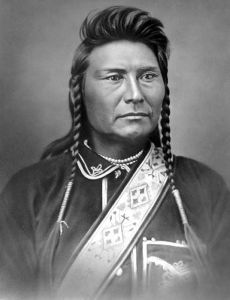


 The transportation company’s stages had emptied their loads of dust covered sightseers at the open doors of the Fountain House, and the ink on the register was not yet dry wherewith the newcomers had written their names, when the Fountain geyser began to grumble, hiss and send up clouds of steam, promising an early eruption. Following suit, all the finger holes and cracks in the formation, the hot springs and the baby geysers shot out jets of steam. The Mammoth Paint Pot began to plop, plop, plop! And throw up gobs of pink, white and yellow mud into the air from its bowl full of scalding clay. All this hubbub was a vain attempt to attract the tourist attention.
 M. Mark Miller, Author